- Market Value (2025): USD 1.0 Bn
- Estimated Value (2026): USD 1.1 Bn
- Forecast Value (2036): USD 2.6 Bn
- CAGR (2026-2036): 9.0%
What is the Diffuse Large B-Cell Lymphoma Therapeutics Market forecast to be worth by 2036?
USD 1.1 billion in 2026 to USD 2.6 billion by 2036, at 9.0% CAGR.
- The Diffuse Large B-Cell Lymphoma Therapeutics market was valued at USD 1.0 billion in 2025 influenced by first-line regimen use and relapsed treatment pathways.
- Demand is projected to increase from USD 1.1 billion in 2026 to USD 2.6 billion by 2036.
- The market is forecast to record a 9.0% CAGR from 2026 to 2036 due to treatment sequencing across newly diagnosed and relapsed DLBCL patients.
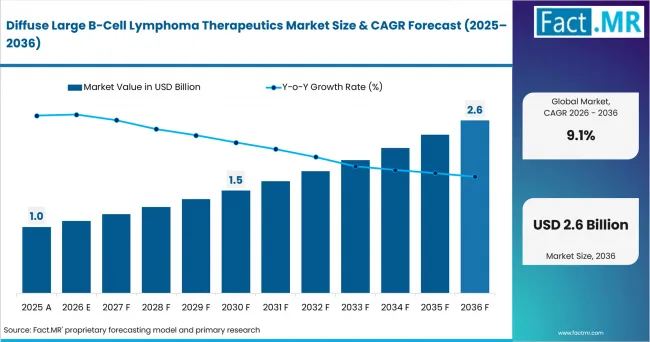
Diffuse Large B Cell Lymphoma Therapeutics Market Value Analysis | Source: Fact.MR
What are the defining numbers behind Diffuse Large B-Cell Lymphoma Therapeutics Market growth?
USD 1.5 billion absolute opportunity is projected by 2036, led by Chemotherapy and Newly Diagnosed DLBCL alongside hospital-based treatment administration.
- Demand Drivers in the Market
- Hospitals require clear treatment plans for higher-risk patients who are newly diagnosed with DLBCL. These plans must show when first-line chemoimmunotherapy can be used with antibody-drug conjugates.
- Cancer centers benefit from a clear referral process for CAR-T therapy. Patients whose cancer returns may face delays while the treatment is prepared, so doctors must also decide what care to provide during that time.
- Bispecific antibody treatment requires clear steps for slowly increasing the dose and watching for cytokine-release reactions. The same guidance must work for patients treated in hospital and those treated as outpatients.
- Diagnostic staff review the molecular type of the disease and follow patients with imaging tests. ABC and GCB forms of DLBCL may require different treatment orders.
- Key Segments Analyzed
- By Therapy Type: Chemotherapy is expected to hold 21.7% share in 2026 supported by continued first-line use in chemoimmunotherapy regimens.
- By Disease Type: Newly Diagnosed DLBCL is projected to account for 45.0% share in 2026 due to the larger incident treatment pool.
- By Route of Administration: Intravenous is anticipated to capture 38.3% share in 2026 owing to infusion-led delivery across major regimens.
- By End User: Hospitals are estimated to represent 30.0% share in 2026 attributable to inpatient treatment access and toxicity management needs.
- Analyst Opinion at Fact.MR
- Shambhu Nath Jha, Senior Analyst at Fact.MR, states, “DLBCL treatment now depends more on the patient’s disease risk, earlier treatment, and overall health. Companies that support antibody-based treatment for newly diagnosed patients and improve access to CAR-T therapy and bispecific antibodies for returning disease are likely to see wider use. Treatment centers must also have clear steps for choosing patients, arranging referrals, and checking safety during treatment.”
- Strategic Implications
- Drug companies must clearly explain which newly diagnosed patients are suitable for treatment plans that include polatuzumab before expanding hospital training.
- CAR-T providers can support faster treatment by helping with referrals and giving regular updates on preparation time. Delays can affect where patients with returning or hard-to-treat disease receive care.
- Companies offering bispecific antibodies must train hospital staff on how to raise the dose step by step and watch for cytokine-release reactions before wider outpatient use.
- Diagnostic companies can make testing more useful by linking molecular subtype and imaging results directly to treatment choice instead of handling them as separate tasks.
Germany is expected to record a 12.3% CAGR from 2026 to 2036 driven by early regimen change and hospital depth. Brazil is projected to post an 11.4% CAGR by 2036 supported by wider sequencing needs after early relapse. The USA is anticipated to advance at a 10.5% CAGR through 2036 owing to CAR-T capacity and regulatory depth. South Korea is estimated to record a 9.6% CAGR from 2026 to 2036 attributable to hospital concentration and digital care infrastructure. The United Kingdom is forecast to post an 8.6% CAGR from 2026 to through 2036 supported by national pathway coordination. Japan is expected to record a 7.7% CAGR by 2036 due to subtype review and imaging-led response assessment.
How does the Diffuse Large B-Cell Lymphoma Therapeutics Market break down by segment?
Chemotherapy is estimated to lead at 21.7% by Therapy Type segment in 2026. Newly Diagnosed DLBCL is projected to lead at 45.0% by Disease Type segment in 2026.
Which Therapy Type dominates?
Chemotherapy holds 21.7% share in 2026.
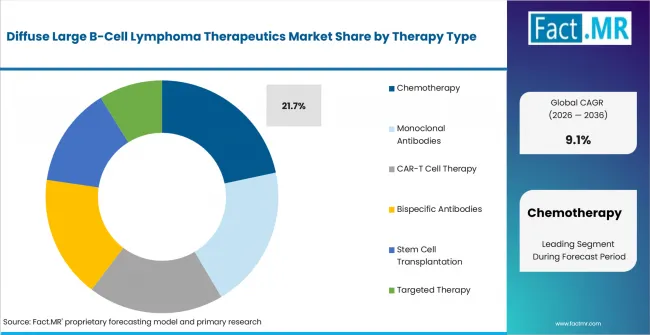
Diffuse Large B Cell Lymphoma Therapeutics Market Analysis By Therapy Type | Source: Fact.MR
Chemotherapy is estimated to hold 21.7% share in 2026, reflecting its established role in first-line chemoimmunotherapy for newly diagnosed patients. Monoclonal Antibodies remain closely tied to CD20-directed care across standard treatment pathways. CAR-T Cell Therapy addresses high-need relapsed cases, although referral timing and manufacturing capacity affect access. Bispecific Antibodies offer an off-the-shelf option, with step-up dosing and adverse-event monitoring shaping how hospitals introduce treatment.
What leads the Disease Type segment?
Newly Diagnosed DLBCL accounts for 45.0% share in 2026.
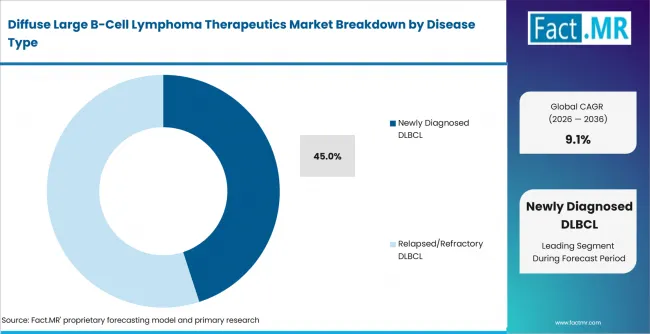
Diffuse Large B Cell Lymphoma Therapeutics Market Analysis By Disease Type | Source: Fact.MR
Newly Diagnosed DLBCL is projected to account for 45.0% share in 2026. Most patients enter care through first-line treatment, creating a larger treatment pool than later-stage disease pathways. Relapsed or Refractory DLBCL still carries strong commercial importance as patients move toward CAR-T therapy, bispecific antibodies or selected targeted medicines. Prior response, disease timing, patient fitness and referral access influence how these later-line options are selected.
How does Route of Administration shape demand?
Intravenous leads with 38.3% share in 2026.
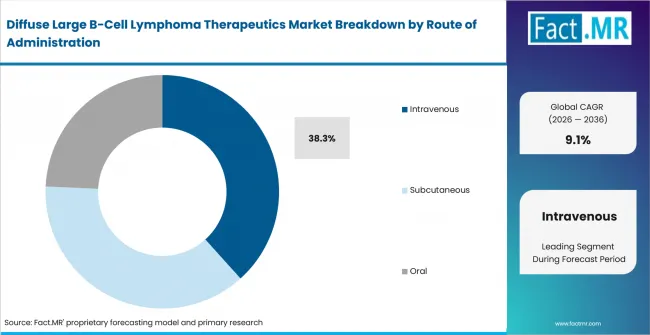
Diffuse Large B Cell Lymphoma Therapeutics Market Analysis By Route Of Administration | Source: Fact.MR
Intravenous administration is anticipated to capture 38.3% share in 2026, supported by its use across chemotherapy and antibody-based regimens delivered in hospital infusion units. The route allows treatment reactions to be observed while supportive care is adjusted during administration. Subcutaneous delivery changes site planning for selected bispecific antibodies after early monitored doses. Oral therapy serves narrower targeted pathways. Each route creates a different requirement for chair time, observation and clinical supervision.
What supports Hospitals within End User?
Hospitals hold 30.0% share in 2026.
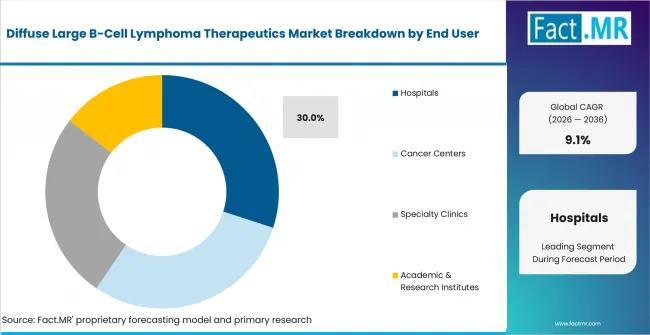
Diffuse Large B Cell Lymphoma Therapeutics Market Analysis By End User | Source: Fact.MR
Hospitals are estimated to represent 30.0% share in 2026 due to their infusion facilities, diagnostic services and capacity to manage serious treatment reactions. Cancer Centers play a different role by coordinating CAR-T referrals, cell collection and clinical trial access. Specialty Clinics support selected follow-up and routine administration after protocols become established. Academic and Research Institutes contribute through molecular testing, subtype research and early evidence that guides future treatment choices.
What is accelerating Diffuse Large B-Cell Lymphoma Therapeutics Market adoption, and what is holding it back?
Treatment sequencing is anticipated to drive market growth, while referral friction and toxicity management restrain it.
Drivers Impact Analysis
| DRIVER | (~) % IMPACT ON CAGR | GEOGRAPHIC RELEVANCE | IMPACT TIMELINE |
|---|---|---|---|
| First-line ADC adoption | +1.5% | Germany and USA | Medium term (2-4 years) |
| CAR-T therapy expansion | +1.1% | USA and South Korea | Long term (>=4 years) |
| Bispecific antibody uptake | +0.8% | South Korea and Germany with United Kingdom | Short term (<=2 years) |
| Molecular subtyping and imaging protocols | +0.6% | Japan | Medium term (2-4 years) |
| Sequencing pathways after early relapse | +0.4% | Brazil | Long term (>=4 years) |
Source: Fact.MR analysis. Updated Jul 20, 2026
- First-line ADC adoption: Polatuzumab-containing first-line use changes the comparison point for selected higher-risk DLBCL patients. This driver is expected to support protocol updates in hospitals that already manage multi-drug infusion regimens.
- CAR-T therapy expansion: Autologous CAR-T therapy depends on collection and patient-specific manufacturing before infusion. Demand is projected to widen where referral timing becomes clearer for relapsed or refractory patients.
- Bispecific antibody uptake: Subcutaneous epcoritamab and fixed-duration glofitamab options create off-the-shelf alternatives after multiple prior lines. Adoption is anticipated to expand where step-up dosing pathways are staffed properly.
- Molecular subtyping and imaging protocols: ABC and GCB review helps clinicians identify patients who need deeper treatment discussion. Imaging-based response assessment is expected to support follow-up decisions after CAR-T treatment.
- Sequencing pathways after early relapse: Early relapse creates a narrow decision window for CAR-T referral and later-line treatment. Brazil is expected to benefit where regional networks shorten the distance between diagnosis and specialist care.
Opportunity Impact Analysis
| OPPORTUNITY | (~) % IMPACT ON CAGR | GEOGRAPHIC RELEVANCE | IMPACT TIMELINE |
|---|---|---|---|
| Outpatient bispecific administration | +0.6% | South Korea and United Kingdom | Short term (<=2 years) |
| Specialty-clinic and cancer-center CAR-T referral networks | +0.5% | USA and Germany | Medium term (2-4 years) |
| AI-assisted ABC/GCB subtype triage | +0.4% | Japan | Medium term (2-4 years) |
| Real-world relapsed/refractory outcome registries | +0.3% | Brazil | Long term (>=4 years) |
Source: Fact.MR analysis. Updated Jul 20, 2026
- Outpatient bispecific administration: Cancer centers are expected to move selected dosing steps outside inpatient beds once monitoring rules are clear. This opportunity depends on staff training and rapid escalation routes.
- CAR-T referral networks: Specialty clinics can identify eligible patients earlier when referral criteria are built into routine relapse review. Network design is projected to improve throughput without changing the stated therapy categories.
- AI-assisted subtype triage: Digital pathology tools can support faster ABC and GCB triage before molecular confirmation. Japan is anticipated to benefit because diagnostic depth already supports careful treatment selection.
- Outcome registries: Real-world registries are expected to help hospitals compare treatment sequences after relapse. Brazil benefits where regional data clarifies capacity gaps and reimbursement needs.
Restraints Impact Analysis
| RESTRAINT | (~) % IMPACT ON CAGR | GEOGRAPHIC RELEVANCE | IMPACT TIMELINE |
|---|---|---|---|
| CAR-T manufacturing and referral turnaround | -0.5% | USA | Short term (<=2 years) |
| Toxicity management burden | -0.4% | United Kingdom | Medium term (2-4 years) |
| Incomplete referral and reimbursement pathways | -0.3% | Brazil | Long term (>=4 years) |
| Molecular confirmation gap | -0.2% | Japan | Medium term (2-4 years) |
Source: Fact.MR analysis. Updated Jul 20, 2026
- CAR-T turnaround: Autologous therapy requires patient-specific manufacturing before infusion. This restraint limits adoption when disease progression outpaces referral completion and bridging treatment planning.
- Toxicity management burden: Cytokine-release syndrome and neurologic events require trained staff and clear escalation rules. Hospitals without this support are expected to delay wider bispecific and CAR-T use.
- Referral and reimbursement gaps: Relapsed patients need rapid movement from community diagnosis into specialist decision-making. Brazil is projected to face slower conversion where public and private pathways remain uneven.
- Molecular confirmation gap: Subtype-linked choices require reliable pathology and molecular review. Japan is anticipated to face slower treatment switching when confirmation timelines remain separated from prescribing visits.
Which countries are scaling Diffuse Large B-Cell Lymphoma Therapeutics Market fastest?
Germany 12.3%, Brazil 11.4%, USA 10.5%, South Korea 9.6%, United Kingdom 8.6%, Japan 7.7%.
Regional analysis covers North America and Europe alongside East Asia and South Asia and Pacific. Latin America and the Middle East and Africa complete the geographic coverage.
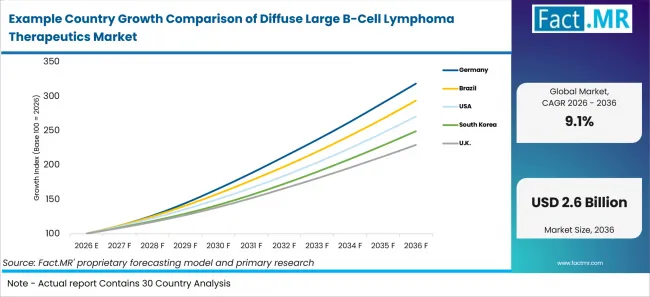
Example Country Growth Comparison Of Diffuse Large B Cell Lymphoma Therapeutics Market | Source: Fact.MR
| COUNTRY | CAGR |
|---|---|
| Germany | 12.3% |
| Brazil | 11.4% |
| USA | 10.5% |
| South Korea | 9.6% |
| United Kingdom | 8.6% |
| Japan | 7.7% |
Source: Fact.MR analysis. Updated Jul 20, 2026
What is driving Germany’s growth through 2036?
12.3% CAGR, driven by first-line regimen changes and structured treatment assessment.
Germany combines university hospitals, lymphoma study groups and formal reimbursement review for new treatment options. Polatuzumab-containing first-line therapy has changed how later treatment choices are assessed, especially for patients who may move to CAR-T therapy, transplantation or bispecific antibodies. The market is projected to record a 12.3% CAGR from 2026 to 2036 as hospitals update treatment order around prior therapy and defined patient groups.
How is Brazil scaling DLBCL therapeutics demand?
11.4% CAGR, supported by faster referral after early relapse and wider specialist access.
Brazil has a large patient base spread across public and private treatment systems with different levels of access to advanced therapy. Early relapse or primary refractory disease creates pressure for quick diagnostic confirmation and referral to specialist cancer centres. The market is forecast to post an 11.4% CAGR from 2026 to 2036 as treatment providers improve links between pathology review, coverage decisions and access to later-line therapies.
What supports the USA outlook?
10.5% CAGR, owing to CAR-T treatment capacity and broad regulatory coverage.
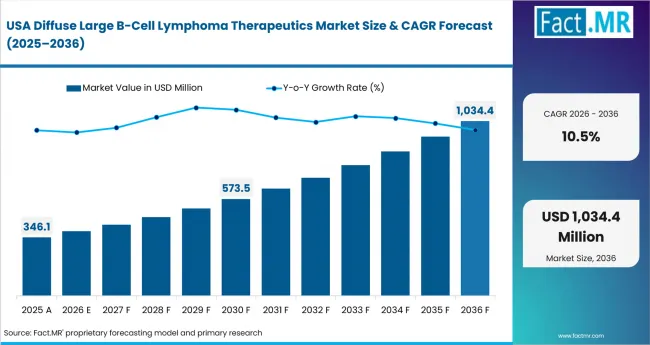
Diffuse Large B Cell Lymphoma Therapeutics Market Country Value Analysis | Source: Fact.MR
The USA has a deep network of cancer centres that provide CAR-T therapy and other treatments for relapsed or refractory DLBCL. Commercial demand depends on fast referral, cell collection, manufacturing coordination and post-infusion monitoring. The market is anticipated to advance at a 10.5% CAGR from 2026 to 2036 as hospitals reduce delays between treatment failure and specialist assessment while adding newer later-line options.
What underpins South Korea’s growth?
9.6% CAGR, driven by bispecific antibody use and concentrated specialist care.
South Korea’s major hospitals combine strong specialist access with dense clinical infrastructure in large cities. Bispecific antibodies provide an off-the-shelf option, but early doses still require step-up administration and close monitoring for serious reactions. The market is estimated to record a 9.6% CAGR from 2026 to 2036 as hospitals develop clearer dosing, observation and follow-up procedures that support wider use beyond prolonged inpatient treatment.
How is the United Kingdom developing DLBCL therapeutics demand?
8.6% CAGR, supported by national treatment guidance and coordinated referral pathways.
The United Kingdom uses national guidance to define when first-line regimens, CAR-T therapy and bispecific antibodies are suitable. Earlier treatment choices can affect later eligibility and response, making therapy order an important part of care planning. The market is forecast to post an 8.6% CAGR from 2026 to 2036 as NHS centres improve referral timing, toxicity management and coordination between local hospitals and specialist cancer centres.
What supports Japan’s DLBCL therapeutics outlook?
7.7% CAGR, driven by detailed patient selection and imaging-led treatment review.
Japan has strong pathology, imaging and specialist medicine capabilities that support careful treatment choice after earlier regimens fail. CAR-T therapy and other advanced options require detailed eligibility checks, manufacturing planning and repeated response assessment. The market is expected to record a 7.7% CAGR from 2026 to 2036 as hospitals connect molecular review and imaging results more closely with prescribing decisions across later-line treatment pathways.
Who leads the Diffuse Large B-Cell Lymphoma Therapeutics Market?
Roche Holding AG and Bristol Myers Squibb lead direct regimen influence, while Gilead Sciences and Genmab A/S strengthen CAR-T and bispecific therapy coverage.
Roche Holding AG is part of DLBCL treatment planning through Polivy and Columvi, which are used at different stages of care. Bristol Myers Squibb competes with Breyanzi and its CAR-T treatment network for patients whose large B-cell lymphoma has returned or has not responded to earlier therapy. Gilead Sciences supports CAR-T treatment through Yescarta and Kite’s manufacturing experience. Genmab A/S and AbbVie Inc. are developing epcoritamab for B-cell cancers.
Novartis AG remains active through Kymriah and its experience in cell-based treatments for blood cancers. Incyte Corporation and Regeneron Pharmaceuticals, Inc. bring wider cancer and blood-disease product ranges that support work on treatment combinations and treatment order. ADC Therapeutics SA also take part through cancer research and related blood-cancer programs. Through 2036, competition is likely to depend on the strength of clinical results and whether treatment centers are ready to use these therapies. Safety management and insurance coverage will also affect wider use.
Which companies are the key providers?
ADC Therapeutics SA and AbbVie Inc. are included in the profiled company set. Genmab A/S and Incyte Corporation are also included. Regeneron Pharmaceuticals, Inc. completes the company set.
- Roche Holding AG
- Bristol Myers Squibb
- Gilead Sciences
- Novartis AG
- ADC Therapeutics SA
- AbbVie Inc.
- Genmab A/S
- Incyte Corporation
- Regeneron Pharmaceuticals, Inc.
Bibliography
- AbbVie. (2026, June 29). AbbVie announces positive phase 3 results for epcoritamab plus lenalidomide in patients with relapsed or refractory diffuse large B-cell lymphoma.
- Incyte Corporation. (2026, June 19). Incyte Japan announces approval of Minjuvi® (tafasitamab) in combination with lenalidomide for the treatment of adults with relapsed or refractory diffuse large B-cell lymphoma (DLBCL).
- U.S. Food and Drug Administration. (2025, February 12). FDA approves brentuximab vedotin with lenalidomide and rituximab for relapsed or refractory large B-cell lymphoma.
- National Cancer Institute. (2025, May 12). Aggressive B-cell non-Hodgkin lymphoma treatment (PDQ®)–Health professional version.
- Gilead Sciences, Inc. (2025, December 7). Yescarta delivers consistent safety, efficacy, and quality-of-life benefits across broad range of relapsed/refractory large B-cell lymphoma patients in new analysis at ASH 2025.
This Report Answers
- The report addresses therapy sequencing across first-line treatment and relapsed disease. It also covers antibody-drug conjugates and CAR-T therapy alongside bispecific antibodies.
- The report evaluates segment performance for Chemotherapy and Newly Diagnosed DLBCL. It also covers Intravenous delivery and hospital-based treatment pathways.
- Country growth is assessed across Germany and Brazil through the 2026 to 2036. The USA and South Korea are also reviewed. United Kingdom and Japan complete the country comparison.
- Competitive positioning is reviewed for Roche Holding AG and Bristol Myers Squibb. Gilead Sciences and Genmab A/S are also assessed. AbbVie Inc. and the wider profiled company set complete the competitive view.
- Operational constraints are tied to CAR-T manufacturing and referral timing. Step-up dosing and toxicity management capacity define the next operational pressure point.
What does the Diffuse Large B-Cell Lymphoma Therapeutics Market cover?
Coverage includes Chemotherapy and Monoclonal Antibodies used in newly diagnosed and relapsed DLBCL treatment. CAR-T Cell Therapy and Bispecific Antibodies are included. Stem Cell Transplantation and Targeted Therapy complete the Therapy Type scope.
The Diffuse Large B-Cell Lymphoma Therapeutics Market covers systemic medicines and cell-based treatments used for DLBCL care. Coverage includes newly diagnosed and relapsed or refractory disease across intravenous and subcutaneous delivery routes. Oral delivery is included where targeted regimens apply. The market differs from procedure spending because commercial value comes from therapeutic products and supporting treatment pathways.
What is included in the scope?
Systemic and cell-based DLBCL therapies are covered across hospital and cancer-center settings. Specialty-clinic and research settings are included where treatment pathways apply.
The scope includes Chemotherapy and Monoclonal Antibodies alongside CAR-T Cell Therapy and Bispecific Antibodies. Stem Cell Transplantation and Targeted Therapy complete the Therapy Type coverage. Coverage spans Newly Diagnosed DLBCL and Relapsed/Refractory DLBCL across Intravenous and Subcutaneous administration. Oral administration is included where the stated therapy categories apply. Hospital and cancer-center demand is included because these sites manage infusion and referral. Monitoring and toxicity response define the treatment-site workload.
What is excluded from the scope?
General oncology services and unrelated lymphoma diagnostics are outside the market boundary.
The scope excludes complete hospital expenditure and procedure-level care costs that are not tied to therapeutic products. Standalone diagnostic equipment remains outside the boundary unless it directly supports treatment selection within DLBCL pathways. Adjacent hematology drugs are excluded when they are not used in the stated disease categories.
How Was the Analysis Built?
The analysis draws on 120+ sources, 35+ company portfolios, 25+ countries, and more than 20 industry interviews.
- Primary Research: Primary research includes discussions with manufacturers, service providers, technology developers, distributors, end users, procurement teams, and subject-matter experts. These conversations examine purchasing priorities, product adoption, operational challenges, approval requirements, competitive positioning, and the factors that influence wider market acceptance.
- Desk Research: Desk research covers government statistics, regulatory publications, company filings, trade data, technical studies, industry associations, standards, public policy, and other authoritative sources. Every source used in the analysis is documented in the bibliography.
- Market Sizing and Forecasting: Market estimates combine historical performance, demand indicators, pricing and volume trends, segment shares, company participation, country-level growth, adoption patterns, investment activity, and barriers to market expansion.
- Data Validation and Update Cycle: Findings are validated by comparing primary interviews with public data, company activity, regulatory changes, trade patterns, and industry developments. Regular updates review new product launches, capacity changes, partnerships, approvals, procurement trends, and shifts in commercial adoption.
Segmentation
What is the report’s scope and coverage?
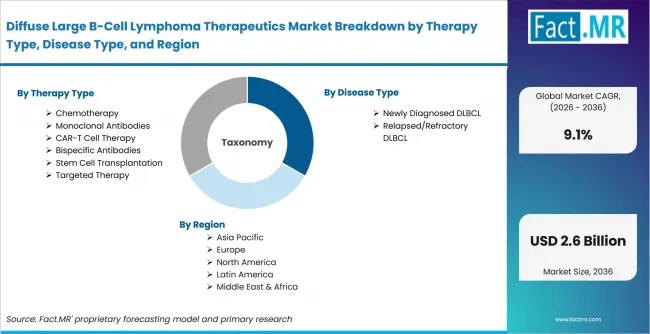
Diffuse Large B Cell Lymphoma Therapeutics Market Breakdown By Therapy Type, Disease Type, And Region | Source: Fact.MR
| Attribute | Details |
|---|---|
| Quantitative Units | USD billion in 2026 to USD billion by 2036 at a CAGR |
| Market Definition | Systemic medicines and cell-based treatments used for newly diagnosed and relapsed or refractory diffuse large B-cell lymphoma. |
| Therapy Type | Chemotherapy; Monoclonal Antibodies; CAR-T Cell Therapy; Bispecific Antibodies; Stem Cell Transplantation; Targeted Therapy |
| Disease Type | Newly Diagnosed DLBCL; Relapsed/Refractory DLBCL |
| Route of Administration | Intravenous; Subcutaneous; Oral |
| End User | Hospitals; Cancer Centers; Specialty Clinics; Academic & Research Institutes |
| Regions Covered | North America; Latin America; Western Europe; Eastern Europe; East Asia; South Asia and Pacific; Middle East and Africa |
| Countries Covered | Germany; Brazil; USA; South Korea; United Kingdom; Japan and 30+ countries |
| Key Companies Profiled | Roche Holding AG; Bristol Myers Squibb; Gilead Sciences; Novartis AG; ADC Therapeutics SA; AbbVie Inc.; Genmab A/S; Incyte Corporation; Regeneron Pharmaceuticals, Inc. |
| Forecast Period | 2026 to 2036 |
| Approach | Hybrid top-down and bottom-up approach using therapy line movement and route mix. Treatment-site roles and company portfolio evidence support expert validation. |
Source: Fact.MR analysis. Updated Jul 20, 2026
How is the market segmented?
-
By Therapy Type:
- Chemotherapy
- Monoclonal Antibodies
- CAR-T Cell Therapy
- Bispecific Antibodies
- Stem Cell Transplantation
- Targeted Therapy
-
By Disease Type:
- Newly Diagnosed DLBCL
- Relapsed/Refractory DLBCL
- By Route of Administration
- Intravenous
- Subcutaneous
- Oral
-
By End User:
- Hospitals
- Cancer Centers
- Specialty Clinics
- Academic & Research Institutes
-
By Region:
- North America
- Latin America
- Western Europe
- Eastern Europe
- East Asia
- South Asia and Pacific
- Middle East and Africa
Frequently Asked Questions
Which Therapy Type leads the Diffuse Large B-Cell Lymphoma Therapeutics Market?
Which Disease Type leads the Diffuse Large B-Cell Lymphoma Therapeutics Market?
Which Route of Administration leads the Diffuse Large B-Cell Lymphoma Therapeutics Market?
Which End User leads the Diffuse Large B-Cell Lymphoma Therapeutics Market?
Which country records the highest CAGR in the Diffuse Large B-Cell Lymphoma Therapeutics Market?
How does Brazil perform in the Diffuse Large B-Cell Lymphoma Therapeutics Market?
How does the USA perform in the Diffuse Large B-Cell Lymphoma Therapeutics Market?
How does South Korea perform in the Diffuse Large B-Cell Lymphoma Therapeutics Market?
What is the primary driver in the Diffuse Large B-Cell Lymphoma Therapeutics Market?
What is the main restraint in the Diffuse Large B-Cell Lymphoma Therapeutics Market?
Why is Newly Diagnosed DLBCL significant?
Why do hospitals dominate demand?
Who worked on this report


Preview the report firsthand - request a free sample
Free SampleGet the brochure for pricing and purchase details
Download PDF