
- Market Value (2025): USD 307.8 Mn
- Estimated Value (2026): USD 330.0 Mn
- Forecast Value (2036): USD 661.4 Mn
- CAGR (2026-2036): 7.2%
Hygienic Rotary Valve Units Market Forecast and Outlook 2026 to 2036
The hygienic rotary valve units market is projected to grow from USD 330.0 million in 2026 to USD 661.4 million by 2036. The forecast implies a compound annual growth rate of 7.2% over the forecast period.
Food, dairy, pharmaceutical and specialty chemical processors use hygienic rotary valves to discharge and meter powders while limiting contamination, dust release and unwanted air leakage. Equipment selection depends on the material, cleanability requirements, seal design and operating conditions. Suppliers offer stainless-steel rotary valves with accessible product-contact surfaces, removable rotors and dedicated cleaning arrangements. Coperion supplies ZRD-CIP and ZFD-CIP valves designed for automated cleaning in place, while its other hygienic designs are intended for different cleaning procedures. In October 2026, the UK Budget announced more than GBP 1 billion in life sciences investments by Convatec, Vertex Pharmaceuticals and Kindeva.
Market figures and highlights: Hygienic Rotary Valve Units Market
- Sales of hygienic rotary valve units stood at USD 307.8 million in 2025
- Hygienic Rotary Valve Units Market Value (2026): USD 330.0 million
- Hygienic Rotary Valve Units Market Forecast Value (2036): USD 661.4 million
- Hygienic Rotary Valve Units Market Forecast CAGR (2026-2036): 7.2%
- Leading Product Type: CIP-capable rotary valve (28.1%)
- Key Market Participants: Coperion, Gericke, DMN-Westinghouse, Rotolok, WAMGROUP
- Key Growth Regions: United Kingdom, Netherlands, United States, Germany, Italy
Fonterra reported in March 2026 that construction of its Studholme advanced protein hub was complete and that trial products had been produced in February. In May 2026, FrieslandCampina announced an investment programme exceeding EUR 90 million for whey protein production upgrades in the Netherlands. These projects illustrate investment in powder-related manufacturing, where hygienic material-transfer equipment may be required. Valve specifications will depend on each processing line and its cleaning requirements.
Hygienic Rotary Valve Units Market
| Metric | Value |
|---|---|
| Estimated Value in (2026) | USD 330.0 million |
| Forecast Value in (2036) | USD 661.4 million |
| Forecast CAGR (2026 to 2036) | 7.2% |
Source: Fact.MR analysis.
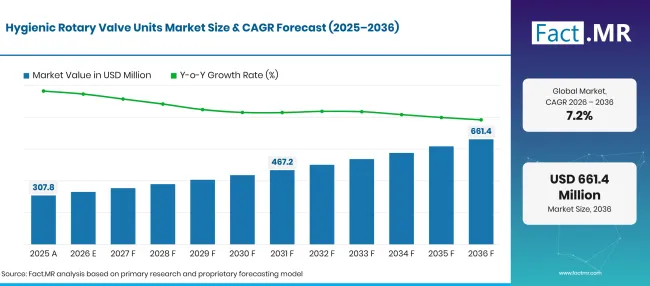
Hygienic Rotary Valve Units Forecast Global | Source: Fact.MR
Category
| Category | Segments |
|---|---|
| Product Type | CIP-capable rotary valve, High-containment rotary valve, Drop-through sanitary valve, Quick-release rotor valve, Blow-through sanitary valve |
| Operating Mode | Continuous, Turnkey integrated, Modular inline, Batch, Semi-continuous |
| Capacity Tier | High throughput, Small commercial, Pilot and laboratory, Custom high-capacity, Medium throughput |
| Customer Industry | Chemicals, Pharmaceutical, Food and beverage, Other industrial, General manufacturing |
| Selected Countries | United Kingdom; Netherlands; United States; Germany; Italy |
Source: Fact.MR analysis. Updated Nov 24, 2026
Segmental Analysis
Why do CIP-capable rotary valves lead product demand in the Hygienic Rotary Valve Units Market?
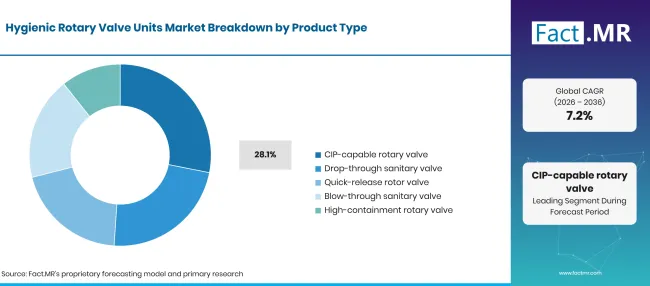
Hygienic Rotary Valve Units Breakdown Product Type | Source: Fact.MR
CIP-capable rotary valves account for 28.1% of revenue in 2026, approximately USD 92.7 million. Producers handling dairy powders and selected food or pharmaceutical ingredients may require liquid cleaning without routine rotor removal. Coperion offers ZRD-CIP and ZFD-CIP rotary valves designed for integration into automated cleaning systems. Manufacturers must still validate cleaning performance for the product, installation and applicable hygiene requirements.
How is continuous operation leading demand in the Hygienic Rotary Valve Units Market?
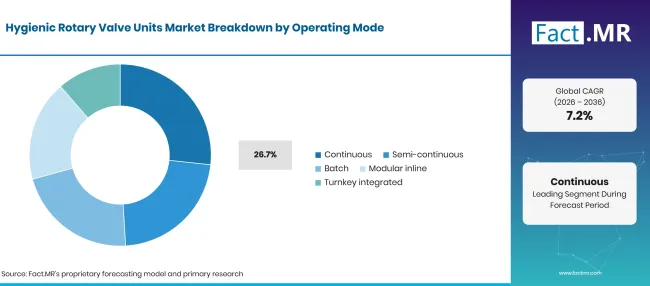
Hygienic Rotary Valve Units Breakdown Operating Mode | Source: Fact.MR
Continuous operation represents 26.7% of revenue in 2026, valued at approximately USD 88.1 million, reflecting the importance of uninterrupted powder transfer beneath dryers, silos and filtration equipment. Rotary airlocks maintain controlled material discharge while managing pressure differences in conveying systems. Extended operating campaigns place greater demands on bearings and seals. Manufacturers are improving component durability and maintenance accessibility.
Why does high throughput lead capacity demand in the Hygienic Rotary Valve Units Market?
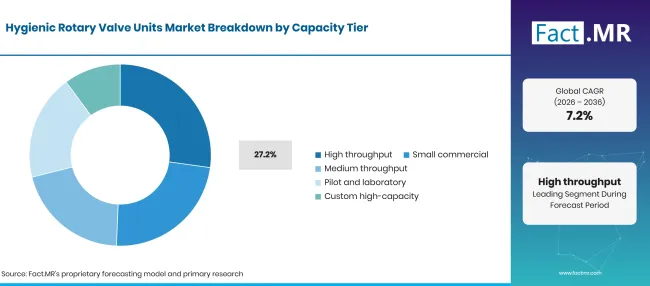
Hygienic Rotary Valve Units Breakdown Capacity Tier | Source: Fact.MR
High-throughput units hold 27.2% of revenue in 2026, equivalent to approximately USD 89.8 million. Large powder processing facilities need controlled discharge at production rates that match upstream equipment. Valve sizing considers rotor-pocket filling, bulk density, pressure differential, leakage and cleanability. Coperion supplies rotary valves for sanitary conveying and powder discharge, with configurations selected for the specific process.
How is the chemicals industry leading customer demand in the Hygienic Rotary Valve Units Market?
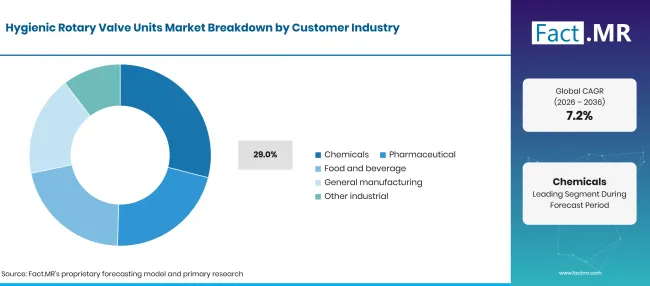
Hygienic Rotary Valve Units Breakdown Customer Industry | Source: Fact.MR
Chemical manufacturers contribute 29.0% of revenue in 2026, approximately USD 95.7 million, as specialty powder production requires careful contamination control and secure material handling. Frequent changes between chemical grades increase cleaning requirements. Coperion offers hygienic rotary valves with accessible internal components and specialized sealing arrangements. Facilities handling combustible powders also assess explosion protection, material compatibility and operator safety.
Hygienic Rotary Valve Units Market: Drivers, Restraints and Trends
Drivers
Investment in nutrition and pharmaceutical processing creates opportunities for hygienic powder-handling equipment. In May 2026, FrieslandCampina announced more than EUR 90 million for upgrades to Dutch whey protein production. In April 2026, the ABPI highlighted AstraZeneca’s GBP 300 million UK expansion and Boehringer Ingelheim’s GBP 150 million AI investment. These projects reflect activity in related industries, although neither source confirms rotary-valve purchases.
Restraints
Hygienic rotary valves can require more specialized materials, surface finishes and cleaning provisions than standard industrial rotary valves, increasing purchase and maintenance costs. Italy’s industrial production was 0.1% below its year-earlier level in September 2026, according to Istat. Investment decisions depend on plant requirements, available budgets and the cost of meeting hygiene standards.
Trend
Faster Rotor Access. Producers with frequent recipe changes are examining rotary valves that provide easier access for inspection and cleaning. Gericke RotaVal expanded its Fast Clean range to include extractable rotary valves up to 400 mm, with features designed to assist rotor removal and realignment. Cleaning intervals still depend on the material and processing conditions.
Trend
Containment and Process Safety. Powder processing sites assess valves for seal performance, hygienic design and suitability for their operating environment. Where combustible dust or hazardous ingredients are present, operators must verify the applicable explosion-protection or containment specifications.
Hygienic Rotary Valve Units Market: Country Analysis
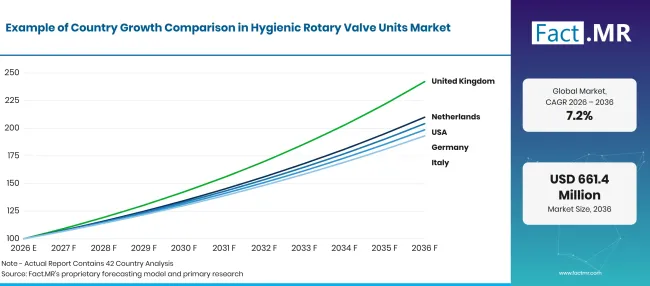
Hygienic Rotary Valve Units Growth Index | Source: Fact.MR
| Country | CAGR (2026-2036) |
|---|---|
| United Kingdom | 9.3% |
| Netherlands | 7.7% |
| United States | 7.4% |
| Germany | 7.1% |
| Italy | 6.8% |
Source: Fact.MR analysis.
What is driving hygienic rotary valve units demand in the United Kingdom?
Demand for hygienic rotary valve units in the United Kingdom is forecast to rise at a 9.3% CAGR through 2036, the fastest among the five countries.
In October 2026, the UK Budget announced more than GBP 1 billion in life sciences investment commitments, including facilities and research activity. UK-based Rotolok supplies stainless-steel rotary airlocks for powder-handling applications, where cleaning access and material compatibility influence equipment selection.
How is dairy processing supporting hygienic rotary valve units sales in the Netherlands?
Sales of hygienic rotary valve units in the Netherlands are forecast to expand at a 7.7% CAGR through 2036.
In May 2026, FrieslandCampina announced more than EUR 90 million in investments covering whey protein operations at Bedum, Veghel and Workum. Dutch supplier DMN-WESTINGHOUSE offers hygienic rotary valves for dairy powders, including equipment designed for accessible cleaning.
What is shaping hygienic rotary valve units demand in the United States?
Demand for hygienic rotary valve units in the United States is projected to increase at a 7.4% CAGR through 2036.
Dairy, nutrition and pet food processors assess rotary valves for material transfer between drying, storage and conveying operations. Coperion offers sanitary rotary valve solutions for such installations. Equipment choice depends on product sensitivity, cleaning procedures and line capacity, rather than sector expansion alone.
How is the chemicals recovery shaping hygienic rotary valve units sales in Germany?
Sales of hygienic rotary valve units in Germany are forecast to grow at a 7.1% CAGR through 2036.
Chemical, food ingredient and pharmaceutical manufacturers may replace existing powder-handling components to meet process and cleaning requirements. German supplier Coperion provides dedicated hygienic rotary valve designs, including certified CIP-capable configurations. Purchases depend on planned plant upgrades and the requirements of individual materials.
Why is growth slower for hygienic rotary valve units in Italy?
Demand for hygienic rotary valve units in Italy is projected to grow at a 6.8% CAGR through 2036, the slowest among the five countries. Istat reported that industrial production in the third quarter of 2026 declined by 0.4% from the preceding quarter.
Italian manufacturer WAMGROUP supplies rotary valve technology for bulk solids handling. Food and pharmaceutical users need to confirm that selected models meet their particular hygiene and cleaning requirements.
Competitive Landscape for Hygienic Rotary Valve Units Market
Hygienic rotary valve suppliers differentiate their equipment through cleanability, product-contact materials, seal selection and ease of maintenance. Coperion offers CIP-capable ZRD-CIP and ZFD-CIP designs alongside hygienic valves for other cleaning methods. Gericke RotaVal provides Fast Clean equipment with extractable rotors. DMN-WESTINGHOUSE serves dairy powder applications with hygienic rotary valve designs, while Rotolok supplies stainless-steel rotary airlocks. WAMGROUP serves a broad range of bulk-solids applications; sanitary suitability must be assessed for each model and installation.
Cleaning and maintenance access continue to influence equipment design. At POWTECH 2026, Coperion presented its AutoAccess rotary valve extraction system to speed inspection, cleaning and maintenance. Gericke RotaVal has expanded its Fast Clean range with extractable valves up to 400 mm. Suppliers compete on access, cleaning performance and integration with existing powder-handling systems.
Recent Developments
- In 2026, Gericke RotaVal expanded its Fast Clean rotary valve range with extractable models up to 400 mm. The updated designs are intended to simplify rotor access and maintenance while supporting hygienic powder handling.
Key Players in Hygienic Rotary Valve Units Market
Key companies operating in the market include Coperion, Gericke, DMN-Westinghouse, Rotolok, and WAMGROUP.
- Coperion
- Gericke
- DMN-Westinghouse
- Rotolok
- WAMGROUP
Bibliography
- Association of the British Pharmaceutical Industry. (2026, April 29). ABPI celebrates a month of major investment commitments into UK life sciences.
- Coperion. (2026). Coperion at POWTECH 2026.
- Fonterra Co-operative Group. (2026, March). Fonterra delivers another strong result for HY26
- FrieslandCampina. (2026, May 5). FrieslandCampina announces major investment programme to accelerate growth in high-value whey proteins.
- Gericke. (2026). Gericke RotaVal Fast Clean rotary valves: Extractable models up to 400 mm.
- HM Treasury. (2026, October 28). Budget 2026.
- Istat. (2026, November 11). Industrial production – September 2026.
- Coperion. (2026). Sanitary design rotary valves.
- DMN-WESTINGHOUSE. (2025). Dairy powder handling: Hygienic rotary valves.
- Department for Science, Innovation and Technology. (2026, April 14). Vital medicines and new jobs in over GBP 80 million for UK life sciences.
Segmentation
Scope of Report
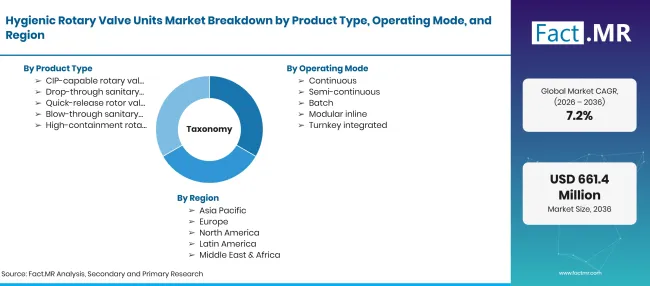
Hygienic Rotary Valve Units Taxonomy | Source: Fact.MR
| Items | Values |
|---|---|
| Quantitative Units | USD million |
| Product Type | CIP-capable rotary valve, High-containment rotary valve, Drop-through sanitary valve, Quick-release rotor valve, Blow-through sanitary valve |
| Operating Mode | Continuous, Turnkey integrated, Modular inline, Batch, Semi-continuous |
| Capacity Tier | High throughput, Small commercial, Pilot and laboratory, Custom high-capacity, Medium throughput |
| Customer Industry | Chemicals, Pharmaceutical, Food and beverage, Other industrial, General manufacturing |
| Regions Covered | North America, Latin America, Europe, Asia Pacific, Middle East & Africa |
| Countries Covered | United Kingdom, Netherlands, United States, Germany, Italy, and other countries |
| Key Companies Profiled | Coperion, Gericke, DMN-Westinghouse, Rotolok, WAMGROUP |
| Additional Attributes | Dollar revenue in the Hygienic Rotary Valve Units Market is segmented by product type (CIP-capable, high-containment, drop-through sanitary, quick-release rotor, blow-through sanitary valve), operating mode, capacity tier, customer industry and region. |
Source: Fact.MR analysis. Updated Nov 24, 2026
Hygienic Rotary Valve Units Market by Segments
-
Product Type
- CIP-capable rotary valve
- High-containment rotary valve
- Drop-through sanitary valve
- Quick-release rotor valve
- Blow-through sanitary valve
-
Operating Mode
- Continuous
- Turnkey integrated
- Modular inline
- Batch
- Semi-continuous
-
Capacity Tier
- High throughput
- Small commercial
- Pilot and laboratory
- Custom high-capacity
- Medium throughput
-
Customer Industry
- Chemicals
- Pharmaceutical
- Food and beverage
- Other industrial
- General manufacturing
-
Region:
- North America
- United States
- Canada
- Mexico
- Europe
- Germany
- United Kingdom
- France
- Italy
- Spain
- Rest of Europe
- Asia Pacific
- China
- India
- Japan
- South Korea
- Australia
- Rest of Asia Pacific
- Latin America
- Brazil
- Argentina
- Rest of Latin America
- Middle East & Africa
- GCC Countries
- South Africa
- Rest of Middle East & Africa
- North America
Table of Contents
Key Takeaways
- Market Size and CAGR
- Top Growth Driver
- Fastest Growing Segment
- Leading Region
- Key Companies
- Emerging Opportunities

