
- Market Value (2025): USD 101.0 Mn
- Estimated Value (2026): USD 110.0 Mn
- Forecast Value (2036): USD 258.0 Mn
- CAGR (2026-2036): 8.9%
High-Energy-Efficiency Mixing Platforms Market Forecast and Outlook 2026 to 2036
The high-energy-efficiency mixing platforms market is projected to grow from USD 110.0 million in 2026 to USD 258.0 million by 2036. The forecast implies a compound annual growth rate of 8.9% over the forecast period.
Industrial food, chemical and materials processors assess mixing equipment for product uniformity, processing time and electricity use. High-shear mixers, controlled agitator designs and variable-speed drives can improve efficiency for suitable formulations. In November 2026, GEA reported that its third-quarter order intake increased 20.3% to EUR 1.65 billion across the group. The results provide context for process equipment spending but are not a measure of demand for energy-efficient mixers alone.
Market figures and highlights: High-Energy-Efficiency Mixing Platforms Market
- Sales of high-energy-efficiency mixing platforms stood at USD 101.0 million in 2025
- High-Energy-Efficiency Mixing Platforms Market Value (2026): USD 110.0 million
- High-Energy-Efficiency Mixing Platforms Market Forecast Value (2036): USD 258.0 million
- High-Energy-Efficiency Mixing Platforms Market Forecast CAGR (2026-2036): 8.9%
- Leading Product Type: Energy-recovery mixer (29.1%)
- Key Market Participants: Bühler, GEA, Coperion, Clextral, Wenger Manufacturing, Baker Perkins
- Key Growth Regions: United Kingdom, United States, Italy, Germany, Japan
Mixing equipment manufacturers are improving process controls, product circulation and cleaning systems to reduce energy consumption per finished batch. In November 2025, GEA announced a large-scale flavor mixing plant for Symrise that incorporates heat recovery for clean-in-place return flows. Energy performance depends on the product, plant design, mixing cycle and overall utilities.
High-Energy-Efficiency Mixing Platforms Market
| Metric | Value |
|---|---|
| Estimated Value in (2026) | USD 110.0 million |
| Forecast Value in (2036) | USD 258.0 million |
| Forecast CAGR (2026 to 2036) | 8.9% |
Source: Fact.MR analysis.
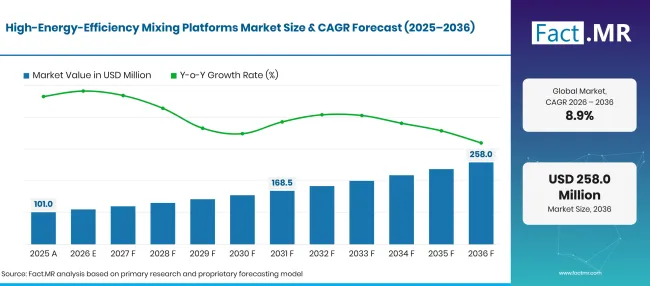
High Energy Efficiency Mixing Platforms Forecast Global | Source: Fact.MR
Category
| Category | Segments |
|---|---|
| Product Type | Energy-recovery mixer, Continuous twin-shaft mixer, High-shear batch mixer, Variable-speed intelligent mixer, Hybrid low-energy mixer |
| Operating Mode | Batch, Semi-continuous, Turnkey integrated, Modular inline, Continuous |
| Capacity Tier | Custom high-capacity, High throughput, Pilot and laboratory, Medium throughput, Small commercial |
| Customer Industry | Chemicals, Food and beverage, Other industrial, General manufacturing, Pharmaceutical |
| Region | United Kingdom; United States; Italy; Germany; Japan |
Source: Fact.MR analysis. Updated Nov 24, 2026
Segmental Analysis
Why do energy-recovery mixers lead product demand in the High-Energy-Efficiency Mixing Platforms Market?
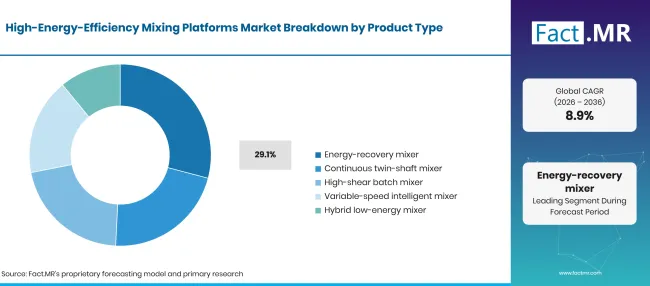
High Energy Efficiency Mixing Platforms Breakdown Product Type | Source: Fact.MR
Energy-recovery mixers account for 29.1% of revenue in 2026, approximately USD 32.0 million. Energy recovery can involve regenerative drive arrangements or the capture of recoverable heat in supporting processes. GEA’s Symrise mixing plant project, announced in November 2025, includes heat recovery from clean-in-place return flows. The attainable savings depend on each installation’s operating profile and system boundaries.
How is batch operation leading demand in the High-Energy-Efficiency Mixing Platforms Market?
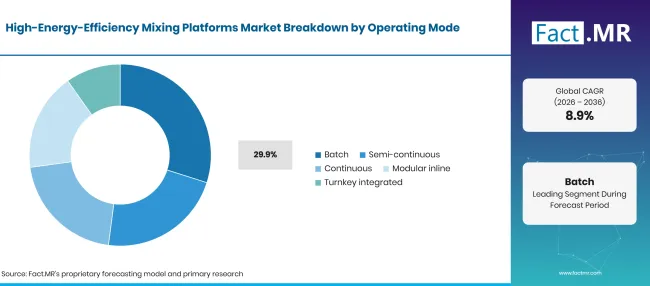
High Energy Efficiency Mixing Platforms Breakdown Operating Mode | Source: Fact.MR
Batch operation represents 29.9% of revenue in 2026, valued at approximately USD 32.9 million, reflecting the need for controlled production across food, chemical and pharmaceutical facilities. Monitoring torque, temperature and power consumption helps operators identify suitable mixing endpoints. Automated controls can prevent unnecessary processing once quality requirements are achieved. Manufacturers are improving recipe management and batch-level energy monitoring.
Why does custom high-capacity equipment lead demand in the High-Energy-Efficiency Mixing Platforms Market?
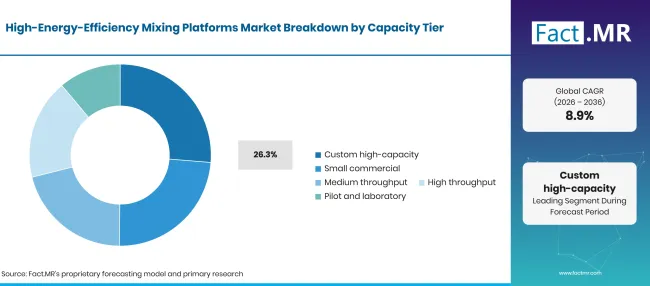
High Energy Efficiency Mixing Platforms Breakdown Capacity Tier | Source: Fact.MR
Custom high-capacity mixers hold 26.3% of revenue in 2026, equivalent to approximately USD 28.9 million, as large industrial installations require equipment matched to specific material properties and production volumes. Manufacturers adjust agitator geometry, motor ratings and vessel design to control energy consumption. Efficient operation depends on mixing quality, batch duration and auxiliary equipment rather than installed power alone.
How is the chemicals industry leading customer demand in the High-Energy-Efficiency Mixing Platforms Market?
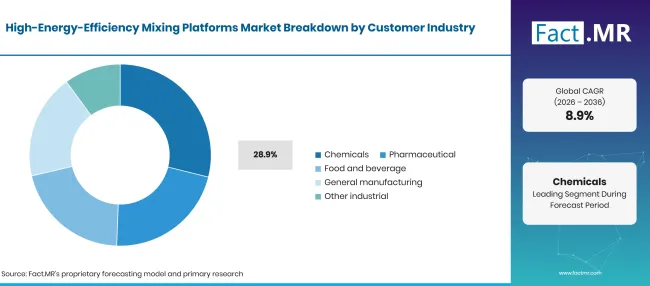
High Energy Efficiency Mixing Platforms Breakdown Customer Industry | Source: Fact.MR
Chemical manufacturers account for 28.9% of revenue in 2026, approximately USD 31.8 million. Adhesives, coatings and polymer compounds require equipment matched to viscosity, dispersion and thermal control requirements. High-torque mixers and compounding systems serve different material properties, with equipment selection determined by the processing method and required output. Buyers consider mixing performance, energy use and output quality.
High-Energy-Efficiency Mixing Platforms Market: Drivers, Restraints and Trends
Drivers
Processors are evaluating efficient motors, shorter mixing cycles and heat recovery to manage production costs. In November 2025, GEA announced a large-scale flavor mixing plant for Symrise with heat recovery for clean-in-place return flows. This project offers an application-specific example of reducing utility consumption in a mixing installation.
Restraints
High initial equipment costs, long replacement cycles and process validation requirements can limit upgrades. Energy savings vary with recipe, batch size, throughput and operating schedule. Buyers compare measured electricity consumption and maintenance costs with the expense of replacing an established mixing line.
Trend
Intelligent Variable-Speed Mixing. Mixer suppliers are developing controlled-speed drives, recipe management and monitoring of torque, temperature and processing time. These functions can help operators maintain product quality while avoiding unnecessary mixing when validated process conditions are reached.
Trend
Continuous and Hybrid Low-Energy Processes. Continuous mixing arrangements can reduce repeated start-up and shutdown cycles in suitable applications. Equipment selection depends on consistent material feeding, residence time and product quality requirements. Plant operators assess the energy consumed per unit of finished output rather than relying on motor efficiency alone.
High-Energy-Efficiency Mixing Platforms Market: Country Analysis
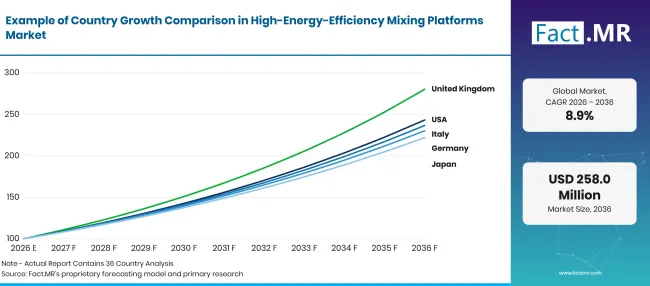
High Energy Efficiency Mixing Platforms Growth Index | Source: Fact.MR
| Country | CAGR (2026-2036) |
|---|---|
| United Kingdom | 10.9% |
| United States | 9.3% |
| Italy | 9.0% |
| Germany | 8.7% |
| Japan | 8.3% |
Source: Fact.MR analysis.
What is driving high-energy-efficiency mixing platforms demand in the United Kingdom?
Demand for high-energy-efficiency mixing platforms in the United Kingdom is projected to increase at a 10.9% CAGR through 2036, the fastest among the five countries.
Industrial food and chemical plants can examine variable-speed mixers, improved agitator designs and automated process monitoring when replacing older systems. UK food machinery suppliers, including Baker Perkins, provide mixing and processing equipment. Purchase decisions depend on product quality, throughput and documented operating costs.
How is food machinery demand supporting high-energy-efficiency mixing platforms sales in the United States?
Sales of high-energy-efficiency mixing platforms in the United States are projected to grow at a 9.3% CAGR through 2036.
Food and chemical processors can upgrade mixing equipment to reduce processing time and improve consistency. Equipment suppliers offer high-shear mixers, controlled drives and monitoring systems for different production requirements. Selection depends on measured energy consumption, cleaning time and total operating costs.
What is shaping high-energy-efficiency mixing platforms demand in Italy?
Demand for high-energy-efficiency mixing platforms in Italy is projected to rise at a 9.0% CAGR through 2036.
Food, bakery and chemical manufacturers may consider mixing upgrades as part of plant modernization. UCIMU reported that total machine-tool orders increased 10.5% in the third quarter of 2026, although domestic orders declined. These figures describe wider machinery investment and do not measure mixer orders. Buyers will assess process requirements and equipment payback.
How are equipment makers shaping high-energy-efficiency mixing platforms sales in Germany?
Sales of high-energy-efficiency mixing platforms in Germany are forecast to grow at an 8.7% CAGR through 2036.
Düsseldorf-based GEA reported a 20.3% increase in third-quarter 2026 group order intake. Its BATCH FORMULA PRO high-shear mixer is designed to optimize mixing and processing time for liquid food applications. German manufacturers can compare mixing quality, utilities, cleaning requirements and maintenance needs when updating production lines.
Why is growth slower for high-energy-efficiency mixing platforms in Japan?
Demand for high-energy-efficiency mixing platforms in Japan is likely to increase at an 8.3% CAGR through 2036, the slowest among the five countries.
Established energy management practices and efficient industrial equipment may limit replacement opportunities based solely on electricity savings. Japan's machine tool orders increased by 42.5% in October 2026, indicating broader manufacturing investment rather than confirmed mixer purchases. Chemical and battery material processors remain potential customers for specialized mixing technology. Further investment will depend on process precision, equipment reliability and measurable operating cost reductions.
Competitive Landscape for High-Energy-Efficiency Mixing Platforms Market
Mixing platform suppliers compete on processing time, product consistency and measurable energy consumption. GEA supplies BATCH FORMULA high-shear mixers for liquid food applications, including systems designed to shorten process cycles and optimize cleaning. Bühler offers industrial mixing and kneading systems. Coperion provides twin-screw compounding and mixing technologies for polymers, while Clextral supplies twin-screw extrusion equipment with integrated mixing functions. Wenger Manufacturing and Baker Perkins serve food-processing applications. The suppliers address different production requirements, from liquid food mixing to high-viscosity material processing.
GEA’s BATCH FORMULA PRO high-shear mixer offers an example of equipment designed to optimize process time and operating efficiency. Separately, the large-scale mixing plant GEA announced for Symrise in November 2025 includes heat recovery in its cleaning system. Coperion’s ZSK and STS twin-screw systems, presented at K 2025, address polymer compounding and extrusion rather than stand-alone industrial mixers. Suppliers will compete on documented process performance, maintenance and energy use.
Recent Developments
- In November 2025, GEA announced a large-scale flavor mixing plant for Symrise at Holzminden, Germany. The plant design includes heat recovery for clean-in-place return flows, water-efficient cleaning and controlled processing of liquid flavors. Commissioning was planned for spring 2026.
Key Players in High-Energy-Efficiency Mixing Platforms Market
Key companies operating in the market include Bühler, GEA, Coperion, Clextral, Wenger Manufacturing, and Baker Perkins.
- Bühler
- GEA
- Coperion
- Clextral
- Wenger Manufacturing
- Baker Perkins
Bibliography
- Bühler Group. (2026, May 7). Bühler launches innovations and releases major upgrades to its Grains & Food portfolio.
- Evonik Industries AG. (2026, November 3). Quarterly Statement Q3 2026.
- Food Engineering. (2026, October 13). The state of food manufacturing in 2026.
- GEA. (2025, November 18). GEA builds new large-scale mixing plant for flavor production at Symrise.
- GEA Group Aktiengesellschaft. (2026, November). Quarterly statement Q3 2026.
- Siemens AG. (2026, November 12). Outstanding fiscal 2026 performance – Industrial AI to drive future growth.
- UCIMU-SISTEMI PER PRODURRE. (2026, October 13). UCIMU: Order index in the third quarter of 2026 on the rise (+10.5%); foreign orders (+24.7%); domestic orders (-7.1%).
- International Federation of Robotics. (2026, September 24). Five million robots now operate in factories globally.
- Istat. (2026, November 11). Produzione industriale – Settembre 2026.
- Bühler Group. (2026, May 6). Bühler ushers in a new era of extrusion systems with Nutrex 7 Series.
- GEA. (2026, November). GEA delivers strong third quarter: Order intake rises substantially.
- GEA. (2025). GEA BATCH FORMULA PRO high shear mixer.
- Coperion. (2025). Coperion at K 2025: ZSK and STS twin-screw extruders.
Segmentation
Scope of Report
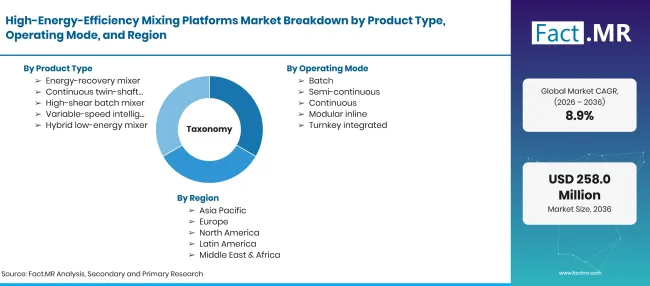
High Energy Efficiency Mixing Platforms Taxonomy | Source: Fact.MR
| Items | Values |
|---|---|
| Quantitative Units | USD million |
| Product Type | Energy-recovery mixer, Continuous twin-shaft mixer, High-shear batch mixer, Variable-speed intelligent mixer, Hybrid low-energy mixer |
| Operating Mode | Batch, Semi-continuous, Turnkey integrated, Modular inline, Continuous |
| Capacity Tier | Custom high-capacity, High throughput, Pilot and laboratory, Medium throughput, Small commercial |
| Customer Industry | Chemicals, Food and beverage, Other industrial, General manufacturing, Pharmaceutical |
| Regions Covered | North America, Latin America, Europe, East Asia, South Asia and Pacific, Middle East & Africa |
| Countries Covered | United Kingdom, United States, Italy, Germany, Japan, and other countries |
| Key Companies Profiled | Bühler, GEA, Coperion, Clextral, Wenger Manufacturing, Baker Perkins |
| Additional Attributes | Dollar revenue in the High-Energy-Efficiency Mixing Platforms Market is segmented by product type (energy-recovery, continuous twin-shaft, high-shear batch, variable-speed intelligent, hybrid low-energy mixer), operating mode, capacity tier, customer industry and region. |
Source: Fact.MR analysis. Updated Nov 24, 2026
High-Energy-Efficiency Mixing Platforms Market by Segments
-
Product Type
- Energy-recovery mixer
- Continuous twin-shaft mixer
- High-shear batch mixer
- Variable-speed intelligent mixer
- Hybrid low-energy mixer
-
Operating Mode
- Batch
- Semi-continuous
- Turnkey integrated
- Modular inline
- Continuous
-
Capacity Tier
- Custom high-capacity
- High throughput
- Pilot and laboratory
- Medium throughput
- Small commercial
-
Customer Industry
- Chemicals
- Food and beverage
- Other industrial
- General manufacturing
- Pharmaceutical
-
Region:
- North America
- United States
- Canada
- Mexico
- Europe
- Germany
- United Kingdom
- France
- Italy
- Spain
- Rest of Europe
- Asia Pacific
- China
- India
- Japan
- South Korea
- Australia
- Rest of Asia Pacific
- Latin America
- Brazil
- Argentina
- Rest of Latin America
- Middle East & Africa
- GCC Countries
- South Africa
- Rest of Middle East & Africa
- North America
Table of Contents
Key Takeaways
- Market Size and CAGR
- Top Growth Driver
- Fastest Growing Segment
- Leading Region
- Key Companies
- Emerging Opportunities

