
- Market Value (2025): USD 281.2 Mn
- Estimated Value (2026): USD 300.0 Mn
- Forecast Value (2036): USD 573.8 Mn
- CAGR (2026-2036): 6.7%
Raised-Frame Extrusion Systems Market Forecast and Outlook 2026 to 2036
Fact.MR studies the raised-frame extrusion systems market crossed the valuation of USD 281.2 million in 2025 and is projected to grow from USD 300.0 million in 2026 to USD 573.8 million by 2036. Demand for raised-frame extrusion systems is likely to grow at a CAGR of 6.7% over the forecast period.
Demand for raised-frame extrusion systems is rising as processors want extruders mounted on open, elevated frames so floors underneath can be washed and inspected. Raised frames remove hidden spaces where product and water collect, a common audit finding. For example, the EU Machinery Regulation (EU) 2023/1230, applying from January 2027, adds design requirements for safe access and maintenance on food machinery. Similar design rules are projected to drive sales of raised-frame extrusion systems through 2036.
Key Takeaways from the Raised-Frame Extrusion Systems Market
- Raised-Frame Extrusion Systems Market Value (2025): USD 281.2 million
- Raised-Frame Extrusion Systems Market Value (2026): USD 300.0 million
- Raised-Frame Extrusion Systems Market Forecast Value (2036): USD 573.8 million
- Raised-Frame Extrusion Systems Market Forecast CAGR (2026-2036): 6.7%
- Leading Raised-frame layout: Open underframe (42.2%)
- Key Market Participants: GEA, JBT Marel, Heat and Control, Bühler, Baker Perkins, tna solutions
- Key Growth Regions: India, United States, China, Italy, Germany
Food safety auditors under schemes such as BRCGS and IFS increasingly cite poor cleaning access beneath equipment. Demand for raised-frame extrusion systems is growing as processors rebuild lines with open frames. Suppliers are offering stainless frames with sloped surfaces. Similar audit findings are projected to drive sales across food and pet food plants.
Raised-Frame Extrusion Systems Market
| Metric | Value |
|---|---|
| Estimated Value in (2026) | USD 300.0 million |
| Forecast Value in (2036) | USD 573.8 million |
| Forecast CAGR (2026 to 2036) | 6.7% |
Source: Fact.MR analysis.
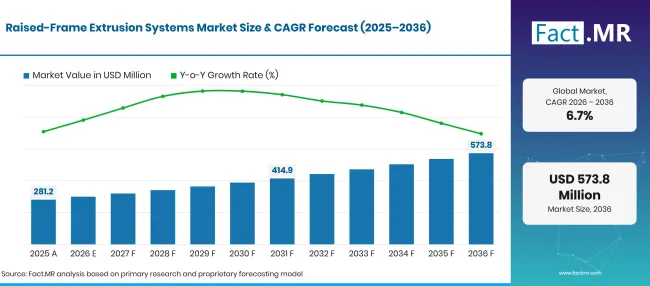
Raised Frame Extrusion Systems Forecast Global | Source: Fact.MR
Category
| Category | Segments |
|---|---|
| Raised-frame layout | Open underframe, Cantilever frame, Elevated modular skid, Mobile raised frame, High-clearance sanitary |
| Processing scale | Pilot / lab, Small commercial, Mid-scale, High-throughput, Ultra-high-throughput |
| Operating configuration | Batch, Semi-continuous, Continuous, Modular skid, Integrated line |
| Food / process application | Bakery / wafers, Confectionery / cocoa, Snacks / seasoning, Brewing / grains, Other food / industrial |
| Region | India; United States; China; Italy; Germany |
Source: Fact.MR analysis.
Segmental Analysis
What is driving demand for open underframe designs in raised-frame extrusion systems?
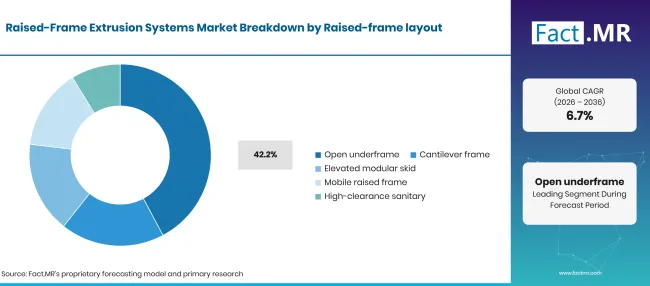
Raised Frame Extrusion Systems Breakdown Raised Frame Layout | Source: Fact.MR
Demand for Open underframe designs account for 42.2% of market revenue in 2026, equivalent to USD 125 million, as food processors prioritize equipment accessibility, floor hygiene and easier inspection beneath production machinery. India's Food Safety and Standards Authority of India (FSSAI), in its March 2026 update, reported that more than 56,000 risk-based inspections had been conducted over three years, alongside expanded food-testing infrastructure. Greater regulatory oversight encourages processors to invest in machinery that simplifies cleaning and sanitation checks. Open-frame extrusion systems therefore offer practical advantages for facilities handling multiple food ingredients and frequent production changeovers.
Which production requirements are increasing sales of high-throughput raised-frame extrusion systems?
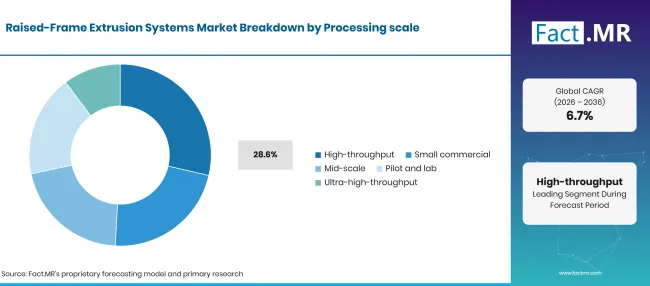
Raised Frame Extrusion Systems Breakdown Processing Scale | Source: Fact.MR
Sales of the high-throughput raised-frame extrusion systems represents 28.6% of market revenue in 2026, about USD 85.8 million, as large snack, cereal and pet-food manufacturers require accessible machinery that supports intensive production schedules and routine sanitation. India's Ministry of Food Processing Industries reported in June 2026 that investments under the PLI scheme had generated 34 lakh metric tonnes per annum of additional processing capacity. Sales of supported products reached ₹1,08,854 crore in FY 2025–26. Expanding industrial capacity creates opportunities for high-volume extrusion installations with open underframes that facilitate maintenance and cleaning access.
How are cleaning requirements influencing semi-continuous raised-frame extrusion system demand?
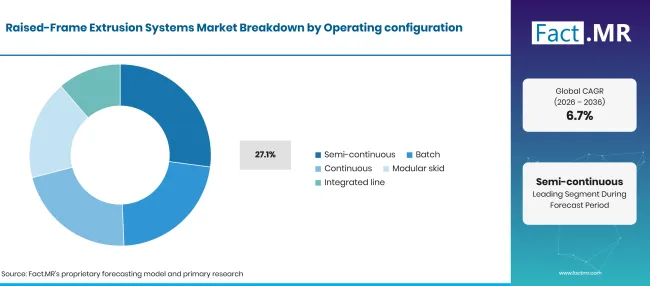
Raised Frame Extrusion Systems Breakdown Operating Configuration | Source: Fact.MR
Demand for Semi-continuous operation accounts for 27.1% of market revenue in 2026, reaching USD 81.3 million, as processors need equipment that accommodates scheduled cleaning, product changeovers and intermittent production stoppages. The U.S. Food and Drug Administration's 2026 Inspection Operations Manual emphasizes that food-processing machinery must be cleaned frequently enough to prevent contamination and allergen cross-contact. It also directs inspectors to examine the sanitary condition of production equipment and cleaning procedures. These requirements support purchasing interest in raised-frame systems that provide easier access beneath machinery and simplify routine maintenance.
What is expanding demand for raised-frame extrusion systems across other food and industrial applications?
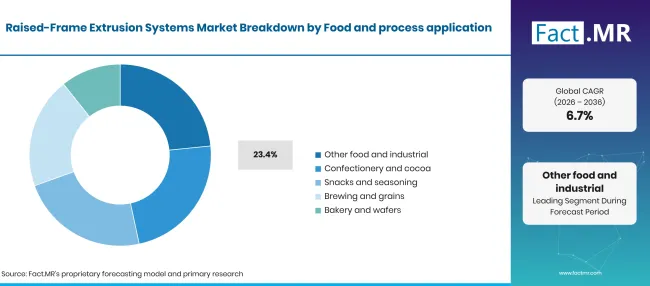
Raised Frame Extrusion Systems Breakdown Food And Process Application | Source: Fact.MR
Other food and industrial applications account for 23.4% of market revenue in 2026, about USD 70.2 million, covering pet food, aquafeed and specialty protein production. India's Department of Biotechnology, through BIRAC's 2026 India Bioeconomy Report, valued the animal nutrition industry at USD 23.04 billion in 2025, compared with USD 20.50 billion in 2024. Aquaculture nutrition increased from USD 6.89 billion to USD 8.61 billion during the same period. Expanding animal nutrition activity creates opportunities for extrusion equipment suppliers serving feed processors that require accessible machinery for cleaning, inspection and maintenance.
Raised-Frame Extrusion Systems Market-Drivers, Restraints & Trends
Drivers: Pet Food Contamination and Hygienic Equipment Design
Demand for raised-frame extrusion systems is supported by increasing regulatory attention to contamination prevention in pet-food manufacturing. In January 2026, the U.S. Food and Drug Administration reported that eight tested samples of Raaw Energy dog food contained one or more harmful bacteria, including Salmonella, Listeria monocytogenes and Campylobacter jejuni. By May 2026, the FDA reported that more than 180 product lots had been included in the expanded recall. The agency also identified Salmonella in specific tested samples. These developments highlight the importance of equipment that facilitates inspection, cleaning and sanitation around processing areas. Manufacturers are therefore encouraged to consider open-frame extrusion designs that improve accessibility for hygiene operations.
Restraints: Retrofit Costs, Downtime and Existing Production Lines
Demand for raised-frame extrusion systems can be constrained by the operational disruption involved in modifying existing production lines. Replacing conventional machine frames may require equipment relocation, structural modifications, floor preparation and production stoppages. India's Food Safety and Standards Authority of India reported 26,267 risk-based food-safety inspections in FY 2024–25, compared with 11,904 in FY 2022–23, in a government disclosure published on March 13, 2026. This represents an increase of approximately 120.6% over the two-year period. Consequently, staged frame replacements and modular hygienic upgrades can be presented as potential ways to reduce disruption for existing processors.
Opportunity: Hygienic Zoning and High-Care Processing Areas
Demand for extrusion equipment designed for hygienic zoning is supported by regulatory requirements to prevent cross-contamination during animal-food production. The U.S. FDA's official guidance on hazard analysis and preventive controls specifically identifies hygienic zoning as particularly relevant to pet-food manufacturing, where Salmonella and Listeria can contaminate products exposed to the processing environment before packaging. The guidance recommends considering equipment layout, ingredient movement, personnel traffic and cross-over areas when designing hygiene zones. Furthermore, FDA regulations require animal-food equipment to be adequately cleanable and installed to facilitate cleaning and maintenance of adjacent spaces. These requirements create opportunities for raised-frame extruders that improve access beneath machinery and support separation between processing and cleaning areas.
Trend: Stainless-Steel Open Frames
Demand for stainless-steel equipment components is supported by increasing consumption of stainless steel across industrial applications. According to India's Ministry of Steel, domestic stainless-steel consumption reached 2.64 million tonnes during April–September 2026, increasing 17.4% compared with 2.25 million tonnes in the corresponding period of 2025. Monthly consumption reached 465,000 tonnes in September 2026, registering 16.8% year-over-year growth. Stainless-steel imports also increased 114.2% during April–September 2026, indicating stronger domestic absorption alongside lower domestic production.
Raised-Frame Extrusion Systems Market by Analysis by Key Country
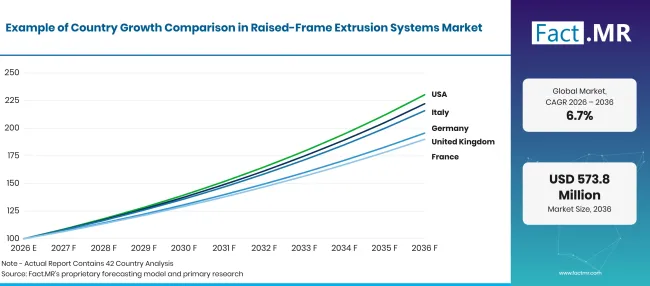
Raised Frame Extrusion Systems Growth Index | Source: Fact.MR
| Country | CAGR (2026-2036) |
|---|---|
| India | 9.0% |
| United States | 8.7% |
| China | 8.3% |
| Italy | 8.2% |
| Germany | 8.0% |
Source: Fact.MR analysis.
What is accelerating demand for raised-frame extrusion systems in India?
Demand in India is projected to grow at a 9.0% CAGR, the fastest among the five key countries, as new snack and pet food plants are designed to export hygiene standards.
New food-processing investments and increasing emphasis on hygienic manufacturing environments in India is estimated to drive the market growth in the country. The Ministry of Food Processing Industries reported in July 2026 that investments under the PLI scheme had generated 34 lakh metric tonnes per annum of additional processing capacity. Sales of PLI-supported products reached ₹1,08,854 crore in FY 2025–26, compared with ₹58,758 crore in FY 2019–20. Expanding snack, cereal and animal-food processing facilities are creating opportunities for accessible extrusion equipment that simplifies cleaning and maintenance.
Which food safety requirements are influencing raised-frame extrusion system sales in the United States?
Sales in the United States are projected to grow at a 8.7% CAGR as FSMA and pet food safety rules push hygienic design.
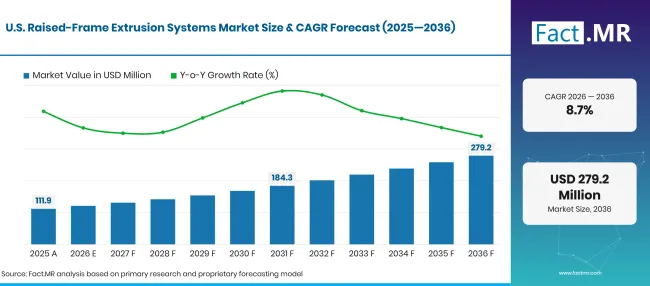
Raised Frame Extrusion Systems Forecast Usa | Source: Fact.MR
The FDA inspects pet food plants under FSMA preventive control rules, and Nestlé Purina has opened new US plants. The FDA's Food Safety Modernization Act requires covered animal-food facilities to implement hazard analysis and risk-based preventive controls. Separately, U.S. food manufacturing generated approximately USD 854.9 billion in sectoral output in 2025, according to Bureau of Labor Statistics data updated in June 2026. This substantial manufacturing base creates opportunities for extrusion equipment featuring accessible underframes, easier inspection and efficient sanitation procedures.
How is China's expanding food manufacturing capacity influencing raised-frame extrusion system demand?
Sales in China are forecast to grow at an 8.3% CAGR as snack and pet food plants expand, and pet food makers such as Gambol and Bridge PetCare build new factories.
Raised-frame designs help export plants pass hygiene audits. The National Bureau of Statistics of China reported that food manufacturing capacity utilization reached 70.8% in the third quarter of 2026, increasing 0.7 percentage points from a year earlier. Manufacturing capacity utilization overall stood at 73.3%. Although the figures indicate moderate rather than accelerating utilization, China's large food-processing base creates opportunities for equipment replacement and hygiene-focused modernization. Open-frame extrusion designs can simplify cleaning and inspection in facilities supplying domestic and export markets.
What is shaping raised-frame extrusion system demand in Italy?
Demand in Italy is projected to register an 8.2% CAGR as pasta and snack producers upgrade lines, and Italy remains one of the world's largest pasta exporters.
GEA's Pavan unit and Storci in Parma supply extrusion lines with open frames for washdown. Rising emphasis of food-processing modernization and its established pasta and snack manufacturing industry in Italy creates opportunity for the market growth. Istat reported in June 2026 that Italy's agri-food sector generated EUR 89 billion in value added during 2025, compared with EUR 83.4 billion in 2024. Production volumes across the food, beverage and tobacco manufacturing industries increased 1.4% in 2025. These developments support investment opportunities for extrusion equipment suppliers serving pasta, snack and specialty food producers, where accessible machinery structures can simplify cleaning, inspection and maintenance.
Why is raised-frame extrusion system growth slower in Germany?
Demand in Germany is forecast to record an 8.0% CAGR, the slowest among the five key countries, as many plants already use hygienic designs required by IFS audits and meat and snack output is flat.
Upgrades are linked to new plant-protein and pet food lines. Destatis reported that Germany's food and animal-feed manufacturing production index recorded a seasonally adjusted value of 96.8 in March 2026, against a 2021 base of 100. This indicates a relatively subdued production environment rather than broad-based expansion. Established food-processing facilities are also more likely to prioritize selective equipment replacement over entirely new installations. Demand opportunities remain in pet-food and plant-protein processing, where manufacturers require accessible equipment for cleaning and maintenance.
Competitive Landscape for Raised-Frame Extrusion Systems Market
The raised-frame extrusion systems market is characterized by competition among integrated food-processing equipment manufacturers and specialized extrusion technology suppliers. Bühler differentiates itself through its Nutrex 7 Series, which incorporates an elevated base frame, stainless-steel construction and improved ground clearance for cleaning access. Baker Perkins competes through its SBX Master twin-screw extruder, featuring stainless-steel open-frame construction and accessible components. Coperion strengthens competition with its ZSK food extruders, which offer hygienic open-frame designs and improved inspection access.
GEA and JBT Marel compete through extrusion equipment for snacks, cereals, pet food and aquafeed, emphasizing process flexibility, throughput and equipment reliability. TNA solutions participates in the broader snack-processing equipment market. Buyers increasingly evaluate equipment based on sanitation access, contamination prevention, frame durability, cleaning time and lifecycle costs. Growing emphasis on hygienic manufacturing is encouraging suppliers to develop accessible stainless-steel structures, simplified cleaning arrangements and equipment configurations that reduce production downtime.
Recent Developments
- The EU Machinery Regulation will apply from January 2027.
- In May 2026, Bühler launched its next-generation Nutrex 7 Series extrusion platform for cereals, snacks, pet food, meat alternatives and food ingredients. The new system incorporates an elevated base frame to increase ground clearance and improve access for cleaning equipment. Bühler also relocated the hydraulic box from the base frame to the side of the extruder to simplify sanitation. Additional developments include modular configurations, integrated digital controls and StepFlow automated startup and shutdown. Bühler reports that the improved cleaning design reduced cleaning times by approximately 50% at selected customer sites, while StepFlow can reduce production waste by up to 30% per run.
- On June 16, 2025, GEA introduced its Bake Extruder at IBA 2025 in Düsseldorf, Germany. The equipment was developed for medium- and large-scale biscuit manufacturers and supports wire-cut, co-extruded, filled, continuous-extruded and deposited product formats. Its design incorporates interchangeable dies, configurable filler blocks and servo-driven cutting mechanisms to improve production flexibility and operating precision. The system can operate as a standalone machine or integrate with downstream oven equipment.
- On April 15, 2026, JBT Marel announced the combined presentation of Wenger and Extru-Tech at Petfood Forum 2026. The showcase featured its recently launched Minimally Processed Pet Food Line, incorporating extrusion, high-pressure processing and integrated steam-tunnel technologies. A key component was Wenger's PetFlex twin-screw extruder, which allows processors to switch between conventional formulations and recipes containing higher fresh-meat inclusions using the same equipment. This development expands the company's offering for premium pet food and specialized nutrition.
Key Players in Raised-Frame Extrusion Systems Market
Key companies operating in the market include GEA, JBT Marel, Bühler, Baker Perkins, tna solutions, and Coperion.
- GEA
- JBT Marel
- Bühler
- Baker Perkins
- tna solutions
- Coperion
Bibliography
- Biotechnology Industry Research Assistance Council. (2026). India bioeconomy report 2026. Government of India.
- Bühler Group. (2026, May 6). Bühler ushers in a new era of extrusion systems with Nutrex 7 Series.
- GEA Group. (2025, June 16). GEA launches new high-speed Bake Extruder.
- JBT Marel Corporation. (2026, April 15). Wenger and Extru-Tech unite under JBT Marel at Petfood Forum 2026.
- National Bureau of Statistics of China. (2026, October 20). Industrial capacity utilization in the third quarter of 2026.
- Press Information Bureau. (2026). FSSAI food safety inspections and enforcement. Government of India.
- Press Information Bureau. (2026). Food processing infrastructure and PLI scheme. Government of India.
- Statistisches Bundesamt (Destatis). (2026). Food and animal feed manufacturing production index.
- Istituto Nazionale di Statistica. (2026, June). Conti economici dell'agricoltura – Anno 2025 [Economic accounts for agriculture – Year 2025].
- U.S. Food and Drug Administration. (2026). 2026 inspection operations manual: Chapter 5.
- U.S. Food and Drug Administration. (2026). FDA's regulation of pet food.
Segmentation
Scope of Report
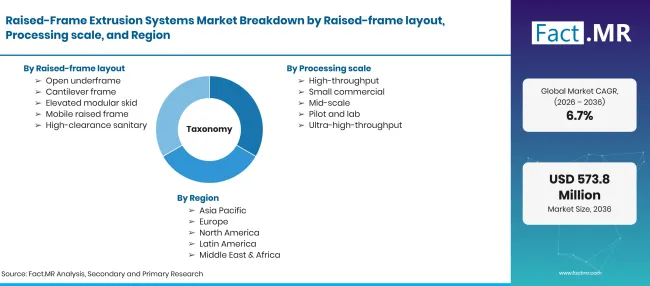
Raised Frame Extrusion Systems Taxonomy | Source: Fact.MR
| Items | Values |
|---|---|
| Quantitative Units (2026) | USD 300.0 Million |
| Raised-frame layout | Open underframe, Cantilever frame, Elevated modular skid, Mobile raised frame, High-clearance sanitary |
| Processing scale | Pilot / lab, Small commercial, Mid-scale, High-throughput, Ultra-high-throughput |
| Operating configuration | Batch, Semi-continuous, Continuous, Modular skid, Integrated line |
| Food / process application | Bakery / wafers, Confectionery / cocoa, Snacks / seasoning, Brewing / grains, Other food / industrial |
| Regions Covered | North America, Latin America, Europe, East Asia, South Asia and Pacific, Middle East & Africa |
| Countries Covered | India, United States, China, Italy, Germany, and other countries |
| Key Companies Profiled | GEA, JBT Marel, Heat and Control, Bühler, Baker Perkins, tna solutions |
| Additional Attributes | Dollar revenue in the Raised-Frame Extrusion Systems Market is segmented by raised-frame layout (open underframe, cantilever frame, elevated modular skid, mobile raised frame, high-clearance sanitary); processing scale (pilot / lab, small commercial, mid-scale, high-throughput, ultra-high-throughput); operating configuration (batch, semi-continuous, continuous, modular skid, integrated line); food / process application (bakery / wafers, confectionery / cocoa, snacks / seasoning, brewing / grains, other food / industrial) and region. |
Source: Fact.MR analysis.
Raised-Frame Extrusion Systems Market by Segments
-
Raised-frame layout
- Open underframe
- Cantilever frame
- Elevated modular skid
- Mobile raised frame
- High-clearance sanitary
-
Processing scale
- Pilot / lab
- Small commercial
- Mid-scale
- High-throughput
- Ultra-high-throughput
-
Operating configuration
- Batch
- Semi-continuous
- Continuous
- Modular skid
- Integrated line
-
Food / process application
- Bakery / wafers
- Confectionery / cocoa
- Snacks / seasoning
- Brewing / grains
- Other food / industrial
-
Region:
- North America
- United States
- Canada
- Mexico
- Europe
- Germany
- United Kingdom
- France
- Italy
- Spain
- Rest of Europe
- Asia Pacific
- China
- India
- Japan
- South Korea
- Australia
- Rest of Asia Pacific
- Latin America
- Brazil
- Mexico
- Argentina
- Rest of Latin America
- Middle East & Africa
- GCC Countries
- South Africa
- Rest of Middle East & Africa
- North America
Table of Contents
Key Takeaways
- Market Size and CAGR
- Top Growth Driver
- Fastest Growing Segment
- Leading Region
- Key Companies
- Emerging Opportunities

