- Market Value (2025): USD 2.4 Bn
- Estimated Value (2026): USD 2.8 Bn
- Forecast Value (2036): USD 10.9 Bn
- CAGR (2026-2036): 14.6%
What is the Digital Sustainability Twin Platform Market forecast to be worth by 2036?
USD 2.8 billion in 2026 to USD 10.9 billion by 2036 at 14.6% CAGR.
- The digital sustainability twin platform market reached USD 2.4 billion in 2025.
- Demand is projected to increase from USD 2.8 billion in 2026 to USD 10.9 billion by 2036.
- The market is forecast to record 14.6% CAGR from 2026 to 2036.
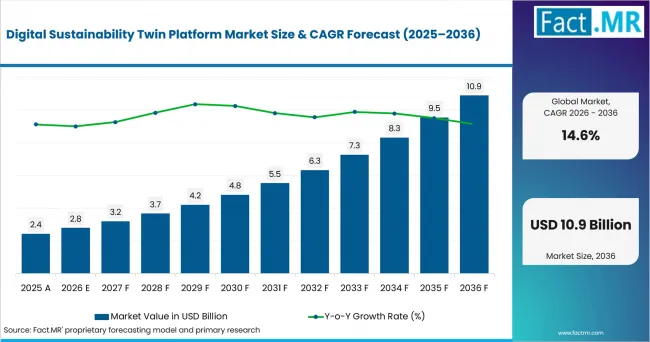
Digital Sustainability Twin Platform Market Value Analysis | Source: Fact.MR
What are the defining numbers behind Digital Sustainability Twin Platform Market growth?
USD 8.1 billion absolute opportunity by 2036, led by cloud-based digital twin and carbon footprint monitoring.
- Demand Drivers in the Market
- Digital sustainability twins help companies test operating changes before those changes affect plant performance or asset reliability.
- Carbon Footprint Monitoring remains central because buyers need one working view of emissions data and compliance evidence.
- Cloud-based deployment is expected to reduce setup friction for teams that manage several sites.
- Manufacturing users are expected to prioritize platforms that turn asset models into energy and reporting decisions.
- Key Segments Analyzed
- By Platform Type: Cloud-based Digital Twin is expected to hold 42.0% share in 2026 because multi-site users need scalable access and easier integration.
- By Sustainability Application: Carbon Footprint Monitoring is projected to account for 39.0% share in 2026 as emissions evidence becomes the first use case.
- By End-use Industry: Manufacturing is anticipated to capture 37.0% share in 2026 since factories need energy and process visibility.
- By Customer Category: Large Enterprises are estimated to represent 40.0% share in 2026 due to wider reporting duties and asset portfolios.
- By Digital Twin Technology: AI-enabled Digital Twin is forecast to hold 41.0% share in 2026 as users move from static models to predictive support.
- Analyst Opinion at Fact.MR
- Shambhu Nath Jha, Principal Consultant at Fact.MR, states, “Digital sustainability twin platform providers must prove use-case fit and data quality. Buyers are expected to reward suppliers that make value and reliability easy to verify.”
- Strategic Implications
- Platform vendors should explain the sustainability workflow they support before discussing broad digital capability.
- Suppliers can improve retention by simplifying implementation materials for engineering and finance teams.
- Implementation partners should align service packages around the leading segments and fastest conversion use cases.
The USA records the highest country CAGR at 15.8% by 2036. Germany follows at 15.2%. The UK is projected at 14.7%. Japan is forecast to expand at 14.1%. Canada is estimated at 13.6%, Singapore at 13.0% and South Korea at 12.5%.
How does the Digital Sustainability Twin Platform Market break down by segment?
Cloud-based Digital Twin leads Platform Type with 42.0% share in 2026. Carbon Footprint Monitoring leads with 39.0%.
Why does cloud-based digital twin lead platform type?
Cloud-based digital twin is projected to account for 42.0% share in 2026.
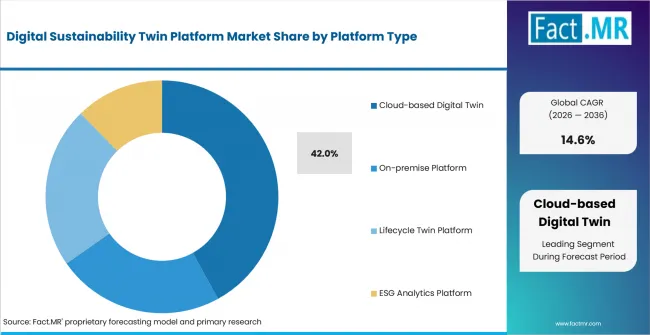
Digital Sustainability Twin Platform Market Analysis By Platform Type | Source: Fact.MR
Its lead comes from easier access across multiple sites, teams and external partners. Hosted deployment also lowers local infrastructure requirements and makes model expansion simpler as more assets are added.
Why does carbon footprint monitoring lead sustainability application?
Carbon footprint monitoring is expected to account for 39.0% share in 2026.
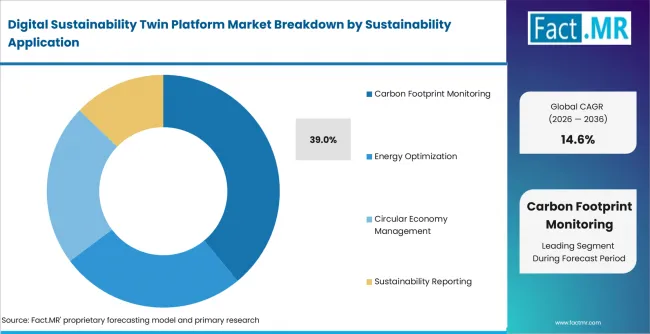
Digital Sustainability Twin Platform Market Analysis By Sustainability Application | Source: Fact.MR
Emissions visibility is often the starting point for sustainability programs. These platforms organize operating data into usable evidence for reporting, target setting and reduction planning.
Why does manufacturing lead end-use industry?
Manufacturing is anticipated to account for 37.0% share in 2026.
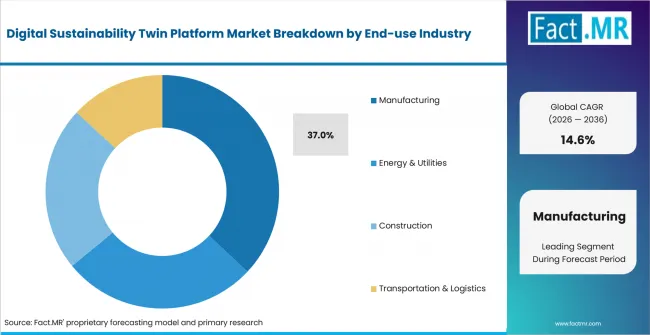
Digital Sustainability Twin Platform Market Analysis By End Use Industry | Source: Fact.MR
Factories benefit from testing energy, process and material-flow changes before altering live operations. Digital twins provide a safer way to compare scenarios while protecting output, asset performance and production continuity.
Why do large enterprises lead customer category?
Large enterprises are estimated to account for 40.0% share in 2026.
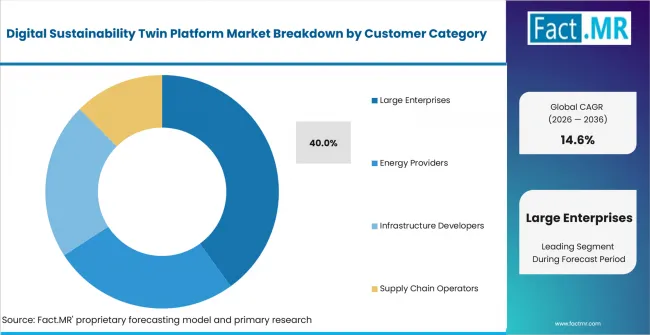
Digital Sustainability Twin Platform Market Analysis By Customer Category | Source: Fact.MR
Broader asset portfolios and reporting duties create stronger demand for consistent sustainability models. Centralized governance helps different business units work with the same assumptions, controls and evidence standards.
Why does AI-enabled digital twin lead digital twin technology?
AI-enabled digital twin is forecast to account for 41.0% share in 2026.
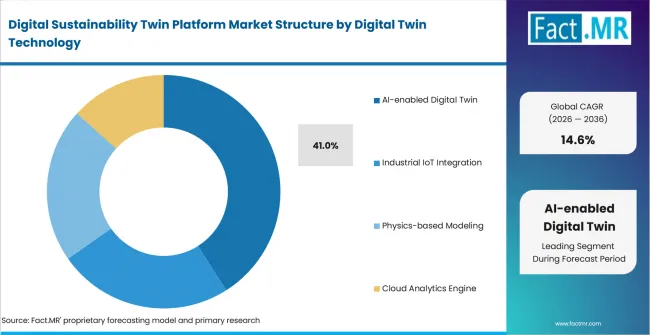
Digital Sustainability Twin Platform Market Analysis By Digital Twin Technology | Source: Fact.MR
Predictive capability gives this technology an advantage over static modeling. AI helps users compare maintenance, energy and operating decisions earlier, turning digital replicas into practical tools for day-to-day planning.
What is accelerating Digital Sustainability Twin Platform Market adoption, and what is holding it back?
Demand is expected to rise through sustainability reporting pressure and asset-level optimization. Growth is likely to be limited by integration cost, model quality and proof of compliance value.
Drivers Impact Analysis
| DRIVER | (~) % IMPACT ON CAGR | GEOGRAPHIC RELEVANCE | IMPACT TIMELINE |
|---|---|---|---|
| Adoption and integration | +1.6% | Global | Short term (<= 2 years) |
| Regulatory and compliance support | +1.4% | USA, Germany, UK | Short term (<= 2 years) |
| Channel and access expansion | +1.1% | Global | Medium term (2-4 years) |
| Clear specification and documentation | +0.9% | USA, UK, Canada | Medium term (2-4 years) |
| Cost and efficiency improvement | +0.6% | Global | Long term (>= 4 years) |
Source: Fact.MR analysis. Updated Aug 7, 2026
- Adoption and integration: Platforms are expected to perform better where operations teams and sustainability teams need the same asset view.
- Regulatory and compliance support: Buyers in the USA and Europe are expected to value workflows that make reporting evidence easier to review.
- Clear specification and documentation: Suppliers that explain model inputs and workflow ownership are expected to shorten procurement review.
Opportunity Impact Analysis
| OPPORTUNITY | (~) % IMPACT ON CAGR | GEOGRAPHIC RELEVANCE | IMPACT TIMELINE |
|---|---|---|---|
| Emerging application expansion | +1.0% | Global | Medium term (2-4 years) |
| Premium and specialist positioning | +0.8% | USA, UK, Germany | Medium term (2-4 years) |
| Channel and partner expansion | +0.7% | Global | Long term (>= 4 years) |
| Standards and compliance alignment | +0.5% | USA, Canada, Singapore | Long term (>= 4 years) |
Source: Fact.MR analysis. Updated Aug 7, 2026
- Emerging application expansion: Recycling plant operations are expected to create room for sustainability twin modules built around material recovery.
- Premium and specialist positioning: Vendors that prove fit for plants and infrastructure are expected to earn stronger enterprise attention.
- Channel and partner expansion: Implementation partners can help users combine twin models with reporting and asset management workflows.
Restraints Impact Analysis
| RESTRAINT | (~) % IMPACT ON CAGR | GEOGRAPHIC RELEVANCE | IMPACT TIMELINE |
|---|---|---|---|
| Cost and complexity | -1.1% | Global | Short term (<= 2 years) |
| Specification and compliance checks | -0.9% | USA, UK, Germany | Short term (<= 2 years) |
| Substitution by lower-cost alternatives | -0.7% | Import-dependent markets | Medium term (2-4 years) |
| Supply chain and pricing pressure | -0.5% | Global | Long term (>= 4 years) |
Source: Fact.MR analysis. Updated Aug 7, 2026
- Cost and complexity: Users are likely to delay purchases when integration work requires new data pipelines and model governance.
- Specification and compliance checks: Procurement teams are expected to test whether platform outputs are reliable enough for audit decisions.
- Substitution by lower-cost alternatives: Basic dashboards are likely to hold smaller accounts when buyers do not need operational modeling.
Which countries are scaling the Digital Sustainability Twin Platform Market fastest?
- The country comparison spans 3.3 percentage points and forms three growth bands.
- The USA remains 0.6 percentage point above Germany through enterprise platform depth and software adoption.
- Germany remains 0.5 percentage point above the UK as industrial engineering supports asset-level sustainability modeling.
- The UK remains 0.6 percentage point above Japan through service-led implementation and compliance workflows.
- Japan remains 0.5 percentage point above Canada because advanced manufacturers value operational precision.
- Canada remains 0.6 percentage point above Singapore through enterprise and infrastructure demand.
- Singapore remains 0.5 percentage point above South Korea due to its role in regional implementation services.
Comparable CAGRs can create different entry conditions due to customer scale and reporting workflows. Full report coverage includes North America; Latin America; Europe; East Asia; South Asia and Pacific; Middle East and Africa.
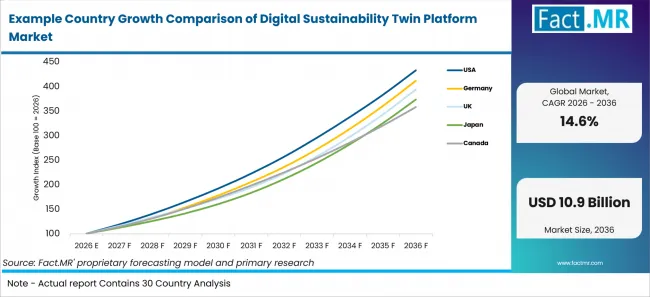
Example Country Growth Comparison Of Digital Sustainability Twin Platform Market | Source: Fact.MR
| Country | CAGR (2026-2036) |
|---|---|
| USA | 15.8% |
| Germany | 15.2% |
| UK | 14.7% |
| Japan | 14.1% |
| Canada | 13.6% |
| Singapore | 13.0% |
| South Korea | 12.5% |
Source: Fact.MR analysis. Updated Aug 7, 2026
What supports USA adoption?
15.8% CAGR, supported by enterprise platform depth and stronger sustainability software adoption.
The USA’s growth reflects large organizations that need one model for operations and reporting. Buyers are expected to favor scalable platforms that work with cloud systems.
How is Germany scaling demand?
15.2% CAGR, backed by industrial engineering strength and asset-level sustainability modeling.
Germany’s market is shaped by manufacturing users that need measurable energy and process visibility. Suppliers perform better when models help teams compare operating choices before plant changes.
What is driving UK growth from 2026 to 2036?
14.7% CAGR, supported by compliance workflows and service-led implementation.
The UK’s growth comes from buyers that need shared sustainability evidence. Service partners are expected to help users organize data and manage model updates.
How does Japan develop demand?
14.1% CAGR, led by advanced manufacturing users and energy-efficiency priorities.
Japan’s outlook reflects demand from users that operate complex assets. Buyers are expected to test energy scenarios before process changes are approved.
What supports Canada growth?
13.6% CAGR, supported by enterprise and infrastructure demand.
Canada’s growth reflects distributed assets and the need for consistent sustainability evidence. Adoption is expected to depend on implementation support.
How is Singapore scaling adoption?
13.0% CAGR, backed by digital infrastructure and regional implementation services.
Singapore’s growth reflects enterprises that use the country as a digital hub. Buyers are expected to favor fast deployment.
What supports South Korea demand?
12.5% CAGR, supported by industrial digitalization and manufacturing-based sustainability planning.
South Korea’s demand is shaped by manufacturing and technology users that need asset and energy visibility. Suppliers that turn models into plant decisions are expected to hold a clearer position.
Who leads the Digital Sustainability Twin Platform Market?
Siemens and Dassault Systèmes anchor the market through industrial modeling and virtual-twin platforms, while Schneider Electric–AVEVA connects sustainability planning with energy and operational data.
PTC and Bentley Systems add lifecycle, infrastructure and asset-management capabilities. Ansys strengthens simulation depth, and Hexagon supports spatial and industrial intelligence. Microsoft and IBM broaden deployment through cloud, AI and enterprise integration, helping customers link digital replicas with emissions monitoring, efficiency analysis and integrated reporting workflows.
Which companies are the key providers?
Key companies include Siemens AG; Dassault Systèmes SE; Schneider Electric SE – AVEVA; PTC Inc.; Bentley Systems, Incorporated; Synopsys, Inc. – Ansys; Hexagon AB; Microsoft Corporation; and IBM Corporation.
- Siemens AG
- Dassault Systèmes SE
- Schneider Electric SE – AVEVA
- PTC Inc.
- Bentley Systems, Incorporated
- Synopsys, Inc. – Ansys
- Hexagon AB
- Microsoft Corporation
- IBM Corporation
Bibliography
- Ansys. (2025, August 12). Ansys Announces Agreement to Offer Access to NVIDIA Omniverse Technology from within Simulation Solutions.
- AVEVA. (2026, June 24). AVEVA, Schneider Electric and Heriot-Watt University to Explore Digital Twin Technologies for Net Zero Energy and Transport Infrastructure.
- Bentley Systems, Incorporated. (2025, November 3). Bentley Systems and EARTHBRAIN Form Strategic Partnership to Advance Smart Construction.
- Dassault Systèmes. (2025, September 18). Grundfos Chooses Dassault Systèmes’ 3DEXPERIENCE Platform on the Cloud for Its Sustainable Business Transformation.
- Hexagon AB. (2026, April 15). Hexagon’s Green Cubes digital twin technology contributes to mining reclamation efforts across South America with Vale.
This Report Answers
- The report provides strategic intelligence on the Digital Sustainability Twin Platform Market across Platform Type and Application choices.
- Segment analysis covers Cloud-based Digital Twin and Carbon Footprint Monitoring as the 2026 share leaders.
- Country outlook evaluates the USA and Germany alongside the UK and Japan. Canada, Singapore and South Korea complete the growth comparison.
- Competitive analysis profiles Siemens AG and Dassault Systèmes SE. Schneider Electric SE – AVEVA completes the first group. PTC Inc.; Bentley Systems; Ansys; Hexagon; Microsoft; and IBM complete the provider set.
- Technology assessment covers AI-enabled Digital Twin and Industrial IoT Integration. Physics-based Modeling and Cloud Analytics Engine complete the technology view.
What does the Digital Sustainability Twin Platform Market cover?
Digital sustainability twin platforms model how assets affect emissions, energy use and resource efficiency. The market includes platforms sold for sustainability planning and evidence-ready reporting.
The market covers software used across assessed platform types and applications. Coverage includes carbon monitoring and energy optimization. Circular economy management and sustainability reporting are included.
What is included in the scope?
Digital sustainability twin platforms are assessed across cloud-based and on-premise deployment models. Lifecycle twin platforms and ESG analytics platforms are included when they support modeled outcomes.
The scope includes Platform Type and Sustainability Application alongside End-use Industry, Customer Category and Digital Twin Technology. Coverage spans industries where platforms test operating scenarios.
What is excluded from the scope?
General dashboards, consulting-only sustainability services and unrelated enterprise software remain outside the scope of this market.
The scope excludes tools that do not create or manage digital twins for sustainability use cases. Standalone reporting templates and basic carbon calculators are excluded. Consulting-only services are excluded when no platform is sold.
How Was the Analysis Built?
The analysis draws on 120+ sources, 35+ company portfolios, 25+ countries, and more than 20 industry interviews.
- Primary Research: Primary research includes discussions with manufacturers, service providers, technology developers, distributors, end users, procurement teams, and subject-matter experts. These conversations examine purchasing priorities, product adoption, operational challenges, approval requirements, competitive positioning, and the factors that influence wider market acceptance.
- Desk Research: Desk research covers government statistics, regulatory publications, company filings, trade data, technical studies, industry associations, standards, public policy, and other authoritative sources. Every source used in the analysis is documented in the bibliography.
- Market Sizing and Forecasting: Market estimates combine historical performance, demand indicators, pricing and volume trends, segment shares, company participation, country-level growth, adoption patterns, investment activity, and barriers to market expansion.
- Data Validation and Update Cycle: Findings are validated by comparing primary interviews with public data, company activity, regulatory changes, trade patterns, and industry developments. Regular updates review new product launches, capacity changes, partnerships, approvals, procurement trends, and shifts in commercial adoption.
Segmentation
What is the report’s scope and coverage?
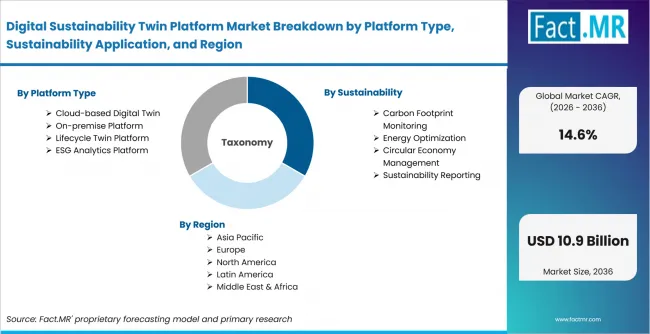
Digital Sustainability Twin Platform Market Breakdown By Platform Type, Sustainability Application, And Region | Source: Fact.MR
| Attribute | Details |
|---|---|
| Quantitative Units | USD billion |
| Market Definition | Software platforms that create sustainability twins of assets and facilities to model emissions, energy use, resource efficiency and operating scenarios |
| Platform Type | Cloud-based Digital Twin; On-premise Platform; Lifecycle Twin Platform; ESG Analytics Platform |
| Sustainability Application | Carbon Footprint Monitoring; Energy Optimization; Circular Economy Management; Sustainability Reporting |
| End-use Industry | Manufacturing; Energy & Utilities; Construction; Transportation & Logistics |
| Customer Category | Large Enterprises; Energy Providers; Infrastructure Developers; Supply Chain Operators |
| Digital Twin Technology | AI-enabled Digital Twin; Industrial IoT Integration; Physics-based Modeling; Cloud Analytics Engine |
| Regions Covered | North America; Latin America; Europe; East Asia; South Asia and Pacific; Middle East and Africa |
| Countries Covered | USA; Germany; UK; Japan; Canada; Singapore; South Korea |
| Key Companies Profiled | Siemens AG; Dassault Systèmes SE; Schneider Electric SE – AVEVA; PTC Inc.; Bentley Systems, Incorporated; Synopsys, Inc. – Ansys; Hexagon AB; Microsoft Corporation; IBM Corporation |
| Forecast Period | 2026 to 2036 |
| Approach | Hybrid top-down and bottom-up approach using platform adoption, sustainability application demand, country growth and company portfolio review |
Source: Fact.MR analysis. Updated Aug 7, 2026
How is the market segmented?
-
By Platform Type
- Cloud-based Digital Twin
- Multi-site Twin Platform
- Hybrid Twin Platform
- On-premise Platform
- Private Enterprise Platform
- Edge-enabled Platform
- Lifecycle Twin Platform
- Product Lifecycle Twin
- Asset Lifecycle Twin
- ESG Analytics Platform
- Regulatory Compliance Analytics
- Scenario Modeling Analytics
- Cloud-based Digital Twin
-
By Sustainability Application
- Carbon Footprint Monitoring
- Scope 1 & 2 Emissions
- Scope 3 Emissions
- Energy Optimization
- Renewable Energy Planning
- Grid Efficiency Analysis
- Circular Economy Management
- Waste Reduction
- Material Reuse Tracking
- Sustainability Reporting
- ESG Disclosure
- Climate Risk Assessment
- Carbon Footprint Monitoring
-
By End-use Industry
- Manufacturing
- Industrial Manufacturing
- Automotive
- Energy & Utilities
- Oil & Gas
- Chemicals
- Construction
- Building & Infrastructure
- Real Estate
- Transportation & Logistics
- Logistics Infrastructure
- Public Infrastructure
- Manufacturing
-
By Customer Category
- Large Enterprises
- Global Manufacturers
- Multinational Corporations
- Energy Providers
- Utility Companies
- Process Industries
- Infrastructure Developers
- Engineering Consultants
- Facility Operators
- Supply Chain Operators
- ESG Reporting Teams
- Public Sector Organizations
- Large Enterprises
-
By Digital Twin Technology
- AI-enabled Digital Twin
- Predictive Simulation
- Real-time Data Integration
- Industrial IoT Integration
- Cloud-native Twin Engine
- 3D Asset Visualization
- Physics-based Modeling
- Lifecycle Simulation
- Geospatial Twin Integration
- Cloud Analytics Engine
- Compliance Automation
- AI-driven Decision Support
- AI-enabled Digital Twin
-
By Region
- North America
- Latin America
- Europe
- East Asia
- South Asia and Oceania
- Middle East and Africa
Frequently Asked Questions
How big is the digital sustainability twin platform market in 2026?
What is the CAGR of the digital sustainability twin platform market from 2026 to 2036?
Which platform type leads the digital sustainability twin platform market?
Which sustainability application leads the digital sustainability twin platform market?
Who are the leading companies in the digital sustainability twin platform market?
Who worked on this report


Preview the report firsthand - request a free sample
Free SampleGet the brochure for pricing and purchase details
Download PDF