- Market Value (2025): USD 5.3 Bn
- Estimated Value (2026): USD 5.9 Bn
- Forecast Value (2036): USD 16.3 Bn
- CAGR (2026-2036): 10.7%
What is the Digital Healthcare Supply Chain Management Market forecast to be worth by 2036?
USD 5.9 billion in 2026 to USD 16.3 billion by 2036 at 10.7% CAGR.
- The digital healthcare supply chain management market surpassed a value of USD 5.3 billion in 2025.
- Demand is projected to increase from USD 5.9 billion in 2026 to USD 16.3 billion by 2036.
- The market is forecast to record 10.7% CAGR from 2026 to 2036.
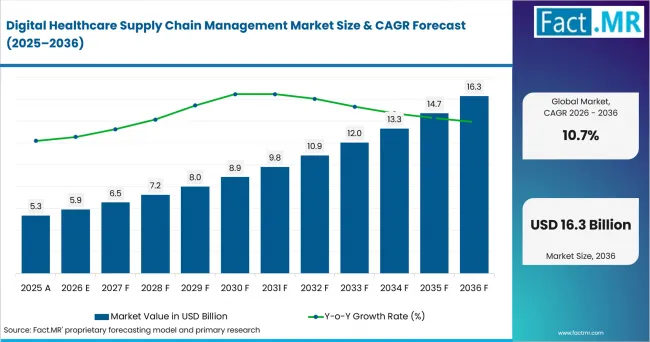
Digital Healthcare Supply Chain Management Market Value Analysis | Source: Fact.MR
What are the defining numbers behind Digital Healthcare Supply Chain Management Market growth?
USD 10.4 billion absolute opportunity by 2036 led by cloud-based SCM software and inventory management.
- Demand Drivers in the Market
- Healthcare providers require live visibility across orders and inventory so critical supplies can be reconciled before care delivery is affected.
- Cloud workflow design is expected to help multi-site hospitals coordinate purchasing records with distributors and internal stores.
- Traceability functions support product authentication and cold-chain records when pharmaceuticals and medical products move through several handoffs.
- Analytics-led planning is anticipated to improve replenishment decisions when historical use and supplier performance are reviewed together.
- Key Segments Analyzed
- By Solution Type: Cloud-based SCM Software is expected to hold 38.0% share in 2026 since hosted deployment suits multi-site procurement and lower infrastructure burden.
- By Supply Chain Function: Inventory Management is projected to account for 40.0% share in 2026 where stock accuracy must improve before wider procurement automation scales.
- By End-use Sector: Hospitals & Health Systems are anticipated to capture 43.0% share in 2026 given that product availability affects care continuity and spend control.
- By User Category: Healthcare Providers are estimated to represent 39.0% share in 2026 through direct responsibility for purchasing and point-of-care availability.
- By Technology Platform: AI-powered Supply Chain Platform is forecast to hold 37.0% share in 2026 when forecasting and exception alerts support daily operating decisions.
- Analyst Opinion at Fact.MR
- Shambhu Nath Jha, Principal Consultant at Fact.MR, states, “Digital Healthcare Supply Chain Management companies need to show how platforms fit each use case. Buyers are expected to reward suppliers that prove value and reliability. Transparent specifications and reliable service are likely to decide repeat sales more than broad category narratives.”
- Strategic Implications
- Hospital procurement teams should define platform requirements around inventory accuracy and traceability before price comparison begins.
- Technology providers can improve customer review by explaining integration steps and compliance controls in simple materials.
- Investors may separate enterprise software exposure from healthcare-specific workflow depth before judging account durability.
USA records the highest country CAGR at 11.6% by 2036 through provider network scale. Germany follows at 11.1% through compliance-led procurement. Japan reaches 10.5% through quality-focused healthcare operations. UK is forecast at 9.9%. China is estimated at 9.3%. India is estimated at 8.8%. Singapore is estimated at 8.2% through compact healthcare logistics and regional support.
How does the Digital Healthcare Supply Chain Management Market break down by segment?
Cloud-based SCM Software is expected to lead Solution Type at 38.0% share in 2026. Inventory Management is projected to lead Supply Chain Function at 40.0% share in 2026.
Which solution type dominates?
Cloud-based SCM software is projected to account for 38.0% share in 2026.
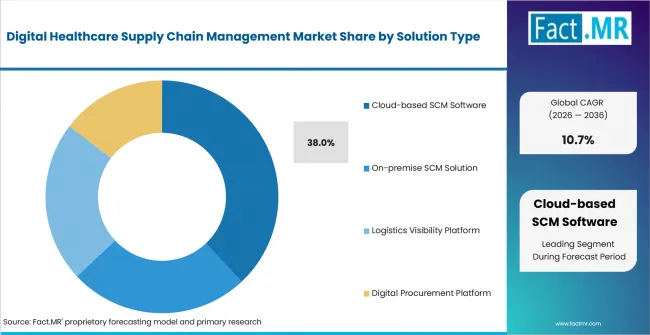
Digital Healthcare Supply Chain Management Market Analysis By Solution Type | Source: Fact.MR
Its lead comes from easier deployment across hospitals, warehouses and purchasing locations without major local infrastructure. Subscription access also simplifies upgrades and user expansion. On-premise SCM solutions remain relevant where healthcare organizations place greater weight on internal data control and customized system management.
How does inventory management shape demand?
By supply chain function, inventory management is expected to hold 40.0% share in 2026.
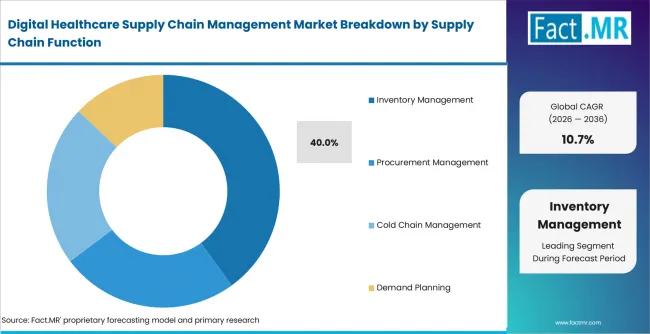
Digital Healthcare Supply Chain Management Market Analysis By Supply Chain Function | Source: Fact.MR
Healthcare buyers usually begin with stock visibility because shortages, expiry and excess inventory directly affect operations. Once product records become dependable, procurement management and demand planning gain greater value. This sequence makes inventory management the foundation for wider supply chain improvement.
Why do hospitals and health systems lead end-use sector?
Hospitals and health systems are anticipated to capture 43.0% share in 2026.
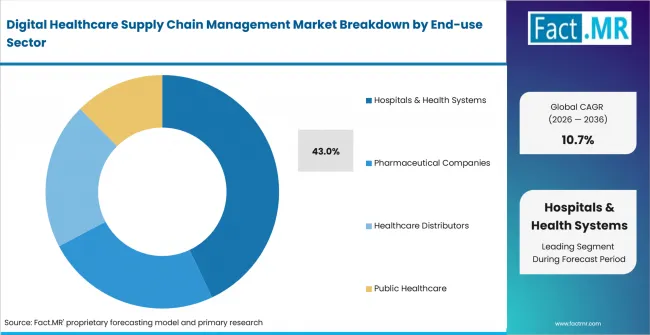
Digital Healthcare Supply Chain Management Market Analysis By End Use Sector | Source: Fact.MR
Large care networks manage thousands of products across departments, facilities and clinical settings. Reliable supply availability supports patient services while helping administrators control purchasing costs. Pharmaceutical companies also use SCM software, but their focus is more closely tied to manufacturing, distribution and regulated product movement.
What supports healthcare providers within user category?
Healthcare providers are estimated to represent 39.0% share in 2026.
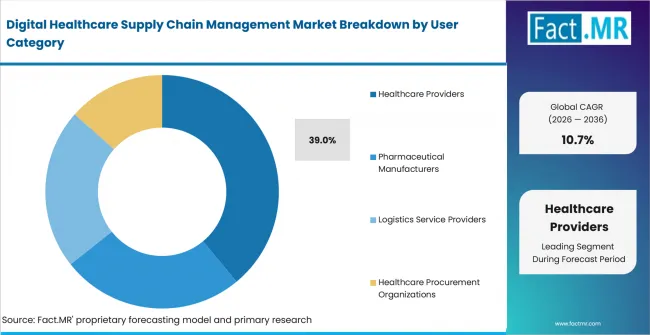
Digital Healthcare Supply Chain Management Market Analysis By User Category | Source: Fact.MR
Providers hold direct responsibility for product availability at the point of care. They use supply chain tools to monitor consumption, reduce shortages and coordinate replenishment across clinical teams. Pharmaceutical manufacturers place stronger emphasis on batch traceability, production planning and controlled distribution.
How does AI-powered supply chain platform perform?
AI-powered supply chain platform is forecast to hold 37.0% share in 2026.
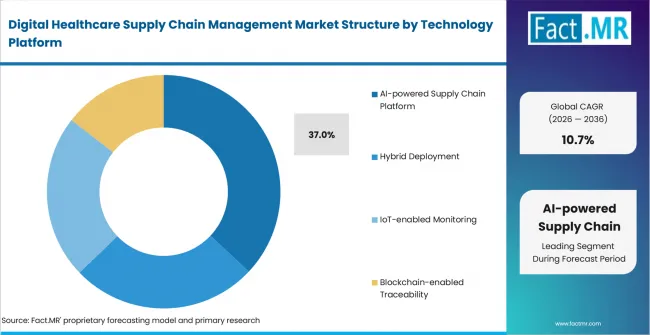
Digital Healthcare Supply Chain Management Market Analysis By Technology Platform | Source: Fact.MR
These platforms attract buyers by combining replenishment recommendations, demand signals and exception alerts within one workflow. Automated guidance helps teams respond faster when usage patterns or supplier conditions change. Hybrid deployment remains useful for organizations that want cloud-based intelligence while keeping selected systems under local control.
What is accelerating Digital Healthcare Supply Chain Management Market adoption, and what is holding it back?
Demand is expected to rise through cloud-based workflow adoption and stronger traceability requirements. Growth may be limited by integration cost and compliance review cycles.
Drivers Impact Analysis
| DRIVER | (~) % IMPACT ON CAGR | GEOGRAPHIC RELEVANCE | IMPACT TIMELINE |
|---|---|---|---|
| Adoption and integration | +1.6% | Global | Short term (<= 2 years) |
| Regulatory and compliance support | +1.4% | USA, Germany, UK | Short term (<= 2 years) |
| Channel and access expansion | +1.1% | Global | Medium term (2-4 years) |
| Clear specification and documentation | +0.9% | USA, UK, Canada | Medium term (2-4 years) |
| Cost and efficiency gains | +0.6% | Global | Long term (>= 4 years) |
Source: Fact.MR analysis. Updated Aug 7, 2026
- Adoption and integration: Buyers are expected to adopt tools faster when software connects purchase orders with inventory records. Distributor status becomes easier to review.
- Regulatory and compliance support: Compliance support is expected to raise value when audit trails and traceability records form part of vendor review.
- Channel and access expansion: Channel visibility is anticipated to improve adoption when vendors work through system integrators and healthcare procurement networks.
Opportunity Impact Analysis
| OPPORTUNITY | (~) % IMPACT ON CAGR | GEOGRAPHIC RELEVANCE | IMPACT TIMELINE |
|---|---|---|---|
| Emerging application expansion | +1.0% | Global | Medium term (2-4 years) |
| Premium and specialist positioning | +0.8% | USA, UK, Germany | Medium term (2-4 years) |
| Channel and partner expansion | +0.7% | Global | Long term (>= 4 years) |
| Standards and compliance alignment | +0.5% | USA, Canada, Singapore | Long term (>= 4 years) |
Source: Fact.MR analysis. Updated Aug 7, 2026
- Emerging application expansion: Use cases are expected to expand when provider systems add pharmacy inventory to the same platform. Cold-chain logistics remains a related demand path for temperature-sensitive products.
- Premium and specialist positioning: Vendors that document healthcare workflow depth are likely to stand apart from general supply chain management software providers.
- Channel and partner expansion: Partner-led delivery is expected to matter when buyers need integration support before platform licensing is approved.
Restraints Impact Analysis
| RESTRAINT | (~) % IMPACT ON CAGR | GEOGRAPHIC RELEVANCE | IMPACT TIMELINE |
|---|---|---|---|
| Cost and complexity | -1.1% | Global | Short term (<= 2 years) |
| Specification and compliance checks | -0.9% | USA, UK, Germany | Short term (<= 2 years) |
| Substitution by lower-cost alternatives | -0.7% | Import-dependent markets | Medium term (2-4 years) |
| Supply chain and pricing pressure | -0.5% | Global | Long term (>= 4 years) |
Source: Fact.MR analysis. Updated Aug 7, 2026
- Cost and complexity: Integration cost is expected to slow projects when legacy purchasing systems must connect with distributor data.
- Specification and compliance checks: Security review can lengthen procurement when traceability and audit records require approval before deployment.
- Supply chain and pricing pressure: Lower-cost alternatives may delay premium platform selection when buyers only need basic inventory visibility.
Which countries are scaling the Digital Healthcare Supply Chain Management Market fastest?
- The country comparison spans 3.4 percentage points and forms a clear growth ladder across the forecast period.
- The USA remains 0.5 percentage point above Germany through large provider networks and stronger platform integration.
- Germany stays 0.6 percentage point above Japan when compliance-led procurement rewards documented systems.
- Japan remains 0.6 percentage point above UK through quality-focused care operations and careful platform selection.
- UK stays 0.6 percentage point above China through centralized buying routes and provider digitalization.
- China remains 0.5 percentage point above India through hospital network expansion and wider platform use.
- India stays 0.6 percentage point above Singapore when large provider groups seek better procurement visibility.
Comparable CAGRs can create different entry conditions due to procurement scale, integration needs and local compliance review. Full report coverage includes North America; Latin America; Europe; East Asia; South Asia and Pacific; Middle East and Africa.
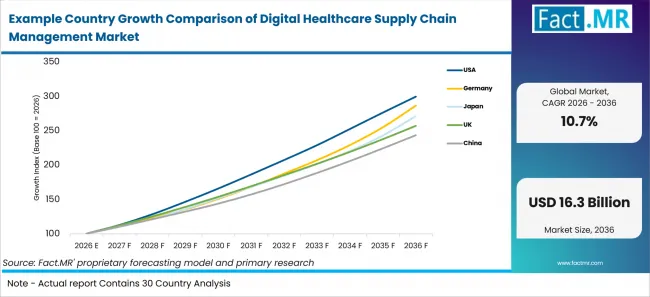
Example Country Growth Comparison Of Digital Healthcare Supply Chain Management Market | Source: Fact.MR
Country CAGR (2026-2036)
| Country | CAGR (2026-2036) |
|---|---|
| USA | 11.6% |
| Germany | 11.1% |
| Japan | 10.5% |
| UK | 9.9% |
| Singapore | 8.2% |
Source: Fact.MR analysis. Updated Aug 7, 2026
What supports USA adoption?
11.6% CAGR, supported by provider network scale and platform integration.
The USA benefits from large healthcare systems that require dependable supply visibility across many facilities. Buyers often assess vendor continuity, traceability and integration depth before expanding deployment. Platforms that reduce inventory gaps and maintain service levels are likely to gain stronger acceptance.
How is Germany scaling demand?
11.1% CAGR, backed by compliance-led procurement and hospital inventory control.
Germany’s market is shaped by structured purchasing and close attention to documentation. Hospitals are more likely to approve digital platforms when data governance, audit trails and access controls are clearly explained. Strong implementation records can also shorten internal review cycles.
What is driving Japan’s growth from 2026 to 2036?
10.5% CAGR, supported by quality-focused care networks and disciplined procurement.
Japan places high value on process reliability and consistent product availability. Healthcare buyers tend to favor suppliers that provide careful onboarding and stable operating support. Repeat adoption is expected to depend on how well platforms fit established purchasing routines.
How does the UK perform?
9.9% CAGR, led by centralized buying routes and provider digitalization.
Centralized procurement gives the UK a practical base for wider platform use across hospitals and care settings. Buyers look for clear workflow alignment before moving beyond pilot programs. Solutions that connect supplier visibility with routine purchasing can support larger deployments.
How is China developing demand?
9.3% CAGR, driven by hospital network expansion and domestic digital platform use.
China’s growth comes from the need to coordinate inventory across expanding provider networks and multiple distributors. Domestic platforms may benefit where local support and pricing matter. However, premium systems may face slower adoption when basic stock control is sufficient.
What supports India’s growth?
8.8% CAGR, supported by private healthcare expansion and procurement visibility needs.
India’s market is developing as hospitals seek cleaner inventory records and better purchase coordination. Private providers are likely to compare subscription costs with savings from reduced shortages and excess stock. Scalable platforms with simple onboarding may gain wider use across growing hospital groups.
How does Singapore scale adoption?
8.2% CAGR, backed by compact healthcare logistics and regional service support.
Singapore’s concentrated healthcare system allows suppliers, hospitals and logistics providers to operate within a closely connected environment. Digital handoff records can improve visibility across this network. The country may also serve as a regional reference market for providers expanding across Southeast Asia.
Who leads the Digital Healthcare Supply Chain Management Market?
Oracle Corporation and SAP SE show the enterprise software relevance. Infor Inc. and Blue Yonder strengthen the field through supply-chain planning and execution depth.
Oracle Corporation supports healthcare buyers through enterprise supply-chain and procurement tools. SAP SE contributes business-network depth for supplier collaboration. Infor Inc. adds healthcare operations experience. Blue Yonder supports planning and execution workflows. McKesson Corporation adds healthcare distribution exposure. Tecsys Inc. brings healthcare supply-chain software depth. Manhattan Associates, Inc. adds planning software depth. Kinaxis Inc. brings orchestration exposure. E2open and IBM Corporation broaden the provider set.
Which companies are the key providers?
Key companies include Oracle Corporation; SAP SE; Infor Inc.; Blue Yonder; McKesson Corporation; Tecsys Inc.; Manhattan Associates, Inc.; Kinaxis Inc.; E2open; IBM Corporation.
- Oracle Corporation
- SAP SE
- Infor Inc.
- Blue Yonder
- McKesson Corporation
- Tecsys Inc.
- Manhattan Associates, Inc.
- Kinaxis Inc.
- E2open
- IBM Corporation
Bibliography
- NHS Supply Chain. (2025, January 14). NHS Supply Chain advances inventory management deployment.
- UK Department of Health and Social Care. (2025, January 27). A guide to good practice for digital and data-driven health technologies.
- World Health Organization, World Intellectual Property Organization, & World Trade Organization. (2025, July 11). Public procurement as a key tool to tackle health issues discussed at WHO-WIPO-WTO webinar.
- NHS Supply Chain. (2025, September 3). NHS Supply Chain launches policy on data standards for supplier product coding.
This Report Answers
- The report provides strategic intelligence on Solution Type and Supply Chain Function choices that shape healthcare procurement programs.
- Segment analysis covers Cloud-based SCM Software and Inventory Management as the share leaders within the 2026 market.
- Country outlook evaluates the USA and Germany alongside Japan and the UK. China, India and Singapore complete the growth comparison across the profiled markets.
- Competitive analysis profiles Oracle Corporation and SAP SE alongside Infor Inc. and Blue Yonder McKesson Corporation, Tecsys Inc. and other named providers complete the competitive view.
- Technology-platform assessment covers AI-powered Supply Chain Platform and Hybrid Deployment. IoT-enabled Monitoring supports device-led visibility. Blockchain-enabled Traceability supports audit workflows.
What does the Digital Healthcare Supply Chain Management Market cover?
Digital healthcare supply chain management platforms coordinate purchasing and supplier visibility where healthcare products must reach care settings reliably.
The market covers software and platform services used by providers and pharmaceutical companies. Distributors and public healthcare buyers are included when digital tools support supply-chain decisions.
What is included in the scope?
Digital healthcare supply chain management is assessed across five segment dimensions and regional demand.
The scope includes Cloud-based SCM Software and On-premise SCM Solution. Logistics Visibility Platform and Digital Procurement Platform complete Solution Type. Inventory Management; Procurement Management; Cold Chain Management; and Demand Planning define the function view.
What is excluded from the scope?
General enterprise systems without a healthcare supply-chain use case remain outside the scope of this market.
The scope excludes unrelated enterprise software that does not support healthcare purchasing, inventory control or traceability. General logistics services are excluded unless the digital platform is tied to healthcare product visibility. Clinical systems are outside the scope unless they connect to supply-chain planning.
How Was the Analysis Built?
The analysis draws on 120+ sources, 35+ company portfolios, 25+ countries, and more than 20 interviews.
- Primary Research: Interviews with manufacturers, retailers, salon operators, and experts examine purchase priorities, adoption, approval requirements, and competitive positioning.
- Desk Research: Desk research covers government statistics, regulatory publications, company filings, trade data, technical studies, industry associations, standards, and public policy.
- Market Sizing and Forecasting: Estimates combine historical performance, demand indicators, pricing, segment shares, company participation, country growth, adoption patterns, and barriers to expansion.
- Data Validation and Update Cycle: Findings are validated against public data, company activity, regulatory changes, product launches, recalls, and adoption shifts.
Segmentation
What is the report’s scope and coverage?
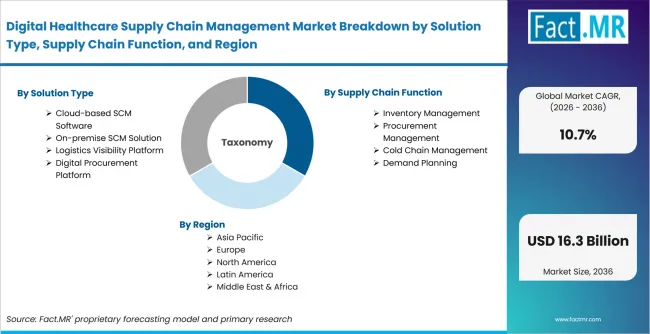
Digital Healthcare Supply Chain Management Market Breakdown By Solution Type, Supply Chain Function, And Region | Source: Fact.MR
| Attribute | Details |
|---|---|
| Quantitative Units | USD billion |
| Market Definition | Digital healthcare supply chain management platforms and services used to plan, source, monitor and move healthcare products across regulated supply chains |
| Solution Type | Cloud-based SCM Software; On-premise SCM Solution; Logistics Visibility Platform; Digital Procurement Platform |
| Supply Chain Function | Inventory Management; Procurement Management; Cold Chain Management; Demand Planning |
| End-use Sector | Hospitals & Health Systems; Pharmaceutical Companies; Healthcare Distributors; Public Healthcare |
| User Category | Healthcare Providers; Pharmaceutical Manufacturers; Logistics Service Providers; Healthcare Procurement Organizations |
| Technology Platform | AI-powered Supply Chain Platform; Hybrid Deployment; IoT-enabled Monitoring; Blockchain-enabled Traceability |
| Regions Covered | North America; Latin America; Europe; East Asia; South Asia and Pacific; Middle East and Africa |
| Countries Covered | USA; Germany; Japan; UK; China; India; Singapore |
| Key Companies Profiled | Oracle Corporation; SAP SE; Infor Inc.; Blue Yonder; McKesson Corporation; Tecsys Inc.; Manhattan Associates, Inc.; Kinaxis Inc.; E2open; IBM Corporation |
| Forecast Period | 2026 to 2036 |
| Approach | Hybrid top-down and bottom-up approach using healthcare procurement demand; hospital inventory control needs; traceability requirements; cloud deployment patterns; compliance review; distributor handoffs; platform integration depth; technology adoption patterns; country growth and company portfolio review |
Source: Fact.MR analysis. Updated Aug 7, 2026
How is the market segmented?
-
By Solution Type
- Cloud-based SCM Software
- Public Cloud SCM
- Private Cloud SCM
- On-premise SCM Solution
- Local Enterprise System
- Hybrid Enterprise Deployment
- Logistics Visibility Platform
- Real-time Shipment Tracking
- Control Tower Platform
- Digital Procurement Platform
- E-sourcing Platform
- Supplier Risk Management
- orm
- Cloud-based SCM Software
-
By Supply Chain Function
- Inventory Management
- Real-time Stock Monitoring
- Automated Replenishment
- Procurement Management
- Supplier Collaboration
- Contract Lifecycle Management
- Cold Chain Management
- Vaccine Distribution
- Biological Product Logistics
- Demand Planning
- Forecasting & Planning
- Capacity Optimization
- Inventory Management
-
By End-use Sector
- Hospitals & Health Systems
- Multi-specialty Hospitals
- Specialty Clinics
- Pharmaceutical Companies
- Biopharmaceutical Companies
- Medical Device Manufacturers
- Healthcare Distributors
- Medical Distributors
- Diagnostic Laboratories
- Public Healthcare
- Public Hospitals
- Healthcare Research Institutes
- Hospitals & Health Systems
-
By User Category
- Healthcare Providers
- Hospital Networks
- Integrated Delivery Networks
- Pharmaceutical Manufacturers
- Distributors & Wholesalers
- Medical Device Companies
- Logistics Service Providers
- Third-party Logistics Providers
- Government Healthcare Agencies
- Healthcare Procurement Organizations
- Group Purchasing Organizations
- Public Health Authorities
- Healthcare Providers
-
By Technology Platform
- AI-powered Supply Chain Platform
- Predictive Analytics Engine
- Machine Learning Platform
- Hybrid Deployment
- On-premise Integration
- ERP Integration Platform
- IoT-enabled Monitoring
- Temperature Monitoring Sensors
- Control Tower Analytics
- Blockchain-enabled Traceability
- Smart Contract Integration
- Digital Twin Simulation
- AI-powered Supply Chain Platform
-
By Region
- North America
- Latin America
- Europe
- East Asia
- South Asia & Oceania
- Middle East & Africa
Frequently Asked Questions
How big is the digital healthcare supply chain management market in 2026?
The digital healthcare supply chain management market is valued at USD 5.9 billion in 2026 and is forecast to reach USD 16.3 billion by 2036.
Which solution type leads the digital healthcare supply chain management market?
Which supply chain function leads the digital healthcare supply chain management market?
Who are the leading companies in the digital healthcare supply chain management market?
Who worked on this report


Preview the report firsthand - request a free sample
Free SampleGet the brochure for pricing and purchase details
Download PDF