- Market Value (2025): USD 12.9 Bn
- Estimated Value (2026): USD 14.2 Bn
- Forecast Value (2036): USD 38.5 Bn
- CAGR (2026-2036): 10.5%
What is the Digital Workplace in Government and Public Sector Market forecast to be worth by 2036?
USD 14.2 billion in 2026 to USD 38.5 billion by 2036 at 10.5% CAGR.
- The digital workplace in government and public sector market surpassed a value of USD 12.9 billion in 2025 as agencies formalized hybrid work and internal workflow programs.
- Demand is projected to increase from USD 14.2 billion in 2026 to USD 38.5 billion by 2036.
- The market is forecast to record 10.5% CAGR from 2026 to 2036.
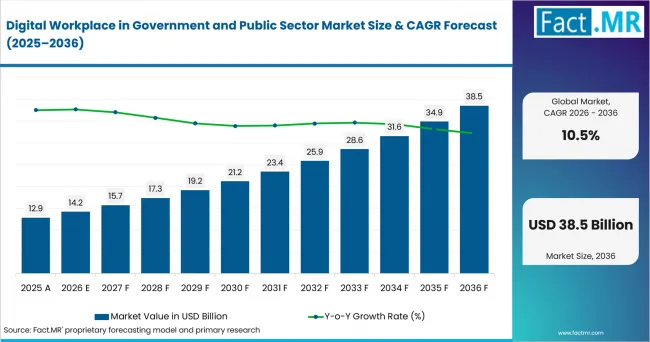
Digital Workplace In Government And Public Sector Market Value Analysis | Source: Fact.MR
What are the defining numbers behind Digital Workplace in Government and Public Sector Market growth?
USD 24.5 billion absolute opportunity by 2036 is led by digital collaboration suite and document & workflow management.
- Demand Drivers in the Market
- Public agencies need shared workspaces for forms and approvals. These tools help staff move routine work without waiting for separate email threads.
- Hybrid operating models are expected to raise demand for cloud computing access and identity control. Agencies need secure access when staff work across offices.
- Document-heavy workflows are expected to push agencies toward knowledge management tools. Policy files and case records need searchable access before service teams can work faster.
- Key Segments Analyzed
- By Solution Type: Digital Collaboration Suite is expected to hold 38.0% share in 2026 since agencies need secure messaging and task coordination in one workspace.
- By Functional Area: Document & Workflow Management is projected to account for 40.0% share in 2026 as approvals remain central to public administration.
- By Public Sector Vertical: Central Government is anticipated to capture 42.0% share in 2026. National agencies manage the broadest compliance burden.
- By User Category: Government Agencies are estimated to represent 39.0% share in 2026 due to their direct role in services and work routing.
- By Deployment Architecture: Cloud-based Digital Workplace is forecast to hold 41.0% share in 2026. Managed platforms reduce the burden on internal infrastructure teams.
- Analyst Opinion at Fact.MR
- Shambhu Nath Jha, Principal Consultant at Fact.MR, states, “Digital workplace providers serving government and public sector customers need to prove security and workflow fit before agencies expand deployment. Repeat demand is expected to depend on clear documentation and measurable user outcomes.”
- Strategic Implications
- Platform providers should show how collaboration and workflow tools support a defined public-sector use case. Clear positioning is expected to shorten procurement review.
- Service teams can strengthen retention by giving agencies implementation guides and governance documents. This makes rollout planning easier for internal technology teams.
- Channel partners should align public-sector offers with managed cloud services. Agencies often need deployment support before they approve wider software distribution.
The USA leads at 11.4% CAGR through federal collaboration needs and broad public-sector software depth. UK follows at 10.9% as public services modernize workplace and workflow systems. Germany reaches 10.4% through regulated administration. Japan posts 9.9%. Canada reaches 9.5%. Australia records 9.1%. Singapore reaches 8.6% through compact agency structures.
How does the Digital Workplace in Government and Public Sector Market break down by segment?
Digital Collaboration Suite is expected to lead Solution Type at 38.0% share in 2026. Document & Workflow Management is projected to lead Functional Area at 40.0% share in 2026.
Which solution type dominates?
Digital collaboration suite is projected to account for 38.0% share in 2026.
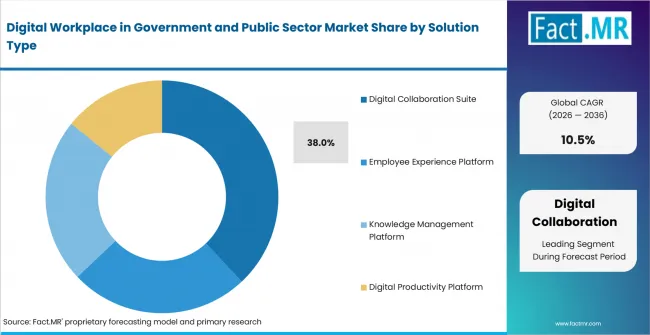
Digital Workplace In Government And Public Sector Market Analysis By Solution Type | Source: Fact.MR
Its lead reflects the everyday need for secure messaging, file sharing and coordinated communication across public agencies. Employee platforms remain important where organizations place greater emphasis on staff services, internal support and workplace engagement.
What leads the functional area segment?
Document and workflow management is expected to hold 40.0% share in 2026.
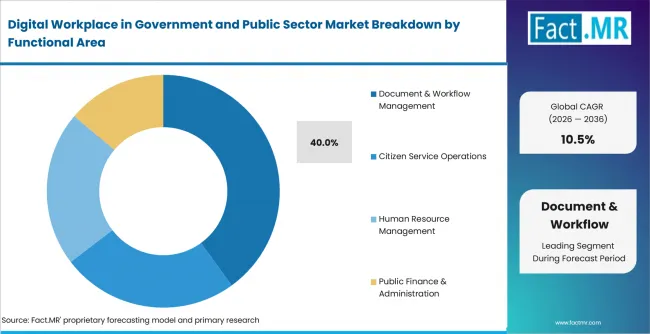
Digital Workplace In Government And Public Sector Market Analysis By Functional Area | Source: Fact.MR
Public-sector operations depend heavily on approvals, records and case files moving between departments. Digital routing helps reduce delays and keeps responsibility visible. Citizen service operations and human resource management add demand as more administrative work shifts away from manual processes.
How does public sector vertical shape demand?
Central government is anticipated to lead with 42.0% share in 2026.
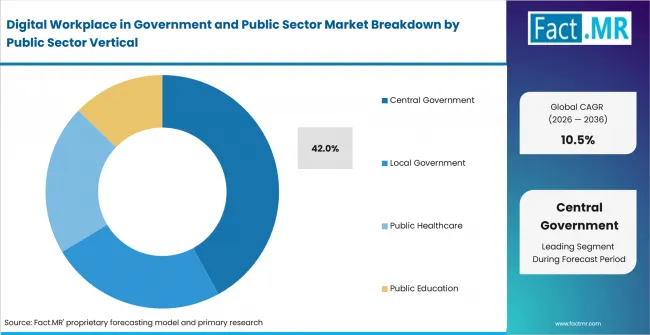
Digital Workplace In Government And Public Sector Market Analysis By Public Sector Vertical | Source: Fact.MR
National agencies typically manage larger workforces, broader responsibilities and stricter compliance requirements. Their scale creates stronger demand for standardized workplace platforms. Local government and public healthcare support additional adoption where employees and service users are distributed across many locations.
What supports government agencies within user category?
Government agencies are estimated to represent 39.0% share in 2026.
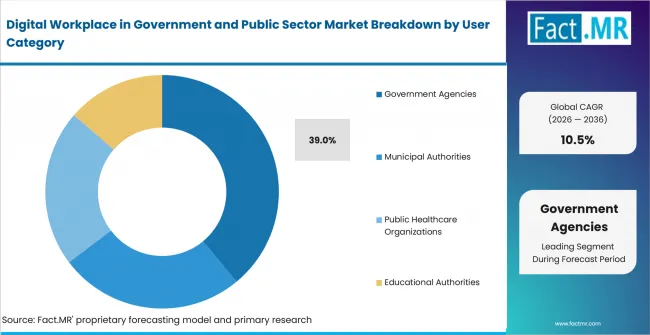
Digital Workplace In Government And Public Sector Market Analysis By User Category | Source: Fact.MR
These organizations handle the widest mix of policy development, administration and public communication. Shared digital tools help teams coordinate work across departments and maintain clear records. Municipal and educational authorities create more focused demand around local services and institutional operations.
Why does cloud-based digital workplace lead deployment architecture?
Cloud-based digital workplace is forecast to hold 41.0% share in 2026.
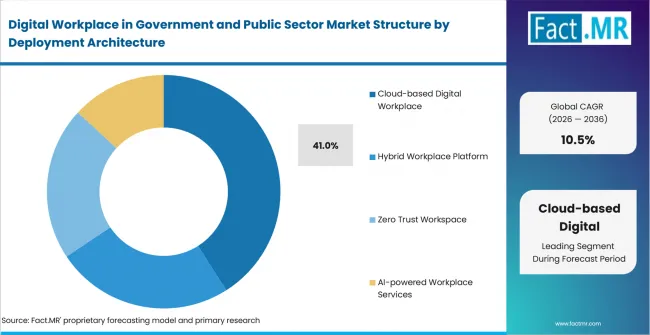
Digital Workplace In Government And Public Sector Market Analysis By Deployment Architecture | Source: Fact.MR
Cloud delivery reduces the burden of maintaining collaboration infrastructure inside every agency. It also supports easier updates and wider access across remote teams. Hybrid workplace platforms and zero-trust workspaces remain relevant where sensitive data and identity verification require tighter control.
What is accelerating Digital Workplace in Government and Public Sector Market adoption, and what is holding it back?
Demand is expected to rise as agencies shift everyday tasks from scattered tools into secure workflow environments. Adoption can slow when migration cost and legacy integration remain unresolved.
Drivers Impact Analysis
| DRIVER | (~) % IMPACT ON CAGR | GEOGRAPHIC RELEVANCE | IMPACT TIMELINE |
|---|---|---|---|
| Adoption and integration | +1.6% | Global | Short term (<= 2 years) |
| Regulatory and compliance support | +1.4% | USA, Germany, UK | Short term (<= 2 years) |
| Channel and access expansion | +1.1% | Global | Medium term (2-4 years) |
| Clear specification and documentation | +0.9% | USA, UK, Canada | Medium term (2-4 years) |
| Cost and efficiency gains | +0.6% | Global | Long term (>= 4 years) |
Source: Fact.MR analysis. Updated Aug 7, 2026
- Adoption and integration: Agencies are expected to standardize collaboration and task routing as more work moves through digital channels.
- Regulatory and compliance support: Public-sector teams are expected to prefer vendors that provide audit controls and security documentation.
- Channel and access expansion: Wider partner coverage is expected to help agencies deploy workplace tools with less internal burden.
Opportunity Impact Analysis
| OPPORTUNITY | (~) % IMPACT ON CAGR | GEOGRAPHIC RELEVANCE | IMPACT TIMELINE |
|---|---|---|---|
| Emerging application expansion | +1.0% | Global | Medium term (2-4 years) |
| Premium and specialist positioning | +0.8% | USA, UK, Germany | Medium term (2-4 years) |
| Channel and partner expansion | +0.7% | Global | Long term (>= 4 years) |
| Standards and compliance alignment | +0.5% | USA, Canada, Singapore | Long term (>= 4 years) |
Source: Fact.MR analysis. Updated Aug 7, 2026
- Emerging application expansion: AI-assisted search and secure collaboration are expected to widen the use case base.
- Premium and specialist positioning: Vendors with public-sector controls can support application transformation programs that replace legacy systems.
- Channel and partner expansion: Implementation partners are expected to turn workplace suites into managed programs tied to support.
Restraints Impact Analysis
| RESTRAINT | (~) % IMPACT ON CAGR | GEOGRAPHIC RELEVANCE | IMPACT TIMELINE |
|---|---|---|---|
| Cost and complexity | -1.1% | Global | Short term (<= 2 years) |
| Specification and compliance checks | -0.9% | USA, UK, Germany | Short term (<= 2 years) |
| Substitution by lower-cost alternatives | -0.7% | Import-dependent markets | Medium term (2-4 years) |
| Supply chain and pricing pressure | -0.5% | Global | Long term (>= 4 years) |
Source: Fact.MR analysis. Updated Aug 7, 2026
- Cost and complexity: Agencies can delay deployment when migration work and change management stretch budgets.
- Specification and compliance checks: Procurement teams need evidence that workplace platforms meet security and records-management rules.
- Substitution by lower-cost alternatives: Some public bodies are expected to choose narrow tools when full platform value is not clear.
Which countries are scaling the Digital Workplace in Government and Public Sector Market fastest?
- The country comparison spans 2.8 percentage points and forms a tight growth band across the forecast period.
- The USA remains 0.5 percentage point above UK through deeper federal software deployment and broad provider coverage.
- UK remains 0.5 percentage point above Germany as public-service modernization keeps workplace and workflow demand active.
- Germany remains 0.5 percentage point above Japan through regulated administration and data-governance requirements.
- Japan remains 0.4 percentage point above Canada as agency modernization supports steady collaboration-platform demand.
- Canada remains 0.4 percentage point above Australia through federal service modernization and cloud adoption planning.
- Australia remains 0.5 percentage point above Singapore. Singapore closes the range through compact public-sector structures and digital government maturity.
Comparable CAGRs create different entry conditions due to agency size and procurement rules. Full report coverage includes North America and Latin America. It also includes Europe and East Asia. South Asia and Pacific plus Middle East and Africa complete the regional view.
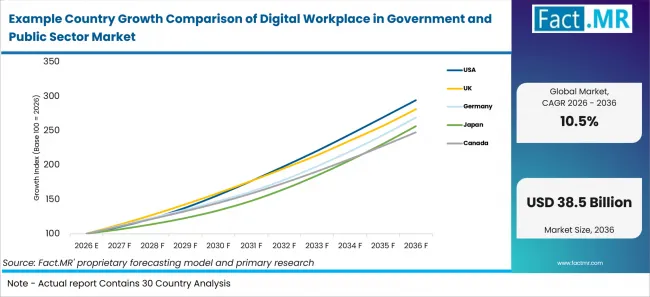
Example Country Growth Comparison Of Digital Workplace In Government And Public Sector Market | Source: Fact.MR
| Country | CAGR (2026-2036) |
|---|---|
| USA | 11.4% |
| UK | 10.9% |
| Germany | 10.4% |
| Japan | 9.9% |
| Canada | 9.5% |
| Australia | 9.1% |
| Singapore | 8.6% |
Source: Fact.MR analysis. Updated Aug 7, 2026
What supports USA adoption?
11.4% CAGR, supported by federal software depth and large agency user bases.
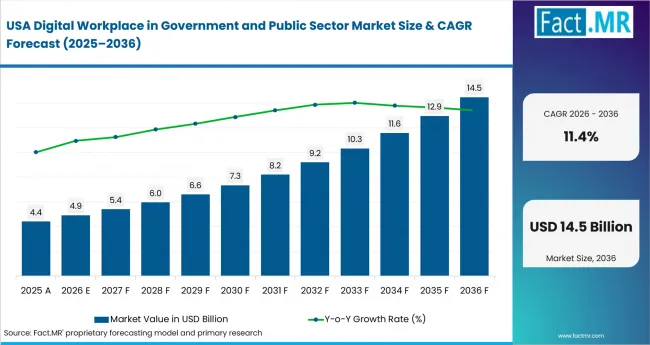
Digital Workplace In Government And Public Sector Market Country Value Analysis | Source: Fact.MR
The USA benefits from a established enterprise software environment and strong public-sector demand for secure collaboration. Federal agencies typically review identity controls, data protection and migration requirements before approval. Vendors that present clear implementation plans and dependable workflow support are more likely to progress from pilot use to broader deployment.
How is the UK scaling demand?
10.9% CAGR, led by public service modernization and cloud planning.
UK departments are moving toward shared workspaces that make forms, approvals and service activity easier to follow. Workflow platforms reduce manual handoffs between teams and improve accountability across central and local bodies. Cloud-oriented procurement also gives suppliers a clearer route into modernization programs.
What is driving Germany’s growth from 2026 to 2036?
10.4% CAGR, backed by regulated administration and document-heavy processes.
Germany’s public agencies place strong emphasis on data protection, access rules and records control. This creates demand for platforms that explain storage responsibility and governance in precise terms. Administrative workflows involving large document volumes further support adoption of digital routing and approval tools.
How is Japan developing demand?
9.9% CAGR, shaped by agency modernization and reduced paper dependence.
Japan’s outlook is linked to efforts to digitize document sharing and approval activity across government offices. Workplace platforms can simplify coordination between departments that still rely on manual processes. Training quality remains important because established user habits may slow full platform use after deployment.
What supports Canada’s growth?
9.5% CAGR, supported by service modernization and distributed workforce access.
Canada’s public-sector organizations often operate across wide geographic areas, making secure remote access especially valuable. Modernization programs are expected to increase demand for visible records, accessible interfaces and consistent governance controls. Procurement teams are likely to favor platforms that combine usability with clear oversight.
How does Australia perform?
9.1% CAGR, led by managed cloud use and dispersed public services.
Australia’s agencies require workplace systems that connect employees across large service territories. Cloud-first procurement supports managed platforms with identity controls and centralized updates. Digital workflows can reduce duplicate work, although smaller public bodies may adopt more slowly when staffing and implementation resources are limited.
What supports Singapore’s growth?
8.6% CAGR, supported by digital government maturity and centralized planning.
Singapore’s compact public-sector structure allows agencies to evaluate shared systems more quickly than larger markets. Strong digital service capability supports demand for secure collaboration, information retrieval and standardized workflows. Central planning helps compare platforms efficiently, though the smaller agency base limits total deployment volume.
Who leads the Digital Workplace in Government and Public Sector Market?
Microsoft and Google Workspace hold strong positions through secure collaboration and cloud productivity, while Oracle and Cisco add enterprise workflow and communication infrastructure.
IBM supports public-sector transformation through hybrid cloud and automation. Omnissa strengthens digital workspace management. Salesforce and ServiceNow contribute case handling, service workflows and employee support. OpenText adds records and content governance, while Atlassian broadens the field through project coordination, knowledge sharing and team-based workflow tools for government and public-sector users across agencies.
Which companies are the key providers?
Key companies include Microsoft Corporation; Google LLC – Google Workspace; Oracle Corporation; Cisco Systems, Inc.; International Business Machines Corporation; Omnissa, LLC; Salesforce, Inc.; ServiceNow, Inc.; OpenText Corporation; Atlassian Corporation plc.
- Microsoft Corporation
- Google LLC – Google Workspace
- Oracle Corporation
- Cisco Systems, Inc.
- International Business Machines Corporation
- Omnissa, LLC
- Salesforce, Inc.
- ServiceNow, Inc.
- OpenText Corporation
- Atlassian Corporation plc
Bibliography
- U.S. General Services Administration. (2025, April 10). GSA secures cost savings through strategic agreement with Google.
- UK Department for Science, Innovation and Technology, & Government Digital Service. (2025, January 21). State of digital government review.
- UK Government Digital Service. (2025, July 4). Digital workplace community.
- Microsoft Corporation. (2025, March 31). What’s new in Microsoft 365 Copilot for Government.
This Report Answers
- The report provides strategic intelligence on the Digital Workplace in Government and Public Sector Market across solution and deployment choices.
- Segment analysis covers Digital Collaboration Suite and Document & Workflow Management as the share leaders within the 2026 market.
- Country outlook evaluates the USA and UK alongside Germany and Japan. Canada and Australia are included. Singapore completes the growth comparison.
- Competitive analysis profiles Microsoft Corporation and Google LLC – Google Workspace alongside Oracle Corporation and Cisco Systems, Inc. The remaining providers complete the assessed set.
- Deployment assessment covers Cloud-based Digital Workplace and Hybrid Workplace Platform. Zero Trust Workspace and AI-powered Workplace Services complete the deployment view.
What does the Digital Workplace in Government and Public Sector Market cover?
Digital workplace platforms connect public-sector employees with collaboration tools and workflow systems. They help agencies manage records access and user support inside controlled operating environments.
The Digital Workplace in Government and Public Sector Market covers solutions used by central government and local government bodies. Coverage extends to public healthcare organizations and public education bodies. The market includes collaboration suites and employee platforms. Knowledge tools and digital productivity systems are included when they support public-sector workplace use.
What is included in the scope?
The scope includes digital workplace systems used across the covered solution and deployment categories. These tools support collaboration and workflow inside government and public-sector bodies.
Coverage spans Digital Collaboration Suite and Employee Experience Platform. Knowledge Management Platform and Digital Productivity Platform complete the solution scope. The listed functional areas and deployment architectures are included when they support public-sector workplace use.
What is excluded from the scope?
Standalone software that does not support public-sector workplace use remains outside the scope of this market.
The scope excludes unrelated enterprise software and hardware-only procurement. Consumer collaboration applications are not included. Pure cybersecurity tools and general cloud hosting are excluded unless they directly support the defined public-sector workplace use case.
How Was the Analysis Built?
The analysis draws on 120+ sources, 35+ company portfolios, 25+ countries, and more than 20 industry interviews.
- Primary Research: Primary research includes discussions with manufacturers, service providers, technology developers, distributors, end users, procurement teams, and subject-matter experts. These conversations examine purchasing priorities, product adoption, operational challenges, approval requirements, competitive positioning, and the factors that influence wider market acceptance.
- Desk Research: Desk research covers government statistics, regulatory publications, company filings, trade data, technical studies, industry associations, standards, public policy, and other authoritative sources. Every source used in the analysis is documented in the bibliography.
- Market Sizing and Forecasting: Market estimates combine historical performance, demand indicators, pricing and volume trends, segment shares, company participation, country-level growth, adoption patterns, investment activity, and barriers to market expansion.
- Data Validation and Update Cycle: Findings are validated by comparing primary interviews with public data, company activity, regulatory changes, trade patterns, and industry developments. Regular updates review new product launches, capacity changes, partnerships, approvals, procurement trends, and shifts in commercial adoption.
Segmentation
What is the report’s scope and coverage?
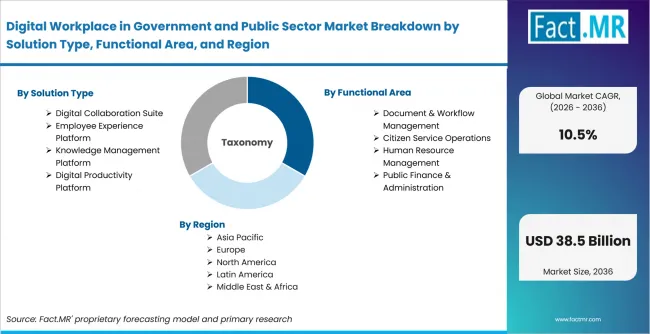
Digital Workplace In Government And Public Sector Market Breakdown By Solution Type, Functional Area, And Region | Source: Fact.MR
| Attribute | Details |
|---|---|
| Quantitative Units | USD billion in 2026 to USD billion by 2036 at CAGR |
| Market Definition | Digital workplace platforms and services used by government and public sector organizations for collaboration, workflow, records access, productivity, security, and user support |
| Solution Type | Digital Collaboration Suite; Employee Experience Platform; Knowledge Management Platform; Digital Productivity Platform |
| Functional Area | Document & Workflow Management; Citizen Service Operations; Human Resource Management; Public Finance & Administration |
| Public Sector Vertical | Central Government; Local Government; Public Healthcare; Public Education |
| User Category | Government Agencies; Municipal Authorities; Public Healthcare Organizations; Educational Authorities |
| Deployment Architecture | Cloud-based Digital Workplace; Hybrid Workplace Platform; Zero Trust Workspace; AI-powered Workplace Services |
| Regions Covered | North America; Latin America; Europe; East Asia; South Asia and Pacific; Middle East and Africa |
| Countries Covered | USA; UK; Germany; Japan; Canada; Australia; Singapore |
| Key Companies Profiled | Microsoft Corporation; Google LLC – Google Workspace; Oracle Corporation; Cisco Systems, Inc.; International Business Machines Corporation; Omnissa, LLC; Salesforce, Inc.; ServiceNow, Inc.; OpenText Corporation; Atlassian Corporation plc |
| Forecast Period | 2026 to 2036 |
| Approach | Hybrid top-down and bottom-up approach using segment demand; country growth; cloud adoption; compliance needs; procurement signals; and company portfolio review |
Source: Fact.MR analysis. Updated Aug 7, 2026
How is the market segmented?
-
By Solution Type
- Digital Collaboration Suite
- Enterprise Collaboration
- Team Communication Tools
- Employee Experience Platform
- Digital Workspace Portal
- Remote Work Environment
- Knowledge Management Platform
- Document Repository
- Content Management
- Digital Productivity Platform
- Productivity Applications
- Process Automation
- Digital Collaboration Suite
-
By Functional Area
- Document & Workflow Management
- e-File Management
- Digital Records
- Citizen Service Operations
- Citizen Request Processing
- Service Desk Automation
- Human Resource Management
- Workforce Planning
- Employee Self-Service
- Public Finance & Administration
- Budget Management
- Financial Reporting
- Document & Workflow Management
-
By Public Sector Vertical
- Central Government
- Federal Departments
- National Ministries
- Local Government
- City Administrations
- Regional Authorities
- Public Healthcare
- Government Hospitals
- Public Health Agencies
- Public Education
- Public Universities
- School Districts
- Central Government
-
By User Category
- Government Agencies
- Public Sector IT Teams
- Digital Transformation Offices
- Municipal Authorities
- Public Service Organizations
- Public Institutions
- Public Healthcare Organizations
- Healthcare Administrators
- Public Health Departments
- Educational Authorities
- Education Departments
- Public Education Boards
- Government Agencies
-
By Deployment Architecture
- Cloud-based Digital Workplace
- Public Cloud
- Hybrid Cloud
- Hybrid Workplace Platform
- Private Cloud
- Secure Virtual Desktop
- Zero Trust Workspace
- Identity-based Access
- Secure Access Gateway
- AI-powered Workplace Services
- AI Virtual Assistant
- Intelligent Workflow Automation
- Cloud-based Digital Workplace
-
By Region
- North America
- Latin America
- Europe
- East Asia
- South Asia & Pacific
- Middle East and Africa
Frequently Asked Questions
How big is the digital workplace in government and public sector market in 2026?
What is the CAGR of the digital workplace in government and public sector market from 2026 to 2036?
Which solution type leads the digital workplace in government and public sector market?
Which functional area leads the digital workplace in government and public sector market?
Who are the leading companies in the digital workplace in government and public sector market?
Who worked on this report


Preview the report firsthand - request a free sample
Free SampleGet the brochure for pricing and purchase details
Download PDF