Disinfection Byproduct Control Chemicals in Drinking Water Market

Disinfection Byproduct Control Chemicals in Drinking Water Market Size and Share Forecast Outlook 2026 to 2036

Disinfection byproduct control chemicals in drinking water market is projected to grow from USD 0.5 billion in 2026 to USD 1.3 billion by 2036, at a CAGR of 9.2%. Activated Carbon & Adsorbents will dominate with a 30.0% market share, while municipal drinking water plants will lead the application area segment with a 38.0% share.

Disinfection Byproduct Control Chemicals in Drinking Water Market Forecast and Outlook 2026 to 2036

The global market for disinfection byproduct control chemicals is witnessing robust growth, driven by stringent regulatory standards for drinking water safety and increasing public awareness of waterborne health risks. Valued at USD 0.52 billion in 2026, the market is projected to reach USD 1.25 billion by 2036, advancing at a CAGR of 9.2%.

Key Takeaways from the Disinfection Byproduct Control Chemicals in Drinking Water Market

  • Market Value for 2026: USD 0.52 Billion
  • Market Value for 2036: USD 1.25 Billion
  • Forecast CAGR (2026-2036): 9.2%
  • Leading Chemical Type Share (2026): Activated Carbon & Adsorbents (30%)
  • Leading Application Area Share (2026): Municipal Drinking Water Plants (38%)
  • Leading DBP Type Controlled Share (2026): Trihalomethanes (THMs) (34%)
  • Key Players in the Market: Kemira, Ecolab, Solenis, Veolia Water Technologies, SUEZ Water Technologies
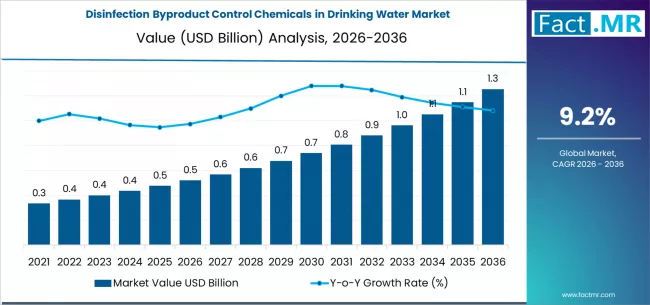
Disinfection Byproduct Control Chemicals In Drinking Water Market Market Value Analysis

Activated carbon and specialized adsorbents lead the market among chemical types, holding a 30% share. Municipal drinking water treatment plants represent the dominant application area, accounting for 38% of demand. The control of Trihalomethanes (THMs) is the primary focus, constituting 34% of the market, reflecting their status as the most prevalent and regulated DBP class.

This expansion is fundamentally propelled by the global enforcement of stricter maximum contaminant levels for DBPs, which form when disinfectants like chlorine react with natural organic matter in water. As utilities strive to balance effective pathogen control with minimizing carcinogenic byproducts, advanced chemical treatment solutions have become essential. These chemicals either remove DBP precursors, scavenge excess disinfectant, or alter formation pathways, enabling compliance without compromising primary disinfection.

The market's evolution is centered on developing more efficient, cost-effective, and sustainable chemistries that integrate seamlessly into existing treatment trains. Innovations aim to address not only traditional DBPs like THMs and HAAs but also emerging nitrogenous and iodinated compounds, ensuring comprehensive protection of public health amidst changing water quality profiles.

Metric

Metric Value
Market Value (2026) USD 0.52 Billion
Market Forecast Value (2036) USD 1.25 Billion
Forecast CAGR (2026-2036) 9.2%

Category

Category Segments
Chemical Type Activated Carbon & Adsorbents, Chlorine Scavengers (Sulfites, Thiosulfate), Bio-Based DBP Control Agents, pH Adjusters & Coagulant Aids, Other Specialty DBP Control Chemicals
Application Area Municipal Drinking Water Plants, Industrial Potable Water Systems, Residential & Commercial Water Treatment, Rural & Decentralized Water Systems, Point-of-Entry / Household Filtration
DBP Type Controlled Trihalomethanes (THMs), Haloacetic Acids (HAAs), Chloramines, Bromate/Chlorite, Other Emerging DBPs
Region North America, Latin America, Western Europe, Eastern Europe, East Asia, South Asia & Pacific, MEA

Segmental Analysis

By Chemical Type, Which Segment is the Workhorse for Precursor Removal?
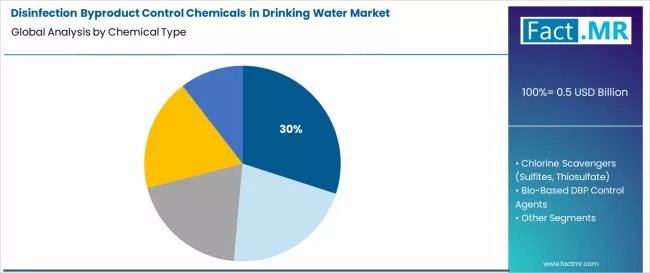
Disinfection Byproduct Control Chemicals In Drinking Water Market Analysis By Chemical Type

Activated carbon and advanced adsorbents lead the market with a 30% share. Their dominance is rooted in their physical removal mechanism, which directly extracts natural organic matter from raw water before disinfection.

Granular and powdered activated carbon (GAC/PAC) are integrated into existing filtration infrastructure, offering a reliable and widely understood solution for utilities to achieve compliance. Their effectiveness in also improving taste, odor, and color reinforces their status as a foundational treatment step for DBP control.

By Application Area, Which Sector Bears the Greatest Regulatory Burden?
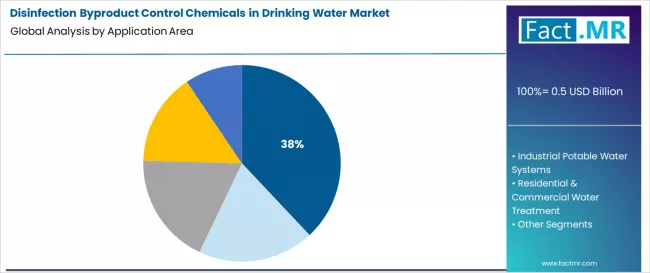
Disinfection Byproduct Control Chemicals In Drinking Water Market Analysis By Application Area

Municipal drinking water treatment plants represent the largest application area, commanding a 38% share. These facilities serve large populations, are subject to the most rigorous, and frequent monitoring for DBPs under regulations like the U.S. EPA's Stage 2 Disinfectants and Disinfection Byproducts Rule.

The scale of their operations and the legal imperative to provide safe water create consistent, high-volume demand for chemical solutions that can reliably keep DBP concentrations below mandated limits across vast distribution networks.

By DBP Type Controlled, Which Class Demands the Most Attention?
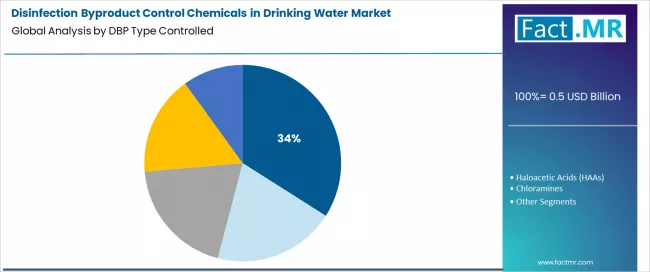
Disinfection Byproduct Control Chemicals In Drinking Water Market Analysis By Dbp Type Controlled

Trihalomethanes (THMs) represent the largest segment of controlled DBPs, holding a 34% share. THMs, including chloroform, are the most commonly detected byproducts of chlorination and are classified as potential human carcinogens.

Their volatility and presence in distribution system dead-ends make them a persistent challenge. Regulatory limits for THMs are often the driving compliance metric for utilities, concentrating research, monitoring, and treatment investments on this specific class of compounds.

What are the Drivers, Restraints, and Key Trends of the DBP Control Chemicals Market?

The primary market driver is the global proliferation and tightening of drinking water quality standards specifically targeting DBPs. Aging infrastructure in many regions introduces variable residence times and higher organic loads, exacerbating DBP formation and pushing utilities toward advanced control measures.

Growing consumer awareness and concern about tap water safety further incentivize utilities to invest in robust treatment. The shift toward alternative disinfectants like chloramines, which produce different byproducts like nitrosamines, also creates demand for new control chemistries.

A significant market restraint is the high capital and operational cost associated with some advanced treatment methods, such as large-scale GAC contactors or membrane systems, which can be prohibitive for smaller utilities. The addition of control chemicals can sometimes create secondary water quality issues, such as changes in pH or increased sulfate levels from sulfite-based scavengers. There is also a technical complexity in optimizing multiple treatment steps to work in harmony without compromising any single objective.

Key trends include the growing adoption of predictive water quality modeling that uses real-time sensor data to optimize chemical dosing for DBP precursor removal ahead of disinfection. There is increasing use of alternative disinfectants combined with enhanced precursor removal strategies to minimize byproduct formation at the source. The market is also seeing a rise in decentralized and point-of-entry solutions, including advanced adsorbent cartridges for households, as consumers take direct action to ensure water safety beyond municipal treatment.

Analysis of the DBP Control Chemicals Market by Key Countries
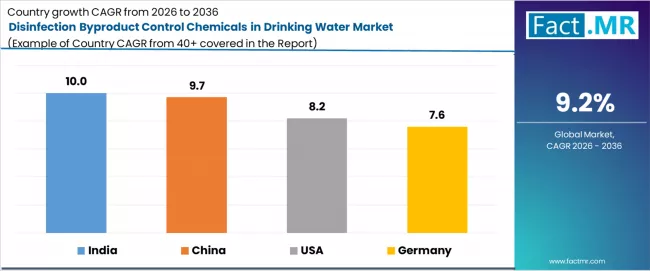
Disinfection Byproduct Control Chemicals In Drinking Water Market Cagr Analysis By Country

Country CAGR (2026-2036)
India 10.00%
China 9.70%
USA 8.20%
Germany 7.60%

How do India’s Expanding Urban Water Systems and New Standards Drive Demand?

India’s leading CAGR of 10.00% is fueled by the rapid expansion of its municipal water supply infrastructure and the introduction of more stringent drinking water standards, such as those under the Jal Jeevan Mission.

As new treatment plants are built and old ones upgraded, there is a significant opportunity to integrate DBP control from the design stage. The challenge of treating surface waters with high organic loads in a warm climate makes DBP management a critical priority, driving adoption of adsorbent and advanced oxidation technologies.

What is the Impact of China’s Drinking Water Safety Upgrades and Pollution Control?

China’s 9.70% growth is linked to its national campaigns to upgrade urban drinking water safety and control source water pollution. The enforcement of stricter standards for DBPs in its drinking water hygiene code compels thousands of water plants to retrofit existing processes.

China’s focus on advanced treatment technologies, including ozone-BAC and enhanced coagulation, creates substantial demand for complementary chemical programs to manage the byproducts of these advanced processes themselves.

How does the USA’s Mature Regulatory Framework and Infrastructure Renewal Shape the Market?
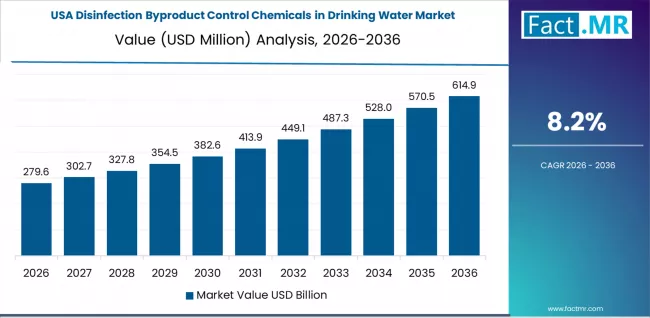
Disinfection Byproduct Control Chemicals In Drinking Water Market Country Value Analysis

A long-standing and evolving regulatory framework supports the USA’s 8.20% CAGR for DBPs, which continuously pushes utilities toward lower contaminant levels. Investments in renewing aging water infrastructure often include upgrades to GAC filtration, membrane systems, and advanced chemical feed systems for better process control. The market is characterized by a shift from reactive compliance to proactive optimization, favoring sophisticated chemical treatment programs and monitoring technologies.

Why is Germany a Focus for High-Efficiency and Process-Integrated Solutions?

Germany’s 7.60% growth reflects its rigorous adherence to EU drinking water directives and a strong engineering emphasis on process efficiency and optimization. German water utilities prioritize integrated treatment trains that minimize chemical usage overall.

This drives demand for highly effective, low-dose specialty chemicals for coagulation and pH adjustment that maximize NOM removal upstream, thereby reducing the disinfectant demand and DBP formation potential downstream, aligning with a preventative, holistic approach.

Competitive Landscape of the DBP Control Chemicals Market
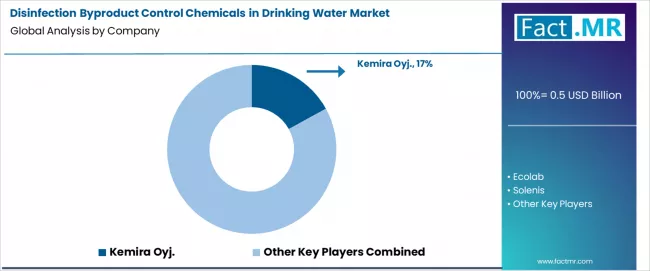
Disinfection Byproduct Control Chemicals In Drinking Water Market Analysis By Company

Global water treatment chemical companies characterize the competitive landscape with extensive portfolios spanning coagulants, disinfectants, and specialty additives. Leaders like Kemira and Ecolab compete by offering integrated chemical solutions that address the entire treatment chain, from optimized coagulation for NOM removal to precise disinfectant residual management.

Competition centers on providing application-specific technical support, demonstrable compliance data from full-scale installations, and digital tools for dose optimization. A key differentiator is the ability to offer a complete "water quality management" program that guarantees DBP compliance while optimizing other operational costs like sludge production and corrosion control.

Key Players in the Disinfection Byproduct Control Chemicals Market

  • Kemira Oyj.
  • Ecolab
  • Solenis
  • Veolia Water Technologies
  • SUEZ Water Technologies

Scope of Report

Items Values
Quantitative Units USD Billion
Chemical Type Activated Carbon/Adsorbents, Chlorine Scavengers, Bio-Based Agents, pH Adjusters/Coagulant Aids, Specialty Chemicals
Application Area Municipal Plants, Industrial Systems, Residential/Commercial Treatment, Decentralized Systems, Point-of-Entry Filtration
DBP Type Controlled Trihalomethanes (THMs), Haloacetic Acids (HAAs), Chloramines, Bromate/Chlorite, Emerging DBPs
Key Countries India, China, USA, Germany
Key Companies Kemira, Ecolab, Solenis, Veolia Water Technologies, SUEZ Water Technologies
Additional Analysis Analysis of DBP formation potential (DBPFP) testing; impact of source water characteristics (NOM type, bromide levels); interaction between different disinfectants and control chemicals; lifecycle cost analysis of adsorption vs. chemical scavenging; regulatory evolution and future MCL trends.

Market by Segments

  • Chemical Type :

    • Activated Carbon & Adsorbents
    • Chlorine Scavengers (Sulfites, Thiosulfate)
    • Bio-Based DBP Control Agents
    • pH Adjusters & Coagulant Aids
    • Other Specialty DBP Control Chemicals
  • Application Area :

    • Municipal Drinking Water Plants
    • Industrial Potable Water Systems
    • Residential & Commercial Water Treatment
    • Rural & Decentralized Water Systems
    • Point-of-Entry/Household Filtration
  • DBP Type Controlled :

    • Trihalomethanes (THMs)
    • Haloacetic Acids (HAAs)
    • Chloramines
    • Bromate/Chlorite
    • Other Emerging DBPs
  • Region :

    • North America

      • USA
      • Canada
    • Latin America

      • Brazil
      • Mexico
      • Argentina
      • Rest of Latin America
    • Western Europe

      • Germany
      • UK
      • France
      • Spain
      • Italy
      • BENELUX
      • Rest of Western Europe
    • Eastern Europe

      • Russia
      • Poland
      • Czech Republic
      • Rest of Eastern Europe
    • East Asia

      • China
      • Japan
      • South Korea
      • Rest of East Asia
    • South Asia & Pacific

      • India
      • ASEAN
      • Australia
      • Rest of South Asia & Pacific
    • MEA

      • Saudi Arabia
      • UAE
      • Turkiye
      • Rest of MEA

Table of Content

  1. Executive Summary
    • Global Market Outlook
    • Demand to side Trends
    • Supply to side Trends
    • Technology Roadmap Analysis
    • Analysis and Recommendations
  2. Market Overview
    • Market Coverage / Taxonomy
    • Market Definition / Scope / Limitations
  3. Market Background
    • Market Dynamics
      • Drivers
      • Restraints
      • Opportunity
      • Trends
    • Scenario Forecast
      • Demand in Optimistic Scenario
      • Demand in Likely Scenario
      • Demand in Conservative Scenario
    • Opportunity Map Analysis
    • Product Life Cycle Analysis
    • Supply Chain Analysis
    • Investment Feasibility Matrix
    • Value Chain Analysis
    • PESTLE and Porter’s Analysis
    • Regulatory Landscape
    • Regional Parent Market Outlook
    • Production and Consumption Statistics
    • Import and Export Statistics
  4. Global Market Analysis 2021 to 2025 and Forecast, 2026 to 2036
    • Historical Market Size Value (USD Million) Analysis, 2021 to 2025
    • Current and Future Market Size Value (USD Million) Projections, 2026 to 2036
      • Y to o to Y Growth Trend Analysis
      • Absolute $ Opportunity Analysis
  5. Global Market Pricing Analysis 2021 to 2025 and Forecast 2026 to 2036
  6. Global Market Analysis 2021 to 2025 and Forecast 2026 to 2036, By Chemical Type
    • Introduction / Key Findings
    • Historical Market Size Value (USD Million) Analysis By Chemical Type, 2021 to 2025
    • Current and Future Market Size Value (USD Million) Analysis and Forecast By Chemical Type, 2026 to 2036
      • Activated Carbon & Adsorbents
      • Chlorine Scavengers (Sulfites, Thiosulfate)
      • Bio-Based DBP Control Agents
      • pH Adjusters & Coagulant Aids
      • Other Specialty DBP Control Chemicals
    • Y to o to Y Growth Trend Analysis By Chemical Type, 2021 to 2025
    • Absolute $ Opportunity Analysis By Chemical Type, 2026 to 2036
  7. Global Market Analysis 2021 to 2025 and Forecast 2026 to 2036, By Application Area
    • Introduction / Key Findings
    • Historical Market Size Value (USD Million) Analysis By Application Area, 2021 to 2025
    • Current and Future Market Size Value (USD Million) Analysis and Forecast By Application Area, 2026 to 2036
      • Municipal Drinking Water Plants
      • Industrial Potable Water Systems
      • Residential & Commercial Water Treatment
      • Rural & Decentralized Water Systems
      • Point-of-Entry / Household Filtration
    • Y to o to Y Growth Trend Analysis By Application Area, 2021 to 2025
    • Absolute $ Opportunity Analysis By Application Area, 2026 to 2036
  8. Global Market Analysis 2021 to 2025 and Forecast 2026 to 2036, By DBP Type Controlled
    • Introduction / Key Findings
    • Historical Market Size Value (USD Million) Analysis By DBP Type Controlled, 2021 to 2025
    • Current and Future Market Size Value (USD Million) Analysis and Forecast By DBP Type Controlled, 2026 to 2036
      • Trihalomethanes (THMs)
      • Haloacetic Acids (HAAs)
      • Chloramines
      • Bromate / Chlorite
      • Other Emerging DBPs
    • Y to o to Y Growth Trend Analysis By DBP Type Controlled, 2021 to 2025
    • Absolute $ Opportunity Analysis By DBP Type Controlled, 2026 to 2036
  9. Global Market Analysis 2021 to 2025 and Forecast 2026 to 2036, By Region
    • Introduction
    • Historical Market Size Value (USD Million) Analysis By Region, 2021 to 2025
    • Current Market Size Value (USD Million) Analysis and Forecast By Region, 2026 to 2036
      • North America
      • Latin America
      • Western Europe
      • Eastern Europe
      • East Asia
      • South Asia and Pacific
      • Middle East & Africa
    • Market Attractiveness Analysis By Region
  10. North America Market Analysis 2021 to 2025 and Forecast 2026 to 2036, By Country
    • Historical Market Size Value (USD Million) Trend Analysis By Market Taxonomy, 2021 to 2025
    • Market Size Value (USD Million) Forecast By Market Taxonomy, 2026 to 2036
      • By Country
        • USA
        • Canada
        • Mexico
      • By Chemical Type
      • By Application Area
      • By DBP Type Controlled
    • Market Attractiveness Analysis
      • By Country
      • By Chemical Type
      • By Application Area
      • By DBP Type Controlled
    • Key Takeaways
  11. Latin America Market Analysis 2021 to 2025 and Forecast 2026 to 2036, By Country
    • Historical Market Size Value (USD Million) Trend Analysis By Market Taxonomy, 2021 to 2025
    • Market Size Value (USD Million) Forecast By Market Taxonomy, 2026 to 2036
      • By Country
        • Brazil
        • Chile
        • Rest of Latin America
      • By Chemical Type
      • By Application Area
      • By DBP Type Controlled
    • Market Attractiveness Analysis
      • By Country
      • By Chemical Type
      • By Application Area
      • By DBP Type Controlled
    • Key Takeaways
  12. Western Europe Market Analysis 2021 to 2025 and Forecast 2026 to 2036, By Country
    • Historical Market Size Value (USD Million) Trend Analysis By Market Taxonomy, 2021 to 2025
    • Market Size Value (USD Million) Forecast By Market Taxonomy, 2026 to 2036
      • By Country
        • Germany
        • UK
        • Italy
        • Spain
        • France
        • Nordic
        • BENELUX
        • Rest of Western Europe
      • By Chemical Type
      • By Application Area
      • By DBP Type Controlled
    • Market Attractiveness Analysis
      • By Country
      • By Chemical Type
      • By Application Area
      • By DBP Type Controlled
    • Key Takeaways
  13. Eastern Europe Market Analysis 2021 to 2025 and Forecast 2026 to 2036, By Country
    • Historical Market Size Value (USD Million) Trend Analysis By Market Taxonomy, 2021 to 2025
    • Market Size Value (USD Million) Forecast By Market Taxonomy, 2026 to 2036
      • By Country
        • Russia
        • Poland
        • Hungary
        • Balkan & Baltic
        • Rest of Eastern Europe
      • By Chemical Type
      • By Application Area
      • By DBP Type Controlled
    • Market Attractiveness Analysis
      • By Country
      • By Chemical Type
      • By Application Area
      • By DBP Type Controlled
    • Key Takeaways
  14. East Asia Market Analysis 2021 to 2025 and Forecast 2026 to 2036, By Country
    • Historical Market Size Value (USD Million) Trend Analysis By Market Taxonomy, 2021 to 2025
    • Market Size Value (USD Million) Forecast By Market Taxonomy, 2026 to 2036
      • By Country
        • China
        • Japan
        • South Korea
      • By Chemical Type
      • By Application Area
      • By DBP Type Controlled
    • Market Attractiveness Analysis
      • By Country
      • By Chemical Type
      • By Application Area
      • By DBP Type Controlled
    • Key Takeaways
  15. South Asia and Pacific Market Analysis 2021 to 2025 and Forecast 2026 to 2036, By Country
    • Historical Market Size Value (USD Million) Trend Analysis By Market Taxonomy, 2021 to 2025
    • Market Size Value (USD Million) Forecast By Market Taxonomy, 2026 to 2036
      • By Country
        • India
        • ASEAN
        • Australia & New Zealand
        • Rest of South Asia and Pacific
      • By Chemical Type
      • By Application Area
      • By DBP Type Controlled
    • Market Attractiveness Analysis
      • By Country
      • By Chemical Type
      • By Application Area
      • By DBP Type Controlled
    • Key Takeaways
  16. Middle East & Africa Market Analysis 2021 to 2025 and Forecast 2026 to 2036, By Country
    • Historical Market Size Value (USD Million) Trend Analysis By Market Taxonomy, 2021 to 2025
    • Market Size Value (USD Million) Forecast By Market Taxonomy, 2026 to 2036
      • By Country
        • Kingdom of Saudi Arabia
        • Other GCC Countries
        • Turkiye
        • South Africa
        • Other African Union
        • Rest of Middle East & Africa
      • By Chemical Type
      • By Application Area
      • By DBP Type Controlled
    • Market Attractiveness Analysis
      • By Country
      • By Chemical Type
      • By Application Area
      • By DBP Type Controlled
    • Key Takeaways
  17. Key Countries Market Analysis
    • USA
      • Pricing Analysis
      • Market Share Analysis, 2025
        • By Chemical Type
        • By Application Area
        • By DBP Type Controlled
    • Canada
      • Pricing Analysis
      • Market Share Analysis, 2025
        • By Chemical Type
        • By Application Area
        • By DBP Type Controlled
    • Mexico
      • Pricing Analysis
      • Market Share Analysis, 2025
        • By Chemical Type
        • By Application Area
        • By DBP Type Controlled
    • Brazil
      • Pricing Analysis
      • Market Share Analysis, 2025
        • By Chemical Type
        • By Application Area
        • By DBP Type Controlled
    • Chile
      • Pricing Analysis
      • Market Share Analysis, 2025
        • By Chemical Type
        • By Application Area
        • By DBP Type Controlled
    • Germany
      • Pricing Analysis
      • Market Share Analysis, 2025
        • By Chemical Type
        • By Application Area
        • By DBP Type Controlled
    • UK
      • Pricing Analysis
      • Market Share Analysis, 2025
        • By Chemical Type
        • By Application Area
        • By DBP Type Controlled
    • Italy
      • Pricing Analysis
      • Market Share Analysis, 2025
        • By Chemical Type
        • By Application Area
        • By DBP Type Controlled
    • Spain
      • Pricing Analysis
      • Market Share Analysis, 2025
        • By Chemical Type
        • By Application Area
        • By DBP Type Controlled
    • France
      • Pricing Analysis
      • Market Share Analysis, 2025
        • By Chemical Type
        • By Application Area
        • By DBP Type Controlled
    • India
      • Pricing Analysis
      • Market Share Analysis, 2025
        • By Chemical Type
        • By Application Area
        • By DBP Type Controlled
    • ASEAN
      • Pricing Analysis
      • Market Share Analysis, 2025
        • By Chemical Type
        • By Application Area
        • By DBP Type Controlled
    • Australia & New Zealand
      • Pricing Analysis
      • Market Share Analysis, 2025
        • By Chemical Type
        • By Application Area
        • By DBP Type Controlled
    • China
      • Pricing Analysis
      • Market Share Analysis, 2025
        • By Chemical Type
        • By Application Area
        • By DBP Type Controlled
    • Japan
      • Pricing Analysis
      • Market Share Analysis, 2025
        • By Chemical Type
        • By Application Area
        • By DBP Type Controlled
    • South Korea
      • Pricing Analysis
      • Market Share Analysis, 2025
        • By Chemical Type
        • By Application Area
        • By DBP Type Controlled
    • Russia
      • Pricing Analysis
      • Market Share Analysis, 2025
        • By Chemical Type
        • By Application Area
        • By DBP Type Controlled
    • Poland
      • Pricing Analysis
      • Market Share Analysis, 2025
        • By Chemical Type
        • By Application Area
        • By DBP Type Controlled
    • Hungary
      • Pricing Analysis
      • Market Share Analysis, 2025
        • By Chemical Type
        • By Application Area
        • By DBP Type Controlled
    • Kingdom of Saudi Arabia
      • Pricing Analysis
      • Market Share Analysis, 2025
        • By Chemical Type
        • By Application Area
        • By DBP Type Controlled
    • Turkiye
      • Pricing Analysis
      • Market Share Analysis, 2025
        • By Chemical Type
        • By Application Area
        • By DBP Type Controlled
    • South Africa
      • Pricing Analysis
      • Market Share Analysis, 2025
        • By Chemical Type
        • By Application Area
        • By DBP Type Controlled
  18. Market Structure Analysis
    • Competition Dashboard
    • Competition Benchmarking
    • Market Share Analysis of Top Players
      • By Regional
      • By Chemical Type
      • By Application Area
      • By DBP Type Controlled
  19. Competition Analysis
    • Competition Deep Dive
      • Kemira Oyj.
        • Overview
        • Product Portfolio
        • Profitability by Market Segments (Product/Age /Sales Channel/Region)
        • Sales Footprint
        • Strategy Overview
          • Marketing Strategy
          • Product Strategy
          • Channel Strategy
      • Ecolab
      • Solenis
      • Veolia Water Technologies
      • SUEZ Water Technologies
  20. Assumptions & Acronyms Used
  21. Research Methodology

List Of Table

  • Table 1: Global Market Value (USD Million) Forecast by Region, 2021 to 2036
  • Table 2: Global Market Value (USD Million) Forecast by Chemical Type, 2021 to 2036
  • Table 3: Global Market Value (USD Million) Forecast by Application Area, 2021 to 2036
  • Table 4: Global Market Value (USD Million) Forecast by DBP Type Controlled, 2021 to 2036
  • Table 5: North America Market Value (USD Million) Forecast by Country, 2021 to 2036
  • Table 6: North America Market Value (USD Million) Forecast by Chemical Type, 2021 to 2036
  • Table 7: North America Market Value (USD Million) Forecast by Application Area, 2021 to 2036
  • Table 8: North America Market Value (USD Million) Forecast by DBP Type Controlled, 2021 to 2036
  • Table 9: Latin America Market Value (USD Million) Forecast by Country, 2021 to 2036
  • Table 10: Latin America Market Value (USD Million) Forecast by Chemical Type, 2021 to 2036
  • Table 11: Latin America Market Value (USD Million) Forecast by Application Area, 2021 to 2036
  • Table 12: Latin America Market Value (USD Million) Forecast by DBP Type Controlled, 2021 to 2036
  • Table 13: Western Europe Market Value (USD Million) Forecast by Country, 2021 to 2036
  • Table 14: Western Europe Market Value (USD Million) Forecast by Chemical Type, 2021 to 2036
  • Table 15: Western Europe Market Value (USD Million) Forecast by Application Area, 2021 to 2036
  • Table 16: Western Europe Market Value (USD Million) Forecast by DBP Type Controlled, 2021 to 2036
  • Table 17: Eastern Europe Market Value (USD Million) Forecast by Country, 2021 to 2036
  • Table 18: Eastern Europe Market Value (USD Million) Forecast by Chemical Type, 2021 to 2036
  • Table 19: Eastern Europe Market Value (USD Million) Forecast by Application Area, 2021 to 2036
  • Table 20: Eastern Europe Market Value (USD Million) Forecast by DBP Type Controlled, 2021 to 2036
  • Table 21: East Asia Market Value (USD Million) Forecast by Country, 2021 to 2036
  • Table 22: East Asia Market Value (USD Million) Forecast by Chemical Type, 2021 to 2036
  • Table 23: East Asia Market Value (USD Million) Forecast by Application Area, 2021 to 2036
  • Table 24: East Asia Market Value (USD Million) Forecast by DBP Type Controlled, 2021 to 2036
  • Table 25: South Asia and Pacific Market Value (USD Million) Forecast by Country, 2021 to 2036
  • Table 26: South Asia and Pacific Market Value (USD Million) Forecast by Chemical Type, 2021 to 2036
  • Table 27: South Asia and Pacific Market Value (USD Million) Forecast by Application Area, 2021 to 2036
  • Table 28: South Asia and Pacific Market Value (USD Million) Forecast by DBP Type Controlled, 2021 to 2036
  • Table 29: Middle East & Africa Market Value (USD Million) Forecast by Country, 2021 to 2036
  • Table 30: Middle East & Africa Market Value (USD Million) Forecast by Chemical Type, 2021 to 2036
  • Table 31: Middle East & Africa Market Value (USD Million) Forecast by Application Area, 2021 to 2036
  • Table 32: Middle East & Africa Market Value (USD Million) Forecast by DBP Type Controlled, 2021 to 2036

List Of Figures

  • Figure 1: Global Market Pricing Analysis
  • Figure 2: Global Market Value (USD Million) Forecast 2021 to 2036
  • Figure 3: Global Market Value Share and BPS Analysis by Chemical Type, 2026 and 2036
  • Figure 4: Global Market Y to o to Y Growth Comparison by Chemical Type, 2026 to 2036
  • Figure 5: Global Market Attractiveness Analysis by Chemical Type
  • Figure 6: Global Market Value Share and BPS Analysis by Application Area, 2026 and 2036
  • Figure 7: Global Market Y to o to Y Growth Comparison by Application Area, 2026 to 2036
  • Figure 8: Global Market Attractiveness Analysis by Application Area
  • Figure 9: Global Market Value Share and BPS Analysis by DBP Type Controlled, 2026 and 2036
  • Figure 10: Global Market Y to o to Y Growth Comparison by DBP Type Controlled, 2026 to 2036
  • Figure 11: Global Market Attractiveness Analysis by DBP Type Controlled
  • Figure 12: Global Market Value (USD Million) Share and BPS Analysis by Region, 2026 and 2036
  • Figure 13: Global Market Y to o to Y Growth Comparison by Region, 2026 to 2036
  • Figure 14: Global Market Attractiveness Analysis by Region
  • Figure 15: North America Market Incremental Dollar Opportunity, 2026 to 2036
  • Figure 16: Latin America Market Incremental Dollar Opportunity, 2026 to 2036
  • Figure 17: Western Europe Market Incremental Dollar Opportunity, 2026 to 2036
  • Figure 18: Eastern Europe Market Incremental Dollar Opportunity, 2026 to 2036
  • Figure 19: East Asia Market Incremental Dollar Opportunity, 2026 to 2036
  • Figure 20: South Asia and Pacific Market Incremental Dollar Opportunity, 2026 to 2036
  • Figure 21: Middle East & Africa Market Incremental Dollar Opportunity, 2026 to 2036
  • Figure 22: North America Market Value Share and BPS Analysis by Country, 2026 and 2036
  • Figure 23: North America Market Value Share and BPS Analysis by Chemical Type, 2026 and 2036
  • Figure 24: North America Market Y to o to Y Growth Comparison by Chemical Type, 2026 to 2036
  • Figure 25: North America Market Attractiveness Analysis by Chemical Type
  • Figure 26: North America Market Value Share and BPS Analysis by Application Area, 2026 and 2036
  • Figure 27: North America Market Y to o to Y Growth Comparison by Application Area, 2026 to 2036
  • Figure 28: North America Market Attractiveness Analysis by Application Area
  • Figure 29: North America Market Value Share and BPS Analysis by DBP Type Controlled, 2026 and 2036
  • Figure 30: North America Market Y to o to Y Growth Comparison by DBP Type Controlled, 2026 to 2036
  • Figure 31: North America Market Attractiveness Analysis by DBP Type Controlled
  • Figure 32: Latin America Market Value Share and BPS Analysis by Country, 2026 and 2036
  • Figure 33: Latin America Market Value Share and BPS Analysis by Chemical Type, 2026 and 2036
  • Figure 34: Latin America Market Y to o to Y Growth Comparison by Chemical Type, 2026 to 2036
  • Figure 35: Latin America Market Attractiveness Analysis by Chemical Type
  • Figure 36: Latin America Market Value Share and BPS Analysis by Application Area, 2026 and 2036
  • Figure 37: Latin America Market Y to o to Y Growth Comparison by Application Area, 2026 to 2036
  • Figure 38: Latin America Market Attractiveness Analysis by Application Area
  • Figure 39: Latin America Market Value Share and BPS Analysis by DBP Type Controlled, 2026 and 2036
  • Figure 40: Latin America Market Y to o to Y Growth Comparison by DBP Type Controlled, 2026 to 2036
  • Figure 41: Latin America Market Attractiveness Analysis by DBP Type Controlled
  • Figure 42: Western Europe Market Value Share and BPS Analysis by Country, 2026 and 2036
  • Figure 43: Western Europe Market Value Share and BPS Analysis by Chemical Type, 2026 and 2036
  • Figure 44: Western Europe Market Y to o to Y Growth Comparison by Chemical Type, 2026 to 2036
  • Figure 45: Western Europe Market Attractiveness Analysis by Chemical Type
  • Figure 46: Western Europe Market Value Share and BPS Analysis by Application Area, 2026 and 2036
  • Figure 47: Western Europe Market Y to o to Y Growth Comparison by Application Area, 2026 to 2036
  • Figure 48: Western Europe Market Attractiveness Analysis by Application Area
  • Figure 49: Western Europe Market Value Share and BPS Analysis by DBP Type Controlled, 2026 and 2036
  • Figure 50: Western Europe Market Y to o to Y Growth Comparison by DBP Type Controlled, 2026 to 2036
  • Figure 51: Western Europe Market Attractiveness Analysis by DBP Type Controlled
  • Figure 52: Eastern Europe Market Value Share and BPS Analysis by Country, 2026 and 2036
  • Figure 53: Eastern Europe Market Value Share and BPS Analysis by Chemical Type, 2026 and 2036
  • Figure 54: Eastern Europe Market Y to o to Y Growth Comparison by Chemical Type, 2026 to 2036
  • Figure 55: Eastern Europe Market Attractiveness Analysis by Chemical Type
  • Figure 56: Eastern Europe Market Value Share and BPS Analysis by Application Area, 2026 and 2036
  • Figure 57: Eastern Europe Market Y to o to Y Growth Comparison by Application Area, 2026 to 2036
  • Figure 58: Eastern Europe Market Attractiveness Analysis by Application Area
  • Figure 59: Eastern Europe Market Value Share and BPS Analysis by DBP Type Controlled, 2026 and 2036
  • Figure 60: Eastern Europe Market Y to o to Y Growth Comparison by DBP Type Controlled, 2026 to 2036
  • Figure 61: Eastern Europe Market Attractiveness Analysis by DBP Type Controlled
  • Figure 62: East Asia Market Value Share and BPS Analysis by Country, 2026 and 2036
  • Figure 63: East Asia Market Value Share and BPS Analysis by Chemical Type, 2026 and 2036
  • Figure 64: East Asia Market Y to o to Y Growth Comparison by Chemical Type, 2026 to 2036
  • Figure 65: East Asia Market Attractiveness Analysis by Chemical Type
  • Figure 66: East Asia Market Value Share and BPS Analysis by Application Area, 2026 and 2036
  • Figure 67: East Asia Market Y to o to Y Growth Comparison by Application Area, 2026 to 2036
  • Figure 68: East Asia Market Attractiveness Analysis by Application Area
  • Figure 69: East Asia Market Value Share and BPS Analysis by DBP Type Controlled, 2026 and 2036
  • Figure 70: East Asia Market Y to o to Y Growth Comparison by DBP Type Controlled, 2026 to 2036
  • Figure 71: East Asia Market Attractiveness Analysis by DBP Type Controlled
  • Figure 72: South Asia and Pacific Market Value Share and BPS Analysis by Country, 2026 and 2036
  • Figure 73: South Asia and Pacific Market Value Share and BPS Analysis by Chemical Type, 2026 and 2036
  • Figure 74: South Asia and Pacific Market Y to o to Y Growth Comparison by Chemical Type, 2026 to 2036
  • Figure 75: South Asia and Pacific Market Attractiveness Analysis by Chemical Type
  • Figure 76: South Asia and Pacific Market Value Share and BPS Analysis by Application Area, 2026 and 2036
  • Figure 77: South Asia and Pacific Market Y to o to Y Growth Comparison by Application Area, 2026 to 2036
  • Figure 78: South Asia and Pacific Market Attractiveness Analysis by Application Area
  • Figure 79: South Asia and Pacific Market Value Share and BPS Analysis by DBP Type Controlled, 2026 and 2036
  • Figure 80: South Asia and Pacific Market Y to o to Y Growth Comparison by DBP Type Controlled, 2026 to 2036
  • Figure 81: South Asia and Pacific Market Attractiveness Analysis by DBP Type Controlled
  • Figure 82: Middle East & Africa Market Value Share and BPS Analysis by Country, 2026 and 2036
  • Figure 83: Middle East & Africa Market Value Share and BPS Analysis by Chemical Type, 2026 and 2036
  • Figure 84: Middle East & Africa Market Y to o to Y Growth Comparison by Chemical Type, 2026 to 2036
  • Figure 85: Middle East & Africa Market Attractiveness Analysis by Chemical Type
  • Figure 86: Middle East & Africa Market Value Share and BPS Analysis by Application Area, 2026 and 2036
  • Figure 87: Middle East & Africa Market Y to o to Y Growth Comparison by Application Area, 2026 to 2036
  • Figure 88: Middle East & Africa Market Attractiveness Analysis by Application Area
  • Figure 89: Middle East & Africa Market Value Share and BPS Analysis by DBP Type Controlled, 2026 and 2036
  • Figure 90: Middle East & Africa Market Y to o to Y Growth Comparison by DBP Type Controlled, 2026 to 2036
  • Figure 91: Middle East & Africa Market Attractiveness Analysis by DBP Type Controlled
  • Figure 92: Global Market - Tier Structure Analysis
  • Figure 93: Global Market - Company Share Analysis

- FAQs -

How big is the disinfection byproduct control chemicals in drinking water market in 2026?

The global disinfection byproduct control chemicals in drinking water market is estimated to be valued at USD 0.5 billion in 2026.

What will be the size of disinfection byproduct control chemicals in drinking water market in 2036?

The market size for the disinfection byproduct control chemicals in drinking water market is projected to reach USD 1.3 billion by 2036.

How much will be the disinfection byproduct control chemicals in drinking water market growth between 2026 and 2036?

The disinfection byproduct control chemicals in drinking water market is expected to grow at a 9.2% CAGR between 2026 and 2036.

What are the key product types in the disinfection byproduct control chemicals in drinking water market?

The key product types in disinfection byproduct control chemicals in drinking water market are activated carbon & adsorbents, chlorine scavengers (sulfites, thiosulfate), bio-based dbp control agents, ph adjusters & coagulant aids and other specialty dbp control chemicals.

Which application area segment to contribute significant share in the disinfection byproduct control chemicals in drinking water market in 2026?

In terms of application area, municipal drinking water plants segment to command 38.0% share in the disinfection byproduct control chemicals in drinking water market in 2026.

Disinfection Byproduct Control Chemicals in Drinking Water Market