- Base Value(2026): 260.00 Mn
- Estimated Value(2026): 260.0 Mn
- Forecast Value (2036): 662.2 Mn
- CAGR (2026 - 2036): 9.8%
Bio-Based Coagulants for Municipal Water Market Forecast and Outlook 2026 to 2036
The global market for bio-based coagulants in municipal water treatment is projected to reach USD 662.21 million by 2036. The market is valued at USD 260.00 million in 2026 and is set to rise at a CAGR of 9.8% during the assessment period.
Key Takeaways from the Bio-Based Coagulants for Municipal Water Market
- Market Value for 2026: USD 260.00 Million
- Market Value for 2036: USD 662.21 Million
- Forecast CAGR (2026-2036): 9.8%
- Leading Coagulant Type Share (2026): Bio-Polymer Coagulants (Chitosan, Starch, Guar) (38%)
- Leading Treatment Application Share (2026): Drinking Water Treatment (42%)
- Leading Municipality Size Share (2026): Large Urban Utilities (40%)
- Key Players in the Market: SNF Floerger, Kemira Oyj., Solenis, Ecolab Inc., Veolia Environnement S.A.
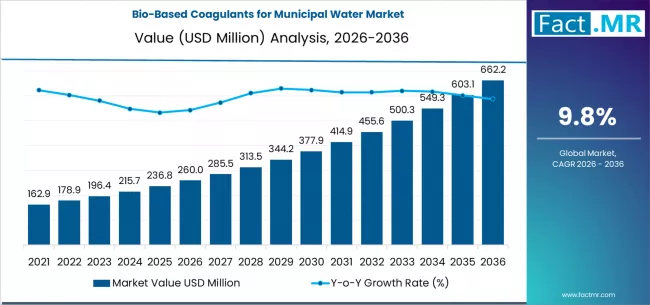
Bio Based Coagulants For Municipal Water Market Market Value Analysis | Source: Fact.MR
By coagulant type, bio-polymer coagulants hold a leading 38% share. The treatment application for drinking water treatment represents the dominant segment at 42%. Large urban utilities constitute the leading municipality size, accounting for a 40% share.
This growth is propelled by a global shift toward sustainable and non-toxic water treatment chemicals, driven by stricter regulations on residual chemical traces in drinking water and a growing emphasis on circular economy principles within municipal infrastructure.
Bio-based coagulants, derived from natural sources like plants, crustacean shells, and starches, offer an effective alternative to conventional metal salts. They address key concerns over aluminum or iron residues in treated water and sludge, while also providing a biodegradable and often renewable solution for clarifying raw water, treating wastewater, and managing sludge.
Bio-Based Coagulants for Municipal Water Market
| Metric | Value |
|---|---|
| Market Value (2026) | USD 260.00 Million |
| Market Forecast Value (2036) | USD 662.21 Million |
| Forecast CAGR (2026-2036) | 9.8% |
Source: Fact.MR analysis. Updated Dec 29, 2025
Category
| Category | Segments |
|---|---|
| Coagulant Type | Bio-Polymer Coagulants (Chitosan, Starch, Guar), Plant-Derived Tannin-Based Coagulants, Bio-Modified Hybrid Coagulants, Other Organic & Natural Coagulants |
| Treatment Application | Drinking Water Treatment, Sewage & Wastewater Clarification, Sludge Thickening & Dewatering, Stormwater & Surface Water Treatment, Other Municipal Water Uses |
| Municipality Size | Large Urban Utilities, Medium-Sized Municipalities, Small Town/Rural Utilities, Decentralized/Community-Based Systems |
| Region | North America, Latin America, Western Europe, Eastern Europe, East Asia, South Asia & Pacific, MEA |
Source: Fact.MR analysis. Updated Dec 29, 2025
Segmental Analysis
By Coagulant Type, Which Segment is at the Forefront of Bio-Based Adoption?
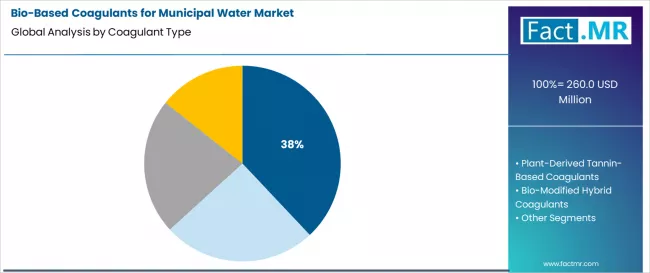
Bio Based Coagulants For Municipal Water Market Analysis By Coagulant Type | Source: Fact.MR
Bio-polymer coagulants, including chitosan, starch, and guar derivatives, lead the segment with a 38% share. Their dominance stems from their effectiveness and relative commercial maturity. Chitosan, in particular, is valued for its dual action as a coagulant and flocculant, effective at lower doses across a wider pH range compared to some plant-based options.
The versatility and proven performance of these biopolymers in both drinking and wastewater applications make them the primary entry point for municipalities transitioning from conventional chemicals.
By Treatment Application, Where is the Demand for Non-Toxic Coagulants Most Critical?
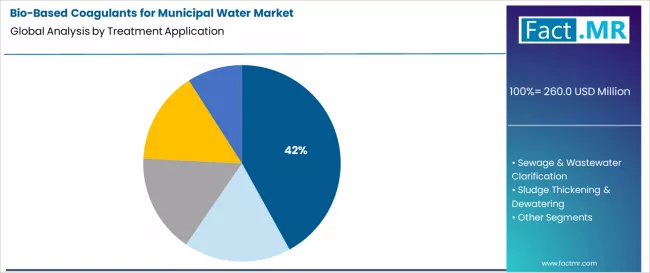
Bio Based Coagulants For Municipal Water Market Analysis By Treatment Application | Source: Fact.MR
Drinking water treatment represents the largest application segment at 42%. The imperative to eliminate residual metal ions like aluminum from finished water is a powerful driver. Health-conscious consumers and stringent potable water standards are pushing large utilities to explore and adopt bio-based alternatives that leave no harmful residues, ensuring safety from the treatment plant to the tap. This focus on public health safety creates the most significant and quality-sensitive demand.
By Municipality Size, Which Segment Leads in Piloting and Scaling New Technologies?
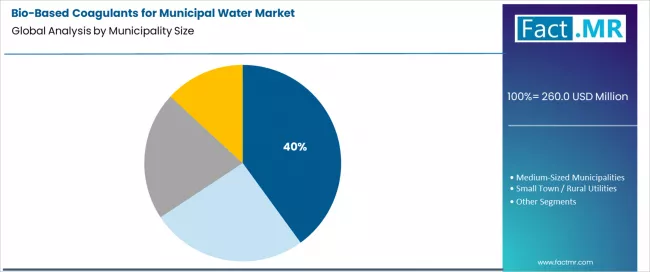
Bio Based Coagulants For Municipal Water Market Analysis By Municipality Size | Source: Fact.MR
Large urban utilities lead with a 40% share. These entities possess the technical expertise, larger budgets for innovation, and the scale to pilot new technologies. Facing scrutiny over their environmental footprint and sludge disposal challenges, large utilities are strategically investing in bio-based coagulants to future-proof their operations, reduce chemical sludge toxicity, and meet ambitious sustainability targets, thereby setting trends for the wider market.
What are the Drivers, Restraints, and Key Trends of the Bio-Based Coagulants for Municipal Water Market?
The fundamental market driver is the increasing regulatory and consumer pressure to reduce the environmental and health impact of water treatment chemicals. Regulations limiting metal residues in sludge applied to land directly incentivize the switch to bio-based options. Municipal sustainability goals and certifications further accelerate adoption, as bio-based coagulants contribute to greener operations and a reduced carbon footprint.
A primary restraint is the performance variability of natural products compared to standardized synthetic chemicals. The efficacy of bio-based coagulants can be influenced by raw water quality parameters like temperature, pH, and organic content, requiring careful selection and possible process adjustment. Their generally higher unit cost and sometimes shorter shelf-life can also pose economic and logistical challenges for budget-constrained municipalities.
Key trends include the development of enhanced and modified biopolymers with improved stability, shelf-life, and efficacy across varying water conditions. There is growing innovation in locally sourced, circular economy feedstocks, such as using agricultural waste for coagulant production. The market is also seeing the rise of blended or hybrid formulations that combine bio-based materials with minimal amounts of traditional coagulants to optimize performance and cost.
Analysis of the Bio-Based Coagulants for Municipal Water Market by Key Countries
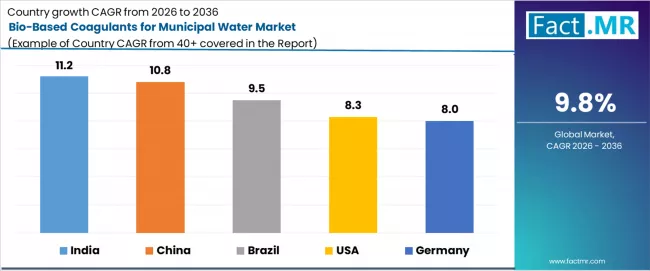
Bio Based Coagulants For Municipal Water Market Cagr Analysis By Country | Source: Fact.MR
| Country | CAGR (2026-2036) |
|---|---|
| India | 11.20% |
| China | 10.80% |
| Brazil | 9.50% |
| USA | 8.30% |
| Germany | 8.00% |
Source: Fact.MR analysis. Updated Dec 29, 2025
How is India's Focus on Sustainable Water Management Driving Market Growth?
India's leading CAGR of 11.20% is driven by its national Jal Jeevan Mission and AMRUT 2.0, which emphasize sustainable urban water management. The need to treat vast quantities of surface water for drinking, coupled with initiatives to utilize local, natural materials, positions bio-based coagulants as an ideal solution. Government support for green technologies and the scale of implementation create a high-growth environment for these products.
What is the Impact of China's Ecological Civilization Goals on the Market?
China's 10.80% growth is supported by its Beautiful China and Sponge City initiatives, which prioritize environmentally friendly infrastructure. As China upgrades thousands of water treatment plants to higher standards, the push to reduce chemical sludge and use sustainable materials generates significant demand for bio-based alternatives, with strong state-backed research into local biopolymer sources.
Why is Brazil a Natural Market for Plant-Derived Coagulants?
Brazil's 9.50% CAGR is anchored in its vast biodiversity and agricultural sector, providing abundant raw materials for tannin and starch-based coagulants. Facing challenges with algae-laden surface waters and a need for cost-effective, locally produced treatment chemicals, Brazilian utilities are increasingly turning to plant-derived solutions, fostering a domestic innovation ecosystem.
How is the USA's Regulatory Landscape and Utility Innovation Influencing Demand?
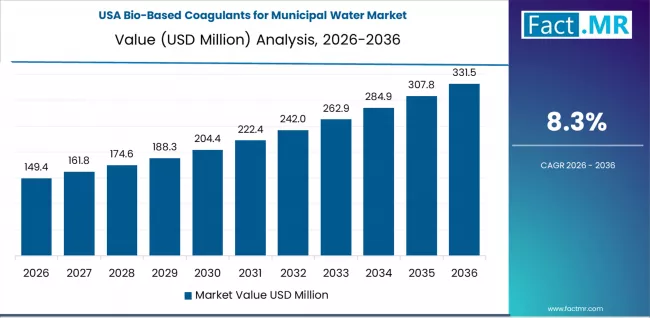
Bio Based Coagulants For Municipal Water Market Country Value Analysis | Source: Fact.MR
The USA's 8.30% growth is underpinned by evolving state-level regulations on PFAS and other contaminants, which is causing utilities to re-evaluate all chemical inputs. Leading utilities with strong sustainability mandates are piloting bio-based coagulants to reduce their chemical footprint and explore safer sludge disposal options, driving early adoption and market development.
What Role does Germany's Circular Economy and Precision Engineering Play?
Germany's 8.00% growth reflects its stringent EU chemical regulations (REACH) and commitment to a circular bio-economy. German engineering firms and utilities seek high-performance, certified bio-based products that integrate seamlessly into advanced treatment trains. The demand is for precision formulations that deliver consistent results, making Germany a market for high-quality, technically validated bio-coagulants.
Competitive Landscape of the Bio-Based Coagulants for Municipal Water Market
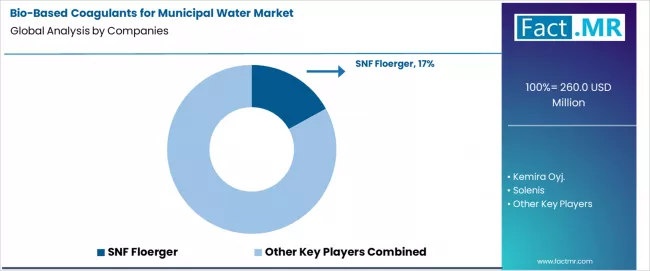
Bio Based Coagulants For Municipal Water Market Analysis By Company | Source: Fact.MR
The competitive landscape involves traditional water treatment chemical companies diversifying their portfolios and specialty green chemistry firms. Established players like Kemira and SNF are leveraging their application knowledge to develop and market high-performance bio-based lines alongside their synthetic products.
Competition centers on securing reliable, scalable supply chains for natural feedstocks, achieving consistent product quality, and providing robust technical data and case studies to convince risk-averse municipal engineers of the efficacy and reliability of bio-based solutions.
Key Players in the Bio-Based Coagulants for Municipal Water Market
- SNF Floerger
- Kemira Oyj.
- Solenis
- Ecolab Inc.
- Veolia Environnement S.A.
Segmentation
Scope of Report
| Items | Values |
|---|---|
| Quantitative Units | USD Million |
| Coagulant Type | Bio-Polymers, Tannin-Based, Bio-Modified Hybrids, Other Organic |
| Treatment Application | Drinking Water, Sewage/Wastewater, Sludge Management, Stormwater, Other |
| Municipality Size | Large Urban, Medium, Small/Rural, Decentralized Systems |
| Key Countries | India, China, Brazil, USA, Germany |
| Key Companies | SNF Floerger, Kemira Oyj., Solenis, Ecolab Inc., Veolia Environnement S.A. |
| Additional Analysis | Analysis of feedstock sustainability and sourcing; performance comparison with alum/ferric salts on key parameters (turbidity, TOC removal); impact on sludge characteristics and disposal costs; regulatory pathways for approval of novel bio-based water treatment chemicals; life cycle assessment (LCA) of bio-based vs. conventional coagulants. |
Source: Fact.MR analysis. Updated Dec 29, 2025
Market by Segments
-
Coagulant Type :
- Bio-Polymer Coagulants (Chitosan, Starch, Guar)
- Plant-Derived Tannin-Based Coagulants
- Bio-Modified Hybrid Coagulants
- Other Organic & Natural Coagulants
-
Treatment Application :
- Drinking Water Treatment
- Sewage & Wastewater Clarification
- Sludge Thickening & Dewatering
- Stormwater & Surface Water Treatment
- Other Municipal Water Uses
-
Municipality Size :
- Large Urban Utilities
- Medium-Sized Municipalities
- Small Town/Rural Utilities
- Decentralized/Community-Based Systems
-
Region :
-
North America
- USA
- Canada
-
Latin America
- Brazil
- Mexico
- Argentina
- Rest of Latin America
-
Western Europe
-
Germany
- UK
- France
- Spain
- Italy
- BENELUX
- Rest of Western Europe
-
-
Eastern Europe
- Russia
- Poland
- Czech Republic
- Rest of Eastern Europe
-
East Asia
- China
- Japan
- South Korea
- Rest of East Asia
-
South Asia & Pacific
- India
- ASEAN
- Australia
- Rest of South Asia & Pacific
-
MEA
- Saudi Arabia
- UAE
- Turkiye
- Rest of MEA
-
Frequently Asked Questions
How big is the bio-based coagulants for municipal water market in 2026?
What will be the size of bio-based coagulants for municipal water market in 2036?
How much will be the bio-based coagulants for municipal water market growth between 2026 and 2036?
What are the key product types in the bio-based coagulants for municipal water market?
Which treatment application segment to contribute significant share in the bio-based coagulants for municipal water market in 2026?
Who worked on this report


Preview the report firsthand - request a free sample
Free SampleGet the brochure for pricing and purchase details
Download PDF