- Market Value (2025): USD 7.45 Bn
- Estimated Value (2026): USD 7.84 Bn
- Forecast Value (2036): USD 13.1 Bn
- CAGR (2026-2036): 5.2%
What is the Dual-sport Motorcycle Market forecast to be worth by 2036?
USD 7.8 billion in 2026 to USD 13.1 billion by 2036 at a 5.2% CAGR.
- The dual-sport motorcycle market stood at USD 7.45 billion in 2025, reflecting purchases of road-legal machines designed for everyday travel and trips onto permitted unpaved routes.
- Worldwide revenue is projected to reach from USD 7.84 billion in 2026 to USD 13.1 billion by 2036 as riders weigh one versatile motorcycle against separate road and trail machines.
- The market is forecast to expand at 5.2% CAGR from 2026 to 2036. Vehicle mix and retail pricing also influence total value.
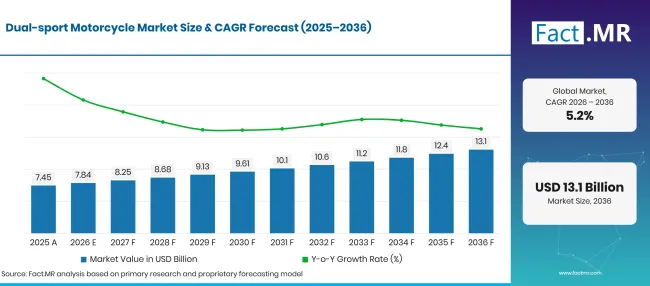
Dual Sport Motorcycle Market Forecast Global | Source: Fact.MR
| Year | Basis | Market Value (USD billion) |
|---|---|---|
| 2025 | Actual | 7.45 |
| 2026 | Estimate | 7.84 |
| 2036 | Forecast | 13.1 |
| CAGR 2026 to 2036 | Forecast period | 5.2% |
Source: Fact.MR analysis. Updated Nov 5, 2026
What are the defining numbers behind Dual-sport Motorcycle Market growth?
USD 5.3 billion in additional market value by 2036.
- Demand Drivers in the Market
- Riders who regularly move between public roads and gravel tracks generally look for road registration, manageable weight and suspension that can cope with uneven ground.
- Mid-capacity motorcycles attract riders who want highway capability without the bulk of a heavyweight touring model.
- Seat height and riding position can matter as much as engine output when a motorcycle is used away from paved roads. Dealers who offer different sizes and explain the effect on low-speed control can help riders choose a machine they feel confident handling.
- Manufacturers continue to widen the lower-displacement choice. Hero MotoCorp launched the Xpulse 210 in January 2025 and announced its first customer deliveries for March 2025 [2].
- Brazil’s assembly operations offer motorcycle dealers access to local model supply and established replacement-parts channels. That base supports consideration of road-legal motorcycles designed for mixed-surface use.
- Key Segments Analyzed
- By Capacity Type: The 500cc–1,000cc class accounts for 42.8% of 2026 revenue, combining longer-distance road use with purposeful unpaved-road capability.
- By Sales Channel: Store sales lead with 76.5% in 2026 because test rides and dealer-supported setup remain relevant for complete motorcycles.
- By Transmission Type: Manual transmission captures 72.5% in 2026 as riders value direct gear selection on changing surfaces.
- Analyst Opinion at Fact.MR
- Shambhu Nath Jha, Principal Consultant at Fact.MR, states, “For buyers comparing dual-sport motorcycles, the useful question is how much weight and seat height they can manage during everyday riding and on uneven ground. Dealer demonstrations could help clarify those trade-offs, particularly when riders are choosing between a lighter trail machine and a larger model intended for longer road journeys.”
- Strategic Implications
- Manufacturers can make motorcycle comparisons easier by stating suspension travel, service intervals and operating limits clearly. Buyers planning regular unpaved-road use need to understand the upkeep involved alongside the vehicle’s road performance.
- Dealers should explain how a lighter dual-sport motorcycle differs from a road-oriented adventure model, especially in wheel choice, tire design and low-speed handling.
- Component distributors should track wear items used on dirt roads, particularly tires and chain parts, since these affect maintenance spending after purchase.
- Riding schools and tour operators can match motorcycle weight and seat height to the difficulty of their planned routes. A suitable machine gives participants more room to develop control before moving to heavier models.
Germany is projected to record 6.0% CAGR, followed by Brazil at 5.5%. The USA is forecast at 4.9%, the UK at 4.4% and Japan at 3.9%. These separate demand profiles reflect differences in motorcycle use, buyer spending and available dealer networks.
How does the Dual-sport Motorcycle Market break down by segment?
500cc–1,000cc capacity leads at 42.8%; Store at 76.5%; Manual transmission at 72.5%.
Which Capacity Type dominates?
500cc–1,000cc motorcycles hold 42.8% of 2026 market revenue.
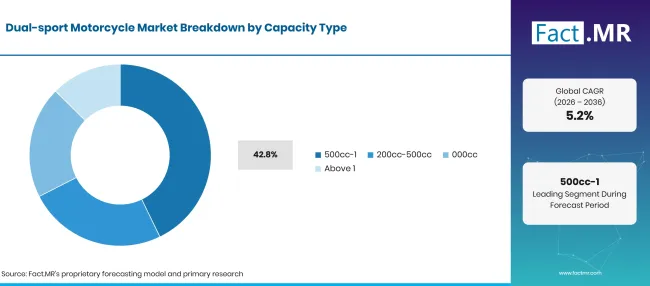
Dual Sport Motorcycle Market Breakdown Capacity Type | Source: Fact.MR
| Capacity Type | Share (2026) |
|---|---|
| 500cc–1,000cc (Leading segment) | 42.8% |
| Other capacity types combined | 57.2% |
| Total | 100.0% |
Source: Fact.MR analysis. Updated Nov 5, 2026
The 500cc–1,000cc range gives manufacturers room to offer stronger highway performance while retaining wheels and suspension designed for loose surfaces. Yamaha’s Ténéré 700 provides a clear example of that balance. A longer road journey often puts wind protection and fuel capacity near the front of the purchase decision. Lighter machines from 200cc to 500cc serve riders who prioritize handling on difficult terrain. Models above 1,000cc compete more directly with heavyweight adventure touring motorcycles, where vehicle mass changes the off-road experience.
What leads the Sales Channel segment?
Store purchases represent 76.5% of 2026 sales.
| Sales Channel | Share (2026) |
|---|---|
| Store (Leading segment) | 76.5% |
| Other channels combined | 23.5% |
| Total | 100.0% |
Source: Fact.MR analysis. Updated Nov 5, 2026
A dealership visit helps a rider judge reach to the ground and the effort needed to move a motorcycle at low speed. These physical checks are more difficult online. Showroom staff also explain finance terms and local registration requirements, while workshop access matters for buyers expecting trail use. Online listings remain useful for searching stock and narrowing a shortlist before purchase. Motorcycles are often compared through technical pages first and tested in person later. Store and online purchases represent distinct motorcycle sales channels.
How does Transmission Type shape buying decisions?
Manual transmission captures 72.5% of 2026 value.
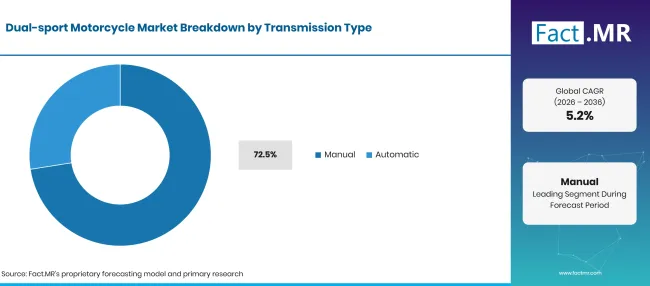
Dual Sport Motorcycle Market Breakdown Transmission Type | Source: Fact.MR
| Transmission Type | Share (2026) |
|---|---|
| Manual (Leading segment) | 72.5% |
| Other transmission types combined | 27.5% |
| Total | 100.0% |
Source: Fact.MR analysis. Updated Nov 5, 2026
Manual gear selection lets a rider choose engine response before a steep or slippery section. The design is familiar across motorcycles built for trail riding and can suit slow control on unpaved roads. Yamaha specifies a conventional six-speed transmission on the Ténéré 700 [1]. Alternative automatic or assisted shifting systems appeal to people who prefer fewer controls during stop-start travel. The practical choice depends on rider experience, maintenance preferences and the specific motorcycle architecture.
What is accelerating Dual-sport Motorcycle Market adoption, and what is holding it back?
Demand is supported by motorcycles that combine everyday road travel with access to permitted unpaved routes. Purchase decisions also reflect the cost of ownership, the rider’s experience and confidence in handling the machine.
Drivers Impact Analysis
| Driver | (~) % Impact on CAGR | Geographic Relevance | Impact Timeline |
|---|---|---|---|
| Mixed road and trail use | +1.1% | Global | Medium term |
| Mid-capacity product availability | +0.9% | Europe, North America | Medium term |
| Local dealer and maintenance reach | +0.7% | Brazil, USA | Short term |
| Recreational riding participation | +0.6% | Europe, Japan | Long term |
| Practical technology and ride control | +0.4% | Global | Medium term |
Source: Fact.MR analysis. Updated Nov 5, 2026
Opportunity Impact Analysis
| Opportunity | (~) % Impact on CAGR | Geographic Relevance | Impact Timeline |
|---|---|---|---|
| Lightweight entry models | +0.7% | Brazil, Asia | Medium term |
| Dealer-led test rides | +0.5% | Germany, UK, USA | Short term |
| Service and parts programs | +0.4% | Global | Medium term |
| Accessories tailored to trails | +0.3% | Global | Long term |
Source: Fact.MR analysis. Updated Nov 5, 2026
Restraints Impact Analysis
| Restraint | (~) % Impact on CAGR | Geographic Relevance | Impact Timeline |
|---|---|---|---|
| High purchase and upkeep costs | -0.8% | Global | Short term |
| Road safety concerns | -0.6% | USA, Brazil | Long term |
| Limited lawful riding access | -0.5% | Europe, Japan | Medium term |
| Product fit and vehicle weight | -0.4% | Global | Short term |
Source: Fact.MR analysis. Updated Nov 5, 2026
Which countries are scaling the Dual-sport Motorcycle Market through 2036?
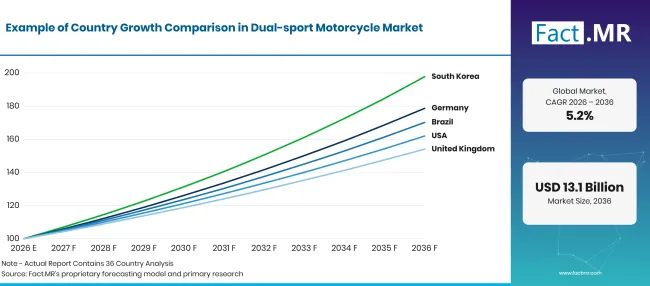
Dual Sport Motorcycle Market Growth Index | Source: Fact.MR
| Country | CAGR (2026 to 2036) |
|---|---|
| Germany | 6.0% |
| Brazil | 5.5% |
| USA | 4.9% |
| UK | 4.4% |
| Japan | 3.9% |
Source: Fact.MR analysis. Updated Nov 5, 2026
How is Germany balancing touring comfort with off-road versatility?
6.0% CAGR, supported by a large motorcycle fleet and steady replacement demand.
Germany’s dual-sport buyers compare highway comfort with handling on gravel and other permitted unpaved routes. In March 2026, the Federal Statistical Office reported 162,009 new motorcycle registrations in Germany for 2025 [6]. A separate vehicle-stock release put the motorcycle fleet at 5.06 million at the start of 2025 [7].
Why is Brazil attracting practical dual-sport buyers?
5.5% CAGR, driven by strong service networks and motorcycles suited to mixed road conditions.
Brazil’s established motorcycle assembly and service networks can support demand for road-legal models suited to both paved and unpaved travel. Local availability of spare parts is particularly useful for riders who use their motorcycles regularly and need dependable workshop access. Buyers still have to compare the motorcycle’s weight, seat height and running costs against the conditions of their usual routes, which shapes whether a dual-sport model offers enough practical value to justify the purchase.
How is the USA sustaining dual-sport motorcycle interest?
4.9% CAGR, linked to trail access, road use and established mid-capacity model availability.
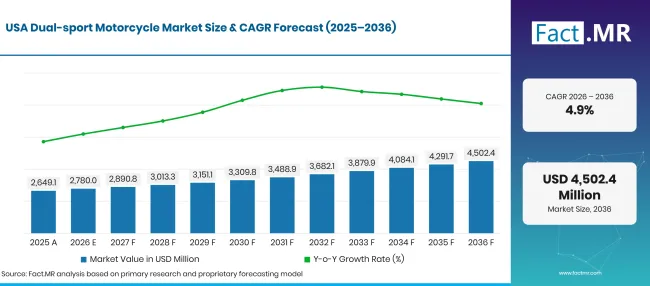
Dual Sport Motorcycle Market Forecast Usa | Source: Fact.MR
United States customers often select dual-sport motorcycles for public-road travel combined with riding on trails that permit motorized access. Honda’s official 2025 CRF300L specifications list a 286cc engine and a six-speed manual transmission [8]. In the wider safety setting, the National Highway Traffic Safety Administration reported 6,228 motorcyclist deaths during 2024 in its 2026 safety materials [3].
What is shaping dual-sport motorcycle demand in the UK?
4.4% CAGR, supported by road-focused riding, legal unpaved access and dealer guidance on fit.
United Kingdom demand reflects the balance between road riding and access to legally permitted unpaved routes. The Department for Transport reported approximately 100,000 first registrations of motorcycles during 2025 in its April 2026 release [4]. The same release recorded 1.36 million licensed motorcycles at year-end. UK dealers are likely to find value in helping customers compare seat height and tire choices during a test ride.
Why does Japan retain a focused dual-sport motorcycle market?
3.9% CAGR, tied to domestic motorcycle production, manageable machine size and weekend trail use.
Japan combines established motorcycle engineering with a domestic market where riding comfort and manageable machine size affect product choice. The Japan Automobile Manufacturers Association reported 683,000 motorcycles produced domestically in 2025 [5]. Its industry figures also recorded 362,000 motorcycle sales during the same year. Motorcycles that balance daily travel with weekend riding on permitted trails are likely to retain a focused customer base.
Who leads the Dual-sport Motorcycle Market?
Competition covers Japanese manufacturers with broad model ranges and specialist makers focused on trail performance. Honda Motor serves the category through CRF dual-sport motorcycles, while Kawasaki Motors offers road-registered trail machines such as the KLR family.
Yamaha Motor competes through Ténéré models suited to longer trips. Suzuki Motor has the DR-Z dual-purpose range. KTM Sportmotorcycle positions its Adventure R motorcycles toward riders seeking more dedicated off-road suspension. Hero MotoCorp addresses smaller capacities through the Xpulse family. Product comparisons should focus on the intended use and the local model lineup, not unsupported global company shares.
Which companies are the key providers?
Key companies include Honda Motor, Kawasaki Motors, KTM Sportmotorcycle, Suzuki Motor, Yamaha Motor, and Hero MotoCorp.
- Honda Motor
- Kawasaki Motors
- KTM Sportmotorcycle
- Suzuki Motor
- Yamaha Motor
- Hero MotoCorp
Bibliography
- [1] Yamaha Motor Corporation, U.S.A. (2026). 2026 Ténéré 700: Specifications.
- [2] Hero MotoCorp. (2025, January 17). Bharat Mobility 2025: Hero MotoCorp launches exciting products in premium and scooter segment.
- [3] National Highway Traffic Safety Administration. (n.d.). Motorcycle safety.
- [4] Department for Transport. (2026, April 29). Vehicle licensing statistics, United Kingdom: 2025. GOV.UK.
- [5] Ministry of Land, Infrastructure, Transport and Tourism. (2026). 数字でみる自動車2026 [Motor vehicles in figures 2026]. Government of Japan.
- [6] Statistisches Bundesamt (Destatis). (2026, March 23). Neuzulassungen von Kraftfahrzeugen in Deutschland.
- [7] Statistisches Bundesamt (Destatis). (2026, March 23). Bestand an Kraftfahrzeugen und Schienenfahrzeugen für die Jahre 2021 bis 2025.
- [8] American Honda Motor Co., Inc. (2025). 2025 CRF300L dual sport motorcycle specifications.
This Report Answers
- The report explains how capacity choices balance road travel with off-road control.
- Channel analysis examines why customers compare motorcycle fit at dealers before buying.
- Transmission analysis considers direct gear selection on loose surfaces and assisted alternatives.
- Country analysis compares motorcycle activity in Germany, Brazil, the USA, the UK and Japan.
- Competitive analysis distinguishes manufacturer model positioning and after-sales coverage.
What does the Dual-sport Motorcycle Market cover?
The report covers road-legal motorcycles made for paved and unpaved routes. Motorcycle revenue excludes separate spending on riding equipment.
What is included in the scope?
Street-registered dual-sport motorcycles and adventure models with mixed-surface capability are included. Store and online sales are covered as purchase routes.
What is excluded from the scope?
Track-only motocross bikes, separate accessories and repair services are excluded. Pure road-tourers are also outside the category.
Motorcycle ownership categories include two-wheeler tires and off-road motorcycle accessories.
How Was the Analysis Built?
The analysis draws on 120+ sources, 35+ company portfolios, 25+ countries, and more than 20 industry interviews.
- Primary Research: Primary research includes discussions with manufacturers, service providers, technology developers, distributors, end users, and subject-matter experts. These conversations examine purchasing priorities, product adoption, operational challenges, approval requirements, competitive positioning, and the factors that influence wider market acceptance.
- Desk Research: Desk research covers government statistics, regulatory publications, company filings, trade data, technical studies, industry associations, standards, public policy, and other authoritative sources. Every source used in the analysis is documented in the bibliography.
- Market Sizing and Forecasting: Market estimates combine historical performance, demand indicators, pricing and volume trends, segment shares, company participation, country-level growth, adoption patterns, investment activity, and barriers to market expansion.
- Data Validation and Update Cycle: Findings are validated by comparing primary interviews with public data, company activity, regulatory changes, trade patterns, and industry developments. Regular updates review new product launches, capacity changes, partnerships, approvals, and shifts in commercial adoption.
Segmentation
What is the report’s scope and coverage?
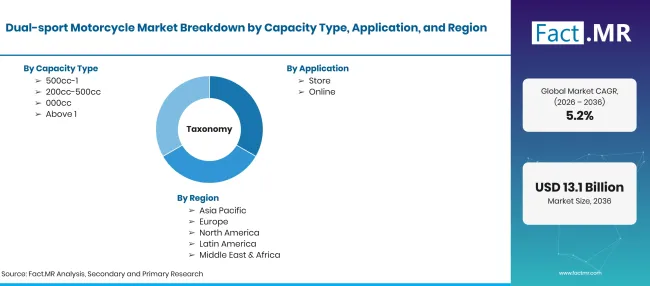
Dual Sport Motorcycle Market Taxonomy | Source: Fact.MR
| Attribute | Details |
|---|---|
| Quantitative Units | USD billion |
| Market Definition | Road-legal motorcycles designed for meaningful travel on paved and unpaved routes |
| Capacity Type | 200cc–500cc; 500cc–1,000cc; Above 1,000cc |
| Sales Channel | Store; Online |
| Transmission Type | Manual; Automatic |
| Regions Covered | North America; Latin America; Western Europe; Eastern Europe; East Asia; South Asia & Pacific; Middle East & Africa |
| Countries Covered | Germany; Brazil; USA; UK; Japan |
| Companies Profiled | Honda Motor, Kawasaki Motors, KTM Sportmotorcycle, Suzuki Motor, Yamaha Motor, and Hero MotoCorp. |
| Forecast Period | 2026 to 2036 |
| Approach | Motorcycle model scope and manufacturer positioning; motorcycle industry statistics for country context; forecast inputs and comparative segment analysis |
Source: Fact.MR analysis. Updated Nov 5, 2026
How is the market segmented?
-
By Capacity Type
- 200cc–500cc
- 500cc–1,000cc
- Above 1,000cc
-
By Application
- Store
- Online
-
By Transmission Type
- Manual
- Automatic
-
By Region
- North America
- Latin America
- Western Europe
- Eastern Europe
- East Asia
- South Asia & Pacific
- Middle East & Africa
Frequently Asked Questions
How big is the Dual-sport Motorcycle Market in 2026?
What is the CAGR of the Dual-sport Motorcycle Market from 2026 to 2036?
Which capacity type leads the Dual-sport Motorcycle Market?
Which sales channel leads the Dual-sport Motorcycle Market?
Who are the leading companies in the Dual-sport Motorcycle Market?
Who worked on this report


Preview the report firsthand - request a free sample
Free SampleGet the brochure for pricing and purchase details
Download PDF