Dual-Fuel Diesel - Gas Fuel Delivery Market (2026 - 2036)
Dual-Fuel Diesel - Gas Fuel Delivery Market Size and Share Forecast Outlook 2026 to 2036
Core Findings
Dual-Fuel Diesel-Gas Fuel Delivery Market Forecast Outlook 2026 to 2036
The dual-fuel diesel-gas fuel delivery market is projected to reach USD 604 million in 2026 and grow to USD 1,295 million by 2036, reflecting a CAGR of 7.9%.
Summary of Dual-Fuel Diesel-Gas Fuel Delivery Market - Key Takeaways
- The dual-fuel diesel-gas fuel delivery market includes systems used in vehicles and industrial engines that combine diesel with gaseous fuels like CNG, LNG, and biogas for improved fuel efficiency and reduced emissions.
- The market is projected to grow at a CAGR of 7.9% from 2026 to 2036, expanding from USD 604 million in 2026 to USD 1,295 million by 2036, based on Fact.MR forecasting and growing demand for cleaner energy solutions.
- Diesel + CNG fuel type dominates the market with a 59% share in 2026, as it offers significant cost and environmental benefits over traditional diesel-only systems, especially in commercial transport and public transportation.
- New build OEM sales account for 57% of the market share in 2026, driven by OEMs integrating dual-fuel systems into new vehicle and engine models to meet environmental regulations and improve fuel efficiency.
- China records the fastest growth at a 10.3% CAGR, supported by strong government incentives and growing natural gas infrastructure, fueling the adoption of dual-fuel systems in transportation and power generation.
- Key players in the market include Westport Fuel Systems Inc., Cummins Inc., Robert Bosch GmbH, and DENSO CORPORATION, focusing on advancing fuel injection technology and optimizing powertrain efficiency for dual-fuel applications.

Dominant players in this market defend their pricing power through established brand recognition, robust technological capabilities, and long-term supplier relationships. These companies benefit from economies of scale, allowing them to maintain competitive prices while ensuring high-quality products.
Entry barriers are upheld by the complexity of dual-fuel systems, requiring advanced engineering, regulatory compliance, and significant capital investment in production facilities. Smaller players may struggle to meet these demands, keeping the market relatively concentrated. Fragmentation will likely persist, especially as new technological advancements and regional regulatory variations create niche opportunities. Over time, consolidation may occur as larger firms acquire smaller competitors to expand their market share and strengthen their position in the evolving fuel delivery ecosystem.
Dual-Fuel Diesel-Gas Fuel Delivery Market
| Metric | Value |
|---|---|
| Estimated Value in (2026E) | USD 604 million |
| Forecast Value in (2036F) | USD 1,295 million |
| Forecast CAGR 2026 to 2036 | 7.9% |
Category
| Category | Sub-Segment |
|---|---|
| By Application | Heavy-Duty Trucks; Off-Highway; Marine; Other |
| By Fuel Type | Diesel + CNG; Diesel + LNG; Diesel + Biogas; Other |
| By System Component | Gas Metering & Injectors; Dual-Fuel ECUs/Controls; Rails/Lines/Valves; Other |
| By Sales Channel | New Build OEM; Conversion/Retrofit; Aftermarket Service; Other |
| Region | North America; Europe; Asia Pacific; Latin America; Middle East & Africa |
Segmental Analysis
What is Driving the Dominance of Diesel + CNG Fuel Type in the Dual-Fuel Diesel - Gas Fuel Delivery Market?
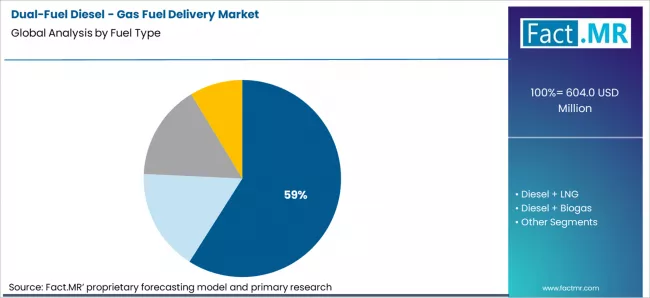
Diesel + CNG fuel type holds 59% of the market share in 2026. This blend is preferred due to the cost and environmental benefits it offers over traditional diesel-only systems. By combining diesel with compressed natural gas (CNG), vehicles and engines can achieve lower emissions and improved fuel efficiency, while maintaining the performance required for heavy-duty applications. The widespread adoption of this dual-fuel system in commercial transport, especially in long-haul trucking and public transportation, continues to drive the growth of the market.
What is the Role of New Build OEM in the Dual-Fuel Diesel - Gas Fuel Delivery Market?
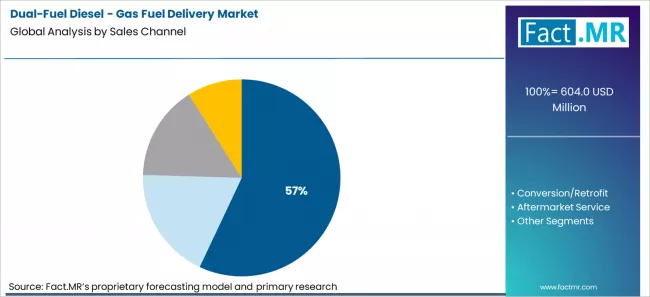
New Build OEM accounts for 57% of the market share in 2026. Original Equipment Manufacturers (OEMs) are crucial to the dual-fuel diesel-gas fuel delivery market, as they integrate these systems into new vehicle and engine designs. The OEM market benefits from the growing trend toward cleaner, more efficient fuel solutions in the commercial transport and heavy-duty sectors. By offering dual-fuel systems in new builds, OEMs enable operators to meet increasingly stringent environmental regulations while improving operational cost-efficiency, which contributes to the strong demand for dual-fuel technologies in new vehicle production.
What are the Principal Drivers, Constraints, and Evolving Dynamics of the DualFuel Diesel Gas Fuel Delivery Market?
Growth in the dual fuel diesel gas fuel delivery market is driven by stricter emissions standards and the pursuit of lower operating costs in heavy duty transportation and stationary power sectors. Dual fuel systems allow engines to operate on a mix of diesel and gaseous fuels, such as natural gas, lowering carbon dioxide and nitrogen oxides compared with diesel alone. This regulatory support and economic benefit encourage adoption among commercial fleets and power generation users.
A significant constraint lies in the added system complexity and cost compared with conventional diesel delivery systems. Dual fuel systems require specialized injectors, controls, and fuel management hardware that can raise upfront costs and maintenance requirements. Infrastructure limitations for gaseous fuels in many regions also slow deployment.
Emerging dynamics include refinements in fuel delivery components that improve combustion stability and responsiveness across varying load conditions. There is increased focus on integration with electronic engine controls to optimize dual fuel operation. Retrofit activity is present where operators seek to extend the life of existing diesel engines by adding dual fuel capability. Supply chain priorities influence component availability, with localized production and partnerships between system suppliers and engine manufacturers gaining attention.
Analysis of the Dual-Fuel Diesel - Gas Fuel Delivery Market by Key Country
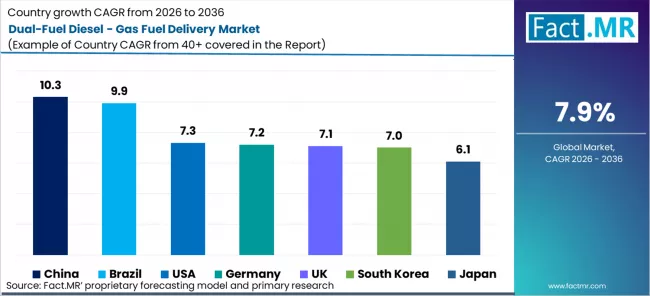
| Country | CAGR 2026 to 2036 |
|---|---|
| USA | 7.3% |
| Japan | 6.1% |
| South Korea | 7.0% |
| Germany | 7.2% |
| China | 10.3% |
| UK | 7.1% |
| Brazil | 9.9% |
The report covers an in-depth analysis of 40+ countries; top-performing countries are highlighted below.
What is Driving the Growth of the Dual-Fuel Diesel - Gas Fuel Delivery Market in the USA?
The USA’s Dual-Fuel Diesel - Gas Fuel Delivery market is projected to grow at 7.3%, driven by the increasing demand for cleaner and more fuel-efficient solutions in the transportation and industrial sectors. Dual-fuel systems, which combine diesel and gas, offer a significant reduction in carbon emissions while improving fuel efficiency, making them an attractive choice for fleet operators and industries seeking to meet environmental regulations. Additionally, the U.S. government’s push for cleaner energy alternatives and greater adoption of natural gas vehicles contributes to market growth. The evolving energy landscape and innovation in fuel delivery technologies further support the expansion of this market.
How is the Dual-Fuel Diesel - Gas Fuel Delivery Market Expanding in Japan?
Japan’s Dual-Fuel Diesel - Gas Fuel Delivery market is growing at 6.1%, supported by the country’s ongoing efforts to reduce carbon emissions and adopt cleaner energy sources in its transportation and industrial sectors. Japan has made substantial investments in LNG infrastructure, and dual-fuel technology is increasingly being used in both commercial vehicles and power generation to reduce emissions and improve fuel efficiency. The government’s commitment to environmental sustainability and the promotion of alternative fuels further fuels the adoption of dual-fuel diesel-gas systems, ensuring steady market growth in Japan.
What Factors Are Fueling the Growth of the Dual-Fuel Diesel - Gas Fuel Delivery Market in South Korea?
South Korea’s Dual-Fuel Diesel - Gas Fuel Delivery market is projected to grow at 7.0%, driven by the country’s industrial and transportation sectors, where there is a rising demand for cleaner and more cost-effective fuel solutions. As South Korea continues to focus on reducing its carbon footprint, dual-fuel diesel-gas systems are gaining traction due to their ability to lower emissions and improve fuel efficiency. With government policies supporting the shift towards cleaner energy sources and growing investments in LNG infrastructure, the market for dual-fuel systems is expected to grow as industries seek sustainable and efficient fuel delivery technologies.
How is the Dual-Fuel Diesel - Gas Fuel Delivery Market Evolving in Germany?
Germany’s Dual-Fuel Diesel - Gas Fuel Delivery market is growing at 7.2%, fueled by the country’s strong focus on sustainability and reducing carbon emissions in both the transportation and industrial sectors. With Germany's emphasis on environmental regulations, especially in the automotive industry, dual-fuel systems offer an attractive solution for reducing emissions in heavy-duty vehicles and machinery. The country’s investment in natural gas infrastructure and its commitment to cleaner energy alternatives further support the adoption of dual-fuel diesel-gas technologies. As industries in Germany increasingly transition to low-emission and cost-efficient fuel systems, the dual-fuel market continues to grow.
What is Contributing to the Growth of the Dual-Fuel Diesel - Gas Fuel Delivery Market in China?
China’s Dual-Fuel Diesel - Gas Fuel Delivery market is expanding at 10.3%, the highest growth rate among key countries, driven by the country’s large-scale adoption of natural gas in the transportation sector and its ongoing industrialization. China’s commitment to reducing air pollution and carbon emissions has led to a growing shift towards dual-fuel systems in both transportation and power generation. Government incentives, combined with the country's expanding natural gas infrastructure, are accelerating the adoption of dual-fuel diesel-gas systems. As China transitions to more sustainable fuel sources, the demand for efficient fuel delivery systems continues to rise, ensuring strong market growth.
What is Driving the Growth of the Dual-Fuel Diesel - Gas Fuel Delivery Market in the UK?
The UK’s Dual-Fuel Diesel - Gas Fuel Delivery market is growing at 7.1%, supported by the country’s push for cleaner energy solutions and the growing adoption of alternative fuels. As the UK works toward its carbon-neutral goals, dual-fuel systems are increasingly used in the transportation sector to reduce emissions and improve fuel efficiency. The government’s support for natural gas vehicles and incentives for low-emission technologies help drive market adoption. The UK’s strong infrastructure for LNG and its focus on transitioning to cleaner fuels contribute to steady growth in the dual-fuel market.
What is Contributing to the Growth of the Dual-Fuel Diesel - Gas Fuel Delivery Market in Brazil?
Brazil’s Dual-Fuel Diesel - Gas Fuel Delivery market is expanding at 9.9%, driven by the country’s growing demand for sustainable fuel solutions in its transportation and industrial sectors. As Brazil seeks to reduce its carbon emissions and lower fuel costs, dual-fuel systems, which combine diesel and natural gas, offer an attractive solution. The country’s investment in LNG infrastructure, combined with government policies encouraging the adoption of cleaner energy sources, supports the market’s growth. With a large agricultural and industrial base that relies heavily on transportation, Brazil is increasingly turning to dual-fuel diesel-gas systems to meet both environmental and economic goals.
How Are Key Players Competing in the Dual-Fuel Diesel-Gas Fuel Delivery Market?
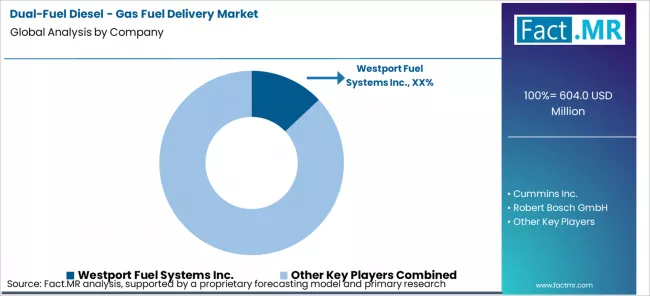
In the dual-fuel diesel-gas fuel delivery market, Westport Fuel Systems Inc. and Cummins Inc. lead the charge by advancing dual-fuel technology and optimizing powertrain efficiency. Robert Bosch GmbH and DENSO CORPORATION focus on delivering precise fuel injection and management systems that seamlessly integrate both diesel and gas. Hexagon Agility and BorgWarner Inc. specialize in providing reliable components that ensure fuel system performance and emissions reduction. Continental AG, Eaton Corporation plc, Parker-Hannifin Corporation, and Weifu High-Technology Group Co., Ltd. are continuously innovating in fuel delivery systems and expanding their dual-fuel solutions to meet growing demand in the commercial vehicle and industrial sectors.
Recent Industry Developments
- Contract / Technology Program - Next-Gen LNG HPDI fuel system adaptation for Euro 7 (Published Dec 19, 2023) Westport announced a USD 33 million OEM-funded development program to adapt and commercialize its Next Generation LNG HPDI fuel system to meet Euro 7 heavy-duty emissions requirements, advancing ultra-high-pressure diesel-pilot + natural-gas delivery architectures.
- Joint Venture Launch - Volvo Group and Westport close and launch “Cespira” (Published Jun 3, 2024) Volvo Group and Westport confirmed the closing and launch of their joint venture to accelerate commercialization of HPDI fuel system technology for long-haul and off-road applications (diesel ignition + high-pressure gas injection).
- Technology / Commercialization Update - Volvo Group & Westport highlight HPDI injector enabling diesel + high-pressure natural gas (Published Jul 5, 2024) A joint update describes the HPDI fuel system’s injector (dual concentric needle) delivering small diesel quantities with large volumes of natural gas at high pressure, reinforcing the market’s push toward OEM-integrated dual-fuel delivery platforms.
Key Players of the Dual-Fuel Diesel-Gas Fuel Delivery Market
- Westport Fuel Systems Inc.
- Cummins Inc.
- Robert Bosch GmbH
- DENSO CORPORATION
- Hexagon Agility (a business of Hexagon Composites ASA)
- BorgWarner Inc.
- Continental AG
- Eaton Corporation plc
- Parker-Hannifin Corporation
- Weifu High-Technology Group Co., Ltd.
Bibliographies
- International Energy Agency (IEA). (2023). The role of natural gas in decarbonising heavy-duty transport. IEA Publications.
- United Nations Economic Commission for Europe (UNECE). (2024). Regulation No. 110: Specific requirements for vehicles using compressed natural gas (CNG) and liquefied natural gas (LNG). UNECE.
- U.S. Environmental Protection Agency (EPA). (2024). Alternative fuel vehicle conversion and emissions compliance guidance. EPA.
- National Renewable Energy Laboratory (NREL). (2023). Performance evaluation of natural gas-diesel dual-fuel engines in heavy-duty applications. U.S. DOE.
- Oak Ridge National Laboratory (ORNL). (2024). Combustion dynamics and injector control strategies in dual-fuel compression ignition engines. U.S. Department of Energy.
Scope of the Report
| Items | Values |
|---|---|
| Quantitative Units (2026) | USD 604 Million |
| By Application | Heavy-Duty Trucks, Off-Highway, Marine, Other |
| By Fuel Type | Diesel + CNG, Diesel + LNG, Diesel + Biogas, Other |
| By System Component | Gas Metering & Injectors, Dual-Fuel ECUs/Controls, Rails/Lines/Valves, Other |
| By Sales Channel | New Build OEM, Conversion/Retrofit, Aftermarket Service, Other |
| Regions Covered | North America, Europe, Asia Pacific, Latin America, Middle East & Africa |
| Countries Covered | United States, Canada, Mexico, Germany, United Kingdom, France, Japan, South Korea, China, India, Brazil, and other countries |
| Key Companies Profiled | Westport Fuel Systems Inc., Cummins Inc., Robert Bosch GmbH, DENSO CORPORATION, Hexagon Agility (a business of Hexagon Composites ASA), BorgWarner Inc., Continental AG, Eaton Corporation plc, Parker-Hannifin Corporation, Weifu High-Technology Group Co., Ltd. |
| Additional Attributes | Market trends by application, fuel type, system component, and sales channel; regional demand trends; competitive landscape; technological advancements in dual-fuel diesel-gas fuel delivery systems; operational performance optimization initiatives; and product development strategies |
Dual-Fuel Diesel-Gas Fuel Delivery Market Key Segments
-
By Application :
- Heavy-Duty Trucks
- Off-Highway
- Marine
- Other
-
By Fuel Type :
- Diesel + CNG
- Diesel + LNG
- Diesel + Biogas
- Other
-
By System Component :
- Gas Metering & Injectors
- Dual-Fuel ECUs/Controls
- Rails/Lines/Valves
- Other
-
By Sales Channel :
- New Build OEM
- Conversion/Retrofit
- Aftermarket Service
- Other
-
Region :
- North America
- USA
- Canada
- Mexico
- Europe
- Germany
- UK
- France
- Italy
- Spain
- Nordic Countries
- BENELUX
- Rest of Europe
- Asia Pacific
- China
- Japan
- South Korea
- India
- Australia
- Rest of Asia Pacific
- Latin America
- Brazil
- Argentina
- Rest of Latin America
- Middle East and Africa
- Kingdom of Saudi Arabia
- United Arab Emirates
- South Africa
- Rest of Middle East and Africa
- Other Regions
- Oceania
- Central Asia
- Other Markets
- North America
Table of Content
- Executive Summary
- Global Market Outlook
- Demand to side Trends
- Supply to side Trends
- Technology Roadmap Analysis
- Analysis and Recommendations
- Market Overview
- Market Coverage / Taxonomy
- Market Definition / Scope / Limitations
- Research Methodology
- Chapter Orientation
- Analytical Lens and Working Hypotheses
- Market Structure, Signals, and Trend Drivers
- Benchmarking and Cross-market Comparability
- Market Sizing, Forecasting, and Opportunity Mapping
- Research Design and Evidence Framework
- Desk Research Programme (Secondary Evidence)
- Company Annual and Sustainability Reports
- Peer-reviewed Journals and Academic Literature
- Corporate Websites, Product Literature, and Technical Notes
- Earnings Decks and Investor Briefings
- Statutory Filings and Regulatory Disclosures
- Technical White Papers and Standards Notes
- Trade Journals, Industry Magazines, and Analyst Briefs
- Conference Proceedings, Webinars, and Seminar Materials
- Government Statistics Portals and Public Data Releases
- Press Releases and Reputable Media Coverage
- Specialist Newsletters and Curated Briefings
- Sector Databases and Reference Repositories
- FMR Internal Proprietary Databases and Historical Market Datasets
- Subscription Datasets and Paid Sources
- Social Channels, Communities, and Digital Listening Inputs
- Additional Desk Sources
- Expert Input and Fieldwork (Primary Evidence)
- Primary Modes
- Qualitative Interviews and Expert Elicitation
- Quantitative Surveys and Structured Data Capture
- Blended Approach
- Why Primary Evidence is Used
- Field Techniques
- Interviews
- Surveys
- Focus Groups
- Observational and In-context Research
- Social and Community Interactions
- Stakeholder Universe Engaged
- C-suite Leaders
- Board Members
- Presidents and Vice Presidents
- R&D and Innovation Heads
- Technical Specialists
- Domain Subject-matter Experts
- Scientists
- Physicians and Other Healthcare Professionals
- Governance, Ethics, and Data Stewardship
- Research Ethics
- Data Integrity and Handling
- Primary Modes
- Tooling, Models, and Reference Databases
- Desk Research Programme (Secondary Evidence)
- Data Engineering and Model Build
- Data Acquisition and Ingestion
- Cleaning, Normalisation, and Verification
- Synthesis, Triangulation, and Analysis
- Quality Assurance and Audit Trail
- Market Background
- Market Dynamics
- Drivers
- Restraints
- Opportunity
- Trends
- Scenario Forecast
- Demand in Optimistic Scenario
- Demand in Likely Scenario
- Demand in Conservative Scenario
- Opportunity Map Analysis
- Product Life Cycle Analysis
- Supply Chain Analysis
- Investment Feasibility Matrix
- Value Chain Analysis
- PESTLE and Porter’s Analysis
- Regulatory Landscape
- Regional Parent Market Outlook
- Production and Consumption Statistics
- Import and Export Statistics
- Market Dynamics
- Global Market Analysis 2021 to 2025 and Forecast, 2026 to 2036
- Historical Market Size Value (USD Million) Analysis, 2021 to 2025
- Current and Future Market Size Value (USD Million) Projections, 2026 to 2036
- Y to o to Y Growth Trend Analysis
- Absolute $ Opportunity Analysis
- Global Market Pricing Analysis 2021 to 2025 and Forecast 2026 to 2036
- Global Market Analysis 2021 to 2025 and Forecast 2026 to 2036, By Fuel Type
- Introduction / Key Findings
- Historical Market Size Value (USD Million) Analysis By Fuel Type, 2021 to 2025
- Current and Future Market Size Value (USD Million) Analysis and Forecast By Fuel Type, 2026 to 2036
- Diesel + CNG
- Diesel + LNG
- Diesel + Biogas
- Other
- Diesel + CNG
- Y to o to Y Growth Trend Analysis By Fuel Type, 2021 to 2025
- Absolute $ Opportunity Analysis By Fuel Type, 2026 to 2036
- Global Market Analysis 2021 to 2025 and Forecast 2026 to 2036, By Sales Channel
- Introduction / Key Findings
- Historical Market Size Value (USD Million) Analysis By Sales Channel, 2021 to 2025
- Current and Future Market Size Value (USD Million) Analysis and Forecast By Sales Channel, 2026 to 2036
- New Build OEM
- Conversion/Retrofit
- Aftermarket Service
- Other
- New Build OEM
- Y to o to Y Growth Trend Analysis By Sales Channel, 2021 to 2025
- Absolute $ Opportunity Analysis By Sales Channel, 2026 to 2036
- Global Market Analysis 2021 to 2025 and Forecast 2026 to 2036, By Region
- Introduction
- Historical Market Size Value (USD Million) Analysis By Region, 2021 to 2025
- Current Market Size Value (USD Million) Analysis and Forecast By Region, 2026 to 2036
- North America
- Latin America
- Western Europe
- Eastern Europe
- East Asia
- South Asia and Pacific
- Middle East & Africa
- Market Attractiveness Analysis By Region
- North America Market Analysis 2021 to 2025 and Forecast 2026 to 2036, By Country
- Historical Market Size Value (USD Million) Trend Analysis By Market Taxonomy, 2021 to 2025
- Market Size Value (USD Million) Forecast By Market Taxonomy, 2026 to 2036
- By Country
- USA
- Canada
- Mexico
- By Fuel Type
- By Sales Channel
- By Country
- Market Attractiveness Analysis
- By Country
- By Fuel Type
- By Sales Channel
- Key Takeaways
- Latin America Market Analysis 2021 to 2025 and Forecast 2026 to 2036, By Country
- Historical Market Size Value (USD Million) Trend Analysis By Market Taxonomy, 2021 to 2025
- Market Size Value (USD Million) Forecast By Market Taxonomy, 2026 to 2036
- By Country
- Brazil
- Chile
- Rest of Latin America
- By Fuel Type
- By Sales Channel
- By Country
- Market Attractiveness Analysis
- By Country
- By Fuel Type
- By Sales Channel
- Key Takeaways
- Western Europe Market Analysis 2021 to 2025 and Forecast 2026 to 2036, By Country
- Historical Market Size Value (USD Million) Trend Analysis By Market Taxonomy, 2021 to 2025
- Market Size Value (USD Million) Forecast By Market Taxonomy, 2026 to 2036
- By Country
- Germany
- UK
- Italy
- Spain
- France
- Nordic
- BENELUX
- Rest of Western Europe
- By Fuel Type
- By Sales Channel
- By Country
- Market Attractiveness Analysis
- By Country
- By Fuel Type
- By Sales Channel
- Key Takeaways
- Eastern Europe Market Analysis 2021 to 2025 and Forecast 2026 to 2036, By Country
- Historical Market Size Value (USD Million) Trend Analysis By Market Taxonomy, 2021 to 2025
- Market Size Value (USD Million) Forecast By Market Taxonomy, 2026 to 2036
- By Country
- Russia
- Poland
- Hungary
- Balkan & Baltic
- Rest of Eastern Europe
- By Fuel Type
- By Sales Channel
- By Country
- Market Attractiveness Analysis
- By Country
- By Fuel Type
- By Sales Channel
- Key Takeaways
- East Asia Market Analysis 2021 to 2025 and Forecast 2026 to 2036, By Country
- Historical Market Size Value (USD Million) Trend Analysis By Market Taxonomy, 2021 to 2025
- Market Size Value (USD Million) Forecast By Market Taxonomy, 2026 to 2036
- By Country
- China
- Japan
- South Korea
- By Fuel Type
- By Sales Channel
- By Country
- Market Attractiveness Analysis
- By Country
- By Fuel Type
- By Sales Channel
- Key Takeaways
- South Asia and Pacific Market Analysis 2021 to 2025 and Forecast 2026 to 2036, By Country
- Historical Market Size Value (USD Million) Trend Analysis By Market Taxonomy, 2021 to 2025
- Market Size Value (USD Million) Forecast By Market Taxonomy, 2026 to 2036
- By Country
- India
- ASEAN
- Australia & New Zealand
- Rest of South Asia and Pacific
- By Fuel Type
- By Sales Channel
- By Country
- Market Attractiveness Analysis
- By Country
- By Fuel Type
- By Sales Channel
- Key Takeaways
- Middle East & Africa Market Analysis 2021 to 2025 and Forecast 2026 to 2036, By Country
- Historical Market Size Value (USD Million) Trend Analysis By Market Taxonomy, 2021 to 2025
- Market Size Value (USD Million) Forecast By Market Taxonomy, 2026 to 2036
- By Country
- Kingdom of Saudi Arabia
- Other GCC Countries
- Turkiye
- South Africa
- Other African Union
- Rest of Middle East & Africa
- By Fuel Type
- By Sales Channel
- By Country
- Market Attractiveness Analysis
- By Country
- By Fuel Type
- By Sales Channel
- Key Takeaways
- Key Countries Market Analysis
- USA
- Pricing Analysis
- Market Share Analysis, 2025
- By Fuel Type
- By Sales Channel
- Canada
- Pricing Analysis
- Market Share Analysis, 2025
- By Fuel Type
- By Sales Channel
- Mexico
- Pricing Analysis
- Market Share Analysis, 2025
- By Fuel Type
- By Sales Channel
- Brazil
- Pricing Analysis
- Market Share Analysis, 2025
- By Fuel Type
- By Sales Channel
- Chile
- Pricing Analysis
- Market Share Analysis, 2025
- By Fuel Type
- By Sales Channel
- Germany
- Pricing Analysis
- Market Share Analysis, 2025
- By Fuel Type
- By Sales Channel
- UK
- Pricing Analysis
- Market Share Analysis, 2025
- By Fuel Type
- By Sales Channel
- Italy
- Pricing Analysis
- Market Share Analysis, 2025
- By Fuel Type
- By Sales Channel
- Spain
- Pricing Analysis
- Market Share Analysis, 2025
- By Fuel Type
- By Sales Channel
- France
- Pricing Analysis
- Market Share Analysis, 2025
- By Fuel Type
- By Sales Channel
- India
- Pricing Analysis
- Market Share Analysis, 2025
- By Fuel Type
- By Sales Channel
- ASEAN
- Pricing Analysis
- Market Share Analysis, 2025
- By Fuel Type
- By Sales Channel
- Australia & New Zealand
- Pricing Analysis
- Market Share Analysis, 2025
- By Fuel Type
- By Sales Channel
- China
- Pricing Analysis
- Market Share Analysis, 2025
- By Fuel Type
- By Sales Channel
- Japan
- Pricing Analysis
- Market Share Analysis, 2025
- By Fuel Type
- By Sales Channel
- South Korea
- Pricing Analysis
- Market Share Analysis, 2025
- By Fuel Type
- By Sales Channel
- Russia
- Pricing Analysis
- Market Share Analysis, 2025
- By Fuel Type
- By Sales Channel
- Poland
- Pricing Analysis
- Market Share Analysis, 2025
- By Fuel Type
- By Sales Channel
- Hungary
- Pricing Analysis
- Market Share Analysis, 2025
- By Fuel Type
- By Sales Channel
- Kingdom of Saudi Arabia
- Pricing Analysis
- Market Share Analysis, 2025
- By Fuel Type
- By Sales Channel
- Turkiye
- Pricing Analysis
- Market Share Analysis, 2025
- By Fuel Type
- By Sales Channel
- South Africa
- Pricing Analysis
- Market Share Analysis, 2025
- By Fuel Type
- By Sales Channel
- USA
- Market Structure Analysis
- Competition Dashboard
- Competition Benchmarking
- Market Share Analysis of Top Players
- By Regional
- By Fuel Type
- By Sales Channel
- Competition Analysis
- Competition Deep Dive
- Westport Fuel Systems Inc.
- Overview
- Product Portfolio
- Profitability by Market Segments (Product/Age /Sales Channel/Region)
- Sales Footprint
- Strategy Overview
- Marketing Strategy
- Product Strategy
- Channel Strategy
- Cummins Inc.
- Robert Bosch GmbH
- DENSO CORPORATION
- Hexagon Agility (a business of Hexagon Composites ASA)
- BorgWarner Inc.
- Continental AG
- Eaton Corporation plc
- Parker-Hannifin Corporation
- Weifu High-Technology Group Co., Ltd.
- Westport Fuel Systems Inc.
- Competition Deep Dive
- Assumptions & Acronyms Used
List Of Table
- Table 1: Global Market Value (USD Million) Forecast by Region, 2021 to 2036
- Table 2: Global Market Value (USD Million) Forecast by Fuel Type, 2021 to 2036
- Table 3: Global Market Value (USD Million) Forecast by Sales Channel, 2021 to 2036
- Table 4: North America Market Value (USD Million) Forecast by Country, 2021 to 2036
- Table 5: North America Market Value (USD Million) Forecast by Fuel Type, 2021 to 2036
- Table 6: North America Market Value (USD Million) Forecast by Sales Channel, 2021 to 2036
- Table 7: Latin America Market Value (USD Million) Forecast by Country, 2021 to 2036
- Table 8: Latin America Market Value (USD Million) Forecast by Fuel Type, 2021 to 2036
- Table 9: Latin America Market Value (USD Million) Forecast by Sales Channel, 2021 to 2036
- Table 10: Western Europe Market Value (USD Million) Forecast by Country, 2021 to 2036
- Table 11: Western Europe Market Value (USD Million) Forecast by Fuel Type, 2021 to 2036
- Table 12: Western Europe Market Value (USD Million) Forecast by Sales Channel, 2021 to 2036
- Table 13: Eastern Europe Market Value (USD Million) Forecast by Country, 2021 to 2036
- Table 14: Eastern Europe Market Value (USD Million) Forecast by Fuel Type, 2021 to 2036
- Table 15: Eastern Europe Market Value (USD Million) Forecast by Sales Channel, 2021 to 2036
- Table 16: East Asia Market Value (USD Million) Forecast by Country, 2021 to 2036
- Table 17: East Asia Market Value (USD Million) Forecast by Fuel Type, 2021 to 2036
- Table 18: East Asia Market Value (USD Million) Forecast by Sales Channel, 2021 to 2036
- Table 19: South Asia and Pacific Market Value (USD Million) Forecast by Country, 2021 to 2036
- Table 20: South Asia and Pacific Market Value (USD Million) Forecast by Fuel Type, 2021 to 2036
- Table 21: South Asia and Pacific Market Value (USD Million) Forecast by Sales Channel, 2021 to 2036
- Table 22: Middle East & Africa Market Value (USD Million) Forecast by Country, 2021 to 2036
- Table 23: Middle East & Africa Market Value (USD Million) Forecast by Fuel Type, 2021 to 2036
- Table 24: Middle East & Africa Market Value (USD Million) Forecast by Sales Channel, 2021 to 2036
List Of Figures
- Figure 1: Global Market Pricing Analysis
- Figure 2: Global Market Value (USD Million) Forecast 2021 to 2036
- Figure 3: Global Market Value Share and BPS Analysis by Fuel Type, 2026 and 2036
- Figure 4: Global Market Y to o to Y Growth Comparison by Fuel Type, 2026 to 2036
- Figure 5: Global Market Attractiveness Analysis by Fuel Type
- Figure 6: Global Market Value Share and BPS Analysis by Sales Channel, 2026 and 2036
- Figure 7: Global Market Y to o to Y Growth Comparison by Sales Channel, 2026 to 2036
- Figure 8: Global Market Attractiveness Analysis by Sales Channel
- Figure 9: Global Market Value (USD Million) Share and BPS Analysis by Region, 2026 and 2036
- Figure 10: Global Market Y to o to Y Growth Comparison by Region, 2026 to 2036
- Figure 11: Global Market Attractiveness Analysis by Region
- Figure 12: North America Market Incremental Dollar Opportunity, 2026 to 2036
- Figure 13: Latin America Market Incremental Dollar Opportunity, 2026 to 2036
- Figure 14: Western Europe Market Incremental Dollar Opportunity, 2026 to 2036
- Figure 15: Eastern Europe Market Incremental Dollar Opportunity, 2026 to 2036
- Figure 16: East Asia Market Incremental Dollar Opportunity, 2026 to 2036
- Figure 17: South Asia and Pacific Market Incremental Dollar Opportunity, 2026 to 2036
- Figure 18: Middle East & Africa Market Incremental Dollar Opportunity, 2026 to 2036
- Figure 19: North America Market Value Share and BPS Analysis by Country, 2026 and 2036
- Figure 20: North America Market Value Share and BPS Analysis by Fuel Type, 2026 and 2036
- Figure 21: North America Market Y to o to Y Growth Comparison by Fuel Type, 2026 to 2036
- Figure 22: North America Market Attractiveness Analysis by Fuel Type
- Figure 23: North America Market Value Share and BPS Analysis by Sales Channel, 2026 and 2036
- Figure 24: North America Market Y to o to Y Growth Comparison by Sales Channel, 2026 to 2036
- Figure 25: North America Market Attractiveness Analysis by Sales Channel
- Figure 26: Latin America Market Value Share and BPS Analysis by Country, 2026 and 2036
- Figure 27: Latin America Market Value Share and BPS Analysis by Fuel Type, 2026 and 2036
- Figure 28: Latin America Market Y to o to Y Growth Comparison by Fuel Type, 2026 to 2036
- Figure 29: Latin America Market Attractiveness Analysis by Fuel Type
- Figure 30: Latin America Market Value Share and BPS Analysis by Sales Channel, 2026 and 2036
- Figure 31: Latin America Market Y to o to Y Growth Comparison by Sales Channel, 2026 to 2036
- Figure 32: Latin America Market Attractiveness Analysis by Sales Channel
- Figure 33: Western Europe Market Value Share and BPS Analysis by Country, 2026 and 2036
- Figure 34: Western Europe Market Value Share and BPS Analysis by Fuel Type, 2026 and 2036
- Figure 35: Western Europe Market Y to o to Y Growth Comparison by Fuel Type, 2026 to 2036
- Figure 36: Western Europe Market Attractiveness Analysis by Fuel Type
- Figure 37: Western Europe Market Value Share and BPS Analysis by Sales Channel, 2026 and 2036
- Figure 38: Western Europe Market Y to o to Y Growth Comparison by Sales Channel, 2026 to 2036
- Figure 39: Western Europe Market Attractiveness Analysis by Sales Channel
- Figure 40: Eastern Europe Market Value Share and BPS Analysis by Country, 2026 and 2036
- Figure 41: Eastern Europe Market Value Share and BPS Analysis by Fuel Type, 2026 and 2036
- Figure 42: Eastern Europe Market Y to o to Y Growth Comparison by Fuel Type, 2026 to 2036
- Figure 43: Eastern Europe Market Attractiveness Analysis by Fuel Type
- Figure 44: Eastern Europe Market Value Share and BPS Analysis by Sales Channel, 2026 and 2036
- Figure 45: Eastern Europe Market Y to o to Y Growth Comparison by Sales Channel, 2026 to 2036
- Figure 46: Eastern Europe Market Attractiveness Analysis by Sales Channel
- Figure 47: East Asia Market Value Share and BPS Analysis by Country, 2026 and 2036
- Figure 48: East Asia Market Value Share and BPS Analysis by Fuel Type, 2026 and 2036
- Figure 49: East Asia Market Y to o to Y Growth Comparison by Fuel Type, 2026 to 2036
- Figure 50: East Asia Market Attractiveness Analysis by Fuel Type
- Figure 51: East Asia Market Value Share and BPS Analysis by Sales Channel, 2026 and 2036
- Figure 52: East Asia Market Y to o to Y Growth Comparison by Sales Channel, 2026 to 2036
- Figure 53: East Asia Market Attractiveness Analysis by Sales Channel
- Figure 54: South Asia and Pacific Market Value Share and BPS Analysis by Country, 2026 and 2036
- Figure 55: South Asia and Pacific Market Value Share and BPS Analysis by Fuel Type, 2026 and 2036
- Figure 56: South Asia and Pacific Market Y to o to Y Growth Comparison by Fuel Type, 2026 to 2036
- Figure 57: South Asia and Pacific Market Attractiveness Analysis by Fuel Type
- Figure 58: South Asia and Pacific Market Value Share and BPS Analysis by Sales Channel, 2026 and 2036
- Figure 59: South Asia and Pacific Market Y to o to Y Growth Comparison by Sales Channel, 2026 to 2036
- Figure 60: South Asia and Pacific Market Attractiveness Analysis by Sales Channel
- Figure 61: Middle East & Africa Market Value Share and BPS Analysis by Country, 2026 and 2036
- Figure 62: Middle East & Africa Market Value Share and BPS Analysis by Fuel Type, 2026 and 2036
- Figure 63: Middle East & Africa Market Y to o to Y Growth Comparison by Fuel Type, 2026 to 2036
- Figure 64: Middle East & Africa Market Attractiveness Analysis by Fuel Type
- Figure 65: Middle East & Africa Market Value Share and BPS Analysis by Sales Channel, 2026 and 2036
- Figure 66: Middle East & Africa Market Y to o to Y Growth Comparison by Sales Channel, 2026 to 2036
- Figure 67: Middle East & Africa Market Attractiveness Analysis by Sales Channel
- Figure 68: Global Market - Tier Structure Analysis
- Figure 69: Global Market - Company Share Analysis
- Frequently Asked Questions -
How big is the dual-fuel diesel - gas fuel delivery market in 2026?
The global dual-fuel diesel - gas fuel delivery market is estimated to be valued at USD 604.0 million in 2026.
What will be the size of dual-fuel diesel - gas fuel delivery market in 2036?
The market size for the dual-fuel diesel - gas fuel delivery market is projected to reach USD 1,292.0 million by 2036.
How much will be the dual-fuel diesel - gas fuel delivery market growth between 2026 and 2036?
The dual-fuel diesel - gas fuel delivery market is expected to grow at a 7.9% CAGR between 2026 and 2036.
What are the key product types in the dual-fuel diesel - gas fuel delivery market?
The key product types in dual-fuel diesel - gas fuel delivery market are diesel + cng, diesel + lng, diesel + biogas and other.
Which sales channel segment to contribute significant share in the dual-fuel diesel - gas fuel delivery market in 2026?
In terms of sales channel, new build oem segment to command 57.0% share in the dual-fuel diesel - gas fuel delivery market in 2026.