- Market Value (2025): USD 1.3 Bn
- Estimated Value (2026): USD 1.4 Bn
- Forecast Value (2036): USD 3.2 Bn
- CAGR (2026-2036): 9.0%
What is the Dual-Inverter Power Modules Market forecast to be worth by 2036?
USD 1.4 billion in 2026 to USD 3.2 billion by 2036 at a 9.0% CAGR.
- The Dual-Inverter Power Modules Market reached USD 1.3 billion in 2025.
- Demand is expected to increase from USD 1.4 billion in 2026 to USD 3.2 billion by 2036.
- The market is forecast to record a 9.0% CAGR from 2026 to 2036.
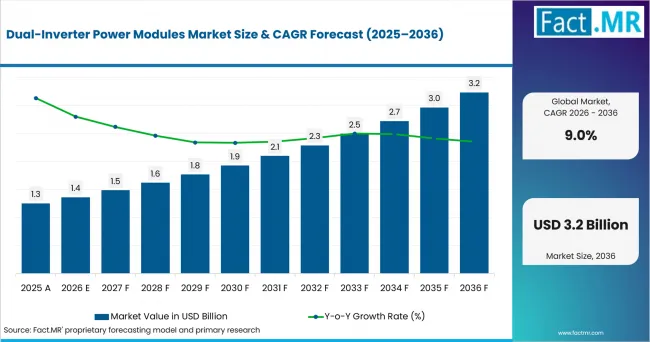
Dual Inverter Power Modules Market Value Analysis | Source: Fact.MR
What are the defining numbers behind Dual-Inverter Power Modules Market growth?
An absolute opportunity of USD 1.9 billion is expected between 2026 and 2036.
- Demand Drivers in the Market
- Electric-drive design teams need compact power stages that coordinate two inverter functions inside one cooling and package design envelope.
- High-voltage platform teams need lower switching losses as battery voltage rises. Silicon carbide power devices support this design path when a module must handle more power while keeping thermal headroom for a second bridge or motor channel.
- The International Energy Agency reported that electric car sales exceeded 20 million worldwide in 2025 and represented about one-quarter of all new car sales. A wider EV vehicle base expands the addressable pool for multi-inverter traction designs.
- Vehicle platform teams increasingly divide propulsion work by axle, motor or auxiliary load. This design favors modules that combine two controlled power paths while preserving electrical isolation and heat control.
- Key Segments Analyzed
- By Module Architecture: Dual 3-phase inverter is expected to hold 38.0% share in 2026. One module can support two three-phase motor channels within a linked thermal and control design.
- By Voltage: <400 V is expected to hold 34.0% share in 2026. The segment benefits from a large installed base of lower-voltage passenger and auxiliary electric-drive platforms.
- By Power: <100 kW is expected to capture 30.0% share in 2026. Compact vehicle and secondary-drive uses favor lower power classes and smaller package size.
- By Vehicle: Passenger EV is expected to hold 36.0% share in 2026. The segment benefits from large global electric-car output and the spread of multi-motor passenger designs.
- Analyst Opinion at Fact.MR
- Shambhu Nath Jha, Principal Consultant at Fact.MR, states, “Dual-inverter modules gain value when two controlled power paths must fit inside one vehicle package. The category is expected to benefit from wider SiC use and multi-motor layouts. Testing still requires careful thermal and electrical checks. Suppliers need compact hardware and clear fit support that match the OEM voltage and power window.”
- Strategic Implications
- The U.S. Energy Information Administration reported in February 2026 that hybrid, battery-electric, and plug-in hybrid vehicles accounted for about 22% of U.S. light-duty vehicle sales in 2025. Power-module suppliers should keep silicon and SiC options available for different vehicle cost and efficiency targets.
- Tier-1 inverter developers should design cooling and busbar layouts around the combined heat load of two controlled power paths. Adjacent e-axle inverter systems show why early system fit reduces redesign work late in a vehicle program.
- Vehicle OEM teams should compare 400 V and 800 V options against motor count and duty cycle before locking the module package. Cable loss and charging strategy should remain part of the same design review.
- Semiconductor vendors should provide gate-drive and sensing support that reduces the work needed to test a dual-channel inverter design. Safety documents and use guidance should match the target voltage and power range.
The USA is expected to post 9.9% CAGR through 2036 as EV electricity use expands. Germany is projected at 9.6% owing to rising BEV registrations. France is estimated at 9.3% as electric models gain share. The UK is forecast at 8.7% supported by zero-emission registrations. Japan is expected to reach 7.8% as policy support broadens.
How does the Dual-Inverter Power Modules Market break down by segment?
Dual 3-phase inverter is expected to lead Module Architecture at 38.0% share in 2026. Passenger EV is expected to lead Vehicle at 36.0%.
Which Module Architecture dominates?
Dual 3-phase inverter is expected to hold 38.0% share in 2026.
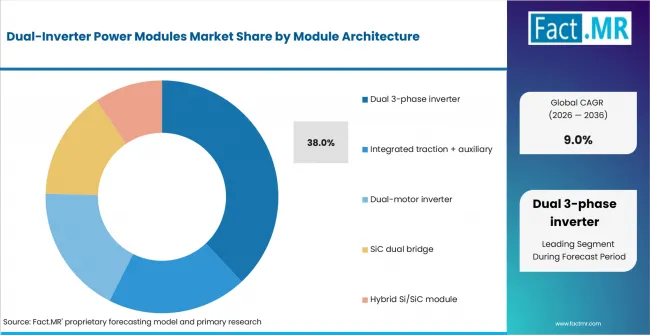
Dual Inverter Power Modules Market Analysis By Module Architecture | Source: Fact.MR
Dual 3-phase designs combine two three-phase switching functions in one module. The same principle appears in SiC dual inverters where paired motor paths share package space and cooling. Shared interconnects can reduce module volume while linked control supports multi-motor vehicle layouts.
DENSO reported in October 2025 that its newly developed inverter for Toyota’s new bZ4X uses SiC power semiconductors and a flat dual-sided cooling structure. Compared with DENSO’s previous Si-based products, the inverter reduces power loss by approximately 70%, while its core module has been downsized by about 30%. DENSO achieved these improvements by integrating SiC semiconductor technology, circuit and structural design, and high-efficiency cooling.
What leads the Voltage segment?
<400 V is expected to hold 34.0% share in 2026.
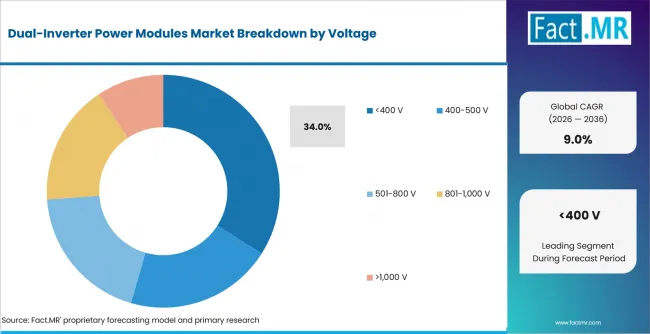
Dual Inverter Power Modules Market Analysis By Voltage | Source: Fact.MR
The <400 V band serves passenger platforms and secondary electric loads where cost remains central. Higher voltage classes become more relevant as propulsion inverter modules move toward faster switching and higher output. Systems above 800 V require more insulation margin and tighter heat control.
In July 2025, onsemi announced that Schaeffler selected its next-generation EliteSiC technology for a traction inverter on a plug-in hybrid electric vehicle platform. onsemi stated that the technology enables a compact, thermally efficient inverter design and supports high-efficiency electric powertrains in both battery-electric and plug-in hybrid vehicles.
How does Power shape demand?
<100 kW is expected to capture 30.0% share in 2026.
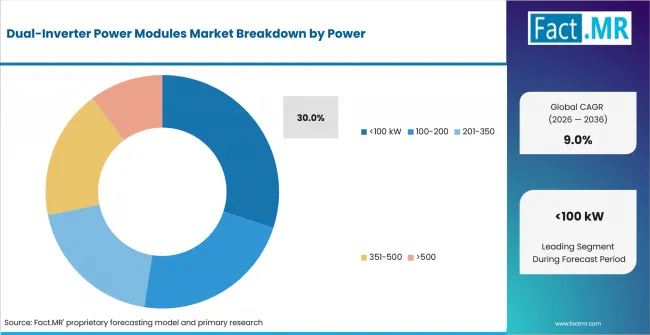
Dual Inverter Power Modules Market Analysis By Power | Source: Fact.MR
Modules below 100 kW fit compact propulsion and secondary electric-drive functions. Mid-power classes serve mainstream passenger traction while higher bands need stronger cooling. The device mix overlaps with automotive chips because MOSFET and IGBT choice shapes switching loss and package size.
Infineon’s automotive IGBT module portfolio covers inverter power classes from 30 kW to 250 kW and includes half-bridge and B6-bridge configurations. In January 2025, the company introduced new EiceDRIVER isolated gate-driver ICs for electric-vehicle traction inverters, with selected devices supporting high-performance inverter applications up to over 300 kW.
What supports Passenger EV within Vehicle?
Passenger EV is expected to hold 36.0% share in 2026.
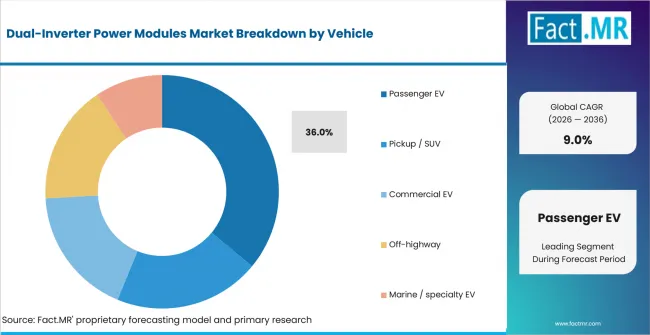
Dual Inverter Power Modules Market Analysis By Vehicle | Source: Fact.MR
Passenger EV programs create the broadest vehicle base for compact inverter fit. Pickup and SUV platforms raise torque and heat needs, as seen in adjacent electrified pickup inverters. Commercial EVs need durable cooling and repeatable power delivery over long duty cycles.
Valeo announced in October 2025 that its new-generation Dual Inverter solution had secured serial production contracts with two major Chinese automakers. Mass production is scheduled to begin in 2026 for plug-in hybrid electric vehicles. Valeo states that the system combines control of two electric motors in one compact inverter with a shared control board, supporting efficient and flexible PHEV powertrain integration.
What is accelerating Dual-Inverter Power Modules Market adoption, and what is holding it back?
Multi-motor EV designs drive adoption; testing cost and thermal complexity restrain it.
Drivers Impact Analysis
| DRIVER | (~) % IMPACT ON CAGR | GEOGRAPHIC RELEVANCE | IMPACT TIMELINE |
|---|---|---|---|
| Multi-motor and dual-channel EV architectures | +1.8% | Global | Short term (<= 2 years) |
| SiC adoption in higher-voltage inverters | +1.4% | North America, Europe, Japan | Medium term (2-4 years) |
| Integrated traction and auxiliary packaging | +1.1% | Global | Medium term (2-4 years) |
| Higher power requirements in SUVs and commercial EVs | +0.8% | North America, Europe | Long term (>= 4 years) |
Source: Fact.MR analysis. Updated Sep 25, 2026
Opportunity Impact Analysis
| OPPORTUNITY | (~) % IMPACT ON CAGR | GEOGRAPHIC RELEVANCE | IMPACT TIMELINE |
|---|---|---|---|
| 800 V and 900 V dual-inverter modules | +1.0% | North America, Europe, Japan | Medium term (2-4 years) |
| Integrated multi-function power electronics | +0.8% | Global | Medium term (2-4 years) |
| Hybrid Si and SiC module architectures | +0.6% | Global | Short term (<= 2 years) |
Source: Fact.MR analysis. Updated Sep 25, 2026
Restraints Impact Analysis
| RESTRAINT | (~) % IMPACT ON CAGR | GEOGRAPHIC RELEVANCE | IMPACT TIMELINE |
|---|---|---|---|
| SiC cost and automotive qualification burden | -0.6% | Global | Medium term (2-4 years) |
| Thermal packaging and electrical-isolation complexity | -0.5% | Global | Short term (<= 2 years) |
| Uneven battery-electric vehicle penetration | -0.4% | Japan, France | Short term (<= 2 years) |
Source: Fact.MR analysis. Updated Sep 25, 2026
Which countries are scaling the Dual-Inverter Power Modules Market through 2036?
- The country comparison spans 2.1 percentage points across the forecast period, from 9.9% in the USA to 7.8% in Japan.
- The USA remains 0.3 percentage point above Germany as EV electricity use and vehicle EV shift create demand for traction-inverter hardware.
- Germany remains 0.3 percentage point above France as BEV registrations and public charging capacity support high-voltage vehicle platforms.
- France remains 0.6 percentage point above the UK as electric passenger cars account for a material share of new registrations.
- The UK remains 0.9 percentage point above Japan as zero-emission registrations expand from a larger battery-electric base.
- Japan closes the displayed range while subsidies and charging investment support gradual movement from hybrid-heavy EV shift toward battery-electric platforms.
Comparable CAGRs can lead to different module needs because vehicle voltage and motor count vary by country. Platform mix and EV penetration also shape power and cooling needs. Full report coverage includes North America, Latin America, Western Europe, Eastern Europe, East Asia, South Asia & Pacific, Middle East & Africa.
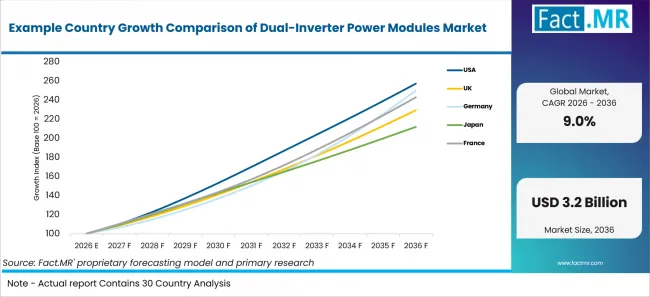
Example Country Growth Comparison Of Dual Inverter Power Modules Market | Source: Fact.MR
| Country | CAGR (2026-2036) |
|---|---|
| United States | 9.9% |
| Germany | 9.6% |
| France | 9.3% |
| United Kingdom | 8.7% |
| Japan | 7.8% |
Source: Fact.MR analysis. Updated Sep 25, 2026
What supports USA adoption?
9.9% CAGR, supported by electric-drive scale and multi-motor vehicle platforms.
U.S. electric-drive programs span passenger cars and larger multi-motor platforms. Dual-channel modules are useful where one package must manage two controlled power paths. The U.S. Energy Information Administration reported in August 2026 that estimated electricity consumption by light-duty plug-in electric vehicles totaled 23,532,855 MWh in 2025. That operating base supports continued traction-inverter design work across silicon and SiC systems, especially where OEMs need compact cooling and linked control.
How is Germany scaling demand?
9.6% CAGR, driven by BEV registrations and high-voltage vehicle programs.
Germany combines a deep automotive design base with rising battery-electric vehicle volume. This creates a steady environment for traction inverters and power modules. The Federal Ministry for Economic Affairs and Energy reported in January 2026 that 545,142 new battery-electric cars were registered in 2025. Higher BEV volume expands the number of platforms that need qualified inverter hardware. Dual-motor and higher-voltage layouts increase the value of compact heat control and scalable chip choices.
What supports France adoption?
9.3% CAGR, supported by a rising electric share of passenger-car registrations.
France is adding electric models across compact and crossover programs, which widens the power range required from inverter modules. The Statistical Service for Data and Studies reported in February 2026 that 331,200 new electric passenger cars were registered in 2025. That vehicle base gives module suppliers more room to support shared cooling and dual-channel control. Traction-plus-auxiliary layouts can extend the same package approach beyond a single motor bridge.
What supports the United Kingdom’s growth?
8.7% CAGR, backed by zero-emission car registrations and broader EV deployment.
The United Kingdom is expanding its battery-electric passenger-car base, which increases the number of platforms that need compact traction power electronics. The Department for Transport reported in April 2026 that 473,000 zero-emission cars were registered for the first time in 2025. Passenger cars and light commercial uses create varied power needs. Modular dual-inverter designs can serve several output classes while preserving package efficiency.
How does Japan perform?
7.8% CAGR, shaped by policy support and gradual battery-electric expansion.
Japan combines long-standing hybrid expertise with a gradual increase in battery-electric programs. Inverter suppliers need designs that cover several powertrain types. The Ministry of Economy, Trade and Industry announced in December 2025 that the maximum Clean Energy Vehicle subsidy for eligible EVs would increase to 1.3 million yen for vehicles newly registered from January 1, 2026. The policy supports battery-electric adoption and keeps design attention on efficient power conversion, compact cooling and reliable SiC fit.
Who leads the Dual-Inverter Power Modules Market?
Infineon Technologies supplies automotive power modules through its HybridPACK and EasyPACK families using Si IGBT and CoolSiC technologies. In May 2025, Infineon announced that Rivian's R2 platform would use silicon and SiC modules from the HybridPACK Drive G2 family for traction inverters, with supply expected to begin in 2026. The program demonstrates the use of scalable automotive power modules in a production-intent electric-vehicle platform.
STMicroelectronics remains active in automotive SiC technology. A January 2025 ST datasheet covers an automotive-grade 1200 V SiC MOSFET designed for applications including electric-traction main inverters. onsemi supports traction-inverter designs for 400 V to 800 V battery systems through EliteSiC and VE-Trac solutions, including SiC and IGBT power-module technologies.
In April 2026, Bosch announced the introduction of its third-generation SiC chips, which it states deliver 20% higher performance than the previous generation. Valeo is active through its scalable Dual Inverter platform, while DENSO has developed compact SiC-based inverter technology using flat dual-sided cooling for electric drivetrains. Across these suppliers, the competitive landscape spans power semiconductor devices, automotive power modules, and integrated inverter systems.
Which companies are the key providers?
Key companies include Infineon Technologies, STMicroelectronics, onsemi, Bosch, DENSO, and Valeo.
- Infineon Technologies
- STMicroelectronics
- onsemi
- Bosch
- DENSO
- Valeo
Bibliography
- Robert Bosch GmbH. (2026, April 22). A leap in semiconductor efficiency: Bosch introduces third generation of SiC chips.
- Valeo. (2025, October 20). Valeo is awarded contracts to supply its new generation Dual Inverter solution to two leading Chinese automakers.
- DENSO Corporation. (2025, October 10). DENSO’s electrification products adopted for TOYOTA’s new “bZ4X”.
- onsemi. (2025, July 24). onsemi and Schaeffler expand collaboration with new EliteSiC-based PHEV platform.
- STMicroelectronics. (2025, January 3). Automotive-grade silicon carbide Power MOSFET 1200 V, 40 mΩ typ., 40 A in an HU3PAK package [Datasheet].
- Infineon Technologies AG. (2025, May 19). Infineon will supply Rivian’s R2 Platform with power modules for electric vehicle traction inverters.
- Ministry of Economy, Trade and Industry. (2025, December 19). Press conference by Minister Akazawa (excerpt).
- Department for Transport. (2026, April 29). Vehicle licensing statistics, United Kingdom: 2025.
- Service des données et études statistiques. (2026, February 11). Immatriculations de voitures en 2025 : le marché du neuf baisse, celui de l’occasion résiste [Car registrations in 2025: New-car market declines, used-car market holds up].
- Federal Ministry for Economic Affairs and Energy. (2026, January 27). Great prospects for electric mobility.
- U.S. Energy Information Administration. (2026, August 26). Electric Power Monthly: Appendix D. Estimated U.S. electricity consumption by light-duty electric vehicles.
- U.S. Energy Information Administration. (2026, February 9). Electric vehicle sales fell as hybrid vehicle sales continued to rise in 2025.
- International Energy Agency. (2026, May 20). Electric vehicle batteries. In Global EV Outlook 2026.
- International Energy Agency. (2026, May 20). Trends in electric cars. In Global EV Outlook 2026.
This Report Answers
- The report explains how dual-inverter power modules fit within automotive power electronics and where two controlled power paths create packaging value.
- Segment analysis identifies the design, voltage, power and vehicle groups that define the forecast structure. It explains why each group has distinct engineering needs.
- Country analysis compares the United States, Germany, France, the United Kingdom and Japan using current EV adoption and infrastructure evidence.
- Competitive analysis reviews the six profiled providers across chip technology, traction inverters and module integration. It also covers recent electric-drive works.
- Application analysis assesses how voltage, motor count, thermal load and vehicle type influence the selection of dual-channel power-module designs.
What does the Dual-Inverter Power Modules Market cover?
The Dual-Inverter Power Modules Market covers power modules used where an electric-drive system requires two inverter functions or closely integrated controlled power paths. It forms part of the wider power-electronics stack, including adjacent EV power electronics protection systems that manage insulation and heat around high-voltage modules.
The assessment follows module architecture, voltage, power, and vehicle classes. It also considers how electric vehicle components interact with traction motors because inverter topology must match motor phase count, torque demand, battery voltage, and cooling capability.
What is included in the scope?
The scope includes dual 3-phase inverter modules, integrated traction + auxiliary modules, dual-motor inverter modules, SiC dual-bridge modules, and hybrid Si/SiC modules. Thermal design also overlaps with power module bonding materials because compact packages need reliable heat transfer and electrical isolation.
Vehicle coverage includes passenger EVs, pickups and SUVs, commercial EVs, off-highway vehicles, and marine or specialty EVs. Adjacent demand from electric commercial vehicles is included when propulsion architecture uses two inverter channels or combines traction with a second high-power controlled load.
What is excluded from the scope?
The market boundary covers dual-channel or closely integrated two-path inverter modules. Stand-alone single-inverter assemblies, bare semiconductor dies, stand-alone motors and chargers belong to adjacent categories. General automotive electronics outside high-voltage motor or auxiliary power conversion are treated separately.
Battery cells and battery packs are outside the market unless they are discussed only as demand context. General electric vehicles are likewise outside the revenue boundary. The report focuses on the power-module layer and related inverter fit rather than the full vehicle value chain or unrelated intelligent power devices.
How Was the Analysis Built?
The analysis draws on 120+ sources, 35+ company portfolios, 25+ countries, and more than 20 industry interviews.
- Primary Research: Primary research includes discussions with manufacturers, service providers, technology developers, distributors, end users, and subject-matter experts. These conversations examine purchasing priorities, product adoption, operational challenges, approval requirements, competitive positioning, and the factors that influence wider market acceptance.
- Desk Research: Desk research covers government statistics, regulatory publications, company filings, trade data, technical studies, industry associations, standards, public policy, and other authoritative sources. Every source used in the analysis is documented in the bibliography.
- Market Sizing and Forecasting: Market estimates combine historical performance, demand indicators, pricing and volume trends, segment shares, company participation, country-level growth, adoption patterns, investment activity, and barriers to market expansion.
- Data Validation and Update Cycle: Findings are validated by comparing primary interviews with public data, company activity, regulatory changes, trade patterns, and industry developments. Regular updates review new product launches, capacity changes, partnerships, approvals, and shifts in commercial adoption.
Segmentation
What is the report’s scope and coverage?
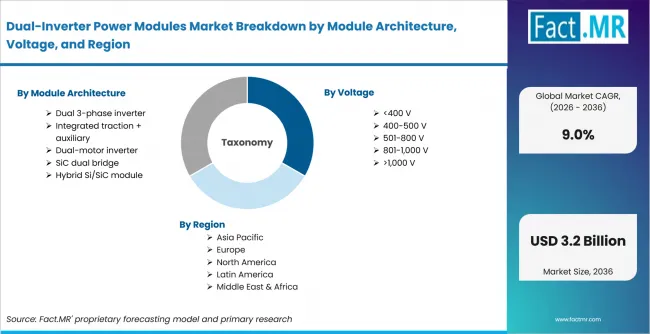
Dual Inverter Power Modules Market Breakdown By Module Architecture, Voltage, And Region | Source: Fact.MR
| Attribute | Details |
|---|---|
| Quantitative Units | USD Billion |
| Market Definition | Power-module assemblies designed to support two inverter functions or two controlled power paths in electric-drive systems, including dual 3-phase, dual-motor, traction-plus-auxiliary, SiC dual-bridge, and hybrid Si/SiC architectures. |
| Module Architecture | Dual 3-phase inverter; Integrated traction + auxiliary; Dual-motor inverter; SiC dual bridge; Hybrid Si/SiC module |
| Voltage | <400 V; 400-500 V; 501-800 V; 801-1,000 V; >1,000 V |
| Power | <100 kW; 100-200 kW; 201-350 kW; 351-500 kW; >500 kW |
| Vehicle | Passenger EV; Pickup / SUV; Commercial EV; Off-highway; Marine / specialty EV |
| Regions Covered | North America; Latin America; Western Europe; Eastern Europe; East Asia; South Asia & Pacific; Middle East & Africa |
| Countries Covered | United States; United Kingdom; Germany; Japan; France |
| Key Companies Profiled | Infineon Technologies; STMicroelectronics; onsemi; Bosch; Denso; Valeo |
| Forecast Period | 2026 to 2036 |
| Approach | Hybrid top-down and bottom-up framework using electric-vehicle deployment, traction-inverter architecture, semiconductor technology, voltage class, power class, country adoption, and verified provider activity. |
Source: Fact.MR analysis. Updated Sep 25, 2026
How is the market segmented?
-
By Module Architecture
- Dual 3-phase inverter
- Integrated traction + auxiliary
- Dual-motor inverter
- SiC dual bridge
- Hybrid Si/SiC module
-
By Voltage
- <400 V
- 400-500 V
- 501-800 V
- 801-1,000 V
- >1,000 V
-
By Power
- <100 kW
- 100-200 kW
- 201-350 kW
- 351-500 kW
- >500 kW
-
By Vehicle
- Passenger EV
- Pickup / SUV
- Commercial EV
- Off-highway
- Marine / specialty EV
-
By Region
- North America
- Latin America
- Western Europe
- Eastern Europe
- East Asia
- South Asia & Pacific
- Middle East & Africa
Frequently Asked Questions
How big is the Dual-Inverter Power Modules Market in 2026?
What is the CAGR of the Dual-Inverter Power Modules Market from 2026 to 2036?
Which module architecture leads the Dual-Inverter Power Modules Market?
Which vehicle segment leads the Dual-Inverter Power Modules Market?
Who are the leading companies in the Dual-Inverter Power Modules Market?
Who worked on this report


Preview the report firsthand - request a free sample
Free SampleGet the brochure for pricing and purchase details
Download PDF