- Market Value (2025): USD 0.2 Bn
- Estimated Value (2026): USD 0.3 Bn
- Forecast Value (2036): USD 0.7 Bn
- CAGR (2026-2036): 8.8%
What is the dual-chamber cartridge plungers market forecast to be worth by 2036?
USD 0.3 billion in 2026 to USD 0.7 billion by 2036, at 8.8% CAGR.
- The dual-chamber cartridge plungers market crossed a valuation of USD 0.2 billion in 2025. Demand is expected to increase from USD 0.3 billion in 2026 to USD 0.7 billion by 2036. The market is forecast to record 8.8% CAGR from 2026 to 2036 as lyophilized biologics, peptides and complex injectable therapies move toward cartridge-based self-administration.
- Dual-chamber cartridge plungers are elastomeric sealing components used inside two-compartment cartridge systems. These plungers separate drug chambers and support controlled reconstitution before injection. The category connects with drug delivery systems because plunger performance affects dosing accuracy and device reliability.
- West Pharmaceutical Services highlighted its 1.5 mL FluroTec cartridge plunger in 2024, with a symmetric design and double-sided fluoropolymer film. This supports demand for low-interaction plungers used in cartridge-based injectable products.
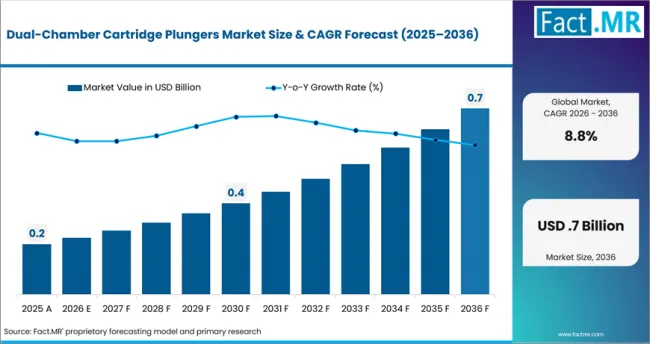
Dual Chamber Cartridge Plungers Market Value Analysis | Source: Fact.MR
What are the defining numbers behind dual-chamber cartridge plunger market growth?
USD 0.4 billion absolute opportunity by 2036, led by the United States and Germany.
- Demand Drivers in the Market
- Lyophilized injectable developers need chamber separation inside reconstitution cartridges.
- Device teams need plungers that support predictable glide during activation.
- Biologic programs need coated elastomers with low extractables risk.
- Fill-finish providers need plunger formats that support automated assembly.
- Key Segments Analyzed
- By Plunger Position: Middle Separating Plungers are expected to hold 44.0% share in 2026 because they isolate drug and diluent chambers.
- By Coating Type: Fluoropolymer-Coated Plungers lead because sensitive biologics need lower interaction risk. The share is projected at 47.0% in 2026.
- By Cartridge Configuration: Lyo-Liquid Dual-Chamber Cartridges are likely to account for 58.0% share in 2026 because lyophilized drugs need reconstitution before injection.
- By Drug Use: Biologics and Peptide Therapies lead with 46.0% share in 2026 because these therapies drive premium cartridge component demand.
- By Customer Type: Pharma Combination Product Programs are expected to hold 51.0% share in 2026 because sponsors specify plunger compatibility early.
- By Geography: The United States is projected to record 14.3% CAGR through 2036 as cartridge-based self-injection programs expand.
- Analyst Opinion at Fact.MR
- Shambhu Nath Jha, Senior Analyst at Fact.MR, states, “Dual-chamber cartridge plungers are moving from a sealing component into a drug-device performance factor. We see sponsors evaluating plunger coating, glide force and chamber integrity earlier in development. Suppliers that combine materials science with dual-chamber validation support will gain stronger access to biologic and peptide programs.”
- Strategic Implications
- Elastomer suppliers should build coated plunger portfolios for sensitive drug contact.
- Cartridge makers should qualify middle plunger movement during reconstitution.
- Pharma sponsors should test plunger compatibility before device design lock.
- Fill-finish providers should align plunger formats with automated assembly lines.
Aptar Pharma offers cartridge plungers for pen-injectors as part of its GLP-1 injection component portfolio. This shows how cartridge plunger demand is tied to self-injection and chronic therapy platforms.
Datwyler states that its cartridge plungers use specialized butyl-based formulations and support plunger barrel seal integrity. This reinforces the need for elastomer systems that protect sensitive drug products during long contact periods.
The United States is projected to record 14.3% CAGR through 2036 as biologic and peptide self-injection programs expand. Germany is expected to post 13.6% CAGR through 2036 as dual-chamber containment and fill-finish expertise supports lyophilized drugs. Switzerland is likely to record 13.0% CAGR as Datwyler and drug-device programs support premium elastomer demand. Italy is forecast to advance at 12.5% CAGR as Stevanato Group supports dual-chamber cartridge development. Japan is set to record 11.8% CAGR as self-injection programs use compact cartridge systems.
How does the dual-chamber cartridge plungers market break down by segment?
Middle Separating Plungers lead at 44.0%; Fluoropolymer-Coated Plungers lead at 47.0%.
Which plunger position dominates?
Middle Separating Plungers hold 44.0% share in 2026.
Middle Separating Plungers are expected to hold 44.0% share in 2026 because the component isolates the two chambers before use. It must prevent premature mixing and then move smoothly during reconstitution. The design is critical for lyophilized drug and diluent systems. The segment connects with combination products because the plunger is evaluated as part of the full drug-device system.
Which coating type dominates?
Fluoropolymer-Coated Plungers lead with 47.0% share in 2026.
Fluoropolymer-Coated Plungers lead because sensitive injectable drugs need lower extractables and leachables risk. The coating type is projected to capture 47.0% share in 2026. West’s FluroTec and Aptar’s PremiumCoat platforms show how coated elastomers support sensitive biologic and peptide programs. Coated plungers also help improve glide consistency during cartridge activation.
Which cartridge configuration dominates?
Lyo-Liquid Dual-Chamber Cartridges hold 58.0% share in 2026.
Lyo-Liquid Dual-Chamber Cartridges lead because many sensitive drugs are stored as lyophilized cakes and reconstituted before use. The configuration is likely to account for 58.0% share in 2026. SCHOTT Pharma’s double chamber cartridges allow reconstitution of lyophilized drugs and support sequential injection use cases. This format creates strong demand for separating plungers and end plungers.
Which drug use dominates?
Biologics and Peptide Therapies account for 46.0% share in 2026.
Biologics and Peptide Therapies lead because these products often need premium containment and careful device compatibility. The drug use category is expected to hold 46.0% share in 2026. GLP-1, hormone and specialty biologic programs also use cartridge systems for repeat dosing. The segment connects with biologics because drug sensitivity increases the need for better elastomer contact materials.
Which customer type dominates?
Pharma Combination Product Programs hold 51.0% share in 2026.
Pharma Combination Product Programs lead because drug sponsors define the cartridge and plunger system during development. The customer type is expected to hold 51.0% share in 2026. Sponsors must test stability, movement and reconstitution performance. Device platform firms and fill-finish partners then execute the selected component strategy. Plunger movement must match device mechanics, activation force, and cartridge geometry.
What is accelerating dual-chamber cartridge plunger demand, and what is holding it back?
Lyophilized self-injection drives demand, while validation complexity restrains adoption.
Lyophilized self-injection is the main driver. Dual-chamber cartridges simplify reconstitution by storing drug and diluent in one container. Stevanato Group states that dual-chamber cartridges use separate chambers and a bypass system for safe reconstitution before administration.
The main restraint is validation complexity. Plunger movement, coating compatibility and seal integrity must be tested with each formulation and device. This adds time before a sponsor can scale a dual-chamber cartridge program.
Where do the biggest dual-chamber cartridge plunger opportunities sit?
Lyophilized biologics, GLP-1 combinations and automated reconstitution devices.
- Lyophilized Biologics: Sponsors can use dual-chamber cartridges to simplify reconstitution before injection.
- GLP-1 Combinations: Cartridge systems can support repeat dosing and device-based administration.
- Automated Reconstitution Devices: Plungers can support controlled mixing inside injector platforms.
Which countries are scaling dual-chamber cartridge plungers fastest?
United States 14.3%, Germany 13.6%, Switzerland 13.0%, Italy 12.5%, Japan 11.8%.
Based on regional analysis, the dual-chamber cartridge plungers market covers North America, Western Europe, Asia Pacific, Latin America, and the Middle East & Africa.
| Country | CAGR |
|---|---|
| United States | 14.3% |
| Germany | 13.6% |
| Switzerland | 13.0% |
| Italy | 12.5% |
| Japan | 11.8% |
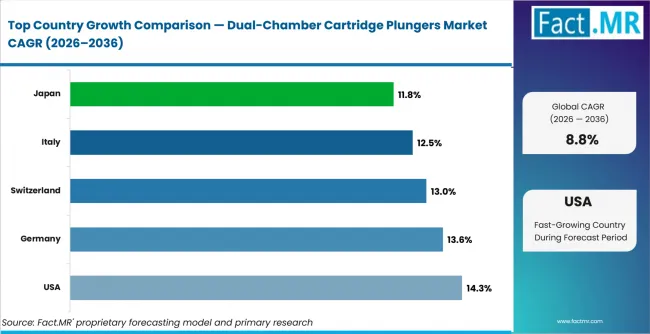
Dual Chamber Cartridge Plungers Market Cagr Analysis By Country | Source: Fact.MR
What is powering the United States lead?
14.3% CAGR, driven by West Pharmaceutical Services and biologic self-injection programs.
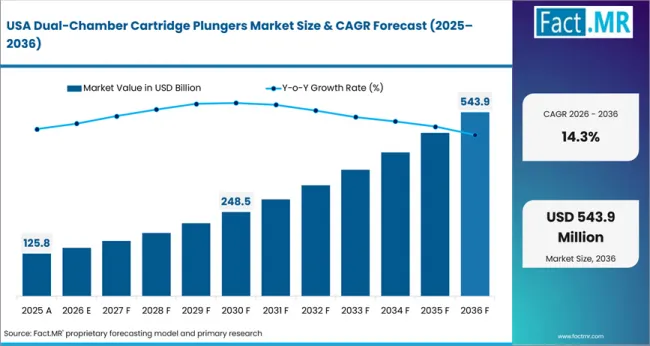
Dual Chamber Cartridge Plungers Market Country Value Analysis | Source: Fact.MR
The United States is projected to record 14.3% CAGR by 2036 as biologic and peptide sponsors evaluate dual-chamber cartridge systems. West supports cartridge plungers with FluroTec and NovaPure component platforms. Drug-device programs need coated components for long-contact injectable formulations. Growth will favor suppliers with strong compatibility data and development support.
How is Germany scaling dual-chamber cartridge plunger demand?
13.6% CAGR, supported by SCHOTT Pharma dual-chamber expertise.
Germany is expected to post 13.6% CAGR through 2036 as dual-chamber containment and fill-finish capabilities support lyophilized products. SCHOTT Pharma supplies double chamber cartridges for lyophilized drugs and sequential injection. Growth will favor plunger systems that fit industrial fill-finish workflows.
What supports Switzerland’s outlook?
13.0% CAGR, driven by Datwyler and premium elastomer demand.
Switzerland is likely to record 13.0% CAGR by 2036 as high-value injectable programs use premium cartridge plungers. Datwyler supports butyl-based cartridge plungers and seal integrity requirements. Swiss pharma programs need materials that fit sensitive biologics. Growth will favor coated elastomers and strong quality files.
How is Italy scaling dual-chamber cartridge plunger adoption?
12.5% CAGR, backed by Stevanato Group and dual-chamber cartridge development.
Italy is forecast to advance at 12.5% CAGR through 2036 as Stevanato Group supports dual-chamber containment solutions. Cartridge developers need compatible plungers for lyo-liquid systems and bypass cartridge designs. Italian device and glass-container expertise supports early-stage development. Growth will favor integrated cartridge and component validation.
What underpins Japan’s growth?
11.8% CAGR, driven by self-injection programs and precision component demand.
Japan is set to record 11.8% CAGR by 2036 as self-injection programs use compact cartridge systems. Sensitive formulations require stable storage and controlled reconstitution. Device developers need smooth plunger motion and reliable chamber separation. Growth will favor high-quality elastomer components with strong documentation.
Who leads the dual-chamber cartridge plungers market?
West Pharmaceutical Services and Datwyler lead through premium elastomer cartridge components.
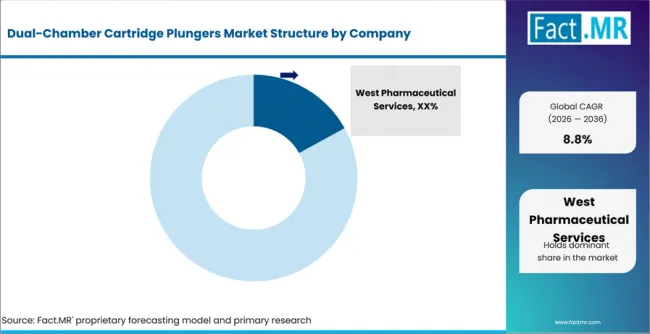
Dual Chamber Cartridge Plungers Market Analysis By Company | Source: Fact.MR
Dual-chamber cartridge plungers are supplied by elastomer component firms and dual-chamber containment providers. West Pharmaceutical Services leads through FluroTec and NovaPure cartridge plunger platforms. Datwyler supports cartridge plungers through butyl-based formulations and seal integrity expertise.
Aptar Pharma competes through coated plungers and cartridge components for pen-injector applications. SCHOTT Pharma supports the cartridge system side through double-chamber cartridges for lyophilized drugs. Stevanato Group supports dual-chamber cartridge development and ready-to-use containment solutions.
Competition through 2036 will depend on material compatibility and reconstitution performance. Suppliers need low-interaction coatings and precise plunger dimensions. The medical polymers layer matters because elastomer and coating choices shape extractables risk. Advanced syringe formats are relevant because dual-chamber systems share containment and glide-performance requirements.
Which companies are the key providers?
West Pharmaceutical Services and Datwyler are key providers. Aptar Pharma and SCHOTT Pharma are also profiled. Stevanato Group completes the company set.
- West Pharmaceutical Services
- Datwyler
- Aptar Pharma
- SCHOTT Pharma
- Stevanato Group
Bibliography
- West Pharmaceutical Services. (2024, February 2). Filling the gap with 1.5 mL FluroTec® plunger for cartridge-based technology. West Pharmaceutical Services.
- Aptar Pharma. (2026). Closure solutions for GLP-1 applications. Aptar Pharma.
- Datwyler. (2026). Cartridges. Datwyler Healthcare.
- SCHOTT Pharma. (2026). Cartridges Double Chamber (DC): Dual-chamber cartridges for lyophilized drugs and sequential injections. SCHOTT Pharma.
- Barichello, E., & Ravazzolo, V. (2025, September 26). Two into one: Solving complex drug delivery problems with dual-chamber containment solutions. ONdrugDelivery.
- Neumeier, M. (2025, September 26). Advancing lyophilised drug development in dual-chamber systems. ONdrugDelivery.
This Report Addresses
- Strategic intelligence on dual-chamber cartridge plungers across plunger position and coating type.
- Segment analysis covering Middle Separating Plungers and Fluoropolymer-Coated Plungers.
- Regional outlook covering the United States, Germany, Switzerland, Italy, and Japan.
- Competitive analysis of West Pharmaceutical Services, Datwyler, Aptar Pharma, SCHOTT Pharma, Stevanato Group.
- Technology assessment covering coated elastomers, chamber separation, glide force, and reconstitution performance.
- Use case assessment covering lyophilized biologics, GLP-1 combinations, and automated reconstitution devices.
- Primary interviews, supplier checks and official source review support the forecast.
What does the dual-chamber cartridge plungers market cover?
Elastomer plungers used to separate and seal chambers in dual-chamber cartridges.
The dual-chamber cartridge plungers market covers middle stoppers, end plungers and coated elastomer plungers used in dual-chamber cartridge systems. It includes components used in lyo-liquid cartridges and liquid-liquid cartridge formats. The scope connects with prefilled syringes because both formats rely on elastomer sealing and glide performance.
The market differs from ordinary cartridge plunger demand because dual-chamber systems need more precise chamber separation. The middle plunger must maintain isolation before activation and allow predictable movement during reconstitution. Any sealing issue can affect mixing, dose accuracy or drug stability.
What is included in the scope?
Middle separating plungers and end plungers for dual-chamber injectable cartridges.
The scope includes uncoated and film-coated plungers used inside glass or polymer dual-chamber cartridges. It covers plungers used for lyophilized drug reconstitution and sequential injection. The scope includes self-injection devices when cartridge plungers are assembled into pen injectors or automated delivery systems.
The scope includes plungers supplied to drug-device developers, cartridge makers, and fill-finish providers. It covers plunger qualification support and compatibility testing where the component is sold for dual-chamber cartridge applications.
What is excluded from the scope?
Standard syringe plungers and vial stoppers outside cartridge use.
The scope excludes ordinary syringe plungers used outside dual-chamber cartridge systems. It excludes vial stoppers and lyophilization stoppers unless they are part of a dual-chamber cartridge assembly. It excludes cartridge glass barrels and caps when sold without plunger components. It also excludes complete injectors unless plunger value is separately identifiable.
How was the analysis built?
100+ sources, 40+ company portfolios, 25+ countries, 20+ interviews.
- Primary Research: Primary research includes interviews with injectable packaging engineers and drug-device program managers. It includes input from elastomer component suppliers and fill-finish technical teams.
- Desk Research: Desk research reviews official product sources and dual-chamber containment references. It covers fluoropolymer-coated plungers, butyl elastomers and pharmaceutical packaging used for injectable therapies.
- Market-Sizing and Forecasting: Forecasting uses dual-chamber cartridge adoption and elastomer component pull-through. Biologic pipeline activity and reconstitution device development support the market assessment.
- Data Validation and Update Cycle: Forecasts are validated through supplier checks and device program references. Product launches and dual-chamber containment updates help confirm market direction.
What is the report’s scope and coverage?
| Attribute | Details |
|---|---|
| Quantitative Units | USD Billion in 2026 to USD Billion by 2036 at CAGR |
| Market Definition | Elastomer plungers used to separate and seal chambers in dual-chamber cartridge systems |
| Plunger Position | Middle Separating Plungers; End Plungers; Activation Plungers; Bypass-Compatible Plungers; Custom Dual-Seal Plungers |
| Coating Type | Fluoropolymer-Coated Plungers; ETFE-Coated Plungers; Uncoated Butyl Plungers; Silicone-Managed Plungers; Low-Extractable Coated Plungers |
| Cartridge Configuration | Lyo-Liquid Dual-Chamber Cartridges; Liquid-Liquid Dual-Chamber Cartridges; Sequential Injection Cartridges; Pen-Compatible Cartridges; Automated Reconstitution Cartridges |
| Drug Use | Biologics and Peptide Therapies; GLP-1 and Metabolic Drugs; Hormone Therapies; Emergency Reconstitution Drugs; Specialty Injectable Drugs |
| Customer Type | Pharma Combination Product Programs; Cartridge System Suppliers; Fill-Finish Providers; Device Platform Developers; CDMOs |
| Regions Covered | North America; Western Europe; Asia Pacific; Latin America; Middle East and Africa |
| Countries Covered | United States; Germany; Switzerland; Italy; Japan |
| Key Companies Profiled | West Pharmaceutical Services; Datwyler; Aptar Pharma; SCHOTT Pharma; Stevanato Group |
| Forecast Period | 2026 to 2036 |
| Approach | Hybrid top-down and bottom-up approach using dual-chamber cartridge adoption, elastomer component demand, biologic self-injection programs and supplier validation |
How is the market segmented?
-
By Plunger Position:
- Middle Separating Plungers
- End Plungers
- Activation Plungers
- Bypass-Compatible Plungers
- Custom Dual-Seal Plungers
-
By Coating Type:
- Fluoropolymer-Coated Plungers
- ETFE-Coated Plungers
- Uncoated Butyl Plungers
- Silicone-Managed Plungers
- Low-Extractable Coated Plungers
-
By Cartridge Configuration:
- Lyo-Liquid Dual-Chamber Cartridges
- Liquid-Liquid Dual-Chamber Cartridges
- Sequential Injection Cartridges
- Pen-Compatible Cartridges
- Automated Reconstitution Cartridges
-
By Drug Use:
- Biologics and Peptide Therapies
- GLP-1 and Metabolic Drugs
- Hormone Therapies
- Emergency Reconstitution Drugs
- Specialty Injectable Drugs
-
By Customer Type:
- Pharma Combination Product Programs
- Cartridge System Suppliers
- Fill-Finish Providers
- Device Platform Developers
- CDMOs
-
Region:
- North America
- United States
- Canada
- Europe
- Germany
- Switzerland
- Italy
- France
- United Kingdom
- Asia Pacific
- Japan
- China
- South Korea
- Singapore
- India
- Latin America
- Brazil
- Mexico
- Argentina
- Middle East & Africa
- UAE
- Saudi Arabia
- South Africa
- Israel
- North America