- Market Value (2025): USD 737.2 Mn
- Estimated Value (2026): USD 816.8 Mn
- Forecast Value (2036): USD 2277.8 Mn
- CAGR (2026-2036): 10.8%
What is the Duchenne Muscular Dystrophy Transcriptomic Profiling Market forecast to be worth by 2036?
USD 816.8 million in 2026 and USD 2,277.8 million by 2036 at a 10.8% CAGR.
- The Duchenne Muscular Dystrophy Transcriptomic Profiling market was valued at USD 737.2 million in 2025 influenced by therapeutic monitoring and specialist neuromuscular research demand.
- Demand is projected to increase from USD 816.8 million in 2026 to USD 2,277.8 million by 2036.
- The market is forecast to record a 10.8% CAGR from 2026 to 2036 driven by response measurement for gene therapy and exon-skipping programs.
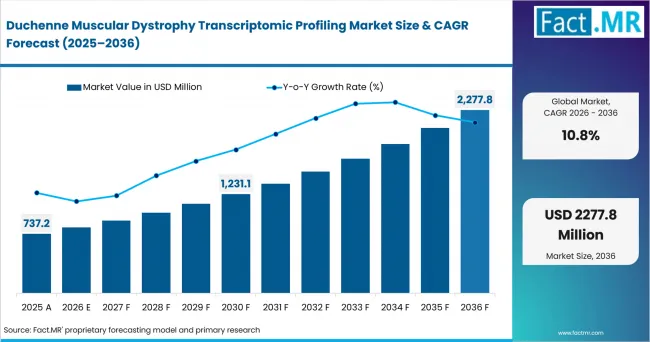
Duchenne Muscular Dystrophy Transcriptomic Profiling Market Value Analysis | Source: Fact.MR
What are the defining numbers behind Duchenne Muscular Dystrophy Transcriptomic Profiling Market growth?
USD 1,461.0 million absolute opportunity by 2036 is expected to be led by RNA Sequencing (RNA-Seq) and Biomarker Discovery alongside Skeletal Muscle Biopsy workflows.
- Demand Drivers in the Market
- DMD treatment research now includes gene therapy, exon-skipping drugs and treatments that reduce inflammation. These different approaches require RNA-based checks to show how the body responds.
- ClinicalTrials.gov records continue to show the use of biological markers in DMD studies. These markers are often included in gene therapy and exon-skipping trials to help measure treatment effects.
- Single-cell and spatial RNA testing are expected to help researchers study small muscle samples in greater detail. These methods can show differences between individual cells that standard RNA sequencing may miss.
- Key Segments Analyzed
- By Technology: RNA Sequencing (RNA-Seq) is expected to hold 30.0% share in 2026 supported by broad use in expression and splicing studies.
- By Application: Biomarker Discovery is projected to account for 30.0% share in 2026 owing to measurable response needs in DMD development programs.
- By Sample Type: Skeletal Muscle Biopsy is anticipated to capture 30.0% share in 2026 due to direct dystrophin-pathway evidence from affected tissue.
- By End User: Pharmaceutical & Biotechnology Companies are estimated to represent 30.0% share in 2026 attributable to trial design and therapy monitoring work.
- Analyst Opinion at Fact.MR
- Shambhu Nath Jha, Senior Analyst at Fact.MR, states, “Duchenne muscular dystrophy research now goes beyond finding the gene change. RNA testing helps researchers see how treatment affects muscle and immune activity. Methods that work with small tissue samples are likely to receive greater use. They must also compare patients who begin treatment at different stages and show whether RNA changes match improvements seen during clinical checks.”
- Strategic Implications
- Therapy developers can set clear limits for successful splice correction before choosing an RNA testing method for a study.
- Specialist laboratories should compare blood and cell-model results with muscle biopsy findings before treating them as easier alternatives.
- Research sponsors can review standard RNA sequencing alongside single-cell and spatial methods before adding the tests across several study sites.
- Clinical staffs should record age, corticosteroid use and muscle scarring when reviewing RNA results. Muscle condition also belongs in the same assessment so the finding is not judged alone.
Safety monitoring is expected to carry greater weight in DMD treatment decisions after regulators narrowed eligibility and required longer patient follow-up. On November 14, 2025, the FDA approved a new boxed warning for Elevidys and limited its use to ambulatory DMD patients aged 4 years and older. The action also required a postmarketing observational study of approximately 200 DMD patients followed for at least 12 months after administration.
Germany is expected to record a 14.6% CAGR from 2026 to 2036, helped by specialist muscle disease centers and laboratories linked to clinical trials. Brazil is projected to post a 13.5% CAGR as blood tests and cell-based methods offer easier options than muscle biopsy. The USA is anticipated to grow at a 12.4% CAGR, backed by new treatment approvals and biotechnology investment. South Korea is estimated to reach an 11.3% CAGR through its large hospital network and advanced medical testing. The United Kingdom is forecast at 10.3%, while Japan is projected to record a 9.2% CAGR with careful local testing and specialist care.
How does the Duchenne Muscular Dystrophy Transcriptomic Profiling Market break down by segment?
RNA Sequencing (RNA-Seq) leads at 30.0% by Technology, and Biomarker Discovery leads at 30.0% by Application in 2026.
Why does RNA Sequencing (RNA-Seq) lead Technology?
RNA Sequencing (RNA-Seq) is estimated to hold 30.0% share within Technology in 2026.
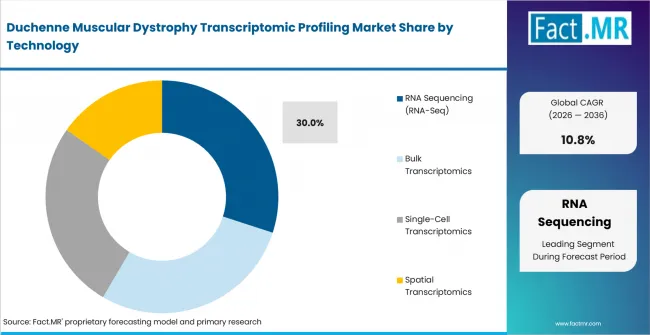
Duchenne Muscular Dystrophy Transcriptomic Profiling Market Analysis By Technology | Source: Fact.MR
RNA Sequencing (RNA-Seq) provides a broad view of gene-expression changes and abnormal splicing across DMD samples. This makes it useful when researchers need to compare treatment response with underlying disease activity. Bulk Transcriptomics supports larger group comparisons, while single-cell transcriptomics separates signals from individual cell populations. Spatial transcriptomics adds tissue-location detail where researchers need to understand how molecular changes differ across affected muscle regions.
Why does Biomarker Discovery lead Application?
Biomarker Discovery is projected to account for 30.0% share within Application in 2026.
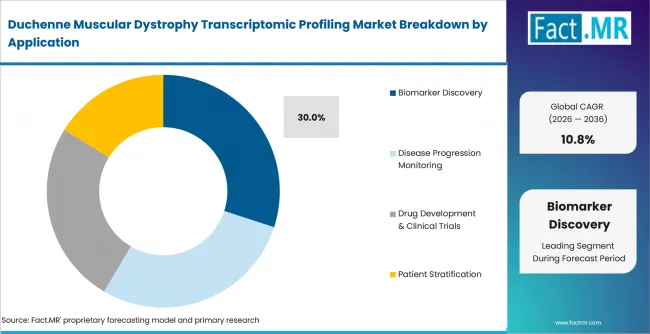
Duchenne Muscular Dystrophy Transcriptomic Profiling Market Analysis By Application | Source: Fact.MR
Biomarker Discovery holds the leading position as therapy developers look for RNA signals that can support patient selection, dose decisions and treatment-response assessment. Disease progression monitoring depends on markers that remain stable enough for repeat use. Drug development & clinical trials require signals that can be reproduced across study sites, while Patient stratification uses those markers to separate patients by disease pattern, treatment eligibility or likely response.
Why does Skeletal Muscle Biopsy lead Sample Type?
Skeletal Muscle Biopsy is anticipated to capture 30.0% share within Sample Type in 2026.
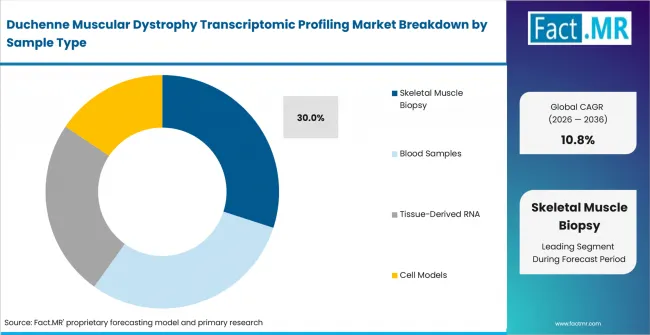
Duchenne Muscular Dystrophy Transcriptomic Profiling Market Analysis By Sample Type | Source: Fact.MR
Affected muscle tissue gives researchers the most direct view of dystrophin-related expression, fibrosis and inflammatory activity. Skeletal muscle biopsy therefore remains central when blood-based findings need tissue confirmation. Blood samples offer an easier route for repeated monitoring, although the detected signal may not fully reflect local muscle changes. Tissue-Derived RNA supports focused laboratory analysis, while Cell Models help examine mechanisms before additional patient sampling is considered.
Why do Pharmaceutical & Biotechnology Companies lead End User?
Pharmaceutical & Biotechnology Companies are forecast to represent 30.0% share within End User in 2026.
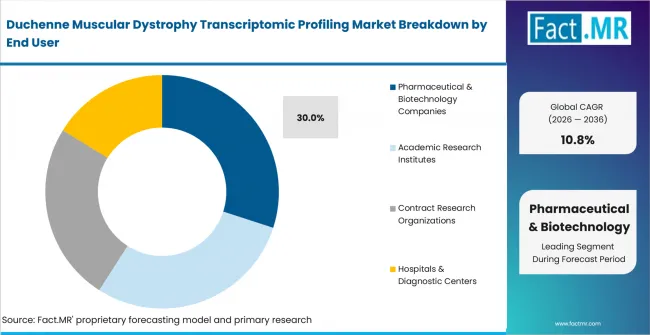
Duchenne Muscular Dystrophy Transcriptomic Profiling Market Analysis By End User | Source: Fact.MR
Drug developers account for the largest share as transcriptomic evidence supports target selection, trial design, biomarker planning and regulatory submissions. Academic Research Institutes contribute early disease biology and method development using smaller rare-disease cohorts. Contract Research Organizations provide sequencing, sample processing and data analysis for sponsored studies. Hospitals and diagnostic centers take a larger role when transcriptomic testing becomes part of funded clinical protocols or treatment-monitoring programs.
What is accelerating Duchenne Muscular Dystrophy Transcriptomic Profiling Market adoption, and what is holding it back?
Therapy-response measurement is anticipated to drive market growth. Tissue scarcity and interpretation burden are expected to restrain adoption where sites lack repeatable sample workflows.
Drivers Impact Analysis
| DRIVER | (~) % IMPACT ON CAGR | GEOGRAPHIC RELEVANCE | IMPACT TIMELINE |
|---|---|---|---|
| Post-approval biomarker monitoring for gene therapy | +1.6% | USA and other markets with expanded gene-therapy eligibility | Short term (<=2 years) |
| Mutation-independent therapy response tracking | +1.3% | USA and United Kingdom | Medium term (2-4 years) |
| Expanding gene therapy and exon-skipping pipeline | +1.0% | Germany and United Kingdom | Medium term (2-4 years) |
| Single-cell methods overcoming biopsy scarcity | +0.8% | Brazil and other markets balancing biopsy access | Long term (>=4 years) |
| Natural-history data supporting external controls | +0.6% | Japan and academic research settings | Long term (>=4 years) |
Source: Fact.MR analysis. Updated Jul 20, 2026
- Post-approval biomarker monitoring: Safety actions and treatment-eligibility rules keep biomarker evidence tied to therapy use. Specialist laboratories are expected to receive repeat testing work when results show what changed after treatment and why the signal is credible.
- Mutation-independent therapy response tracking: FDA approved Duvyzat in March 2024 for DMD patients aged 6 years and older. FDA's April 2026 Drug Trials Snapshot reported one supporting trial with 179 male DMD patients across 45 sites in 11 countries.
- Expanding gene therapy and exon-skipping pipeline: Active studies continue to combine molecular biomarkers with gene therapy and exon-skipping approaches. This pipeline is projected to widen the number of programs that need RNA evidence before major trial decisions.
Opportunity Impact Analysis
| OPPORTUNITY | (~) % IMPACT ON CAGR | GEOGRAPHIC RELEVANCE | IMPACT TIMELINE |
|---|---|---|---|
| Blood-based and cell-model alternatives to biopsy | +0.5% | Brazil and other markets balancing biopsy access | Short term (<=2 years) |
| Spatial and single-cell transcriptomic expansion | +0.4% | Germany and South Korea | Medium term (2-4 years) |
| Patient stratification for exon-skipping and gene therapy trials | +0.3% | United Kingdom and USA | Medium term (2-4 years) |
| CRO and hospital-network testing capacity | +0.3% | South Korea and Japan | Long term (>=4 years) |
Source: Fact.MR analysis. Updated Jul 20, 2026
- Blood-based and cell-model alternatives: Skeletal muscle biopsy remains central but is invasive and scarce. Laboratories are expected to win more study work when lower-burden samples preserve the relevant DMD signal.
- Spatial and single-cell transcriptomics: Cell-resolved methods are projected to expand where bulk RNA-Seq hides differences between degenerating fibers and fibrotic tissue. The commercial case depends on clearer interpretation, not extra data volume.
- Patient stratification: Exon-skipping and gene-therapy trials need patient groups that match the intended mechanism. Transcriptomic evidence is expected to support enrollment rules, response interpretation and later safety review.
Restraints Impact Analysis
| RESTRAINT | (~) % IMPACT ON CAGR | GEOGRAPHIC RELEVANCE | IMPACT TIMELINE |
|---|---|---|---|
| Scarce and invasive skeletal muscle biopsy supply | -0.5% | Brazil and other mixed public-private markets | Short term (<=2 years) |
| Confounding biology across age, steroid exposure and fibrosis | -0.4% | South Korea and broader patient populations | Medium term (2-4 years) |
| Institutional capacity gaps in staff and monitoring | -0.3% | Japan and smaller specialist centers | Medium term (2-4 years) |
| Cross-site transfer and validation burden | -0.2% | Global | Long term (>=4 years) |
Source: Fact.MR analysis. Updated Jul 20, 2026
- Scarce biopsy supply: Repeat muscle biopsy is difficult for patients and clinicians. Adoption is anticipated to slow where the test depends on tissue that a site cannot collect consistently.
- Confounding biology: Age and steroid exposure change the RNA background before therapy response is measured. Fibrosis and inflammation add further noise that laboratories must separate before calling a molecular change useful.
- Capacity gaps: A technically sound result has limited value when no team owns follow-up testing, safety review or reimbursement paperwork. Smaller sites are expected to adopt cautiously until responsibility for each follow-up step is clear.
Which countries are scaling Duchenne Muscular Dystrophy Transcriptomic Profiling Market fastest?
The country outlook shows a steady fall in growth across the six markets. Germany and Brazil lead the group, followed by the USA and South Korea. The United Kingdom and Japan record slightly lower growth. The gap between the countries is not large, but it shows clear differences in access to specialist centers, laboratory services and treatment research.
- Germany and Brazil form the leading pair for different reasons. Germany has strong muscle disease research centers and well-equipped laboratories. Brazil has greater demand for blood tests and cell-based methods that reduce the use of repeated muscle biopsies.
- The USA and South Korea make up the next group. Growth in the USA is linked to treatment approvals, clinical trials and biotechnology funding. South Korea benefits from large hospital networks and strong testing services.
- The United Kingdom and Japan grow at a slower pace. National genetic testing networks support the U.K. market. Japan places more focus on local study results, patient history and careful hospital review.
Overall, the ranking shows a gradual decline rather than a sharp split between countries. Similar growth rates can still hide differences in biopsy access, laboratory staff, clinical trial work and patient follow-up. The full report covers North America, Latin America, Western Europe, Eastern Europe, East Asia, South Asia and Pacific, and the Middle East and Africa.
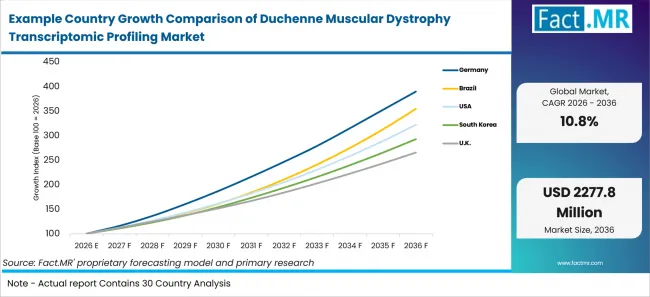
Example Country Growth Comparison Of Duchenne Muscular Dystrophy Transcriptomic Profiling Market | Source: Fact.MR
| COUNTRY | CAGR from 2026 to 2036 |
|---|---|
| Germany | 14.6% |
| Brazil | 13.5% |
| USA | 12.4% |
| South Korea | 11.3% |
| United Kingdom | 10.3% |
| Japan | 9.2% |
Source: Fact.MR analysis. Updated Jul 20, 2026
What is driving Germany’s growth through 2036?
14.6% CAGR, helped by specialist muscle disease research and strong laboratory services.
Germany’s opportunity comes from university hospitals that bring muscle sampling, RNA testing and medical review into one DMD research process. The results are most useful when laboratories follow the same biopsy rules and explain whether an RNA change comes from treatment or from the stage of the disease. The market is projected to record a 14.6% CAGR from 2026 to 2036 as this hospital and laboratory base supports gene therapy and exon-skipping studies.
How is Brazil scaling demand?
13.5% CAGR, supported by testing options that reduce repeated muscle biopsies.
Brazil has a clear opening where hospitals want to avoid repeated and invasive tissue collection. Blood samples and cell models are easier to use across the country’s public and private care systems. However, laboratories still have to show that these results match what is found in affected muscle. Demand is expected to post a 13.5% CAGR through 2036 as hospitals test practical sample options where muscle biopsies are difficult to collect or process.
What supports the USA outlook?
12.4% CAGR, linked to active treatment development and closer safety checks.
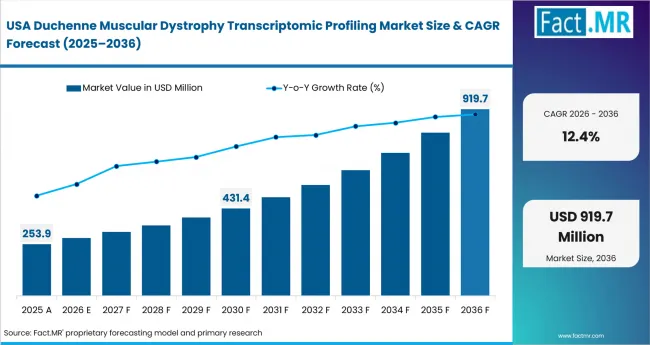
Duchenne Muscular Dystrophy Transcriptomic Profiling Market Country Value Analysis | Source: Fact.MR
Demand in the USA is closely connected with drug approvals, clinical trials and follow-up after treatment. In November 2025, the FDA added a boxed warning to Elevidys and limited its use to DMD patients aged four years and older who can still walk. This placed greater focus on clear patient selection and proper follow-up records. The market is estimated to grow at a 12.4% CAGR by 2036 as RNA results help doctors review treatment response and safety.
What underpins South Korea’s growth?
11.3% CAGR, driven by large hospital networks and consistent handling of test results.
South Korea has major hospitals that can combine sequencing, patient records and specialist DMD care. Its strength comes from preparing samples and reviewing results in the same way during each patient check. Simply adding more sequencing machines is not enough. The market is forecast to record an 11.3% CAGR from 2026 to 2036 as hospitals compare RNA findings with treatment history, physical tests and later patient follow-up.
How is the United Kingdom developing demand?
10.3% CAGR, supported by shared genetic testing networks and joint evidence review.
The United Kingdom is building demand through shared laboratory services and NHS review instead of leaving each hospital to work alone. This setup helps research sites follow common sample rules and compare treatment-response signs across gene therapy and exon-skipping studies. The market is projected to post a 10.3% CAGR through 2036 as research centers can share and review RNA findings more easily.
How does Japan perform?
9.2% CAGR, shaped by patient-history data and careful testing in local hospitals.
Japan’s outlook depends on proving that RNA changes are useful in small DMD patient groups. Results may differ with age, past treatment and the stage of the disease. Hospitals are expected to compare RNA findings with long-term patient records before using them in treatment checks. The market is anticipated to record a 9.2% CAGR from 2026 to 2036 as local studies and specialist hospital review guide wider use.
Who leads the Duchenne Muscular Dystrophy Transcriptomic Profiling Market?
Sarepta Therapeutics and Roche lead DMD therapy coverage. Illumina and Thermo Fisher Scientific strengthen sequencing and transcriptomic workflow capacity.
Sarepta Therapeutics has a central role in the commercial DMD gene therapy field through Elevidys and the safety checks linked to its use. Roche also remains active through neuromuscular treatment partnerships and its experience in rare diseases. Illumina and Thermo Fisher Scientific provide the equipment and tools used for RNA sequencing and related testing.
Solid Biosciences and Regenxbio add new gene therapy programs that keep muscle biopsy and biological testing important in clinical research. In May 2026, Regenxbio reported positive early pivotal results for RGX-202 in the AFFINITY DUCHENNE study. QIAGEN and Revvity provide sample preparation products and testing tools for research and clinical studies.
Which companies are the key providers?
Sarepta Therapeutics and F. Hoffmann-La Roche are key participants. Solid Biosciences and REGENXBIO are also profiled. Illumina, Thermo Fisher Scientific, QIAGEN, Revvity, 10x Genomics and Bruker complete the company set.
- Sarepta Therapeutics, Inc.
- F. Hoffmann-La Roche Ltd.
- Solid Biosciences Inc.
- Regenxbio Inc.
- Illumina, Inc.
- Thermo Fisher Scientific Inc.
- QIAGEN N.V.
- Revvity, Inc.
Bibliography
- U.S. Food and Drug Administration. (2025, November 14). FDA approves new safety warning and revised indication that limits use for Elevidys following reports of fatal liver injury.
- Solid Biosciences Inc. (2026, May 12). Solid Biosciences reports first quarter 2026 financial results and provides business updates.
- REGENXBIO Inc. (2026, May 14). REGENXBIO announces positive topline results from pivotal Phase III AFFINITY DUCHENNE® study of RGX-202.
- Sarepta Therapeutics, Inc. (2025, July 25). Sarepta Therapeutics provides clarifying statement on ELEVIDYS.
- U.S. Food and Drug Administration. (2026, April 29). Drug Trials Snapshots: DUVYZAT.
This Report Addresses
- The report provides strategic intelligence on transcriptomic profiling across Technology and Application choices used in Duchenne therapy development.
- Segment analysis covers RNA Sequencing (RNA-Seq) and Biomarker Discovery as the share within the 2026 market.
- Regional outlook evaluates Germany; Brazil; USA; South Korea; United Kingdom; and Japan.
- Competitive analysis profiles Sarepta Therapeutics and Roche alongside Illumina and Thermo Fisher Scientific, followed by additional active providers.
- Sample assessment covers Skeletal Muscle Biopsy and Blood Samples and Tissue-Derived RNA and Cell Models across evidence needs in DMD research.
- Use-case assessment covers Biomarker Discovery and Disease Progression Monitoring alongside Drug Development & Clinical Trials and Patient Stratification.
What does the Duchenne Muscular Dystrophy Transcriptomic Profiling Market cover?
RNA sequencing and related transcriptomic services are used to study DMD biology. They identify biomarkers, confirm splicing effects and measure treatment response.
The Duchenne Muscular Dystrophy Transcriptomic Profiling Market covers RNA-based profiling services and workflows used across Duchenne muscular dystrophy research and therapeutic development. Coverage includes bulk transcriptomic methods and cell-resolved approaches used with muscle biopsy and blood-derived samples. Tissue RNA and cell models remain within scope when they support DMD mechanism or response analysis.
The market differs from general genetic testing because commercial value comes from transcript-level interpretation and response evidence. Whole clinical care spending and unrelated neuromuscular diagnostics remain outside the boundary.
What is included in the scope?
Transcriptomic profiling services and related workflows are included when they support Duchenne research, clinical development and therapy-response monitoring.
The scope includes Technology; Application; Sample Type; and End User categories. Coverage spans RNA Sequencing (RNA-Seq), Bulk Transcriptomics and Single-Cell Transcriptomics. Spatial Transcriptomics is included when specialist centers use cell-location evidence in DMD research programs.
What is excluded from the scope?
Unrelated equipment, complete care expenditure and adjacent diagnostics outside the transcriptomic profiling boundary are excluded.
The scope excludes broader hospital treatment costs and genetic tests that do not measure transcriptomic response. Public publications support context and do not replace Fact.MR market values.
How Was the Analysis Built?
The analysis draws on 120+ sources, 35+ company portfolios, 25+ countries, and more than 20 industry interviews.
- Primary Research: Primary research includes discussions with manufacturers, service providers, technology developers, distributors, end users, procurement teams, and subject-matter experts. These conversations examine purchasing priorities, product adoption, operational challenges, approval requirements, competitive positioning, and the factors that influence wider market acceptance.
- Desk Research: Desk research covers government statistics, regulatory publications, company filings, trade data, technical studies, industry associations, standards, public policy, and other authoritative sources. Every source used in the analysis is documented in the bibliography.
- Market Sizing and Forecasting: Market estimates combine historical performance, demand indicators, pricing and volume trends, segment shares, company participation, country-level growth, adoption patterns, investment activity, and barriers to market expansion.
- Data Validation and Update Cycle: Findings are validated by comparing primary interviews with public data, company activity, regulatory changes, trade patterns, and industry developments. Regular updates review new product launches, capacity changes, partnerships, approvals, procurement trends, and shifts in commercial adoption.
Segmentation
What is the report’s scope and coverage?
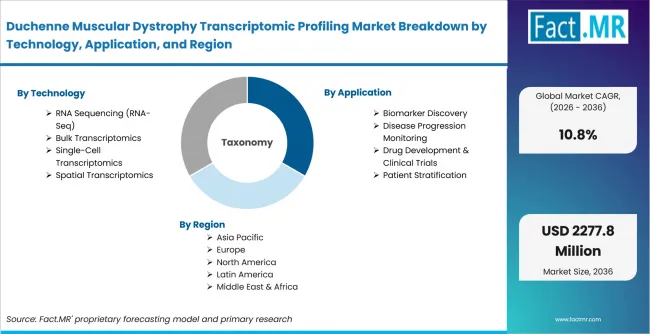
Duchenne Muscular Dystrophy Transcriptomic Profiling Market Breakdown By Technology, Application, And Region | Source: Fact.MR
| Attribute | Details |
|---|---|
| Quantitative Units | USD Million in 2026 to USD Million by 2036 at CAGR |
| Market Definition | RNA-based profiling services and workflows used to measure gene expression, splicing effects, biological pathways and treatment response across Duchenne muscular dystrophy research and therapeutic development |
| Technology | RNA Sequencing (RNA-Seq); Bulk Transcriptomics; Single-Cell Transcriptomics; Spatial Transcriptomics |
| Application | Biomarker Discovery; Disease Progression Monitoring; Drug Development & Clinical Trials; Patient Stratification |
| Sample Type | Skeletal Muscle Biopsy; Blood Samples; Tissue-Derived RNA; Cell Models |
| End User | Pharmaceutical & Biotechnology Companies; Academic Research Institutes; Contract Research Organizations; Hospitals & Diagnostic Centers |
| Regions Covered | North America; Latin America; Western Europe; Eastern Europe; East Asia; South Asia and Pacific; Middle East and Africa |
| Countries Covered | Germany; Brazil; USA; South Korea; United Kingdom; Japan |
| Key Companies Profiled | Sarepta Therapeutics, Inc.; F. Hoffmann-La Roche Ltd.; Solid Biosciences Inc.; REGENXBIO Inc.; Illumina, Inc.; Thermo Fisher Scientific Inc.; QIAGEN N.V.; Revvity, Inc.; 10x Genomics, Inc.; Bruker Corporation |
| Forecast Period | 2026 to 2036 |
| Approach | Hybrid top-down and bottom-up approach using DMD therapy-development activity; transcriptomic profiling use in clinical studies; biomarker attachment rates; RNA sequencing adoption; muscle-biopsy availability; blood and cell-model validation; gene-therapy and exon-skipping pipelines; laboratory capacity; country growth conditions and company participation |
Source: Fact.MR analysis. Updated Jul 20, 2026
How is the market segmented?
-
By Technology:
- RNA Sequencing (RNA-Seq)
- Bulk Transcriptomics
- Single-Cell Transcriptomics
- Spatial Transcriptomics
-
By Application:
- Biomarker Discovery
- Disease Progression Monitoring
- Drug Development & Clinical Trials
- Patient Stratification
-
By Sample Type:
- Skeletal Muscle Biopsy
- Blood Samples
- Tissue-Derived RNA
- Cell Models
-
By End User:
- Pharmaceutical & Biotechnology Companies
- Academic Research Institutes
- Contract Research Organizations
- Hospitals & Diagnostic Centers
-
By Region:
- North America
- Latin America
- Western Europe
- Eastern Europe
- East Asia
- South Asia and Pacific
- Middle East and Africa
Frequently Asked Questions
Which Technology leads the Duchenne Muscular Dystrophy Transcriptomic Profiling Market?
Which Application leads the market?
Which Sample Type leads the market?
Which End User leads the market?
Which country records the highest CAGR?
How does Brazil perform in the market?
What is the primary driver?
What is the main restraint?
Why is RNA Sequencing (RNA-Seq) significant?
Why do Pharmaceutical & Biotechnology Companies dominate demand?
Who worked on this report


Preview the report firsthand - request a free sample
Free SampleGet the brochure for pricing and purchase details
Download PDF