- Market Value (2025): USD 417.8 Mn
- Estimated Value (2026): USD 445.0 Mn
- Forecast Value (2036): USD 1,150 Mn
- CAGR (2026-2036): 10.0%
What is the Dyestuff for Textile Market forecast to be worth by 2036?
USD 7.92 billion in 2026 to USD 12.7 billion by 2036 at a 4.8% CAGR.
- As per Fact.MR analysis, the dyestuff for textile market was valued at USD 7.56 billion in 2025.
- Demand is projected to increase from USD 7.92 billion in 2026 to USD 12.7 billion by 2036.
- The market is forecast to expand at a 4.8% CAGR from 2026 to 2036 as textile manufacturers seek reliable coloration across apparel and other textile applications.
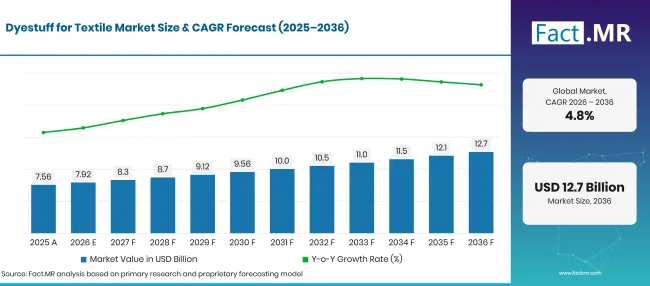
Dyestuff For Textile Market Forecast Global | Source: Fact.MR
| Year | Basis | Market Value (USD billion) |
|---|---|---|
| 2025 | Actual | 7.5 |
| 2026 | Estimate | 7.9 |
| 2036 | Forecast | 12.7 |
| CAGR (2026–2036) | Forecast period | 4.8% |
Source: Fact.MR analysis. Updated Oct 26, 2026
What are the defining numbers behind Dyestuff for Textile Market growth?
USD 4.8 billion in absolute opportunity between 2026 and 2036.
- Demand Drivers in the Market
- Textile producers require dyes that deliver repeatable shades across production batches. The German Federal Statistical Office's industrial database tracks textile manufacturing, apparel manufacturing, and textile finishing as distinct activities, providing an official framework for assessing the industrial base that purchases coloration chemicals [1].
- Synthetic fibers are important to textile coloration demand. Dye selection must account for fiber chemistry because disperse dyes are suited to polyester coloration, whereas reactive dyes are widely used for cotton and other compatible cellulosic fibers.
- Environmental compliance is influencing dye formulation and textile processing decisions. India's Ministry of Textiles reported in March 2026 that textile-sector facilities are subject to applicable effluent standards and requirements for effluent treatment plants or common effluent treatment plants. The ministry also highlighted environmental considerations under the Eco-Mark Scheme [2] [5].
- Key Segments Analyzed
- By Type: Reactive Dyes will account for 32.6% of the market in 2026, supported by their suitability for cellulosic fibers and applications requiring strong wash fastness.
- By Application: Apparel is leading with 52.3% of the market in 2026, reflecting the recurring need for coloration across garments and fashion products.
- By Fiber Type: Polyester will hold 52.0% share in 2026, reflecting the importance of synthetic fibers in textile production and associated dyeing requirements.
- Analyst Opinion at Fact.MR
- Shambhu Nath Jha, Principal Consultant at Fact.MR, states, “Textile dye suppliers are likely to compete on shade consistency, application efficiency, and environmental performance. Producers that align dye chemistry with fiber requirements and help mills manage processing conditions will be better positioned to support repeat orders.”
- Strategic Implications
- Dye manufacturers need to document fiber compatibility, colorfastness performance, and applicable chemical compliance requirements for each product grade.
- Textile processors must select dyes according to fiber composition, desired shade depth, production conditions, and wastewater treatment capabilities.
- Apparel supply-chain participants can evaluate color consistency and batch reproducibility when qualifying dye suppliers for large production programs.
- Specialty chemical suppliers can prioritize technical support for dye-house process optimization and wastewater management.
Germany is set to record a 6.0% CAGR through 2036. Brazil is projected to post 5.5%, followed by the USA at 4.9%. The UK is estimated to advance at 4.4%, while Japan is forecast to record 3.9%.
How does the Dyestuff for Textile Market break down by segment?
Fact.MR finds that Reactive Dyes leads Type at 32.6%; Apparel leads Application at 52.3%; and Polyester Leads Fiber Type at 52.0% in 2026.
Which Type dominates?
Reactive Dyes is set to hold a 32.6% share in 2026.
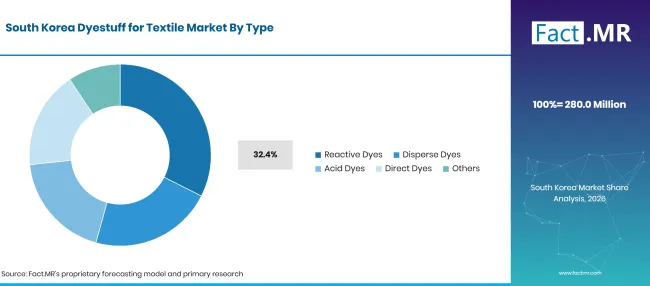
Factmr Dyestuff For Textile Market South Korea By Type | Source: Fact.MR
| Type | Share (2026) |
|---|---|
| Reactive Dyes (Leading segment) | 32.6% |
| Other segments combined | 67.4%* |
| Total | 100.0% |
Source: Fact.MR analysis. Updated Oct 26, 2026
Reactive dyes form covalent bonds with suitable fibers and are widely used for cotton and other cellulosic materials. Their application supports apparel and home textile production where wash fastness and shade reproducibility are important. Disperse dyes serve polyester and other suitable synthetic fibers, while acid and direct dyes meet different fiber and processing requirements. Selection depends on the substrate and dyeing method, along with shade specifications and finishing conditions.
What leads the Application segment?
Apparel is set to represent a 52.3% share in 2026.
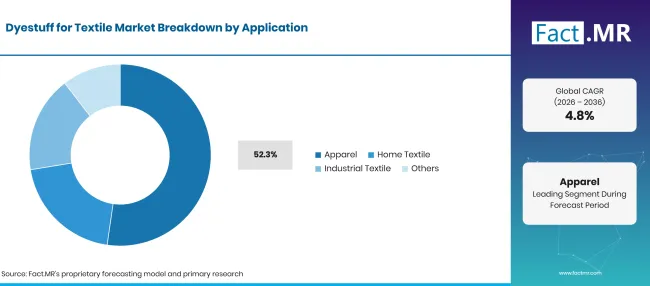
Dyestuff For Textile Market Breakdown Application | Source: Fact.MR
| Application | Share (2026) |
|---|---|
| Apparel (Leading segment) | 52.3% |
| Other segments combined | 47.7%* |
| Total | 100.0% |
Source: Fact.MR analysis. Updated Oct 26, 2026
Apparel generates recurring demand for dyes across shirts, trousers, dresses, sportswear, uniforms, and fashion garments. Seasonal collections and changing color preferences require textile mills to reproduce specified shades at commercial scale. Home textiles require coloration for products such as curtains, bedding, and upholstery, while industrial textiles prioritize functional performance and application-specific specifications. These differences influence dye selection, order volumes, and processing requirements.
How does Fiber Type shape demand?
Polyester is likely to account for a 52.0% share in 2026.
| Fiber Type | Share (2026) |
|---|---|
| Polyester (Leading segment) | 52.0% |
| Other segments combined | 48.0%* |
| Total | 100.0% |
Source: Fact.MR analysis. Updated Oct 26, 2026
Polyester requires dye systems suited to its hydrophobic polymer structure. Disperse dyes are widely used because they can diffuse into polyester under appropriate temperature and processing conditions. Cotton generally requires a different coloration approach, including reactive or direct dyes depending on the intended performance. Wool, silk, and nylon have their own dye compatibility requirements. Blended fabrics create additional challenges because manufacturers may need to achieve consistent coloration across fibers with different chemical properties.
What is accelerating Dyestuff for Textile Market adoption, and what is holding it back?
Demand for apparel coloration and synthetic-fiber processing supports growth, while wastewater treatment requirements and the need for consistent color performance create operational challenges.
Drivers Impact Analysis
| DRIVER | Approx. CAGR Impact | Geographic Relevance | Impact Timeline |
|---|---|---|---|
| Recurring apparel coloration demand | +1.0% | Global | Medium term (2–4 years) |
| Polyester textile processing | +0.9% | Asia, Europe | Medium term (2–4 years) |
| Demand for repeatable colorfastness | +0.7% | Global | Short term (≤ 2 years) |
| Specialty dye formulations | +0.5% | Global | Medium term (2–4 years) |
| Technical support for dye-house operations | +0.4% | Global | Short term (≤ 2 years) |
Source: Fact.MR analysis. Updated Oct 26, 2026
Opportunity Impact Analysis
| OPPORTUNITY | Approx. CAGR Impact | Geographic Relevance | Impact Timeline |
|---|---|---|---|
| Lower-impact dyeing processes | +0.8% | Europe, Asia | Medium term (2–4 years) |
| Improved shade reproducibility | +0.6% | Global | Short term (≤ 2 years) |
| Fiber-specific dye formulations | +0.5% | Global | Medium term (2–4 years) |
| Wastewater treatment compatibility | +0.4% | Global | Long term (≥ 4 years) |
Source: Fact.MR analysis. Updated Oct 26, 2026
Restraints Impact Analysis
| RESTRAINT | Approx. CAGR Impact | Geographic Relevance | Impact Timeline |
|---|---|---|---|
| Effluent treatment and compliance costs | -0.8% | Global | Short term (≤ 2 years) |
| Variable shade consistency across batches | -0.6% | Global | Short term (≤ 2 years) |
| Raw material price fluctuations | -0.5% | Global | Medium term (2–4 years) |
| Compatibility challenges in blended fabrics | -0.4% | Global | Medium term (2–4 years) |
Source: Fact.MR analysis. Updated Oct 26, 2026
Which countries are scaling the Dyestuff for Textile Market through 2036?
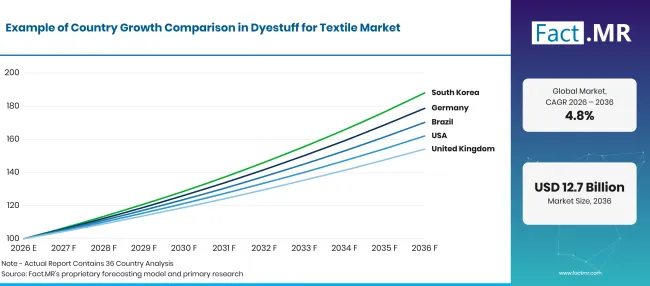
Dyestuff For Textile Market Growth Index | Source: Fact.MR
| Country | CAGR (2026–2036) |
|---|---|
| Germany | 6.0% |
| Brazil | 5.5% |
| USA | 4.9% |
| UK | 4.4% |
| Japan | 3.9% |
Source: Fact.MR analysis. Updated Oct 26, 2026
What supports Germany adoption?
6.0% CAGR, supported by specialty chemical demand and established textile processing capabilities.
Germany’s textile manufacturing sector provides a relevant industrial base for textile dyes and processing chemicals. According to Germany’s Federal Statistical Office (Destatis), the country had 647 textile manufacturing establishments employing 52,713 people in 2025, with turnover reaching approximately €11.61 billion [6]. Textile finishing accounted for 82 establishments and 5,478 employees, while technical textile manufacturing included 124 establishments employing 10,767 people.
Apparel manufacturing added another 3,218 establishments and 361,081 employees across the broader clothing sector’s reported industrial statistics [7]. These activities support demand for dyes suited to different fiber types and processing requirements. Future demand will depend on textile production volumes, colorfastness specifications and compliance with environmental standards.
How is Brazil developing dyestuff adoption?
5.5% CAGR, led by textile coloration requirements across apparel and other textile products.
Brazil's textile and apparel value chain creates demand for dyes used in fabric production and garment manufacturing. Suppliers can compete through reliable color matching, suitable formulations for different fibers, and technical support for textile processors. Market expansion will also depend on manufacturing activity, input costs, and compliance with applicable environmental requirements.
What supports United States adoption?
4.9% CAGR, backed by demand for differentiated textile products and specialized coloration applications.
The US market includes buyers of apparel, home textiles, and technical textile products. Dye suppliers must meet customer specifications for colorfastness, chemical compliance, and consistency across production batches. Opportunities depend on domestic textile processing activity and demand from downstream manufacturers. Imports and sourcing decisions also influence the competitive position of domestic dye producers.
How is the United Kingdom building adoption?
4.4% CAGR, shaped by textile manufacturing requirements and demand for specialized textile products.
The UK's textile manufacturing industry remains an identifiable component of the national production economy. The Office for National Statistics publishes separate production indicators for textile manufacturing, including monthly and quarterly output data [3]. Market demand will depend on textile production volumes, imported fabrics, specialty finishing requirements, and purchasing decisions by downstream manufacturers.
What supports Japan adoption?
3.9% CAGR, driven by industrial textile production and demand for controlled coloration.
Japan's Ministry of Economy, Trade and Industry maintains a Current Survey of Production covering manufactured textile products and other industrial categories [4]. Dye suppliers will need to address requirements for shade precision, reliable batch performance, and suitable formulations for different fibers. Demand will also depend on manufacturing volumes and the product mix of domestic textile processors.
Who leads the Dyestuff for Textile Market?
Fact.MR profiles Archroma, Everlight Chemical Industrial Corporation, Zhejiang Longsheng Group Co., Ltd., Kiri Industries Limited, and Zhejiang Runtu Co., Ltd. among the companies operating in the dyestuff for textile market.
Competition centers on dye chemistry, fiber compatibility, colorfastness, formulation quality, technical support and environmental compliance. Manufacturers differentiate their portfolios through reactive, disperse, acid and other dye categories designed for specific textile substrates and processing conditions. Product consistency, manufacturing capacity and compliance with chemical regulations also influence supplier selection.
Archroma supplies textile dyes and coloration solutions, with product development focused on color performance and efficient dyeing processes. Everlight Chemical Industrial Corporation offers textile colorants for different fiber types and dyeing requirements. Zhejiang Longsheng Group Co., Ltd. participates in the dyestuff industry through its dye and dye-intermediate manufacturing activities. Kiri Industries Limited supplies textile dyes and dye intermediates, while Zhejiang Runtu Co., Ltd. manufactures dyestuffs and related chemical products for industrial applications.
Market positioning depends on portfolio breadth, product performance, customer relationships and the ability to meet evolving textile-processing and environmental requirements. Manufacturers that combine consistent coloration with efficient processing and reliable technical support compete to address the varied needs of textile producers.
Which companies are the key providers?
Key companies profiled include Archroma; Everlight Chemical Industrial Corporation; Zhejiang Longsheng Group Co., Ltd.; Kiri Industries Limited; and Zhejiang Runtu Co., Ltd.
- Archroma
- Everlight Chemical Industrial Corporation
- Zhejiang Longsheng Group Co., Ltd.
- Kiri Industries Limited
- Zhejiang Runtu Co., Ltd.
Bibliography
- [1] Statistisches Bundesamt (Destatis). (n.d.). Beschäftigte und Umsatz der Betriebe im Verarbeitenden Gewerbe: Deutschland, Jahre, Wirtschaftszweige (WZ2008 2-/3-/4-Steller). GENESIS-Online. Destatis GENESIS table 42271-0002
- [2] Ministry of Textiles, Government of India. (2026, March 10). Extended producer responsibility. Press Information Bureau. PIB source
- [3] Office for National Statistics. (2026, October 15). 13: Manufacture of Textiles: CVM: annual & monthly gr. ONS time series K28G
- [4] Ministry of Economy, Trade and Industry. (2026, June 30). Current Survey of Production. METI source
- [5] Ministry of Textiles, Government of India. (2026). Annual report 2025–2026. Ministry of Textiles report PDF
- [6] Statistisches Bundesamt (Destatis). (n.d.). Beschäftigte und Umsatz der Betriebe im Verarbeitenden Gewerbe: Deutschland, Jahre, Wirtschaftszweige (WZ2008 2–4-Steller-Hierarchie). GENESIS-Online. Destatis GENESIS table 42271-0003
- [7] Bundesministerium für Wirtschaft und Energie. (n.d.). Textil- und Bekleidungsindustrie. BMWE source
- [8] Zhejiang Longsheng Group Co., Ltd. (2026, April 16). 破局·新生,活性“龙盛黑”首次亮相! [Reactive “Longsheng Black” makes its debut]. Zhejiang Longsheng announcement
This Report Answers
- The report describes the use of textile dyestuffs across apparel, home textiles, industrial textiles, and other applications.
- Segment analysis evaluates reactive dyes, disperse dyes, acid dyes, direct dyes, and other dye categories.
- Fiber analysis explains the relationship between polyester, cotton, wool, silk, nylon, and dye chemistry.
- Country analysis discusses Germany, Brazil, the USA, the UK, and Japan alongside official industrial indicators.
- The competitive overview profiles major dye manufacturers and specialty chemical suppliers.
- Market analysis considers coloration performance, processing compatibility, and environmental compliance requirements.
What does the Dyestuff for Textile Market cover?
The market covers colorants used to dye textile fibers, yarns, fabrics, and related products. It includes reactive dyes, disperse dyes, acid dyes, direct dyes, and other relevant dye categories. Applications include apparel, home textiles, and industrial textiles. Market demand depends on fiber composition, coloration requirements, production volumes, colorfastness expectations, and the technical requirements of textile processing.
What is included in the scope?
Included products are dyestuffs intended for textile coloration.
The analysis covers the specified dye types, applications, and fiber categories. It also considers the role of dye selection in shade consistency, wash fastness, processing efficiency, and compliance with applicable chemical and environmental requirements.
What is excluded from the scope?
The analysis excludes pigments and colorants sold exclusively for non-textile applications.
Coatings, paints, printing inks, and paper colorants are excluded unless a product is specifically included within the defined textile dyestuff category. Textile machinery, dyeing equipment, and wastewater treatment systems are also excluded from dyestuff market revenue. Textile auxiliaries and finishing chemicals are outside the scope unless explicitly classified as dyestuffs.
How Was the Analysis Built?
The analysis considers market forecasts, industry developments, company activities, technical requirements and relevant government statistics to assess market conditions and growth opportunities.
- Primary Research: Discussions with manufacturers, distributors, textile processors, technical specialists, and industry participants examine dye selection, purchasing priorities, application requirements, product performance, and competitive positioning.
- Desk Research: Research covers official government statistics, environmental regulations, company publications, industry associations, technical literature, and other authoritative sources. Relevant references are documented in the bibliography.
- Market Sizing and Forecasting: Market estimates combine historical performance, pricing and volume trends, segment shares, company participation, country-level growth estimates, manufacturing indicators, and factors affecting adoption.
- Data Validation and Update Cycle: Findings are assessed against available official statistics, company activity, regulatory changes, and industry developments. Updates consider product introductions, manufacturing changes, evolving compliance requirements, and shifts in textile processing demand.
Segmentation
What is the report's scope and coverage?
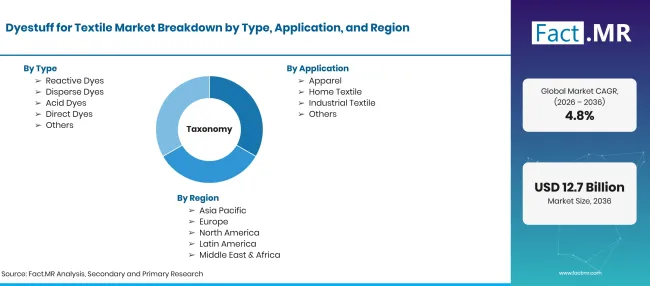
Dyestuff For Textile Market Taxonomy | Source: Fact.MR
| Attribute | Details |
|---|---|
| Quantitative Units | USD billion |
| Market Definition | Dyes and colorants used to impart color to textile fibers, yarns, fabrics, and related textile products |
| Type | Reactive Dyes; Disperse Dyes; Acid Dyes; Direct Dyes; Others |
| Application | Apparel; Home Textile; Industrial Textile; Others |
| Fiber Type | Polyester; Cotton; Wool; Silk; Nylon; Others |
| Regions Covered | North America; Latin America; Western Europe; Eastern Europe; East Asia; South Asia & Pacific; Middle East & Africa |
| Countries Covered | Germany; Brazil; USA; UK; Japan |
| Companies Profiled | Archroma, Everlight Chemical Industrial Corporation, Zhejiang Longsheng Group Co., Ltd., Kiri Industries Limited, and Zhejiang Runtu Co., Ltd. |
| Forecast Period | 2026 to 2036 |
| Approach | Market segmentation and scenario-based analysis supported by official textile manufacturing statistics and environmental regulations |
Source: Fact.MR analysis. Updated Oct 26, 2026
How is the market segmented?
-
By Type
- Reactive Dyes
- Disperse Dyes
- Acid Dyes
- Direct Dyes
- Others
-
By Application
- Apparel
- Home Textile
- Industrial Textile
- Others
-
By Fiber Type
- Polyester
- Cotton
- Wool
- Silk
- Nylon
- Others
-
By Region
- North America
- Latin America
- Western Europe
- Eastern Europe
- East Asia
- South Asia & Pacific
- Middle East & Africa
Frequently Asked Questions
How big is the Dyestuff for Textile Market in 2026?
What is the CAGR from 2026 to 2036?
Which Type has the largest share?
Which Application leads the market?
Which Fiber Type has the largest share?
Which countries are covered?
Which companies are covered?
Who worked on this report


Preview the report firsthand - request a free sample
Free SampleGet the brochure for pricing and purchase details
Download PDF