Subscription Refill Programs Market (2026 - 2036)
Subscription Refill Programs Market Size and Share Forecast Outlook 2026 to 2036
Core Findings
Subscription Refill Programs Market Forecast and Outlook 2026 to 2036
The subscription refill programs market is anticipated to expand from USD 8.5 billion in 2026 to USD 47.6 billion in 2036 at a CAGR of 18.8%.
Key Takeaways from Subscription Refill Programs Market
- Market Value (2026): USD 8.5 billion
- Market Forecast Value (2036): USD 47.6 billion
- Market Forecast CAGR: 18.8%
- Leading Component: Software (42.7%)
- Leading Application: Healthcare (28.5%)
- Key Growth Regions: China, India, Brazil, Germany, USA, UK, Japan
- Key Players: Amazon, Philips, Procter & Gamble (P&G), Nestlé, Unilever, Harry's, Dollar Shave Club, Gillette (P&G), Colgate‑Palmolive, Quip, BarkBox, Blue Apron, HelloFresh, Chewy, Petco, Walmart, Target, Scentbird, Loot Crate, Stitch Fix
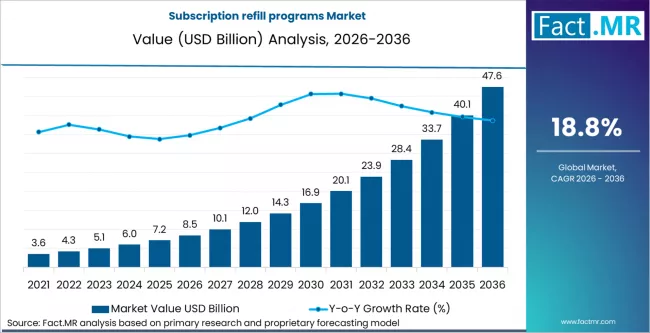
Software dominates the component segment, supported by hardware and services, reflecting the critical role of digital platforms in enabling automated replenishment. Healthcare applications lead the market, complemented by retail, e-commerce, food and beverage, personal care, and other verticals, highlighting broad cross-industry adoption. High-growth regions such as China and India are witnessing accelerated uptake due to urbanization, digital penetration, and evolving consumer lifestyles, while mature markets in the United States, Germany, and Japan are driving growth through innovation in subscription models, personalization, and value-added services. Companies that combine seamless digital experiences with operational efficiency and product reliability are positioned to capture long-term market share in this rapidly evolving landscape.
Subscription Refill Programs Market
| Metric | Value |
|---|---|
| Market Value 2026 | USD 8.5 Billion |
| Market Forecast Value 2036 | USD 47.6 Billion |
| Forecast CAGR 2026 to 2036 | 18.8% |
Category
| Category | Segments |
|---|---|
| Component | Software; Hardware; Services; Other |
| Application | Healthcare; Retail; E-commerce; Food and Beverage; Personal Care; Other |
| Distribution Channel | Direct-to-Consumer; Online Platforms; Retail Partners; Other |
| End User | Individual Consumers; Businesses; Institutions; Other |
| Region | North America; Europe; Asia Pacific; Latin America; Middle East & Africa |
Segmental Analysis
Which Component Drives the Largest Share in the Subscription Refill Programs Market?
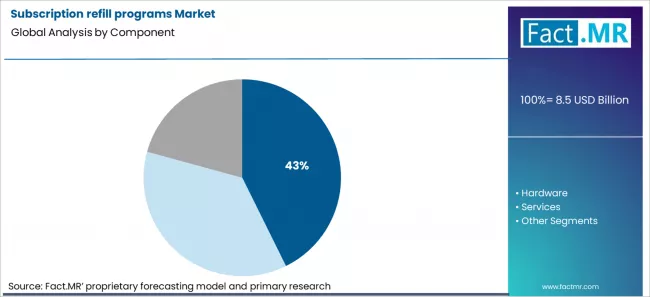
Software dominates the subscription refill programs market with a 42.7% share. This segment includes digital platforms, apps, and automated management systems that enable consumers to schedule, track, and customize recurring product deliveries. Software adoption is driven by ease of use, personalization capabilities, and integration with e-commerce and loyalty programs.
- Providers are enhancing software platforms with predictive analytics, AI-driven recommendations, and seamless payment options.
- Growing consumer preference for convenience and automated replenishment ensures software remains the leading component in the market.
Which Application Accounts for the Highest Adoption in the Subscription Refill Programs Market?
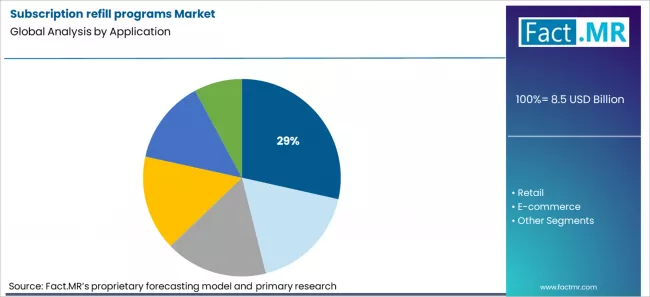
Healthcare leads the application segment with a 28.5% share. Subscription models in healthcare cover medications, wellness products, and home diagnostics, offering reliability, repeat access, and improved patient adherence. These programs are increasingly integrated into digital health and telemedicine platforms.
- Providers leverage subscription systems to ensure consistent product availability and adherence tracking for patients.
- Rising focus on convenience, continuity of care, and preventive health drives adoption of subscription refill programs in healthcare.
What are the Drivers, Restraints, and Key Trends in the Subscription Refill Programs Market?
- Drivers: Expansion of recurring revenue models in healthcare, retail, food and beverage, personal care and e commerce sectors is increasing uptake of subscription refill programs that automate replenishment of consumables and services. Brands including Amazon, Procter & Gamble, Nestlé and Unilever are integrating advanced software with predictive analytics to trigger replenishment based on user behaviour and consumption patterns, strengthening retention and reducing churn. Rising consumer demand for convenient, hassle free replenishment and improvements in last mile logistics have broadened subscription refill adoption across China, India, Brazil, Germany, the USA and the UK as flexible, tech enabled recurring purchasing experiences grow.
- Restraints: Complex regulatory environments governing auto renewal consent, data privacy and subscription billing compliance raise operational costs for platforms and increase legal risk. The need to align refill scheduling with healthcare rules in pharmacy and prescription segments adds workflow constraints and slows introduction of new programs in certain applications. These compliance burdens and technical barriers limit expansion into highly regulated and fragmented markets.
- Trend 1: Investment in unified subscription management solutions that integrate billing, inventory allocation, delivery routing and behavioural data to improve fulfilment accuracy and consumer experience.
- Trend 2: Broader deployment of hybrid subscription models linking digital platforms with physical delivery networks to enhance convenience and expand reach of automatic refill services globally.
Analysis of the Subscription Refill Programs Market by Key Country
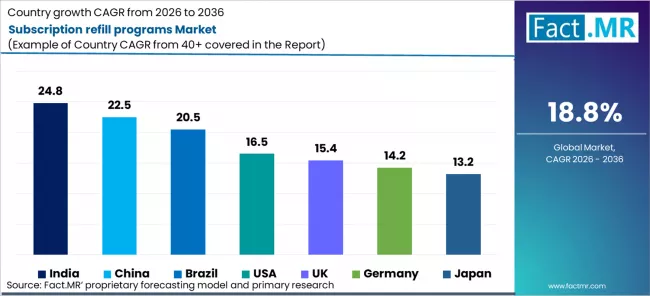
| Country | CAGR |
|---|---|
| China | 22.5% |
| India | 24.8% |
| Brazil | 20.5% |
| Germany | 14.2% |
| USA | 16.5% |
| UK | 15.4% |
| Japan | 13.2% |
How Are Digital Platforms Driving Subscription Refill Programs in China?
China’s Subscription Refill Programs market is projected to grow at a CAGR of 22.5% from 2026 to 2036. Urban consumers increasingly adopt software- and app-based subscription services for food, personal care, and household products. E-commerce platforms and mobile apps enhance convenience, while demand for recurring deliveries and automated restocking supports growth. Rising awareness of efficiency, cost savings, and lifestyle convenience drives uptake among metropolitan households and small businesses.
Why Is India Emerging as a High-Growth Market for Subscription Refill Programs?
India’s market is projected to expand at a CAGR of 24.8% from 2026 to 2036. Software-driven subscription platforms dominate adoption, particularly in healthcare and personal care applications. Urban consumers and institutional users are integrating subscription programs for automated replenishment. Growth is fueled by increasing internet penetration, smartphone adoption, and a growing preference for convenient, time-saving solutions in urban centers, enabling both domestic and international platforms to scale rapidly.
What Factors Are Influencing Subscription Refill Programs Demand in Brazil?
Brazil’s market is expected to grow at a CAGR of 20.5% from 2026 to 2036. Hardware-based subscription solutions, such as connected dispensers and automated refill devices, are increasingly adopted in retail and commercial settings. Consumers and businesses are motivated by convenience, cost efficiency, and sustainable consumption practices. Urban and metropolitan regions are leading adoption, while product accessibility through local distributors and retail partnerships drives further expansion of subscription refill programs.
How Are E-Commerce and Services Supporting Subscription Refill Programs Growth in Germany?
Germany’s market is projected to expand at a CAGR of 14.2% from 2026 to 2036. Service- and e-commerce-based subscription programs are gaining traction for personal care, household, and food items. Consumers value reliability, convenience, and automation, particularly in urban areas. Retailers and service providers are increasingly offering bundled subscription models to enhance customer retention. Growing awareness of sustainable and time-saving solutions continues to support steady adoption of recurring refill programs.
Why Does the USA Remain a Key Market for Subscription Refill Programs?
The USA Subscription Refill Programs market is projected to grow at a CAGR of 16.5% from 2026 to 2036. Consumers and businesses increasingly adopt automated refill services for food, beverages, and personal care products. E-commerce platforms, delivery apps, and subscription-based software facilitate adoption, while premium and multifunctional product offerings drive repeated usage. Urban and suburban households favor convenience, predictability, and efficiency, sustaining rapid expansion in metropolitan and digitally connected regions.
What Is Supporting Subscription Refill Programs Adoption in the UK?
The UK market is expected to expand at a CAGR of 15.4% from 2026 to 2036. Personal care and household subscription services are increasingly adopted among urban consumers seeking convenience and environmental sustainability. E-commerce platforms, mobile apps, and recurring delivery models enhance accessibility. Awareness of automated replenishment benefits and lifestyle efficiency drives uptake, while domestic and international providers continue to innovate subscription offerings for metropolitan households.
How Is Market Maturity Affecting Subscription Refill Programs Demand in Japan?
Japan’s Subscription Refill Programs market is projected to grow at a CAGR of 13.2% from 2026 to 2036. Consumers are increasingly adopting software- and service-driven programs for personal care, food, and miscellaneous household products. Mature retail and e-commerce infrastructure supports recurring delivery adoption. Urban households favor predictable, automated solutions for convenience and efficiency, while established domestic and international brands compete to provide user-friendly, reliable subscription experiences, ensuring steady market growth.
How is Competition Structured in the Subscription Refill Programs Market?
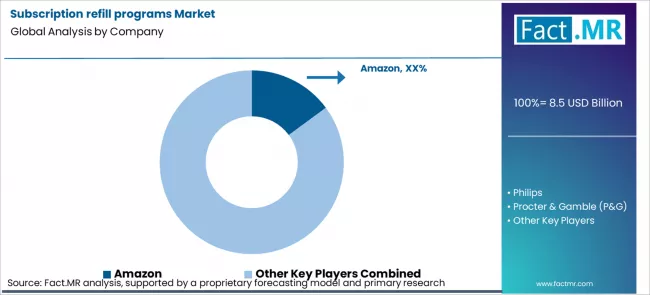
Competition in the Subscription Refill Programs Market is driven by platform integration, service flexibility, and cross-industry applications. Amazon and Philips lead with software and hardware-based subscription solutions serving healthcare and retail applications, emphasizing seamless user experience and operational reliability. Procter & Gamble and Nestlé focus on services and product-based subscriptions across e-commerce and food and beverage categories, combining consumer convenience with recurring revenue models.
Unilever, Harry’s, Dollar Shave Club, Gillette, Colgate Palmolive, Quip, BarkBox, Blue Apron, HelloFresh, Chewy, Petco, Walmart, Target, Scentbird, Loot Crate, and Stitch Fix differentiate through specialized offerings, personalization capabilities, and multi-channel distribution. Competitive advantage arises from platform scalability, integration with consumer routines, and service reliability. Buyers evaluate suppliers based on delivery efficiency, user engagement, product variety, and subscription flexibility. From 2026 onward, strategies are expected to focus on AI-driven personalization, predictive replenishment, and integration across physical and digital channels, enhancing customer retention, convenience, and data-driven insights across healthcare, personal care, and consumer product sectors.
Key Players in the Subscription Refill Programs Market
- Amazon
- Philips
- Procter & Gamble (P&G)
- Nestlé
- Unilever
- Harry's
- Dollar Shave Club
- Gillette (P&G)
- Colgate‑Palmolive
- Quip
- BarkBox
- Blue Apron
- HelloFresh
- Chewy
- Petco
- Walmart
- Target
- Scentbird
- Loot Crate
- Stitch Fix
Scope of the Report
| Items | Values |
|---|---|
| Quantitative Units (2026) | USD 8.5 Billion |
| Component | Software, Hardware, Services, Other |
| Application | Healthcare, Retail, E-commerce, Food and Beverage, Personal Care, Other |
| Regions Covered | Asia Pacific, North America, Europe, Latin America, and Middle East & Africa |
| Countries Covered | China, India, Brazil, Germany, USA, UK, Japan, and other countries |
| Key Companies Profiled | Amazon, Philips, Procter & Gamble (P&G), Nestlé, Unilever, Harry's, Dollar Shave Club, Gillette (P&G), ColgatePalmolive, Quip, BarkBox, Blue Apron, HelloFresh, Chewy, Petco, Walmart, Target, Scentbird, Loot Crate, Stitch Fix, and other leading subscription service providers |
| Additional Attributes | Dollar revenue by component, application, and region; regional demand trends, competitive landscape, innovations in subscription and refill program technologies, e-commerce integration, customer retention strategies, and brand positioning analysis |
Subscription Refill Programs Market by Segments
-
Component:
- Software
- Hardware
- Services
-
Application:
- Healthcare
- Retail
- E-commerce
- Food and Beverage
- Personal Care
- Others
-
Region:
- North America
- USA
- Canada
- Mexico
- Europe
- Germany
- Italy
- UK
- France
- Spain
- Netherlands
- Switzerland
- Rest of Europe
- Asia Pacific
- Japan
- Australia
- South Korea
- China
- India
- Rest of Asia Pacific
- Latin America
- Brazil
- Argentina
- Rest of Latin America
- Middle East and Africa
- United Arab Emirates
- South Africa
- Rest of Middle East and Africa
- North America
Bibliography
- Organisation for Economic Co-operation and Development. (2023). Digital business models and consumer policy. OECD.
- World Health Organization. (2023). Digital health and health system transformation. World Health Organization.
- United Nations Conference on Trade and Development. (2024). Digital economy report 2024. UNCTAD.
- International Telecommunication Union. (2023). Measuring digital development: facts and figures 2023. ITU.
- USA Food and Drug Administration. (2023). Medication adherence and digital health technologies. USA Food and Drug Administration.
Table of Content
- Executive Summary
- Global Market Outlook
- Demand to side Trends
- Supply to side Trends
- Technology Roadmap Analysis
- Analysis and Recommendations
- Market Overview
- Market Coverage / Taxonomy
- Market Definition / Scope / Limitations
- Research Methodology
- Chapter Orientation
- Analytical Lens and Working Hypotheses
- Market Structure, Signals, and Trend Drivers
- Benchmarking and Cross-market Comparability
- Market Sizing, Forecasting, and Opportunity Mapping
- Research Design and Evidence Framework
- Desk Research Programme (Secondary Evidence)
- Company Annual and Sustainability Reports
- Peer-reviewed Journals and Academic Literature
- Corporate Websites, Product Literature, and Technical Notes
- Earnings Decks and Investor Briefings
- Statutory Filings and Regulatory Disclosures
- Technical White Papers and Standards Notes
- Trade Journals, Industry Magazines, and Analyst Briefs
- Conference Proceedings, Webinars, and Seminar Materials
- Government Statistics Portals and Public Data Releases
- Press Releases and Reputable Media Coverage
- Specialist Newsletters and Curated Briefings
- Sector Databases and Reference Repositories
- FMR Internal Proprietary Databases and Historical Market Datasets
- Subscription Datasets and Paid Sources
- Social Channels, Communities, and Digital Listening Inputs
- Additional Desk Sources
- Expert Input and Fieldwork (Primary Evidence)
- Primary Modes
- Qualitative Interviews and Expert Elicitation
- Quantitative Surveys and Structured Data Capture
- Blended A10oach
- Why Primary Evidence is Used
- Field Techniques
- Interviews
- Surveys
- Focus Groups
- Observational and In-context Research
- Social and Community Interactions
- Stakeholder Universe Engaged
- C-suite Leaders
- Board Members
- Presidents and Vice Presidents
- R&D and Innovation Heads
- Technical Specialists
- Domain Subject-matter Experts
- Scientists
- Physicians and Other Healthcare Professionals
- Governance, Ethics, and Data Stewardship
- Research Ethics
- Data Integrity and Handling
- Primary Modes
- Tooling, Models, and Reference Databases
- Desk Research Programme (Secondary Evidence)
- Data Engineering and Model Build
- Data Acquisition and Ingestion
- Cleaning, Normalisation, and Verification
- Synthesis, Triangulation, and Analysis
- Quality Assurance and Audit Trail
- Market Background
- Market Dynamics
- Drivers
- Restraints
- Opportunity
- Trends
- Scenario Forecast
- Demand in Optimistic Scenario
- Demand in Likely Scenario
- Demand in Conservative Scenario
- Opportunity Map Analysis
- Product Life Cycle Analysis
- Supply Chain Analysis
- Investment Feasibility Matrix
- Value Chain Analysis
- PESTLE and Porter’s Analysis
- Regulatory Landscape
- Regional Parent Market Outlook
- Production and Consumption Statistics
- Import and Export Statistics
- Market Dynamics
- Global Market Analysis 2021 to 2025 and Forecast, 2026 to 2036
- Historical Market Size Value (USD Million) Analysis, 2021 to 2025
- Current and Future Market Size Value (USD Million) Projections, 2026 to 2036
- Y to o to Y Growth Trend Analysis
- Absolute $ Opportunity Analysis
- Global Market Pricing Analysis 2021 to 2025 and Forecast 2026 to 2036
- Global Market Analysis 2021 to 2025 and Forecast 2026 to 2036, By Component
- Introduction / Key Findings
- Historical Market Size Value (USD Million) Analysis By Component, 2021 to 2025
- Current and Future Market Size Value (USD Million) Analysis and Forecast By Component, 2026 to 2036
- Software
- Hardware
- Services
- Software
- Y to o to Y Growth Trend Analysis By Component, 2021 to 2025
- Absolute $ Opportunity Analysis By Component, 2026 to 2036
- Global Market Analysis 2021 to 2025 and Forecast 2026 to 2036, By Application
- Introduction / Key Findings
- Historical Market Size Value (USD Million) Analysis By Application, 2021 to 2025
- Current and Future Market Size Value (USD Million) Analysis and Forecast By Application, 2026 to 2036
- Healthcare
- Retail
- E-commerce
- Food and Beverage
- Personal Care
- Others
- Healthcare
- Y to o to Y Growth Trend Analysis By Application, 2021 to 2025
- Absolute $ Opportunity Analysis By Application, 2026 to 2036
- Global Market Analysis 2021 to 2025 and Forecast 2026 to 2036, By Deployment Mode
- Introduction / Key Findings
- Historical Market Size Value (USD Million) Analysis By Deployment Mode, 2021 to 2025
- Current and Future Market Size Value (USD Million) Analysis and Forecast By Deployment Mode, 2026 to 2036
- Cloud
- On-Premises
- Cloud
- Y to o to Y Growth Trend Analysis By Deployment Mode, 2021 to 2025
- Absolute $ Opportunity Analysis By Deployment Mode, 2026 to 2036
- Global Market Analysis 2021 to 2025 and Forecast 2026 to 2036, By Enterprise Size
- Introduction / Key Findings
- Historical Market Size Value (USD Million) Analysis By Enterprise Size, 2021 to 2025
- Current and Future Market Size Value (USD Million) Analysis and Forecast By Enterprise Size, 2026 to 2036
- Small and Medium Enterprises
- Large Enterprises
- Small and Medium Enterprises
- Y to o to Y Growth Trend Analysis By Enterprise Size, 2021 to 2025
- Absolute $ Opportunity Analysis By Enterprise Size, 2026 to 2036
- Global Market Analysis 2021 to 2025 and Forecast 2026 to 2036, By End‑User
- Introduction / Key Findings
- Historical Market Size Value (USD Million) Analysis By End‑User, 2021 to 2025
- Current and Future Market Size Value (USD Million) Analysis and Forecast By End‑User, 2026 to 2036
- Direct‑to‑Consumer Brands
- Pharmacies
- Retailers
- Others
- Direct‑to‑Consumer Brands
- Y to o to Y Growth Trend Analysis By End‑User, 2021 to 2025
- Absolute $ Opportunity Analysis By End‑User, 2026 to 2036
- Global Market Analysis 2021 to 2025 and Forecast 2026 to 2036, By Region
- Introduction
- Historical Market Size Value (USD Million) Analysis By Region, 2021 to 2025
- Current Market Size Value (USD Million) Analysis and Forecast By Region, 2026 to 2036
- North America
- Latin America
- Western Europe
- Eastern Europe
- East Asia
- South Asia and Pacific
- Middle East & Africa
- Market Attractiveness Analysis By Region
- North America Market Analysis 2021 to 2025 and Forecast 2026 to 2036, By Country
- Historical Market Size Value (USD Million) Trend Analysis By Market Taxonomy, 2021 to 2025
- Market Size Value (USD Million) Forecast By Market Taxonomy, 2026 to 2036
- By Country
- USA
- Canada
- Mexico
- By Component
- By Application
- By Deployment Mode
- By Enterprise Size
- By End‑User
- By Country
- Market Attractiveness Analysis
- By Country
- By Component
- By Application
- By Deployment Mode
- By Enterprise Size
- By End‑User
- Key Takeaways
- Latin America Market Analysis 2021 to 2025 and Forecast 2026 to 2036, By Country
- Historical Market Size Value (USD Million) Trend Analysis By Market Taxonomy, 2021 to 2025
- Market Size Value (USD Million) Forecast By Market Taxonomy, 2026 to 2036
- By Country
- Brazil
- Chile
- Rest of Latin America
- By Component
- By Application
- By Deployment Mode
- By Enterprise Size
- By End‑User
- By Country
- Market Attractiveness Analysis
- By Country
- By Component
- By Application
- By Deployment Mode
- By Enterprise Size
- By End‑User
- Key Takeaways
- Western Europe Market Analysis 2021 to 2025 and Forecast 2026 to 2036, By Country
- Historical Market Size Value (USD Million) Trend Analysis By Market Taxonomy, 2021 to 2025
- Market Size Value (USD Million) Forecast By Market Taxonomy, 2026 to 2036
- By Country
- Germany
- UK
- Italy
- Spain
- France
- Nordic
- BENELUX
- Rest of Western Europe
- By Component
- By Application
- By Deployment Mode
- By Enterprise Size
- By End‑User
- By Country
- Market Attractiveness Analysis
- By Country
- By Component
- By Application
- By Deployment Mode
- By Enterprise Size
- By End‑User
- Key Takeaways
- Eastern Europe Market Analysis 2021 to 2025 and Forecast 2026 to 2036, By Country
- Historical Market Size Value (USD Million) Trend Analysis By Market Taxonomy, 2021 to 2025
- Market Size Value (USD Million) Forecast By Market Taxonomy, 2026 to 2036
- By Country
- Russia
- Poland
- Hungary
- Balkan & Baltic
- Rest of Eastern Europe
- By Component
- By Application
- By Deployment Mode
- By Enterprise Size
- By End‑User
- By Country
- Market Attractiveness Analysis
- By Country
- By Component
- By Application
- By Deployment Mode
- By Enterprise Size
- By End‑User
- Key Takeaways
- East Asia Market Analysis 2021 to 2025 and Forecast 2026 to 2036, By Country
- Historical Market Size Value (USD Million) Trend Analysis By Market Taxonomy, 2021 to 2025
- Market Size Value (USD Million) Forecast By Market Taxonomy, 2026 to 2036
- By Country
- China
- Japan
- South Korea
- By Component
- By Application
- By Deployment Mode
- By Enterprise Size
- By End‑User
- By Country
- Market Attractiveness Analysis
- By Country
- By Component
- By Application
- By Deployment Mode
- By Enterprise Size
- By End‑User
- Key Takeaways
- South Asia and Pacific Market Analysis 2021 to 2025 and Forecast 2026 to 2036, By Country
- Historical Market Size Value (USD Million) Trend Analysis By Market Taxonomy, 2021 to 2025
- Market Size Value (USD Million) Forecast By Market Taxonomy, 2026 to 2036
- By Country
- India
- ASEAN
- Australia & New Zealand
- Rest of South Asia and Pacific
- By Component
- By Application
- By Deployment Mode
- By Enterprise Size
- By End‑User
- By Country
- Market Attractiveness Analysis
- By Country
- By Component
- By Application
- By Deployment Mode
- By Enterprise Size
- By End‑User
- Key Takeaways
- Middle East & Africa Market Analysis 2021 to 2025 and Forecast 2026 to 2036, By Country
- Historical Market Size Value (USD Million) Trend Analysis By Market Taxonomy, 2021 to 2025
- Market Size Value (USD Million) Forecast By Market Taxonomy, 2026 to 2036
- By Country
- Kingdom of Saudi Arabia
- Other GCC Countries
- Turkiye
- South Africa
- Other African Union
- Rest of Middle East & Africa
- By Component
- By Application
- By Deployment Mode
- By Enterprise Size
- By End‑User
- By Country
- Market Attractiveness Analysis
- By Country
- By Component
- By Application
- By Deployment Mode
- By Enterprise Size
- By End‑User
- Key Takeaways
- Key Countries Market Analysis
- USA
- Pricing Analysis
- Market Share Analysis, 2025
- By Component
- By Application
- By Deployment Mode
- By Enterprise Size
- By End‑User
- Canada
- Pricing Analysis
- Market Share Analysis, 2025
- By Component
- By Application
- By Deployment Mode
- By Enterprise Size
- By End‑User
- Mexico
- Pricing Analysis
- Market Share Analysis, 2025
- By Component
- By Application
- By Deployment Mode
- By Enterprise Size
- By End‑User
- Brazil
- Pricing Analysis
- Market Share Analysis, 2025
- By Component
- By Application
- By Deployment Mode
- By Enterprise Size
- By End‑User
- Chile
- Pricing Analysis
- Market Share Analysis, 2025
- By Component
- By Application
- By Deployment Mode
- By Enterprise Size
- By End‑User
- Germany
- Pricing Analysis
- Market Share Analysis, 2025
- By Component
- By Application
- By Deployment Mode
- By Enterprise Size
- By End‑User
- UK
- Pricing Analysis
- Market Share Analysis, 2025
- By Component
- By Application
- By Deployment Mode
- By Enterprise Size
- By End‑User
- Italy
- Pricing Analysis
- Market Share Analysis, 2025
- By Component
- By Application
- By Deployment Mode
- By Enterprise Size
- By End‑User
- Spain
- Pricing Analysis
- Market Share Analysis, 2025
- By Component
- By Application
- By Deployment Mode
- By Enterprise Size
- By End‑User
- France
- Pricing Analysis
- Market Share Analysis, 2025
- By Component
- By Application
- By Deployment Mode
- By Enterprise Size
- By End‑User
- India
- Pricing Analysis
- Market Share Analysis, 2025
- By Component
- By Application
- By Deployment Mode
- By Enterprise Size
- By End‑User
- ASEAN
- Pricing Analysis
- Market Share Analysis, 2025
- By Component
- By Application
- By Deployment Mode
- By Enterprise Size
- By End‑User
- Australia & New Zealand
- Pricing Analysis
- Market Share Analysis, 2025
- By Component
- By Application
- By Deployment Mode
- By Enterprise Size
- By End‑User
- China
- Pricing Analysis
- Market Share Analysis, 2025
- By Component
- By Application
- By Deployment Mode
- By Enterprise Size
- By End‑User
- Japan
- Pricing Analysis
- Market Share Analysis, 2025
- By Component
- By Application
- By Deployment Mode
- By Enterprise Size
- By End‑User
- South Korea
- Pricing Analysis
- Market Share Analysis, 2025
- By Component
- By Application
- By Deployment Mode
- By Enterprise Size
- By End‑User
- Russia
- Pricing Analysis
- Market Share Analysis, 2025
- By Component
- By Application
- By Deployment Mode
- By Enterprise Size
- By End‑User
- Poland
- Pricing Analysis
- Market Share Analysis, 2025
- By Component
- By Application
- By Deployment Mode
- By Enterprise Size
- By End‑User
- Hungary
- Pricing Analysis
- Market Share Analysis, 2025
- By Component
- By Application
- By Deployment Mode
- By Enterprise Size
- By End‑User
- Kingdom of Saudi Arabia
- Pricing Analysis
- Market Share Analysis, 2025
- By Component
- By Application
- By Deployment Mode
- By Enterprise Size
- By End‑User
- Turkiye
- Pricing Analysis
- Market Share Analysis, 2025
- By Component
- By Application
- By Deployment Mode
- By Enterprise Size
- By End‑User
- South Africa
- Pricing Analysis
- Market Share Analysis, 2025
- By Component
- By Application
- By Deployment Mode
- By Enterprise Size
- By End‑User
- USA
- Market Structure Analysis
- Competition Dashboard
- Competition Benchmarking
- Market Share Analysis of Top Players
- By Regional
- By Component
- By Application
- By Deployment Mode
- By Enterprise Size
- By End‑User
- Competition Analysis
- Competition Deep Dive
- Amazon
- Overview
- Product Portfolio
- Profitability by Market Segments (Product/Age /Sales Channel/Region)
- Sales Footprint
- Strategy Overview
- Marketing Strategy
- Product Strategy
- Channel Strategy
- Philips
- Procter & Gamble (P&G)
- Nestlé
- Unilever
- Harry's
- Dollar Shave Club
- Gillette (P&G)
- Colgate‑Palmolive
- Quip
- BarkBox
- Blue Apron
- HelloFresh
- Chewy
- Petco
- Walmart
- Target
- Scentbird
- Loot Crate
- Stitch Fix
- Amazon
- Competition Deep Dive
- Assumptions & Acronyms Used
List Of Table
- Table 1: Global Market Value (USD Million) Forecast by Region, 2021 to 2036
- Table 2: Global Market Value (USD Million) Forecast by Component, 2021 to 2036
- Table 3: Global Market Value (USD Million) Forecast by Application, 2021 to 2036
- Table 4: Global Market Value (USD Million) Forecast by Deployment Mode, 2021 to 2036
- Table 5: Global Market Value (USD Million) Forecast by Enterprise Size, 2021 to 2036
- Table 6: Global Market Value (USD Million) Forecast by End‑User, 2021 to 2036
- Table 7: North America Market Value (USD Million) Forecast by Country, 2021 to 2036
- Table 8: North America Market Value (USD Million) Forecast by Component, 2021 to 2036
- Table 9: North America Market Value (USD Million) Forecast by Application, 2021 to 2036
- Table 10: North America Market Value (USD Million) Forecast by Deployment Mode, 2021 to 2036
- Table 11: North America Market Value (USD Million) Forecast by Enterprise Size, 2021 to 2036
- Table 12: North America Market Value (USD Million) Forecast by End‑User, 2021 to 2036
- Table 13: Latin America Market Value (USD Million) Forecast by Country, 2021 to 2036
- Table 14: Latin America Market Value (USD Million) Forecast by Component, 2021 to 2036
- Table 15: Latin America Market Value (USD Million) Forecast by Application, 2021 to 2036
- Table 16: Latin America Market Value (USD Million) Forecast by Deployment Mode, 2021 to 2036
- Table 17: Latin America Market Value (USD Million) Forecast by Enterprise Size, 2021 to 2036
- Table 18: Latin America Market Value (USD Million) Forecast by End‑User, 2021 to 2036
- Table 19: Western Europe Market Value (USD Million) Forecast by Country, 2021 to 2036
- Table 20: Western Europe Market Value (USD Million) Forecast by Component, 2021 to 2036
- Table 21: Western Europe Market Value (USD Million) Forecast by Application, 2021 to 2036
- Table 22: Western Europe Market Value (USD Million) Forecast by Deployment Mode, 2021 to 2036
- Table 23: Western Europe Market Value (USD Million) Forecast by Enterprise Size, 2021 to 2036
- Table 24: Western Europe Market Value (USD Million) Forecast by End‑User, 2021 to 2036
- Table 25: Eastern Europe Market Value (USD Million) Forecast by Country, 2021 to 2036
- Table 26: Eastern Europe Market Value (USD Million) Forecast by Component, 2021 to 2036
- Table 27: Eastern Europe Market Value (USD Million) Forecast by Application, 2021 to 2036
- Table 28: Eastern Europe Market Value (USD Million) Forecast by Deployment Mode, 2021 to 2036
- Table 29: Eastern Europe Market Value (USD Million) Forecast by Enterprise Size, 2021 to 2036
- Table 30: Eastern Europe Market Value (USD Million) Forecast by End‑User, 2021 to 2036
- Table 31: East Asia Market Value (USD Million) Forecast by Country, 2021 to 2036
- Table 32: East Asia Market Value (USD Million) Forecast by Component, 2021 to 2036
- Table 33: East Asia Market Value (USD Million) Forecast by Application, 2021 to 2036
- Table 34: East Asia Market Value (USD Million) Forecast by Deployment Mode, 2021 to 2036
- Table 35: East Asia Market Value (USD Million) Forecast by Enterprise Size, 2021 to 2036
- Table 36: East Asia Market Value (USD Million) Forecast by End‑User, 2021 to 2036
- Table 37: South Asia and Pacific Market Value (USD Million) Forecast by Country, 2021 to 2036
- Table 38: South Asia and Pacific Market Value (USD Million) Forecast by Component, 2021 to 2036
- Table 39: South Asia and Pacific Market Value (USD Million) Forecast by Application, 2021 to 2036
- Table 40: South Asia and Pacific Market Value (USD Million) Forecast by Deployment Mode, 2021 to 2036
- Table 41: South Asia and Pacific Market Value (USD Million) Forecast by Enterprise Size, 2021 to 2036
- Table 42: South Asia and Pacific Market Value (USD Million) Forecast by End‑User, 2021 to 2036
- Table 43: Middle East & Africa Market Value (USD Million) Forecast by Country, 2021 to 2036
- Table 44: Middle East & Africa Market Value (USD Million) Forecast by Component, 2021 to 2036
- Table 45: Middle East & Africa Market Value (USD Million) Forecast by Application, 2021 to 2036
- Table 46: Middle East & Africa Market Value (USD Million) Forecast by Deployment Mode, 2021 to 2036
- Table 47: Middle East & Africa Market Value (USD Million) Forecast by Enterprise Size, 2021 to 2036
- Table 48: Middle East & Africa Market Value (USD Million) Forecast by End‑User, 2021 to 2036
List Of Figures
- Figure 1: Global Market Pricing Analysis
- Figure 2: Global Market Value (USD Million) Forecast 2021 to 2036
- Figure 3: Global Market Value Share and BPS Analysis by Component, 2026 and 2036
- Figure 4: Global Market Y to o to Y Growth Comparison by Component, 2026 to 2036
- Figure 5: Global Market Attractiveness Analysis by Component
- Figure 6: Global Market Value Share and BPS Analysis by Application, 2026 and 2036
- Figure 7: Global Market Y to o to Y Growth Comparison by Application, 2026 to 2036
- Figure 8: Global Market Attractiveness Analysis by Application
- Figure 9: Global Market Value Share and BPS Analysis by Deployment Mode, 2026 and 2036
- Figure 10: Global Market Y to o to Y Growth Comparison by Deployment Mode, 2026 to 2036
- Figure 11: Global Market Attractiveness Analysis by Deployment Mode
- Figure 12: Global Market Value Share and BPS Analysis by Enterprise Size, 2026 and 2036
- Figure 13: Global Market Y to o to Y Growth Comparison by Enterprise Size, 2026 to 2036
- Figure 14: Global Market Attractiveness Analysis by Enterprise Size
- Figure 15: Global Market Value Share and BPS Analysis by End‑User, 2026 and 2036
- Figure 16: Global Market Y to o to Y Growth Comparison by End‑User, 2026 to 2036
- Figure 17: Global Market Attractiveness Analysis by End‑User
- Figure 18: Global Market Value (USD Million) Share and BPS Analysis by Region, 2026 and 2036
- Figure 19: Global Market Y to o to Y Growth Comparison by Region, 2026 to 2036
- Figure 20: Global Market Attractiveness Analysis by Region
- Figure 21: North America Market Incremental Dollar Opportunity, 2026 to 2036
- Figure 22: Latin America Market Incremental Dollar Opportunity, 2026 to 2036
- Figure 23: Western Europe Market Incremental Dollar Opportunity, 2026 to 2036
- Figure 24: Eastern Europe Market Incremental Dollar Opportunity, 2026 to 2036
- Figure 25: East Asia Market Incremental Dollar Opportunity, 2026 to 2036
- Figure 26: South Asia and Pacific Market Incremental Dollar Opportunity, 2026 to 2036
- Figure 27: Middle East & Africa Market Incremental Dollar Opportunity, 2026 to 2036
- Figure 28: North America Market Value Share and BPS Analysis by Country, 2026 and 2036
- Figure 29: North America Market Value Share and BPS Analysis by Component, 2026 and 2036
- Figure 30: North America Market Y to o to Y Growth Comparison by Component, 2026 to 2036
- Figure 31: North America Market Attractiveness Analysis by Component
- Figure 32: North America Market Value Share and BPS Analysis by Application, 2026 and 2036
- Figure 33: North America Market Y to o to Y Growth Comparison by Application, 2026 to 2036
- Figure 34: North America Market Attractiveness Analysis by Application
- Figure 35: North America Market Value Share and BPS Analysis by Deployment Mode, 2026 and 2036
- Figure 36: North America Market Y to o to Y Growth Comparison by Deployment Mode, 2026 to 2036
- Figure 37: North America Market Attractiveness Analysis by Deployment Mode
- Figure 38: North America Market Value Share and BPS Analysis by Enterprise Size, 2026 and 2036
- Figure 39: North America Market Y to o to Y Growth Comparison by Enterprise Size, 2026 to 2036
- Figure 40: North America Market Attractiveness Analysis by Enterprise Size
- Figure 41: North America Market Value Share and BPS Analysis by End‑User, 2026 and 2036
- Figure 42: North America Market Y to o to Y Growth Comparison by End‑User, 2026 to 2036
- Figure 43: North America Market Attractiveness Analysis by End‑User
- Figure 44: Latin America Market Value Share and BPS Analysis by Country, 2026 and 2036
- Figure 45: Latin America Market Value Share and BPS Analysis by Component, 2026 and 2036
- Figure 46: Latin America Market Y to o to Y Growth Comparison by Component, 2026 to 2036
- Figure 47: Latin America Market Attractiveness Analysis by Component
- Figure 48: Latin America Market Value Share and BPS Analysis by Application, 2026 and 2036
- Figure 49: Latin America Market Y to o to Y Growth Comparison by Application, 2026 to 2036
- Figure 50: Latin America Market Attractiveness Analysis by Application
- Figure 51: Latin America Market Value Share and BPS Analysis by Deployment Mode, 2026 and 2036
- Figure 52: Latin America Market Y to o to Y Growth Comparison by Deployment Mode, 2026 to 2036
- Figure 53: Latin America Market Attractiveness Analysis by Deployment Mode
- Figure 54: Latin America Market Value Share and BPS Analysis by Enterprise Size, 2026 and 2036
- Figure 55: Latin America Market Y to o to Y Growth Comparison by Enterprise Size, 2026 to 2036
- Figure 56: Latin America Market Attractiveness Analysis by Enterprise Size
- Figure 57: Latin America Market Value Share and BPS Analysis by End‑User, 2026 and 2036
- Figure 58: Latin America Market Y to o to Y Growth Comparison by End‑User, 2026 to 2036
- Figure 59: Latin America Market Attractiveness Analysis by End‑User
- Figure 60: Western Europe Market Value Share and BPS Analysis by Country, 2026 and 2036
- Figure 61: Western Europe Market Value Share and BPS Analysis by Component, 2026 and 2036
- Figure 62: Western Europe Market Y to o to Y Growth Comparison by Component, 2026 to 2036
- Figure 63: Western Europe Market Attractiveness Analysis by Component
- Figure 64: Western Europe Market Value Share and BPS Analysis by Application, 2026 and 2036
- Figure 65: Western Europe Market Y to o to Y Growth Comparison by Application, 2026 to 2036
- Figure 66: Western Europe Market Attractiveness Analysis by Application
- Figure 67: Western Europe Market Value Share and BPS Analysis by Deployment Mode, 2026 and 2036
- Figure 68: Western Europe Market Y to o to Y Growth Comparison by Deployment Mode, 2026 to 2036
- Figure 69: Western Europe Market Attractiveness Analysis by Deployment Mode
- Figure 70: Western Europe Market Value Share and BPS Analysis by Enterprise Size, 2026 and 2036
- Figure 71: Western Europe Market Y to o to Y Growth Comparison by Enterprise Size, 2026 to 2036
- Figure 72: Western Europe Market Attractiveness Analysis by Enterprise Size
- Figure 73: Western Europe Market Value Share and BPS Analysis by End‑User, 2026 and 2036
- Figure 74: Western Europe Market Y to o to Y Growth Comparison by End‑User, 2026 to 2036
- Figure 75: Western Europe Market Attractiveness Analysis by End‑User
- Figure 76: Eastern Europe Market Value Share and BPS Analysis by Country, 2026 and 2036
- Figure 77: Eastern Europe Market Value Share and BPS Analysis by Component, 2026 and 2036
- Figure 78: Eastern Europe Market Y to o to Y Growth Comparison by Component, 2026 to 2036
- Figure 79: Eastern Europe Market Attractiveness Analysis by Component
- Figure 80: Eastern Europe Market Value Share and BPS Analysis by Application, 2026 and 2036
- Figure 81: Eastern Europe Market Y to o to Y Growth Comparison by Application, 2026 to 2036
- Figure 82: Eastern Europe Market Attractiveness Analysis by Application
- Figure 83: Eastern Europe Market Value Share and BPS Analysis by Deployment Mode, 2026 and 2036
- Figure 84: Eastern Europe Market Y to o to Y Growth Comparison by Deployment Mode, 2026 to 2036
- Figure 85: Eastern Europe Market Attractiveness Analysis by Deployment Mode
- Figure 86: Eastern Europe Market Value Share and BPS Analysis by Enterprise Size, 2026 and 2036
- Figure 87: Eastern Europe Market Y to o to Y Growth Comparison by Enterprise Size, 2026 to 2036
- Figure 88: Eastern Europe Market Attractiveness Analysis by Enterprise Size
- Figure 89: Eastern Europe Market Value Share and BPS Analysis by End‑User, 2026 and 2036
- Figure 90: Eastern Europe Market Y to o to Y Growth Comparison by End‑User, 2026 to 2036
- Figure 91: Eastern Europe Market Attractiveness Analysis by End‑User
- Figure 92: East Asia Market Value Share and BPS Analysis by Country, 2026 and 2036
- Figure 93: East Asia Market Value Share and BPS Analysis by Component, 2026 and 2036
- Figure 94: East Asia Market Y to o to Y Growth Comparison by Component, 2026 to 2036
- Figure 95: East Asia Market Attractiveness Analysis by Component
- Figure 96: East Asia Market Value Share and BPS Analysis by Application, 2026 and 2036
- Figure 97: East Asia Market Y to o to Y Growth Comparison by Application, 2026 to 2036
- Figure 98: East Asia Market Attractiveness Analysis by Application
- Figure 99: East Asia Market Value Share and BPS Analysis by Deployment Mode, 2026 and 2036
- Figure 100: East Asia Market Y to o to Y Growth Comparison by Deployment Mode, 2026 to 2036
- Figure 101: East Asia Market Attractiveness Analysis by Deployment Mode
- Figure 102: East Asia Market Value Share and BPS Analysis by Enterprise Size, 2026 and 2036
- Figure 103: East Asia Market Y to o to Y Growth Comparison by Enterprise Size, 2026 to 2036
- Figure 104: East Asia Market Attractiveness Analysis by Enterprise Size
- Figure 105: East Asia Market Value Share and BPS Analysis by End‑User, 2026 and 2036
- Figure 106: East Asia Market Y to o to Y Growth Comparison by End‑User, 2026 to 2036
- Figure 107: East Asia Market Attractiveness Analysis by End‑User
- Figure 108: South Asia and Pacific Market Value Share and BPS Analysis by Country, 2026 and 2036
- Figure 109: South Asia and Pacific Market Value Share and BPS Analysis by Component, 2026 and 2036
- Figure 110: South Asia and Pacific Market Y to o to Y Growth Comparison by Component, 2026 to 2036
- Figure 111: South Asia and Pacific Market Attractiveness Analysis by Component
- Figure 112: South Asia and Pacific Market Value Share and BPS Analysis by Application, 2026 and 2036
- Figure 113: South Asia and Pacific Market Y to o to Y Growth Comparison by Application, 2026 to 2036
- Figure 114: South Asia and Pacific Market Attractiveness Analysis by Application
- Figure 115: South Asia and Pacific Market Value Share and BPS Analysis by Deployment Mode, 2026 and 2036
- Figure 116: South Asia and Pacific Market Y to o to Y Growth Comparison by Deployment Mode, 2026 to 2036
- Figure 117: South Asia and Pacific Market Attractiveness Analysis by Deployment Mode
- Figure 118: South Asia and Pacific Market Value Share and BPS Analysis by Enterprise Size, 2026 and 2036
- Figure 119: South Asia and Pacific Market Y to o to Y Growth Comparison by Enterprise Size, 2026 to 2036
- Figure 120: South Asia and Pacific Market Attractiveness Analysis by Enterprise Size
- Figure 121: South Asia and Pacific Market Value Share and BPS Analysis by End‑User, 2026 and 2036
- Figure 122: South Asia and Pacific Market Y to o to Y Growth Comparison by End‑User, 2026 to 2036
- Figure 123: South Asia and Pacific Market Attractiveness Analysis by End‑User
- Figure 124: Middle East & Africa Market Value Share and BPS Analysis by Country, 2026 and 2036
- Figure 125: Middle East & Africa Market Value Share and BPS Analysis by Component, 2026 and 2036
- Figure 126: Middle East & Africa Market Y to o to Y Growth Comparison by Component, 2026 to 2036
- Figure 127: Middle East & Africa Market Attractiveness Analysis by Component
- Figure 128: Middle East & Africa Market Value Share and BPS Analysis by Application, 2026 and 2036
- Figure 129: Middle East & Africa Market Y to o to Y Growth Comparison by Application, 2026 to 2036
- Figure 130: Middle East & Africa Market Attractiveness Analysis by Application
- Figure 131: Middle East & Africa Market Value Share and BPS Analysis by Deployment Mode, 2026 and 2036
- Figure 132: Middle East & Africa Market Y to o to Y Growth Comparison by Deployment Mode, 2026 to 2036
- Figure 133: Middle East & Africa Market Attractiveness Analysis by Deployment Mode
- Figure 134: Middle East & Africa Market Value Share and BPS Analysis by Enterprise Size, 2026 and 2036
- Figure 135: Middle East & Africa Market Y to o to Y Growth Comparison by Enterprise Size, 2026 to 2036
- Figure 136: Middle East & Africa Market Attractiveness Analysis by Enterprise Size
- Figure 137: Middle East & Africa Market Value Share and BPS Analysis by End‑User, 2026 and 2036
- Figure 138: Middle East & Africa Market Y to o to Y Growth Comparison by End‑User, 2026 to 2036
- Figure 139: Middle East & Africa Market Attractiveness Analysis by End‑User
- Figure 140: Global Market - Tier Structure Analysis
- Figure 141: Global Market - Company Share Analysis
- FAQs -
How big is the subscription refill programs market in 2026?
The global subscription refill programs market is estimated to be valued at USD 8.5 billion in 2026.
What will be the size of subscription refill programs market in 2036?
The market size for the subscription refill programs market is projected to reach USD 47.6 billion by 2036.
How much will be the subscription refill programs market growth between 2026 and 2036?
The subscription refill programs market is expected to grow at a 18.8% CAGR between 2026 and 2036.
What are the key product types in the subscription refill programs market?
The key product types in subscription refill programs market are software, hardware and services.
Which application segment to contribute significant share in the subscription refill programs market in 2026?
In terms of application, healthcare segment to command 28.5% share in the subscription refill programs market in 2026.