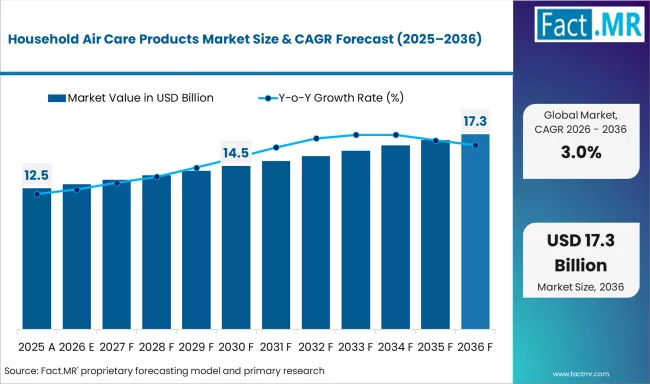
- Base Value(2025): 12.48 Bn
- Estimated Value(2026): 12.87 Bn
- Forecast Value (2036): 17.29 Bn
- CAGR (2026 - 2036): 3.0%
Household Air Care Products Market Size, Market Forecast and Outlook By FACT.MR
The Household Air Care Products market was valued at USD 12.48 billion in 2025, projected to reach USD 12.87 billion in 2026, and is forecast to expand to USD 17.29 billion by 2036 at a 3.0% CAGR. Consistent consumer demand for home fragrance and odor elimination products across global modern retail and grocery channels sustains steady market expansion above general FMCG category growth benchmarks. Premium home fragrance subcategory development including scented candle, reed diffuser, and natural botanical spray formats creates incremental value growth above commodity aerosol and spray market pricing. Heightened post-pandemic home environment awareness sustains above-trend consumer air care product purchase frequency across key developed markets.
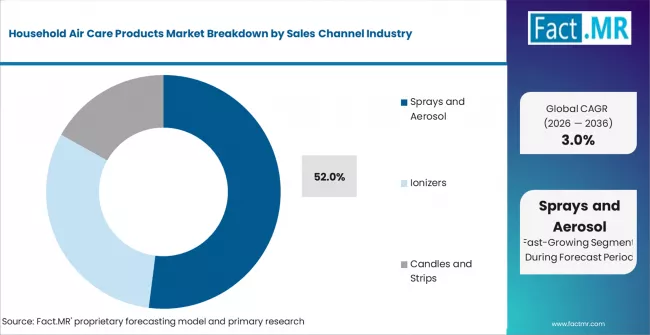
The absolute dollar growth of USD 4.42 billion across the forecast decade reflects household air care's mature but value-expanding market position anchored by product format premiumization and fragrance portfolio sophistication above basic functional odor elimination. Sprays and Aerosol retaining 52.0% of product type share confirms the instant-use convenience format as the dominant air care purchase category across modern retail, grocery, and convenience store distribution. Floral fragrance commanding 34.0% of fragrance share sustains the broadest consumer acceptance profile across global household air care category purchase demographics.
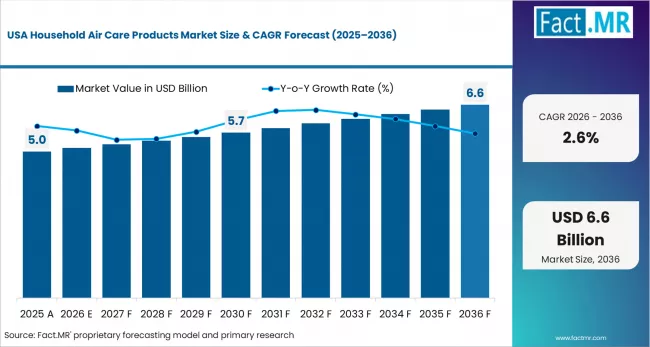
Based on FACT.MR's regional analysis, India leads at 3.75% CAGR as rising urban household disposable income, expanding modern retail penetration of branded air care product formats, and post-pandemic home cleanliness awareness sustain above-average category growth. Germany advances at 3.45% as premium natural botanical fragrance and certified organic air care product development commands growing shelf space in health-conscious German household care retail channels. Brazil tracks at 3.15% as urban household income growth and pharmacy and supermarket chain air care category expansion sustain consistent product volume growth. The United Kingdom records 2.85% as established premium home fragrance culture and new product format development in reed diffuser and natural spray categories sustain value growth. The United States registers 2.55% where mature category penetration is supplemented by premium segment development and private label competition maintains consistent volume. Japan advances at 2.25% where established consumer air care product culture in a highly developed household goods market sustains stable category volume with measured premium format growth.
Household Air Care Products Market Market Value Analysis | Source: Fact.MR
Household Air Care Products Market Key Takeaways
| Metric | Details |
|---|---|
| Industry Size (2026) | USD 12.87 Billion |
| Industry Value (2036) | USD 17.29 Billion |
| CAGR (2026-2036) | 3.0% |
| Source | Fact.MR, 2026 |
Source: Fact.MR analysis. Updated Mar 14, 2026
Household Air Care Products Market Definition
The Household Air Care Products market encompasses consumer aerosol sprays, pump sprays, passive ionizers, scented candles, and fabric and paper strip air freshener products used in residential and light commercial settings to eliminate malodor and impart fragrance to indoor environments. Product categories span immediate-release aerosol and pump spray formats for instant room freshening, passive continuous-release formats including candles, reed diffusers, gel beads, and hanging strips, and electronic plug-in diffuser formats delivering programmable fragrance release. Fragrance profiles cover floral, fruity, vanilla, spice and herb, and other specialty fragrance families distributed through modern retail, grocery, convenience, and e-commerce channels.
Household Air Care Products Market Inclusions
Market scope covers aerosol spray, pump spray, ionizer, candle, fabric strip, reed diffuser, and electronic plug-in air freshener product formats in floral, fruity, vanilla, spice and herb, and other fragrance categories. Distribution coverage spans modern trade, grocery stores, convenience stores, e-commerce, and specialty home fragrance retail. Regional and country-level analysis covers India, Germany, Brazil, UK, USA, Japan, and 40 plus countries for the 2026 to 2036 forecast period.
Household Air Care Products Market Exclusions
Professional commercial air care systems for hospitality and facility management applications operating above household consumer product specifications are excluded. Air purification and filtration equipment without fragrance delivery functionality fall outside defined scope. Industrial odor control products for food processing, waste management, and manufacturing environments are omitted. Personal fragrance products including cologne, perfume, and body spray without household environment air care application are explicitly excluded from the market valuation.
Household Air Care Products Market Research Methodology
- Primary Research: Analysts interviewed household care retail category managers, FMCG brand marketing directors, and fragrance house innovation teams across India, Germany, Brazil, UK, and the USA to validate product format preference trends and fragrance portfolio development dynamics.
- Desk Research: Data aggregation covered FMCG retail audit sell-out data for household air care categories, e-commerce platform category growth reports, national household expenditure survey data, and fragrance industry association product innovation trend publications.
- Market-Sizing and Forecasting: Baseline values derive from bottom-up aggregation of national household air care product volume sell-out data from retail audit sources, applying per-household purchase frequency models and premium format adoption curves to project regional market revenue through 2036.
- Data Validation and Update Cycle: Forecasts cross-validate against household care segment revenues from SC Johnson and Son Inc., Reckitt Benckiser, The Procter and Gamble Co., Church and Dwight Co. Inc., and Henkel KGaA annual investor reports.
Summary of Household Air Care Products Market
- Household Air Care Products Market Definition
- The Household Air Care Products market covers aerosol sprays, pump sprays, ionizers, candles, strips, and electronic diffuser formats in floral, fruity, vanilla, and specialty fragrance families distributed through modern trade, grocery, convenience, and e-commerce channels globally.
- Demand Drivers in the Market
- Rising urban household disposable income in India and Brazil expands modern retail access to branded air care product formats beyond basic aerosol sprays to include premium reed diffuser, scented candle, and botanical spray segments previously accessible only in metropolitan specialty retail.
- Natural and certified organic fragrance product development in Germany and the UK captures growing consumer demand for household air care products formulated without synthetic fragrance compounds, VOC solvents, or petrochemical aerosol propellants.
- E-commerce channel growth enables subscription replenishment and premium home fragrance bundle purchasing that drives higher per-household air care category spend above single-unit mass retail transaction values in the USA and UK.
- Key Segments Analyzed in the FACT.MR Report
- Sprays and Aerosol lead by Product Type with 52.0% share in 2026, where instant-use convenience format dominates across modern retail, grocery, and convenience store distribution as the primary household odor elimination and fragrance delivery format.
- Floral Fragrance commands 34.0% of fragrance share in 2026, sustaining the broadest consumer acceptance profile across global household air care category demographics above fruity, vanilla, and spice fragrance alternatives.
- Modern Trade accounts for 36.5% of Sales Channel share in 2026, where supermarket and hypermarket household care aisle placement sustains the primary air care product purchase occasion for consumer basket shoppers globally.
- Analyst Opinion at FACT.MR
- Shambhu Nath Jha, Principal Consultant, opines: 'The household air care category is bifurcating between a high-volume commodity aerosol and spray segment where private label competition is intensifying price pressure on branded products, and a premium home fragrance segment where scented candles, reed diffusers, and botanical room sprays command materially higher margin per unit and are growing faster than the category average. Brand owners that invest in premium home fragrance product line architecture with distinctive vessel design, signature fragrance identity, and natural ingredient sourcing credentials will capture the growing consumer willingness to invest in home environment aesthetics above basic functional air freshening.'
- Strategic Implications / Executive Takeaways
- Household air care brand owners must develop premium home fragrance product line architecture with distinctive vessel design, signature fragrance identity documentation, and natural botanical sourcing credentials to capture margin expansion above commodity aerosol market positioning.
- India and Brazil market development requires distribution partnership with modern trade chains and pharmacy networks to achieve the shelf presence necessary for category trial conversion among urban middle-class households transitioning from basic odor elimination to home fragrance product adoption.
- E-commerce subscription and bundle program development converts single-occasion air care purchasers into higher-frequency multi-format home fragrance category spenders through curated seasonal fragrance rotation and premium format introduction programs.
- Methodology
- Primary Research: FACT.MR interviewed household care retail managers and fragrance house innovation teams across 40 countries to validate product format preference trends.
- Desk Research: Analysts aggregated FMCG retail audit sell-out data, e-commerce platform category growth reports, and national household expenditure survey data.
- Market-Sizing and Forecasting: Bottom-up aggregation of household air care volume sell-out data with per-household purchase frequency models and premium format adoption curves applied to regional revenue projections.
- Data Validation: Cross-validation against SC Johnson, Reckitt Benckiser, Procter and Gamble, Church and Dwight, and Henkel annual investor reports for household care segment revenues.
How are New Companies Reinventing Household Air Care?
Surging air pollution and increasing concerns regarding respiratory health have created a surge in demand for innovative household air care products, which is creating attractive moneymaking opportunities for incoming household air care product suppliers. New companies are launching new products to improve their market presence and generate more revenue.
- Freshcraft Technologies, a new company based in India, revealed its new device that enhances indoor air quality in September 2022. Tenshield is an innovative product that disperses plasma-mediated ions to create a shield against surface and air-borne diseases.
New household air care product manufacturers are also focusing on raising new capital to advance their business potential and compete with established market players across the forecast period and beyond.
- Clairify, a Dutch start-up focused on improving indoor space health and air quality, announced that it had raised US$ 624,014 in funding led by Rockstart in March 2022. The company uses a combination of software and sensors to analyze indoor air quality to support the transition towards healthy indoor spaces with better air quality.
An exhaustive analysis of how factors such as new developments, supply chain management, global demand, local supply, and safety regulations impact the current and future start-up scenario has been mentioned in this latest household air care products market research analysis by Fact.MR, a market research and competitive intelligence provider.
Country-wise Insights
.webp "Top Country Growth Comparison Household Air Care Products Market Cagr (2026 2036)")
Top Country Growth Comparison Household Air Care Products Market Cagr (2026 2036) | Source: Fact.MR
Will Investing in Asian Countries Be a Smart Move?
Increasing Disposable Income and Evolving Consumer Preferences-Piquing Interest in APAC
Developing economies in the Asia Pacific region have been proven to be one of the most lucrative markets for the majority of consumer goods and this can be ascribed to rising per capita disposable income and changing standards of living. India, China, Korea, and Japan are estimated to be noteworthy markets in this region across the forecast period.
- This Fact.MR research predicts demand for household air care products to evolve at 3.5% CAGR over the next ten years in South Korea.
Increasing industrialization in the aforementioned countries is resulting in rising air pollution, which is projected to influentially drive up the sales of air fresheners, air filters, air purifiers, and other air care products in the future. China and India are expected to witness higher demand for household air care products as compared to other Asian economies over the next ten years.
- Household air care product shipments in China are extrapolated to rise at a steady 4.6% CAGR across the forecast period and rake in a valuation of US$ 3.71 billion by the end of 2033.
What Makes the United Kingdom a Bankable Market?
Surging Pet Ownership and Demand for Natural Fragrances
The United Kingdom is set to emerge as a highly opportune space for household air care product companies in the future, which is primarily linked to surging pet ownership numbers in the country and the increasing inclination of consumers toward natural fragrances.
- In April 2022, the Pet Food Manufacturer’s Association (PFMA) released its annual population data, which showed that the United Kingdom was home to around 35 million pets in 2022 and pet ownership stood at a peak of 62% in the same year.
Having a pet at home can compromise the air quality and hygiene situation, which is why several pet owners rely on air care systems to keep their dwellings fresh.
Growing awareness and focus regarding sustainability is also shaping the demand for natural fragrances in the household air care products industry in the country. This factor is creating new opportunities for established as well as new household air care product manufacturers in the United Kingdom.
Why are Household Air Care Product Vendors Targeting the United States?
Household Air Care Products Market Country Value Analysis | Source: Fact.MR
High Consumer Spending Potential and Surging Demand for Luxury Home Care Products
The United States is projected to emerge as a highly rewarding space for household air care product suppliers owing to the high consumer spending potential and escalating demand for luxury and premium home care products. Increasing focus on hygiene, high availability of luxury household air care products, and rising pet ownership are other factors that are also expected to influence growth potential over the next ten years.
- As per statistics listed on Forbes, around 66% of households in the United States own at least one pet in 2023. Wherein, millennials account for 33% of all current pet owners and Gen X for 25% in the same year.
- In April 2022, Hamilton Beach Brands Inc. announced the launch of a new line of premium air purifiers. The new products were launched under the Clorox brand name and were the first steps of the company into the home wellness and health space.
Surging prevalence of respiratory disorders has also created increased awareness regarding home hygiene and indoor air quality, which is motivating household air care product companies to launch new products.
- Household air care product sales in the United States are forecasted to attain a revenue of US$ 4.45 billion by 2033-end while rising at a sluggish 2.4% CAGR over the next ten years.
Category-wise Insights
Which Type of Air Care Product is Highly Popular?
Household Air Care Products Market Analysis By Product Type | Source: Fact.MR
Versatility and Ease of Use-Testament to Popularity of Sprays and Aerosols
Based on product type, the market for household air care systems is segmented into sprays and aerosol, ionizers, and candles and strips.
Sprays and aerosol products account for the majority of revenue share in the global marketplace at present and are estimated to maintain a similar stance throughout the forecast period. Air freshener sprays are highly preferred by various users around the world owing to their ease of use, versatility, and quick effect. Evolving consumer preferences and increasing disposable income are other crucial aspects that could primarily influence sales of sprays and aerosols in the future.
- Shipments of sprays and aerosol are forecasted to increase at 3.5% CAGR from 2023 to 2033.
Competitive Landscape
Household Air Care Products Market Analysis By Company | Source: Fact.MR
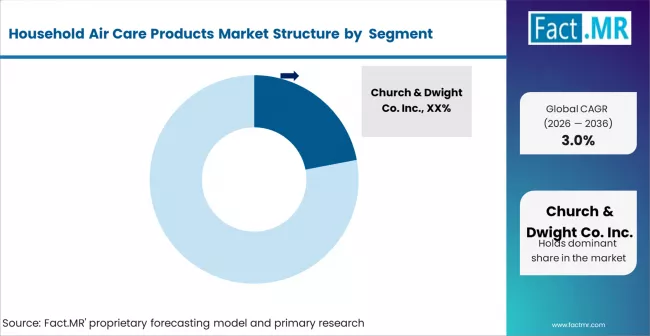
Prime household air care product vendors are eyeing mergers, collaborations, and partnerships to improve their reach and target new audiences to drive revenue generation capacity.
- In April 2023, The Yankee Candle Company collaborated with Vera Bradley, a bag and luggage lifestyle company to create a limited-edition collection of true-to-life fragrances with attractive floral patterns. The collection included 2 candles with a tote bag and a limited-edition diffuser.
Top-tier household air care product manufacturers are focusing on expanding their product portfolio through new launches and strengthening their place in the global competitive landscape.
- In April 2022, Glade, a leading brand providing household air fresheners and owned by SC Johnson, announced the launch of a new summer fragrance. Coastal Sunshine Citrus was available in the form of room sprays, candles, and air fresheners to allow consumers to transition their homes from spring to summer vibe effortlessly.
- In May 2022, Vitruvi, an all-natural air care brand based in Vancouver, debuted in the air care space with the launch of its new Natural Air Freshener Sprays. The company had plans to disrupt the traditional air care space with its natural offerings and tap into new business potential.
Bibliography
- European Commission, Directorate-General for Environment. (2024). Aerosol Dispensers Directive 75/324/EEC: Compliance update for household air care aerosol products. European Commission.
- United States Environmental Protection Agency. (2024). Design for the Environment: VOC content standards for consumer air freshener aerosol products. US EPA.
- Government of India, Bureau of Indian Standards. (2024). IS 7236: Aerosol dispensers for household use: Safety and performance requirements. BIS.
- International Fragrance Association. (2024). IFRA standards: Fragrance ingredient use guidelines for household air care product formulations. IFRA.
- European Aerosol Federation. (2024). Aerosol industry statistics: Household air care product category production and market data. FEA.
- Organisation for Economic Co-operation and Development. (2024). Household expenditure statistics: Home care product spending by country. OECD.
This bibliography is provided for reader reference. The full FACT.MR report contains the complete reference list with primary research documentation.
This Report Addresses
- Market sizing and quantitative forecast metrics detailing revenue projections for the Household Air Care Products market across fragrance, product type, and sales channel categories through 2036.
- Segmentation analysis mapping adoption velocity across spray, aerosol, ionizer, candle, and electronic diffuser formats by floral, fruity, vanilla, and specialty fragrance families in modern trade, grocery, convenience, and e-commerce channels.
- Regional intelligence comparing India and Brazil category penetration expansion dynamics against premium home fragrance development in Germany and UK established markets.
- Regulatory compliance assessment analyzing EU Aerosol Dispensers Directive, US EPA VOC content standards, IFRA fragrance ingredient guidelines, and India BIS aerosol product safety requirements.
- Competitive landscape evaluation tracking SC Johnson, Reckitt Benckiser, Church and Dwight, and Henkel product portfolio strategies across aerosol, premium candle, and natural fragrance format development.
- Premiumization analysis identifying reed diffuser, scented candle, and botanical room spray segment development as primary brand differentiation and margin expansion opportunities above commodity aerosol positioning.
- E-commerce subscription and bundle program analysis identifying seasonal fragrance rotation and premium format introduction programs as digital channel consumer value development strategies.
- Custom data delivery formats encompassing interactive dashboards, raw Excel datasets, and comprehensive PDF narrative reports.
Segmentation
Scope of the Report
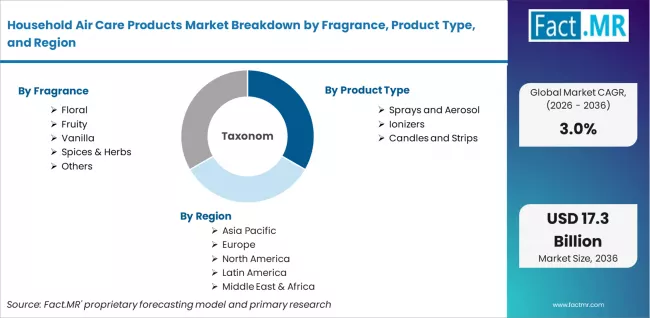
Household Air Care Products Market Breakdown By Fragrance, Product Type, And Region | Source: Fact.MR
| Metric | Value |
|---|---|
| Quantitative Units | USD 12.87 billion to USD 17.29 billion, at a CAGR of 3.0% |
| Market Definition | The Household Air Care Products market covers aerosol sprays, pump sprays, ionizers, candles, strips, and electronic diffuser formats in floral, fruity, vanilla, and specialty fragrance families distributed through modern trade, grocery, convenience, and e-commerce channels globally. |
| Fragrance Segmentation | Floral, Fruity, Vanilla, Spices and Herbs, Others |
| Product Type Segmentation | Sprays and Aerosol, Ionizers, Candles and Strips, Others |
| Sales Channel Segmentation | Modern Trade, Grocery Stores, Convenience Stores, E-Commerce, Others |
| Regions Covered | North America, Latin America, Europe, East Asia, South Asia, Oceania, Middle East and Africa |
| Countries Covered | India, Germany, Brazil, UK, USA, Japan, and 40 plus countries |
| Key Companies Profiled | Church and Dwight Co. Inc., Blyth Inc., J.K. Helene Curtis Limited, California Scents, The Procter and Gamble Co., Air Delights Inc., Henkel KGaA, SC Johnson and Son Inc., The Yankee Candle Company Inc., S.T. Corporation, Earth Chemical Company Ltd., Farcent Enterprise Co. Ltd., Reckitt Benckiser, Godrej Consumer Products Limited |
| Forecast Period | 2026 to 2036 |
| Approach | Bottom-up aggregation of national household air care product volume sell-out data with per-household purchase frequency models and premium format adoption curves applied to regional market revenue projections |
Source: Fact.MR analysis. Updated Mar 14, 2026
Key Segments of Household Air Care Products Industry Research
-
By Fragrance :
- Floral
- Fruity
- Vanilla
- Spices & Herbs
- Others
-
By Product Type :
- Sprays and Aerosol
- Ionizers
- Candles and Strips
-
By Sales Channel :
- Modern Trade
- Grocery Stores
- Convenience Stores
- e-Commerce
- Other Retail Formats
-
By Region :
- North America
- Latin America
- Europe
- APAC
- MEA
Frequently Asked Questions
How large is the demand for Household Air Care Products in the global market in 2026?
What will be the market size of Household Air Care Products by 2036?
What is the expected demand growth between 2026 and 2036?
Which Product Type leads global sales by 2026?
Which Fragrance category leads?
What is India's growth outlook?
Which Sales Channel leads?
What is excluded from the scope?
How does FACT.MR validate the Household Air Care Products forecast?
Who worked on this report


Preview the report firsthand - request a free sample
Free SampleGet the brochure for pricing and purchase details
Download PDF