- Market Value (2025): USD 4.2 Bn
- Estimated Value (2026): USD 4.38 Bn
- Forecast Value (2036): USD 6.64 Bn
- CAGR (2026-2036): 4.2%
What is the Electric Iron Market forecast to be worth by 2036?
USD 4.38 billion in 2026 to USD 6.64 billion by 2036 at a 4.2% CAGR.
- As per Fact.MR analysis, the electric iron market was valued at USD 4.2 billion in 2025.
- Sales are projected to rise from USD 4.38 billion in 2026 to USD 6.64 billion by 2036 as households replace worn irons and compare garment-care features.
- The market is forecast to grow at a 4.2% CAGR from 2026 to 2036, supported by replacement purchases and access through retail channels.
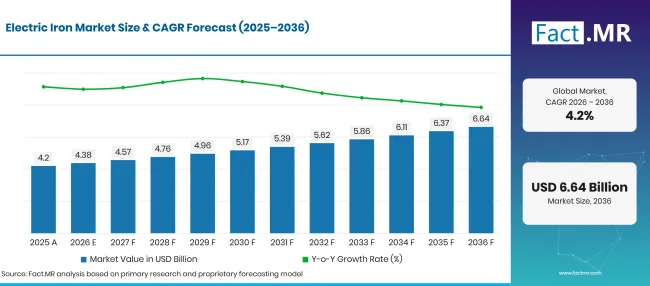
Electric Iron Market Forecast Global | Source: Fact.MR
| Year | Basis | Market Value (USD billion) |
|---|---|---|
| 2025 | Actual | 4.2 |
| 2026 | Estimate | 4.38 |
| 2036 | Forecast | 6.64 |
| CAGR 2026 to 2036 | Forecast period | 4.2% |
Source: Fact.MR analysis. Updated Oct 26, 2026
What are the defining numbers behind Electric Iron Market growth?
USD 2.2 billion additional market value by 2036; dry irons, residential use and offline outlets shape the base.
- Demand Drivers in the Market
- Households replacing worn soleplates usually compare basic dry models against steam irons. Clear settings and easy handling are important when an iron is used for routine clothing care.
- Garment care remains a recurring household task. Customers who press shirts or school uniforms routinely often look for consistent heat and a design that feels comfortable in the hand.
- Retail access affects product choice because consumers often compare price and iron weight before purchasing. Store displays make the handle and soleplate easier to assess. Online listings are useful for comparing product dimensions and warranty coverage.
- Appliance sellers use visible soleplate materials and temperature settings to explain differences between models. These practical features help buyers assess value without requiring complex technical claims.
- Key Segments Analyzed
- By Type: Dry Irons account for 62.3% of 2026 sales, reflecting their straightforward controls and lack of a separate water-filling routine.
- By Usage: Residential applications hold 68.5% share in 2026 as electric irons are common household tools for clothing care.
- By Distribution Channel: Offline outlets represent 60.0% of 2026 sales, offering physical inspection and immediate purchase.
- Analyst Opinion at Fact.MR
- Shambhu Nath Jha, Principal Consultant at Fact.MR, states, “Electric iron buyers choose between straightforward pressing and features intended for particular fabrics. Dry irons appeal to households looking for simple controls, while steam models help users manage stubborn creases. Product teams are likely to gain more from improving safe handling and long-term reliability than from adding functions that customers rarely use.”
- Strategic Implications
- Manufacturers should explain heat settings and soleplate care in everyday language so shoppers understand what changes between dry and steam models.
- Retail chains benefit from displays that let customers compare weight and handle comfort before choosing an iron.
- Online sellers need clear views of the soleplate and practical warranty details to help shoppers compare products confidently.
- Repair and service teams should maintain clear instructions for safe cord replacement and approved servicing where the appliance design permits repair.
The United Kingdom is forecast at 5.4% CAGR and the United States at 4.7%. Germany follows at 4.4%, Japan at 3.6% and Brazil at 3.0%. These projections describe electric irons, while the broader retail statistics elsewhere in the analysis provide background on shopping conditions rather than iron-specific sales volumes.
How does the Electric Iron Market break down by segment?
Dry Irons: 62.3%; Residential: 68.5%; Offline: 60.0% of 2026 market value.
Which Type dominates?
Dry Irons are projected to account for 62.3% share in 2026.
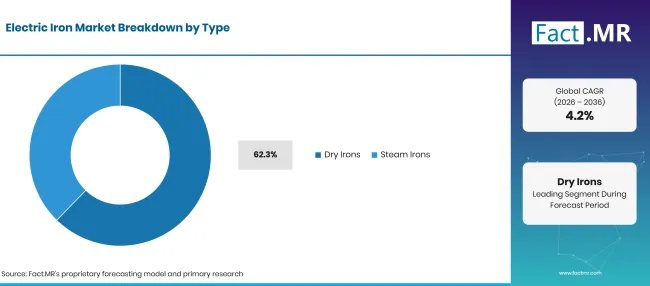
Electric Iron Market Breakdown Type | Source: Fact.MR
| Type | Share (2026) |
|---|---|
| Dry Irons (Leading segment) | 62.3% |
| Steam Irons and other type sales | 37.7% |
| Total | 100.0% |
Source: Fact.MR analysis. Updated Oct 26, 2026
Dry irons remain a simple choice for households that prefer straightforward heat control. These models use a heated soleplate without the water system used by steam irons. Customers can judge weight and grip in a store, while clear online descriptions help compare models remotely. Basic construction keeps the product familiar to users who iron shirts and school uniforms as part of a regular routine.
How does Usage shape electric iron sales?
Residential use is estimated to represent 68.5% share in 2026.
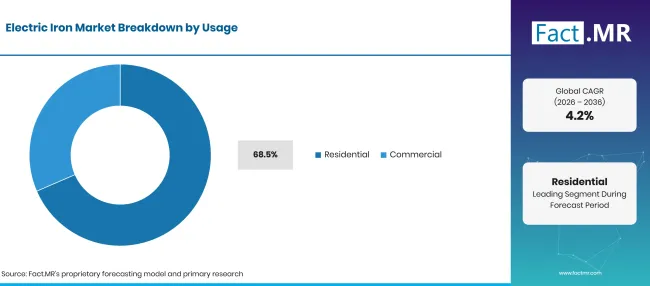
Electric Iron Market Breakdown Usage | Source: Fact.MR
| Usage | Share (2026) |
|---|---|
| Residential (Leading segment) | 68.5% |
| Commercial | 31.5% |
| Total | 100.0% |
Source: Fact.MR analysis. Updated Oct 26, 2026
Residential users purchase electric irons for daily garment care and replacement of existing equipment. The choice often rests on manageable weight and reliable temperature control. A household that presses work clothes frequently may compare a larger soleplate against ease of storage. Clear care instructions help owners use their iron consistently over a longer period.
Which Distribution Channel leads?
Offline outlets are forecast to represent 60.0% of sales in 2026.
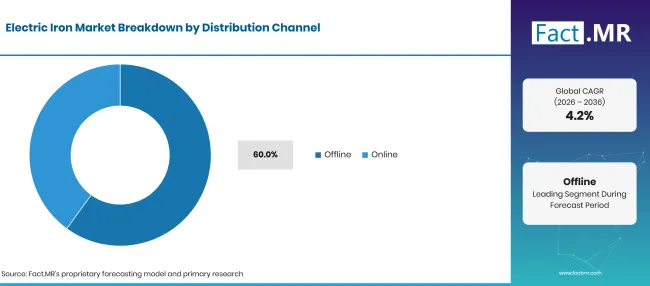
Electric Iron Market Breakdown Distribution Channel | Source: Fact.MR
| Distribution Channel | Share (2026) |
|---|---|
| Offline (Leading segment) | 60.0% |
| Online | 40.0% |
| Total | 100.0% |
Source: Fact.MR analysis. Updated Oct 26, 2026
Offline retailers remain useful because customers can hold an iron and inspect its controls. Those physical checks make weight and grip easier to assess before payment. Online sellers offer broader product comparisons and convenient delivery, although photographs and plain specifications need to communicate the same practical details.
What is accelerating Electric Iron Market adoption, and what is holding it back?
Replacement needs and household garment care support sales; price pressure and product life constrain purchases.
Drivers Impact Analysis
| DRIVER | (~) % IMPACT ON CAGR | GEOGRAPHIC RELEVANCE | IMPACT TIMELINE |
|---|---|---|---|
| Replacement of worn household irons | +1.0% | Global | Short term (<= 2 years) |
| Accessible dry iron choices | +0.8% | South Asia and Latin America | Short term (<= 2 years) |
| Steam functions for fabric care | +0.7% | North America and Europe | Medium term (2–4 years) |
| In-store comparison and service | +0.5% | Global | Medium term (2–4 years) |
Source: Fact.MR analysis. Updated Oct 26, 2026
Opportunity Impact Analysis
| OPPORTUNITY | (~) % IMPACT ON CAGR | GEOGRAPHIC RELEVANCE | IMPACT TIMELINE |
|---|---|---|---|
| Clear temperature and safety guidance | +0.8% | Global | Short term (<= 2 years) |
| Better ergonomic handles | +0.6% | Global | Medium term (2–4 years) |
| Straightforward spare-part support | +0.4% | Selected markets | Medium term (2–4 years) |
Source: Fact.MR analysis. Updated Oct 26, 2026
Restraints Impact Analysis
| RESTRAINT | (~) % IMPACT ON CAGR | GEOGRAPHIC RELEVANCE | IMPACT TIMELINE |
|---|---|---|---|
| Highly price-sensitive purchase decisions | -0.6% | Global | Short term (<= 2 years) |
| Long usable lives of existing irons | -0.5% | Mature household markets | Medium term (2–4 years) |
| Maintenance needs of steam models | -0.4% | Global | Medium term (2–4 years) |
Source: Fact.MR analysis. Updated Oct 26, 2026
Which countries are scaling the Electric Iron Market through 2036?
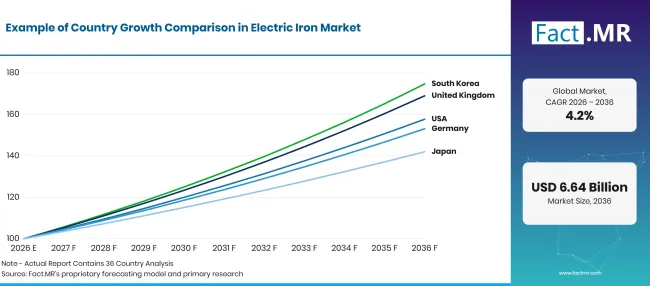
Electric Iron Market Growth Index | Source: Fact.MR
| Country | CAGR (2026 to 2036) |
|---|---|
| United Kingdom | 5.4% |
| United States | 4.7% |
| Germany | 4.4% |
| Japan | 3.6% |
| Brazil | 3.0% |
Source: Fact.MR analysis. Updated Oct 26, 2026
How is United Kingdom developing electric iron sales?
5.4% CAGR, supported by strong online and high-street retail activity.
UK shoppers regularly compare dry and steam irons in high-street stores and online catalogues. The Office for National Statistics reported in August 2026 that online transactions represented 27.4% of total retail sales in Great Britain during 2025 [1]. Store displays remain relevant when users want to assess iron weight and handle comfort before paying. The ONS reported in January 2026 that total retail sales volumes rose 1.3% in 2025 [5].
How is United States developing electric iron sales?
4.7% CAGR, linked to replacement purchases and broad e-commerce access.
American shoppers encounter electric irons in general merchandise stores and large online ranges, where basic models compete on price and warranty terms. The U.S. Census Bureau reported in March 2026 that e-commerce accounted for 16.6% of seasonally adjusted U.S. retail sales in the fourth quarter of 2025 [2]. Replacement purchases create opportunities when old cords or soleplates become inconvenient, while retail pickup can meet immediate needs. In August 2025 the Census Bureau put second-quarter e-commerce at 16.3% of total retail sales [6].
How is Germany developing electric iron sales?
4.4% CAGR, supported by widespread online shopping and appliance-store comparisons.
German electric-iron shoppers can compare soleplate finishes and safety features in specialist appliance stores while using online shops to check specifications. Destatis reported in August 2026 that 85% of internet users in Germany made an online purchase during 2025 [3]. This broad shopping habit gives manufacturers a way to explain product differences beyond the shop floor. Eurostat reported in February 2026 that 78% of EU internet users purchased goods or services online in 2025 [7].
How is Japan developing electric iron sales?
3.6% CAGR, shaped by compact appliance preferences and electronics retail activity.
Japanese households often assess an electric iron by its storage size and ease of handling in smaller living spaces. The Ministry of Economy, Trade and Industry reported in April 2026 that sales at large electronics specialty retailers rose 4.1% during 2025 [8]. The broader appliance retail environment offers room to compare compact designs and features for routine garment care. Japan’s Statistics Bureau reported in February 2026 that average monthly consumption expenditure for households of two or more people reached JPY 314,001 in 2025 [9].
How is Brazil developing electric iron sales?
3.0% CAGR, supported by household appliance sales and local retail availability.
Brazilian consumers commonly evaluate basic electric irons through local appliance stores, where price and warranty coverage help distinguish similar products. The Brazilian Institute of Geography and Statistics reported in February 2026 that retail sales volume for household appliances increased 7.5% in 2025 [4]. This appliance-category evidence supports the relevance of local retail distribution, although it covers products beyond electric irons.
Who leads the Electric Iron Market?
Electric iron competition includes both household-electrical specialists and large appliance brands. Bajaj Electricals, Crompton Greaves Consumer Electricals, GM Modular, and Havells India compete through broad domestic retail networks and everyday household appliance ranges. Their position depends on how well individual models balance heating performance, ease of handling, product life, and accessible after-sales support.
Stanley Black & Decker participates through BLACK+DECKER, while Panasonic and Groupe SEB compete through established garment-care and small-appliance portfolios, including Rowenta under Groupe SEB. These suppliers address buyers looking for practical differences in soleplate design, temperature control, grip, steam functions, and warranty coverage. Retail visibility also matters because customers often compare models in stores while using online channels to review specifications and service terms.
Competition therefore centers on the quality and usability of the actual iron offered in each market. Brands with clear product information, dependable retail availability, comfortable handling, and reliable service support are better placed to retain household and commercial buyers across both dry and steam iron categories.
Which companies are the key providers?
Key companies include Bajaj Electricals Limited; Stanley Black & Decker, Inc. (BLACK+DECKER); Crompton Greaves Consumer Electricals Limited; GM Modular Pvt. Ltd.; Havells India Limited; Panasonic Corporation; Groupe SEB (Rowenta).
- Bajaj Electricals Limited
- Stanley Black & Decker, Inc. (BLACK+DECKER)
- Crompton Greaves Consumer Electricals Limited
- GM Modular Pvt. Ltd.
- Havells India Limited
- Panasonic Corporation
- Groupe SEB (Rowenta)
Bibliography
- [1] Office for National Statistics. (2026, August 21). Internet sales as a percentage of total retail sales (ratio) (%).
- [2] U.S. Census Bureau. (2026, March 10). Quarterly retail e-commerce sales: Fourth quarter 2025.
- [3] Statistisches Bundesamt (Destatis). (2026, August 25). Onlineshopping weit verbreitet 2025.
- [4] Instituto Brasileiro de Geografia e Estatística. (2026, February 13). Vendas no varejo fecham 2025 com alta de 1,6%.
- [5] Office for National Statistics. (2026, January 23). Retail sales, Great Britain: December 2025.
- [6] U.S. Census Bureau. (2025, August 19). Quarterly retail e-commerce sales: Second quarter 2025.
- [7] Eurostat. (2026, February). E-commerce statistics for individuals.
- [8] Ministry of Economy, Trade and Industry. (2026, April 14). Review of retail sales in 2025.
- [9] Statistics Bureau of Japan. (2026, February 6). Family Income and Expenditure Survey: 2025 yearly average.
This Report Answers
- Market size in 2026 and 2036 alongside the forecast CAGR.
- Differences between dry irons and steam irons for day-to-day use.
- The residential and commercial split in electric-iron usage.
- The role of offline outlets and online shopping in product choice.
- Country outlooks for the United Kingdom, United States, Germany, Japan and Brazil.
What does the Electric Iron Market cover?
The wider household appliance trade provides retail context for electric-iron purchasing without changing the product scope.
The market covers electrically heated handheld garment irons sold for residential and commercial pressing. Dry irons apply heat directly, while steam irons use water to release steam during pressing. Revenue follows the electric iron product itself rather than larger laundry or fabric-care systems.
What is included in the scope?
Washing appliances are related laundry equipment but remain outside the handheld-iron revenue boundary.
Corded handheld dry irons and steam irons sold in stores or through online channels are included. The scope covers everyday household models and electric irons intended for commercial garment care. Accessories included with a new iron form part of that sale.
What is excluded from the scope?
Coin-operated laundries and drycleaners may use pressing equipment, but their service revenue is treated separately.
Standalone garment steamers, industrial pressing presses, laundry washers and dryers, ironing boards and separate garment-care chemicals fall outside the electric-iron product category. Sales of replacement accessories alone are not counted as a new electric iron.
How Was the Analysis Built?
The analysis draws on 120+ sources, 35+ company portfolios, 25+ countries, and more than 20 industry interviews.
- Primary Research: Primary research includes discussions with manufacturers, service providers, technology developers, distributors, end users, and subject-matter experts. These conversations examine purchasing priorities, product adoption, operational challenges, approval requirements, competitive positioning, and the factors that influence wider market acceptance.
- Desk Research: Desk research covers government statistics, regulatory publications, company filings, trade data, technical studies, industry associations, standards, public policy, and other authoritative sources. Every source used in the analysis is documented in the bibliography.
- Market Sizing and Forecasting: Market estimates combine historical performance, demand indicators, pricing and volume trends, segment shares, company participation, country-level growth, adoption patterns, investment activity, and barriers to market expansion.
- Data Validation and Update Cycle: Findings are validated by comparing primary interviews with public data, company activity, regulatory changes, trade patterns, and industry developments. Regular updates review new product launches, capacity changes, partnerships, approvals, and shifts in commercial adoption.
Segmentation
What is the report’s scope and coverage?
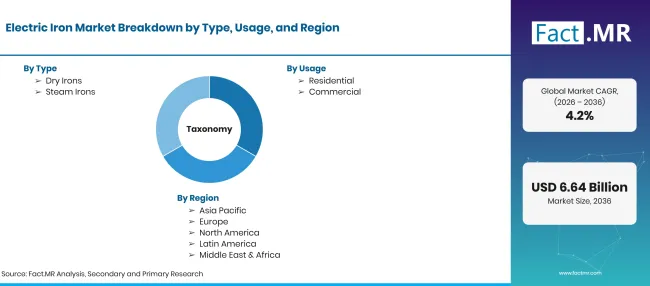
Electric Iron Market Taxonomy | Source: Fact.MR
| Attribute | Details |
|---|---|
| Quantitative Units | USD billion |
| Market Definition | Handheld electrically heated irons used for pressing garments in residential and commercial settings, including dry and steam models. Revenue covers the electric iron product itself rather than broader laundry or fabric-care systems. |
| Type | Dry Irons; Steam Irons |
| Usage | Residential; Commercial |
| Distribution Channel | Offline; Online |
| Regions Covered | North America; Latin America; Western Europe; Eastern Europe; East Asia; South Asia & Pacific; Middle East & Africa |
| Countries Covered | United Kingdom; United States; Germany; Japan; Brazil |
| Companies Profiled | Bajaj Electricals Limited; Stanley Black & Decker, Inc. (BLACK+DECKER); Crompton Greaves Consumer Electricals Limited; GM Modular Pvt. Ltd.; Havells India Limited; Panasonic Corporation; Groupe SEB (Rowenta) |
| Forecast Period | 2026 to 2036 |
| Approach | Assessment of product type, residential and commercial usage, retail-channel conditions, country growth patterns, company participation, and electric-iron replacement behavior. |
Source: Fact.MR analysis. Updated Oct 26, 2026
How is the market segmented?
-
By Type
- Dry Irons
- Steam Irons
-
By Usage
- Residential
- Commercial
-
By Distribution Channel
- Offline
- Online
-
By Region
- North America
- Latin America
- Western Europe
- Eastern Europe
- East Asia
- South Asia & Pacific
- Middle East & Africa
Frequently Asked Questions
How big is the electric iron market in 2026?
What is the electric iron market CAGR?
Which type has the largest share?
Which usage category leads?
Who are the main companies in the electric iron market?
Who worked on this report


Preview the report firsthand - request a free sample
Free SampleGet the brochure for pricing and purchase details
Download PDF