- Market Value (2025): USD 1.00 Bn
- Estimated Value (2026): USD 1.1 Bn
- Forecast Value (2036): USD 2.77 Bn
- CAGR (2026-2036): 9.7%
What is the Electric Hub Drive and Electric Propulsion System for Combat Vehicle Market forecast to be worth by 2036?
USD 1.1 billion in 2026 to USD 2.77 billion by 2036 at a 9.7% CAGR.
- Fact.MR estimates the electric hub drive and electric propulsion system for combat vehicle market at USD 1.00 billion for 2025, with most spending tied to hybrid demonstrators and early prototype builds.
- Value will move from USD 1.1 billion in 2026 to USD 2.77 billion by 2036 as next-generation tank and infantry vehicle programs fix their powertrain choices.
- Annual growth will average a 9.7% CAGR from 2026 to 2036, because each hybrid vehicle adds motor-generators and inverters that a diesel vehicle never needed.
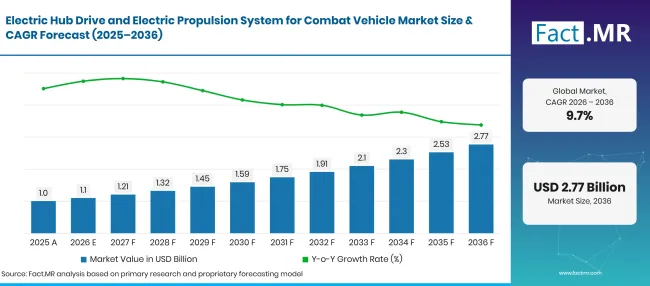
Electric Hub Drive And Electric Propulsion System For Combat Vehicle Market Forecast Global | Source: Fact.MR
| Year | Basis | Market Value (USD billion) |
|---|---|---|
| 2025 | Actual | 1.0 |
| 2026 | Estimate | 1.1 |
| 2036 | Forecast | 2.77 |
| CAGR 2026 to 2036 | Forecast period | 9.7% |
Source: Fact.MR analysis. Updated Oct 23, 2026
What are the defining numbers behind Electric Hub Drive and Electric Propulsion System for Combat Vehicle Market growth?
USD 1.7 billion of added revenue will open up between 2026 and 2036, led by tracked platform programs.
- Demand Drivers in the Market
- Defense budgets in Europe are funding new vehicle fleets. NATO reported that European Allies and Canada spent USD 574 billion on defence in 2025, a real increase of 20% over 2024 [1]. Part of that money goes to tank and infantry vehicle programs that now ask bidders for electrified drive options.
- Hybrid drive has become the default proposal for new infantry carriers. In the U.S. Army’s XM30 competition, all five Phase 2 concept proposals were reportedly hybrid electric vehicles [2]. Program offices see silent watch and onboard power as standard needs for the next fleet.
- Electric weapons and sensors need more onboard power than an alternator can supply. Counter-drone lasers, jammers and radar arrays draw tens of kilowatts. A hybrid drivetrain lets the vehicle generate and store that energy without a separate generator trailer.
- European research money supports land platform technology. The European Commission received a record 410 project proposals for the European Defence Fund 2025 call, which offered EUR 1.065 billion [3]. Part of that funding will reach soldier systems and counter-drone sensors that connect with combat vehicles.
- Fuel logistics drive interest in electrified drives. Convoys that carry diesel to the front are exposed to drones and artillery, so every litre saved through engine-off running reduces risk for supply units.
- Key Segments Analyzed
- By Type: Electric Propulsion System will hold 62.5% share in 2026, since full hybrid powerpacks and electrified transmissions fit inside existing tracked hulls with limited redesign.
- By Application: Tracked Combat Vehicle will account for 58.3% share in 2026, reflecting the heavy tank and infantry carrier programs that fund most hybrid development work.
- Analyst Opinion at Fact.MR
- Shambhu Nath Jha, Principal Consultant at Fact.MR, states, “Combat vehicle buyers no longer ask whether to electrify, they ask how much power the vehicle must export to its weapons and sensors. Suppliers that pair a proven transmission with motor-generators will win the first production awards. Hub drives will gain ground later, once wheeled fleets prove their durability in field trials.”
- Strategic Implications
- Drivetrain suppliers should design hybrid packs that fit the engine bays of tanks and infantry carriers already in service, since upgrade programs will outnumber new hulls for years.
- Vehicle primes should define high-voltage architecture early in each program, because adding power electronics after the hull is frozen raises weight and cost.
- Defense ministries should fund field trials that test batteries and motors in heat, cold and dust, given that reliability data is still thin for electric drives under combat loads.
- Battery and power electronics makers should qualify cells and inverters to military shock and electromagnetic standards, as civil automotive parts rarely pass these tests unchanged.
Japan will lead the five at 10.8% CAGR, where defense outlays are growing and new wheeled vehicle families enter service. Germany follows at 10.1% with record procurement budgets and hybrid tank drive research. An 8.3% pace for the United Kingdom reflects higher spending with domestic industry and a push for lethal, modern land forces. Brazil will expand at 7.7% as 8x8 wheeled combat vehicles join its fleet. Growth of 7.3% in the United States rests on XM30 and tank modernization work.
How does the Electric Hub Drive and Electric Propulsion System for Combat Vehicle Market break down by segment?
Electric Propulsion System will lead Type at 62.5%; Tracked Combat Vehicle will top Application at 58.3%.
Which Type dominates?
Electric Propulsion System takes 62.5% of 2026 sales.
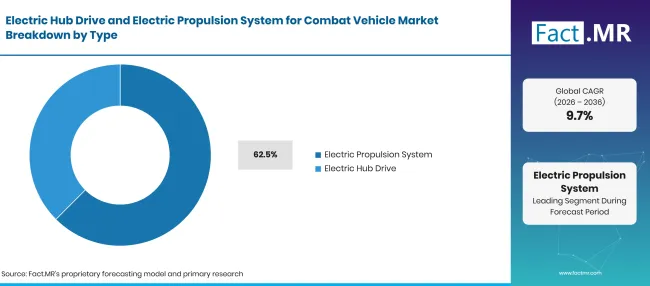
Electric Hub Drive And Electric Propulsion System For Combat Vehicle Market Breakdown Type | Source: Fact.MR
| Type | Share (2026) |
|---|---|
| Electric Propulsion System (Leading segment) | 62.5% |
| Other segments combined | 37.5%* |
| Total | 100.0% |
Source: Fact.MR analysis. Updated Oct 23, 2026
Hybrid propulsion for armored vehicles places one or two motor-generators between the diesel engine and the gearbox. That layout lets a program keep its proven final drives and tracks while adding silent running and export power. Electrified steering transmissions, power electronics and battery management systems make up the rest of the package. Retrofit kits follow the same design idea for vehicles already in service. Electric hub drive for military wheeled vehicles mounts a motor inside each wheel station. Removing the driveshafts and differentials frees space under the floor for armor or batteries, and each wheel can keep driving after another is damaged. The technology draws on civil in-wheel motor designs, though military units need far higher torque and shock tolerance. Hub drives remain at an earlier stage, with fewer funded programs than hybrid powerpacks.
What leads the Application segment?
Tracked Combat Vehicle accounts for 58.3% of 2026 sales.
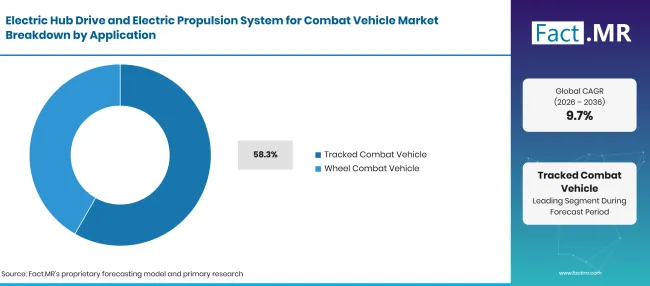
Electric Hub Drive And Electric Propulsion System For Combat Vehicle Market Breakdown Application | Source: Fact.MR
| Application | Share (2026) |
|---|---|
| Tracked Combat Vehicle (Leading segment) | 58.3% |
| Other segments combined | 41.7%* |
| Total | 100.0% |
Source: Fact.MR analysis. Updated Oct 23, 2026
Main battle tanks and tracked infantry carriers weigh 30 to 70 tonnes, and their fuel burn makes them the first target for hybrid savings. Replacement cycles also favor tracked fleets. The U.S. Army fields roughly 2,400 M-2 Bradley vehicles across its active and National Guard armored brigades, and the XM30 is planned to replace them [2]. Tracked armored vehicle programs therefore fund most electrified transmission work. Wheeled combat vehicle electrification begins with lighter platforms and 8x8 carriers. Rheinmetall’s Ermine family, presented in September 2025, shares one diesel-electric hybrid drivetrain and can run completely silent on electric drive [4]. Wheeled vehicles also suit hub motors because each wheel station already carries its own suspension unit. Lessons from civil battery powered propulsion help suppliers size packs and cooling for these vehicles.
What is accelerating Electric Hub Drive and Electric Propulsion System for Combat Vehicle Market adoption, and what is holding it back?
Adoption will gain from new tank and infantry vehicle programs, higher defense budgets and the power demands of electric weapons and sensors. Battery weight, cost per vehicle and limited field data on reliability will slow conversion of existing fleets.
Drivers Impact Analysis
| DRIVER | (~) % IMPACT ON CAGR | GEOGRAPHIC RELEVANCE | IMPACT TIMELINE |
|---|---|---|---|
| Next-generation tank and infantry vehicle programs specifying hybrid drive | +1.6% | North America, Western Europe | Medium term (2-4 years) |
| Rising defense budgets among NATO members and Indo-Pacific allies | +1.3% | Western Europe, East Asia, North America | Short term (<= 2 years) |
| Onboard power needs of counter-drone lasers, jammers and sensors | +1.1% | North America, Western Europe | Medium term (2-4 years) |
| Silent watch and silent mobility for reconnaissance missions | +0.8% | Global | Short term (<= 2 years) |
| Fuel savings that reduce convoy exposure | +0.6% | Global | Long term (>= 4 years) |
Source: Fact.MR analysis. Updated Oct 23, 2026
Opportunity Impact Analysis
| OPPORTUNITY | (~) % IMPACT ON CAGR | GEOGRAPHIC RELEVANCE | IMPACT TIMELINE |
|---|---|---|---|
| Hybrid retrofit kits for tracked and wheeled fleets in service | +0.9% | Western Europe, Eastern Europe, North America | Medium term (2-4 years) |
| In-wheel hub motors for 6x6 and 8x8 wheeled combat vehicles | +0.7% | Western Europe, Latin America, East Asia | Long term (>= 4 years) |
| Hybrid drives for robotic and optionally crewed combat vehicles | +0.6% | North America, Western Europe | Long term (>= 4 years) |
Source: Fact.MR analysis. Updated Oct 23, 2026
Restraints Impact Analysis
| RESTRAINT | (~) % IMPACT ON CAGR | GEOGRAPHIC RELEVANCE | IMPACT TIMELINE |
|---|---|---|---|
| Battery weight and volume inside armored hulls | -0.7% | Global | Medium term (2-4 years) |
| High unit cost of military-grade motors and power electronics | -0.6% | Latin America, South Asia & Pacific | Short term (<= 2 years) |
| Limited field reliability data under combat conditions | -0.4% | Global | Long term (>= 4 years) |
Source: Fact.MR analysis. Updated Oct 23, 2026
Which countries are scaling the Electric Hub Drive and Electric Propulsion System for Combat Vehicle Market through 2036?
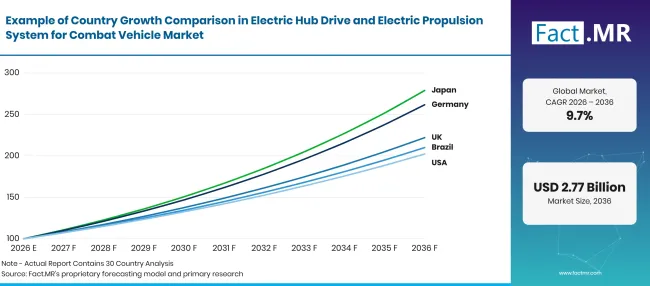
Electric Hub Drive And Electric Propulsion System For Combat Vehicle Market Growth Index 1 | Source: Fact.MR
| Country | CAGR (2026 to 2036) |
|---|---|
| Japan | 10.8% |
| Germany | 10.1% |
| United Kingdom | 8.3% |
| Brazil | 7.7% |
| United States | 7.3% |
Source: Fact.MR analysis. Updated Oct 23, 2026
What supports Japan’s adoption?
10.8% CAGR, driven by fast defense budget growth and new wheeled vehicle families.
Japan defense spending on ground equipment is rising under its buildup plan. The Ministry of Defense set the FY2026 budget proposal at JPY 8.8093 trillion on an outlay basis [5]. The same plan funds 8 Type 10 tanks for JPY 15.8 billion and 18 Type 25 reconnaissance vehicles on a common tactical wheeled chassis [5]. A shared wheeled base gives Japanese suppliers a single platform on which to test electric drive.
How is Germany scaling demand?
10.1% CAGR, backed by record procurement budgets and hybrid tank drive research.
German military procurement funding has expanded sharply. The Bundestag debated a 2027 defence budget of EUR 139.6 billion, with more than EUR 60 billion for military procurement against about EUR 45 billion in 2026 [6]. The Federal Ministry of Defence expects total defence spending to reach about EUR 152 billion by 2029 [7]. German drivetrain makers supply tracked vehicles across Europe and lead hybrid work for the next main battle tank.
What supports United Kingdom adoption?
8.3% CAGR, helped by rising spending with domestic industry and new army priorities.
UK defence spending with industry is rising in real terms. The Ministry of Defence spent GBP 31.9 billion with UK industry and commerce in 2024/25, a 6% real increase, and higher payments for the BOXER program helped lift the weapons group [8]. The Strategic Defence Review 2025 set a goal of a tenfold increase in British Army lethality [9]. More lethal vehicles will need more onboard power for sensors and weapons.
How is Brazil developing demand?
7.7% CAGR, as new 8x8 wheeled combat vehicles enter service.
Brazilian Army armored vehicle purchases are moving toward heavier wheeled platforms. In August 2026, the Army signed a contract that brings its Centauro II 8x8 combat vehicle order to 98 units with a 120 mm gun and technology transfer [10]. Local production and technology transfer will give Brazilian industry a route into drivetrain and power system work. Wide distances and border missions also favor wheeled designs.
How does the United States perform?
7.3% CAGR, reflecting large prototype programs on a mature fleet base.
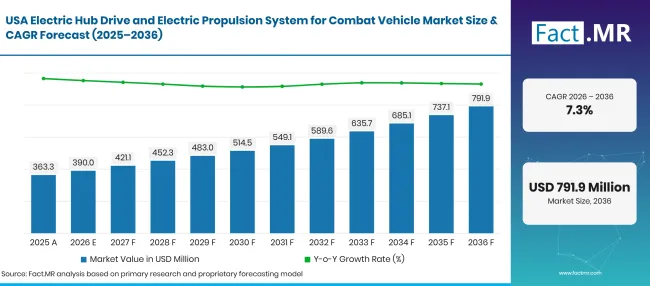
Electric Hub Drive And Electric Propulsion System For Combat Vehicle Market Forecast Usa | Source: Fact.MR
U.S. Army combat vehicle modernization centers on the XM30 and the next Abrams tank. The Army awarded two XM30 detailed design and prototype contracts in June 2023 worth about USD 1.6 billion in total [2]. Hybrid demonstrators for the Bradley and robotic vehicles have built a strong supplier base. Growth will track how quickly these prototypes move into production lots.
Who leads the Electric Hub Drive and Electric Propulsion System for Combat Vehicle Market?
Supply is split between vehicle primes and drivetrain specialists. Rheinmetall AG, BAE Systems and General Dynamics Land Systems design complete hybrid vehicles and integrate the drive with turret power. In September 2026, American Rheinmetall delivered the first Lynx XM30 prototype, which introduces a hybrid-electric powertrain [11].
BAE Systems has integrated a hybrid electric drive on a Bradley testbed, and General Dynamics Land Systems offers a hybrid-electric tracked robot. Drivetrain specialists compete on power density and integration. In March 2026, Rolls-Royce and ZF announced a parallel-hybrid drive for the future MGCS tank, commissioned by Germany’s BAAINBw [12]. RENK Group AG offers the ATREX hybrid electric transmission for tanks. Magnetic Systems Technology builds electric drives for defence vehicles, while ST Engineering offers hybrid electric drive on its Terrex 8x8 and 4x4 vehicles. Proven field reliability and power export capacity will separate winners from the rest.
Which companies are the key providers?
Key companies include BAE Systems plc; Rheinmetall AG; General Dynamics Land Systems; Rolls-Royce plc (Rolls-Royce Power Systems); RENK Group AG; Magnetic Systems Technology Ltd; and ST Engineering.
- BAE Systems plc
- Rheinmetall AG
- General Dynamics Land Systems
- Rolls-Royce plc (Rolls-Royce Power Systems)
- RENK Group AG
- Magnetic Systems Technology Ltd
- ST Engineering
Bibliography
- [1] North Atlantic Treaty Organization. (2026). The Secretary General’s Annual Report 2025.
- [2] Congressional Research Service. (2025, June 5). The Army’s XM-30 Mechanized Infantry Combat Vehicle (Formerly Known as the Optionally Manned Fighting Vehicle [OMFV]).
- [3] European Commission. (2025, October 20). Record response to European Defence Fund 2025 call: 410 project proposals submitted for EUR 1.065 billion envelope.
- [4] Rheinmetall AG. (2025, September 9). DSEI 2025: Ermine, Rheinmetall’s new lightweight hybrid vehicle family for modern armed forces.
- [5] Ministry of Defense, Japan. (2025). 防衛力抜本的強化の進捗と予算 令和8年度予算案の概要 [Progress and budget of the fundamental reinforcement of defense capabilities: Overview of the FY2026 budget proposal].
- [6] Deutscher Bundestag. (2026, September 9). Deutlicher Anstieg bei den Verteidigungsausgaben [Significant increase in defence spending].
- [7] Bundesministerium der Verteidigung. (2026, September 9). Minister Pistorius zum Etat: Dieser Haushalt ist ein Sicherheitsversprechen [Minister Pistorius on the budget: This budget is a security promise].
- [8] Ministry of Defence, United Kingdom. (2025, September 11). MOD regional expenditure with industry 2024/25.
- [9] Ministry of Defence, United Kingdom. (2025). The Strategic Defence Review 2025: two-pager.
- [10] Agência Gov, Government of Brazil. (2026, September 1). Exército inicia aquisição de viaturas blindadas de combate com transferência de tecnologia [Army begins acquisition of armored combat vehicles with technology transfer].
- [11] Rheinmetall AG. (2026, September 1). American Rheinmetall delivers first Lynx XM30 combat vehicle prototype to U.S. Army.
- [12] Rolls-Royce plc. (2026, March 11). Rolls-Royce and ZF develop drive system for future European MGCS tank.
This Report Answers
- What electric drive for combat vehicles will be worth by 2036, and how fast revenue will build from 2026.
- Why full electric propulsion systems and tracked platforms take the bigger share of 2026 spending.
- Where budgets and fleet plans in Japan, Germany, the United Kingdom, Brazil and the United States create demand.
- Which vehicle primes and drivetrain specialists hold hybrid programs, and what each one brings.
- How battery weight, unit cost and field reliability limit the pace of fleet conversion.
What does the Electric Hub Drive and Electric Propulsion System for Combat Vehicle Market cover?
Combat vehicle electric drive in this study takes two forms. Electric propulsion systems combine an engine with motor-generators, an electrified transmission, power electronics and energy storage. Electric hub drives place a traction motor at each wheel station of a wheeled vehicle.
Revenue is tracked for wheeled and tracked combat vehicles, including tanks, infantry carriers, reconnaissance vehicles and armed robotic platforms. Values are measured at the price paid by the vehicle maker or defense ministry for the drive system.
What is included in the scope?
Hybrid powerpacks, motor-generators, traction motors and electrified steering transmissions are counted, along with the permanent magnet motor units built into them. Retrofit kits that hybridize vehicles already in service are also part of the total.
Inverters, converters and control units shipped as part of the drive are included. Their design shares much with automotive power electronics, though military units are hardened for shock and heat. Development and prototype contracts count when they deliver drive hardware.
What is excluded from the scope?
Conventional diesel engines and mechanical transmissions without electric machines fall outside the boundary. Standalone generators and auxiliary power units that do not drive the vehicle are also excluded.
Electric drives for logistics trucks, tactical utility vehicles without a combat role and naval or air platforms are left out. Batteries are counted only when sold inside a drive package.
How Was the Analysis Built?
The analysis draws on 120+ sources, 35+ company portfolios, 25+ countries, and more than 20 industry interviews.
- Primary Research: Primary research includes discussions with manufacturers, service providers, technology developers, distributors, end users, and subject-matter experts. These conversations examine purchasing priorities, product adoption, operational challenges, approval requirements, competitive positioning, and the factors that influence wider market acceptance.
- Desk Research: Desk research covers government statistics, regulatory publications, company filings, trade data, technical studies, industry associations, standards, public policy, and other authoritative sources. Every source used in the analysis is documented in the bibliography.
- Market Sizing and Forecasting: Market estimates combine historical performance, demand indicators, pricing and volume trends, segment shares, company participation, country-level growth, adoption patterns, investment activity, and barriers to market expansion.
- Data Validation and Update Cycle: Findings are validated by comparing primary interviews with public data, company activity, regulatory changes, trade patterns, and industry developments. Regular updates review new product launches, capacity changes, partnerships, approvals, and shifts in commercial adoption.
Segmentation
What is the report’s scope and coverage?
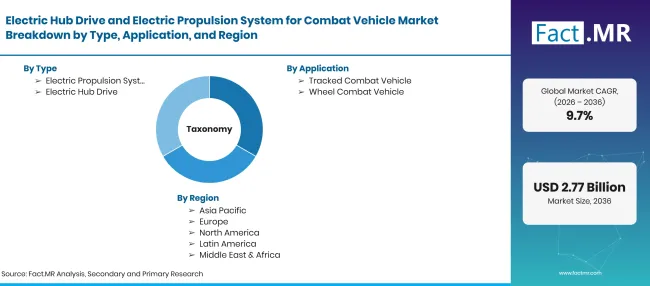
Electric Hub Drive And Electric Propulsion System For Combat Vehicle Market Taxonomy | Source: Fact.MR
| Attribute | Details |
|---|---|
| Quantitative Units | USD billion in 2026 to USD billion by 2036 at CAGR |
| Market Definition | Electric hub drives and electric or hybrid-electric propulsion systems built for tracked and wheeled combat vehicles. Revenue covers motors, generators, electrified transmissions, power electronics and integrated powerpacks sold to vehicle makers and defense ministries. |
| Type | Electric Hub Drive; Electric Propulsion System |
| Application | Wheel Combat Vehicle; Tracked Combat Vehicle |
| Regions Covered | North America; Latin America; Western Europe; Eastern Europe; East Asia; South Asia & Pacific; Middle East & Africa |
| Countries Covered | Japan; Germany; United Kingdom; Brazil; United States |
| Companies Profiled | BAE Systems plc; Rheinmetall AG; General Dynamics Land Systems; Rolls-Royce plc (Rolls-Royce Power Systems); RENK Group AG; Magnetic Systems Technology Ltd; ST Engineering |
| Forecast Period | 2026 to 2036 |
| Approach | Hybrid top-down and bottom-up approach using combat vehicle fleet and program counts; hybrid and electric drive content per vehicle; prototype, retrofit and production schedules; national defense budgets; and supplier portfolio review. |
Source: Fact.MR analysis. Updated Oct 23, 2026
How is the market segmented?
-
By Type
- Electric Hub Drive
- Electric Propulsion System
-
By Application
- Wheel Combat Vehicle
- Tracked Combat Vehicle
-
By Region
- North America
- Latin America
- Western Europe
- Eastern Europe
- East Asia
- South Asia & Pacific
- Middle East & Africa
Frequently Asked Questions
How big is the electric hub drive and electric propulsion system for combat vehicle market in 2026?
What is the CAGR of the electric hub drive and electric propulsion system for combat vehicle market from 2026 to 2036?
Which type leads the electric hub drive and electric propulsion system for combat vehicle market?
Which application leads the electric hub drive and electric propulsion system for combat vehicle market?
Which country will grow the most in the electric hub drive and electric propulsion system for combat vehicle market?
Who are the main companies in the electric hub drive and electric propulsion system for combat vehicle market?
Who worked on this report


Preview the report firsthand - request a free sample
Free SampleGet the brochure for pricing and purchase details
Download PDF