- Market Value (2025): USD 12.8 Bn
- Estimated Value (2026): USD 13.5 Bn
- Forecast Value (2036): USD 22.4 Bn
- CAGR (2026-2036): 5.2%
What is the Electrical Steel Laminations Market forecast to be worth by 2036?
USD 13.5 billion in 2026 to USD 22.4 billion by 2036 at a 5.2% CAGR.
- The electrical steel laminations market reached USD 12.8 billion in 2025.
- Sales are projected to reach from USD 13.5 billion in 2026 to USD 22.4 billion by 2036 as equipment builders commission new units and replace ageing installations.
- A 5.2% CAGR from 2026 to 2036 reflects the combined demand for transformer laminations and motor core components.
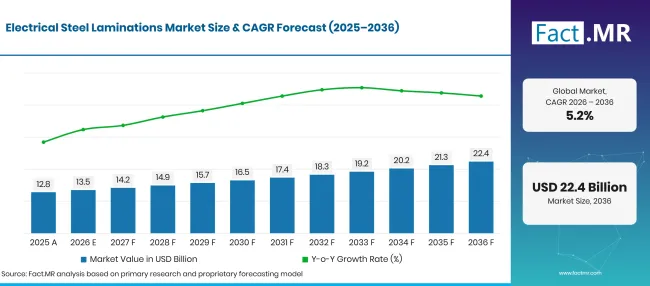
Electrical Steel Laminations Market Forecast Global | Source: Fact.MR
| Year | Basis | Market Value (USD billion) |
|---|---|---|
| 2025 | Actual | 12.8 |
| 2026 | Estimate | 13.5 |
| 2036 | Forecast | 22.4 |
| CAGR 2026 to 2036 | Forecast period | 5.2% |
Source: Fact.MR analysis. Updated Nov 3, 2026
What are the defining numbers behind Electrical Steel Laminations Market growth?
Between 2026 and 2036 the market adds USD 8.9 billion in forecast value.
- Demand Drivers in the Market
- Transformer core manufacturers need consistently insulated grain-oriented sheets to manage no-load losses. The International Energy Agency estimated worldwide grid spending at about USD 400 billion annually in its June 2025 investment review [1].
- Utility engineering teams increasingly review transformer delivery risk before approving core materials. The International Energy Agency reported in February 2025 that prices of power transformers had risen around 75% against the comparison period in its transmission-grid study [2].
- Motor designers use non-grain-oriented laminations to carry changing magnetic flux in rotating equipment. Automotive traction motors require precise slot geometry and controlled sheet thickness.
- Transformer plants also depend on a dependable supply of core steel. The U.S. Department of Energy began a review of transformer standards in June 2026 that explicitly addressed electrical core steel availability and domestic production constraints [3].
- Key Segments Analyzed
- By Magnetic Orientation Type: Grain-oriented laminations account for 62.4% of 2026 sales because transformer cores use directional magnetic properties.
- By Application: Transformers lead with 52.3% of value in 2026 because grid equipment requires substantial laminated magnetic core material.
- By End-User: Automotive capture 31.4% in 2026 as traction drives and conventional motor applications use stamped electrical-steel cores.
- Analyst Opinion at Fact.MR
- Shambhu Nath Jha, Principal Consultant at Fact.MR, states, “Electrical steel suppliers and lamination processors compete on the number of usable parts they can produce from each coil without compromising magnetic performance. Transformer manufacturers also consider whether approved grades can arrive on schedule, since a last-minute material change may require fresh electrical testing.”
- Strategic Implications
- Steel producers can provide clear grade data and coating-performance information to stamping houses before production specifications change.
- Lamination processors benefit from tracking scrap losses by thickness and die design so quotations reflect usable output.
- Transformer builders need to qualify substitute core grades in advance because a late material change can trigger additional electrical testing.
- Motor manufacturers can involve stamping teams during design changes to reduce burr risk and avoid repeated tooling adjustments.
Germany is forecast at 6.0% CAGR, followed by Brazil at 5.5%. The USA is forecast at 4.9%, the UK at 4.4%, and Japan at 3.9% through 2036.
How does the Electrical Steel Laminations Market break down by segment?
Grain-oriented steel leads the magnetic orientation split at 62.4%; transformers lead applications at 52.3%; automotive leads end-users at 31.4%.
Which Magnetic Orientation Type dominates?
Grain-Oriented accounts for 62.4% of market value in 2026.
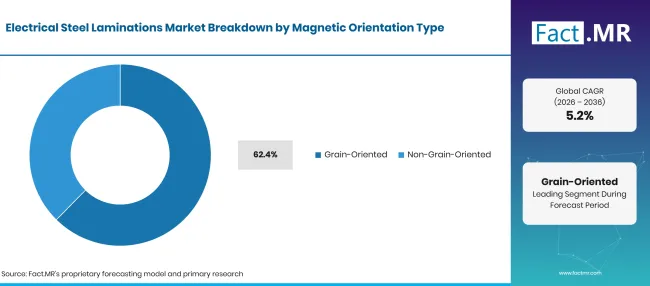
Electrical Steel Laminations Market Breakdown Magnetic Orientation Type | Source: Fact.MR
| Magnetic Orientation Type | Share (2026) |
|---|---|
| Grain-Oriented (Leading segment) | 62.4% |
| Other segments combined | 37.6% |
| Total | 100.0% |
Source: Fact.MR analysis. Updated Nov 3, 2026
Grain-oriented electrical steel is made to carry magnetic flux efficiently in a preferred direction, which makes it well suited to transformer cores. Processors cut and stack the sheets with care because joints and damaged insulation can increase losses. Motor and generator cores face changing magnetic fields, so manufacturers often choose non-grain-oriented grades for those machines instead.
What leads the Application segment?
Transformers lead with 52.3% of market value in 2026.
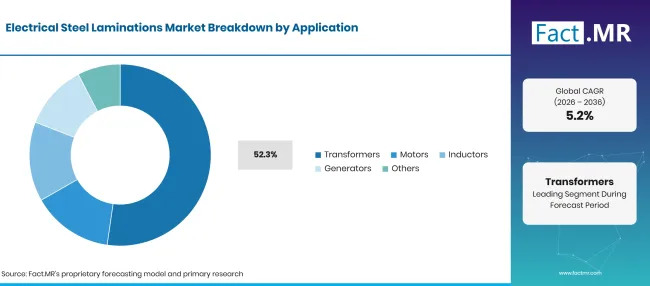
Electrical Steel Laminations Market Breakdown Application | Source: Fact.MR
| Application | Share (2026) |
|---|---|
| Transformers (Leading segment) | 52.3% |
| Other segments combined | 47.7% |
| Total | 100.0% |
Source: Fact.MR analysis. Updated Nov 3, 2026
Transformers require laminated magnetic paths in many power and distribution designs. Core assembly may involve stacked sheets or wound strip depending on the unit. Motor laminations use different geometry and magnetic behavior to manage rotating fields. Inductors and generators add further demand, although each requires its own approach to core design.
How does End-User demand differ?
Automotive captures 31.4% of market value in 2026.
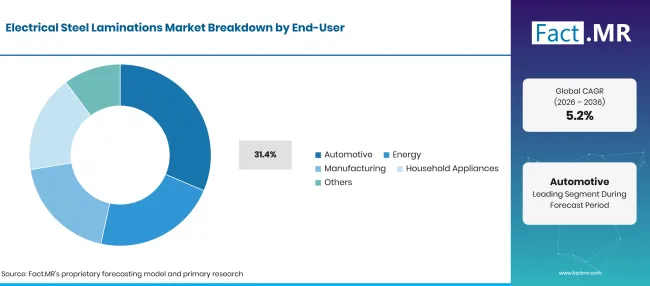
Electrical Steel Laminations Market Breakdown End User | Source: Fact.MR
| End-User | Share (2026) |
|---|---|
| Automotive (Leading segment) | 31.4% |
| Other segments combined | 68.6% |
| Total | 100.0% |
Source: Fact.MR analysis. Updated Nov 3, 2026
Vehicle manufacturers use electrical-steel laminations in traction motors and smaller electrical machines. They examine magnetic losses, noise and the dimensional accuracy of rotor and stator stacks before approving parts. Transformer producers and industrial motor builders apply different performance tests, while appliance makers tend to require consistent quality at high production volumes.
What is accelerating Electrical Steel Laminations Market adoption, and what is holding it back?
Transformer replacement orders and electric-motor production are central demand factors. Electrical-steel supply and the cost of qualifying alternative grades can delay conversions into finished laminations.
Drivers Impact Analysis
| Driver | Indicative % impact on CAGR | Geographic Relevance | Impact Timeline |
|---|---|---|---|
| Transformer grid upgrades | +1.2% | North America; Europe; Brazil | Medium term |
| EV motor core output | +0.9% | Europe; East Asia | Medium term |
| Motor replacement cycles | +0.7% | Global | Long term |
| Core-loss specifications | +0.5% | Global | Long term |
| Production quality control | +0.4% | Global | Short term |
Source: Fact.MR analysis. Updated Nov 3, 2026
Opportunity Impact Analysis
| Opportunity | Indicative % impact on CAGR | Geographic Relevance | Impact Timeline |
|---|---|---|---|
| Lower-loss transformer cores | +0.7% | US; Europe; Japan | Medium term |
| Precision EV motor stamping | +0.6% | Germany; Japan | Medium term |
| Local transformer sourcing | +0.5% | US; Brazil | Long term |
| Improved slit-coil yield | +0.3% | Global | Short term |
Source: Fact.MR analysis. Updated Nov 3, 2026
Restraints Impact Analysis
| Restraint | Indicative % impact on CAGR | Geographic Relevance | Impact Timeline |
|---|---|---|---|
| Electrical-steel availability | -0.7% | US; Europe | Short term |
| Tooling and grade qualification | -0.5% | Global | Medium term |
| Energy and conversion cost | -0.4% | Global | Short term |
Source: Fact.MR analysis. Updated Nov 3, 2026
Which countries are scaling the Electrical Steel Laminations Market through 2036?
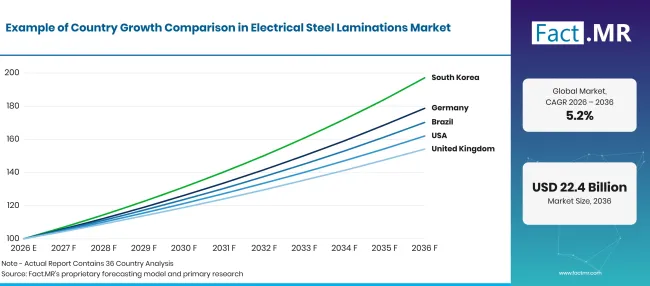
Electrical Steel Laminations Market Growth Index | Source: Fact.MR
| Country | CAGR (2026 to 2036) |
|---|---|
| Germany | 6.0% |
| Brazil | 5.5% |
| USA | 4.9% |
| UK | 4.4% |
| Japan | 3.9% |
Source: Fact.MR analysis. Updated Nov 3, 2026
What supports Germany adoption?
6.0% CAGR, supported by Germany’s electric-motor production and transformer core requirements.
Germany’s lamination demand follows the requirements of electric-motor manufacturers and transformer builders. VDA reported production of 1.67 million electric passenger cars in 2025 [5], supporting a customer base that needs accurately stamped and insulated motor cores. Utilities also require transformer cores with documented magnetic losses.
What supports Brazil adoption?
5.5% CAGR, linked to Brazil’s power-capacity expansion and transformer investment.
Brazil’s Energy Research Office reported that installed electricity generation capacity increased by 24.6 GW in 2025, reaching 261 GW [6]. New power facilities create a need for connection transformers that use magnetic steel cores. The Ministry of Mines and Energy also reported more than 484,000 MVA of transformation capacity in 2025 [12]. Dedicated stamping dies raise the cost of short production runs, and the choice of another grade requires renewed testing.
What supports USA adoption?
4.9% CAGR, driven by U.S. transformer replacement needs and rising grid demand.
The Department of Energy described transformer lead times of 12 to 30 months in a 2026 supply-chain review [10]. Industrial motors create a separate need for stamped non-grain-oriented sheets. Electricity demand strengthens the case for local transformer capacity. The Department of Energy reported that US grid loads had risen at close to 3% annually since 2023 in its September 2026 update [4].
What supports UK adoption?
4.4% CAGR, supported by UK zero-emission vehicle growth and demand for motor laminations.
UK demand combines utility equipment replacement with motor production tied to domestic vehicle programs. The Department for Transport recorded 473,226 first registrations of zero-emission cars in 2025 [7]. The Department for Transport counted 2,017,000 licensed zero-emission cars at the end of June 2026 [11]. Local steel conversion faces energy and equipment costs, and specialized grades can have overseas delivery exposure. Worldsteel reported UK crude steel output of 2.6 million tonnes in 2025 [9].
What supports Japan adoption?
3.9% CAGR, linked to Japan’s hybrid-vehicle base and strict magnetic-performance requirements.
Japanese manufacturers pay close attention to magnetic loss and sheet thickness when choosing motor and transformer laminations. The International Energy Agency reported that conventional hybrids represented around one-third of Japanese car sales in 2025 [8]. The International Energy Agency placed electric cars below 3% of Japanese new-car sales in 2025, a limitation for domestic pure-electric traction motor demand.
Who leads the Electrical Steel Laminations Market?
Electrical-steel producers compete on grade consistency and supply terms, while processors compete on cutting precision and assembled core quality.
Nippon Steel, ArcelorMittal, Baosteel and thyssenkrupp Steel publish electrical-steel product information. Tata Steel and Cleveland-Cliffs also have electrical-steel exposure. Nucor participates in the wider steel supply chain, although a dedicated electrical-steel lamination offering has not been established.
Which companies are the key providers?
Key companies include Nippon Steel Corporation, ArcelorMittal, China Baowu Steel Group (Baosteel), thyssenkrupp Steel, Tata Steel Limited, Nucor Corporation and Cleveland-Cliffs Inc.
- Nippon Steel Corporation
- ArcelorMittal
- China Baowu Steel Group (Baosteel)
- thyssenkrupp Steel
- Tata Steel Limited
- Nucor Corporation
- Cleveland-Cliffs Inc.
Bibliography
- [1] International Energy Agency. (2025, June 5). World Energy Investment 2025.
- [2] International Energy Agency. (2025, February 25). Rising component prices and supply chain pressures are hindering the development of transmission grid infrastructure.
- [3] U.S. Department of Energy. (2026, June 15). DOE issues request for information (RFI) on energy conservation standards for distribution transformers
- [4] U.S. Department of Energy. (2026, August 10). Strengthening America’s grid supply chain
- [5] German Association of the Automotive Industry. (2026, February 3). Production and market in January 2026.
- [6] Empresa de Pesquisa Energética. (2026, June 3). Anuário estatístico de energia elétrica 2026: Destaques.
- [7] Department for Transport. (2026, April 29). Vehicle licensing statistics, United Kingdom: 2025.
- [8] International Energy Agency. (2026, May 20). Global EV Outlook 2026: Trends in electric cars
- [9] World Steel Association. (2026, June 4). World Steel in Figures 2026.
- [10] U.S. Department of Energy. (n.d.). Supply chain and market analysis. Office of Electricity.
- [11] Department for Transport. (2026, September 23). Vehicle licensing statistics: April to June 2026.
- [12] Ministério de Minas e Energia. (2026, May 12). Boletim de Monitoramento do Sistema Elétrico apresenta os principais destaques e resultados de 2025
This Report Answers
- The report explains how grain-oriented and non-grain-oriented core materials serve different electrical equipment designs.
- The report explains how transformer core production and motor stamping create separate buying requirements.
- The report explains why steel qualification, tool design and delivery dependability affect conversion economics.
- The report explains how electrical grid spending and vehicle programs influence the five covered country outlooks.
- The report explains how upstream steel producers differ from businesses that cut and assemble finished laminations.
What does the Electrical Steel Laminations Market cover?
The market includes processed electrical-steel sheets used in magnetic cores for transformers and electrical machines. It covers grain-oriented and non-grain-oriented materials when sold as laminations or core components. Applications cover motors, generators and inductors where suitable electrical steel forms part of the magnetic path.
What is included in the scope?
Stamped rotor and stator laminations are included alongside transformer core packets made from electrical steel. Sales cover the finished lamination stage, including cut and insulated sheet components supplied to electrical equipment manufacturers. The analysis distinguishes the magnetic orientation of steel from its final equipment application.
What is excluded from the scope?
Finished transformers and complete electric motors are outside the lamination revenue boundary. Unprocessed bulk steel and non-electrical structural steel are excluded. Complete electrical generators and grid installation services are also outside the market definition because they include products and labor beyond magnetic core components.
How Was the Analysis Built?
The analysis draws on 120+ sources, 35+ company portfolios, 25+ countries, and more than 20 industry interviews.
- Primary Research: Primary research includes discussions with manufacturers, service providers, technology developers, distributors, end users, and subject-matter experts. These conversations examine purchasing priorities, product adoption, operational challenges, approval requirements, competitive positioning, and the factors that influence wider market acceptance.
- Desk Research: Desk research covers government statistics, regulatory publications, company filings, trade data, technical studies, industry associations, standards, public policy, and other authoritative sources. Every source used in the analysis is documented in the bibliography.
- Market Sizing and Forecasting: Market estimates combine historical performance, demand indicators, pricing and volume trends, segment shares, company participation, country-level growth, adoption patterns, investment activity, and barriers to market expansion.
- Data Validation and Update Cycle: Findings are validated by comparing primary interviews with public data, company activity, regulatory changes, trade patterns, and industry developments. Regular updates review new product launches, capacity changes, partnerships, approvals, and shifts in commercial adoption.
Segmentation
What is the report’s scope and coverage?
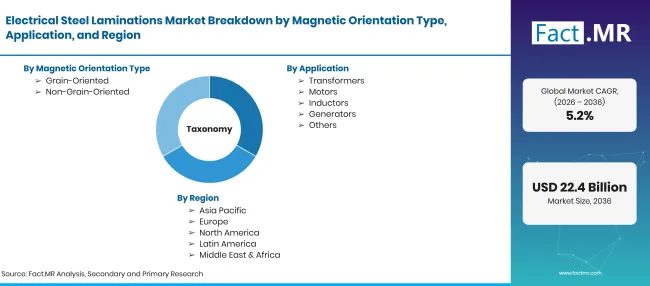
Electrical Steel Laminations Market Taxonomy | Source: Fact.MR
| Attribute | Details |
|---|---|
| Quantitative Units | USD billion |
| Market Definition | Electrical steel sheets cut, stamped or stacked into magnetic laminations for transformers and electrical machines |
| Magnetic Orientation Type | Grain-Oriented; Non-Grain-Oriented |
| Application | Transformers; Motors; Inductors; Generators; Others |
| End-User | Automotive; Energy; Manufacturing; Household Appliances; Others |
| Regions Covered | North America; Latin America; Western Europe; Eastern Europe; East Asia; South Asia & Pacific; Middle East & Africa |
| Countries Covered | Germany; Brazil; USA; UK; Japan |
| Companies Profiled | Nippon Steel Corporation, ArcelorMittal, China Baowu Steel Group (Baosteel), thyssenkrupp Steel, Tata Steel Limited, Nucor Corporation and Cleveland-Cliffs Inc. |
| Forecast Period | 2026 to 2036 |
| Approach | Top-down end-use demand review combined with bottom-up core material and conversion analysis |
Source: Fact.MR analysis. Updated Nov 3, 2026
How is the market segmented?
-
By Magnetic Orientation Type
- Grain-Oriented
- Non-Grain-Oriented
-
By Application
- Transformers
- Motors
- Inductors
- Generators
- Others
-
By End-User
- Automotive
- Energy
- Manufacturing
- Household Appliances
- Others
-
By Region
- North America
- Latin America
- Western Europe
- Eastern Europe
- East Asia
- South Asia & Pacific
- Middle East & Africa
Frequently Asked Questions
How big is the electrical steel laminations market in 2026?
What CAGR applies to electrical steel laminations through 2036?
Which magnetic orientation type accounts for the most revenue?
Which application leads the market?
Which companies participate in the supply chain?
Who worked on this report


Preview the report firsthand - request a free sample
Free SampleGet the brochure for pricing and purchase details
Download PDF