Electro Optical Systems Market Size, Share, Growth and Forecast (2026 - 2036)

The Electro Optical Systems Market is segmented by Component (Sensors [CCD Sensors, CMOS Sensors], Displays [LCD Displays, OLED Displays], Optical Devices [Lenses, Filters], Processors, and Transceivers), Application (Defence and Military [Surveillance Systems, Targeting Systems], Aerospace [Navigation Systems, Communication Systems], Telecommunications [Fiber Optic Communication, Optical Networking], Medical Devices [Imaging Systems, Diagnostic Equipment], and Industrial [Machine Vision Systems, Quality Control Systems]), Technology (Laser-Based Systems, Fiber Optic Systems, Imaging Systems, and Night Vision Systems), End-User (Government and Defence, Commercial Enterprises, Healthcare Providers, and Telecom Operators), and Region. Forecast for 2026 to 2036.

FACT.MR is of the opinion that the electro optical systems market is undergoing a defence-led digitalisation shift. Conventional optical hardware procurement is gradually giving way to sensor-fused, AI-integrated imaging platforms. This transition is being driven by accelerating military modernisation programmes and rising border surveillance requirements.

Electro Optical Systems Market Forecast and OutlookBy Fact.MR

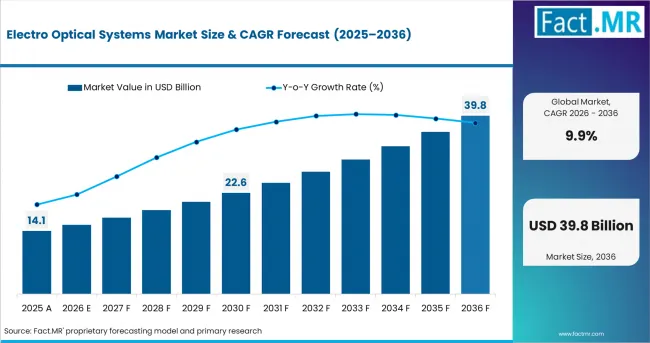
  • In 2025, the electro optical systems market was valued at USD 13.4 billion.
  • Based on Fact.MR analysis, demand for electro optical systems is estimated to grow to USD 14.1 billion in 2026 and USD 23.2 billion by 2036.
  • FACT.MR projects a CAGR of 9.9% during the forecast period.
Electro Optical Systems Market Market Value Analysis

Metric Value
Estimated Value in 2026 USD 14.1 billion
Forecast Value in 2036 USD 23.2 billion
Forecast CAGR (2026 to 2036) 9.9%

Summary of Electro Optical Systems Market

  • Market Definition
    • The market covers sensor assemblies, imaging systems, optical displays, processors, and transceivers operating across visible, infrared, and ultraviolet spectrums, sold globally for defence, aerospace, telecommunications, medical, and industrial applications.
  • Demand Drivers
    • India's Defence Acquisition Council approved EO-integrated surveillance and targeting system procurements worth over USD 2 billion in 2024, directly expanding demand for CMOS sensor platforms and thermal imaging assemblies across land and naval defence programmes.
    • The U.S. Department of Defense allocated over USD 1.6 billion in 2024 for electro optical infrared (EO/IR) sensor upgrades across airborne ISR platforms, sustaining demand for advanced imaging and targeting systems from prime contractors.
    • China's Ministry of Industry and Information Technology mandated smart city surveillance upgrades in 2024, covering 130 cities with AI-integrated EO camera and sensor system installations, driving commercial EO procurement volumes.
  • Key Segments Analyzed
    • By Component: Sensors lead with approximately 30% share in 2026, driven by high demand for CCD and CMOS imaging assemblies across defence surveillance, medical diagnostics, and industrial machine vision applications.
    • By Application: Defence and Military dominates with approximately 45% share in 2026, anchored by targeting, surveillance, and reconnaissance system procurement across NATO and Indo-Pacific defence modernisation programmes.
    • By Technology: Imaging Systems lead with approximately 40% share in 2026, preferred across defence, healthcare, and industrial sectors for real-time visualisation and AI-assisted analytics capabilities.
    • By End-User: Government and Defence holds approximately 50% share in 2026, driven by sustained national defence budgets and security surveillance infrastructure investments across major military-spending nations.
    • By Geography: India leads at 7.8% CAGR, driven by defence procurement expansion, smart surveillance investments, and indigenous manufacturing policy support under the Make in India initiative.
  • Analyst Opinion at FACT.MR
    • Shambhu Nath Jha, Principal Consultant at Fact.MR, opines, ‘CXOs will find a market in the middle of a clear technology shift. Legacy optical hardware is giving way to AI-enabled, multi-spectral platforms with integrated sensing and analytics. Defence procurement remains the core growth engine, while industrial machine vision and medical imaging are expanding commercial adoption.’
  • Strategic Implications
    • Prioritise sensor integration platform development and EO/IR system localisation for India and South Korea defence procurement programmes targeting the 2026 to 2029 modernisation cycle.
    • Accelerate AI-enabled imaging and multi-spectral fusion capabilities in targeting and surveillance product lines to align with NATO and U.S. DoD EO/IR upgrade requirements.
    • Develop partnership frameworks with aerospace prime contractors and defence system integrators to embed EO subsystems as qualified vendor supply for major government programme awards.
  • Methodology
    • Market sizing uses EO system OEM revenues and defence contract award data, validated with 2024–2025 government procurement disclosures and production benchmarks.
    • Analysis includes U.S. DoD EO/IR procurement data, SIPRI military expenditure reports, India DAC approval records, and China MII smart surveillance programme documents.
    • Forecasts incorporate defence budget trajectories, commercial EO adoption rates, and expert interviews with defence procurement officers and industrial machine vision system integrators.

The market is projected to generate approximately USD 9.8 billion in incremental revenue over the forecast period. Growth remains structurally linked to defence spending and national security priorities. Rising geopolitical tensions and border surveillance investments are sustaining long-term demand. Commercial applications in industrial machine vision and medical diagnostics are adding secondary growth momentum. However, high system integration costs continue to limit adoption in cost-sensitive markets. Export controls on advanced optical technologies are also creating supply chain constraints.

Procurement trends are shifting toward integrated and intelligent systems. Defence and aerospace buyers are prioritising multi-spectral imaging, night vision, and real-time data fusion capabilities. Companies such as Lockheed Martin Corporation, Elbit Systems Ltd., and Thales Group are focusing on advanced electro optical platforms with embedded analytics and AI-driven capabilities.

India leads global growth with a CAGR of 7.8% through 2036. Expansion is driven by defence procurement programmes and increasing investment in smart city surveillance infrastructure. China follows at 6.5%. Growth is supported by military modernisation and large-scale deployment of industrial and urban surveillance systems. Germany records a CAGR of 6.2%. Demand is driven by industrial automation and continued investment in defence technologies. Brazil grows at 6.0%. Expansion is linked to strengthening security infrastructure and defence modernisation initiatives. Japan posts 5.8%. Growth is supported by its advanced electronics sector and precision imaging capabilities. The United States records 5.5%. Demand is anchored in defence budgets, aerospace innovation, and ongoing procurement of surveillance and targeting systems.

Segmental Analysis

Electro Optical Systems Market Analysis by Component
Electro Optical Systems Market Analysis By Component

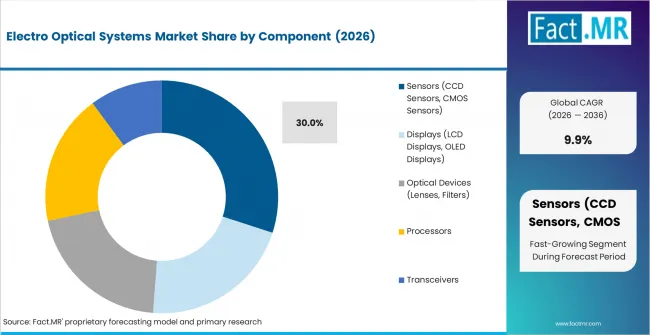
Based on FACT.MR's electro optical systems market report, sensors are estimated to hold approximately 30% share in 2026. They dominate because CCD and CMOS imaging assemblies are fundamental to every EO subsystem across defence targeting, medical imaging, and industrial machine vision, making sensors the single highest-demand component category.

  • L3Harris EO/IR Investment: L3Harris Technologies secured a USD 386 million contract from the U.S. Army in 2024 for next-generation electro optical and infrared sensor assemblies for airborne surveillance platforms, expanding production of CMOS-based imaging modules at its Orlando facility. [1]
  • OLED Display Technology Adoption: Elbit Systems unveiled its advanced OLED-based helmet-mounted display module for fixed-wing and rotary aircraft in 2025, integrating real-time thermal imaging and symbology overlay for pilot situational awareness in low-visibility environments. [2]
  • Sensor Supply Chain Localisation: India's Defence Research and Development Organisation (DRDO) launched a domestic CMOS sensor fabrication programme at SSPL Delhi in 2024, targeting self-sufficiency in imaging sensors for naval and land surveillance system programmes under the Atmanirbhar Bharat defence manufacturing policy. [3]

Electro Optical Systems Market Analysis by Application
Electro Optical Systems Market Analysis By Application

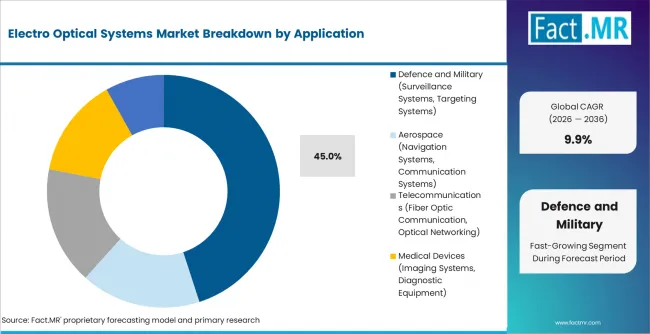
Based on FACT.MR's electro optical systems market report, defence and military is estimated to hold approximately 45% share in 2026. It leads because sustained national defence budgets, border surveillance mandates, and military platform modernisation programmes consistently drive the highest-volume EO system procurement globally.

  • Lockheed Martin Targeting System Award: Lockheed Martin received a USD 510 million contract from the U.S. Air Force in 2024 to supply electro optical targeting pods for F-16 and F-35 platforms, covering LANTIRN successor targeting and infrared search-and-track system upgrades. [4]
  • Medical EO Imaging Expansion: Canon Medical Systems launched its Aquilion Exceed CT imaging platform with enhanced optical sensor resolution in 2025, targeting hospital procurement in Japan and Southeast Asia for diagnostic imaging applications requiring sub-millimetre EO precision. [5]
  • Industrial Machine Vision Growth: Cognex Corporation reported a 14% increase in machine vision system revenues in 2024, driven by EO-integrated quality control deployments in semiconductor and automotive assembly lines across Germany, South Korea, and the United States. [6]

Electro Optical Systems Market Analysis by Technology
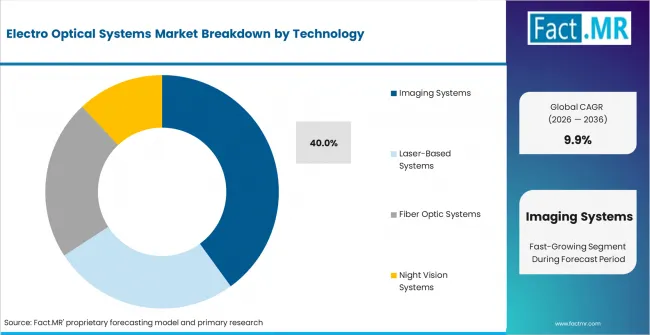
Electro Optical Systems Market Analysis By Technology

Based on FACT.MR's electro optical systems market report, imaging systems are estimated to hold approximately 40% share in 2026. This technology leads because real-time visualisation and AI-assisted analytics are universally demanded across defence surveillance, medical diagnostics, and industrial inspection, making imaging the broadest-application EO technology.

  • Northrop Grumman Imaging Launch: Northrop Grumman delivered its LITENING Advanced Targeting Pod upgrade with enhanced wide-area imaging and two-colour mid-wave infrared sensor fusion in 2024, deployed on U.S. Marine Corps F/A-18 and international air force procurement programmes. [7]
  • Night Vision System Development: Elbit Systems signed a EUR 60 million contract with a European NATO member in 2025 to supply digital night vision goggle systems integrating CMOS image intensification with thermal overlay for infantry ground operations. [2]
  • Fiber Optic Communication Expansion: Corning Incorporated expanded its optical fiber manufacturing capacity in North Carolina by 30% in 2024 to meet rising demand from defence-grade fiber optic communication and networking system integrators across U.S. and allied military programmes. [8]

Electro Optical Systems Market Analysis by End-User
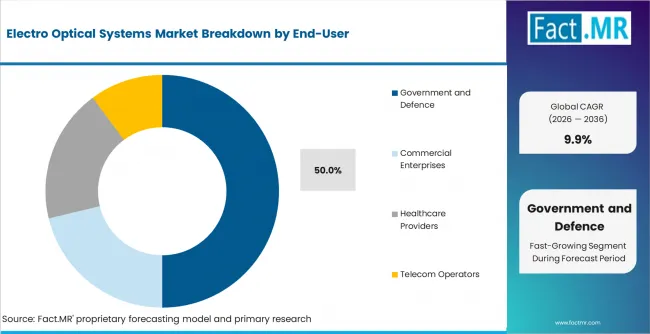
Electro Optical Systems Market Analysis By End User

Based on FACT.MR's electro optical systems market report, government and defence is estimated to hold approximately 50% share in 2026. It dominates because national defence budgets provide the largest, most consistent procurement volumes for integrated EO platforms spanning surveillance, targeting, and reconnaissance across all major military-spending nations.

  • Raytheon DoD Contract: Raytheon Technologies (RTX) was awarded a USD 620 million contract in 2024 by the U.S. Missile Defense Agency for electro optical infrared sensor integration on next-generation interceptor programmes, marking the largest single EO system award in the fiscal year. [9]
  • Healthcare Provider EO Procurement: Nikon Corporation secured supply agreements with three national health system procurement agencies in Europe in 2025 for high-resolution ophthalmic and surgical imaging systems, expanding its medical EO product line into public hospital procurement channels. [10]
  • Telecom EO Network Investment: Thales Group partnered with a major Gulf telecom operator in 2024 to deploy fiber optic optical networking systems for secure government communications infrastructure in the UAE and Saudi Arabia, covering EO transceiver and optical amplifier supply. [11]

Drivers, Restraints, and Opportunities
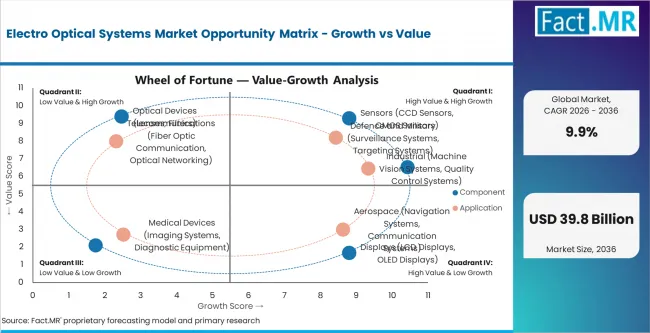
Electro Optical Systems Market Opportunity Matrix Growth Vs Value

FACT.MR analysts observe the electro optical systems market is a structurally expanding category anchored by global defence modernisation mandates and industrial digitalisation programmes.

The market shows clear divergence between high-volume defence procurement and value-driven commercial adoption segments. Legacy passive optical components face pricing pressure as AI-integrated imaging platforms command premium positioning. Standard sensor modules are being displaced by multi-spectral, AI-fused systems in advanced application segments.

  • Defence Budget Escalations: NATO member states committed to raising defence spending to 2% of GDP under the 2024 Brussels Summit declaration, with EO surveillance and targeting systems identified as priority capability gaps. Germany alone allocated EUR 100 billion in special defence fund disbursements in 2024, a portion of which is directed toward EO sensor and imaging platform upgrades.
  • Industrial Automation Mandates: The European Commission's Industry 5.0 strategic framework, updated in 2024, includes machine vision and optical quality control systems as qualifying investments for regional development fund co-financing, accelerating EO adoption in German and Polish manufacturing clusters.
  • Indo-Pacific Surveillance Build-Out: India's Ministry of Defence approved twelve border surveillance system programmes in 2024 under the Comprehensive Integrated Border Management System (CIBMS) phase two expansions, with EO camera arrays and thermal imaging towers covering 2,000 km of land borders as primary equipment.

Regional Analysis

The electro optical systems market is assessed across North America, Europe, Asia Pacific, Latin America, and Middle East and Africa, covering 40+ countries with demand shaped by defence spending intensity, industrial automation policy, surveillance infrastructure investment, and EO technology export regulations. The full report offers market attractiveness analysis by region and country.

Top Country Growth Comparison Electro Optical Systems Market Cagr (2026 2036)

Country CAGR (2026 to 2036)
United States 5.5%
China 6.5%
India 7.8%
Germany 6.2%
Japan 5.8%
Brazil 6.0%

Source: Fact.MR (FACT.MR) analysis, based on proprietary forecasting model and primary research
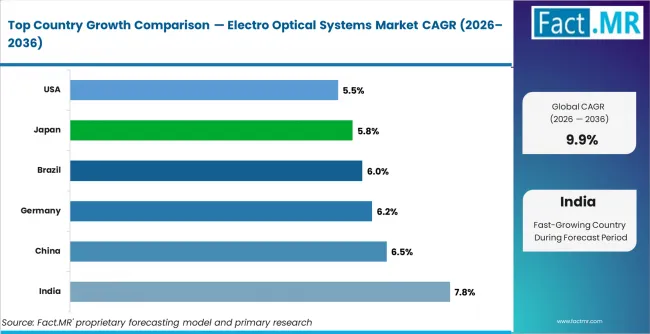
Electro Optical Systems Market Cagr Analysis By Country

Asia Pacific Electro Optical Systems Market Analysis

Asia Pacific leads global growth in electro optical systems. Demand is driven by defence procurement and large-scale surveillance deployment. Regional governments are investing in indigenous capabilities and smart monitoring infrastructure. Companies such as Elbit Systems Ltd., Bharat Electronics Limited, and Norinco are active across defence and commercial segments.

  • India: India stands out with a CAGR of 7.8% through 2036. Defence procurement is accelerating across land, naval, and border surveillance systems. Government programmes are supporting domestic innovation in imaging technologies. Bharat Electronics Limited expanded production capacity for thermal imaging systems. Indigenous startups are also entering the EO ecosystem.
  • China: China maintains strong growth at 6.5% CAGR through 2036. Military modernisation is driving demand for advanced EO systems. People's Liberation Army is upgrading imaging and targeting capabilities. Domestic suppliers such as Norinco are securing major contracts. Smart city surveillance deployment is expanding commercial demand.
  • Japan: Japan reflects stable expansion at 5.8% CAGR through 2036. Defence upgrades are focused on reconnaissance and maritime surveillance. Acquisition, Technology and Logistics Agency is supporting system modernisation. Industrial and agricultural imaging applications are also gaining traction through government-backed R&D programmes.

FACT.MR's analysis of the electro optical systems market in Asia Pacific covers China, India, Japan, South Korea, ASEAN, and Australia and New Zealand. Readers can find defence procurement contract data, surveillance programme volumes, and EO technology adoption benchmarks by country.

North America Electro Optical Systems Market Analysis
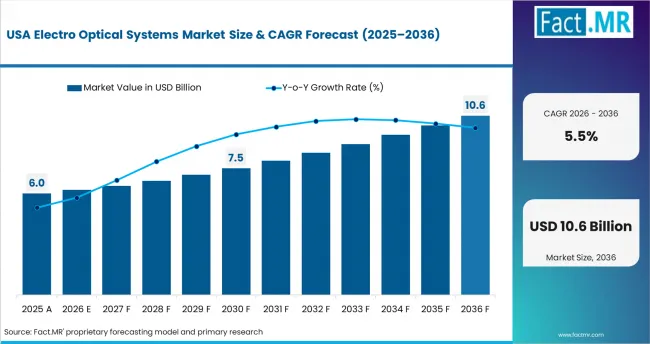
Electro Optical Systems Market Country Value Analysis

North America remains the largest revenue contributor. Growth is supported by sustained defence spending and aerospace investments. Leading players such as Lockheed Martin Corporation, Raytheon Technologies Corporation, and L3Harris Technologies dominate procurement programs.

  • United States: The United States shows steady growth at 5.5% CAGR through 2036. Defence budgets continue to prioritise EO and infrared system upgrades. United States Air Force is investing in ISR platform enhancements. Missile defence programmes are also increasing demand for advanced imaging sensors.

 FACT.MR's analysis of the electro optical systems market in North America covers the United States, Canada, and Mexico. Readers can find DoD procurement data, aerospace programme contract benchmarks, and commercial EO adoption trends by application and end-user.

Europe Electro Optical Systems Market Analysis
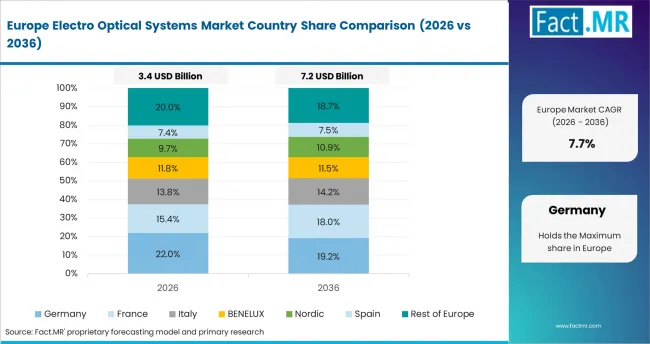
Electro Optical Systems Market Europe Country Market Share Analysis, 2026 & 2036

Europe operates as a precision engineering and industrial benchmark market. NATO commitments and EU funding are supporting both defence and industrial applications. Key suppliers include Hensoldt AG, Thales Group, and Leonardo S.p.A..

  • Germany: Germany demonstrates strong growth at 6.2% CAGR through 2036. Defence contracts are driving demand for advanced EO systems. Hensoldt AG secured major reconnaissance system orders. Industrial digitalisation programmes are also supporting machine vision adoption.

 FACT.MR's analysis of the electro optical systems market in Europe covers Germany, France, the UK, Italy, Spain, Netherlands, and Rest of Europe. Readers can find NATO procurement data, EU industrial digitalisation funding benchmarks, and defence EO contract award trends by country.

Latin America Electro Optical Systems Market Analysis

Latin America is emerging as a developing EO market. Growth is linked to border security and defence modernisation. Investment is increasing in surveillance infrastructure.

  • Brazil: Brazil leads regional growth at 6.0% CAGR through 2036. Border monitoring programmes are expanding deployment of EO systems. Embraer Defence & Security is integrating advanced imaging payloads. Demand is also supported by defence exports and surveillance upgrades.

 FACT.MR's analysis of the electro optical systems market in Latin America covers Brazil, Argentina, Colombia, and Rest of Latin America. Readers can find SISFRON programme data, Embraer defence EO integration trends, and surveillance infrastructure investment volumes by country.

Competitive Aligners for Market Players
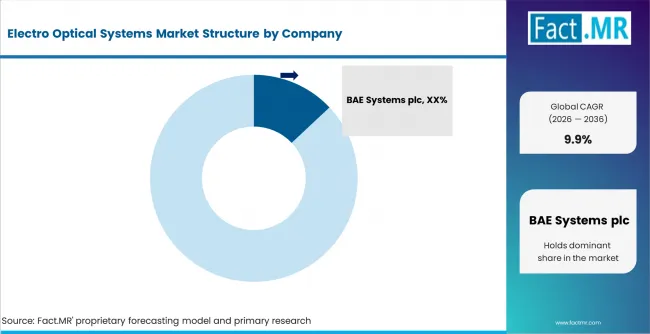
Electro Optical Systems Market Analysis By Company

Competition in the electro optical systems market is increasingly shaped by how well companies can move beyond standalone hardware and deliver integrated, intelligent solutions. Buyers, especially in defence, are no longer looking for individual sensors or imaging units. They want complete systems that combine optics, electronics, software, and analytics into a single operational platform.

Technology integration is a major differentiator. Companies such as Lockheed Martin Corporation and Thales Group are investing heavily in AI-enabled imaging, multi-spectral sensing, and real-time data fusion. These capabilities improve detection accuracy and decision-making speed, which are critical in modern defence environments.

Another key factor is system reliability and field performance. Defence buyers prefer suppliers with proven track records in harsh operating conditions. This gives established players an advantage, as they can demonstrate long-term performance across multiple programmes and geographies.

Supply chain control is also becoming more important. Export restrictions on advanced optical components mean companies need stronger local manufacturing and sourcing strategies. Players that can localise production or secure critical components are better positioned to win government contracts. Customisation and adaptability matter as well. Different countries have unique operational requirements, so suppliers must tailor systems accordingly. Flexible platforms that can be upgraded or reconfigured over time are gaining preference. Finally, long-term partnerships are shaping competition. Vendors that offer lifecycle support, training, and system upgrades are building stronger relationships with customers, leading to repeat contracts and sustained market presence.

Key Players

  • BAE Systems plc
  • Canon Inc.
  • Elbit Systems Ltd.
  • General Dynamics Corporation
  • Hensoldt AG
  • Honeywell International Inc.
  • L3Harris Technologies, Inc.
  • Leonardo S.p.A.
  • Lockheed Martin Corporation
  • MKS Instruments, Inc.
  • Nikon Corporation
  • Northrop Grumman Corporation
  • Opgal Optronic Industries Ltd.
  • QinetiQ Group plc

Bibliography

  • [1] L3Harris Technologies, Inc. (2024). Contract Award: U.S. Army Electro Optical and Infrared Sensor Assembly Programme for Airborne Surveillance Platforms Including CMOS Imaging Module Production at Orlando Facility. l3harris.com/newsroom
  • [2] Elbit Systems Ltd. (2025). Product Launch: Advanced OLED Helmet-Mounted Display Module with Thermal Imaging and Infrared Overlay for Fixed-Wing and Rotary Aircraft Pilot Situational Awareness Applications. elbitsystems.com/news
  • [3] Defence Research and Development Organisation (DRDO). (2024). Programme Announcement: Domestic CMOS Sensor Fabrication Initiative at Solid State Physics Laboratory Delhi for Naval and Land Surveillance System Programmes Under Atmanirbhar Bharat Defence Policy. drdo.gov.in/pressrelease
  • [4] Lockheed Martin Corporation. (2024). Contract Award: U.S. Air Force Electro Optical Targeting Pod Supply for F-16 and F-35 Platforms Including LANTIRN Successor Targeting and Infrared Search-and-Track System Upgrades. lockheedmartin.com/news
  • [5] Canon Medical Systems Corporation. (2025). Product Launch: Aquilion Exceed CT Imaging Platform with Enhanced Optical Sensor Resolution for Hospital Procurement in Japan and Southeast Asia Diagnostic Imaging Applications. medical.canon/news
  • [6] Cognex Corporation. (2024). Annual Report 2024: Machine Vision System Revenue Growth Including EO-Integrated Quality Control Deployment Benchmarks in Semiconductor and Automotive Assembly Lines in Germany, South Korea, and USA. cognex.com/investor-relations
  • [7] Northrop Grumman Corporation. (2024). System Delivery: LITENING Advanced Targeting Pod Upgrade with Wide-Area Imaging and Two-Colour Mid-Wave Infrared Sensor Fusion for U.S. Marine Corps and International Air Force Programmes. northropgrumman.com/news
  • [8] Corning Incorporated. (2024). Facility Investment: North Carolina Optical Fiber Manufacturing Capacity Expansion to Meet Rising Demand from Defence-Grade Fiber Optic Communication and Networking System Integrators. corning.com/media
  • [9] Raytheon Technologies Corporation (RTX). (2024). Contract Award: U.S. Missile Defense Agency Electro Optical Infrared Sensor Integration Contract for Next-Generation Interceptor Programmes Including Kill Vehicle Discrimination Sensors. rtx.com/news
  • [10] Nikon Corporation. (2025). Supply Agreement: Medical Imaging System Procurement Contracts with European National Health System Agencies for High-Resolution Ophthalmic and Surgical Imaging EO Product Lines. nikon.com/news
  • [11] Thales Group. (2024). Partnership Announcement: Fiber Optic Optical Networking System Deployment for Secure Government Communications Infrastructure in UAE and Saudi Arabia Including EO Transceiver and Optical Amplifier Supply. thalesgroup.com/newsroom

This Report Addresses

  • Strategic intelligence across the United States, India, China, Germany, Japan, and Brazil. Covers sensor, display, optical device, processor, and transceiver demand by application and end-user.
  • Market forecast from USD 14.1 billion in 2026 to USD 23.2 billion by 2036 at a CAGR of 9.9%.
  • Opportunity mapping across U.S. DoD EO/IR sensor procurement, India DAC surveillance system approvals, China smart city EO mandates, Germany Bundeswehr targeting system contracts, and NATO member state EO capability gap investments.
  • Segment analysis by component, application, technology, and end-user. Covers global and regional markets with country-level CAGR forecasts.
  • Regional outlook across Asia Pacific, North America, Europe, and Latin America. Focus on defence procurement volumes, surveillance infrastructure investment, and industrial EO adoption trends by country.
  • Competitive analysis of Lockheed Martin, Raytheon Technologies, L3Harris, Elbit Systems, Hensoldt, Thales Group, and Northrop Grumman. Focus on government programme qualification, sensor integration roadmaps, and EO platform partnership strategies.
  • Regulatory analysis covering U.S. ITAR/EAR export control frameworks, NATO EO procurement standards, EU dual-use technology regulations, India DAP defence acquisition guidelines, and China MII smart surveillance mandates.
  • Report delivered in PDF, Excel, and presentation formats. Supported by validated data and expert interviews with defence procurement officers, EO system integrators, and industrial machine vision programme managers.

Electro Optical Systems Market Definition

The electro optical systems market covers sensor, imaging, display, and optical processing equipment that detects, converts, and transmits electromagnetic radiation across visible, infrared, and ultraviolet spectrums.

Electro Optical Systems Market Inclusions

Covers global and regional forecasts from 2026 to 2036 by component, application, technology type, and end-user. Includes sensor assemblies (CCD, CMOS), display modules (LCD, OLED), optical devices, processors, transceivers, and integrated system platforms across defence, aerospace, telecommunications, medical, and industrial verticals.

Electro Optical Systems Market Exclusions

Excludes standalone consumer camera modules and smartphone imaging sensors not integrated into defence or industrial systems. Finished consumer electronics devices, standalone satellite payloads, and radar-only detection platforms are not included.

Electro Optical Systems Market Research Methodology

  • Primary Research
    • Interviews with defence procurement officers, aerospace system integrators, industrial machine vision engineers, medical imaging procurement managers, and electro optical OEM product managers across the United States, India, Germany, China, Japan, and Israel.
  • Desk Research
    • Uses defence ministry procurement disclosures, company annual filings, USPTO and EPO patent data, SIPRI military expenditure reports, NASA and ESA aerospace programme documents, and 2024–2025 electro optical system tender and contract award databases.
  • Market Sizing and Forecasting
    • Hybrid model using EO system OEM revenues, government defence procurement contract values, regional surveillance and aerospace programme budgets, average selling prices by system type and technology, and commercial adoption benchmarks from industrial and medical end-users.
  • Data Validation and Update Cycle
    • Validated using OEM revenue disclosures, defence contract award databases, and national surveillance programme procurement volumes. Supported by expert interviews with system integrators, defence procurement specialists, and industrial automation programme managers.

Scope of Report

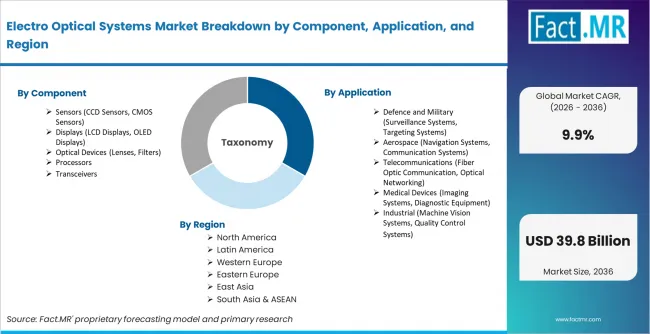
Electro Optical Systems Market Breakdown By Component, Application, And Region

Attribute Details
Quantitative Units USD 14.1 billion (2026) to USD 23.2 billion (2036), at a CAGR of 9.9%
Market Definition Sensor assemblies, imaging systems, optical displays, processors, and transceiver components operating across visible, infrared, and ultraviolet spectrums, deployed globally for defence, aerospace, telecommunications, medical, and industrial applications.
Component Segmentation Sensors (CCD, CMOS), Displays (LCD, OLED), Optical Devices (Lenses, Filters), Processors, Transceivers
Application Segmentation Defence and Military, Aerospace, Telecommunications, Medical Devices, Industrial
Technology Segmentation Laser-Based Systems, Fiber Optic Systems, Imaging Systems, Night Vision Systems
End-User Segmentation Government and Defence, Commercial Enterprises, Healthcare Providers, Telecom Operators
Application Coverage Defence platform EO/IR procurement, aerospace navigation system supply, smart city surveillance deployment, medical imaging procurement, and industrial machine vision quality control.
Regions Covered North America, Europe, Asia Pacific, Latin America, Middle East and Africa
Countries Covered USA, Canada, Mexico, Germany, UK, France, Italy, Spain, Netherlands, Nordic, BENELUX, China, Japan, South Korea, India, ASEAN, Australia and New Zealand, Brazil, Argentina, Colombia, Saudi Arabia, GCC, Turkey, South Africa, Rest of MEA
Key Companies Profiled BAE Systems, Canon Inc., Elbit Systems, General Dynamics, Hensoldt AG, Honeywell, L3Harris Technologies, Leonardo, Lockheed Martin, Northrop Grumman, Raytheon Technologies, Teledyne Technologies, Thales Group, Nikon, Zygo Corporation
Forecast Period 2026 to 2036
Approach Hybrid top-down and bottom-up model using EO system OEM revenues, government defence contract awards, regional surveillance programme budgets, average selling prices by system type, and primary interviews with defence procurement officers and system integrators.

Electro Optical Systems Market By Segment

  • By Component

    • Sensors (CCD Sensors, CMOS Sensors)
    • Displays (LCD Displays, OLED Displays)
    • Optical Devices (Lenses, Filters)
    • Processors
    • Transceivers
  • By Application

    • Defence and Military (Surveillance Systems, Targeting Systems)
    • Aerospace (Navigation Systems, Communication Systems)
    • Telecommunications (Fiber Optic Communication, Optical Networking)
    • Medical Devices (Imaging Systems, Diagnostic Equipment)
    • Industrial (Machine Vision Systems, Quality Control Systems)
  • By Technology

    • Laser-Based Systems
    • Fiber Optic Systems
    • Imaging Systems
    • Night Vision Systems
  • By End-User

    • Government and Defence
    • Commercial Enterprises
    • Healthcare Providers
    • Telecom Operators
  • By Region

    • North America
      • United States
      • Canada
      • Mexico
    • Latin America
      • Brazil
      • Argentina
      • Colombia
      • Rest of Latin America
    • Western Europe
      • Germany
      • United Kingdom
      • France
      • Italy
      • Spain
      • Netherlands
      • Nordic Countries
      • BENELUX
      • Rest of Western Europe
    • Eastern Europe
      • Russia
      • Poland
      • Hungary
      • Balkan and Baltic
      • Rest of Eastern Europe
    • East Asia
      • China
      • Japan
      • South Korea
    • South Asia and Pacific
      • India
      • ASEAN
      • Australia and New Zealand
      • Rest of South Asia and Pacific
    • Middle East and Africa
      • Kingdom of Saudi Arabia
      • Other GCC Countries
      • Turkey
      • South Africa
      • Rest of Middle East and Africa

- Frequently Asked Questions -

How large is the global electro optical systems market in 2025?

The global electro optical systems market was valued at USD 13.4 billion in 2025.

What will the market size be in 2026?

Based on Fact.MR analysis, demand for electro optical systems is estimated to grow to USD 14.1 billion in 2026.

What is the projected market size by 2036?

The market is projected to reach USD 23.2 billion by 2036, generating USD 9.8 billion in absolute dollar opportunity over the forecast period.

What is the expected CAGR from 2026 to 2036?

FACT.MR projects a CAGR of 9.9% for the global electro optical systems market during the 2026 to 2036 forecast period.

Which component segment is poised to lead the market?

Sensors lead with approximately 30% share in 2026, driven by high demand for CCD and CMOS imaging assemblies across defence surveillance, medical diagnostics, and industrial machine vision applications.

Which application segment holds the largest share?

Defence and military dominates with approximately 45% share in 2026, anchored by targeting, surveillance, and reconnaissance system procurement across global military modernisation programmes.

Which technology segment leads the electro optical systems market?

Imaging systems lead with approximately 40% share in 2026, driven by universal demand for real-time visualisation and AI-assisted analytics across defence, healthcare, and industrial sectors.

Which country shows the fastest growth?

India leads at 7.8% CAGR through 2036, driven by defence procurement expansion, CIBMS border surveillance investment, and domestic EO manufacturing policy support.

Who are the key players in the electro optical systems market?

Major players include BAE Systems, Elbit Systems, L3Harris Technologies, Leonardo, Lockheed Martin, Northrop Grumman, Raytheon Technologies, Thales Group, Hensoldt AG, and Teledyne Technologies.

Table of Content

  1. Executive Summary
    • Global Market Outlook
    • Demand to side Trends
    • Supply to side Trends
    • Technology Roadmap Analysis
    • Analysis and Recommendations
  2. Market Overview
    • Market Coverage / Taxonomy
    • Market Definition / Scope / Limitations
  3. Research Methodology
    • Chapter Orientation
    • Analytical Lens and Working Hypotheses
      • Market Structure, Signals, and Trend Drivers
      • Benchmarking and Cross-market Comparability
      • Market Sizing, Forecasting, and Opportunity Mapping
    • Research Design and Evidence Framework
      • Desk Research Programme (Secondary Evidence)
        • Company Annual and Sustainability Reports
        • Peer-reviewed Journals and Academic Literature
        • Corporate Websites, Product Literature, and Technical Notes
        • Earnings Decks and Investor Briefings
        • Statutory Filings and Regulatory Disclosures
        • Technical White Papers and Standards Notes
        • Trade Journals, Industry Magazines, and Analyst Briefs
        • Conference Proceedings, Webinars, and Seminar Materials
        • Government Statistics Portals and Public Data Releases
        • Press Releases and Reputable Media Coverage
        • Specialist Newsletters and Curated Briefings
        • Sector Databases and Reference Repositories
        • Fact.MR Internal Proprietary Databases and Historical Market Datasets
        • Subscription Datasets and Paid Sources
        • Social Channels, Communities, and Digital Listening Inputs
        • Additional Desk Sources
      • Expert Input and Fieldwork (Primary Evidence)
        • Primary Modes
          • Qualitative Interviews and Expert Elicitation
          • Quantitative Surveys and Structured Data Capture
          • Blended Approach
        • Why Primary Evidence is Used
        • Field Techniques
          • Interviews
          • Surveys
          • Focus Groups
          • Observational and In-context Research
          • Social and Community Interactions
        • Stakeholder Universe Engaged
          • C-suite Leaders
          • Board Members
          • Presidents and Vice Presidents
          • R&D and Innovation Heads
          • Technical Specialists
          • Domain Subject-matter Experts
          • Scientists
          • Physicians and Other Healthcare Professionals
        • Governance, Ethics, and Data Stewardship
          • Research Ethics
          • Data Integrity and Handling
      • Tooling, Models, and Reference Databases
    • Data Engineering and Model Build
      • Data Acquisition and Ingestion
      • Cleaning, Normalisation, and Verification
      • Synthesis, Triangulation, and Analysis
    • Quality Assurance and Audit Trail
  4. Market Background
    • Market Dynamics
      • Drivers
      • Restraints
      • Opportunity
      • Trends
    • Scenario Forecast
      • Demand in Optimistic Scenario
      • Demand in Likely Scenario
      • Demand in Conservative Scenario
    • Opportunity Map Analysis
    • Product Life Cycle Analysis
    • Supply Chain Analysis
    • Investment Feasibility Matrix
    • Value Chain Analysis
    • PESTLE and Porter’s Analysis
    • Regulatory Landscape
    • Regional Parent Market Outlook
    • Production and Consumption Statistics
    • Import and Export Statistics
  5. Global Market Analysis 2021 to 2025 and Forecast, 2026 to 2036
    • Historical Market Size Value (USD Million) Analysis, 2021 to 2025
    • Current and Future Market Size Value (USD Million) Projections, 2026 to 2036
      • Y to o to Y Growth Trend Analysis
      • Absolute $ Opportunity Analysis
  6. Global Market Pricing Analysis 2021 to 2025 and Forecast 2026 to 2036
  7. Global Market Analysis 2021 to 2025 and Forecast 2026 to 2036, By Laser Type
    • Introduction / Key Findings
    • Historical Market Size Value (USD Million) Analysis By Laser Type , 2021 to 2025
    • Current and Future Market Size Value (USD Million) Analysis and Forecast By Laser Type , 2026 to 2036
      • Fiber Lasers
      • CO₂ Lasers
      • Solid-State Lasers
    • Y to o to Y Growth Trend Analysis By Laser Type , 2021 to 2025
    • Absolute $ Opportunity Analysis By Laser Type , 2026 to 2036
  8. Global Market Analysis 2021 to 2025 and Forecast 2026 to 2036, By Process
    • Introduction / Key Findings
    • Historical Market Size Value (USD Million) Analysis By Process, 2021 to 2025
    • Current and Future Market Size Value (USD Million) Analysis and Forecast By Process, 2026 to 2036
      • Cutting
      • Welding
      • Marking and Engraving
    • Y to o to Y Growth Trend Analysis By Process, 2021 to 2025
    • Absolute $ Opportunity Analysis By Process, 2026 to 2036
  9. Global Market Analysis 2021 to 2025 and Forecast 2026 to 2036, By Application
    • Introduction / Key Findings
    • Historical Market Size Value (USD Million) Analysis By Application, 2021 to 2025
    • Current and Future Market Size Value (USD Million) Analysis and Forecast By Application, 2026 to 2036
      • Automotive
      • Electronics and Semiconductors
      • Aerospace and Defense
    • Y to o to Y Growth Trend Analysis By Application, 2021 to 2025
    • Absolute $ Opportunity Analysis By Application, 2026 to 2036
  10. Global Market Analysis 2021 to 2025 and Forecast 2026 to 2036, By End Use
    • Introduction / Key Findings
    • Historical Market Size Value (USD Million) Analysis By End Use, 2021 to 2025
    • Current and Future Market Size Value (USD Million) Analysis and Forecast By End Use, 2026 to 2036
      • OEMs
      • Contract Manufacturers
      • Fabrication Shops
    • Y to o to Y Growth Trend Analysis By End Use, 2021 to 2025
    • Absolute $ Opportunity Analysis By End Use, 2026 to 2036
  11. Global Market Analysis 2021 to 2025 and Forecast 2026 to 2036, By Sales Channel
    • Introduction / Key Findings
    • Historical Market Size Value (USD Million) Analysis By Sales Channel, 2021 to 2025
    • Current and Future Market Size Value (USD Million) Analysis and Forecast By Sales Channel, 2026 to 2036
      • Direct Institutional Sales
      • Distributor Sales
      • System Integrator Supply
    • Y to o to Y Growth Trend Analysis By Sales Channel, 2021 to 2025
    • Absolute $ Opportunity Analysis By Sales Channel, 2026 to 2036
  12. Global Market Analysis 2021 to 2025 and Forecast 2026 to 2036, By Region
    • Introduction
    • Historical Market Size Value (USD Million) Analysis By Region, 2021 to 2025
    • Current Market Size Value (USD Million) Analysis and Forecast By Region, 2026 to 2036
      • North America
      • Latin America
      • Western Europe
      • Eastern Europe
      • East Asia
      • South Asia and Pacific
      • Middle East & Africa
    • Market Attractiveness Analysis By Region
  13. North America Market Analysis 2021 to 2025 and Forecast 2026 to 2036, By Country
    • Historical Market Size Value (USD Million) Trend Analysis By Market Taxonomy, 2021 to 2025
    • Market Size Value (USD Million) Forecast By Market Taxonomy, 2026 to 2036
      • By Country
        • USA
        • Canada
        • Mexico
      • By Laser Type
      • By Process
      • By Application
      • By End Use
      • By Sales Channel
    • Market Attractiveness Analysis
      • By Country
      • By Laser Type
      • By Process
      • By Application
      • By End Use
      • By Sales Channel
    • Key Takeaways
  14. Latin America Market Analysis 2021 to 2025 and Forecast 2026 to 2036, By Country
    • Historical Market Size Value (USD Million) Trend Analysis By Market Taxonomy, 2021 to 2025
    • Market Size Value (USD Million) Forecast By Market Taxonomy, 2026 to 2036
      • By Country
        • Brazil
        • Chile
        • Rest of Latin America
      • By Laser Type
      • By Process
      • By Application
      • By End Use
      • By Sales Channel
    • Market Attractiveness Analysis
      • By Country
      • By Laser Type
      • By Process
      • By Application
      • By End Use
      • By Sales Channel
    • Key Takeaways
  15. Western Europe Market Analysis 2021 to 2025 and Forecast 2026 to 2036, By Country
    • Historical Market Size Value (USD Million) Trend Analysis By Market Taxonomy, 2021 to 2025
    • Market Size Value (USD Million) Forecast By Market Taxonomy, 2026 to 2036
      • By Country
        • Germany
        • UK
        • Italy
        • Spain
        • France
        • Nordic
        • BENELUX
        • Rest of Western Europe
      • By Laser Type
      • By Process
      • By Application
      • By End Use
      • By Sales Channel
    • Market Attractiveness Analysis
      • By Country
      • By Laser Type
      • By Process
      • By Application
      • By End Use
      • By Sales Channel
    • Key Takeaways
  16. Eastern Europe Market Analysis 2021 to 2025 and Forecast 2026 to 2036, By Country
    • Historical Market Size Value (USD Million) Trend Analysis By Market Taxonomy, 2021 to 2025
    • Market Size Value (USD Million) Forecast By Market Taxonomy, 2026 to 2036
      • By Country
        • Russia
        • Poland
        • Hungary
        • Balkan & Baltic
        • Rest of Eastern Europe
      • By Laser Type
      • By Process
      • By Application
      • By End Use
      • By Sales Channel
    • Market Attractiveness Analysis
      • By Country
      • By Laser Type
      • By Process
      • By Application
      • By End Use
      • By Sales Channel
    • Key Takeaways
  17. East Asia Market Analysis 2021 to 2025 and Forecast 2026 to 2036, By Country
    • Historical Market Size Value (USD Million) Trend Analysis By Market Taxonomy, 2021 to 2025
    • Market Size Value (USD Million) Forecast By Market Taxonomy, 2026 to 2036
      • By Country
        • China
        • Japan
        • South Korea
      • By Laser Type
      • By Process
      • By Application
      • By End Use
      • By Sales Channel
    • Market Attractiveness Analysis
      • By Country
      • By Laser Type
      • By Process
      • By Application
      • By End Use
      • By Sales Channel
    • Key Takeaways
  18. South Asia and Pacific Market Analysis 2021 to 2025 and Forecast 2026 to 2036, By Country
    • Historical Market Size Value (USD Million) Trend Analysis By Market Taxonomy, 2021 to 2025
    • Market Size Value (USD Million) Forecast By Market Taxonomy, 2026 to 2036
      • By Country
        • India
        • ASEAN
        • Australia & New Zealand
        • Rest of South Asia and Pacific
      • By Laser Type
      • By Process
      • By Application
      • By End Use
      • By Sales Channel
    • Market Attractiveness Analysis
      • By Country
      • By Laser Type
      • By Process
      • By Application
      • By End Use
      • By Sales Channel
    • Key Takeaways
  19. Middle East & Africa Market Analysis 2021 to 2025 and Forecast 2026 to 2036, By Country
    • Historical Market Size Value (USD Million) Trend Analysis By Market Taxonomy, 2021 to 2025
    • Market Size Value (USD Million) Forecast By Market Taxonomy, 2026 to 2036
      • By Country
        • Kingdom of Saudi Arabia
        • Other GCC Countries
        • Turkiye
        • South Africa
        • Other African Union
        • Rest of Middle East & Africa
      • By Laser Type
      • By Process
      • By Application
      • By End Use
      • By Sales Channel
    • Market Attractiveness Analysis
      • By Country
      • By Laser Type
      • By Process
      • By Application
      • By End Use
      • By Sales Channel
    • Key Takeaways
  20. Key Countries Market Analysis
    • USA
      • Pricing Analysis
      • Market Share Analysis, 2025
        • By Laser Type
        • By Process
        • By Application
        • By End Use
        • By Sales Channel
    • Canada
      • Pricing Analysis
      • Market Share Analysis, 2025
        • By Laser Type
        • By Process
        • By Application
        • By End Use
        • By Sales Channel
    • Mexico
      • Pricing Analysis
      • Market Share Analysis, 2025
        • By Laser Type
        • By Process
        • By Application
        • By End Use
        • By Sales Channel
    • Brazil
      • Pricing Analysis
      • Market Share Analysis, 2025
        • By Laser Type
        • By Process
        • By Application
        • By End Use
        • By Sales Channel
    • Chile
      • Pricing Analysis
      • Market Share Analysis, 2025
        • By Laser Type
        • By Process
        • By Application
        • By End Use
        • By Sales Channel
    • Germany
      • Pricing Analysis
      • Market Share Analysis, 2025
        • By Laser Type
        • By Process
        • By Application
        • By End Use
        • By Sales Channel
    • UK
      • Pricing Analysis
      • Market Share Analysis, 2025
        • By Laser Type
        • By Process
        • By Application
        • By End Use
        • By Sales Channel
    • Italy
      • Pricing Analysis
      • Market Share Analysis, 2025
        • By Laser Type
        • By Process
        • By Application
        • By End Use
        • By Sales Channel
    • Spain
      • Pricing Analysis
      • Market Share Analysis, 2025
        • By Laser Type
        • By Process
        • By Application
        • By End Use
        • By Sales Channel
    • France
      • Pricing Analysis
      • Market Share Analysis, 2025
        • By Laser Type
        • By Process
        • By Application
        • By End Use
        • By Sales Channel
    • India
      • Pricing Analysis
      • Market Share Analysis, 2025
        • By Laser Type
        • By Process
        • By Application
        • By End Use
        • By Sales Channel
    • ASEAN
      • Pricing Analysis
      • Market Share Analysis, 2025
        • By Laser Type
        • By Process
        • By Application
        • By End Use
        • By Sales Channel
    • Australia & New Zealand
      • Pricing Analysis
      • Market Share Analysis, 2025
        • By Laser Type
        • By Process
        • By Application
        • By End Use
        • By Sales Channel
    • China
      • Pricing Analysis
      • Market Share Analysis, 2025
        • By Laser Type
        • By Process
        • By Application
        • By End Use
        • By Sales Channel
    • Japan
      • Pricing Analysis
      • Market Share Analysis, 2025
        • By Laser Type
        • By Process
        • By Application
        • By End Use
        • By Sales Channel
    • South Korea
      • Pricing Analysis
      • Market Share Analysis, 2025
        • By Laser Type
        • By Process
        • By Application
        • By End Use
        • By Sales Channel
    • Russia
      • Pricing Analysis
      • Market Share Analysis, 2025
        • By Laser Type
        • By Process
        • By Application
        • By End Use
        • By Sales Channel
    • Poland
      • Pricing Analysis
      • Market Share Analysis, 2025
        • By Laser Type
        • By Process
        • By Application
        • By End Use
        • By Sales Channel
    • Hungary
      • Pricing Analysis
      • Market Share Analysis, 2025
        • By Laser Type
        • By Process
        • By Application
        • By End Use
        • By Sales Channel
    • Kingdom of Saudi Arabia
      • Pricing Analysis
      • Market Share Analysis, 2025
        • By Laser Type
        • By Process
        • By Application
        • By End Use
        • By Sales Channel
    • Turkiye
      • Pricing Analysis
      • Market Share Analysis, 2025
        • By Laser Type
        • By Process
        • By Application
        • By End Use
        • By Sales Channel
    • South Africa
      • Pricing Analysis
      • Market Share Analysis, 2025
        • By Laser Type
        • By Process
        • By Application
        • By End Use
        • By Sales Channel
  21. Market Structure Analysis
    • Competition Dashboard
    • Competition Benchmarking
    • Market Share Analysis of Top Players
      • By Regional
      • By Laser Type
      • By Process
      • By Application
      • By End Use
      • By Sales Channel
  22. Competition Analysis
    • Competition Deep Dive
      • IPG Photonics Corporation
        • Overview
        • Product Portfolio
        • Profitability by Market Segments (Product/Age /Sales Channel/Region)
        • Sales Footprint
        • Strategy Overview
          • Marketing Strategy
          • Product Strategy
          • Channel Strategy
      • TRUMPF SE + Co. KG
      • Coherent Corp.
      • Han’s Laser Technology Industry Group Co., Ltd.
      • Bystronic AG
      • Amada Co., Ltd.
  23. Assumptions & Acronyms Used

List Of Table

  • Table 1: Global Market Value (USD Million) Forecast by Region, 2021 to 2036
  • Table 2: Global Market Value (USD Million) Forecast by Laser Type, 2021 to 2036
  • Table 3: Global Market Value (USD Million) Forecast by Process, 2021 to 2036
  • Table 4: Global Market Value (USD Million) Forecast by Application, 2021 to 2036
  • Table 5: Global Market Value (USD Million) Forecast by End Use, 2021 to 2036
  • Table 6: Global Market Value (USD Million) Forecast by Sales Channel, 2021 to 2036
  • Table 7: North America Market Value (USD Million) Forecast by Country, 2021 to 2036
  • Table 8: North America Market Value (USD Million) Forecast by Laser Type, 2021 to 2036
  • Table 9: North America Market Value (USD Million) Forecast by Process, 2021 to 2036
  • Table 10: North America Market Value (USD Million) Forecast by Application, 2021 to 2036
  • Table 11: North America Market Value (USD Million) Forecast by End Use, 2021 to 2036
  • Table 12: North America Market Value (USD Million) Forecast by Sales Channel, 2021 to 2036
  • Table 13: Latin America Market Value (USD Million) Forecast by Country, 2021 to 2036
  • Table 14: Latin America Market Value (USD Million) Forecast by Laser Type, 2021 to 2036
  • Table 15: Latin America Market Value (USD Million) Forecast by Process, 2021 to 2036
  • Table 16: Latin America Market Value (USD Million) Forecast by Application, 2021 to 2036
  • Table 17: Latin America Market Value (USD Million) Forecast by End Use, 2021 to 2036
  • Table 18: Latin America Market Value (USD Million) Forecast by Sales Channel, 2021 to 2036
  • Table 19: Western Europe Market Value (USD Million) Forecast by Country, 2021 to 2036
  • Table 20: Western Europe Market Value (USD Million) Forecast by Laser Type, 2021 to 2036
  • Table 21: Western Europe Market Value (USD Million) Forecast by Process, 2021 to 2036
  • Table 22: Western Europe Market Value (USD Million) Forecast by Application, 2021 to 2036
  • Table 23: Western Europe Market Value (USD Million) Forecast by End Use, 2021 to 2036
  • Table 24: Western Europe Market Value (USD Million) Forecast by Sales Channel, 2021 to 2036
  • Table 25: Eastern Europe Market Value (USD Million) Forecast by Country, 2021 to 2036
  • Table 26: Eastern Europe Market Value (USD Million) Forecast by Laser Type, 2021 to 2036
  • Table 27: Eastern Europe Market Value (USD Million) Forecast by Process, 2021 to 2036
  • Table 28: Eastern Europe Market Value (USD Million) Forecast by Application, 2021 to 2036
  • Table 29: Eastern Europe Market Value (USD Million) Forecast by End Use, 2021 to 2036
  • Table 30: Eastern Europe Market Value (USD Million) Forecast by Sales Channel, 2021 to 2036
  • Table 31: East Asia Market Value (USD Million) Forecast by Country, 2021 to 2036
  • Table 32: East Asia Market Value (USD Million) Forecast by Laser Type, 2021 to 2036
  • Table 33: East Asia Market Value (USD Million) Forecast by Process, 2021 to 2036
  • Table 34: East Asia Market Value (USD Million) Forecast by Application, 2021 to 2036
  • Table 35: East Asia Market Value (USD Million) Forecast by End Use, 2021 to 2036
  • Table 36: East Asia Market Value (USD Million) Forecast by Sales Channel, 2021 to 2036
  • Table 37: South Asia and Pacific Market Value (USD Million) Forecast by Country, 2021 to 2036
  • Table 38: South Asia and Pacific Market Value (USD Million) Forecast by Laser Type, 2021 to 2036
  • Table 39: South Asia and Pacific Market Value (USD Million) Forecast by Process, 2021 to 2036
  • Table 40: South Asia and Pacific Market Value (USD Million) Forecast by Application, 2021 to 2036
  • Table 41: South Asia and Pacific Market Value (USD Million) Forecast by End Use, 2021 to 2036
  • Table 42: South Asia and Pacific Market Value (USD Million) Forecast by Sales Channel, 2021 to 2036
  • Table 43: Middle East & Africa Market Value (USD Million) Forecast by Country, 2021 to 2036
  • Table 44: Middle East & Africa Market Value (USD Million) Forecast by Laser Type, 2021 to 2036
  • Table 45: Middle East & Africa Market Value (USD Million) Forecast by Process, 2021 to 2036
  • Table 46: Middle East & Africa Market Value (USD Million) Forecast by Application, 2021 to 2036
  • Table 47: Middle East & Africa Market Value (USD Million) Forecast by End Use, 2021 to 2036
  • Table 48: Middle East & Africa Market Value (USD Million) Forecast by Sales Channel, 2021 to 2036

List Of Figures

  • Figure 1: Global Market Pricing Analysis
  • Figure 2: Global Market Value (USD Million) Forecast 2021-2036
  • Figure 3: Global Market Value Share and BPS Analysis by Laser Type, 2026 and 2036
  • Figure 4: Global Market Y-o-Y Growth Comparison by Laser Type, 2026 to 2036
  • Figure 5: Global Market Attractiveness Analysis by Laser Type
  • Figure 6: Global Market Value Share and BPS Analysis by Process, 2026 and 2036
  • Figure 7: Global Market Y-o-Y Growth Comparison by Process, 2026 to 2036
  • Figure 8: Global Market Attractiveness Analysis by Process
  • Figure 9: Global Market Value Share and BPS Analysis by Application, 2026 and 2036
  • Figure 10: Global Market Y-o-Y Growth Comparison by Application, 2026 to 2036
  • Figure 11: Global Market Attractiveness Analysis by Application
  • Figure 12: Global Market Value Share and BPS Analysis by End Use, 2026 and 2036
  • Figure 13: Global Market Y-o-Y Growth Comparison by End Use, 2026 to 2036
  • Figure 14: Global Market Attractiveness Analysis by End Use
  • Figure 15: Global Market Value Share and BPS Analysis by Sales Channel, 2026 and 2036
  • Figure 16: Global Market Y-o-Y Growth Comparison by Sales Channel, 2026 to 2036
  • Figure 17: Global Market Attractiveness Analysis by Sales Channel
  • Figure 18: Global Market Value (USD Million) Share and BPS Analysis by Region, 2026 and 2036
  • Figure 19: Global Market Y-o-Y Growth Comparison by Region, 2026 to 2036
  • Figure 20: Global Market Attractiveness Analysis by Region
  • Figure 21: North America Market Incremental Dollar Opportunity, 2026 to 2036
  • Figure 22: Latin America Market Incremental Dollar Opportunity, 2026 to 2036
  • Figure 23: Western Europe Market Incremental Dollar Opportunity, 2026 to 2036
  • Figure 24: Eastern Europe Market Incremental Dollar Opportunity, 2026 to 2036
  • Figure 25: East Asia Market Incremental Dollar Opportunity, 2026 to 2036
  • Figure 26: South Asia and Pacific Market Incremental Dollar Opportunity, 2026 to 2036
  • Figure 27: Middle East & Africa Market Incremental Dollar Opportunity, 2026 to 2036
  • Figure 28: North America Market Value Share and BPS Analysis by Country, 2026 and 2036
  • Figure 29: North America Market Value Share and BPS Analysis by Laser Type, 2026 and 2036
  • Figure 30: North America Market Y-o-Y Growth Comparison by Laser Type, 2026 to 2036
  • Figure 31: North America Market Attractiveness Analysis by Laser Type
  • Figure 32: North America Market Value Share and BPS Analysis by Process, 2026 and 2036
  • Figure 33: North America Market Y-o-Y Growth Comparison by Process, 2026 to 2036
  • Figure 34: North America Market Attractiveness Analysis by Process
  • Figure 35: North America Market Value Share and BPS Analysis by Application, 2026 and 2036
  • Figure 36: North America Market Y-o-Y Growth Comparison by Application, 2026 to 2036
  • Figure 37: North America Market Attractiveness Analysis by Application
  • Figure 38: North America Market Value Share and BPS Analysis by End Use, 2026 and 2036
  • Figure 39: North America Market Y-o-Y Growth Comparison by End Use, 2026 to 2036
  • Figure 40: North America Market Attractiveness Analysis by End Use
  • Figure 41: North America Market Value Share and BPS Analysis by Sales Channel, 2026 and 2036
  • Figure 42: North America Market Y-o-Y Growth Comparison by Sales Channel, 2026 to 2036
  • Figure 43: North America Market Attractiveness Analysis by Sales Channel
  • Figure 44: Latin America Market Value Share and BPS Analysis by Country, 2026 and 2036
  • Figure 45: Latin America Market Value Share and BPS Analysis by Laser Type, 2026 and 2036
  • Figure 46: Latin America Market Y-o-Y Growth Comparison by Laser Type, 2026 to 2036
  • Figure 47: Latin America Market Attractiveness Analysis by Laser Type
  • Figure 48: Latin America Market Value Share and BPS Analysis by Process, 2026 and 2036
  • Figure 49: Latin America Market Y-o-Y Growth Comparison by Process, 2026 to 2036
  • Figure 50: Latin America Market Attractiveness Analysis by Process
  • Figure 51: Latin America Market Value Share and BPS Analysis by Application, 2026 and 2036
  • Figure 52: Latin America Market Y-o-Y Growth Comparison by Application, 2026 to 2036
  • Figure 53: Latin America Market Attractiveness Analysis by Application
  • Figure 54: Latin America Market Value Share and BPS Analysis by End Use, 2026 and 2036
  • Figure 55: Latin America Market Y-o-Y Growth Comparison by End Use, 2026 to 2036
  • Figure 56: Latin America Market Attractiveness Analysis by End Use
  • Figure 57: Latin America Market Value Share and BPS Analysis by Sales Channel, 2026 and 2036
  • Figure 58: Latin America Market Y-o-Y Growth Comparison by Sales Channel, 2026 to 2036
  • Figure 59: Latin America Market Attractiveness Analysis by Sales Channel
  • Figure 60: Western Europe Market Value Share and BPS Analysis by Country, 2026 and 2036
  • Figure 61: Western Europe Market Value Share and BPS Analysis by Laser Type, 2026 and 2036
  • Figure 62: Western Europe Market Y-o-Y Growth Comparison by Laser Type, 2026 to 2036
  • Figure 63: Western Europe Market Attractiveness Analysis by Laser Type
  • Figure 64: Western Europe Market Value Share and BPS Analysis by Process, 2026 and 2036
  • Figure 65: Western Europe Market Y-o-Y Growth Comparison by Process, 2026 to 2036
  • Figure 66: Western Europe Market Attractiveness Analysis by Process
  • Figure 67: Western Europe Market Value Share and BPS Analysis by Application, 2026 and 2036
  • Figure 68: Western Europe Market Y-o-Y Growth Comparison by Application, 2026 to 2036
  • Figure 69: Western Europe Market Attractiveness Analysis by Application
  • Figure 70: Western Europe Market Value Share and BPS Analysis by End Use, 2026 and 2036
  • Figure 71: Western Europe Market Y-o-Y Growth Comparison by End Use, 2026 to 2036
  • Figure 72: Western Europe Market Attractiveness Analysis by End Use
  • Figure 73: Western Europe Market Value Share and BPS Analysis by Sales Channel, 2026 and 2036
  • Figure 74: Western Europe Market Y-o-Y Growth Comparison by Sales Channel, 2026 to 2036
  • Figure 75: Western Europe Market Attractiveness Analysis by Sales Channel
  • Figure 76: Eastern Europe Market Value Share and BPS Analysis by Country, 2026 and 2036
  • Figure 77: Eastern Europe Market Value Share and BPS Analysis by Laser Type, 2026 and 2036
  • Figure 78: Eastern Europe Market Y-o-Y Growth Comparison by Laser Type, 2026 to 2036
  • Figure 79: Eastern Europe Market Attractiveness Analysis by Laser Type
  • Figure 80: Eastern Europe Market Value Share and BPS Analysis by Process, 2026 and 2036
  • Figure 81: Eastern Europe Market Y-o-Y Growth Comparison by Process, 2026 to 2036
  • Figure 82: Eastern Europe Market Attractiveness Analysis by Process
  • Figure 83: Eastern Europe Market Value Share and BPS Analysis by Application, 2026 and 2036
  • Figure 84: Eastern Europe Market Y-o-Y Growth Comparison by Application, 2026 to 2036
  • Figure 85: Eastern Europe Market Attractiveness Analysis by Application
  • Figure 86: Eastern Europe Market Value Share and BPS Analysis by End Use, 2026 and 2036
  • Figure 87: Eastern Europe Market Y-o-Y Growth Comparison by End Use, 2026 to 2036
  • Figure 88: Eastern Europe Market Attractiveness Analysis by End Use
  • Figure 89: Eastern Europe Market Value Share and BPS Analysis by Sales Channel, 2026 and 2036
  • Figure 90: Eastern Europe Market Y-o-Y Growth Comparison by Sales Channel, 2026 to 2036
  • Figure 91: Eastern Europe Market Attractiveness Analysis by Sales Channel
  • Figure 92: East Asia Market Value Share and BPS Analysis by Country, 2026 and 2036
  • Figure 93: East Asia Market Value Share and BPS Analysis by Laser Type, 2026 and 2036
  • Figure 94: East Asia Market Y-o-Y Growth Comparison by Laser Type, 2026 to 2036
  • Figure 95: East Asia Market Attractiveness Analysis by Laser Type
  • Figure 96: East Asia Market Value Share and BPS Analysis by Process, 2026 and 2036
  • Figure 97: East Asia Market Y-o-Y Growth Comparison by Process, 2026 to 2036
  • Figure 98: East Asia Market Attractiveness Analysis by Process
  • Figure 99: East Asia Market Value Share and BPS Analysis by Application, 2026 and 2036
  • Figure 100: East Asia Market Y-o-Y Growth Comparison by Application, 2026 to 2036
  • Figure 101: East Asia Market Attractiveness Analysis by Application
  • Figure 102: East Asia Market Value Share and BPS Analysis by End Use, 2026 and 2036
  • Figure 103: East Asia Market Y-o-Y Growth Comparison by End Use, 2026 to 2036
  • Figure 104: East Asia Market Attractiveness Analysis by End Use
  • Figure 105: East Asia Market Value Share and BPS Analysis by Sales Channel, 2026 and 2036
  • Figure 106: East Asia Market Y-o-Y Growth Comparison by Sales Channel, 2026 to 2036
  • Figure 107: East Asia Market Attractiveness Analysis by Sales Channel
  • Figure 108: South Asia and Pacific Market Value Share and BPS Analysis by Country, 2026 and 2036
  • Figure 109: South Asia and Pacific Market Value Share and BPS Analysis by Laser Type, 2026 and 2036
  • Figure 110: South Asia and Pacific Market Y-o-Y Growth Comparison by Laser Type, 2026 to 2036
  • Figure 111: South Asia and Pacific Market Attractiveness Analysis by Laser Type
  • Figure 112: South Asia and Pacific Market Value Share and BPS Analysis by Process, 2026 and 2036
  • Figure 113: South Asia and Pacific Market Y-o-Y Growth Comparison by Process, 2026 to 2036
  • Figure 114: South Asia and Pacific Market Attractiveness Analysis by Process
  • Figure 115: South Asia and Pacific Market Value Share and BPS Analysis by Application, 2026 and 2036
  • Figure 116: South Asia and Pacific Market Y-o-Y Growth Comparison by Application, 2026 to 2036
  • Figure 117: South Asia and Pacific Market Attractiveness Analysis by Application
  • Figure 118: South Asia and Pacific Market Value Share and BPS Analysis by End Use, 2026 and 2036
  • Figure 119: South Asia and Pacific Market Y-o-Y Growth Comparison by End Use, 2026 to 2036
  • Figure 120: South Asia and Pacific Market Attractiveness Analysis by End Use
  • Figure 121: South Asia and Pacific Market Value Share and BPS Analysis by Sales Channel, 2026 and 2036
  • Figure 122: South Asia and Pacific Market Y-o-Y Growth Comparison by Sales Channel, 2026 to 2036
  • Figure 123: South Asia and Pacific Market Attractiveness Analysis by Sales Channel
  • Figure 124: Middle East & Africa Market Value Share and BPS Analysis by Country, 2026 and 2036
  • Figure 125: Middle East & Africa Market Value Share and BPS Analysis by Laser Type, 2026 and 2036
  • Figure 126: Middle East & Africa Market Y-o-Y Growth Comparison by Laser Type, 2026 to 2036
  • Figure 127: Middle East & Africa Market Attractiveness Analysis by Laser Type
  • Figure 128: Middle East & Africa Market Value Share and BPS Analysis by Process, 2026 and 2036
  • Figure 129: Middle East & Africa Market Y-o-Y Growth Comparison by Process, 2026 to 2036
  • Figure 130: Middle East & Africa Market Attractiveness Analysis by Process
  • Figure 131: Middle East & Africa Market Value Share and BPS Analysis by Application, 2026 and 2036
  • Figure 132: Middle East & Africa Market Y-o-Y Growth Comparison by Application, 2026 to 2036
  • Figure 133: Middle East & Africa Market Attractiveness Analysis by Application
  • Figure 134: Middle East & Africa Market Value Share and BPS Analysis by End Use, 2026 and 2036
  • Figure 135: Middle East & Africa Market Y-o-Y Growth Comparison by End Use, 2026 to 2036
  • Figure 136: Middle East & Africa Market Attractiveness Analysis by End Use
  • Figure 137: Middle East & Africa Market Value Share and BPS Analysis by Sales Channel, 2026 and 2036
  • Figure 138: Middle East & Africa Market Y-o-Y Growth Comparison by Sales Channel, 2026 to 2036
  • Figure 139: Middle East & Africa Market Attractiveness Analysis by Sales Channel
  • Figure 140: Global Market - Tier Structure Analysis
  • Figure 141: Global Market - Company Share Analysis

Electro Optical Systems Market