- Market Value (2025): USD 1.9 Bn
- Estimated Value (2026): USD 2.1 Bn
- Forecast Value (2036): USD 4.7 Bn
- CAGR (2026-2036): 8.5%
What is the Pet Sitting Services Market forecast to be worth by 2036?
USD 2.1 billion in 2026 to USD 4.7 billion by 2036 at an 8.5% CAGR.
- The Pet Sitting Services Market crossed a valuation of USD 1.9 billion in 2025.
- Demand is projected to increase from USD 2.1 billion in 2026 to USD 4.7 billion by 2036.
- The market is forecast to record 8.5% CAGR from 2026 to 2036 as pet owners use scheduled visits for workdays, trips and recurring animal routines.
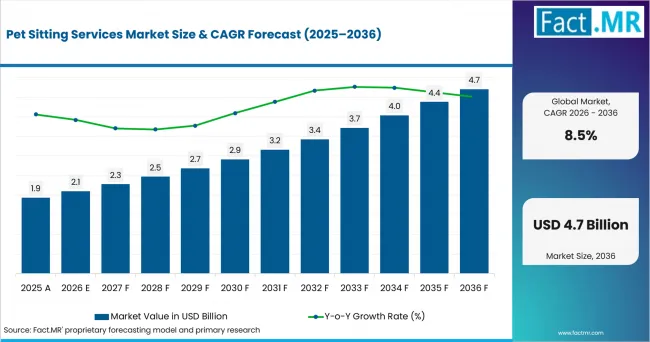
Pet Sitting Services Market Value Analysis | Source: Fact.MR
What are the defining numbers behind Pet Sitting Services Market growth?
USD 2.6 billion absolute opportunity by 2036, led by in-home pet sitting, companion dog care and online service platforms.
- Demand Drivers in the Market
- Dog owners need reliable daily visits when workdays or travel leave animals at home for longer periods.
- The American Pet Products Association stated in March 2026 that 95 million U.S. households owned at least one pet in 2025.
- Cat owners value in-home care because feeding, litter cleaning and medication routines stay inside a familiar setting.
- Individual pet owners use sitter profiles, reviews and booking records to reduce trust gaps before granting home access.
- Service platforms improve repeat booking by pairing schedule visibility with payments, reminders and post-visit updates.
- Key Segments Analyzed
- By Product: In-Home Pet Sitting Services is expected to hold 52.80% share in 2026 because owners prefer feeding, walking and basic companionship inside the animal's usual environment.
- By Application: Companion Dog Care is projected to account for 68.70% share in 2026 as dogs need scheduled outdoor time and direct interaction during owner absence.
- By End Use: Individual Pet Owners are anticipated to capture 74.10% share in 2026 since household owners make most sitting decisions and pay directly for visits.
- By Technology: Digital Booking Platforms are estimated to represent 37.50% share in 2026 owing to searchable profiles, calendars and messaging that shorten the path to confirmed care.
- By Formulation: Subscription Service Models are forecast to hold 63.90% share in 2026 where weekly and monthly plans reduce repeated search effort for recurring care.
- By Distribution Channel: Online Service Platforms are projected to account for 79.40% share in 2026, supported by local comparison, booking and payment in one buying path.
- Analyst Opinion at Fact.MR
- Shambhu Nath Jha, Principal Consultant at Fact.MR, states, “Pet sitting is a trust business before it is a booking business. Owners want proof that the caregiver understands the animal and reaches the home on time. Platforms are expected to gain where they combine verified caregiver supply, repeat scheduling and clear owner updates.”
- Strategic Implications
- Agencies should document sitter screening, visit records and escalation steps so owners understand how safety is managed.
- Marketplace platforms should show sitter availability, service boundaries and response speed before payment.
- Service providers should make sitter vetting, access rules and visit updates visible inside booking flows because home access is the highest-trust step.
- Franchise operators should train caregivers on pet handling, home-entry rules and owner communication before scaling local territories.
- Providers should design recurring plans around work travel, weekend trips and medical routines that need consistent visits.
The USA is projected to record 8.3% CAGR through 2036 as pet ownership scale supports formal sitter use. The UK is anticipated to post 8.2% CAGR because hybrid work keeps weekly care routines uneven. Japan is estimated to reach 8.1% CAGR, driven by dense households and cat-care needs. South Korea is forecast to advance at 7.6% CAGR through mobile booking habits and companion-animal household formation. Germany is expected to record 6.8% CAGR with local service demand and high single-person household numbers.
How does the Pet Sitting Services Market break down by segment?
In-home pet sitting services lead at 52.80%; online service platforms lead at 79.40%.
Which Product dominates?
In-Home Pet Sitting Services holds 52.8% share in 2026.
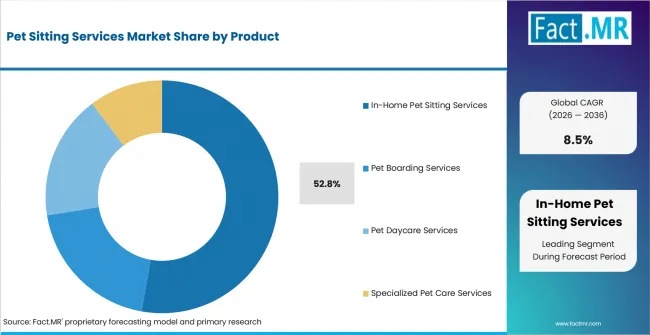
Pet Sitting Services Market Analysis By Product | Source: Fact.MR
In-home pet sitting leads because many owners prefer care in the animal's familiar space. Visits usually cover feeding, walks, litter cleaning, medication reminders and basic companionship during owner absence.
What leads the Application segment?
Companion Dog Care holds 68.7% share in 2026.
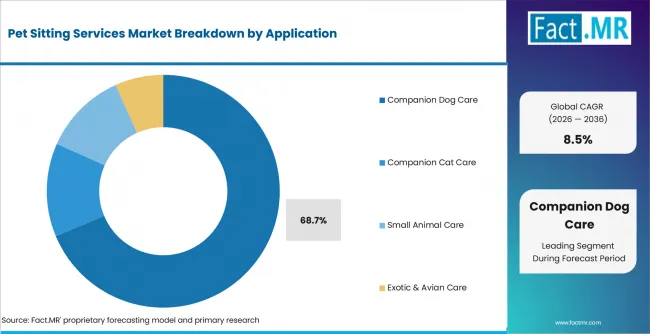
Pet Sitting Services Market Analysis By Application | Source: Fact.MR
Companion dog care accounts for the largest application share because dogs often need walks and direct interaction at fixed times. Routine care helps households maintain feeding schedules and behavior patterns.
Cat care remains relevant for feeding, litter maintenance and medication support. Small animal care stays more specialist due to handling needs.
How does End Use shape demand?
Individual Pet Owners hold 74.1% share in 2026.
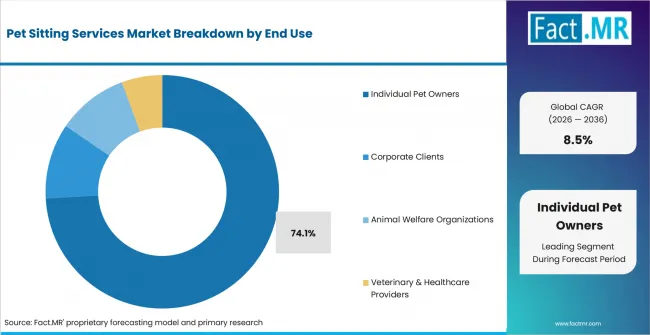
Pet Sitting Services Market Analysis By End Use | Source: Fact.MR
Individual pet owners lead spending because sitting decisions are usually made at the household level. Urban and suburban households use services for office days, short trips and vacation periods.
Corporate clients and welfare groups form smaller demand pools. Their needs usually involve employee benefits, rescue care or referral arrangements.
What supports Technology demand?
Digital Booking Platforms hold 37.5% share in 2026.
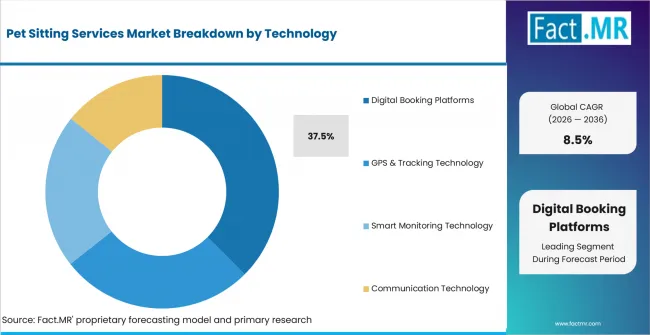
Pet Sitting Services Market Analysis By Technology | Source: Fact.MR
Digital booking platforms lead technology use because they combine search, calendars, messaging and payment. Owners want a clear record when sitters enter the home or manage animals alone.
GPS and video monitoring add value for walks and longer visits. Owners often judge quality through updates received during absence.
Which Formulation leads?
Subscription Service Models hold 63.9% share in 2026.
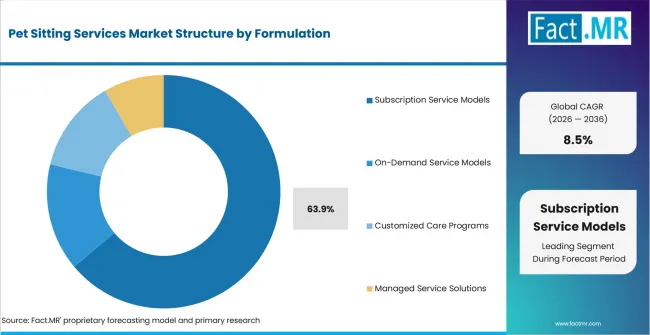
Pet Sitting Services Market Analysis By Formulation | Source: Fact.MR
Subscription service models lead because households need regular visits around workdays or recurring travel. Weekly and monthly plans reduce repeated search effort and help agencies schedule caregiver hours.
On-demand models remain useful for emergencies and one-time trips. Customized programs fit aging or anxious pets.
What leads Distribution Channel?
Online Service Platforms hold 79.4% share in 2026.
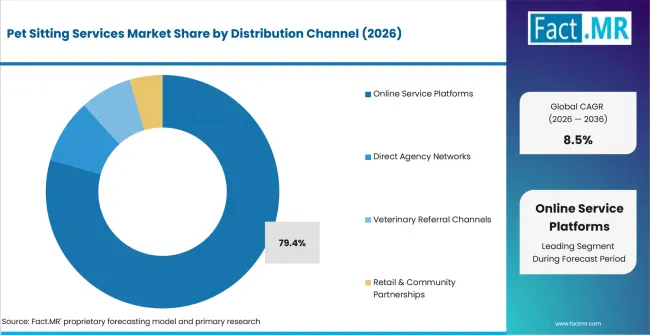
Pet Sitting Services Market Analysis By Distribution Channel | Source: Fact.MR
Online service platforms lead distribution because owners often begin local service searches online. Marketplaces and company portals make comparison easier than phone-based agency discovery.
Dedicated marketplaces offer search filters, reviews and service records. Direct agency networks retain value where owners prefer local offices.
What is accelerating Pet Sitting Services Market adoption, and what is holding it back?
Demand is expected to rise through pet ownership, digital booking and recurring care routines. Adoption is constrained by trust, licensing and caregiver availability.
Drivers Impact Analysis
| DRIVER | (~) % IMPACT ON CAGR | GEOGRAPHIC RELEVANCE | IMPACT TIMELINE |
|---|---|---|---|
| Pet ownership and household companion-animal care needs | +1.5% | North America, Europe, East Asia | Short term (<= 2 years) |
| Digital booking and payment platforms for sitter discovery | +1.2% | Global | Medium term (2-4 years) |
| Recurring workday and travel-related visit requirements | +0.9% | North America, Western Europe | Medium term (2-4 years) |
| Specialized care for senior pets and animals needing medication | +0.7% | North America, East Asia | Long term (>= 4 years) |
Source: Fact.MR analysis. Updated Sep 2, 2026
- Pet ownership and household care needs: A broad base of dogs and cats is expected to create regular service occasions when owners need feeding, walks or supervision.
- Digital booking and payment platforms: Online search is projected to reduce friction by showing sitter profiles, calendars and service options before payment.
- Recurring workday and travel requirements: Repeat visits are anticipated to help owners maintain routines while keeping pets inside familiar settings.
- Specialized care needs: Older pets and animals needing medication are expected to raise the value of caregivers who follow written instructions.
Opportunity Impact Analysis
| OPPORTUNITY | (~) % IMPACT ON CAGR | GEOGRAPHIC RELEVANCE | IMPACT TIMELINE |
|---|---|---|---|
| Verified sitter networks with documented safety practices | +1.0% | Global | Short term (<= 2 years) |
| Subscription plans for weekly and monthly care | +0.8% | North America, Europe | Medium term (2-4 years) |
| Pet wellness links with grooming, diagnostics and veterinary referrals | +0.6% | North America, East Asia | Long term (>= 4 years) |
Source: Fact.MR analysis. Updated Sep 2, 2026
- Verified sitter networks: Agencies are expected to improve conversion when screening steps and visit records are visible before the owner pays.
- Subscription plans: Weekly and monthly arrangements are projected to reduce booking repetition and create steadier schedules for caregiver allocation.
- Pet wellness links: Sitting providers are anticipated to coordinate better with grooming, diagnostics and veterinary referrals when pets need broader care.
Restraints Impact Analysis
| RESTRAINT | (~) % IMPACT ON CAGR | GEOGRAPHIC RELEVANCE | IMPACT TIMELINE |
|---|---|---|---|
| Trust and home-access concerns among pet owners | -0.6% | Global | Short term (<= 2 years) |
| Local licensing and animal welfare compliance | -0.5% | Europe, North America | Medium term (2-4 years) |
| Caregiver supply, training and weekend staffing pressure | -0.4% | Global | Long term (>= 4 years) |
Source: Fact.MR analysis. Updated Sep 2, 2026
- Trust and home-access concerns: Pet owners may delay first bookings when caregiver screening, insurance coverage, identity verification, and visit records are unclear. Transparent booking procedures and documented care updates can help service providers build confidence before entering customers’ homes.
- Local licensing and welfare compliance: Pet-care providers need to understand the licensing and welfare requirements that apply to different service models. Clear separation between home boarding and in-home pet-sitting activities helps businesses structure services correctly and maintain compliance with local animal-welfare rules.
- Caregiver supply and training: Weekend, evening, and holiday demand can create staffing pressure for agencies that need dependable local coverage. Recruiting trained caregivers, maintaining service standards, and coordinating schedules are therefore important for delivering consistent pet-sitting services during peak periods.
Which countries are scaling the Pet Sitting Services Market through 2036?
- The country comparison spans 1.5 percentage points between the USA and Germany.
- The USA remains 0.1 percentage point above the UK as pet ownership scale and animal-care labor depth support paid sitter use.
- The UK remains 0.1 percentage point above Japan as hybrid work and pet ownership sustain weekly care needs.
- Japan remains 0.5 percentage point above South Korea because compact households favor short in-home visits.
- South Korea remains 0.8 percentage point above Germany as companion-animal households and mobile booking behavior widen service access.
- Germany closes the displayed range while single-person households and local agencies support stable repeat demand.
Entry conditions differ because pet ownership, work routines, local licensing and sitter density vary by country. Full report coverage includes North America, Latin America, Western Europe, Eastern Europe, East Asia, South Asia & Pacific, Middle East & Africa.
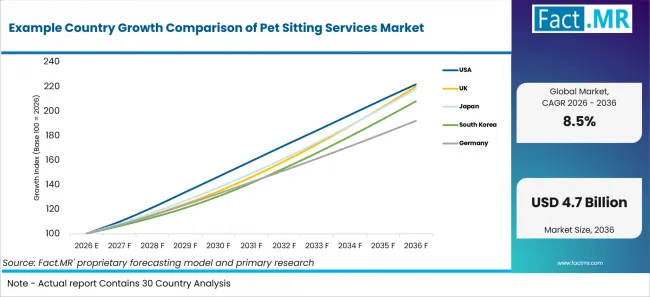
Example Country Growth Comparison Of Pet Sitting Services Market | Source: Fact.MR
| Country | CAGR (2026-2036) |
|---|---|
| USA | 8.3% |
| UK | 8.2% |
| Japan | 8.1% |
| South Korea | 7.6% |
| Germany | 6.8% |
Source: Fact.MR analysis. Updated Sep 2, 2026
What supports USA adoption?
8.3% CAGR, supported by pet-owning household scale and scheduled in-home care.
The U.S. Bureau of Labor Statistics projects about 69,400 openings for animal care and service workers each year, on average, from 2025 to 2035, alongside 11% employment growth over the decade. BLS states that employment growth is expected as more households include companion pets and pet owners continue to demonstrate willingness to pay more for pet care.
What supports UK adoption?
8.2% CAGR, led by hybrid work patterns and formal pet-care rules.
ONS reported on June 11, 2025, that 28% of working adults in Great Britain hybrid worked between January 8 and March 30, 2025. The work-pattern statistic provides context for variable weekday schedules, while pet-sitting demand remains a separate market assessment.
How does Japan perform?
8.1% CAGR, backed by compact households and short in-home visits.
The Statistics Bureau of Japan reported 57.125 million households in the preliminary 2025 Population Census counts, with 2.15 persons per household. These figures provide current evidence on Japan's household structure for the country assessment.
How is South Korea scaling demand?
7.6% CAGR, driven by companion-animal households and mobile-first booking.
MAFRA reported on February 12, 2026, that 29.2% of households directly raised companion animals at their current residence in 2025. The officially approved survey provides a current measure of companion-animal-owning households for the country assessment.
What supports Germany adoption?
6.8% CAGR, supported by single-person households and stable local service coverage.
Destatis’ 2025 Microcensus first results record 17.327 million people living alone in Germany. The statistic provides current evidence on the scale of single-person households for the country assessment.
Who leads the Pet Sitting Services Market?
Service platforms, franchise networks and local agencies lead through caregiver trust and booking convenience.
Competition spans online care marketplaces, franchise day care networks, local agencies and specialist sitters. Care.com covers pet care within a broader family-care marketplace, while Fetch! Pet Care use networked local service models.
Which companies are the key providers?
Key companies include Care.com, Fetch! Pet Care, First Class Pet Sitting Services, HouseCarers, and Petpals (UK) Limited.
- Care.com
- Fetch! Pet Care
- First Class Pet Sitting Services
- HouseCarers
- Petpals (UK) Limited
Bibliography
- American Pet Products Association. (2026, March 26). U.S. pet industry reaches $158 billion in 2025, poised for continued growth in 2026.
- U.S. Bureau of Labor Statistics. (2026, August 27). Animal care and service workers. Occupational Outlook Handbook.
- Care.com. (2025, June 2). Care.com debuts bold new look and enhanced product experience, unlocking the brand’s next chapter.
- Department for Environment, Food & Rural Affairs. (2026, June 1). Home boarding for dogs licensing: Statutory guidance for local authorities.
- Office for National Statistics. (2025, June 11). Who has access to hybrid work in Great Britain?
- Statistics Bureau of Japan. (2026, May 29). Preliminary counts of the population and households: 2025 Population Census.
- Federal Statistical Office (Destatis). (2026, April 13). Unattached people (including people living alone).
This Report Answers
- The report explains where pet sitting services are used across product, application, end use, technology, formulation and distribution channel.
- Segment analysis identifies the leading subsegments and the practical reasons pet owners choose them.
- Country analysis examines the listed markets and the household, labor, digital and regulatory conditions supporting service adoption.
- Competitive analysis reviews service providers across marketplace, franchise, agency and local specialist models.
- Application analysis assesses how companion dog care, cat care and specialized animal needs influence booking decisions.
What does the Pet Sitting Services Market cover?
The Pet Sitting Services Market covers paid services that look after companion animals during owner absence. It includes in-home visits, overnight sitting, boarding, daycare and specialized care. The scope sits next to pet grooming services and pet wellness services because owners often buy these services as part of a broader care routine.
The assessment covers booking models, technology tools and service channels used by owners, corporate clients and animal welfare organizations. It also considers care handoffs linked with companion animal diagnostics and pet dental health during owner absence.
What is included in the scope?
The scope includes licensed or professionally arranged pet sitting, home boarding, daycare and visit-based services. It also includes marketplaces, agency networks and subscription plans. Related paths include senior pet care services and mobile grooming services around the home.
It includes online service platforms, company-owned booking portals, direct local agencies and referral channels. Adjacent signals from direct-to-customer pet food, pet functional food toppers and pet at home diagnostic tests are reviewed only where they explain the broader care setting.
What is excluded from the scope?
The scope excludes veterinary treatment, pet food manufacturing, pet product retailing and unpaid informal help from friends or family. It also excludes pure grooming, diagnostics or wellness services outside sitting, boarding, daycare or visit-based care.
Pet transportation, emergency veterinary care and pet insurance are outside scope except when bundled into a defined service. General household services sit outside scope when animal-care tasks are absent.
How Was the Analysis Built?
The analysis draws on 120+ sources, 35+ company portfolios, 25+ countries and more than 20 industry interviews.
- Primary Research: Interviews cover service providers, platforms, agencies, caregivers and pet owners. Discussions examine booking behavior, care routines and trust requirements.
- Desk Research: Desk research covers government statistics, regulations, company announcements, ownership surveys, employment data and associations.
- Market Sizing and Forecasting: Estimates combine historical performance, service frequency, channel mix, segment shares, country growth and adoption barriers.
- Data Validation and Update Cycle: Findings are checked against public data, company activity, regulations and service developments. Updates review platform features and agency expansion.
Segmentation
What is the report’s scope and coverage?
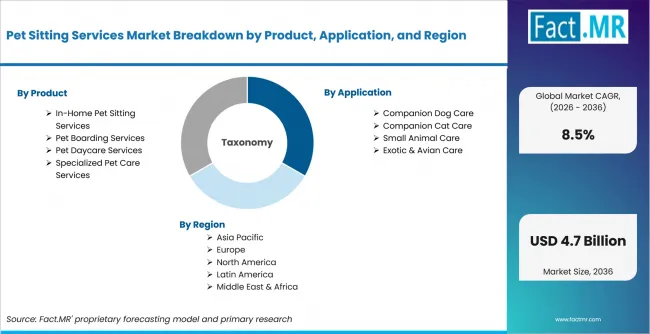
Pet Sitting Services Market Breakdown By Product, Application, And Region | Source: Fact.MR
| Attribute | Details |
|---|---|
| Quantitative Units | USD billion |
| Market Definition | Paid services that care for companion animals during owner absence, including in-home visits, overnight care, boarding, daycare and specialized pet care. |
| Product | In-Home Pet Sitting Services, Pet Boarding Services, Pet Daycare Services, and Specialized Pet Care Services |
| Application | Companion Dog Care, Companion Cat Care, Small Animal Care, and Exotic & Avian Care |
| End Use | Individual Pet Owners, Corporate Clients, Animal Welfare Organizations, and Veterinary & Healthcare Providers |
| Technology | Digital Booking Platforms, GPS & Tracking Technology, Smart Monitoring Technology, and Communication Technology |
| Formulation | Subscription Service Models, On-Demand Service Models, Customized Care Programs, and Managed Service Solutions |
| Distribution Channel | Online Service Platforms, Direct Agency Networks, Veterinary Referral Channels, and Retail & Community Partnerships |
| Regions Covered | North America; Latin America; Western Europe; Eastern Europe; East Asia; South Asia & Pacific; Middle East & Africa |
| Countries Covered | USA; UK; Japan; South Korea; Germany |
| Key Companies Profiled | Care.com, Fetch! Pet Care, First Class Pet Sitting Services, HouseCarers, and Petpals (UK) Limited. |
| Forecast Period | 2026 to 2036 |
| Approach | Hybrid top-down and bottom-up approach using service frequency, booking-channel mix, household ownership, caregiver supply, country adoption and provider portfolio review. |
Source: Fact.MR analysis. Updated Sep 2, 2026
How is the market segmented?
-
By Product
- In-Home Pet Sitting Services
- Daily Visit Services
- Overnight Care Services
- Pet Boarding Services
- Home Boarding Services
- Facility Boarding Services
- Pet Daycare Services
- Half-Day Daycare
- Full-Day Daycare
- Specialized Pet Care Services
- Medical Support Services
- Behavioral Support Services
- In-Home Pet Sitting Services
-
By Application
- Companion Dog Care
- Routine Care Services
- Extended Care Services
- Companion Cat Care
- Basic Home Care
- Extended Stay Care
- Small Animal Care
- Rodent Care Services
- Rabbit Care Services
- Exotic & Avian Care
- Bird Care Services
- Exotic Animal Services
- Companion Dog Care
-
By End Use
- Individual Pet Owners
- Urban Households
- Suburban Households
- Corporate Clients
- Employee Benefit Programs
- Hospitality Partnerships
- Animal Welfare Organizations
- Rescue Organizations
- Shelter Facilities
- Veterinary & Healthcare Providers
- Veterinary Clinics
- Animal Hospitals
- Individual Pet Owners
-
By Technology
- Digital Booking Platforms
- Web-Based Booking Systems
- Mobile Booking Applications
- GPS & Tracking Technology
- Live Location Systems
- Geofencing Solutions
- Smart Monitoring Technology
- Video Monitoring Systems
- Sensor-Based Monitoring
- Communication Technology
- Client Notification Systems
- AI-Assisted Communication
- Digital Booking Platforms
-
By Formulation
- Subscription Service Models
- Recurring Weekly Plans
- Recurring Monthly Plans
- On-Demand Service Models
- Instant Booking Services
- Scheduled Booking Services
- Customized Care Programs
- Personalized Care Plans
- Lifestyle Care Plans
- Managed Service Solutions
- Agency Managed Programs
- Franchise Managed Programs
- Subscription Service Models
-
By Distribution Channel
- Online Service Platforms
- Dedicated Pet Care Marketplaces
- Company-Owned Platforms
- Direct Agency Networks
- Local Agency Offices
- National Agency Networks
- Veterinary Referral Channels
- Clinic Referral Programs
- Hospital Referral Programs
- Retail & Community Partnerships
- Pet Store Partnerships
- Community Referral Networks
- Online Service Platforms
-
By Region
- North America
- Latin America
- Western Europe
- Eastern Europe
- East Asia
- South Asia & Pacific
- Middle East & Africa
Frequently Asked Questions
How big is the pet sitting services market in 2026?
What is the CAGR of the pet sitting services market from 2026 to 2036?
Which product leads the pet sitting services market?
Which application leads the pet sitting services market?
Who are the leading companies in the pet sitting services market?
Who worked on this report


Preview the report firsthand - request a free sample
Free SampleGet the brochure for pricing and purchase details
Download PDF