- Market Value (2025): USD 242.8 Mn
- Estimated Value (2026): USD 268.0 Mn
- Forecast Value (2036): USD 720.0 Mn
- CAGR (2026-2036): 10.4%
What is the Electrochemical Reactor Skids Market forecast to be worth by 2036?
USD 268.0 million in 2026 to USD 720.0 million by 2036 at 10.4% CAGR.
- The electrochemical reactor skids market crossed a valuation of USD 242.8 million in 2025.
- Demand is projected to increase from USD 268.0 million in 2026 to USD 720.0 million by 2036.
- The market is forecast to record a 10.4% CAGR from 2026 to 2036 as industrial sites look for treatment steps that handle persistent contaminants and recover value from concentrated process streams.
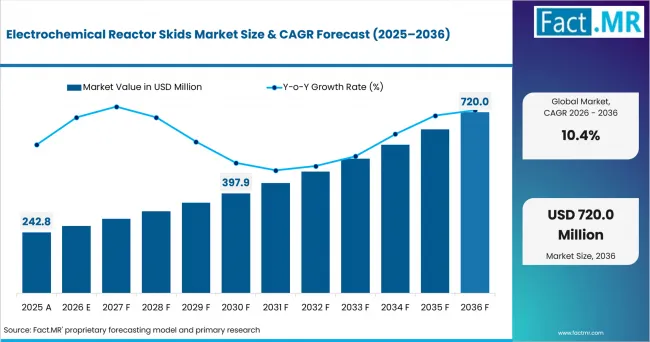
Electrochemical Reactor Skids Market Value Analysis | Source: Fact.MR
What are the defining numbers behind Electrochemical Reactor Skids Market growth?
USD 452.0 million absolute opportunity is expected by 2036. Growth is expected to center on Parallel-plate cells and DSA/mixed metal oxide electrodes.
- Demand Drivers in the Market
- Industrial wastewater plants use electrochemical oxidation when biological treatment and common chemical methods cannot remove difficult compounds from the final water stream.
- Factory-built skids are easier to install because the pumps, controls, power supply and wiring arrive together on one frame and are tested before delivery.
- Metal recovery can improve project value because waste streams from specialty chemical and electronics plants may still contain materials that can be sold.
- On-site electrochemical production lowers the risks linked to transporting and storing dangerous chemicals. It is especially useful where plants produce disinfectants or reactive chemicals as part of their own process.
- Key Segments Analyzed
- By Reactor Configuration: Parallel-plate cells are expected to hold 31.0% share in 2026 because the geometry is familiar to process engineers and easier to quote for pilot and small production duties.
- By Electrode Material: DSA/mixed metal oxide is projected to account for 30.0% share in 2026 owing to its use in anodic service where coated titanium carries the operating load.
- By Application: Wastewater treatment is anticipated to capture 29.0% share in 2026 as discharge limits and PFAS monitoring pressure draw attention to treatment steps beyond conventional oxidation.
- By Capacity: Bench/pilot skids are estimated to represent 24.0% share in 2026 because many orders begin with proof on the customer's own stream before larger equipment is approved.
- By End User: Chemical & specialty is forecast to hold 28.0% share in 2026 due to technically staffed plants that evaluate electrodes, current efficiency and waste-stream chemistry before purchase.
- Analyst Opinion at Fact.MR
- Shambhu Nath Jha, Senior Analyst at Fact.MR, states, "Customers are more likely to approve an electrochemical reactor skid after seeing results from their own liquid stream. Laboratory results alone do not show how the system will perform inside the plant. Operators also look at electrode coating life, power use and the effect of buildup during operation."
- Strategic Implications
- Plant operators can ask for current-efficiency data across the intended operating range before approving an electrochemical skid. The review should also cover how electrode wear changes output and operating cost over time.
- Suppliers should include a bench or pilot skid in the commercial offer so customers can test the chemistry before committing to a full production unit.
- Service plans can cover electrode monitoring, recoating and replacement so the first equipment sale develops into a longer support relationship.
- Control systems should use clear alarms, interlocks and maintenance screens that site technicians can manage without regular support from the engineering team.
UAE is estimated to post an 11.1% CAGR as water scarcity and industrial diversification support advanced treatment equipment. USA is anticipated to advance at a 10.4% CAGR as PFAS rules and industrial discharge controls increase interest in stronger treatment steps. Japan is forecast to record a 10.3% CAGR where electronics, fine chemicals and metal recovery create technical use cases. UK is projected to post a 10.1% CAGR as water companies and industrial sites review persistent contaminant exposure. Germany is estimated to record a 9.8% CAGR because chemical plants typically require documented pilot results before adopting new treatment equipment.
How does the Electrochemical Reactor Skids Market break down by segment?
Parallel-plate cells are expected to lead Reactor Configuration at 31.0% share in 2026. DSA/mixed metal oxide is projected to lead Electrode Material at 30.0% share in 2026.
Why do Parallel-Plate Cells lead Reactor Configuration?
Parallel-Plate Cells are estimated to hold 31.0% share in 2026.
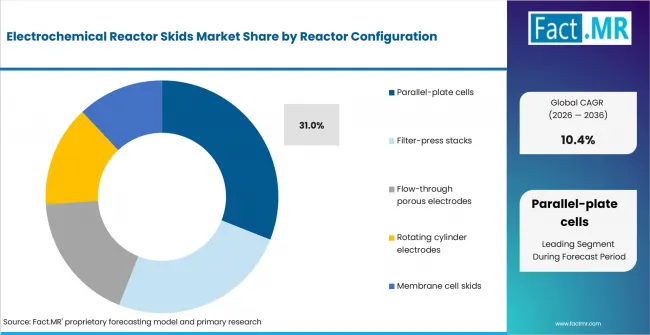
Electrochemical Reactor Skids Market Analysis By Reactor Configuration | Source: Fact.MR
Parallel-Plate Cells give skid builders a familiar and easy-to-manage design. Engineers can set the flow path, spacing between electrodes and frame size with good control. Filter-Press Stacks are used where tighter flow control is important. Flow-Through Porous Electrodes provide more contact area for selected liquid streams. Rotating Cylinder Electrodes suit jobs where movement near the electrode affects performance. Membrane Cell Skids keep the two sides of the reaction separate when required.
Why does DSA/Mixed Metal Oxide lead Electrode Material?
DSA/Mixed Metal Oxide is estimated to hold 30.0% share in 2026.
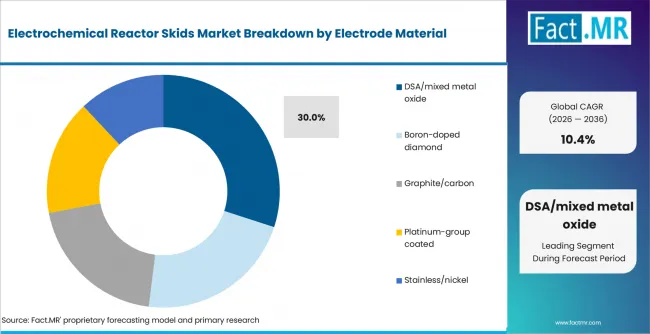
Electrochemical Reactor Skids Market Analysis By Electrode Material | Source: Fact.MR
DSA/Mixed Metal Oxide coatings are widely used in difficult operating conditions. They give anodes good resistance without reaching the high cost of diamond-based electrodes. Boron-Doped Diamond remains useful for hard-to-treat oxidation work. Graphite and Carbon support lower-cost systems and selected reduction jobs. Platinum-Group Coated Electrodes are used in smaller high-performance applications. Stainless Steel and Nickel fit processes where corrosion can be kept under control.
Why does Wastewater Treatment lead Application?
Wastewater Treatment is projected to account for 29.0% share in 2026.
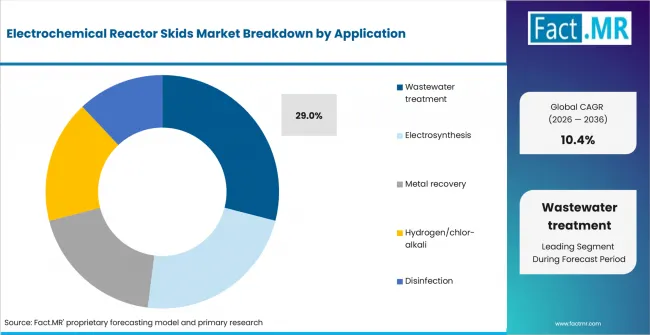
Electrochemical Reactor Skids Market Analysis By Application | Source: Fact.MR
Wastewater plants often turn to electrochemical skids when standard treatment cannot meet discharge or water-reuse limits. The same type of equipment is also used in Electrosynthesis for controlled chemical production. Metal Recovery can lower costs or create value from recovered material. Hydrogen and Chlor-Alkali applications connect with long-established electrochemical processes. Disinfection projects also benefit when chemicals are produced on-site, reducing the work and risk linked to transport and storage.
Why do Bench/Pilot Skids lead Capacity?
Bench/Pilot Skids are anticipated to hold 24.0% share in 2026.
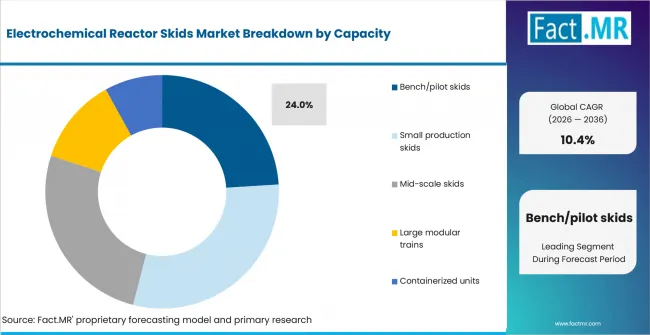
Electrochemical Reactor Skids Market Analysis By Capacity | Source: Fact.MR
Bench and Pilot Skids allow customers to test the system with their own liquid before buying a larger unit. This step is important since real plant streams can behave very differently from laboratory samples. Small Production Skids support lower commercial volumes, while Mid-Scale Skids handle regular plant work. Large Modular Trains combine several units for higher output. Containerized Units reduce installation work at remote sites or plants with limited space.
Why does Chemical & Specialty lead End User?
Chemical & Specialty is forecast to hold 28.0% share in 2026.
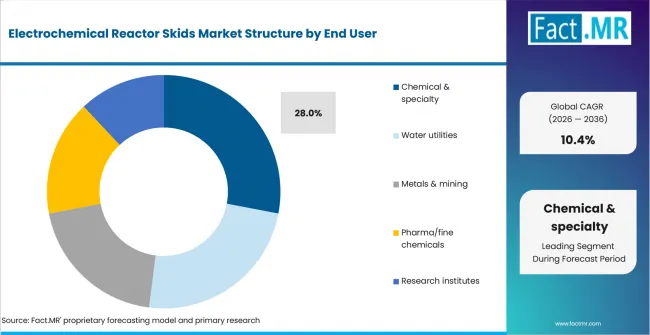
Electrochemical Reactor Skids Market Analysis By End User | Source: Fact.MR
Chemical and specialty producers already work with electrode performance, coating life, power use and process controls. This makes it easier for them to assess and operate electrochemical skids. Water Utilities consider these systems when normal treatment methods fall short. Metals and Mining companies use them for metal removal and recovery from concentrated streams. Pharma and Fine Chemical plants value controlled oxidation and clean separation. Research Institutes continue testing new reactions before wider plant use begins.
What is accelerating Electrochemical Reactor Skids Market adoption, and what is holding it back?
Hard-to-treat industrial wastewater is anticipated to expand Electrochemical Reactor Skids Market demand, while electricity intensity is expected to restrain adoption where power costs dominate the operating case.
Drivers Impact Analysis
| DRIVER | (~) % IMPACT ON CAGR | GEOGRAPHIC RELEVANCE | IMPACT TIMELINE |
|---|---|---|---|
| PFAS and persistent contaminant pressure | +3.0% | USA; UK; Germany | Short term (<=2 years) |
| Factory-built modular treatment packages | +2.2% | UAE; USA | Short term (<=2 years) |
| Metal recovery from concentrated streams | +1.6% | Japan; Germany | Medium term (2-4 years) |
| On-site generation and lower chemical handling | +1.0% | UAE; USA; water utilities | Medium term (2-4 years) |
Source: Fact.MR analysis. Updated Jul 21, 2026
- PFAS and persistent contaminant pressure: EPA finalized legally enforceable drinking water limits for PFOA and PFOS at 4.0 ppt in April 2024. That rule does not make every industrial site buy an electrochemical skid, yet it sharpens attention on destruction and pretreatment routes for persistent compounds.
- Factory-built modular treatment packages: A skid gives the plant a defined boundary for pumps and power electronics. Controls and electrodes remain inside the same package. That helps engineering teams compare pilot results with a later production unit.
- Metal recovery from concentrated streams: Electrochemical separation is expected to carry more weight when waste streams contain nickel, copper or other recoverable metals. The business case is cleaner when avoided disposal cost and recovered material are reviewed together.
- On-site generation and lower chemical handling: Disinfection and reactive intermediate duties benefit when the plant produces the active agent near the point of use. That reduces storage exposure and simplifies transport requirements for hazardous chemicals.
Opportunity Impact Analysis
| OPPORTUNITY | (~) % IMPACT ON CAGR | GEOGRAPHIC RELEVANCE | IMPACT TIMELINE |
|---|---|---|---|
| Electrode-service business | +1.8% | UAE; Germany | Short term (<=2 years) |
| Renewable-power integration | +1.3% | UAE; USA | Medium term (2-4 years) |
| Hybrid membrane-electrochemical skids | +1.0% | Japan; UK; Germany | Medium term (2-4 years) |
| Pilot-to-production contracting | +0.8% | USA chemical parks | Long term (>=4 years) |
Source: Fact.MR analysis. Updated Jul 21, 2026
- Electrode-service business: Electrode life decides operating cost after installation. Recoating, replacement planning and performance monitoring are expected to become a larger part of supplier value.
- Renewable-power integration: Electrochemical treatment converts electricity into process work. Sites with lower-cost power have a better chance to justify duties that run for long hours.
- Hybrid membrane-electrochemical skids: Membranes help keep anodic and cathodic streams apart where selectivity is needed. This pairing is expected to support higher-value duties in fine chemicals and recovery streams.
- Pilot-to-production contracting: Customers often need a trial on their own liquid before capital approval. Suppliers that credit the pilot against a later production skid are expected to reduce stalled projects.
Restraints Impact Analysis
| RESTRAINT | (~) % IMPACT ON CAGR | GEOGRAPHIC RELEVANCE | IMPACT TIMELINE |
|---|---|---|---|
| Electricity intensity | -2.3% | Global | Short term (<=2 years) |
| Electrode degradation | -1.7% | Global | Short term (<=2 years) |
| Pilot-to-scale uncertainty | -1.2% | USA; Germany; Japan | Medium term (2-4 years) |
| By-product and fouling risk | -0.8% | Chemical; pharma; water utilities | Medium term (2-4 years) |
Source: Fact.MR analysis. Updated Jul 21, 2026
- Electricity intensity: Electrochemical reactors use power as a process input. The cost case weakens quickly when treatment duties need long residence time or high current density.
- Electrode degradation: Coating wear changes the replacement schedule and the real cost per cubic meter treated. Buyers therefore ask for service-life data before approving production-scale equipment.
- Pilot-to-scale uncertainty: A clean bench result does not always survive higher flow, fouling and mixed contaminants. That is why plants often require a site trial before placing a larger order.
- By-product and fouling risk: Electrochemical treatment has to be tuned to the stream. Operators need clarity on chlorate and perchlorate. They also need a plan for scaling and electrode fouling before routine adoption expands.
Which countries are scaling Electrochemical Reactor Skids Market demand fastest?
The global growth rate combines the results of every country covered in the study. UAE is growing faster than the worldwide average. The USA and Japan remain close to it, while the United Kingdom and Germany are moving at a slightly slower pace. These six countries are examples and do not represent the full market.
- Each country follows its own growth path. Wider use depends on wastewater problems, electricity costs, access to pilot testing and local support for electrode repair or replacement.
- The UAE follows a different route through water reuse, desalination and industrial expansion. These projects often favor packaged systems that can be installed quickly.
- In the USA, tighter review of PFAS and industrial wastewater supports demand. Japan is more closely linked to electronics, fine chemicals and metal recovery. These uses place greater focus on accurate control and reliable electrode service.
- The United Kingdom uses electrochemical skids as an extra treatment step when current water systems cannot remove difficult pollutants. Germany takes a more careful path. Chemical plants usually look for repeatable pilot results before approving full production units.
Countries with similar growth rates can still offer very different business conditions. Power costs, electrode life, access to testing and service support all affect how quickly a trial unit moves into regular plant use. The complete report covers North America, Latin America, Europe, East Asia, South Asia and Oceania, and the Middle East and Africa.
.webp "Example Country Growth Comparison Of Electrochemical Reactor Skids Market (2)")
Example Country Growth Comparison Of Electrochemical Reactor Skids Market (2) | Source: Fact.MR
| COUNTRY | CAGR (2026 to 2036) |
|---|---|
| UAE | 11.1% |
| USA | 10.4% |
| Japan | 10.3% |
| UK | 10.1% |
| Germany | 9.8% |
Source: Fact.MR analysis. Updated Jul 21, 2026
How is the UAE scaling demand?
11.1% CAGR, driven by water reuse and industrial growth.
The UAE’s 11.1% CAGR is linked to greater use of treated water in desalination plants and industrial sites. Compact electrochemical skids can remove pollutants or produce treatment chemicals at the plant. They can also be installed without major changes to the existing facility. This makes them useful where space is limited and fast installation is important.
What supports USA adoption?
10.4% CAGR, led by PFAS concerns and tighter industrial wastewater rules.
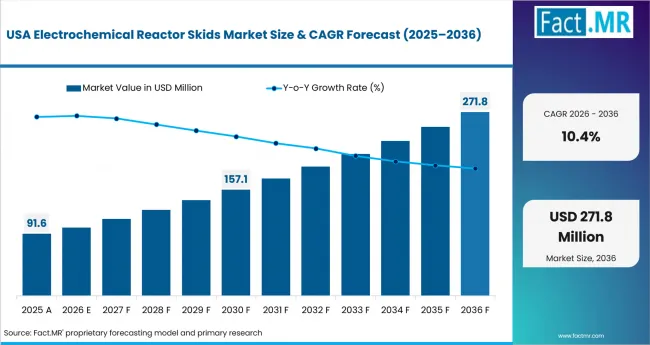
Electrochemical Reactor Skids Market Country Value Analysis | Source: Fact.MR
USA demand is growing at 10.4% CAGR through 2036. Industrial plants are looking for an extra treatment step when standard methods leave difficult chemicals in the wastewater. Electrochemical oxidation is being tested for concentrated waste streams that contain PFAS and other long-lasting pollutants. Stronger discharge rules are giving plant operators more reason to review these systems.
How is Japan developing demand?
10.3% CAGR, supported by electronics production and metal recovery.
Japan’s 10.3% CAGR is connected to electronics and fine-chemical plants that produce concentrated liquid waste. Electrochemical systems can recover useful metals and reduce the amount of waste sent for disposal. Equipment approval often depends on accurate controls and reliable electrode service. Buyers also look for clear proof that the system can deliver steady results over time.
What shapes United Kingdom growth?
10.1% CAGR, backed by difficult-pollutant treatment and water-system upgrades.
The United Kingdom is reviewing treatment methods that destroy difficult pollutants instead of moving them into another waste stream. Electrochemical skids can be added to current plants as a final treatment stage. This gives water operators another option when existing systems cannot meet treatment targets. These conditions support a 10.1% CAGR through 2036.
How does Germany perform?
9.8% CAGR, driven by pilot testing and careful equipment approval.
Germany’s 9.8% CAGR reflects a slower and more detailed approval process in established chemical plants. Operators usually look for repeatable pilot results before buying full production equipment. Testing covers removal rates, unwanted by-products and electrode life. Suppliers with strong test records have a better chance of turning small trials into regular plant orders.
Who leads the Electrochemical Reactor Skids Market?
De Nora and Nel ASA lead broad electrochemical-process relevance, while Faraday Technology and ElectroCell strengthen pilot development and scale-up support.
De Nora brings established electrochemical and water-treatment capabilities across municipal and industrial applications. Nel ASA contributes engineered electrochemical systems and process-development expertise for scale-sensitive applications. Faraday Technology supports customers from bench testing through pilot and pre-production work using plate-and-frame electroreactors. ElectroCell provides modular flow cells for laboratory testing, pilot projects and production use.
From 2026 to 2036, competition is expected to depend on electrode life, current efficiency and pilot-to-production conversion. Plant operators are also likely to compare electricity use, by-product control and service terms for recoating or replacement. Providers that combine application testing with clear scale-up support may gain stronger demand from chemical plants, water utilities and metal-recovery projects.
Which companies are the key providers?
ElectroCell; De Nora; Nel ASA; Faraday Technology.
- ElectroCell
- De Nora
- Nel ASA
- Faraday Technology
Bibliography
- U.S. Environmental Protection Agency. (2024, April 10). Biden-Harris Administration finalizes first-ever national drinking water standard to protect 100M people from PFAS pollution. U.S. Environmental Protection Agency.
- Industrie De Nora S.p.A. (2026, July). De Nora completes the acquisition of BW Water.
- UN-Water. (2024). Progress on wastewater treatment - 2024 update.
- U.S. Environmental Protection Agency. (2024, December 16). EPA launches new studies and data collection efforts to better protect communities from PFAS. U.S. Environmental Protection Agency.
This Report Addresses
- The report provides strategic intelligence on Electrochemical Reactor Skids Market across Reactor Configuration and Electrode Material choices that shape purchasing decisions.
- Segment analysis covers Parallel-plate cells as the share leader within the 2026 market structure.
- Regional outlook evaluates China and UAE alongside USA and Japan, while UK and Germany complete the growth comparison.
- Competitive analysis profiles De Nora and Nel ASA. Faraday Technology is also covered as verified providers tied to electrochemical systems or engineering.
- Use-case assessment covers the applications that shape electrochemical reactor skids market demand across the forecast period.
What does the Electrochemical Reactor Skids Market cover?
The market covers packaged electrochemical process units sold as modular skids for treatment and synthesis. It also covers recovery, disinfection and related process duties. The scope focuses on equipment where the reactor and electrodes with power and circulation hardware. Controls remain part of the same integrated package.
What is included in the scope?
Included categories cover electrochemical cell stacks and skid piping. Recirculation systems, power supplies and controls also sit inside the modular unit. The scope includes bench, pilot and production systems when the reactor skid is separately identifiable in the customer project.
What is excluded from the scope?
Excluded categories include commodity batteries and laboratory-only electroanalytical instruments. Complete chlor-alkali complexes and hydrogen projects are excluded when the reactor skid is not separately priced. These areas use electrochemistry, but the buying decision differs from packaged reactor skids.
How Was the Analysis Built?
The analysis draws on 120+ sources, 35+ company portfolios, 25+ countries, and more than 20 industry interviews.
- Primary Research: Primary research includes discussions with manufacturers, service providers, technology developers, distributors, end users, procurement teams, and subject-matter experts. These conversations examine purchasing priorities, product adoption, operational challenges, approval requirements, competitive positioning, and the factors that influence wider market acceptance.
- Desk Research: Desk research covers government statistics, regulatory publications, company filings, trade data, technical studies, industry associations, standards, public policy, and other authoritative sources. Every source used in the analysis is documented in the bibliography.
- Market Sizing and Forecasting: Market estimates combine historical performance, demand indicators, pricing and volume trends, segment shares, company participation, country-level growth, adoption patterns, investment activity, and barriers to market expansion.
- Data Validation and Update Cycle: Findings are validated by comparing primary interviews with public data, company activity, regulatory changes, trade patterns, and industry developments. Regular updates review new product launches, capacity changes, partnerships, approvals, procurement trends, and shifts in commercial adoption.
Segmentation
What is the report's scope and coverage?
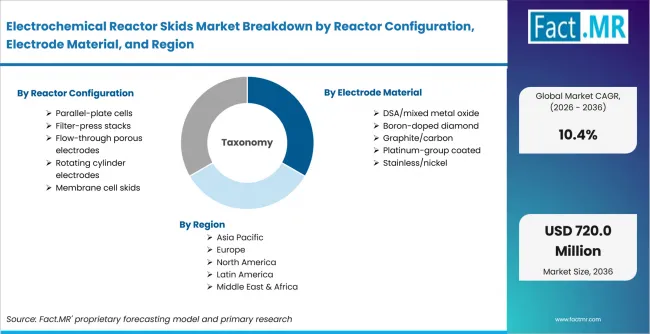
Electrochemical Reactor Skids Market Breakdown By Reactor Configuration, Electrode Material, And Region | Source: Fact.MR
| Attribute | Details |
|---|---|
| Quantitative Units | USD million; CAGR from 2026 to 2036 |
| Market Definition | An electrochemical reactor skid packages the cell, electrodes, power electronics, recirculation pumps, piping, instruments and controls onto one transportable process frame. |
| Reactor Configuration | Parallel-plate cells; Filter-press stacks; Flow-through porous electrodes; Rotating cylinder electrodes; Membrane cell skids |
| Electrode Material | DSA/mixed metal oxide; Boron-doped diamond; Graphite/carbon; Platinum-group coated; Stainless/nickel |
| Application | Wastewater treatment; Electrosynthesis; Metal recovery; Hydrogen/chlor-alkali; Disinfection |
| Capacity | Bench/pilot skids; Small production skids; Mid-scale skids; Large modular trains; Containerized units |
| End User | Chemical & specialty; Water utilities; Metals & mining; Pharma/fine chemicals; Research institutes |
| Regions Covered | North America; Latin America; Europe; East Asia; South Asia & Oceania; Middle East & Africa |
| Countries Covered | USA; Canada; Brazil; Mexico; Germany; U.K.; France; Italy; Spain; South Korea; Japan; Australia & New Zealand; GCC Countries; South Africa; UAE |
| Key Companies Profiled | De Nora; Nel ASA; Faraday Technology |
| Forecast Period | 2026 to 2036 |
| Approach | Hybrid top-down and bottom-up approach using demand indicators across Reactor Configuration, Electrode Material, Application, Capacity and End User. |
Source: Fact.MR analysis. Updated Jul 21, 2026
How is the market segmented?
-
By Reactor Configuration
- Parallel-plate cells
- Filter-press stacks
- Flow-through porous electrodes
- Rotating cylinder electrodes
- Membrane cell skids
-
By Electrode Material
- DSA/mixed metal oxide
- Boron-doped diamond
- Graphite/carbon
- Platinum-group coated
- Stainless/nickel
-
By Application
- Wastewater treatment
- Electrosynthesis
- Metal recovery
- Hydrogen/chlor-alkali
- Disinfection
-
By Capacity
- Bench/pilot skids
- Small production skids
- Mid-scale skids
- Large modular trains
- Containerized units
-
By End User
- Chemical & specialty
- Water utilities
- Metals & mining
- Pharma/fine chemicals
- Research institutes
-
By Region
- North America
- USA
- Canada
- Latin America
- Brazil
- Mexico
- Rest of Latin America
- Europe
- Germany
- U.K.
- France
- Italy
- Spain
- Rest of Europe
- East Asia
- South Korea
- Japan
- South Asia & Oceania
- Australia & New Zealand
- Rest of South Asia & Oceania
- Middle East & Africa
- GCC Countries
- South Africa
- UAE
- Rest of Middle East & Africa
- North America
Frequently Asked Questions
Which Reactor Configuration leads the Electrochemical Reactor Skids Market?
Which Electrode Material leads the Electrochemical Reactor Skids Market?
Which Application leads the Electrochemical Reactor Skids Market?
Which Capacity leads the Electrochemical Reactor Skids Market?
Which End User leads the Electrochemical Reactor Skids Market?
How does UAE perform in the Electrochemical Reactor Skids Market?
How does USA perform in the Electrochemical Reactor Skids Market?
What is the primary driver in the Electrochemical Reactor Skids Market?
What is the main restraint in the Electrochemical Reactor Skids Market?
Who worked on this report


Preview the report firsthand - request a free sample
Free SampleGet the brochure for pricing and purchase details
Download PDF