- Base Value(2025): 0.4 Bn
- Forecast Value (2036): 11.5 Bn
- CAGR (2036): 36.8%
Synthetic Data Governance Services Market Size, Market Forecast and Outlook by Fact.MR
- The synthetic data governance services market was valued at USD 0.4 billion in 2025.
- Demand is expected to increase from USD 0.5 billion in 2026 to USD 11.5 billion by 2036.
- The market is forecast to record 36.8% CAGR from 2026 to 2036 as AI teams need privacy-tested synthetic data for training and validation.
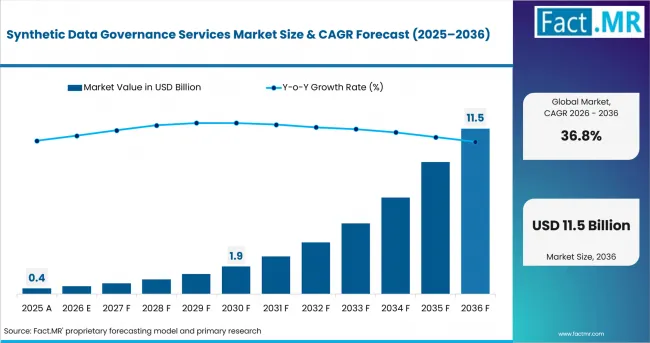
Synthetic Data Governance Services Market Value Analysis | Source: Fact.MR
| Metric | Details |
|---|---|
| Market Size in 2026 | USD 0.5 billion |
| Market Forecast in 2036 | USD 11.5 billion |
| CAGR 2026 to 2036 | 36.8% |
Source: Fact.MR analysis. Updated Jun 22, 2026
Summary of Synthetic Data Governance Services Market
- Demand Drivers in the Market
- Privacy engineering heads need re-identification testing before synthetic datasets move into AI pipelines.
- AI governance leads need dataset lineage records that can support model approval.
- Data science platform owners need utility checks because synthetic data can distort model behavior.
- Compliance teams need proof that synthetic data claims can survive internal review.
- Key Segments Analyzed
- By Service Type: Privacy assurance and re-identification Testing is expected to hold 38.0% share in 2026 because privacy proof is the first approval gate.
- By Data Type: Tabular Enterprise Data leads because structured customer and operational records are used first. The segment is projected to capture 34.0% share in 2026.
- By Assurance Method: Re-identification Risk Testing is expected to account for 41.0% share in 2026 because regulators and privacy teams need attack-based evidence.
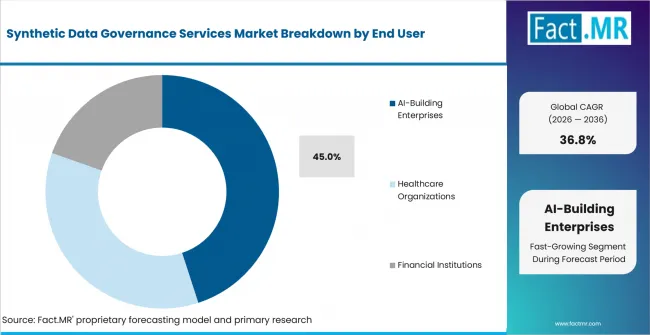
- By End User: AI-Building Enterprises hold 45.0% share in 2026 as enterprise AI teams create the first paid demand base.
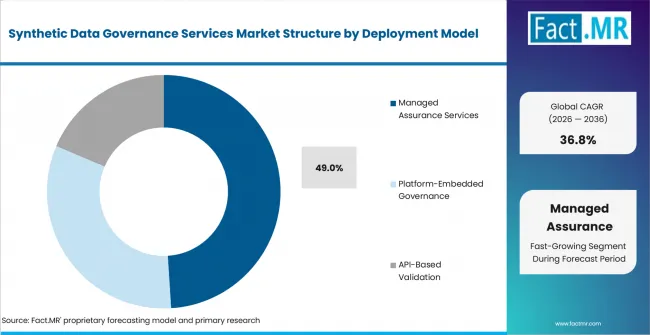
- By Deployment Model: Managed Assurance Services are expected to capture 49.0% share in 2026 because enterprises need expert review before internal certification.
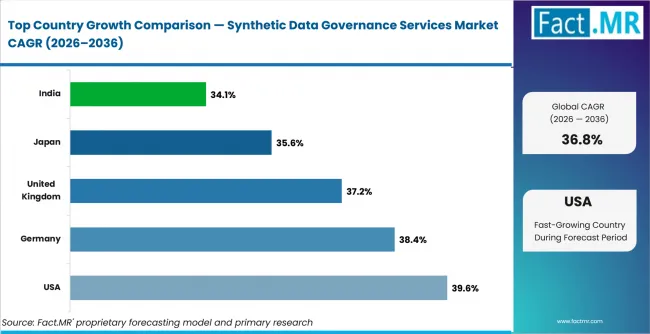
- By Geography: The United States is projected to grow at 39.6% CAGR through 2036 as AI labs and regulated enterprises scale synthetic data assurance faster.
- Analyst Opinion at Fact.MR
- Shambhu Nath Jha, Senior Analyst at Fact.MR, notes, “Synthetic data governance will become a control layer for enterprise AI. AI teams will not be able to rely only on a vendor claim that data is anonymous. They will need privacy tests and utility evidence before synthetic datasets enter model training.”
- Strategic Implications
- Synthetic data vendors should add assurance reports before enterprise privacy teams demand them.
- AI governance teams need lineage records that connect source data to synthetic output.
- Financial institutions should test re-identification risk before using synthetic data in model development.
- Healthcare AI teams need privacy proof before sharing synthetic records with external developers.
Services that validate and track lineage for synthetic datasets used to train AI - preventing model collapse and privacy leakage. This market is different from synthetic data generation software. Its value comes from proving that a dataset is safe enough, useful enough and traceable enough for enterprise AI use.
The EU AI Act gives data governance more weight in high-risk AI systems because training and testing datasets need stronger controls. [1] NIST guidance on differential privacy supports the need to quantify privacy loss instead of accepting broad privacy claims. [2] These signals make assurance services more important as synthetic data use expands.
The United States is expected to record 39.6% CAGR through 2036 as AI labs and regulated enterprises scale synthetic data review. Germany is set to advance at 38.4% CAGR as EU data governance pressure supports privacy assurance. The United Kingdom is likely to post 37.2% CAGR as anonymisation review becomes more formal. Japan is projected to grow at 35.6% CAGR as quality-sensitive enterprises test synthetic datasets carefully. India is forecast to record 34.1% CAGR as software service teams need reusable privacy-safe data.
Segmental Analysis
Synthetic Data Governance Services Market Analysis by Service Type
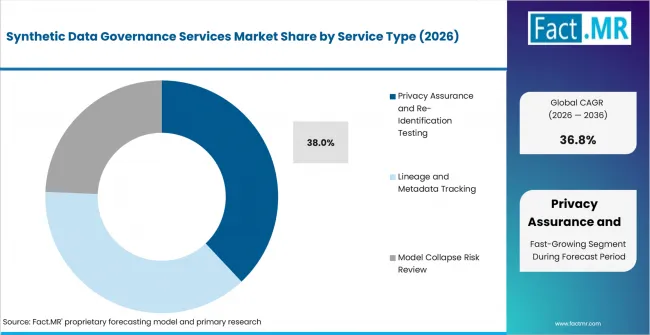
Synthetic Data Governance Services Market Analysis By Service Type | Source: Fact.MR
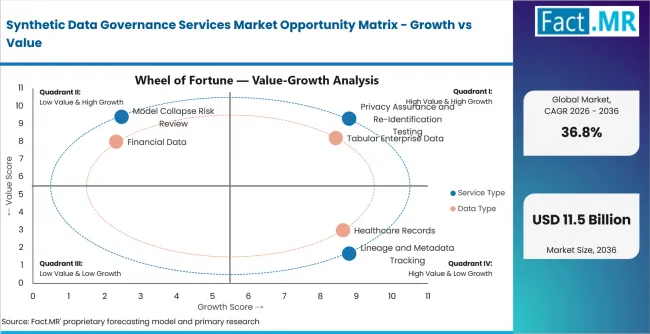
Privacy assurance and re-identification testing is expected to hold 38.0% share in 2026 because privacy review is the first barrier for synthetic data use. Lineage and metadata tracking follows because AI teams need evidence of source controls. Model collapse risk review gains attention as synthetic data enters repeated training cycles.
- Privacy Assurance and Re-Identification Testing: This service tests whether synthetic records can expose source individuals.
- Lineage and Metadata Tracking: Lineage tracking records how source data becomes synthetic output.
- Model Collapse Risk Review: Model-collapse review checks whether synthetic data can reduce model quality.
Synthetic Data Governance Services Market Analysis by Data Type
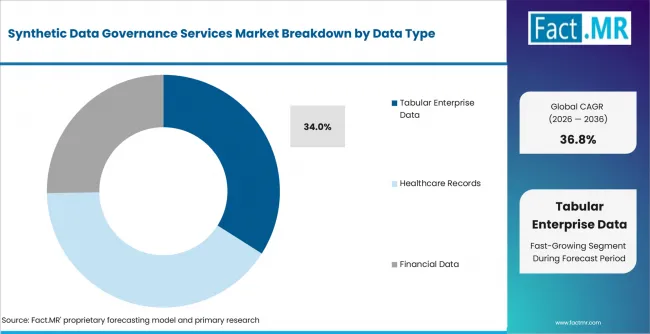
Synthetic Data Governance Services Market Analysis By Data Type | Source: Fact.MR
Tabular Enterprise Data leads because it is easier to test and compare against source datasets. Healthcare Records need stronger assurance because privacy exposure can be severe. Tabular enterprise data is projected to capture 34.0% share in 2026 as customer and transaction datasets move into AI development first. Financial Data follows through model testing demand.
- Tabular Enterprise Data: Tabular datasets support early governance because risk and utility tests are clearer.
- Healthcare Records: Healthcare records need privacy proof before research and AI model training.
- Financial Data: Financial data needs synthetic versions for model testing under strict controls.
Synthetic Data Governance Services Market Analysis by Assurance Method
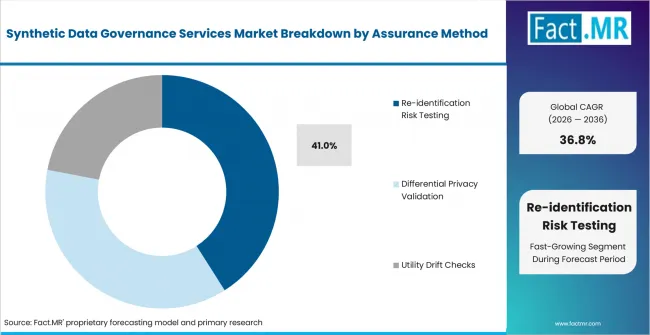
Synthetic Data Governance Services Market Analysis By Assurance Method | Source: Fact.MR
Re-identification Risk Testing is expected to account for 41.0% share in 2026 because privacy teams need attack-based evidence. Differential Privacy Validation supports stronger mathematical guarantees. Utility Drift Checks are gaining use as teams compare synthetic data against source patterns. The PDPC guide supports post-generation risk assessment before wider use. [3]
- Re-identification Risk Testing: Re-identification tests assess whether individuals can be inferred from synthetic data.
- Differential Privacy Validation: Differential privacy validation checks whether stated privacy guarantees are meaningful.
- Utility Drift Checks: Utility drift checks review whether synthetic data preserves useful patterns.
Synthetic Data Governance Services Market Analysis by End User
Synthetic Data Governance Services Market Analysis By End User | Source: Fact.MR
AI-Building Enterprises hold 45.0% share in 2026 as internal model teams need privacy-safe development data. Healthcare Organizations follow because sensitive records need stronger assurance. Financial Institutions use governance services before model validation and testing. Software Vendors use them to support customer trust during product development.
- AI-Building Enterprises: AI-building enterprises need governed synthetic data for training and validation.
- Healthcare Organizations: Healthcare organizations need privacy assurance before sharing patient-like datasets.
- Financial Institutions: Financial institutions use synthetic data review before model testing.
Synthetic Data Governance Services Market Analysis by Deployment Model
Synthetic Data Governance Services Market Analysis By Deployment Model | Source: Fact.MR
Managed Assurance Services are expected to capture 49.0% share in 2026 because enterprises need expert review before internal sign-off. Platform-Embedded Governance follows as synthetic data tools add reporting layers. API-Based Validation supports faster checks inside data pipelines. Consulting-Led Certification supports high-risk use cases with deeper documentation.
- Managed Assurance Services: Managed services help enterprises validate datasets before AI use.
- Platform-Embedded Governance: Embedded governance adds privacy reporting inside synthetic data tools.
- API-Based Validation: API validation supports faster risk checks during dataset creation.
Synthetic Data Governance Services Market Drivers, Restraints, and Opportunities
Synthetic Data Governance Services Market Opportunity Matrix Growth Vs Value | Source: Fact.MR
The main driver is regulatory review of anonymisation and pseudonymisation. EDPB guidance states that pseudonymisation does not imply anonymity. [4] This helps explain why synthetic datasets need their own privacy review before a simple anonymous label.
The main restraint is the difficulty of proving privacy without damaging data utility. Synthetic data can be safer but weaker for model training if too much noise is added. Nature’s model-collapse research adds another concern because repeated generated data can reduce model quality over time. [5]
Opportunities in the Synthetic Data Governance Services Market
- Privacy Assurance Reports: Providers can sell re-identification testing as a required approval step.
- Lineage Certification: AI teams can use lineage reports to explain how synthetic data was created.
- Model-Collapse Review: Governance services can test whether synthetic data hurts model quality across training cycles.
Regional Analysis
Based on regional analysis, the synthetic data governance services market is segmented into North America, Europe, East Asia, South Asia and Pacific, Latin America, and Middle East and Africa.
.webp "Top Country Growth Comparison Synthetic Data Governance Services Market Cagr (2026 2036)")
Top Country Growth Comparison Synthetic Data Governance Services Market Cagr (2026 2036) | Source: Fact.MR
| Country | CAGR 2026 to 2036 |
|---|---|
| United States | 39.6% |
| Germany | 38.4% |
| United Kingdom | 37.2% |
| Japan | 35.6% |
| India | 34.1% |
Source: Fact.MR analysis. Updated Jun 22, 2026
Synthetic Data Governance Services Market Cagr Analysis By Country | Source: Fact.MR
North America Synthetic Data Governance Services Market Analysis
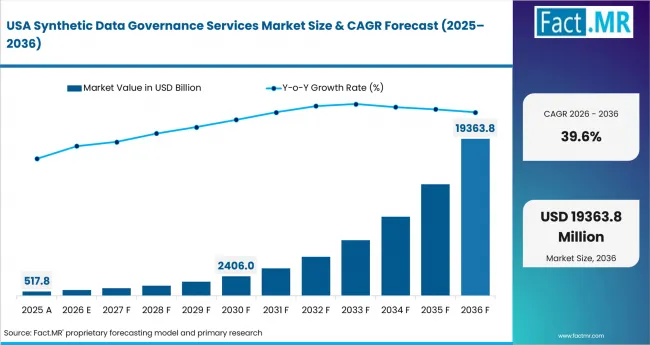
Synthetic Data Governance Services Market Country Value Analysis | Source: Fact.MR
North America demand is led by the United States because AI labs and regulated enterprises are expanding synthetic data testing before production use.
- United States: The United States has the strongest demand base because AI labs and regulated enterprises already test synthetic datasets for model training. Synthetic data governance services are expected to record 39.6% CAGR through 2036 as privacy teams require re-identification testing before wider model use. Healthcare and financial firms need evidence that synthetic records do not expose real people. Providers that combine lineage records with privacy reports can win faster enterprise review.
Europe Synthetic Data Governance Services Market Analysis
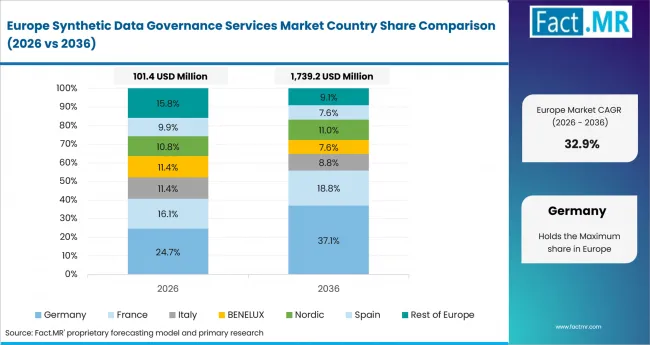
Synthetic Data Governance Services Market Europe Country Market Share Analysis, 2026 & 2036 | Source: Fact.MR
Europe demand is tied to GDPR discipline and AI Act data governance. Germany and the United Kingdom show stronger early adoption because privacy review is already formal.
- Germany: Germany reflects a compliance-led path because AI teams must connect synthetic data use with GDPR and EU AI Act records. The country is set to advance at 38.4% CAGR through 2036 as risk teams ask for proof that synthetic datasets are anonymous enough for reuse. Banks and insurers will be early users because model testing often needs realistic customer patterns. Vendors with local-language audit reports can reduce sign-off delays.
- United Kingdom: The United Kingdom demand is tied to financial services and health-data innovation because synthetic records allow testing without direct patient or customer exposure. Synthetic data governance services are likely to post 37.2% CAGR through 2036 as privacy officers require stronger anonymisation evidence. AI vendors need validation before sharing synthetic datasets with partners. Service providers can gain by offering risk scoring and lineage reports that match board-level review.
Asia Pacific Synthetic Data Governance Services Market Analysis
Asia Pacific demand is split between quality-sensitive enterprise AI projects and scale-led software development. Japan grows through quality assurance while India grows through high-volume engineering demand.
- Japan: Japan’s opportunity comes from quality-sensitive enterprise AI projects and careful data-sharing culture. The market is projected to grow at 35.6% CAGR through 2036 as banks and healthcare organizations test synthetic data before wider AI use. Model teams will need proof that synthetic records preserve useful patterns without exposing source individuals. Governance providers can support this by testing privacy risk and dataset drift. Japan will favor trusted assurance partners that can explain technical findings to compliance teams and data scientists without overstating privacy guarantees during executive approval and audits reviews.
- India: India is building demand through enterprise AI pilots and large software service teams that need reusable test data. Synthetic data governance services are forecast to record 34.1% CAGR through 2036 as banks and technology firms seek privacy-safe development datasets. Cost pressure will make automated validation important. Service providers must offer clear reports at prices that fit large engineering teams. India will favor solutions that combine privacy testing with dataset lineage so project managers can approve model work without exposing live customer records during outsourced development cycles and audits reviews.
Competitive Aligners for Market Providers
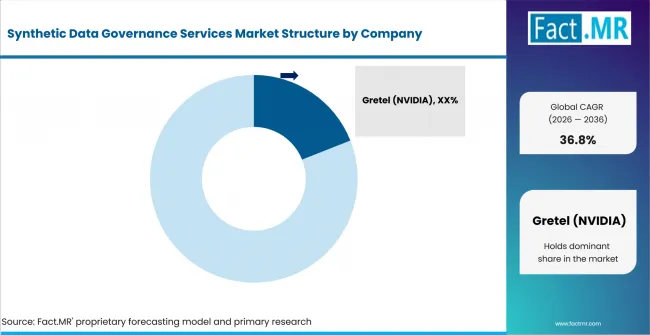
Synthetic Data Governance Services Market Analysis By Company | Source: Fact.MR
The synthetic data governance services market is led by vendors that can connect generation tools with assurance evidence. Gretel (NVIDIA) supports privacy-focused synthetic data workflows. MOSTLY AI has quality assurance reporting for synthetic datasets. Tonic.ai supports privacy-safe test data and AI development workflows. Syntheticus focuses on privacy-preserving synthetic data use.
Competition is moving from generation output to governance proof. AI teams need to know whether synthetic data is safe enough for use and useful enough for training. Privacy teams need reports that explain re-identification risk in a way legal reviewers can understand.
Provider strength through 2036 will come from assurance depth. The strongest providers will connect privacy tests, lineage records and utility checks. Vendors that treat synthetic data as a one-time output will face pressure from providers that turn it into a governed AI asset.
Key Companies in Synthetic Data Governance Services Market
- Gretel (NVIDIA)
- MOSTLY AI
- Tonic.ai
- Syntheticus
- SAS Institute Inc.
Bibliography
- [1] European Parliament & Council of the European Union. (2024). Regulation (EU) 2024/1689 of the European Parliament and of the Council of 13 June 2024 laying down harmonised rules on artificial intelligence and amending certain Union legislative acts (Artificial Intelligence Act). Official Journal of the European Union, L, 2024/1689.
- [2] Near, J. P., Darais, D., Lefkovitz, N., & Howarth, G. S. (2025, March). Guidelines for evaluating differential privacy guarantees (NIST SP 800-226). National Institute of Standards and Technology.
- [3] Personal Data Protection Commission Singapore. (2024, July 15). Proposed Guide to Synthetic Data Generation Now Available.
- [4] European Data Protection Board. (2025, January 16). Guidelines 01/2025 on pseudonymisation.
- [5] Shumailov, I., Shumaylov, Z., Zhao, Y., Papernot, N., Anderson, R., & Gal, Y. (2024). AI models collapse when trained on recursively generated data. Nature, 631, 755–759.
This Report Addresses
- Strategic intelligence on synthetic data governance services across service type and data type.
- Forecast mapping from USD 0.5 billion in 2026 to USD 11.5 billion by 2036.
- Segment analysis covering Privacy Assurance and Re-identification Testing.
- Assurance review covering Re-identification Risk Testing and Differential Privacy Validation.
- Regional outlook covering the United States, Germany, United Kingdom, Japan and India.
- Competitive analysis of Gretel (NVIDIA), MOSTLY AI, Tonic.ai, Syntheticus and SAS Institute Inc..
Synthetic Data Governance Services Market Definition
The synthetic data governance services market covers services that test and certify synthetic datasets before they are used in AI training or analytics. It includes privacy assurance and utility review. The market also includes checks for model-collapse risk. It differs from generation software because its purpose is verification and governance after or during synthetic data creation.
Synthetic Data Governance Services Market Inclusions
The scope includes privacy testing and re-identification risk review. It includes differential privacy validation and synthetic dataset lineage tracking. It covers managed audits for AI training datasets. It includes certification services that confirm whether synthetic data can be used under internal policy.
Synthetic Data Governance Services Market Exclusions
The scope excludes basic synthetic data generation software with no assurance service. It excludes data masking tools unless they test synthetic output privacy. It excludes general data governance platforms unless they validate synthetic datasets. It excludes AI model monitoring tools unless they track synthetic training data lineage.
Synthetic Data Governance Services Market Research Methodology
- Primary Research: Primary research includes discussions with AI governance leads and privacy engineering heads. Data science platform owners are reviewed separately.
- Desk Research: Desk research reviews privacy guidance and official synthetic data documentation. Company disclosures support provider-side validation.
- Market-Sizing and Forecasting: Market estimates are developed through AI-building enterprise demand and assurance contract potential. Managed audit activity supports service sizing.
- Data Validation and Update Cycle: Forecasts are checked through provider activity and regulatory guidance signals. Synthetic data risk research supports validation.
Segmentation
Scope of the Report
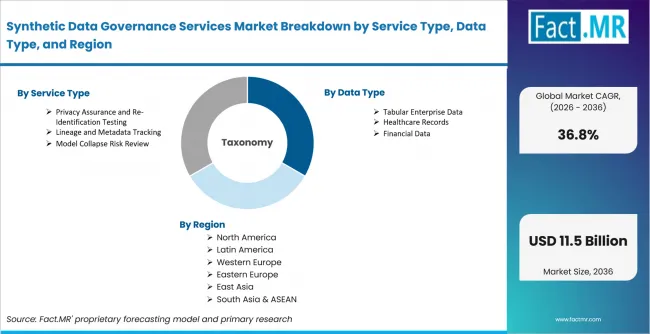
Synthetic Data Governance Services Market Breakdown By Service Type, Data Type, And Region | Source: Fact.MR
| Attribute | Details |
|---|---|
| Quantitative Units | USD 0.5 billion in 2026 to USD 11.5 billion by 2036 at 36.8% CAGR |
| Market Definition | Services that validate privacy guarantees and track lineage for synthetic datasets used to train AI |
| Service Type | Privacy Assurance and Re-identification Testing / Lineage and Metadata Tracking / Model Collapse Risk Review / Compliance Certification / Managed Synthetic Data Audit |
| Data Type | Tabular Enterprise Data / Healthcare Records / Financial Data / Customer Behavior Data / Text and Multimodal Datasets |
| Assurance Method | Re-identification Risk Testing / Differential Privacy Validation / Utility Drift Checks / Lineage Audit / Human Expert Review |
| End User | AI-Building Enterprises / Healthcare Organizations / Financial Institutions / Software Vendors / Public Sector |
| Deployment Model | Managed Assurance Services / Platform-Embedded Governance / API-Based Validation / Consulting-Led Certification |
| Estimated Providers | 60 to 120 providers globally |
| Regions Covered | North America / Europe / East Asia / South Asia and Pacific / Latin America / Middle East and Africa |
| Countries Covered | United States / Germany / United Kingdom / Japan / India |
| Key Companies Profiled | Gretel (NVIDIA), MOSTLY AI, Tonic.ai, Syntheticus and SAS Institute Inc. |
| Forecast Period | 2026 to 2036 |
| Approach | Hybrid top-down and bottom-up approach using AI-building enterprise demand, privacy assurance activity, provider coverage and regulatory pressure |
Source: Fact.MR analysis. Updated Jun 22, 2026
Synthetic Data Governance Services Market Analysis by Segments
-
By Service Type:
- Privacy Assurance and Re-Identification Testing
- Lineage and Metadata Tracking
- Model Collapse Risk Review
- Compliance Certification
- Managed Synthetic Data Audit
-
By Data Type:
- Tabular Enterprise Data
- Healthcare Records
- Financial Data
- Customer Behavior Data
- Text and Multimodal Datasets
-
By Assurance Method:
- Re-identification Risk Testing
- Differential Privacy Validation
- Utility Drift Checks
- Lineage Audit
- Human Expert Review
-
By End User:
- AI-Building Enterprises
- Healthcare Organizations
- Financial Institutions
- Software Vendors
- Public Sector
-
By Deployment Model:
- Managed Assurance Services
- Platform-Embedded Governance
- API-Based Validation
- Consulting-Led Certification
-
Region:
- North America
- United States
- Europe
- Germany
- United Kingdom
- East Asia
- Japan
- South Asia and Pacific
- India
- Latin America
- Middle East and Africa
- GCC Countries
- South Africa
- UAE
- Rest of Middle East & Africa
- North America
Frequently Asked Questions
What is the Synthetic Data Governance Services Market size in 2026?
What will the Synthetic Data Governance Services Market be worth by 2036?
What CAGR is projected for the Synthetic Data Governance Services Market?
Which service type leads the Synthetic Data Governance Services Market?
Which country grows fastest in the Synthetic Data Governance Services Market?
How does Germany perform in the Synthetic Data Governance Services Market?
How does the United Kingdom perform in the Synthetic Data Governance Services Market?
How does Japan perform in the Synthetic Data Governance Services Market?
How does India perform in the Synthetic Data Governance Services Market?
What drives the Synthetic Data Governance Services Market?
What restrains the Synthetic Data Governance Services Market?
What is the main opportunity in the Synthetic Data Governance Services Market?
Who worked on this report


Preview the report firsthand - request a free sample
Free SampleGet the brochure for pricing and purchase details
Download PDF