- Market Value (2025): USD 242.8 Mn
- Estimated Value (2026): USD 276.6 Mn
- Forecast Value (2036): USD 1020.0 Mn
- CAGR (2026-2036): 13.9%
What is the Screen-Free AI Learning Devices Market forecast to be worth by 2036?
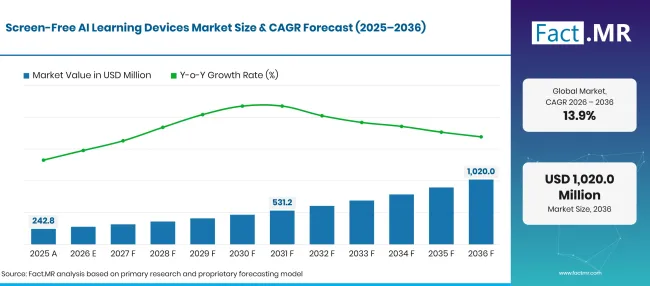
USD 276.6 million in 2026 to USD 1,020.0 million by 2036 at a 13.9% CAGR.
- Screen-free AI learning devices were a USD 242.8 million category in 2025, with most revenue coming from voice-led companions sold to homes and early learning settings.
- Revenue will expand from USD 276.6 million in 2026 to USD 1020.0 million by 2036, as subscription content and school pilots add value on top of hardware sales.
- A 13.9% CAGR reflects a young product base where each new generation of speech models improves the quality of a spoken lesson.
| Year | Basis | Market Value (USD million) |
|---|---|---|
| 2025 | Actual | 242.8 |
| 2026 | Estimate | 276.6 |
| 2036 | Forecast | 1020.0 |
| CAGR 2026 to 2036 | Forecast period | 13.9% |
Source: Fact.MR analysis. Updated Nov 12, 2026
Screen Free Ai Learning Devices Forecast Global 1 | Source: Fact.MR
What are the defining numbers behind Screen-Free AI Learning Devices Market growth?
The decade from 2026 to 2036 adds USD 743.4 million in new value, led by voice-first tutors, cloud-linked content and institutional buying.
- Demand Drivers in the Market
- Parents want learning tools that talk with a child without adding passive viewing time. Public guidance now treats AI toys as a distinct product group: the NSW Government published advice in June 2026 telling families to check whether a toy records conversations, connects to the internet and stores data overseas.
- Tactile formats lower the age at which children can use AI on their own. Haivivi presents BubblePal as a screen-free companion that clips onto an existing plush toy and starts a conversation when a child presses a single button.
- National education policy is making AI literacy a school goal from the early grades. China’s April 2025 guideline on education digitalization calls for AI to be built into teaching, learning and assessment, and the ministry has already introduced AI models for 13 disciplines. Policies of this kind give device makers a curriculum frame for spoken practice and early science content.
- Personalized pacing is a strong reason to buy. A child can ask the same question twice, switch languages or request an easier story, and the device adjusts without a teacher present.
- Key Segments Analyzed
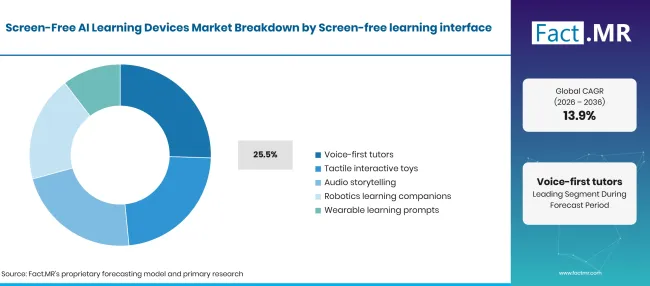
- By Learning Interface: Voice-First Tutors will account for 25.5% of 2026 value, since spoken question and answer play suits children who cannot yet read.
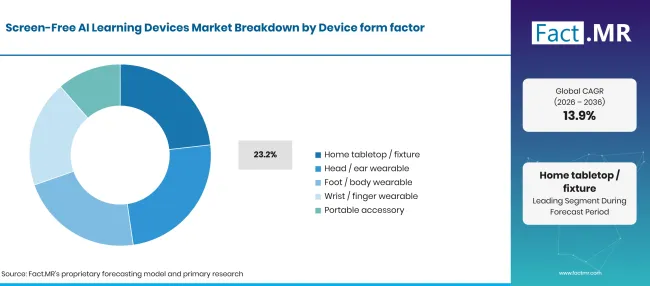
- By Device Form Factor: Home Tabletop / Fixture will hold 23.2% share in 2026, as a fixed unit in a bedroom or living room fits daily learning routines and parental oversight.
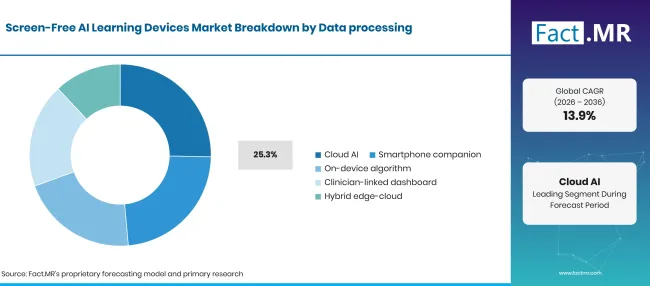
- By Data Processing: Cloud AI will capture 25.3% of the market in 2026, given that large language models and fresh content libraries still run more cheaply on remote servers.
- By Sales Channel: B2B / Institutional will represent 29.4% of 2026 revenue, helped by bulk orders from schools, learning centers and early childhood programs.
- Analyst Opinion at Fact.MR
- Shambhu Nath Jha, Principal Consultant at Fact.MR, states, “Families are not buying a gadget here, they are buying a conversation partner they can trust with a five-year-old. Brands that publish plain privacy terms and keep answers accurate at a child’s level will win repeat content subscriptions. The gap between toys and tutors will narrow as schools start to test these devices in early literacy and language classes.”
- Strategic Implications
- Device manufacturers should invest in speech recognition tuned to young voices and accents, since a misheard question ends a learning session faster than any content gap.
- AI developers should build guardrails that separate open chat from structured lessons and block unsuitable replies before they reach a child.
- Content publishers should license stories, phonics and early math in several languages, then refresh them on a set schedule to keep repeat use high.
- Schools and retailers should run short pilots and in-store demonstrations that show parents how data is handled and what a subscription includes.
South Korea leads the country set at 17.5%, where an online-first retail channel brings new AI learning products to parents quickly. The United States follows at 16.4%, only 0.1 point ahead of China at 16.3%; federal privacy rules shape product design in the first, while school AI guidelines steer demand in the second. Japan and Germany share a 13.9% rate, the same pace as the global market. Both face shrinking child populations, so growth there depends on higher spending per child more than on a wider user base.
How does the Screen-Free AI Learning Devices Market break down by segment?
Voice-First Tutors will lead Learning Interface at 25.5%; Home Tabletop / Fixture will lead Device Form Factor at 23.2%; Cloud AI will lead Data Processing at 25.3%; B2B / Institutional will lead Sales Channel at 29.4% in 2026.
Which Learning Interface leads?
Voice-First Tutors hold 25.5% of 2026 sales.
Screen Free Ai Learning Devices Breakdown Screen Free Learning Interface | Source: Fact.MR
| Learning Interface | Share (2026) |
|---|---|
| Voice-First Tutors (Leading segment) | 25.5% |
| Other segments combined | 74.5%* |
| Total | 100.0% |
Source: Fact.MR analysis. Updated Nov 12, 2026
Young children speak long before they read, which makes a spoken tutor the most natural entry point. These devices answer “why” questions, run vocabulary games and coach pronunciation in short sessions. Products that bridge toys and lessons, such as interactive robots, show how much children respond to a device that talks back. Tactile interactive toys, audio storytelling players and robotics learning companions serve families who want a physical object to hold or cards to swap. Wearable learning prompts remain a small niche aimed at older children and travel use.
What supports Home Tabletop / Fixture within Device Form Factor?
Home Tabletop / Fixture units take 23.2% of 2026 revenue.
Screen Free Ai Learning Devices Breakdown Device Form Factor | Source: Fact.MR
| Device Form Factor | Share (2026) |
|---|---|
| Home Tabletop / Fixture (Leading segment) | 23.2% |
| Other segments combined | 76.8%* |
| Total | 100.0% |
Source: Fact.MR analysis. Updated Nov 12, 2026
A device that stays in one room becomes part of a bedtime or homework routine. Parents can place it where they hear the conversation, which eases worries about unsupervised AI chat. Families who already own a smart speaker often see a dedicated child device as the safer choice. Head and ear wearables, wrist and finger wearables, body-worn units and portable accessories let learning move beyond the home. These formats suit language practice on the go, though small batteries and microphones limit session length.
How does Data Processing shape demand?
Cloud AI accounts for 25.3% of 2026 value.
Screen Free Ai Learning Devices Breakdown Data Processing | Source: Fact.MR
| Data Processing | Share (2026) |
|---|---|
| Cloud AI (Leading segment) | 25.3% |
| Other segments combined | 74.7%* |
| Total | 100.0% |
Source: Fact.MR analysis. Updated Nov 12, 2026
Remote processing lets a small, low-cost toy run large language models and pull new lessons each week. The same link raises questions about what happens to recorded speech. The US Federal Trade Commission opened a Section 6(b) inquiry in September 2025 into seven firms offering AI chatbots that act as companions, asking how they test for harm to children and handle conversation data. Smartphone companion apps, on-device algorithms, clinician-linked dashboards and hybrid edge-cloud designs give buyers other choices. Local processing cuts response time and keeps more data in the home, which appeals to privacy-minded parents and to schools with weak connectivity.
Which Sales Channel carries the most weight?
B2B / Institutional buyers represent 29.4% of 2026 sales.
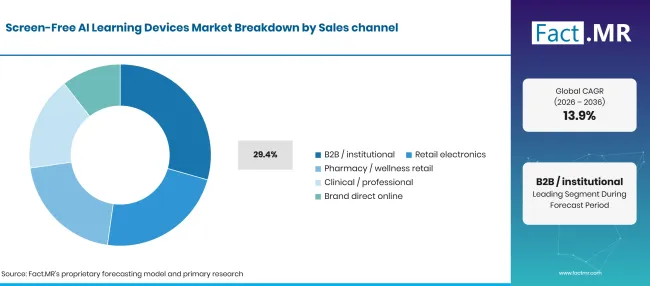
Screen Free Ai Learning Devices Breakdown Sales Channel | Source: Fact.MR
| Sales Channel | Share (2026) |
|---|---|
| B2B / Institutional (Leading segment) | 29.4% |
| Other segments combined | 70.6%* |
| Total | 100.0% |
Source: Fact.MR analysis. Updated Nov 12, 2026
Schools, tutoring centers and early years programs buy in batches and renew content licenses each term. Federal policy in the United States now backs this route: Executive Order 14277 of April 2025 directs the Secretary of Education to issue guidance on using grant funds for AI-based instruction. Spending on educational technology gives these buyers a budget line for pilot devices. Retail electronics stores, pharmacy and wellness retail, clinical and professional channels and brand-direct online stores reach families and therapists.
What is accelerating Screen-Free AI Learning Devices Market adoption, and what is holding it back?
Parents who want less screen time, schools adding AI literacy and better speech models are pulling demand forward. Privacy concerns, the risk of wrong or unsuitable AI answers and the cost of monthly content plans slow purchases. Devices that work offline for core lessons and explain their data practices in plain terms clear most of these hurdles.
Drivers Impact Analysis
| DRIVER | (~) % IMPACT ON CAGR | GEOGRAPHIC RELEVANCE | IMPACT TIMELINE |
|---|---|---|---|
| Parental interest in alternatives to screen-based learning | +1.0% | North America, Western Europe, East Asia | Medium term (2-4 years) |
| Demand for conversational and personalized learning | +0.9% | Global | Short term (<=2 years) |
| Growth of tactile AI toys and audio story content | +0.7% | East Asia, North America | Medium term (2-4 years) |
| AI literacy goals in national school policy | +0.5% | East Asia, North America | Medium term (2-4 years) |
| Institutional interest in supplementary learning tools | +0.4% | Global | Long term (>=4 years) |
Source: Fact.MR analysis. Updated Nov 12, 2026
Opportunity Impact Analysis
| OPPORTUNITY | (~) % IMPACT ON CAGR | GEOGRAPHIC RELEVANCE | IMPACT TIMELINE |
|---|---|---|---|
| Multilingual voice-based learning content | +0.8% | East Asia, North America | Medium term (2-4 years) |
| Age-adaptive educational content and tutoring | +0.6% | Global | Medium term (2-4 years) |
| School and institutional procurement partnerships | +0.5% | North America, Western Europe, East Asia | Long term (>=4 years) |
| Offline and hybrid AI processing capabilities | +0.4% | Global | Medium term (2-4 years) |
Source: Fact.MR analysis. Updated Nov 12, 2026
Restraints Impact Analysis
| RESTRAINT | (~) % IMPACT ON CAGR | GEOGRAPHIC RELEVANCE | IMPACT TIMELINE |
|---|---|---|---|
| Child data privacy and AI safety concerns | -0.8% | Global | Short term (<=2 years) |
| Inaccurate or unsuitable AI-generated responses | -0.6% | Global | Medium term (2-4 years) |
| Device and subscription affordability | -0.5% | South Asia & Pacific, Latin America | Short term (<=2 years) |
| Dependence on internet connectivity and cloud services | -0.4% | Emerging markets | Medium term (2-4 years) |
Source: Fact.MR analysis. Updated Nov 12, 2026
Which countries are scaling the Screen-Free AI Learning Devices Market through 2036?
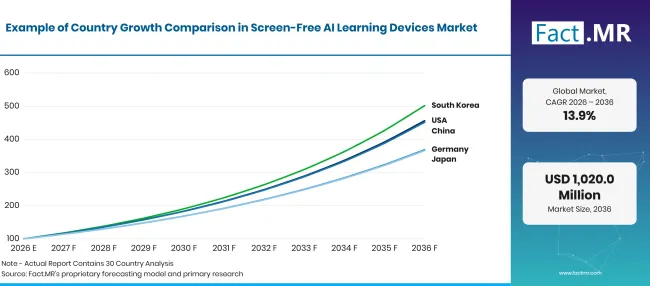
Screen Free Ai Learning Devices Growth Index | Source: Fact.MR
| Country | CAGR (2026 to 2036) |
|---|---|
| South Korea | 17.5% |
| United States | 16.4% |
| China | 16.3% |
| Japan | 13.9% |
| Germany | 13.9% |
Source: Fact.MR analysis. Updated Nov 12, 2026
What is driving South Korea’s adoption?
17.5% CAGR, driven by mobile-first shopping and strong parental spending on early learning.
Korean parents buy new education products online and quickly. Statistics Korea reported online shopping transactions of KRW 24.97 trillion in September 2026, up 4.1% year on year, with mobile purchases at KRW 19.08 trillion, up 5.4%. That channel suits young AI device brands that sell direct, bundle content plans and update features over the air.
How is the United States developing demand?
16.4% CAGR, backed by AI toy launches and federal rules on children’s data.
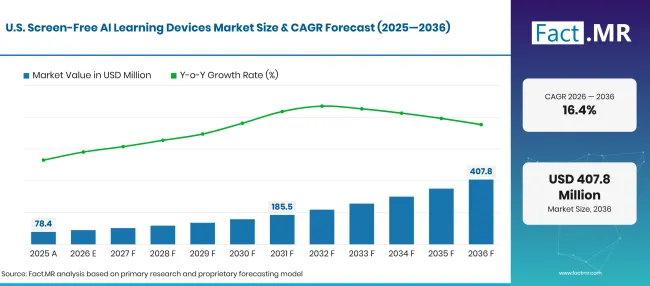
Screen Free Ai Learning Devices Forecast Usa | Source: Fact.MR
American families have the widest choice of AI plush toys and voice companions. The Federal Trade Commission finalized changes to its children’s privacy rule in January 2025, requiring separate verifiable parental consent before a company shares a child’s data with third parties and limiting how long data can be kept. Brands that design for these rules from day one gain an edge with parents and school buyers alike.
What is supporting China’s adoption?
16.3% CAGR, as school AI education rules shape home learning hardware.
China’s Ministry of Education issued two guidelines in May 2025 on AI general education and generative AI use in primary and secondary schools. The rules bar primary pupils from using open-ended content generation tools on their own and require strict privacy safeguards. Screen-free devices with closed, curriculum-linked content fit those limits well, which pushes local makers toward guided spoken lessons over free chat.
How does Japan perform?
13.9% CAGR, reflecting higher spending per child in a shrinking child population.
Japan’s Statistics Bureau counted 13.29 million children under 15 as of April 1, 2026, down 0.35 million from a year earlier and 10.8% of the population. Fewer children per household lifts spending on each child, and grandparents often fund premium learning toys. Products that teach English through song and story and that run quietly in small homes find steady interest.
What is strengthening Germany’s adoption?
13.9% CAGR, helped by EU toy safety rules that reward privacy-first design.
Destatis recorded about 654,300 births in Germany in 2025, 3.4% fewer than in 2024. A smaller cohort means growth comes from value, not volume. The EU’s new toy safety rules extend protection to the mental health and well-being of children using digitally connected toys and require makers to consider child vulnerabilities when AI features are assessed.
Who leads the Screen-Free AI Learning Devices Market?
The field splits into three groups. AI plush and companion makers such as Curio Interactive, Bondu, Haivivi and FoloToy compete on character design, voice quality and how safely a toy handles open conversation.
Haivivi describes BubblePal as an attachment that turns an existing plush toy into a voice companion with no display. Learning-first brands such as Wippi and Talenpal pair a speaker with story cards, radio content or collectible figures, so value comes from the size and quality of the content library. Wippi sells a card-based starter kit with phonics, numbers and homework help in many languages. A third group, led by Luka, builds reading robots that recognize printed picture books and read them aloud, keeping the child’s attention on paper. Competition will turn on three things: privacy design that satisfies regulators, accurate age-level answers and content plans that parents renew.
Which companies are the key providers?
Key companies in the Screen-Free AI Learning Devices Market include Wippi, Curio Interactive, Bondu, Haivivi, Talenpal, FoloToy and Luka.
- Wippi
- Curio Interactive
- Bondu
- Haivivi
- Talenpal
- FoloToy
- Luka
What is the report’s scope and coverage?
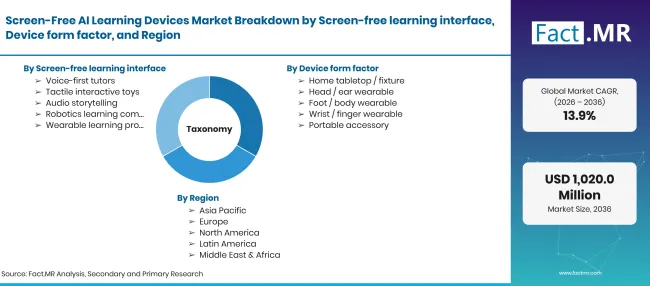
Screen Free Ai Learning Devices Taxonomy | Source: Fact.MR
| Attribute | Details |
|---|---|
| Quantitative Units | USD million in 2026 to USD million by 2036 at CAGR |
| Market Definition | AI-enabled learning devices for children that deliver lessons, stories and conversation through voice, audio and tactile controls without a display screen. |
| Learning Interface | Voice-First Tutors; Tactile Interactive Toys; Audio Storytelling; Robotics Learning Companions; Wearable Learning Prompts |
| Device Form Factor | Home Tabletop / Fixture; Head / Ear Wearable; Foot / Body Wearable; Wrist / Finger Wearable; Portable Accessory |
| Data Processing | Cloud AI; Smartphone Companion; On-Device Algorithm; Clinician-Linked Dashboard; Hybrid Edge-Cloud |
| Sales Channel | B2B / Institutional; Retail Electronics; Pharmacy / Wellness Retail; Clinical / Professional; Brand Direct Online |
| Regions Covered | North America; Latin America; Western Europe; Eastern Europe; East Asia; South Asia & Pacific; Middle East & Africa |
| Countries Covered | South Korea; United States; China; Japan; Germany |
| Companies Profiled | Wippi; Curio Interactive; Bondu; Haivivi; Talenpal; FoloToy; Luka |
| Forecast Period | 2026 to 2036 |
| Approach | Device revenue and content subscriptions are tracked by interface, form factor, processing model and channel, then checked against school policy, privacy rules and child population data. |
Source: Fact.MR analysis. Updated Nov 12, 2026
How is the market segmented?
-
By Learning Interface
- Voice-First Tutors
- Tactile Interactive Toys
- Audio Storytelling
- Robotics Learning Companions
- Wearable Learning Prompts
-
By Device Form Factor
- Home Tabletop / Fixture
- Head / Ear Wearable
- Foot / Body Wearable
- Wrist / Finger Wearable
- Portable Accessory
-
By Data Processing
- Cloud AI
- Smartphone Companion
- On-Device Algorithm
- Clinician-Linked Dashboard
- Hybrid Edge-Cloud
-
By Sales Channel
- B2B / Institutional
- Retail Electronics
- Pharmacy / Wellness Retail
- Clinical / Professional
- Brand Direct Online
-
By Region
- North America
- Latin America
- Western Europe
- Eastern Europe
- East Asia
- South Asia & Pacific
- Middle East & Africa
Bibliography
- European Commission. (2025, October 14). Communication from the Commission to the European Parliament concerning the position of the Council on the adoption of a regulation on the safety of toys.
- Federal Trade Commission. (2025, January 16). FTC Finalizes Changes to Children’s Privacy Rule Limiting Companies’ Ability to Monetize Kids’ Data.
- Federal Trade Commission. (2025, September 11). FTC Launches Inquiry into AI Chatbots Acting as Companions.
- Haivivi. (2025, December 4). The Ultimate Guide to Screen-Free Education in 2025: Balancing Tech and Play.
- Henan Provincial People’s Government. (2025, May 13). China issues guidelines to promote AI education in primary and secondary schools.
- Jinxin Technology Holding Company. (2025, December 31). Namibox Launches NAMI INSIGHT One, Introducing a New Category of AI-native Wearable Learning Devices.
- NSW Government. (2026, June 10). Safe use of AI toys.
- Statistics Bureau of Japan. (2026, May 28). News Bulletin May 28, 2026.
- Statistics Korea. (2026, November 2). Online Shopping in August 2026.
- Statistisches Bundesamt (Destatis). (2026, April 28). Zahl der Geburten sinkt im Jahr 2025 auf den niedrigsten Stand der Nachkriegszeit.
- The State Council of the People’s Republic of China. (2025, April 18). New guideline stresses on AI-based education.
- The White House. (2025, April 23). Advancing Artificial Intelligence Education for American Youth.
This Report Answers
- How fast will spending on talking, screen-free learning devices grow between 2026 and 2036?
- Which interface, form factor, processing model and channel hold the lead in 2026, and why?
- How do privacy rules in the United States, the EU and China change product design?
- Why do South Korea, the United States and China outpace Japan and Germany?
- Which companies build AI plush toys, card-based players and reading robots, and how do they compete?
- What restraints, from data concerns to subscription costs, could slow adoption?
What does the Screen-Free AI Learning Devices Market cover?
This study tracks dedicated hardware that lets children talk, listen and play with AI-driven learning content without looking at a display. Voice-first tutors, AI plush companions, card-driven audio players and reading robots form the core of the category.
Value is measured at manufacturer selling prices and includes bundled content subscriptions sold with the device. Standalone robot kits for coding projects are counted only when they ship with a conversational AI learning mode.
What is included in the scope?
AI companions and tutors that answer spoken questions, tell adaptive stories or coach pronunciation.
Tactile devices driven by cards, figures, buttons or plush bodies that trigger AI-led activities.
Reading robots that recognize printed books and read or discuss them aloud.
Content plans and cloud services sold as part of a device package for homes, schools and therapy settings.
What is excluded from the scope?
Tablets, phones and kids tablets used mainly for screen-based learning.
General household voice assistants and connected home hubs without a dedicated child learning mode.
Display-based wearables such as AR learning glasses, including Namibox’s NAMI INSIGHT One released on December 31, 2025.
Educational toys with no AI interaction and learning software sold without a device.
How Was the Analysis Built?
The analysis draws on 120+ sources, 35+ company portfolios, 25+ countries, and more than 20 industry interviews.
- Primary Research: Primary research includes discussions with manufacturers, service providers, technology developers, distributors, end users, and subject-matter experts. These conversations examine purchasing priorities, product adoption, operational challenges, approval requirements, competitive positioning, and the factors that influence wider market acceptance.
- Desk Research: Desk research covers government statistics, regulatory publications, company filings, trade data, technical studies, industry associations, standards, public policy, and other authoritative sources. Every source used in the analysis is documented in the bibliography.
- Market Sizing and Forecasting: Market estimates combine historical performance, demand indicators, pricing and volume trends, segment shares, company participation, country-level growth, adoption patterns, investment activity, and barriers to market expansion.
- Data Validation and Update Cycle: Findings are validated by comparing primary interviews with public data, company activity, regulatory changes, trade patterns, and industry developments. Regular updates review new product launches, capacity changes, partnerships, approvals, and shifts in commercial adoption.
Frequently Asked Questions
How large is the screen-free AI learning devices market in 2026?
What growth rate will the screen-free AI learning devices market record?
Which learning interface leads?
Which device form factor leads?
Which data processing model leads?
Which sales channel leads?
Which country will grow quickest?
Who are the main companies?
What holds the market back?
Who worked on this report


Preview the report firsthand - request a free sample
Free SampleGet the brochure for pricing and purchase details
Download PDF