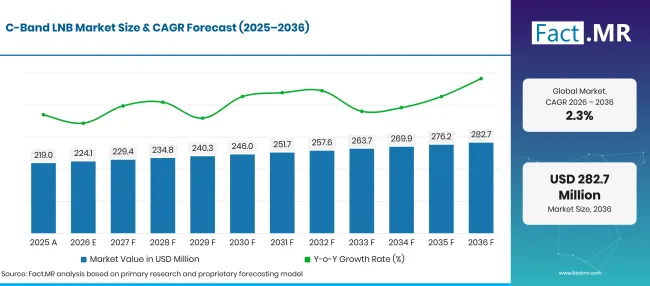
- Market Value (2025): USD 219.0 Mn
- Estimated Value (2026): USD 224.1 Mn
- Forecast Value (2036): USD 282.7 Mn
- CAGR (2026-2036): 2.3%
How Big Is the C-Band LNB Market in 2026?
The global C-band LNB market is valued at USD 224.1 million in 2026, up from USD 219.0 million in 2025, and is projected by Fact.MR to reach USD 282.7 million by 2036, expanding at a 2.3% CAGR from 2026 to 2036 and generating USD 58.6 million in incremental revenue over the 10-year forecast period.
| Market Metric | Valuation / Share / Forecast Benchmark |
|---|---|
| 2025 Market Size (Historical) | USD 219.0 million |
| 2026 Market Size (Estimated) | USD 224.1 million |
| 2036 Market Size (Projected) | USD 282.7 million |
| CAGR (2026 to 2036) | 2.3% |
| Incremental Dollar Opportunity (2026 to 2036) | USD 58.6 million (1.26x the 2026 base) |
| Dominant Product Type (2026 share) | Single-output LNBs, 38.5% (about USD 86.3 million) |
| Leading Application (2026 share) | Satellite communication, 42.1% (about USD 94.3 million) |
| Leading End User (2026 share) | Commercial users, 38.6% (about USD 86.5 million) |
| Largest Country Markets (2026 share) | United States 28.0%, Germany 22.0%, Japan 18.0% |
| Fastest-Growing Countries (CAGR, 2026 to 2036) | Germany 3.1%, Japan 2.7%, United Kingdom 2.4% |
| Leading Tier-1 Companies | Nisshinbo Micro Devices, Norsat International, Orbital Research, Swedish Microwave, Global Invacom Group |
Source: Fact.MR analysis. Updated Nov 16, 2026
Source: Fact.MR analysis of the C-band LNB market, 2026.
C Band Lnb Market Forecast Global | Source: Fact.MR
Executive Market Overview
Demand for C-band LNBs is strongest wherever operators need a downlink that holds up in heavy rain, including cable head-ends and broadcast contribution feeds, VSAT backhaul in equatorial regions, and government and maritime ground segments. In India, new operator authorisations are sustaining this demand: Intelsat (May 2025) received IN-SPACe authorisation for four geostationary satellites, IS-17, IS-20, IS-36 and IS-39, providing C-band coverage over India, and signed three of the country's largest media companies after the approval. Sales of C-band LNBs are concentrated in mature satellite markets. The United States (28.0%), Germany (22.0%) and Japan (18.0%) together account for 68.0% of 2026 revenue. The rest of the world holds 10.0%, and its CAGR of 1.4% is lower than that of every named country.
Prices of C-band LNBs are held down because the downconverter is a mature, tightly specified component. A buyer replacing an LNB at an existing site will normally specify the same local-oscillator frequency, waveguide flange and IF connector as before. Revenue per unit rises with phase-locked oscillators, external 10 MHz referencing for DVB-S2X carriers, and integrated band-pass filtering against terrestrial 5G interference. Germany (3.1% CAGR) and Japan (2.7% CAGR) are growing faster than the global 2.3%, which reflects these premium professional configurations. Brazil (1.6% CAGR) trails because household reception has largely left the band. Fact.MR sizes the market to include single-, dual-, quad- and multi-output C-band LNBs, including PLL, external-reference and filter-integrated units, while excluding standalone LNAs, block upconverters, antennas, feeds, modems and complete satellite terminals.
Analyst Perspective
"C-band LNB revenue will rise faster than unit volume, because operators keeping earth stations in service are paying more for phase-locked, filtered and externally referenced units that fit their existing feeds and receivers. The main commercial risk is spectrum repurposing: the FCC's July 2026 Upper C-band order will close some US receive sites outright where programmers move content delivery to fibre or IP instead of re-equipping a dish."
Shambhu Nath Jha, Principal Consultant, Fact.MR
Major Market Trends and Insights
- Filtered LNBs Become the Default Specification Near 5G Sites: Demand for filtered C-band LNBs is rising as International Mobile Telecommunications (IMT) networks move into 3.3 to 4.2 GHz, and receive sites now specify units with integrated band-pass filtering in place of plain wideband LNBs. The Asia-Pacific Telecommunity (April 2026) documents earth-station band-pass filter performance and coexistence trials in Indonesia and Viet Nam, showing that adjacent-band 5G can coexist with fixed-satellite reception when an additional filter is installed at the dish. Norsat International (accessed November 2026) sells its C-Band 5G Rejection LNB combined with a band-pass filter for this replacement need.
- External-Reference and DVB-S2X-Grade Oscillators Shift the Mix Upmarket: Adoption of external-reference C-band LNBs is increasing because higher-order modulation on professional links needs low phase noise and a stable local oscillator locked to a station 10 MHz reference. Swedish Microwave (March 2026) lists a two-band C-band LNB that covers 3.40 to 4.80 GHz with integrated filters, low phase noise to meet the DVB-S2X VSAT profile, and a choice of internal or external 10 MHz reference models. SatNow (accessed November 2026) lists Orbital Research's 3400X external-reference LNB at a 0.25 dB noise figure across 3.4 to 4.2 GHz.
- LNBs Increasingly Sell Inside Antenna and Terminal Bundles: Sales of C-band LNBs are increasingly made inside antenna bundles, as distributors package reflectors, transceivers and LNBs into one quote. Global Invacom Group (April 2026) became exclusive worldwide distributor of Prodelin SMC antennas, which cover C, Ku, Ka and X bands and are approved by Intelsat and Eutelsat. Global Invacom Group (June 2026) then appointed Viking Satcom to sell Prodelin and Skyware antennas bundled with its RF electronics in the Americas. This favours suppliers that can sell into both the satellite antenna market and the VSAT market.
What Are the Main Drivers, Restraints, and Opportunities?
Demand for C-band LNBs rests on rain-resistant downlinks that broadcasters and VSAT operators cannot easily replace. Terrestrial 5G is shrinking the usable band in key markets and long service lives slow replacement, while filtered retrofit units offer the clearest growth opportunity.
Driver: Rain-Fade Resilience Keeps Professional Downlinks in C-Band
Demand for C-band LNBs holds firm in tropical and monsoon regions, where the 4 GHz downlink loses far less signal to rain than Ku- or Ka-band, so operators keep contribution, distribution and backhaul traffic in C-band.
Intelsat (May 2025) secured authorisation to serve Indian broadcasters directly from four C-band geostationary satellites. Every new broadcaster on that capacity needs receive equipment at its uplink, monitoring and redistribution sites, and the LNB is the part replaced most often. India also has no near-term clearing order comparable to the US process.
Restraint: Spectrum Repurposing and Long Replacement Cycles
Sales of C-band LNBs in the largest market face a structural limit after the Federal Communications Commission (July 2026) adopted its Upper C-band order, making 160 MHz of the 3.98 to 4.2 GHz band available for terrestrial wireless and creating a single 3.7 GHz Service spanning 3.7 to 4.14 GHz.
Congress directed that the auction be completed by 4 July 2027. SatNews (July 2026) reports that the order allocates payments of USD 5.6 billion to SES and USD 504 million to Eutelsat, and Telesat (July 2026) says it is eligible for USD 189 million in incentive payments and must file its transition plan by 5 November 2026. The order brings near-term filter and LNB retrofit work at incumbent earth stations, but it shrinks the US C-band receive base over the decade. Long service lives add to the restraint, because an LNB that still meets its noise and stability specification is rarely replaced early.
Opportunity: Compliance Retrofits and Filter-Integrated Replacement Units
Demand for filter-integrated C-band LNBs rises with every spectrum transition, as buyers replace generic downconverters with filtered, re-tuned units.
Brazil shows the pattern. DPL News (accessed November 2026) reports that the band-clearing entity Siga Antenado completed mitigation for 19,200 professional C-band earth stations across all 5,570 Brazilian municipalities, either migrating them out of extended C-band or fitting filters against 5G interference. Revista SET (October 2025) notes that professional systems remained in C-band above 3,700 MHz after household reception moved to Ku-band. Suppliers with filtered PLL LNBs ready for the US Upper C-band clearing can capture this compliance-driven demand, driven by the wider 5G infrastructure market.
How Is the C-Band LNB Market Segmented?
Fact.MR reports all segment values in USD million at the point of sale, so product type, application, end user and country can be compared on one revenue basis.
| Segmentation Axis | Sub-Segments Covered | 2026 Leading Segment & Share | Main Growth Benchmark (2026 to 2036) |
|---|---|---|---|
| Product Type | Single output, dual output, quad output, others | Single output, 38.5% (USD 86.3 million) | Global market 2.3% CAGR, USD 224.1 million to USD 282.7 million |
| Application | Satellite communication, broadcasting, telecommunication, others | Satellite communication, 42.1% (USD 94.3 million) | USD 58.6 million added across all applications |
| End User | Commercial, residential, industrial, others | Commercial, 38.6% (USD 86.5 million) | Global market grows 1.26x by 2036 |
| Region / Country | North America, Latin America, Europe, East Asia, South Asia and Pacific, Middle East and Africa | United States, 28.0% (USD 62.7 million) | Germany fastest at 3.1% CAGR; Brazil slowest named country at 1.6% |
Source: Fact.MR analysis. Updated Nov 16, 2026
Source: Fact.MR analysis of the C-band LNB market, 2026.
Why Does the Single-Output Segment Lead by Product Type?
C Band Lnb Market Breakdown Product Type | Source: Fact.MR
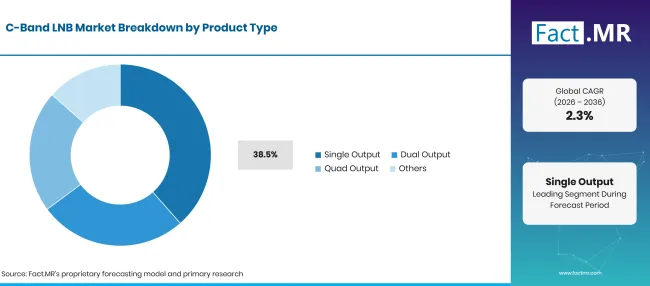
Sales of single-output C-band LNBs account for 38.5% of 2026 revenue, about USD 86.3 million. The segment leads because most professional receive chains feed one demodulator or one L-band distribution input per polarisation. Teleports and head-ends split signals downstream through L-band distribution amplifiers or RF-over-fibre links rather than at the LNB. The standard product is therefore a single-output, waveguide-input unit such as the NJS8496 series from Nisshinbo Micro Devices (April 2022), which covers 3.4 to 4.2 GHz with internal or external reference options. Dual and quad outputs remain relevant mainly in shared-dish and small multi-receiver installations.
Why Does the Satellite Communication Segment Lead by Application?
C Band Lnb Market Breakdown Application | Source: Fact.MR
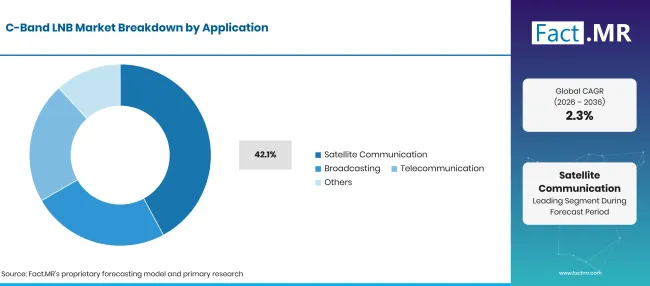
Demand for C-band LNBs in satellite communication accounts for 42.1% of 2026 revenue, about USD 94.3 million, covering VSAT backhaul, enterprise and government networks, and maritime and remote-site terminals that need an always-on link. These sites buy external-reference or high-stability PLL units because carrier frequency drift directly degrades modem lock. Actox's ALS5X, for example, is a 3.4 to 4.2 GHz external-reference LNB with 62 dB conversion gain, designed for C-band VSAT remote terminals, according to everything RF (accessed November 2026). Broadcasting is the second-largest application. Its share depends most on spectrum transitions, because programmers can move some distribution to IP.
Why Does the Commercial Segment Lead by End User?
C Band Lnb Market Breakdown End User | Source: Fact.MR
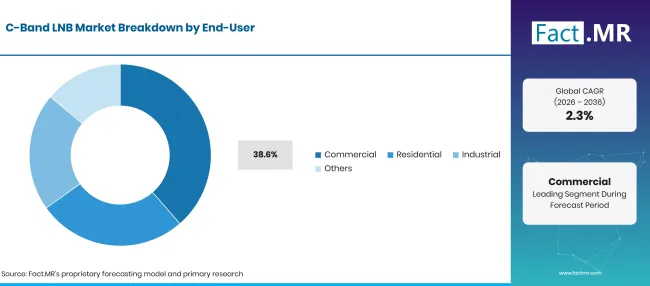
Demand from commercial users accounts for 38.6% of 2026 revenue, about USD 86.5 million. Broadcasters, teleport operators, telecom carriers and enterprise network owners buy to specification and replace units on a schedule to protect service-level commitments. Residential demand is structurally declining where household satellite TV has moved to Ku-band, as in Brazil. Industrial and government users buy smaller volumes of ruggedised, extended-temperature units at higher unit values.
C-Band LNB Market by Region and Country (2026 to 2036)
Sales of C-band LNBs in the five named countries account for 90.0% of 2026 revenue (USD 201.6 million). Fact.MR projects their combined share to rise to 90.9% by 2036, as Germany and Japan grow faster than the global average while Brazil and the rest of the world lose share. The United States remains the largest market throughout, but its share slips from 28.0% to 27.1% as the Upper C-band transition reduces the domestic receive base.
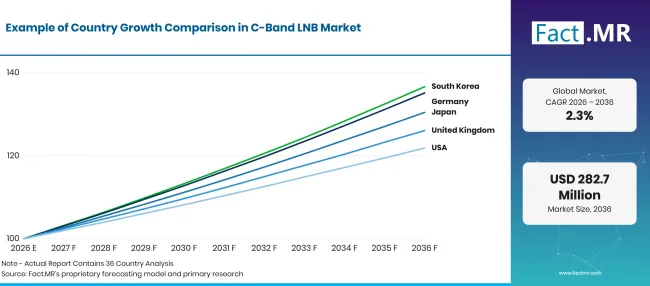
C Band Lnb Market Growth Index | Source: Fact.MR
| Country | 2026 Revenue | 2036 Revenue | 10-Year Addition | 2026 to 2036 CAGR | Global Share (2026 → 2036) |
|---|---|---|---|---|---|
| United States | USD 62.7 million | USD 76.5 million | USD 13.8 million | 2.0% | 28.0% → 27.1% |
| Germany | USD 49.3 million | USD 66.9 million | USD 17.6 million | 3.1% | 22.0% → 23.7% |
| Japan | USD 40.3 million | USD 52.7 million | USD 12.4 million | 2.7% | 18.0% → 18.6% |
| United Kingdom | USD 31.4 million | USD 39.8 million | USD 8.4 million | 2.4% | 14.0% → 14.1% |
| Brazil | USD 17.9 million | USD 21.0 million | USD 3.1 million | 1.6% | 8.0% → 7.4% |
| Rest of world | USD 22.5 million | USD 25.8 million | USD 3.3 million | 1.4% | 10.0% → 9.1% |
| Global total | USD 224.1 million | USD 282.7 million | USD 58.6 million | 2.3% | 100.0% → 100.0% |
Source: Fact.MR analysis. Updated Nov 16, 2026
Source: Fact.MR analysis of the C-band LNB market, 2026.
United States
Sales of C-band LNBs in the United States are projected to grow at a 2.0% CAGR from USD 62.7 million in 2026 to USD 76.5 million by 2036, adding USD 13.8 million (1.22x) while its global share eases from 28.0% to 27.1%. Demand comes from cable head-ends, network affiliates, government ground stations and teleports that have stayed in C-band after the earlier clearing of 3.7 to 4.0 GHz. The Federal Communications Commission (July 2026) is now reallocating a further 160 MHz in the 3.98 to 4.2 GHz band. This creates a short wave of filter and LNB retrofits during the transition, but leaves a smaller long-run installed base.
Germany
Demand for C-band LNBs in Germany is projected to expand at a 3.1% CAGR from USD 49.3 million in 2026 to USD 66.9 million by 2036, adding the largest dollar increment, USD 17.6 million (1.36x), and raising its share from 22.0% to 23.7%. Germany's teleports and broadcast operations handle international contribution feeds and government links that run on externally referenced, DVB-S2X-grade carriers. These sites buy higher-specification units than consumer-grade reception, and suppliers serving them compete on phase noise, reference stability and monitoring-and-control interfaces.
Japan
Sales of C-band LNBs in Japan are projected to grow at a 2.7% CAGR from USD 40.3 million in 2026 to USD 52.7 million by 2036, adding USD 12.4 million (1.31x) and lifting its share from 18.0% to 18.6%. Domestic RF manufacturing strengthens Japan's position. Nisshinbo Micro Devices (April 2022) specifies its NJS8496 series C-band PLL LNBs with internal stabilities of ±3, ±1 and ±0.3 ppm and an external-reference variant, which lets one product family cover both price-sensitive and premium professional orders.
United Kingdom
Demand for C-band LNBs in the United Kingdom is projected to grow at a 2.4% CAGR from USD 31.4 million in 2026 to USD 39.8 million by 2036, adding USD 8.4 million (1.27x) and holding its share at about 14.0% to 14.1%. UK demand is anchored by teleport and broadcast-playout operators and by exporters of satellite RF equipment. Global Invacom Group (April 2026) signed its worldwide Prodelin antenna distribution agreement through its wholly owned UK subsidiary. Global Invacom Group (August 2026) has since appointed TinSky Connect in South Africa to sell those antennas bundled with its RF electronics.
Brazil
Sales of C-band LNBs in Brazil are projected to grow at a 1.6% CAGR from USD 17.9 million in 2026 to USD 21.0 million by 2036, adding USD 3.1 million (1.17x), while its share falls from 8.0% to 7.4%. The low rate reflects the migration of household satellite TV from C-band to Ku-band. Revista SET (October 2025) reports that Globo's domestic digital C-band signals were switched off on 30 March 2025, while professional systems stayed in C-band above 3,700 MHz. Remaining demand therefore comes from professional earth stations, which DPL News (accessed November 2026) reports have been fitted with filters or re-tuned to avoid 5G interference.
Rest of World
Sales of C-band LNBs in the rest of the world, mainly South Asia, Southeast Asia, the Middle East and Africa, are projected to grow at a 1.4% CAGR from USD 22.5 million in 2026 to USD 25.8 million by 2036, adding USD 3.3 million, with its share falling from 10.0% to 9.1%. Unit demand in these markets is high because rain fade keeps VSAT and broadcast traffic in C-band. Revenue per unit is lower, however, because buyers favour lower-cost PLL models sold through regional distributors.
Competitive Environment and Notable Companies
Supply of C-band LNBs is split into two tiers. Tier-1 consists of specialist RF manufacturers with professional, operator-approved product lines: Nisshinbo Micro Devices, Norsat International, Orbital Research, Swedish Microwave and Global Invacom Group. Tier-2 includes regional and value-focused manufacturers such as Actox, along with distributors and integrators such as Av-Comm that resell other makers' LNBs. Many terminal integrators sell LNBs under their own brand or under licence, so a single manufacturer's design often appears under several brand names.
How Are Companies Positioned in the C-Band LNB Market?
Competition among C-band LNB suppliers falls into three groups. The first competes on oscillator stability and noise. Nisshinbo, Orbital Research and Swedish Microwave target teleports and contribution links with PLL and external-reference units. The second competes on interference rejection: Norsat pairs LNBs with band-pass filters for sites exposed to 5G. The third competes on system bundles. Global Invacom Group (April 2026) gained exclusive worldwide distribution of Prodelin antennas, so its LNBs and transceivers increasingly reach buyers as part of an antenna package.
What Matters When a Buyer Selects a C-Band LNB Supplier?
Selection of a C-band LNB supplier starts with mechanical and frequency fit: local-oscillator frequency, input band (standard, extended or INSAT), waveguide flange and IF connector must match the existing feed and receiver. They then compare noise temperature, phase noise against the modulation profile, internal-reference stability or external-reference locking, and interference rejection at the site. Operator approval, warranty length and the availability of identical spares often decide between suppliers whose specifications are similar.
Which Capabilities Distinguish Product Offers?
Differentiation among C-band LNB products rests on integrated filtering, reference flexibility and frequency coverage. Swedish Microwave (March 2026) combines full C-band coverage in two switchable sub-bands, integrated filters and a choice of reference models in one unit. Norsat International (accessed November 2026) offers a combined LNB and band-pass filter for 5G rejection. Nisshinbo Micro Devices (April 2022) offers four stability grades within one series. Monitoring-and-control interfaces and RF-over-fibre outputs further distinguish premium products, which compete with the L-band distribution market at large teleports.
How Does Geographic Reach Affect Competition?
Sales reach in the C-band LNB market depends on distributor coverage, because many buyers are small earth-station operators that purchase through local integrators. Global Invacom Group (July 2026) appointed Optimum Viking Satcom as its distributor for India, after Global Invacom Group (June 2026) appointed Viking Satcom for the Americas. Japanese and European manufacturers rely on regional distributors such as Av-Comm (accessed November 2026) in Australia, which lists Nisshinbo's NJS8496 full C-band LNB. Suppliers without approved local partners struggle to win replacement orders where buyers need same-week spares.
| Verified Company Evidence (2026) | Commercial Effect | Buyer Action |
|---|---|---|
| 24 February 2026: Global Invacom Group launched a rapid-deploy XY antenna range in 0.98 m, 1.2 m, 1.8 m and 2.4 m sizes for multi-orbit connectivity (Global Invacom Group, February 2026). | Extends the group from LNB components into complete terminals, so RF electronics are increasingly sold as part of a system. | Compare bundled terminal pricing against separately sourced antenna, LNB and BUC for lifecycle and spares cost. |
| 24 March 2026: Global Invacom Group signed an MoU with Satwave Arrays for commercial production of a Ka/Ku-band multi-orbit flat-panel antenna (Global Invacom Group, March 2026). | Signals that R&D effort is moving toward higher bands, while C-band lines become mature cash generators. | Confirm the supplier's long-term C-band roadmap and last-time-buy policy before standardising on its range. |
| 21 April 2026: Global Invacom Group became exclusive worldwide distributor of Prodelin SMC antennas, 1.2 m to 3.8 m transmit/receive, covering C, Ku, Ka and X bands (Global Invacom Group, April 2026). | Gives one supplier an operator-approved C-band antenna plus RF electronics, which makes it easier to sell an LNB with every antenna. | Request bundled quotes for C-band antenna, feed and LNB, and confirm Intelsat or Eutelsat approval for the full configuration. |
| 22 July 2026: The FCC adopted its Upper C-band order, reallocating 160 MHz of 3.98 to 4.2 GHz for terrestrial wireless use (Federal Communications Commission, July 2026). | Creates retrofit demand for filtered or re-tuned LNBs at incumbent US earth stations, but shrinks the US receive base over the decade. | Audit US sites against the incumbent earth-station list and order filtered units early, before installers face transition bottlenecks. |
| 27 July 2026: Telesat confirmed it is preparing to execute its Upper C-band transition plan and is eligible for USD 189 million in incentive payments, with plans due 5 November 2026 (Telesat, July 2026). | Space-station operators will schedule earth-station retrofits around their filed transition plans. | Coordinate equipment specifications with the serving satellite operator's transition plan before buying replacements. |
| 18 August 2026: Global Invacom Group appointed TinSky Connect to distribute Prodelin and Skyware antennas with its RF electronics in South Africa (Global Invacom Group, August 2026). | Widens regional spares and installation coverage in a rain-fade-prone C-band market. | Check local stock of matching LNB models and lead times through the new distributor. |
Source: Fact.MR analysis. Updated Nov 16, 2026
Source: Verified corporate disclosures and Fact.MR analysis, 2026.
| Company | Core Positioning | Verified Activity & Source Attribution |
|---|---|---|
| Nisshinbo Micro Devices (Tier-1) | Japanese RF manufacturer of C-band PLL LNBs (NJS8496, NJS8497 and NJS8498 series) | Datasheet specifies internal stabilities of ±3, ±1 and ±0.3 ppm plus an external-reference model (Nisshinbo Micro Devices, April 2022). |
| Norsat International (Tier-1) | C-band LNBs and band-pass filters for 5G interference rejection | Lists a C-Band 5G Rejection LNB and Band Pass Filter for terrestrial interference rejection (Norsat International, accessed November 2026). |
| Orbital Research (Tier-1) | Professional and military SATCOM LNBs (3400X, LNB515A series) | The 3400X external-reference LNB covers 3.4 to 4.2 GHz with a 0.25 dB noise figure (SatNow, accessed November 2026). |
| Swedish Microwave (Tier-1) | Premium professional LNBs and RF-over-fibre for earth stations | Product sheet lists a two-band 3.40 to 4.80 GHz C-band LNB with integrated filters and DVB-S2X-grade phase noise (Swedish Microwave, March 2026). |
| Global Invacom Group (Tier-1) | LNBs, transceivers and SMC antennas sold as bundles | Exclusive worldwide Prodelin antenna distribution from 21 April 2026, followed by distributor appointments for the Americas, India and South Africa (Global Invacom Group, April to August 2026). |
| Actox (Tier-2) | Value-focused PLL and external-reference C-band LNBs for VSAT | The ALS5X covers 3.4 to 4.2 GHz with 62 dB gain for C-band VSAT remote terminals (everything RF, accessed November 2026). |
| Av-Comm (Tier-2 distributor) | Australian distributor and integrator of satellite RF equipment | Lists Nisshinbo's NJS8496 full C-band LNB in its range (Av-Comm, accessed November 2026). |
| Intelsat (demand-side operator) | Geostationary C-band capacity provider driving receive-site demand | Authorised by IN-SPACe for four C-band satellites over India (Intelsat, May 2025). |
| Telesat (demand-side operator) | Incumbent US C-band space-station operator | Preparing to execute its Upper C-band transition plan (Telesat, July 2026). |
Source: Fact.MR analysis. Updated Nov 16, 2026
Research Sources and Bibliography
- Asia-Pacific Telecommunity. (2026, April). APT/AWG/REP-112(Rev.1): APT report on mitigation measures to improve sharing and compatibility between 4G-LTE and 5G-NR systems and other systems operating in portions of 3300-4200 MHz.
- Av-Comm. (Accessed 2026, November 11). NISD NJS8496 full C-band LNB product listing.
- DPL News. (Accessed 2026, November 11). EAF mitiga interferências na faixa de 3.5 GHz no Brasil.
- everything RF. (Accessed 2026, November 11). Actox ALS5X C-band low noise block product listing.
- Federal Communications Commission. (2026, July 31). Upper C-band (3.98-4.2 GHz); Expanding Flexible Use of the 3.7 to 4.2 GHz Band, Report and Order (FCC 26-46), Federal Register.
- Global Invacom Group. (2026, February 24). Global Invacom Group launches rapid deploy XY antenna range for mission-critical, multi-orbit connectivity.
- Global Invacom Group. (2026, March 24). Global Invacom and Satwave Arrays sign MoU for commercial production of next-generation multi-orbit flat panel antenna for Ka/Ku-band.
- Global Invacom Group. (2026, April 21). Global Invacom to market Prodelin (formerly CPI) range of VSAT antennas.
- Global Invacom Group. (2026, June 4). Global Invacom and Viking Satcom to bring Prodelin antennas back to the Americas
- Global Invacom Group. (2026, July 21). Optimum Viking Satcom selected to represent Global Invacom in India.
- Global Invacom Group. (2026, August 18). Global Invacom partners with TinSky Connect to bring Prodelin antennas to South Africa.
- Intelsat. (2025, May 27). Intelsat wins India approval for direct broadcast services.
- Nisshinbo Micro Devices. (2022, April 26). Datasheet of NJS8496 series C-band PLL LNB, internal and external reference model (DS-S8496).
- Norsat International. (Accessed 2026, November 11). C-Band 5G Rejection LNB and Band Pass Filter.
- Revista SET. (2025, October). GT Migração das Parabólicas, Revista SET No. 223
- SatNews. (2026, July 27). FCC approves Upper C-band order, allocating $5.6 billion to SES and $504 million to Eutelsat
- SatNow. (Accessed 2026, November 11). Orbital Research 3400X C-band low noise block
- Swedish Microwave. (2026, March). C LNB 3.40-4.80 GHz 2 Band product sheet
- Telesat. (2026, July 27). Telesat prepared to execute FCC Upper C-band transition plan
Segmentation
C-Band LNB Market Report Scope and Research Methodology
Fact.MR sizes the global C-band LNB market from the bottom up. The model starts with the installed base of C-band receive earth stations, VSAT terminals and broadcast receive sites in each covered country, applies replacement rates based on typical service life, and adds new-site and spectrum-transition retrofit volumes. Average selling prices by product type and stability grade convert volumes into revenue. The results are triangulated against supplier disclosures, distributor price lists and regulator transition filings, including Federal Communications Commission and band-clearing entity records. Country figures for the five named markets are modelled directly, and the rest of the world is derived as the residual of the global total.
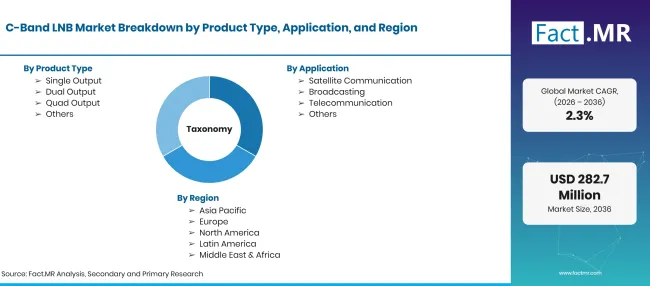
C Band Lnb Market Taxonomy | Source: Fact.MR
| Coverage Field | Report Scope |
|---|---|
| Market definition | Low-noise block downconverters that amplify and convert C-band satellite downlink signals (3.4 to 4.8 GHz) to L-band intermediate frequency for receivers and modems |
| Product types | Single-output, dual-output, quad-output and other multi-output C-band LNBs |
| Variants | PLL internal-reference, external-reference (10 MHz), DRO legacy, filter-integrated (5G rejection), multi-band switchable |
| Components included | LNB housing, LNA stages, mixer, local oscillator, integrated band-pass filter where built into the unit |
| Packaging formats | Waveguide-input units (CPR-229G, WR-229) with N-type or F-type IF output; outdoor weatherproof housings |
| Distribution channels | Direct OEM and operator sales, authorised distributors, system integrators, online B2B channels |
| End users | Commercial (broadcasters, teleports, telecom carriers, enterprises), residential, industrial and government users |
| Exclusions | Standalone LNAs, block upconverters, transceivers, antennas, feeds, standalone filters, modems, receivers and complete terminals |
| Quantitative units | USD million for value; percentage for share and CAGR |
| Volume basis | Units shipped to end users and integrators, counted once at first sale |
| Value basis | Manufacturer selling price revenue in the country of sale, constant 2026 USD |
| Regions covered | North America, Latin America, Europe, East Asia, South Asia and Pacific, Middle East and Africa |
| National coverage | United States, Germany, Japan, United Kingdom, Brazil, with the rest of the world as a residual |
| Companies covered | Nisshinbo Micro Devices, Norsat International, Orbital Research, Swedish Microwave, Global Invacom Group, Actox, Av-Comm |
Source: Fact.MR analysis. Updated Nov 16, 2026
Frequently Asked Questions
How big is the C-band LNB market in 2026?
How fast is the C-band LNB market expected to grow through 2036?
Which product type leads the C-band LNB market?
Which application leads the C-band LNB market?
Which end user leads the C-band LNB market?
Which country is the largest C-band LNB market?
Which countries are expected to grow fastest in the C-band LNB market?
How does spectrum reallocation affect the C-band LNB market?
Who worked on this report


Preview the report firsthand - request a free sample
Free SampleGet the brochure for pricing and purchase details
Download PDF