Embodied-Carbon Chillers Market Size, Share, Growth and Forecast (2026 - 2036)
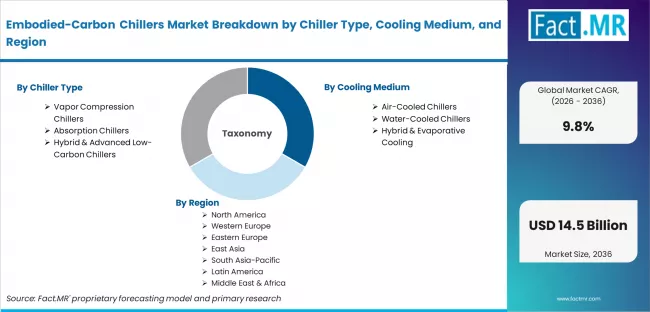
The Embodied-Carbon Chillers Market is segmented by Chiller Type, Cooling Medium, Embodied Carbon Reduction Strategy, Refrigerant Type, Installation Type, Application, End User and Region. Forecast for 2026 to 2036.
Fact.MR is of the opinion that the embodied-carbon chillers market is transitioning from energy-efficiency-focused HVAC procurement toward lifecycle carbon optimization, where low-GWP refrigerants, circular manufacturing practices, and AI-enabled high-efficiency cooling systems will become critical competitive differentiators across commercial and industrial infrastructure.
Embodied-Carbon Chillers Market Overview, Growth Outlook, and Forecast by Fact.MR
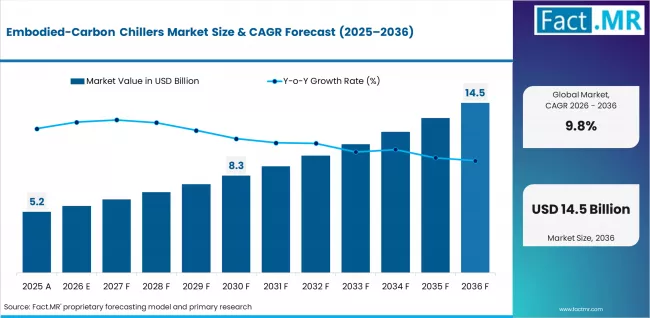
- Global embodied-carbon chillers market was valued at USD 5.2 Bn in 2025 and is forecast to reach USD 14.5 Bn by 2036.
- At a 9.8% CAGR from 2026 to 2036. This market is set to expand ~ 2.5 x in value, adding USD 8.8 Bn in absolute opportunity.
- This represents a transformational growth trajectory rather than incremental expansion, driven by accelerating investments in low-carbon HVAC technologies, high-efficiency chiller systems, low-GWP refrigerants, and AI-enabled sustainable cooling infrastructure.
- Growth momentum is expected to remain strong due to increasing demand for green buildings, data center cooling efficiency, district cooling networks, and lifecycle carbon reduction solutions, although factors such as high upfront installation costs, retrofit complexity, regulatory compliance challenges, and supply chain constraints may moderate adoption across certain applications and regions.
Summary of the Embodied-Carbon Chillers Market
- Market Snapshot
- Global embodied-carbon chillers market revenue stood at USD 5.2 billion in 2025 and is forecast to reach USD 14.5 billion by 2036.
- At a 9.8% CAGR from 2026 to 2036, this market is set to expand ~2.5x in value, adding USD 8.8 billion in absolute opportunity.
- Growth is being driven by increasing adoption of low-carbon and energy-efficient cooling systems across commercial buildings, industrial infrastructure, and institutional facilities.
- Rising focus on reducing lifecycle carbon emissions, improving refrigerant sustainability, and enhancing green building compliance is accelerating deployment of embodied-carbon optimized chillers. Integration of low-GWP refrigerants, circular manufacturing practices, and advanced cooling architectures is further supporting market expansion globally.
- Demand and Growth Drivers
- Increasing emphasis on reducing embodied carbon emissions across HVAC and building infrastructure projects.
- Growing adoption of sustainable cooling technologies aligned with green building standards and carbon neutrality initiatives.
- Expansion of commercial construction and energy-efficient infrastructure modernization programs globally.
- Rising deployment of low-GWP refrigerants and advanced cooling optimization systems in industrial and institutional facilities.
- Need for solutions that provide:
- Reduced lifecycle carbon footprint
- Improved energy efficiency and cooling performance
- Sustainable refrigerant management
- Enhanced compliance with environmental regulations and ESG targets
- Product and Segment View
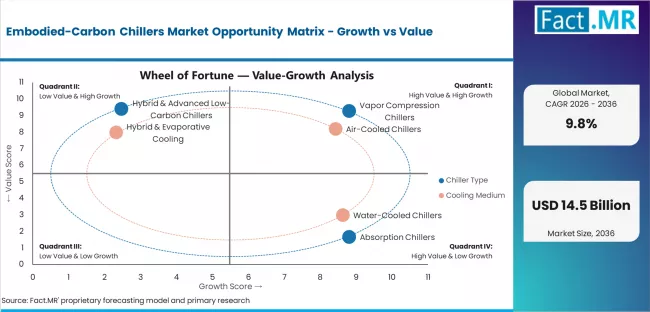
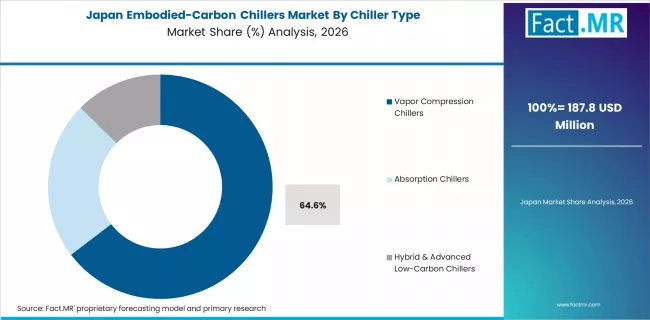
- Vapor compression chillers hold 68% of chiller type share in 2025, emerging as the leading segment due to widespread deployment across commercial and industrial cooling systems.
- Hybrid & advanced low-carbon chillers account for 20% share, while absorption chillers represent 12%.
- Air-cooled chillers account for 46% of cooling medium share in 2025, positioning them as the dominant segment driven by lower installation complexity and energy-efficient operation.
- Water-cooled chillers represent 39% share, while evaporative & hybrid cooling systems account for 15%.
- Energy efficiency optimization holds 47% share by embodied carbon reduction strategy, supported by increasing investment in intelligent cooling optimization technologies.
- Low-carbon material integration contributes 28% share, while circular economy practices account for 25%.
- HFO refrigerants hold 44% share by refrigerant type, reflecting rising adoption of low-global-warming-potential cooling technologies.
- Natural refrigerants represent 24% share, while low-GWP synthetic refrigerants account for 32%.
- Geography and Competitive Outlook
- Growth is supported across North America, Europe, and Asia Pacific driven by increasing investments in sustainable infrastructure and low-carbon building technologies.
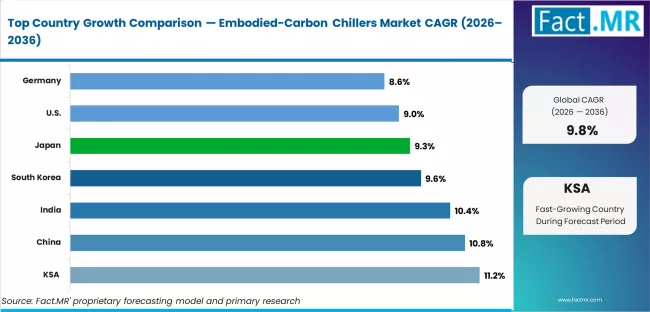
- Key growth markets and CAGR include: Germany at 8.6% CAGR, U.S. at 9.0% CAGR, Japan at 9.3% CAGR, South Korea at 9.6% CAGR, India at 10.4% CAGR, China at 10.8% CAGR, and KSA at 11.2% CAGR.
- Market expansion is closely tied to:
- Increasing deployment of energy-efficient HVAC systems
- Expansion of green commercial buildings and sustainable infrastructure projects
- Rising investment in low-GWP refrigerants and circular cooling technologies
- Key companies active in this market include Trane Technologies, Carrier Global Corporation, Daikin Industries Ltd., Johnson Controls International plc, and Mitsubishi Electric Corporation.
- Analyst Opinion
- Shambhu Nath Jha, Principal Consultant at Fact.MR, says, “The Embodied-Carbon Chillers Market is no longer defined solely by conventional HVAC efficiency standards and basic cooling system deployments. Growth is increasingly driven by low-GWP refrigerant adoption, AI-enabled energy optimization, oil-free high-efficiency chiller technologies, and the shift toward lifecycle carbon reduction solutions that enhance energy performance, operational sustainability, and decarbonization across commercial buildings, data centers, district cooling networks, and industrial infrastructure
Embodied-Carbon Chillers Market— At a Glance
| Attribute | Details |
|---|---|
| Market Value 2025 | USD 5.2 billion |
| Market Value 2036 | USD 14.5 billion |
| Absolute Dollar Opportunity 2025–2036 | USD 8.8 billion |
| Total Growth 2025–2036 | 178.8% |
| CAGR 2026–2036 | 9.8% |
| Growth Multiple | ~2.5x |
| Key Demand Theme | Increasing adoption of low-carbon and sustainable cooling infrastructure |
| Leading Segment by Chiller Type (2025) | Vapor Compression Chillers |
| Segment Share (2025) | 68% |
| Leading Segment by Cooling Medium (2025) | Air-Cooled Chillers |
| Segment Share (2025) | 46% |
| Leading Segment by Carbon Reduction Strategy (2025) | Energy Efficiency Optimization |
| Segment Share (2025) | 47% |
| Leading Segment by Refrigerant Type (2025) | HFO Refrigerants |
| Segment Share (2025) | 44% |
| Leading Segment by Installation Type (2025) | New Installations |
| Segment Share (2025) | 43% |
| Leading Segment by Application (2025) | Commercial Buildings |
| Segment Share (2025) | 41% |
| Leading Segment by End User (2025) | Private Sector |
| Segment Share (2025) | 56% |
| Key Growth Regions | North America, Europe, Asia Pacific |
| Country CAGRs | Germany 8.6%, U.S. 9.0%, Japan 9.3%, South Korea 9.6%, India 10.4%, China 10.8%, KSA 11.2% |
| Top Companies | Trane Technologies, Carrier Global, Daikin Industries, Johnson Controls, Mitsubishi Electric |
| Segmentation by Chiller Type | Vapor Compression Chillers, Absorption Chillers, Hybrid & Advanced Low-Carbon Chillers |
| Segmentation by Cooling Medium | Air-Cooled Chillers, Water-Cooled Chillers, Evaporative & Hybrid Cooling |
| Segmentation by Embodied Carbon Reduction Strategy | Low-Carbon Material Integration, Energy Efficiency Optimization, Circular Economy Practices |
| Segmentation by Refrigerant Type | HFO Refrigerants, Natural Refrigerants, Low-GWP Synthetic Refrigerants |
| Segmentation by Installation Type | New Installations, Retrofit Installations, Modular Installations |
| Segmentation by Application | Commercial Buildings, Industrial Applications, Infrastructure & Institutional |
| Segmentation by End User | Private Sector, Public Sector, Energy & Utility Providers |
| Segmentation by Region | North America, Latin America, Europe, Asia Pacific, Middle East & Africa |
How Is Commercial Building Construction Activity Influencing the Growth of the Embodied-Carbon Chillers Market?
Rapid expansion of commercial construction activity is significantly driving demand for embodied-carbon chillers across office complexes, hospitals, retail centers, hotels, and mixed-use infrastructure projects. Developers are increasingly prioritizing low-carbon HVAC systems to comply with green building regulations, improve energy efficiency, and achieve sustainability certifications such as LEED and BREEAM. Growing investments in smart buildings and net-zero commercial infrastructure are accelerating adoption of chillers using low-GWP refrigerants, AI-enabled optimization systems, and energy-efficient compressor technologies. Emerging economies are witnessing strong demand due to urbanization and infrastructure modernization, while developed regions are increasingly focused on retrofitting aging commercial HVAC systems with sustainable cooling technologies.
Why Are Low-GWP Refrigerant Adoption Rates Critical to the Embodied-Carbon Chillers Market?
The transition toward low-GWP refrigerants is becoming one of the most important growth drivers for the embodied-carbon chillers market due to tightening environmental regulations and global decarbonization targets. Governments and regulatory agencies are gradually phasing down high-GWP hydrofluorocarbon refrigerants under frameworks such as the Kigali Amendment and regional F-gas regulations. This is encouraging manufacturers and building operators to adopt chillers utilizing HFOs, natural refrigerants, and advanced refrigerant blends with lower environmental impact. Low-GWP refrigerants not only reduce direct greenhouse gas emissions but also support long-term sustainability goals for commercial buildings, industrial facilities, data centers, and district cooling infrastructure worldwide.
Key Growth Drivers, Constraints, and Opportunities
Key Factors Driving Growth
- The increased demand for low-carbon HVAC solutions, energy-efficient buildings, sustainable industrial cooling infrastructure, and eco-friendly data center cooling systems is expected to fuel market growth worldwide.
- The use of low GWP refrigerants, oil-free magnetic bearing chillers, energy-optimizing AI systems, and advanced smart cooling technologies is expected to fuel market growth.
- The increased development of green building projects, district cooling infrastructure, hyperscale data centers, and commercial HVAC retrofit projects is expected to help drive market growth globally.
| Growth Driver | Demand Impact | Time Horizon | Key Impact Area | Fact.MR Insight |
|---|---|---|---|---|
| Rising investments in green buildings and sustainable commercial infrastructure | High | Short-Mid Term | Low-carbon HVAC systems | Increasing focus on lifecycle carbon reduction is driving adoption of embodied-carbon chillers |
| Growing demand for energy-efficient cooling in data centers and industrial facilities | High | Short-Mid Term | High-efficiency cooling infrastructure | Expansion of hyperscale data centers and industrial automation is accelerating demand for advanced chillers |
| Expansion of district cooling networks and smart city infrastructure | High | Mid-Long Term | Urban cooling systems | Governments and utilities are investing heavily in centralized sustainable cooling solutions |
| Advancements in AI-enabled energy optimization and oil-free chiller technologies | Medium-High | Mid-Long Term | Intelligent HVAC management | Smart cooling systems are improving operational efficiency and reducing lifecycle emissions |
| Rising adoption of low-GWP refrigerants and refrigerant transition regulations | Medium | Short-Mid Term | Sustainable refrigerant ecosystem | Regulatory pressure on high-GWP refrigerants is accelerating replacement of legacy chillers |
Key Market Constraints
- The high installation cost of advanced low-carbon chillers, premium refrigerants, and energy-efficient HVAC solutions is expected to act as a market restraint worldwide.
- Issues associated with retrofit complexity, infrastructure compatibility, lack of skillsets required for such installations, and system integration can affect adoption rates.
- The lack of clarity in regulations in developing economies, maintenance costs of advanced cooling systems, and lack of awareness about embodied carbon accounting may hinder market growth.
Key Opportunity Areas
- Solutions providers that make embodied-carbon chillers will have growth prospects in green commercial buildings, hyperscale data centers, district cooling, and smart infrastructures.
- The increasing application of these solutions in the healthcare industry, industrial manufacturing plants, transportation infrastructure, education institutions, and sustainable cities will offer growth opportunities.
- Increased investments in net-zero buildings, HVAC renovation programs, low GWP refrigerant technology, AI-driven BMS technology, and circular manufacturing solutions will bring long-term market value.
Segment-wise Analysis of the Embodied-Carbon Chillers Market
- By the year 2026, Vapor Compression Chillers accounted for a 68% market share of the chiller type segment due to increasing adoption of energy-efficient cooling systems, rising deployment across commercial buildings and data centers, growing demand for low-GWP refrigerant technologies, and accelerating investments in sustainable HVAC infrastructure.
- Commercial Buildings represent a 41% market share of the application segment by 2026, driven by rising green building construction, increasing retrofit demand for energy-efficient HVAC systems, growing adoption of smart building technologies, and expanding investments in low-carbon commercial infrastructure projects.
The segmentation of the embodied-carbon chillers market includes chiller type, cooling medium, embodied carbon reduction strategy, refrigerant type, installation type, application, end user, and region.
Which Chiller Type Dominates the Embodied-Carbon Chillers Market?
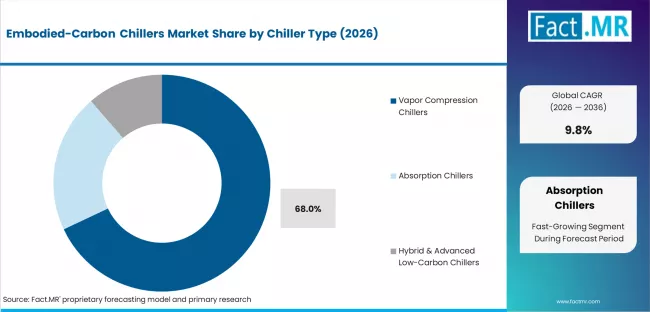
Vapor Compression Chillers hold the 68% market share in the market owing to factors such as high adoption of energy-efficient chillers, use of low-GWP refrigerants, implementation of smart HVAC systems, and adoption of sustainable commercial cooling systems. The factors driving the segment include increased demand for green buildings, advanced data center cooling, industrial process efficiency, and energy optimization using AI.
Which Cooling Medium Dominates the Embodied-Carbon Chillers Market?
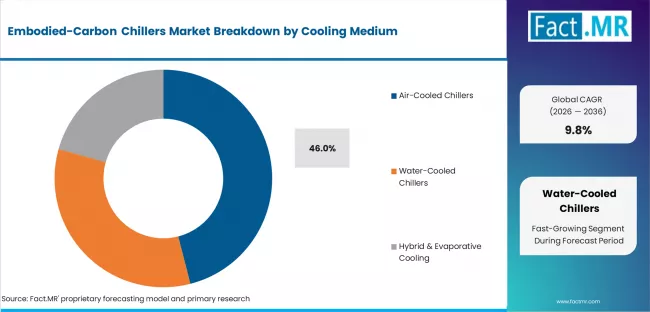
Air-Cooled Chillers hold the 46% market share in the market owing to factors such as high adoption of water-efficient chillers, simplified installation procedures, and energy-efficient commercial HVAC systems. Some of the key growth drivers include rising commercial construction activities, growing number of retrofits, increasing urban infrastructure, and low maintenance cost.
Which Embodied Carbon Reduction Strategy Dominates the Embodied-Carbon Chillers Market?
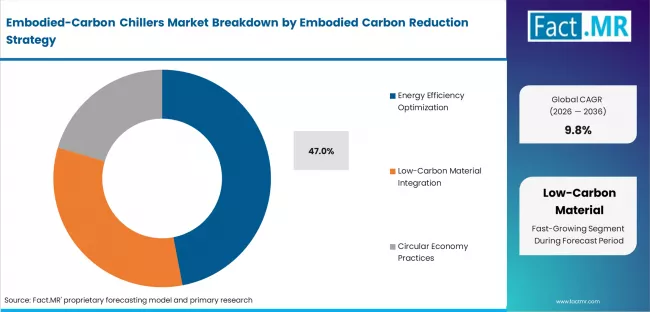
Energy Efficiency Optimization holds the 47% market share in the market owing to factors such as growing use of AI-based building management systems, adoption of variable-speed compressors, and energy optimization. The factors driving the growth of the segment include rising energy costs, efforts towards decarbonization, net-zero initiatives in buildings, and energy optimization.
Which Refrigerant Type Dominates the Embodied-Carbon Chillers Market?
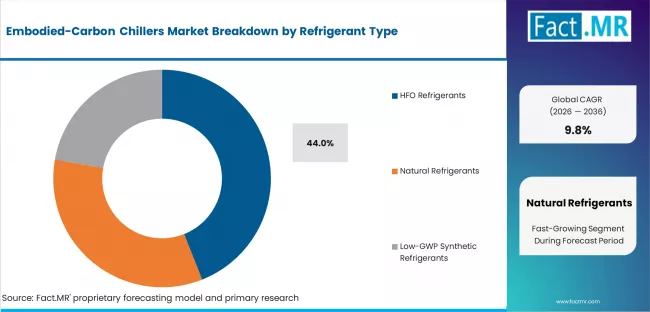
HFO Refrigerants hold the 44% market share in the market owing to factors such as adoption of low-GWP refrigerants, strict environmental regulations, and rise in the adoption of sustainable chillers. The factors driving the segment include global phase down of refrigerants, green building certification, commercial HVAC upgrade, and need for environment-friendly chilling solutions.
Which Application Dominates the Embodied-Carbon Chillers Market?
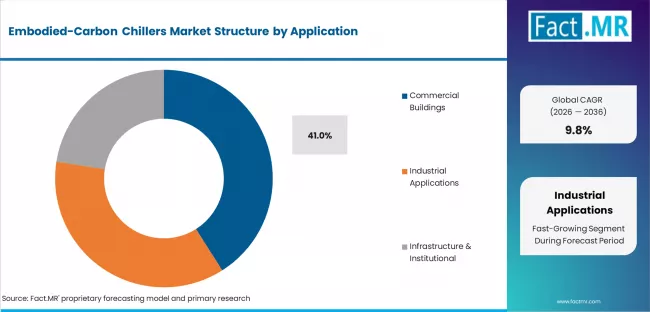
Commercial Buildings hold the 41% market share in the market owing to factors such as the growing adoption of green building norms, use of smart HVAC systems, and sustainable cooling infrastructure in office spaces, retail complexes, hotels, and healthcare facilities. The factors driving the growth of the segment include commercial construction investment, energy-efficiency norms, retrofitting, and net-zero initiatives.
Regional Outlook Across Key Markets
The market analysis covers key global regions, including South Asia and Pacific, Middle East & Africa, North America, Latin America, Western Europe, and Eastern Europe. It is segmented geographically, with specific market dynamics for each region. The full report provides a detailed market attractiveness analysis.
.webp)
CAGR Table
| Country | CAGR (%) |
|---|---|
| Germany | 8.6% |
| U.S. | 9.0% |
| Japan | 9.3% |
| South Korea | 9.6% |
| India | 10.4% |
| China | 10.8% |
| KSA | 11.2% |
Source: Fact.MR (FMR) analysis, based on proprietary forecasting model and primary research.
North America
North America serves as the global innovation hub for sustainable HVAC modernization, supported by stringent energy-efficiency regulations, rapid data center expansion, and large-scale commercial retrofit activity. Major players including Trane Technologies, Carrier Global Corporation, and Johnson Controls maintain strong competitive positioning through low-GWP refrigerant technologies, smart HVAC systems, and AI-enabled building energy optimization platforms. Regional demand is further strengthened by green building investments, federal decarbonization incentives, and growing hyperscale data center cooling requirements.
- U.S. - Demand for embodied-carbon chillers in the U.S. is projected to rise at 9.0% CAGR through 2036. Market growth is supported by federal decarbonization initiatives and expanding sustainable infrastructure investments. In January 2025, the U.S. Department of Energy strengthened commercial building energy-efficiency programs promoting low-emission HVAC adoption [1]. Growing hyperscale data center development, increasing LEED-certified commercial projects, and rising retrofit activity across aging office infrastructure continue to drive strong adoption of energy-efficient and low-carbon cooling systems across the country.
Western Europe
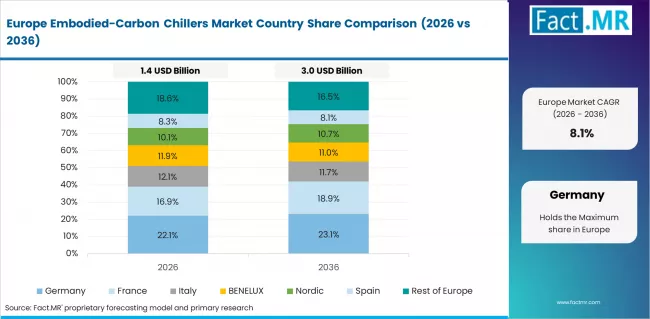
Western Europe acts as the global regulatory laboratory for embodied-carbon cooling technologies, driven by strict F-gas regulations, aggressive net-zero targets, and high adoption of green building certifications. Companies including Daikin Industries Ltd., Bosch Thermotechnology, and Danfoss maintain strong regional influence through sustainable refrigerant innovation and high-efficiency HVAC solutions. Regional demand is shaped by carbon disclosure mandates, energy-efficiency modernization programs, and increasing investments in climate-resilient infrastructure.
- Germany - Demand for embodied-carbon chillers in Germany is projected to rise at 8.6% CAGR through 2036. Growth is supported by stringent decarbonization policies and industrial energy-efficiency modernization programs. In March 2025, Bosch Thermotechnology increased investments in sustainable HVAC manufacturing and refrigerant transition technologies [2].
East Asia
East Asia functions as the global manufacturing and technology powerhouse for advanced cooling systems, supported by large-scale HVAC production capacity, smart infrastructure investments, and rapid industrial modernization. Key companies including Mitsubishi Electric Corporation, LG Electronics, and Panasonic Holdings Corporation dominate regional competition through high-efficiency cooling technologies and low-GWP refrigerant innovation. Demand growth is further accelerated by semiconductor manufacturing expansion, urban infrastructure development, and increasing carbon-neutrality commitments.
- China - Demand for embodied-carbon chillers in China is projected to rise at 10.8% CAGR through 2036. Growth is driven by rapid smart city development, industrial decarbonization policies, and district cooling expansion. In May 2025, Mitsubishi Electric Corporation expanded high-efficiency HVAC manufacturing partnerships supporting low-carbon commercial infrastructure projects in China [3].
- Japan - Demand for embodied-carbon chillers in Japan is projected to rise at 9.3% CAGR through 2036. Market growth is supported by advanced energy-efficiency standards and strong adoption of smart building technologies
South Asia & Pacific
South Asia & Pacific represents the fastest-growing infrastructure expansion zone for embodied-carbon chillers, supported by rapid urbanization, commercial construction growth, and increasing energy-efficiency awareness. Companies including Daikin Industries Ltd., Thermax Limited, and Samsung Electronics are strengthening regional presence through sustainable HVAC manufacturing and smart cooling technologies. Growing demand for green commercial buildings, data centers, and industrial cooling systems continues to create substantial long-term growth opportunities.
- India - Demand for embodied-carbon chillers in India is projected to rise at 10.4% CAGR through 2036. Growth is supported by rapid urban infrastructure development and government-led energy-efficiency initiatives. In January 2025, India expanded implementation of the Energy Conservation Building Code promoting sustainable HVAC systems across commercial projects [4].
Middle East & Africa
The Middle East & Africa region serves as the global district cooling expansion hub, driven by extreme climate conditions, mega infrastructure developments, and rising sustainability mandates. Companies including ENGIE, Smardt Chiller Group, and Carrier Global Corporation maintain strong market positioning through large-scale district cooling projects and high-efficiency chiller deployments. Increasing investments in smart cities, hospitality infrastructure, and low-carbon urban development continue to support robust regional demand growth.
- KSA - Demand for embodied-carbon chillers in KSA is projected to rise at 11.2% CAGR through 2036. Growth is driven by giga-project developments, district cooling expansion, and sustainability-focused infrastructure modernization. In March 2025, ENGIE expanded participation in district cooling and sustainable infrastructure projects linked to NEOM and other large-scale urban developments [5].
Fact.MR’s analysis of the embodied-carbon chillers market provides region-wise and country-wise assessment across North America, Western Europe, East Asia, South Asia & Pacific, and Middle East & Africa. Readers can access detailed insights on sustainable HVAC investments, low-GWP refrigerant adoption, district cooling expansion, green building trends, commercial retrofit activity, industrial cooling demand, data center infrastructure growth, regulatory developments, and competitive positioning shaping long-term market opportunities.
Competitive Benchmarking and Company Positioning
Leading Companies Shaping the Embodied-Carbon Chillers Market
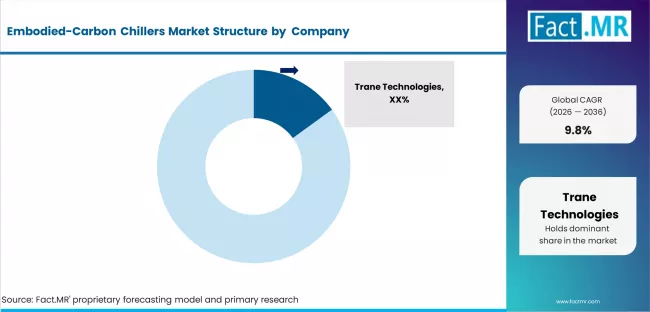
The embodied-carbon chiller industry exhibits moderate levels of concentration, with firms like Trane Technologies, Johnson Controls, Carrier, and Daikin Industries Ltd. among the top firms. The competitive dynamics within the industry are centered around energy efficiency, GWP refrigerants, artificial intelligence-based building management systems, and carbon life cycle optimization. Large organizations have an advantage due to vertical integration, extensive HVAC distribution channels, advanced automation technologies, and service agreements that span several years. Customers in the commercial real estate sector and data centers use a multiple vendor sourcing approach, which lessens their dependence on suppliers and improves their negotiating power.
Key Players of the Embodied-Carbon Chillers Market
- Trane Technologies
- Johnson Controls
- Carrier
- Daikin Industries Ltd.
- Mitsubishi Electric Corporation
- LG Electronics
- Panasonic Holdings Corporation
- Samsung Electronics
- Danfoss
- Siemens AG
- Veolia
- Thermax Limited
Recent Industry Developments
- Trane Technologies launches HSAG air-cooled magnetic bearing chiller for data centers (February 2026): Trane Technologies introduced the HSAG air-cooled magnetic bearing centrifugal chiller designed for Asia-Pacific hyperscale data centers. The system integrates oil-free magnetic levitation technology and low-GWP R1234ze refrigerant to improve energy efficiency and reduce lifecycle carbon emissions across mission-critical cooling applications. (Trane Press Release) [6]
- Carrier Global Corporation announces investment in advanced chiller manufacturing facility in India (May 2026): Carrier Global announced a US$100 million investment in a new manufacturing facility in Sri City, Andhra Pradesh, to expand chiller and cooling system production capacity. The investment is aimed at supporting growing demand from data centers, commercial infrastructure, and sustainable cooling applications. (Thermal Control Magazine) [7]
- Trane Technologies expands thermal management systems portfolio for sustainable cooling applications (June 2025): Trane Technologies expanded its thermal management systems capabilities with advanced liquid cooling technologies and AI-enabled building optimization systems targeting data centers and commercial infrastructure. The expansion strengthens the company’s sustainable HVAC portfolio and supports high-efficiency cooling deployment in low-carbon infrastructure projects. (Trane Press Release) [8]
Sources and Research References
- [1] U.S. Department of Energy, “Commercial Buildings Integration Program and Energy Efficiency Initiatives,” January 2025
- [2] Bosch Thermotechnology, “Bosch Expands Sustainable HVAC and Refrigerant Transition Investments,” March 2025
- [3] Mitsubishi Electric Corporation, “Expansion of High-Efficiency HVAC Manufacturing Partnerships in China,” May 2025
- [4] Bureau of Energy Efficiency (India), “Energy Conservation Building Code Implementation Framework,” January 2025
- [5] ENGIE, “ENGIE Expands Participation in NEOM and District Cooling Infrastructure Projects,” March 2025
- [6] Trane Technologies, “Trane Launches HSAG Air-Cooled Magnetic Bearing Chiller to Drive Asia Pacific Data Center Growth,” February 2026
- [7] Carrier Global Corporation, “Carrier Expands India Manufacturing Footprint with $100 Million Sri City Investment,” May 2026
- [8] Trane Technologies, “Trane Commercial HVAC Press Releases and Sustainable Cooling Portfolio Expansion,” June 2025
Embodied-Carbon Chillers Market Definition
The embodied-carbon chillers market encompasses cooling solutions that lower lifecycle carbon emissions related to manufacture, deployment, operational performance, and refrigerant emissions. Such chillers adopt high energy efficiency compressors, low GWP refrigerants, recycled material usage, and optimization technology to enable sustainable cooling operations. The primary purpose of the equipment in question is to deliver efficient temperature management in commercial buildings, industrial plants, data centers, and district cooling solutions while minimizing environmental impact. Advanced air cooled, water cooled, absorption, and hybrid chillers deployed in green building and decarbonization projects are included.
Embodied-Carbon Chillers Market Inclusions
The research analyzes the size of the market globally and by region, providing volume and value projections for the period 2026-2036. Segmentation covered in the report is based on chiller type, cooling medium, refrigerant type, installation type, application, end-use industry, and geography. Pricing dynamics, technology diffusion, competition, regulatory environment, sustainability developments, and low GWP refrigerant and energy-efficient cooling investments are among issues examined.
Embodied-Carbon Chillers Market Exclusions
The study does not consider traditional chillers without energy-efficient or sustainable features, room air conditioning units, domestic refrigerators, and portable coolers. It does not include maintenance services provided by HVAC professionals, cooling towers, and any other parts of refrigeration systems unrelated to the topic.
Embodied-Carbon Chillers Market Research Methodology
- Primary Research
- Primary Interviews involved interaction with chiller suppliers, HVAC integration systems providers, refrigerant suppliers, developers of commercial buildings, data centers, sustainability experts, and industry analysts in North America, Europe, Asia-Pacific, and the Middle East regions.
- Desk Research
- Secondary Research involved analyzing annual reports, sustainability reports, HVAC industry periodicals, energy efficiency regulations by governments, green building databases, financial information, and technology adoption records.
- Market-Sizing and Forecasting
- Market sizing was done using a combination of bottom-up approaches using chiller shipments and installations as well as top-down using HVAC infrastructure expenditure, refrigerant shift trends, and regional cooling demands.
- Data Validation and Update Cycle
- All market estimates were cross-checked through triangulation methods using primary interviews, supplier revenue estimates, regional demand models, and adoption trends. Assumptions used in forecasting will be regularly updated in light of regulatory changes, infrastructure expenditure trends, and technology commercialization trends.
Scope of Analysis

| Parameter | Details |
|---|---|
| Quantitative Units | USD 5.2 billion in 2025 to USD 14.5 billion in 2036, at a CAGR of 9.8% |
| Market Definition | The Embodied-Carbon Chillers Market comprises sustainable cooling systems designed to reduce lifecycle carbon emissions through energy-efficient technologies, low-GWP refrigerants, recycled materials, and smart HVAC optimization across commercial and industrial infrastructure. |
| Regions Covered | North America, Latin America, Europe, East Asia, South Asia and Pacific, MiddleEastand Africa |
| Countries Covered | USA, Canada, UK, Germany, China, India, 30 plus countries |
| Key Companies | Trane Technologies, Johnson Controls, Carrier, Daikin Industries Ltd., Mitsubishi Electric Corporation, LG Electronics, Panasonic Holdings Corporation, Samsung Electronics, Danfoss, Siemens AG, Veolia, Thermax Limited |
| Forecast Period | 2026 to 2036 |
| Approach | Hybrid demand-side and top-downmethodologybuilt on country-level application demand, product benchmarking, pricing analysis, shipment validation, and primary interviews across manufacturers, distributors, retailers, and end users |
Analysis by Chiller Type, by Cooling Medium, by Embodied Carbon Reduction Strategy, by Refrigerant Type, by Installation Type, by Application, by End User and by Region
-
Embodied-Carbon Chillers Market by Chiller Type
- Vapor Compression Chillers
- Scroll Chillers
- Screw Chillers
- Centrifugal Chillers
- Reciprocating Chillers
- Absorption Chillers
- Single-Effect Absorption
- Double-Effect Absorption
- Triple-Effect Absorption
- Hybrid & Advanced Low-Carbon Chillers
- Heat Recovery Chillers
- Free Cooling Chillers
- Solar-Assisted Chillers
- Vapor Compression Chillers
-
Embodied-Carbon Chillers Market by Cooling Medium
- Air-Cooled Chillers
- Packaged Air-Cooled
- Modular Air-Cooled
- Low-GWP Air-Cooled
- Water-Cooled Chillers
- Open Loop Water-Cooled
- Closed Loop Water-Cooled
- High-Efficiency Water-Cooled
- Hybrid & Evaporative Cooling
- Evaporative Condensing
- Wet-Dry Hybrid Cooling
- Adiabatic Cooling Systems
- Air-Cooled Chillers
-
Embodied-Carbon Chillers Market by Embodied Carbon Reduction Strategy
- Low-Carbon Material Integration
- Recycled Steel Components
- Low-Carbon Aluminum
- Green Concrete Installations
- Energy Efficiency Optimization
- Variable Speed Drives
- AI-Based Energy Management
- Smart Building Integration
- Circular Economy Practices
- Remanufactured Chillers
- Modular Upgrade Systems
- Lifecycle Extension Programs
- Low-Carbon Material Integration
-
Embodied-Carbon Chillers Market by Refrigerant Type
- HFO Refrigerants
- R1234ze
- R1233zd
- HFO Blends
- Natural Refrigerants
- Ammonia (NH3)
- Carbon Dioxide (CO2)
- Hydrocarbons
- Low-GWP Synthetic Refrigerants
- R32
- R513A
- R515B
- HFO Refrigerants
-
Embodied-Carbon Chillers Market by Installation Type
- New Installations
- Greenfield Commercial Projects
- Industrial Facility Development
- Smart Infrastructure Projects
- Retrofit Installations
- HVAC System Modernization
- Refrigerant Replacement Projects
- Energy Efficiency Upgrades
- Modular Installations
- Portable Cooling Systems
- Containerized Chillers
- Scalable Cooling Networks
- New Installations
-
Embodied-Carbon Chillers Market by Application
- Commercial Buildings
- Office Buildings
- Retail Complexes
- Hospitality Facilities
- Industrial Applications
- Food & Beverage Processing
- Pharmaceutical Manufacturing
- Electronics & Semiconductor
- Infrastructure & Institutional
- Data Centers
- District Cooling
- Transportation Infrastructure
- Commercial Buildings
-
Embodied-Carbon Chillers Market by End User
- Private Sector
- Commercial Real Estate
- Industrial Enterprises
- Data Center Operators
- Public Sector
- Government Buildings
- Educational Institutions
- Healthcare Infrastructure
- Energy & Utility Providers
- District Cooling Operators
- Renewable Energy Utilities
- Smart City Projects
- Private Sector
-
Embodied-Carbon Chillers Market by Region
- North America
- USA
- Canada
- Mexico
- Latin America
- Brazil
- Chile
- Rest of LATAM
- East Asia
- China
- Japan
- South Korea
- Western Europe
- Germany
- Italy
- France
- U.K.
- Spain
- BENELUX
- Nordic
- Rest of W. Europe
- Eastern Europe
- Russia
- Hungary
- Poland
- Balkan & Baltics
- Rest of E. Europe
- South Asia & Pacific
- India
- ASEAN
- ANZ
- Rest of SAP
- Middle East and Africa
- Kingdom of Saudi Arabia
- United Arab Emirates
- South Africa
- Rest of Middle East and Africa
- North America
- Frequently Asked Questions -
How large is the demand for Embodied-Carbon Chillers in the global market in 2026?
Demand for Embodied-Carbon Chillers in the global market is estimated to be valued at USD 5.7 billion in 2026.
What will be the market size of Embodied-Carbon Chillers in the global market by 2036?
The market size for Embodied-Carbon Chillers is projected to reach USD 14.5 billion by 2036.
What is the expected demand growth for Embodied-Carbon Chillers in the global market between 2026 and 2036?
Demand for Embodied-Carbon Chillers in the global market is expected to grow at a CAGR of 9.8% between 2026 and 2036, driven by increasing adoption of low-carbon HVAC systems and energy-efficient cooling technologies.
Which chiller type is expected to dominate the market?
Vapor Compression Chillers are expected to dominate the market, accounting for 68% of the market share in 2026, due to their high efficiency, scalability, and widespread commercial adoption.
Which country is expected to show the highest growth rate for Embodied-Carbon Chillers?
Saudi Arabia (KSA) is projected to show the highest regional CAGR at 11.2%, supported by large-scale infrastructure development and increasing focus on sustainable building technologies.
How significant is the growth outlook for China in this market?
China is expected to grow at a CAGR of 10.8%, reflecting rapid urbanization, green building initiatives, and investments in energy-efficient cooling infrastructure.
What is the growth outlook for India in this report?
India is anticipated to grow at a CAGR of 10.4%, supported by expansion of commercial buildings, data centers, and sustainable infrastructure projects.
What is the growth outlook for Japan in the Embodied-Carbon Chillers market?
Japan is expected to grow at a CAGR of 9.3%, influenced by stringent energy efficiency regulations and adoption of low-emission building systems.
Which company is identified as a leading player in the Embodied-Carbon Chillers market?
Trane Technologies is recognized as a leading player in this market, offering energy-efficient and low-carbon chiller solutions for commercial and industrial applications.
Table of Content
- Embodied-Carbon Chillers Market – Executive Summary
- Market Overview
- Market Definition & Introduction
- Market Taxonomy & Research Scope
- Global Embodied-Carbon Chillers Market Demand Analysis 2021-2025 and Forecast, 2026–2036
- Historical Market Volume (Units) Analysis, 2021-2025
- Current and Future Market Volume (Units) Projections, 2026–2036
- Y-o-Y Growth Trend Analysis
- Global Embodied-Carbon Chillers Market - Pricing Analysis
- Product Category and Country-Level Pricing Analysis
- Region Average Pricing Analysis Benchmark
- Price Trends and Forecasts
- Historical price trends
- Future price forecasts
- Factors Influencing Pricing
- Competitive Pricing Strategies
- Cost Structure Analysis: Elementary Deep Dive
- Global Embodied-Carbon Chillers Market Demand (in Value or Size in US$ Bn) Analysis 2021-2025 and Forecast, 2026–2036
- Historical Market Value (US$ Bn) Analysis, 2021-2025
- Current and Future Market Value (US$ Bn) Projections, 2026–2036
- Y-o-Y Growth Trend Analysis
- Absolute $ Opportunity Analysis
- Market Background and Foundational Data Points
- Commercial Building Construction Activity
- Data Center Infrastructure Expansion
- HVAC Retrofit & Replacement Demand
- Low-GWP Refrigerant Adoption Rates
- Green Building Certification Penetration
- Energy Efficiency Regulations
- Industrial Cooling Demand
- District Cooling Infrastructure Investments
- Government Decarbonization Policies
- Smart Building & AI-Based Energy Management Adoption
- Trade Scenario, 2025
- Imports and Export Analysis
- By Region
- By Country
- Imports and Export Analysis
- Embodied-Carbon Chillers Market Opportunity Assessment
- Total Available Market (US$ Bn)
- Serviceable Addressable Market (US$ Bn)
- Serviceable Obtainable Market (US$ Bn)
- Porter’s Five Forces and PESTEL Analysis
- Investment Feasibility Analysis
- Macro-Economic Factors & Forecast Factors - Relevance & Impact
- Industry Value and Supply Chain Analysis
- List of Key Channel Partners
- Profit Margin & Operating Margin at Each Node of Supply Chain.
- Notes on Value Added at Each Node in the Value Chain
- Factors Influencing Value Chain
- Market Dynamics
- Drivers
- Restraints
- Opportunity
- Trend Analysis
- Key Regulations & Certifications
- Embodied-Carbon Chillers Market Analysis 2021-2025 and Forecast 2026–2036, By Chiller Type
- Introduction / Key Findings
- Historical Market Size (US$ Bn) & Volume (Units) Trend Analysis By Chiller Type, 2021-2025
- Current and Future Market Size (US$ Bn) & Volume (Units) Analysis and Forecast By Chiller Type, 2026-2036
- Vapor Compression Chillers
- Scroll Chillers
- Screw Chillers
- Centrifugal Chillers
- Reciprocating Chillers
- Absorption Chillers
- Single-Effect Absorption
- Double-Effect Absorption
- Triple-Effect Absorption
- Hybrid & Advanced Low-Carbon Chillers
- Heat Recovery Chillers
- Free Cooling Chillers
- Solar-Assisted Chillers
- Vapor Compression Chillers
- Market Attractiveness Analysis By Chiller Type
- Embodied-Carbon Chillers Market Analysis 2021-2025 and Forecast 2026–2036, By Cooling Medium
- Introduction / Key Findings
- Historical Market Size (US$ Bn) & Volume (Units) Trend Analysis By Cooling Medium, 2021-2025
- Current and Future Market Size (US$ Bn) & Volume (Units) Analysis and Forecast By Cooling Medium, 2026-2036
- Air-Cooled Chillers
- Packaged Air-Cooled
- Modular Air-Cooled
- Low-GWP Air-Cooled
- Water-Cooled Chillers
- Open Loop Water-Cooled
- Closed Loop Water-Cooled
- High-Efficiency Water-Cooled
- Hybrid & Evaporative Cooling
- Evaporative Condensing
- Wet-Dry Hybrid Cooling
- Adiabatic Cooling Systems
- Air-Cooled Chillers
- Market Attractiveness Analysis By Cooling Medium
- Embodied-Carbon Chillers Market Analysis 2021-2025 and Forecast 2026–2036, By Embodied Carbon Reduction Strategy
- Introduction / Key Findings
- Historical Market Size (US$ Bn) & Volume (Units) Trend Analysis By Embodied Carbon Reduction Strategy, 2021-2025
- Current and Future Market Size (US$ Bn) & Volume (Units) Analysis and Forecast By Embodied Carbon Reduction Strategy, 2026-2036
- Low-Carbon Material Integration
- Recycled Steel Components
- Low-Carbon Aluminum
- Green Concrete Installations
- Energy Efficiency Optimization
- Variable Speed Drives
- AI-Based Energy Management
- Smart Building Integration
- Circular Economy Practices
- Remanufactured Chillers
- Modular Upgrade Systems
- Lifecycle Extension Programs
- Low-Carbon Material Integration
- Market Attractiveness Analysis By Embodied Carbon Reduction Strategy
- Embodied-Carbon Chillers Market Analysis 2021-2025 and Forecast 2026–2036, By Refrigerant Type
- Introduction / Key Findings
- Historical Market Size (US$ Bn) & Volume (Units) Trend Analysis By Refrigerant Type, 2021-2025
- Current and Future Market Size (US$ Bn) & Volume (Units) Analysis and Forecast By Refrigerant Type, 2026-2036
- HFO Refrigerants
- R1234ze
- R1233zd
- HFO Blends
- Natural Refrigerants
- Ammonia (NH3)
- Carbon Dioxide (CO2)
- Hydrocarbons
- Low-GWP Synthetic Refrigerants
- R32
- R513A
- R515B
- HFO Refrigerants
- Market Attractiveness Analysis By Refrigerant Type
- Embodied-Carbon Chillers Market Analysis 2021-2025 and Forecast 2026–2036, By Installation Type
- Introduction / Key Findings
- Historical Market Size (US$ Bn) & Volume (Units) Trend Analysis By Installation Type, 2021-2025
- Current and Future Market Size (US$ Bn) & Volume (Units) Analysis and Forecast By Installation Type, 2026-2036
- New Installations
- Greenfield Commercial Projects
- Industrial Facility Development
- Smart Infrastructure Projects
- Retrofit Installations
- HVAC System Modernization
- Refrigerant Replacement Projects
- Energy Efficiency Upgrades
- Modular Installations
- Portable Cooling Systems
- Containerized Chillers
- Scalable Cooling Networks
- New Installations
- Market Attractiveness Analysis By Installation Type
- Embodied-Carbon Chillers Market Analysis 2021-2025 and Forecast 2026–2036, By Application
- Introduction / Key Findings
- Historical Market Size (US$ Bn) & Volume (Units) Trend Analysis by Application, 2021-2025
- Current and Future Market Size (US$ Bn) & Volume (Units) Analysis and Forecast by Application, 2026-2036
- Commercial Buildings
- Office Buildings
- Retail Complexes
- Hospitality Facilities
- Industrial Applications
- Food & Beverage Processing
- Pharmaceutical Manufacturing
- Electronics & Semiconductor
- Infrastructure & Institutional
- Data Centers
- District Cooling
- Transportation Infrastructure
- Commercial Buildings
- Market Attractiveness Analysis by Application
- Embodied-Carbon Chillers Market Analysis 2021-2025 and Forecast 2026–2036, By End-User
- Introduction / Key Findings
- Historical Market Size (US$ Bn) & Volume (Units) Trend Analysis by End-User, 2021-2025
- Current and Future Market Size (US$ Bn) & Volume (Units) Analysis and Forecast by End-User, 2026-2036
- Private Sector
- Commercial Real Estate
- Industrial Enterprises
- Data Center Operators
- Public Sector
- Government Buildings
- Educational Institutions
- Healthcare Infrastructure
- Energy & Utility Providers
- District Cooling Operators
- Renewable Energy Utilities
- Smart City Projects
- Private Sector
- Market Attractiveness Analysis by End-User
- Global Embodied-Carbon Chillers Market Analysis and Forecast, by Region
- Introduction / Key Findings
- Historical Market Size (US$ Bn) & Volume (Units) Trend Analysis by Region, 2021-2025
- Current and Future Market Size (US$ Bn) & Volume (Units) Analysis and Forecast by Region, 2026-2036
- North America
- Latin America
- Western Europe
- Eastern Europe
- East Asia
- South Asia & Pacific
- Middle East & Africa
- Market Attractiveness Analysis by Region
- North America Embodied-Carbon Chillers Market Analysis and Forecast
- Introduction / Key Findings
- Pricing Analysis
- Historical Market Size (US$ Bn) & Volume (Units) Trend Analysis by Market Taxonomy, 2021-2025
- Current and Future Market Size (US$ Bn) and Volume (Units) Analysis & Forecast by Market Taxonomy, 2026-2036
- By Country
- United States
- Canada
- Mexico
- By Taxonomy
- Market Attractiveness Analysis By Country & Taxonomy
- Market Trends
- Key Market Participants – Intensity Mapping
- Drivers and Restraints - Impact Analysis
- Latin America Embodied-Carbon Chillers Market Analysis and Forecast
- Introduction / Key Findings
- Pricing Analysis
- Historical Market Size (US$ Bn) & Volume (Units) Trend Analysis by Market Taxonomy, 2021-2025
- Current and Future Market Size (US$ Bn) and Volume (Units) Analysis & Forecast by Market Taxonomy, 2026-2036
- By Country
- Brazil
- Chile
- Rest of LATAM
- By Taxonomy
- Market Attractiveness Analysis By Country & Taxonomy
- Market Trends
- Key Market Participants – Intensity Mapping
- Drivers and Restraints - Impact Analysis
- Western Europe Embodied-Carbon Chillers Market Analysis and Forecast
- Introduction / Key Findings
- Pricing Analysis
- Historical Market Size (US$ Bn) & Volume (Units) Trend Analysis by Market Taxonomy, 2021-2025
- Current and Future Market Size (US$ Bn) and Volume (Units) Analysis & Forecast by Market Taxonomy, 2026-2036
- By Country
- Germany
- Italy
- France
- United Kingdom
- Spain
- BENELUX
- Nordics
- Rest of Western Europe
- By Taxonomy
- Market Attractiveness Analysis By Country & Taxonomy
- Market Trends
- Key Market Participants – Intensity Mapping
- Drivers and Restraints - Impact Analysis
- Eastern Europe Embodied-Carbon Chillers Market Analysis and Forecast
- Introduction / Key Findings
- Pricing Analysis
- Historical Market Size (US$ Bn) & Volume (Units) Trend Analysis by Market Taxonomy, 2021-2025
- Current and Future Market Size (US$ Bn) and Volume (Units) Analysis & Forecast by Market Taxonomy, 2026-2036
- By Country
- Russia
- Hungary
- Poland
- Balkan & Baltics
- Rest of Eastern Europe
- By Taxonomy
- Market Attractiveness Analysis By Country & Taxonomy
- Market Trends
- Key Market Participants – Intensity Mapping
- Drivers and Restraints - Impact Analysis
- East Asia Embodied-Carbon Chillers Market Analysis and Forecast
- Introduction / Key Findings
- Pricing Analysis
- Historical Market Size (US$ Bn) & Volume (Units) Trend Analysis by Market Taxonomy, 2021-2025
- Current and Future Market Size (US$ Bn) and Volume (Units) Analysis & Forecast by Market Taxonomy, 2026-2036
- By Country
- China
- Japan
- South Korea
- By Taxonomy
- Market Attractiveness Analysis By Country & Taxonomy
- Market Trends
- Key Market Participants – Intensity Mapping
- Drivers and Restraints - Impact Analysis
- South Asia & Pacific Embodied-Carbon Chillers Market Analysis and Forecast
- Introduction / Key Findings
- Pricing Analysis
- Historical Market Size (US$ Bn) & Volume (Units) Trend Analysis by Market Taxonomy, 2021-2025
- Current and Future Market Size (US$ Bn) and Volume (Units) Analysis & Forecast by Market Taxonomy, 2026-2036
- By Country
- India
- ASEAN
- Australia & New Zealand
- Rest of South Asia & Pacific
- By Taxonomy
- Market Attractiveness Analysis By Country & Taxonomy
- Market Trends
- Key Market Participants – Intensity Mapping
- Drivers and Restraints - Impact Analysis
- Middle East & Africa Embodied-Carbon Chillers Market Analysis and Forecast
- Introduction / Key Findings
- Pricing Analysis
- Historical Market Size (US$ Bn) & Volume (Units) Trend Analysis by Market Taxonomy, 2021-2025
- Current and Future Market Size (US$ Bn) and Volume (Units) Analysis & Forecast by Market Taxonomy, 2026-2036
- By Country
- Kingdom of Saudi Arabia
- Other GCC Countries
- Turkiye
- South Africa
- Other African Union
- By Taxonomy
- Market Attractiveness Analysis By Country & Taxonomy
- Market Trends
- Key Market Participants – Intensity Mapping
- Drivers and Restraints - Impact Analysis
- Country-level Embodied-Carbon Chillers Market Analysis and Forecast
- Introduction
- Market Value Proportion Analysis, By Key Countries
- Global Vs. Country Growth Comparison
- United States Embodied-Carbon Chillers Market Analysis
- Market Size (US$ Bn) & Volume (Units) Analysis by Market Taxonomy, 2021–2036
- By Chiller Type
- By Cooling Medium
- By Embodied Carbon Reduction Strategy
- By Refrigerant Type
- By Installation Type
- By Application
- By End User
- United States Embodied-Carbon Chillers Market Analysis
-
-
- Canada Embodied-Carbon Chillers Market Analysis
- Mexico Embodied-Carbon Chillers Market Analysis
- Brazil Embodied-Carbon Chillers Market Analysis
- Chile Embodied-Carbon Chillers Market Analysis
- Germany Embodied-Carbon Chillers Market Analysis
- France Embodied-Carbon Chillers Market Analysis
- Italy Embodied-Carbon Chillers Market Analysis
- Spain Embodied-Carbon Chillers Market Analysis
- United Kingdom Embodied-Carbon Chillers Market Analysis
- BENELUX Embodied-Carbon Chillers Market Analysis
- Nordics Embodied-Carbon Chillers Market Analysis
- Poland Embodied-Carbon Chillers Market Analysis
- Russia Embodied-Carbon Chillers Market Analysis
- Hungary Embodied-Carbon Chillers Market Analysis
- Balkan & Baltics Embodied-Carbon Chillers Market Analysis
- China Embodied-Carbon Chillers Market Analysis
- Japan Embodied-Carbon Chillers Market Analysis
- South Korea Embodied-Carbon Chillers Market Analysis
- India Embodied-Carbon Chillers Market Analysis
- ASEAN Embodied-Carbon Chillers Market Analysis
- ANZ Embodied-Carbon Chillers Market Analysis
- KSA Embodied-Carbon Chillers Market Analysis
- Other GCC Countries Embodied-Carbon Chillers Market Analysis
- South Africa Embodied-Carbon Chillers Market Analysis
- Turkiye Embodied-Carbon Chillers Market Analysis
-
- Embodied-Carbon Chillers Market Structure Analysis
- Market Analysis by Tier of Companies
- Market Concentration
- Market Share Analysis of Top Players
- Market Space for New Brands and Dollar Opportunity
- Market Presence Analysis
- Regional Footprint of Players
- Product Footprint by Players
- Mobile Optical Pluggable Competition Analysis
- Competition Dashboard
- Pricing Analysis by Competition
- Competition Benchmarking
- Competition Deep Dive
- Trane Technologies
- Overview
- Product Portfolio
- Sales Footprint
- Key Developments
- SWOT Analysis
- Strategy Overview
- Key Financials
- Johnson Controls
- Carrier
- Daikin Industries Ltd.
- Mitsubishi Electric Corporation
- LG Electronics
- Panasonic Holdings Corporation
- Samsung Electronics
- Danfoss
- Siemens AG
- Veolia
- Thermax Limited
- Other Prominent Players
- Trane Technologies
- Primary insights
- Assumptions & Acronyms Used
- Research Methodology & Data Sources
List Of Table
- Table 1: Global Market Value (USD Bn) Forecast by Region, 2021 to 2036
- Table 2: Global Market Volume (Units) Forecast by Region, 2021 to 2036
- Table 3: Global Market Value (USD Bn) Forecast by Chiller Type, 2021 to 2036
- Table 4: Global Market Volume (Units) Forecast by Chiller Type, 2021 to 2036
- Table 5: Global Market Value (USD Bn) Forecast by Cooling Medium, 2021 to 2036
- Table 6: Global Market Volume (Units) Forecast by Cooling Medium, 2021 to 2036
- Table 7: Global Market Value (USD Bn) Forecast by Embodied Carbon Reduction Strategy, 2021 to 2036
- Table 8: Global Market Volume (Units) Forecast by Embodied Carbon Reduction Strategy, 2021 to 2036
- Table 9: Global Market Value (USD Bn) Forecast by Refrigerant Type, 2021 to 2036
- Table 10: Global Market Volume (Units) Forecast by Refrigerant Type, 2021 to 2036
- Table 11: Global Market Value (USD Bn) Forecast by Installation Type, 2021 to 2036
- Table 12: Global Market Volume (Units) Forecast by Installation Type, 2021 to 2036
- Table 13: Global Market Value (USD Bn) Forecast by Application, 2021 to 2036
- Table 14: Global Market Volume (Units) Forecast by Application, 2021 to 2036
- Table 15: Global Market Value (USD Bn) Forecast by End User, 2021 to 2036
- Table 16: Global Market Volume (Units) Forecast by End User, 2021 to 2036
- Table 17: North America Market Value (USD Bn) Forecast by Country, 2021 to 2036
- Table 18: North America Market Volume (Units) Forecast by Country, 2021 to 2036
- Table 19: North America Market Value (USD Bn) Forecast by Chiller Type, 2021 to 2036
- Table 20: North America Market Volume (Units) Forecast by Chiller Type, 2021 to 2036
- Table 21: North America Market Value (USD Bn) Forecast by Cooling Medium, 2021 to 2036
- Table 22: North America Market Volume (Units) Forecast by Cooling Medium, 2021 to 2036
- Table 23: North America Market Value (USD Bn) Forecast by Embodied Carbon Reduction Strategy, 2021 to 2036
- Table 24: North America Market Volume (Units) Forecast by Embodied Carbon Reduction Strategy, 2021 to 2036
- Table 25: North America Market Value (USD Bn) Forecast by Refrigerant Type, 2021 to 2036
- Table 26: North America Market Volume (Units) Forecast by Refrigerant Type, 2021 to 2036
- Table 27: North America Market Value (USD Bn) Forecast by Installation Type, 2021 to 2036
- Table 28: North America Market Volume (Units) Forecast by Installation Type, 2021 to 2036
- Table 29: North America Market Value (USD Bn) Forecast by Application, 2021 to 2036
- Table 30: North America Market Volume (Units) Forecast by Application, 2021 to 2036
- Table 31: North America Market Value (USD Bn) Forecast by End User, 2021 to 2036
- Table 32: North America Market Volume (Units) Forecast by End User, 2021 to 2036
- Table 33: Latin America Market Value (USD Bn) Forecast by Country, 2021 to 2036
- Table 34: Latin America Market Volume (Units) Forecast by Country, 2021 to 2036
- Table 35: Latin America Market Value (USD Bn) Forecast by Chiller Type, 2021 to 2036
- Table 36: Latin America Market Volume (Units) Forecast by Chiller Type, 2021 to 2036
- Table 37: Latin America Market Value (USD Bn) Forecast by Cooling Medium, 2021 to 2036
- Table 38: Latin America Market Volume (Units) Forecast by Cooling Medium, 2021 to 2036
- Table 39: Latin America Market Value (USD Bn) Forecast by Embodied Carbon Reduction Strategy, 2021 to 2036
- Table 40: Latin America Market Volume (Units) Forecast by Embodied Carbon Reduction Strategy, 2021 to 2036
- Table 41: Latin America Market Value (USD Bn) Forecast by Refrigerant Type, 2021 to 2036
- Table 42: Latin America Market Volume (Units) Forecast by Refrigerant Type, 2021 to 2036
- Table 43: Latin America Market Value (USD Bn) Forecast by Installation Type, 2021 to 2036
- Table 44: Latin America Market Volume (Units) Forecast by Installation Type, 2021 to 2036
- Table 45: Latin America Market Value (USD Bn) Forecast by Application, 2021 to 2036
- Table 46: Latin America Market Volume (Units) Forecast by Application, 2021 to 2036
- Table 47: Latin America Market Value (USD Bn) Forecast by End User, 2021 to 2036
- Table 48: Latin America Market Volume (Units) Forecast by End User, 2021 to 2036
- Table 49: Western Europe Market Value (USD Bn) Forecast by Country, 2021 to 2036
- Table 50: Western Europe Market Volume (Units) Forecast by Country, 2021 to 2036
- Table 51: Western Europe Market Value (USD Bn) Forecast by Chiller Type, 2021 to 2036
- Table 52: Western Europe Market Volume (Units) Forecast by Chiller Type, 2021 to 2036
- Table 53: Western Europe Market Value (USD Bn) Forecast by Cooling Medium, 2021 to 2036
- Table 54: Western Europe Market Volume (Units) Forecast by Cooling Medium, 2021 to 2036
- Table 55: Western Europe Market Value (USD Bn) Forecast by Embodied Carbon Reduction Strategy, 2021 to 2036
- Table 56: Western Europe Market Volume (Units) Forecast by Embodied Carbon Reduction Strategy, 2021 to 2036
- Table 57: Western Europe Market Value (USD Bn) Forecast by Refrigerant Type, 2021 to 2036
- Table 58: Western Europe Market Volume (Units) Forecast by Refrigerant Type, 2021 to 2036
- Table 59: Western Europe Market Value (USD Bn) Forecast by Installation Type, 2021 to 2036
- Table 60: Western Europe Market Volume (Units) Forecast by Installation Type, 2021 to 2036
- Table 61: Western Europe Market Value (USD Bn) Forecast by Application, 2021 to 2036
- Table 62: Western Europe Market Volume (Units) Forecast by Application, 2021 to 2036
- Table 63: Western Europe Market Value (USD Bn) Forecast by End User, 2021 to 2036
- Table 64: Western Europe Market Volume (Units) Forecast by End User, 2021 to 2036
- Table 65: Eastern Europe Market Value (USD Bn) Forecast by Country, 2021 to 2036
- Table 66: Eastern Europe Market Volume (Units) Forecast by Country, 2021 to 2036
- Table 67: Eastern Europe Market Value (USD Bn) Forecast by Chiller Type, 2021 to 2036
- Table 68: Eastern Europe Market Volume (Units) Forecast by Chiller Type, 2021 to 2036
- Table 69: Eastern Europe Market Value (USD Bn) Forecast by Cooling Medium, 2021 to 2036
- Table 70: Eastern Europe Market Volume (Units) Forecast by Cooling Medium, 2021 to 2036
- Table 71: Eastern Europe Market Value (USD Bn) Forecast by Embodied Carbon Reduction Strategy, 2021 to 2036
- Table 72: Eastern Europe Market Volume (Units) Forecast by Embodied Carbon Reduction Strategy, 2021 to 2036
- Table 73: Eastern Europe Market Value (USD Bn) Forecast by Refrigerant Type, 2021 to 2036
- Table 74: Eastern Europe Market Volume (Units) Forecast by Refrigerant Type, 2021 to 2036
- Table 75: Eastern Europe Market Value (USD Bn) Forecast by Installation Type, 2021 to 2036
- Table 76: Eastern Europe Market Volume (Units) Forecast by Installation Type, 2021 to 2036
- Table 77: Eastern Europe Market Value (USD Bn) Forecast by Application, 2021 to 2036
- Table 78: Eastern Europe Market Volume (Units) Forecast by Application, 2021 to 2036
- Table 79: Eastern Europe Market Value (USD Bn) Forecast by End User, 2021 to 2036
- Table 80: Eastern Europe Market Volume (Units) Forecast by End User, 2021 to 2036
- Table 81: East Asia Market Value (USD Bn) Forecast by Country, 2021 to 2036
- Table 82: East Asia Market Volume (Units) Forecast by Country, 2021 to 2036
- Table 83: East Asia Market Value (USD Bn) Forecast by Chiller Type, 2021 to 2036
- Table 84: East Asia Market Volume (Units) Forecast by Chiller Type, 2021 to 2036
- Table 85: East Asia Market Value (USD Bn) Forecast by Cooling Medium, 2021 to 2036
- Table 86: East Asia Market Volume (Units) Forecast by Cooling Medium, 2021 to 2036
- Table 87: East Asia Market Value (USD Bn) Forecast by Embodied Carbon Reduction Strategy, 2021 to 2036
- Table 88: East Asia Market Volume (Units) Forecast by Embodied Carbon Reduction Strategy, 2021 to 2036
- Table 89: East Asia Market Value (USD Bn) Forecast by Refrigerant Type, 2021 to 2036
- Table 90: East Asia Market Volume (Units) Forecast by Refrigerant Type, 2021 to 2036
- Table 91: East Asia Market Value (USD Bn) Forecast by Installation Type, 2021 to 2036
- Table 92: East Asia Market Volume (Units) Forecast by Installation Type, 2021 to 2036
- Table 93: East Asia Market Value (USD Bn) Forecast by Application, 2021 to 2036
- Table 94: East Asia Market Volume (Units) Forecast by Application, 2021 to 2036
- Table 95: East Asia Market Value (USD Bn) Forecast by End User, 2021 to 2036
- Table 96: East Asia Market Volume (Units) Forecast by End User, 2021 to 2036
- Table 97: South Asia and Pacific Market Value (USD Bn) Forecast by Country, 2021 to 2036
- Table 98: South Asia and Pacific Market Volume (Units) Forecast by Country, 2021 to 2036
- Table 99: South Asia and Pacific Market Value (USD Bn) Forecast by Chiller Type, 2021 to 2036
- Table 100: South Asia and Pacific Market Volume (Units) Forecast by Chiller Type, 2021 to 2036
- Table 101: South Asia and Pacific Market Value (USD Bn) Forecast by Cooling Medium, 2021 to 2036
- Table 102: South Asia and Pacific Market Volume (Units) Forecast by Cooling Medium, 2021 to 2036
- Table 103: South Asia and Pacific Market Value (USD Bn) Forecast by Embodied Carbon Reduction Strategy, 2021 to 2036
- Table 104: South Asia and Pacific Market Volume (Units) Forecast by Embodied Carbon Reduction Strategy, 2021 to 2036
- Table 105: South Asia and Pacific Market Value (USD Bn) Forecast by Refrigerant Type, 2021 to 2036
- Table 106: South Asia and Pacific Market Volume (Units) Forecast by Refrigerant Type, 2021 to 2036
- Table 107: South Asia and Pacific Market Value (USD Bn) Forecast by Installation Type, 2021 to 2036
- Table 108: South Asia and Pacific Market Volume (Units) Forecast by Installation Type, 2021 to 2036
- Table 109: South Asia and Pacific Market Value (USD Bn) Forecast by Application, 2021 to 2036
- Table 110: South Asia and Pacific Market Volume (Units) Forecast by Application, 2021 to 2036
- Table 111: South Asia and Pacific Market Value (USD Bn) Forecast by End User, 2021 to 2036
- Table 112: South Asia and Pacific Market Volume (Units) Forecast by End User, 2021 to 2036
- Table 113: Middle East & Africa Market Value (USD Bn) Forecast by Country, 2021 to 2036
- Table 114: Middle East & Africa Market Volume (Units) Forecast by Country, 2021 to 2036
- Table 115: Middle East & Africa Market Value (USD Bn) Forecast by Chiller Type, 2021 to 2036
- Table 116: Middle East & Africa Market Volume (Units) Forecast by Chiller Type, 2021 to 2036
- Table 117: Middle East & Africa Market Value (USD Bn) Forecast by Cooling Medium, 2021 to 2036
- Table 118: Middle East & Africa Market Volume (Units) Forecast by Cooling Medium, 2021 to 2036
- Table 119: Middle East & Africa Market Value (USD Bn) Forecast by Embodied Carbon Reduction Strategy, 2021 to 2036
- Table 120: Middle East & Africa Market Volume (Units) Forecast by Embodied Carbon Reduction Strategy, 2021 to 2036
- Table 121: Middle East & Africa Market Value (USD Bn) Forecast by Refrigerant Type, 2021 to 2036
- Table 122: Middle East & Africa Market Volume (Units) Forecast by Refrigerant Type, 2021 to 2036
- Table 123: Middle East & Africa Market Value (USD Bn) Forecast by Installation Type, 2021 to 2036
- Table 124: Middle East & Africa Market Volume (Units) Forecast by Installation Type, 2021 to 2036
- Table 125: Middle East & Africa Market Value (USD Bn) Forecast by Application, 2021 to 2036
- Table 126: Middle East & Africa Market Volume (Units) Forecast by Application, 2021 to 2036
- Table 127: Middle East & Africa Market Value (USD Bn) Forecast by End User, 2021 to 2036
- Table 128: Middle East & Africa Market Volume (Units) Forecast by End User, 2021 to 2036
List Of Figures
- Figure 1: Global Market Volume (Units) Forecast 2021–2036
- Figure 2: Global Market Pricing Analysis
- Figure 3: Global Market Value (USD Bn) Forecast 2021–2036
- Figure 4: Global Market Value Share and BPS Analysis by Chiller Type, 2026 and 2036
- Figure 5: Global Market Y-o-Y Growth Comparison by Chiller Type, 2026 to 2036
- Figure 6: Global Market Attractiveness Analysis by Chiller Type
- Figure 7: Global Market Value Share and BPS Analysis by Cooling Medium, 2026 and 2036
- Figure 8: Global Market Y-o-Y Growth Comparison by Cooling Medium, 2026 to 2036
- Figure 9: Global Market Attractiveness Analysis by Cooling Medium
- Figure 10: Global Market Value Share and BPS Analysis by Embodied Carbon Reduction Strategy, 2026 and 2036
- Figure 11: Global Market Y-o-Y Growth Comparison by Embodied Carbon Reduction Strategy, 2026 to 2036
- Figure 12: Global Market Attractiveness Analysis by Embodied Carbon Reduction Strategy
- Figure 13: Global Market Value Share and BPS Analysis by Refrigerant Type, 2026 and 2036
- Figure 14: Global Market Y-o-Y Growth Comparison by Refrigerant Type, 2026 to 2036
- Figure 15: Global Market Attractiveness Analysis by Refrigerant Type
- Figure 16: Global Market Value Share and BPS Analysis by Installation Type, 2026 and 2036
- Figure 17: Global Market Y-o-Y Growth Comparison by Installation Type, 2026 to 2036
- Figure 18: Global Market Attractiveness Analysis by Installation Type
- Figure 19: Global Market Value Share and BPS Analysis by Application, 2026 and 2036
- Figure 20: Global Market Y-o-Y Growth Comparison by Application, 2026 to 2036
- Figure 21: Global Market Attractiveness Analysis by Application
- Figure 22: Global Market Value Share and BPS Analysis by End User, 2026 and 2036
- Figure 23: Global Market Y-o-Y Growth Comparison by End User, 2026 to 2036
- Figure 24: Global Market Attractiveness Analysis by End User
- Figure 25: Global Market Value (USD Bn) Share and BPS Analysis by Region, 2026 and 2036
- Figure 26: Global Market Y-o-Y Growth Comparison by Region, 2026 to 2036
- Figure 27: Global Market Attractiveness Analysis by Region
- Figure 28: North America Market Incremental $ Opportunity, 2026 to 2036
- Figure 29: Latin America Market Incremental $ Opportunity, 2026 to 2036
- Figure 30: Western Europe Market Incremental $ Opportunity, 2026 to 2036
- Figure 31: Eastern Europe Market Incremental $ Opportunity, 2026 to 2036
- Figure 32: East Asia Market Incremental $ Opportunity, 2026 to 2036
- Figure 33: South Asia and Pacific Market Incremental $ Opportunity, 2026 to 2036
- Figure 34: Middle East & Africa Market Incremental $ Opportunity, 2026 to 2036
- Figure 35: North America Market Value Share and BPS Analysis by Country, 2026 and 2036
- Figure 36: North America Market Value Share and BPS Analysis by Chiller Type, 2026 and 2036
- Figure 37: North America Market Y-o-Y Growth Comparison by Chiller Type, 2026 to 2036
- Figure 38: North America Market Attractiveness Analysis by Chiller Type
- Figure 39: North America Market Value Share and BPS Analysis by Cooling Medium, 2026 and 2036
- Figure 40: North America Market Y-o-Y Growth Comparison by Cooling Medium, 2026 to 2036
- Figure 41: North America Market Attractiveness Analysis by Cooling Medium
- Figure 42: North America Market Value Share and BPS Analysis by Embodied Carbon Reduction Strategy, 2026 and 2036
- Figure 43: North America Market Y-o-Y Growth Comparison by Embodied Carbon Reduction Strategy, 2026 to 2036
- Figure 44: North America Market Attractiveness Analysis by Embodied Carbon Reduction Strategy
- Figure 45: North America Market Value Share and BPS Analysis by Refrigerant Type, 2026 and 2036
- Figure 46: North America Market Y-o-Y Growth Comparison by Refrigerant Type, 2026 to 2036
- Figure 47: North America Market Attractiveness Analysis by Refrigerant Type
- Figure 48: North America Market Value Share and BPS Analysis by Installation Type, 2026 and 2036
- Figure 49: North America Market Y-o-Y Growth Comparison by Installation Type, 2026 to 2036
- Figure 50: North America Market Attractiveness Analysis by Installation Type
- Figure 51: North America Market Value Share and BPS Analysis by Application, 2026 and 2036
- Figure 52: North America Market Y-o-Y Growth Comparison by Application, 2026 to 2036
- Figure 53: North America Market Attractiveness Analysis by Application
- Figure 54: North America Market Value Share and BPS Analysis by End User, 2026 and 2036
- Figure 55: North America Market Y-o-Y Growth Comparison by End User, 2026 to 2036
- Figure 56: North America Market Attractiveness Analysis by End User
- Figure 57: Latin America Market Value Share and BPS Analysis by Country, 2026 and 2036
- Figure 58: Latin America Market Value Share and BPS Analysis by Chiller Type, 2026 and 2036
- Figure 59: Latin America Market Y-o-Y Growth Comparison by Chiller Type, 2026 to 2036
- Figure 60: Latin America Market Attractiveness Analysis by Chiller Type
- Figure 61: Latin America Market Value Share and BPS Analysis by Cooling Medium, 2026 and 2036
- Figure 62: Latin America Market Y-o-Y Growth Comparison by Cooling Medium, 2026 to 2036
- Figure 63: Latin America Market Attractiveness Analysis by Cooling Medium
- Figure 64: Latin America Market Value Share and BPS Analysis by Embodied Carbon Reduction Strategy, 2026 and 2036
- Figure 65: Latin America Market Y-o-Y Growth Comparison by Embodied Carbon Reduction Strategy, 2026 to 2036
- Figure 66: Latin America Market Attractiveness Analysis by Embodied Carbon Reduction Strategy
- Figure 67: Latin America Market Value Share and BPS Analysis by Refrigerant Type, 2026 and 2036
- Figure 68: Latin America Market Y-o-Y Growth Comparison by Refrigerant Type, 2026 to 2036
- Figure 69: Latin America Market Attractiveness Analysis by Refrigerant Type
- Figure 70: Latin America Market Value Share and BPS Analysis by Installation Type, 2026 and 2036
- Figure 71: Latin America Market Y-o-Y Growth Comparison by Installation Type, 2026 to 2036
- Figure 72: Latin America Market Attractiveness Analysis by Installation Type
- Figure 73: Latin America Market Value Share and BPS Analysis by Application, 2026 and 2036
- Figure 74: Latin America Market Y-o-Y Growth Comparison by Application, 2026 to 2036
- Figure 75: Latin America Market Attractiveness Analysis by Application
- Figure 76: Latin America Market Value Share and BPS Analysis by End User, 2026 and 2036
- Figure 77: Latin America Market Y-o-Y Growth Comparison by End User, 2026 to 2036
- Figure 78: Latin America Market Attractiveness Analysis by End User
- Figure 79: Western Europe Market Value Share and BPS Analysis by Country, 2026 and 2036
- Figure 80: Western Europe Market Value Share and BPS Analysis by Chiller Type, 2026 and 2036
- Figure 81: Western Europe Market Y-o-Y Growth Comparison by Chiller Type, 2026 to 2036
- Figure 82: Western Europe Market Attractiveness Analysis by Chiller Type
- Figure 83: Western Europe Market Value Share and BPS Analysis by Cooling Medium, 2026 and 2036
- Figure 84: Western Europe Market Y-o-Y Growth Comparison by Cooling Medium, 2026 to 2036
- Figure 85: Western Europe Market Attractiveness Analysis by Cooling Medium
- Figure 86: Western Europe Market Value Share and BPS Analysis by Embodied Carbon Reduction Strategy, 2026 and 2036
- Figure 87: Western Europe Market Y-o-Y Growth Comparison by Embodied Carbon Reduction Strategy, 2026 to 2036
- Figure 88: Western Europe Market Attractiveness Analysis by Embodied Carbon Reduction Strategy
- Figure 89: Western Europe Market Value Share and BPS Analysis by Refrigerant Type, 2026 and 2036
- Figure 90: Western Europe Market Y-o-Y Growth Comparison by Refrigerant Type, 2026 to 2036
- Figure 91: Western Europe Market Attractiveness Analysis by Refrigerant Type
- Figure 92: Western Europe Market Value Share and BPS Analysis by Installation Type, 2026 and 2036
- Figure 93: Western Europe Market Y-o-Y Growth Comparison by Installation Type, 2026 to 2036
- Figure 94: Western Europe Market Attractiveness Analysis by Installation Type
- Figure 95: Western Europe Market Value Share and BPS Analysis by Application, 2026 and 2036
- Figure 96: Western Europe Market Y-o-Y Growth Comparison by Application, 2026 to 2036
- Figure 97: Western Europe Market Attractiveness Analysis by Application
- Figure 98: Western Europe Market Value Share and BPS Analysis by End User, 2026 and 2036
- Figure 99: Western Europe Market Y-o-Y Growth Comparison by End User, 2026 to 2036
- Figure 100: Western Europe Market Attractiveness Analysis by End User
- Figure 101: Eastern Europe Market Value Share and BPS Analysis by Country, 2026 and 2036
- Figure 102: Eastern Europe Market Value Share and BPS Analysis by Chiller Type, 2026 and 2036
- Figure 103: Eastern Europe Market Y-o-Y Growth Comparison by Chiller Type, 2026 to 2036
- Figure 104: Eastern Europe Market Attractiveness Analysis by Chiller Type
- Figure 105: Eastern Europe Market Value Share and BPS Analysis by Cooling Medium, 2026 and 2036
- Figure 106: Eastern Europe Market Y-o-Y Growth Comparison by Cooling Medium, 2026 to 2036
- Figure 107: Eastern Europe Market Attractiveness Analysis by Cooling Medium
- Figure 108: Eastern Europe Market Value Share and BPS Analysis by Embodied Carbon Reduction Strategy, 2026 and 2036
- Figure 109: Eastern Europe Market Y-o-Y Growth Comparison by Embodied Carbon Reduction Strategy, 2026 to 2036
- Figure 110: Eastern Europe Market Attractiveness Analysis by Embodied Carbon Reduction Strategy
- Figure 111: Eastern Europe Market Value Share and BPS Analysis by Refrigerant Type, 2026 and 2036
- Figure 112: Eastern Europe Market Y-o-Y Growth Comparison by Refrigerant Type, 2026 to 2036
- Figure 113: Eastern Europe Market Attractiveness Analysis by Refrigerant Type
- Figure 114: Eastern Europe Market Value Share and BPS Analysis by Installation Type, 2026 and 2036
- Figure 115: Eastern Europe Market Y-o-Y Growth Comparison by Installation Type, 2026 to 2036
- Figure 116: Eastern Europe Market Attractiveness Analysis by Installation Type
- Figure 117: Eastern Europe Market Value Share and BPS Analysis by Application, 2026 and 2036
- Figure 118: Eastern Europe Market Y-o-Y Growth Comparison by Application, 2026 to 2036
- Figure 119: Eastern Europe Market Attractiveness Analysis by Application
- Figure 120: Eastern Europe Market Value Share and BPS Analysis by End User, 2026 and 2036
- Figure 121: Eastern Europe Market Y-o-Y Growth Comparison by End User, 2026 to 2036
- Figure 122: Eastern Europe Market Attractiveness Analysis by End User
- Figure 123: East Asia Market Value Share and BPS Analysis by Country, 2026 and 2036
- Figure 124: East Asia Market Value Share and BPS Analysis by Chiller Type, 2026 and 2036
- Figure 125: East Asia Market Y-o-Y Growth Comparison by Chiller Type, 2026 to 2036
- Figure 126: East Asia Market Attractiveness Analysis by Chiller Type
- Figure 127: East Asia Market Value Share and BPS Analysis by Cooling Medium, 2026 and 2036
- Figure 128: East Asia Market Y-o-Y Growth Comparison by Cooling Medium, 2026 to 2036
- Figure 129: East Asia Market Attractiveness Analysis by Cooling Medium
- Figure 130: East Asia Market Value Share and BPS Analysis by Embodied Carbon Reduction Strategy, 2026 and 2036
- Figure 131: East Asia Market Y-o-Y Growth Comparison by Embodied Carbon Reduction Strategy, 2026 to 2036
- Figure 132: East Asia Market Attractiveness Analysis by Embodied Carbon Reduction Strategy
- Figure 133: East Asia Market Value Share and BPS Analysis by Refrigerant Type, 2026 and 2036
- Figure 134: East Asia Market Y-o-Y Growth Comparison by Refrigerant Type, 2026 to 2036
- Figure 135: East Asia Market Attractiveness Analysis by Refrigerant Type
- Figure 136: East Asia Market Value Share and BPS Analysis by Installation Type, 2026 and 2036
- Figure 137: East Asia Market Y-o-Y Growth Comparison by Installation Type, 2026 to 2036
- Figure 138: East Asia Market Attractiveness Analysis by Installation Type
- Figure 139: East Asia Market Value Share and BPS Analysis by Application, 2026 and 2036
- Figure 140: East Asia Market Y-o-Y Growth Comparison by Application, 2026 to 2036
- Figure 141: East Asia Market Attractiveness Analysis by Application
- Figure 142: East Asia Market Value Share and BPS Analysis by End User, 2026 and 2036
- Figure 143: East Asia Market Y-o-Y Growth Comparison by End User, 2026 to 2036
- Figure 144: East Asia Market Attractiveness Analysis by End User
- Figure 145: South Asia and Pacific Market Value Share and BPS Analysis by Country, 2026 and 2036
- Figure 146: South Asia and Pacific Market Value Share and BPS Analysis by Chiller Type, 2026 and 2036
- Figure 147: South Asia and Pacific Market Y-o-Y Growth Comparison by Chiller Type, 2026 to 2036
- Figure 148: South Asia and Pacific Market Attractiveness Analysis by Chiller Type
- Figure 149: South Asia and Pacific Market Value Share and BPS Analysis by Cooling Medium, 2026 and 2036
- Figure 150: South Asia and Pacific Market Y-o-Y Growth Comparison by Cooling Medium, 2026 to 2036
- Figure 151: South Asia and Pacific Market Attractiveness Analysis by Cooling Medium
- Figure 152: South Asia and Pacific Market Value Share and BPS Analysis by Embodied Carbon Reduction Strategy, 2026 and 2036
- Figure 153: South Asia and Pacific Market Y-o-Y Growth Comparison by Embodied Carbon Reduction Strategy, 2026 to 2036
- Figure 154: South Asia and Pacific Market Attractiveness Analysis by Embodied Carbon Reduction Strategy
- Figure 155: South Asia and Pacific Market Value Share and BPS Analysis by Refrigerant Type, 2026 and 2036
- Figure 156: South Asia and Pacific Market Y-o-Y Growth Comparison by Refrigerant Type, 2026 to 2036
- Figure 157: South Asia and Pacific Market Attractiveness Analysis by Refrigerant Type
- Figure 158: South Asia and Pacific Market Value Share and BPS Analysis by Installation Type, 2026 and 2036
- Figure 159: South Asia and Pacific Market Y-o-Y Growth Comparison by Installation Type, 2026 to 2036
- Figure 160: South Asia and Pacific Market Attractiveness Analysis by Installation Type
- Figure 161: South Asia and Pacific Market Value Share and BPS Analysis by Application, 2026 and 2036
- Figure 162: South Asia and Pacific Market Y-o-Y Growth Comparison by Application, 2026 to 2036
- Figure 163: South Asia and Pacific Market Attractiveness Analysis by Application
- Figure 164: South Asia and Pacific Market Value Share and BPS Analysis by End User, 2026 and 2036
- Figure 165: South Asia and Pacific Market Y-o-Y Growth Comparison by End User, 2026 to 2036
- Figure 166: South Asia and Pacific Market Attractiveness Analysis by End User
- Figure 167: Middle East & Africa Market Value Share and BPS Analysis by Country, 2026 and 2036
- Figure 168: Middle East & Africa Market Value Share and BPS Analysis by Chiller Type, 2026 and 2036
- Figure 169: Middle East & Africa Market Y-o-Y Growth Comparison by Chiller Type, 2026 to 2036
- Figure 170: Middle East & Africa Market Attractiveness Analysis by Chiller Type
- Figure 171: Middle East & Africa Market Value Share and BPS Analysis by Cooling Medium, 2026 and 2036
- Figure 172: Middle East & Africa Market Y-o-Y Growth Comparison by Cooling Medium, 2026 to 2036
- Figure 173: Middle East & Africa Market Attractiveness Analysis by Cooling Medium
- Figure 174: Middle East & Africa Market Value Share and BPS Analysis by Embodied Carbon Reduction Strategy, 2026 and 2036
- Figure 175: Middle East & Africa Market Y-o-Y Growth Comparison by Embodied Carbon Reduction Strategy, 2026 to 2036
- Figure 176: Middle East & Africa Market Attractiveness Analysis by Embodied Carbon Reduction Strategy
- Figure 177: Middle East & Africa Market Value Share and BPS Analysis by Refrigerant Type, 2026 and 2036
- Figure 178: Middle East & Africa Market Y-o-Y Growth Comparison by Refrigerant Type, 2026 to 2036
- Figure 179: Middle East & Africa Market Attractiveness Analysis by Refrigerant Type
- Figure 180: Middle East & Africa Market Value Share and BPS Analysis by Installation Type, 2026 and 2036
- Figure 181: Middle East & Africa Market Y-o-Y Growth Comparison by Installation Type, 2026 to 2036
- Figure 182: Middle East & Africa Market Attractiveness Analysis by Installation Type
- Figure 183: Middle East & Africa Market Value Share and BPS Analysis by Application, 2026 and 2036
- Figure 184: Middle East & Africa Market Y-o-Y Growth Comparison by Application, 2026 to 2036
- Figure 185: Middle East & Africa Market Attractiveness Analysis by Application
- Figure 186: Middle East & Africa Market Value Share and BPS Analysis by End User, 2026 and 2036
- Figure 187: Middle East & Africa Market Y-o-Y Growth Comparison by End User, 2026 to 2036
- Figure 188: Middle East & Africa Market Attractiveness Analysis by End User
- Figure 189: Global Market – Tier Structure Analysis
- Figure 190: Global Market – Company Share Analysis