Endodontic Reparative Cement Market Size, Share, Growth and Forecast (2026 - 2036)
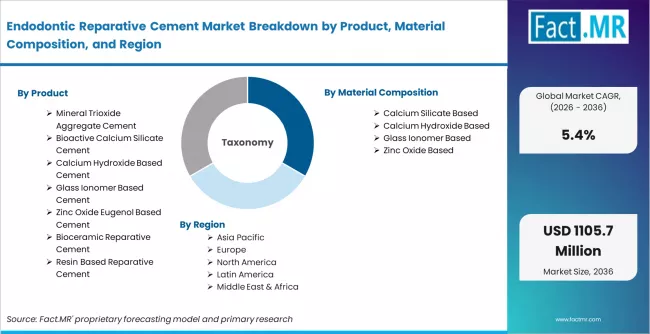
Endodontic Reparative Cement Market is segmented by Product (Mineral Trioxide Aggregate Cement, Bioactive Calcium Silicate Cement, Calcium Hydroxide Based Cement, Glass Ionomer Based Cement, Zinc Oxide Eugenol Based Cement, Bioceramic Reparative Cement, Resin Based Reparative Cement), Material Composition (Calcium Silicate Based, Calcium Hydroxide Based, Glass Ionomer Based, Zinc Oxide Based), Application (Root End Filling, Pulp Capping, Root Canal Sealing, Root Repair Procedures, Regenerative Endodontics), and Region, with forecasts covering the period from 2026 to 2036.
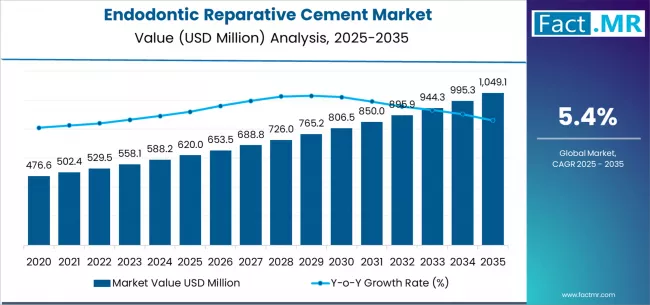
According to Fact.MR estimates, the global endodontic reparative cement market was valued at USD 620.0 million in 2025. The market is projected to reach USD 653.5 million in 2026 and is expected to grow to USD 1,105.7 million by 2036, expanding at a CAGR of 5.4%. Mineral Trioxide Aggregate Cement is anticipated to account for 28.9% of the product segment in 2026, while Calcium Silicate Based is expected to remain the leading application with around 31.4% share.
Endodontic Reparative Cement Market Analysis and Forecast by Fact.MR
- The global endodontic reparative cement market is estimated at USD 620.0 million in 2025 and is forecast to reach USD 653.5 million in 2026 before expanding to USD 1,105.7 million by 2036, progressing at a CAGR of 5.4% over the 2026 to 2036 forecast period.
- Mineral Trioxide Aggregate Cement is anticipated to account for 28.9% share of the product segment in 2026, supported by established clinical evidence for biocompatibility, superior sealing ability, and broad endodontic procedure applicability across root end filling, pulp capping, and perforation repair.
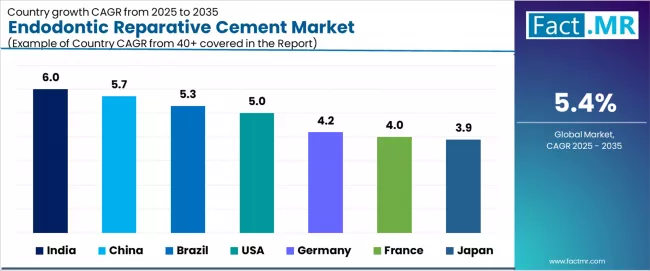
- India (6.0%) and China (5.7%) are the fastest growing country markets through 2036.
Summary of Endodontic Reparative Cement Market
- Market Snapshot
- In 2025, the global Endodontic Reparative Cement Market was valued at approximately USD 620.0 million.
- The market is estimated to reach USD 653.5 million in 2026 and is projected to attain USD 1,105.7 million by 2036.
- The endodontic reparative cement market is likely to expand at a CAGR of 5.4% during the forecast period.
- The market is anticipated to create an absolute dollar opportunity of USD 452.2 million between 2026 and 2036.
- Mineral trioxide aggregate cement accounts for 28.9% of market share in 2026.
- India (6.0%) and China (5.7%) are the key growth markets during the forecast period.
- Demand and Growth Drivers
- Structural shift from legacy zinc oxide-eugenol cements to bioactive calcium silicate and bioceramic formulations creates replacement demand and supports premium product adoption across endodontic practices globally.
- Growing adoption of vital pulp therapy and regenerative endodontic procedures increases per-procedure reparative cement consumption and creates demand for biocompatible materials that promote hard tissue formation.
- Rising endodontic procedure volumes in India, China, and Brazil, driven by expanding dental clinic networks and increasing preference for tooth preservation over extraction, support sustained market growth.
- Rising institutional procurement volumes across hospitals, academic facilities, and government programs create a sustained base-level demand that is less sensitive to short-term economic cycles.
- Expanding distribution through specialized channels and direct-to-institution sales models is improving product accessibility across underpenetrated geographies.
- Product and Segment View
- Mineral Trioxide Aggregate Cement accounts for 28.9% of the product segment in 2026, maintaining the leading position due to established usage patterns and broad commercial adoption.
- Powder and Liquid System represents 27.3% of the form segment in 2026, supported by the largest concentration of end-use demand and procurement volumes.
- The endodontic reparative cement market is segmented by product, material composition, application, end user, form, and region.
- Geography and Competitive Outlook
- India leads growth at 6.0%, supported by infrastructure expansion and increasing institutional adoption.
- North America reflects a mature but steady demand profile, with the USA at 5.0% supported by replacement demand and established clinical protocols.
- Europe maintains stable growth, with Germany at 4.2% supported by regulatory standards and established institutional procurement frameworks.
- Septodont, Dentsply Sirona, Ivoclar hold strong positions through broad product portfolios and established distribution networks.
- Analyst Opinion
- Shambhu Nath Jha, Principal Consultant at Fact.MR, says 'The endodontic reparative cement market is positioned at the intersection of clinical material science and dental treatment philosophy. Growth reflects a structural shift from legacy zinc oxide-eugenol and calcium hydroxide cements toward bioactive calcium silicate and bioceramic formulations that offer superior biocompatibility, hydraulic setting properties, and sealing ability. MTA remains the reference standard in endodontic repair, but premixed bioceramic pastes and injectable formulations are gaining share because they eliminate the mixing variability and handling challenges associated with traditional powder-liquid MTA systems. The market is also benefiting from the growing adoption of vital pulp therapy and regenerative endodontic procedures, both of which require biocompatible reparative cements that promote hard tissue formation rather than merely filling defects. India, China, and Brazil are the fastest-growing markets, driven by expanding dental clinic networks and increasing endodontic procedure volumes as tooth preservation becomes the preferred clinical approach over extraction.'
Key Growth Drivers, Constraints, and Opportunities
Key Factors Driving Growth
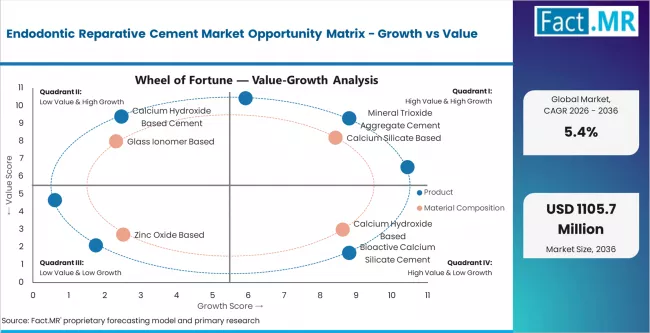
- Structural shift from legacy zinc oxide-eugenol cements to bioactive calcium silicate and bioceramic formulations creates replacement demand and supports premium product adoption across endodontic practices globally.
- Growing adoption of vital pulp therapy and regenerative endodontic procedures increases per-procedure reparative cement consumption and creates demand for biocompatible materials that promote hard tissue formation.
- Rising endodontic procedure volumes in India, China, and Brazil, driven by expanding dental clinic networks and increasing preference for tooth preservation over extraction, support sustained market growth.
Key Market Constraints
- Higher material cost of bioactive calcium silicate and bioceramic cements compared to legacy zinc oxide-eugenol products creates adoption barriers in price-sensitive clinical settings.
- Limited clinical evidence for newer bioceramic formulations in complex endodontic scenarios slows adoption among conservative practitioners who prefer established MTA protocols.
- Handling sensitivity and working time limitations of certain cement formulations create procedural challenges that require practitioner training and technique adaptation.
Key Opportunity Areas
- Development of premixed and injectable bioceramic cement formulations eliminates mixing variability and simplifies clinical workflows, creating user-friendly alternatives to traditional powder-liquid systems.
- Expansion of dental education programs incorporating bioceramic materials into endodontic curricula is building familiarity among new graduates and accelerating clinical adoption.
- Growing emphasis on minimally invasive endodontics and tooth preservation protocols creates sustained demand for reparative cements that support conservative treatment approaches.
Segment-wise Analysis of the Endodontic Reparative Cement Market
- Mineral Trioxide Aggregate Cement holds 28.9% of the product segment in 2026.
- Powder and Liquid System represents 27.3% of the form segment in 2026.
The endodontic reparative cement market is segmented by product, material composition, application, end user, form, and region.
Which Product Segment Leads the Endodontic Reparative Cement Market?
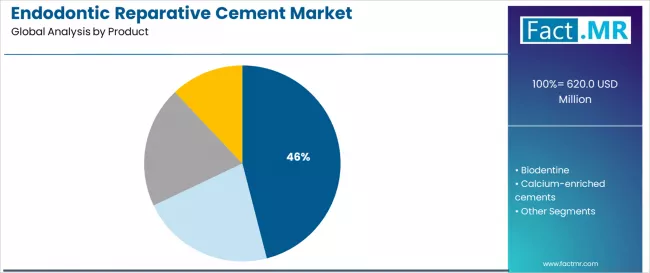
Mineral Trioxide Aggregate Cement accounts for 28.9% of the product segment in 2026. This position reflects established clinical evidence for biocompatibility, superior sealing ability, and broad endodontic procedure applicability across root end filling, pulp capping, and perforation repair. The segment benefits from an established base, broad geographic adoption, and consistent demand from institutional and individual buyer channels.
Which Form Segment Leads the Endodontic Reparative Cement Market?
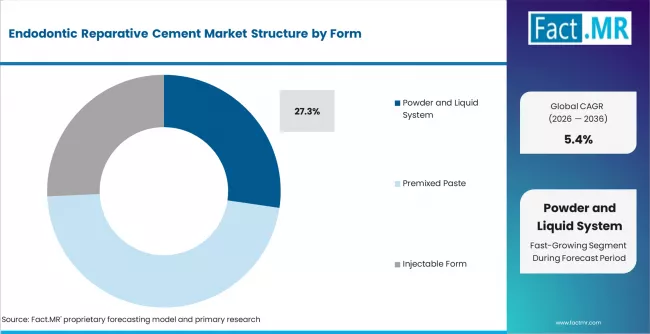
Powder and Liquid System is expected to account for 27.3% of the form segment in 2026. This segment represents the largest concentration of purchasing activity and maintains its position through established procurement cycles and direct alignment with the primary use cases.
Which Product Trend is Shaping the Next Phase of Growth in the Endodontic Reparative Cement Market?
Premixed bioceramic paste and injectable cement formulations are reshaping clinical workflows in endodontic repair procedures. Unlike traditional MTA powder-liquid systems that require chairside mixing and offer limited working time, premixed formulations provide consistent material properties, simplified handling, and reduced procedural time. Injectable forms are particularly suited for perforation repair and apexification procedures where material placement in confined spaces is challenging with conventional techniques. Manufacturers including Septodont and Angelus are leading this transition with products that combine the bioactivity and sealing advantages of calcium silicate chemistry with delivery systems designed for predictable clinical outcomes. As practitioners gain familiarity with premixed and injectable formats through continuing education and training, this product category is positioned to capture an increasing share of the reparative cement market.
Regional Outlook Across Key Markets
.webp)
- India leads growth at 6.0%, supported by infrastructure expansion and rising adoption.
- North America shows steady growth, with the USA at 5.0% reflecting a mature market with established procurement.
- Europe maintains consistent demand, with Germany at 4.2%.
- Asia Pacific is the fastest growing region overall.
Country CAGR Table
| Country | CAGR (%) |
|---|---|
| India | 6.0% |
| China | 5.7% |
| Brazil | 5.3% |
| USA | 5.0% |
| Germany | 4.2% |
| France | 4.0% |
| Japan | 3.9% |
Source: Fact.MR analysis, based on proprietary forecasting model and primary research.
Endodontic Reparative Cement Market in India
India leads global market expansion with a projected CAGR of 6.0% through 2036. Growth reflects expanding dental clinic networks, rising endodontic procedure volumes, growing adoption of bioceramic materials by trained endodontists, and increasing preference for tooth preservation over extraction among patients.
- Dental clinic expansion creates consistent demand for endodontic reparative materials.
- Endodontic procedure volumes grow as tooth preservation preference increases.
- Bioceramic material adoption rises as dental education programs incorporate advanced materials curricula.
Endodontic Reparative Cement Market in China
China is projected to grow at a CAGR of 5.7% through 2036. Demand reflects hospital dental department modernization, growing endodontic specialist base, and increasing adoption of calcium silicate-based reparative materials in clinical practice.
- Hospital dental department modernization drives adoption of advanced endodontic materials.
- Growing endodontic specialist base supports procedure volume expansion and premium material adoption.
- Domestic manufacturing of MTA and bioceramic formulations improves affordability and supply availability.
Endodontic Reparative Cement Market in Brazil
Brazil is projected to grow at a CAGR of 5.3% through 2036. Expansion reflects a strong endodontic practitioner base, established domestic manufacturing by companies like Angelus, and growing adoption of bioceramic cements across both specialist and general dental practices.
- Strong endodontic practitioner base supports high procedure volumes and material consumption.
- Domestic manufacturing by Angelus and others ensures competitive pricing and local product availability.
- Growing adoption of bioceramic materials in general dental practices broadens the market beyond specialist settings.
Endodontic Reparative Cement Market in USA
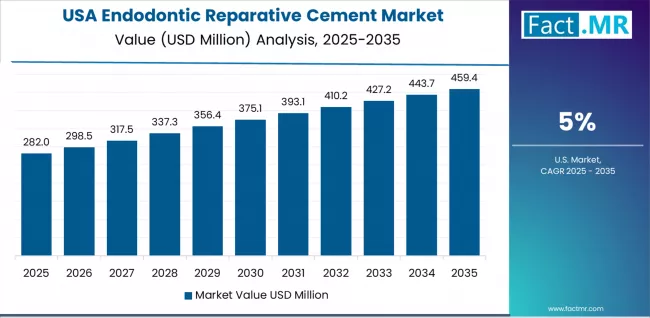
The United States is projected to grow at a CAGR of 5.0% through 2036. The market benefits from high endodontic procedure volumes, established adoption of MTA and bioceramic materials, and growing interest in regenerative endodontic procedures among specialist practitioners.
- High endodontic procedure volumes sustain consistent reparative cement consumption.
- Established MTA and bioceramic adoption supports premium material positioning.
- Regenerative endodontic procedure growth creates incremental demand for biocompatible reparative materials.
Endodontic Reparative Cement Market in Germany
Germany is projected to grow at a CAGR of 4.2% through 2036. Demand reflects established endodontic practice infrastructure, preference for evidence-based material selection, and steady adoption of bioceramic formulations.
- Evidence-based material selection supports adoption of clinically validated bioceramic cements.
- Established endodontic practice infrastructure maintains consistent procedure volumes.
- Dental material quality standards favor premium product positioning.
Endodontic Reparative Cement Market in France
France is projected to grow at a CAGR of 4.0% through 2036. Growth reflects steady endodontic procedure volumes, growing adoption of bioceramic materials through Septodont's domestic market presence, and increasing interest in vital pulp therapy protocols.
- Septodont's domestic presence supports competitive pricing and product availability.
- Vital pulp therapy adoption supports demand for biocompatible reparative materials.
- Endodontic continuing education programs build practitioner familiarity with advanced cement formulations.
Endodontic Reparative Cement Market in Japan
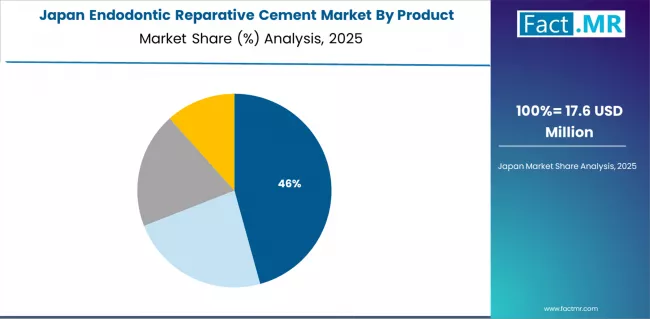
Japan is projected to grow at a CAGR of 3.9% through 2036. The market benefits from aging population dental care needs, high clinical quality standards, and established adoption of advanced endodontic materials.
- Aging population dental needs sustain high endodontic procedure volumes.
- Clinical quality standards support adoption of premium reparative cement formulations.
- Advanced material adoption reflects domestic preference for biocompatible treatment approaches.
Competitive Benchmarking and Company Positioning
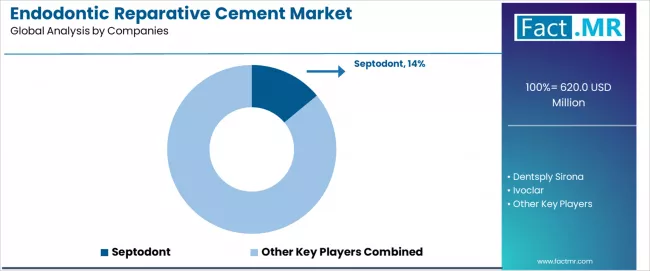
Endodontic Reparative Cement Market Analysis By Company
- Septodont, Dentsply Sirona, Ivoclar hold strong positions through broad portfolios and established distribution networks.
- Angelus, Ultradent, GC Corporation participate meaningfully across specific segments and regional markets.
Septodont and Dentsply Sirona hold strong positions in the global endodontic reparative cement market through established MTA and bioceramic product portfolios, broad global distribution networks, and deep clinical evidence supporting their material formulations.
Angelus and Ultradent participate meaningfully through specialized endodontic material offerings, with Angelus holding particular strength in Latin American markets through domestic MTA manufacturing and competitive pricing.
Ivoclar, GC Corporation, and Coltene compete across broader dental material portfolios that include reparative cements alongside restorative and prosthodontic products, leveraging cross-selling relationships within dental practice supply accounts.
The competitive landscape is moderately fragmented, with MTA and bioceramic formulation performance, ease of handling, clinical evidence, and price positioning as the primary competitive dimensions.
Recent Industry Developments
- Septodont expanded its bioceramic cement portfolio in early 2026, introducing an updated premixed formulation with improved handling characteristics and radiopacity for endodontic repair and vital pulp therapy applications.
- Angelus launched a new injectable MTA-based reparative cement in 2025, targeting endodontic practitioners performing perforation repair and apexification procedures with a focus on simplified delivery and consistent material properties.
- Dentsply Sirona introduced an advanced calcium silicate sealer in 2025, designed to complement its existing endodontic instrument portfolio and support integrated root canal treatment workflows.
Leading Companies in the Endodontic Reparative Cement Market
-
Major Players
- Septodont
- Dentsply Sirona
- Ivoclar
- Angelus
- Ultradent
- GC Corporation
- Coltene
- Bisco
-
Emerging Players
- Premier Dental
- Kuraray Noritake
- FKG Dentaire
- Cerkamed
- Innovative BioCeramix
- Prevest DenPro
- Maruchi
Sources and Research References
- American Association of Endodontists (AAE). Position Statements and Clinical Guidelines for Reparative Endodontic Materials.
- International Association of Dental Traumatology (IADT). Guidelines for Management of Traumatic Dental Injuries.
- Septodont. Product Portfolio and Bioceramic Cement Technology Updates.
- U.S. Food and Drug Administration (FDA). Medical Device Database for Dental Restorative Materials.
- Primary interviews with endodontists, dental material suppliers, dental clinic procurement teams, and academic researchers.
This bibliography is provided for reader reference and is not exhaustive.
Key Questions This Report Addresses
- What is the current and future size of the endodontic reparative cement market?
- How fast is the market expected to grow between 2026 and 2036?
- Which product is likely to lead by 2026?
- Which form segment accounts for the highest demand?
- What factors are driving demand globally?
- Which countries show the fastest growth?
- Who are the key companies?
- How does Fact.MR validate the forecast?
Endodontic Reparative Cement Market Definition
The endodontic reparative cement market covers mineral trioxide aggregate, bioactive calcium silicate, calcium hydroxide-based, glass ionomer-based, and bioceramic cement formulations used in root end filling, pulp capping, root canal sealing, root repair, and regenerative endodontic procedures across dental clinic, hospital, and academic settings.
Endodontic Reparative Cement Market Inclusions
The scope covers global and regional market size and forecasts for 2026 to 2036 across product, material composition, application, end user, form, and region. It includes regional demand analysis, pricing and cost analysis, technology trends, market drivers and constraints, and the competitive landscape.
Endodontic Reparative Cement Market Exclusions
The scope excludes general-purpose devices, products, or services not purpose-built for the applications defined within this market. It excludes unbranded products with low market visibility, rental or leasing services without hardware sales, and custom-built systems without commercial sales distribution.
Endodontic Reparative Cement Market Research Methodology
- Primary research includes interviews with manufacturers, distributors, end users, and institutional procurement teams across key geographies.
- Secondary research draws on industry publications, regulatory filings, company reports, and trade databases.
- Market sizing follows a demand-side model supported by top-down validation across 30 plus countries.
- Final estimates are validated through trade-flow checks, pricing trend analysis, and sensitivity testing.
Scope of Analysis

| Parameter | Details |
|---|---|
| Quantitative Units | USD 653.5 million to USD 1,105.7 million, at a CAGR of 5.4% |
| Market Definition | The endodontic reparative cement market covers mineral trioxide aggregate, bioactive calcium silicate, calcium hydroxide-based, glass ionomer-based, and bioceramic cement formulations used in root end filling, pulp capping, root canal sealing, root repair, and regenerative endodontic procedures across dental clinic, hospital, and academic settings. |
| Regions Covered | North America, Latin America, Europe, East Asia, South Asia and Pacific, Middle East and Africa |
| Countries Covered | USA, India, China, Brazil, Germany, France, Japan, and 30 plus countries |
| Key Companies | Septodont, Dentsply Sirona, Ivoclar, Angelus, Ultradent, GC Corporation, Coltene, Bisco, Premier Dental, Kuraray Noritake |
| Forecast Period | 2026 to 2036 |
| Approach | Hybrid demand-side and top-down methodology built on country-level endodontic procedure volumes, product benchmarking, pricing analysis, and primary interviews across endodontists, dental material suppliers, dental clinics, and academic institutions |
Market Segmentation Analysis
-
Endodontic Reparative Cement Market Segmented by Product:
- Mineral Trioxide Aggregate Cement
- MTA Repair Cement
- MTA Root Canal Sealer Cement
- Bioactive Calcium Silicate Cement
- Calcium Silicate Based Repair Cement
- Bioactive Endodontic Cement Paste
- Calcium Hydroxide Based Cement
- Conventional Calcium Hydroxide Cement
- Enhanced Calcium Hydroxide Formulations
- Glass Ionomer Based Cement
- Resin Modified Glass Ionomer Cement
- High Fluoride Release Cement
- Zinc Oxide Eugenol Based Cement
- Modified Zinc Oxide Eugenol Cement
- Temporary Endodontic Cement
- Bioceramic Reparative Cement
- Putty Consistency Bioceramic Cement
- Injectable Bioceramic Cement
- Resin Based Reparative Cement
- Dual Cure Resin Cement
- Light Cure Endodontic Repair Cement
- Mineral Trioxide Aggregate Cement
-
Endodontic Reparative Cement Market Segmented by Material Composition:
- Calcium Silicate Based
- Tricalcium Silicate Formulations
- Dicalcium Silicate Formulations
- Calcium Hydroxide Based
- Pure Calcium Hydroxide Matrix
- Enhanced Hydroxide Composites
- Glass Ionomer Based
- Fluoroaluminosilicate Glass Matrix
- Zinc Reinforced Glass Ionomer
- Zinc Oxide Based
- Eugenol Based Matrix
- Resin Modified Zinc Oxide Systems
- Calcium Silicate Based
-
Endodontic Reparative Cement Market Segmented by Application:
- Root End Filling
- Apexification Procedures
- Apicoectomy Sealing
- Pulp Capping
- Direct Pulp Capping
- Indirect Pulp Capping
- Root Canal Sealing
- Perforation Repair
- Internal Resorption Repair
- Root Repair Procedures
- Cervical Root Repair
- Lateral Root Perforation Repair
- Regenerative Endodontics
- Pulp Regeneration Support
- Apexogenesis Procedures
- Root End Filling
-
Endodontic Reparative Cement Market Segmented by End User:
- Dental Clinics
- Specialty Endodontic Clinics
- Multi Specialty Dental Clinics
- Dental Hospitals
- Teaching Dental Hospitals
- Private Dental Hospitals
- Academic and Research Institutes
- Dental Training Institutes
- Endodontic Research Centers
- Dental Clinics
-
Endodontic Reparative Cement Market Segmented by Form:
- Powder and Liquid System
- Two Component Mixing Systems
- Pre Measured Capsules
- Premixed Paste
- Ready to Use Syringe Form
- Putty Consistency Cement
- Injectable Form
- Auto Mix Syringe Systems
- Delivered Tip Applicators
- Powder and Liquid System
-
Endodontic Reparative Cement Market by Region:
- North America
- USA
- Canada
- Mexico
- Latin America
- Brazil
- Chile
- Rest of Latin America
- Western Europe
- Germany
- UK
- Italy
- Spain
- France
- Nordic
- BENELUX
- Rest of Western Europe
- Eastern Europe
- Russia
- Poland
- Hungary
- Balkan & Baltic
- Rest of Eastern Europe
- East Asia
- China
- Japan
- South Korea
- South Asia and Pacific
- India
- ASEAN
- Australia & New Zealand
- Rest of South Asia and Pacific
- Middle East & Africa
- Kingdom of Saudi Arabia
- Other GCC Countries
- Turkiye
- South Africa
- Other African Union
- Rest of Middle East & Africa
- North America
- Frequently Asked Questions -
How big is the endodontic reparative cement market in 2025?
The global endodontic reparative cement market is estimated at USD 620.0 million in 2025.
What will be the market size in 2036?
The endodontic reparative cement market is projected to reach USD 1,105.7 million by 2036.
What is the expected CAGR?
The market is expected to grow at a 5.4% CAGR between 2026 and 2036.
What are the key product types?
Key types include mineral trioxide aggregate cement, bioactive calcium silicate cement, calcium hydroxide based cement.
Which form segment leads?
Powder and Liquid System is expected to account for 27.3% share in 2026.
Which countries grow fastest?
India (6.0%) and China (5.7%) lead through 2036.
What is the market definition?
The endodontic reparative cement market covers mineral trioxide aggregate, bioactive calcium silicate, calcium hydroxide-based, glass ionomer-based, and bioceramic cement formulations used in root end filling, pulp capping, root canal sealing, root repair, and regenerative endodontic procedures across dental clinic, hospital, and academic settings.
What methodology is used?
The methodology combines secondary research, primary interviews, and forecast modelling across 30 plus countries.
How big is the endodontic reparative cement market in 2025?
The global endodontic reparative cement market is estimated at USD 620.0 million in 2025.
What will be the market size in 2036?
The endodontic reparative cement market is projected to reach USD 1,105.7 million by 2036.
What is the expected CAGR?
The market is expected to grow at a 5.4% CAGR between 2026 and 2036.
What are the key product types?
Key types include mineral trioxide aggregate cement, bioactive calcium silicate cement, calcium hydroxide based cement.
Which form segment leads?
Powder and Liquid System is expected to account for 27.3% share in 2026.
Which countries grow fastest?
India (6.0%) and China (5.7%) lead through 2036.
What is the market definition?
The endodontic reparative cement market covers mineral trioxide aggregate, bioactive calcium silicate, calcium hydroxide-based, glass ionomer-based, and bioceramic cement formulations used in root end filling, pulp capping, root canal sealing, root repair, and regenerative endodontic procedures across dental clinic, hospital, and academic settings.
What methodology is used?
The methodology combines secondary research, primary interviews, and forecast modelling across 30 plus countries.
Table of Content
- Executive Summary
- Global Market Outlook
- Demand to side Trends
- Supply to side Trends
- Technology Roadmap Analysis
- Analysis and Recommendations
- Market Overview
- Market Coverage / Taxonomy
- Market Definition / Scope / Limitations
- Research Methodology
- Chapter Orientation
- Analytical Lens and Working Hypotheses
- Market Structure, Signals, and Trend Drivers
- Benchmarking and Cross-market Comparability
- Market Sizing, Forecasting, and Opportunity Mapping
- Research Design and Evidence Framework
- Desk Research Programme (Secondary Evidence)
- Company Annual and Sustainability Reports
- Peer-reviewed Journals and Academic Literature
- Corporate Websites, Product Literature, and Technical Notes
- Earnings Decks and Investor Briefings
- Statutory Filings and Regulatory Disclosures
- Technical White Papers and Standards Notes
- Trade Journals, Industry Magazines, and Analyst Briefs
- Conference Proceedings, Webinars, and Seminar Materials
- Government Statistics Portals and Public Data Releases
- Press Releases and Reputable Media Coverage
- Specialist Newsletters and Curated Briefings
- Sector Databases and Reference Repositories
- Fact.MR Internal Proprietary Databases and Historical Market Datasets
- Subscription Datasets and Paid Sources
- Social Channels, Communities, and Digital Listening Inputs
- Additional Desk Sources
- Expert Input and Fieldwork (Primary Evidence)
- Primary Modes
- Qualitative Interviews and Expert Elicitation
- Quantitative Surveys and Structured Data Capture
- Blended Approach
- Why Primary Evidence is Used
- Field Techniques
- Interviews
- Surveys
- Focus Groups
- Observational and In-context Research
- Social and Community Interactions
- Stakeholder Universe Engaged
- C-suite Leaders
- Board Members
- Presidents and Vice Presidents
- R&D and Innovation Heads
- Technical Specialists
- Domain Subject-matter Experts
- Scientists
- Physicians and Other Healthcare Professionals
- Governance, Ethics, and Data Stewardship
- Research Ethics
- Data Integrity and Handling
- Primary Modes
- Tooling, Models, and Reference Databases
- Desk Research Programme (Secondary Evidence)
- Data Engineering and Model Build
- Data Acquisition and Ingestion
- Cleaning, Normalisation, and Verification
- Synthesis, Triangulation, and Analysis
- Quality Assurance and Audit Trail
- Market Background
- Market Dynamics
- Drivers
- Restraints
- Opportunity
- Trends
- Scenario Forecast
- Demand in Optimistic Scenario
- Demand in Likely Scenario
- Demand in Conservative Scenario
- Opportunity Map Analysis
- Product Life Cycle Analysis
- Supply Chain Analysis
- Investment Feasibility Matrix
- Value Chain Analysis
- PESTLE and Porter’s Analysis
- Regulatory Landscape
- Regional Parent Market Outlook
- Production and Consumption Statistics
- Import and Export Statistics
- Market Dynamics
- Global Market Analysis 2021 to 2025 and Forecast, 2026 to 2036
- Historical Market Size Value (USD Million) Analysis, 2021 to 2025
- Current and Future Market Size Value (USD Million) Projections, 2026 to 2036
- Y to o to Y Growth Trend Analysis
- Absolute $ Opportunity Analysis
- Global Market Pricing Analysis 2021 to 2025 and Forecast 2026 to 2036
- Global Market Analysis 2021 to 2025 and Forecast 2026 to 2036, By Product
- Introduction / Key Findings
- Historical Market Size Value (USD Million) Analysis By Product , 2021 to 2025
- Current and Future Market Size Value (USD Million) Analysis and Forecast By Product , 2026 to 2036
- Mineral Trioxide Aggregate Cement
- MTA Repair Cement
- MTA Root Canal Sealer Cement
- Bioactive Calcium Silicate Cement
- Calcium Silicate Based Repair Cement
- Bioactive Endodontic Cement Paste
- Calcium Hydroxide Based Cement
- Conventional Calcium Hydroxide Cement
- Enhanced Calcium Hydroxide Formulations
- Glass Ionomer Based Cement
- Resin Modified Glass Ionomer Cement
- High Fluoride Release Cement
- Zinc Oxide Eugenol Based Cement
- Modified Zinc Oxide Eugenol Cement
- Temporary Endodontic Cement
- Bioceramic Reparative Cement
- Putty Consistency Bioceramic Cement
- Injectable Bioceramic Cement
- Resin Based Reparative Cement
- Dual Cure Resin Cement
- Light Cure Endodontic Repair Cement
- Mineral Trioxide Aggregate Cement
- Y to o to Y Growth Trend Analysis By Product , 2021 to 2025
- Absolute $ Opportunity Analysis By Product , 2026 to 2036
- Global Market Analysis 2021 to 2025 and Forecast 2026 to 2036, By Material Composition
- Introduction / Key Findings
- Historical Market Size Value (USD Million) Analysis By Material Composition, 2021 to 2025
- Current and Future Market Size Value (USD Million) Analysis and Forecast By Material Composition, 2026 to 2036
- Calcium Silicate Based
- Tricalcium Silicate Formulations
- Dicalcium Silicate Formulations
- Calcium Hydroxide Based
- Pure Calcium Hydroxide Matrix
- Enhanced Hydroxide Composites
- Glass Ionomer Based
- Fluoroaluminosilicate Glass Matrix
- Zinc Reinforced Glass Ionomer
- Zinc Oxide Based
- Eugenol Based Matrix
- Resin Modified Zinc Oxide Systems
- Calcium Silicate Based
- Y to o to Y Growth Trend Analysis By Material Composition, 2021 to 2025
- Absolute $ Opportunity Analysis By Material Composition, 2026 to 2036
- Global Market Analysis 2021 to 2025 and Forecast 2026 to 2036, By Application
- Introduction / Key Findings
- Historical Market Size Value (USD Million) Analysis By Application, 2021 to 2025
- Current and Future Market Size Value (USD Million) Analysis and Forecast By Application, 2026 to 2036
- Root End Filling
- Apexification Procedures
- Apicoectomy Sealing
- Pulp Capping
- Direct Pulp Capping
- Indirect Pulp Capping
- Root Canal Sealing
- Perforation Repair
- Internal Resorption Repair
- Root Repair Procedures
- Cervical Root Repair
- Lateral Root Perforation Repair
- Regenerative Endodontics
- Pulp Regeneration Support
- Apexogenesis Procedures
- Root End Filling
- Y to o to Y Growth Trend Analysis By Application, 2021 to 2025
- Absolute $ Opportunity Analysis By Application, 2026 to 2036
- Global Market Analysis 2021 to 2025 and Forecast 2026 to 2036, By End User
- Introduction / Key Findings
- Historical Market Size Value (USD Million) Analysis By End User, 2021 to 2025
- Current and Future Market Size Value (USD Million) Analysis and Forecast By End User, 2026 to 2036
- Dental Clinics
- Specialty Endodontic Clinics
- Multi Specialty Dental Clinics
- Dental Hospitals
- Teaching Dental Hospitals
- Private Dental Hospitals
- Academic and Research Institutes
- Dental Training Institutes
- Endodontic Research Centers
- Dental Clinics
- Y to o to Y Growth Trend Analysis By End User, 2021 to 2025
- Absolute $ Opportunity Analysis By End User, 2026 to 2036
- Global Market Analysis 2021 to 2025 and Forecast 2026 to 2036, By Form
- Introduction / Key Findings
- Historical Market Size Value (USD Million) Analysis By Form, 2021 to 2025
- Current and Future Market Size Value (USD Million) Analysis and Forecast By Form, 2026 to 2036
- Powder and Liquid System
- Two Component Mixing Systems
- Pre Measured Capsules
- Premixed Paste
- Ready to Use Syringe Form
- Putty Consistency Cement
- Injectable Form
- Auto Mix Syringe Systems
- Delivered Tip Applicators
- Powder and Liquid System
- Y to o to Y Growth Trend Analysis By Form, 2021 to 2025
- Absolute $ Opportunity Analysis By Form, 2026 to 2036
- Global Market Analysis 2021 to 2025 and Forecast 2026 to 2036, By Region
- Introduction
- Historical Market Size Value (USD Million) Analysis By Region, 2021 to 2025
- Current Market Size Value (USD Million) Analysis and Forecast By Region, 2026 to 2036
- North America
- Latin America
- Western Europe
- Eastern Europe
- East Asia
- South Asia and Pacific
- Middle East & Africa
- Market Attractiveness Analysis By Region
- North America Market Analysis 2021 to 2025 and Forecast 2026 to 2036, By Country
- Historical Market Size Value (USD Million) Trend Analysis By Market Taxonomy, 2021 to 2025
- Market Size Value (USD Million) Forecast By Market Taxonomy, 2026 to 2036
- By Country
- USA
- Canada
- Mexico
- By Product
- By Material Composition
- By Application
- By End User
- By Form
- By Country
- Market Attractiveness Analysis
- By Country
- By Product
- By Material Composition
- By Application
- By End User
- By Form
- Key Takeaways
- Latin America Market Analysis 2021 to 2025 and Forecast 2026 to 2036, By Country
- Historical Market Size Value (USD Million) Trend Analysis By Market Taxonomy, 2021 to 2025
- Market Size Value (USD Million) Forecast By Market Taxonomy, 2026 to 2036
- By Country
- Brazil
- Chile
- Rest of Latin America
- By Product
- By Material Composition
- By Application
- By End User
- By Form
- By Country
- Market Attractiveness Analysis
- By Country
- By Product
- By Material Composition
- By Application
- By End User
- By Form
- Key Takeaways
- Western Europe Market Analysis 2021 to 2025 and Forecast 2026 to 2036, By Country
- Historical Market Size Value (USD Million) Trend Analysis By Market Taxonomy, 2021 to 2025
- Market Size Value (USD Million) Forecast By Market Taxonomy, 2026 to 2036
- By Country
- Germany
- UK
- Italy
- Spain
- France
- Nordic
- BENELUX
- Rest of Western Europe
- By Product
- By Material Composition
- By Application
- By End User
- By Form
- By Country
- Market Attractiveness Analysis
- By Country
- By Product
- By Material Composition
- By Application
- By End User
- By Form
- Key Takeaways
- Eastern Europe Market Analysis 2021 to 2025 and Forecast 2026 to 2036, By Country
- Historical Market Size Value (USD Million) Trend Analysis By Market Taxonomy, 2021 to 2025
- Market Size Value (USD Million) Forecast By Market Taxonomy, 2026 to 2036
- By Country
- Russia
- Poland
- Hungary
- Balkan & Baltic
- Rest of Eastern Europe
- By Product
- By Material Composition
- By Application
- By End User
- By Form
- By Country
- Market Attractiveness Analysis
- By Country
- By Product
- By Material Composition
- By Application
- By End User
- By Form
- Key Takeaways
- East Asia Market Analysis 2021 to 2025 and Forecast 2026 to 2036, By Country
- Historical Market Size Value (USD Million) Trend Analysis By Market Taxonomy, 2021 to 2025
- Market Size Value (USD Million) Forecast By Market Taxonomy, 2026 to 2036
- By Country
- China
- Japan
- South Korea
- By Product
- By Material Composition
- By Application
- By End User
- By Form
- By Country
- Market Attractiveness Analysis
- By Country
- By Product
- By Material Composition
- By Application
- By End User
- By Form
- Key Takeaways
- South Asia and Pacific Market Analysis 2021 to 2025 and Forecast 2026 to 2036, By Country
- Historical Market Size Value (USD Million) Trend Analysis By Market Taxonomy, 2021 to 2025
- Market Size Value (USD Million) Forecast By Market Taxonomy, 2026 to 2036
- By Country
- India
- ASEAN
- Australia & New Zealand
- Rest of South Asia and Pacific
- By Product
- By Material Composition
- By Application
- By End User
- By Form
- By Country
- Market Attractiveness Analysis
- By Country
- By Product
- By Material Composition
- By Application
- By End User
- By Form
- Key Takeaways
- Middle East & Africa Market Analysis 2021 to 2025 and Forecast 2026 to 2036, By Country
- Historical Market Size Value (USD Million) Trend Analysis By Market Taxonomy, 2021 to 2025
- Market Size Value (USD Million) Forecast By Market Taxonomy, 2026 to 2036
- By Country
- Kingdom of Saudi Arabia
- Other GCC Countries
- Turkiye
- South Africa
- Other African Union
- Rest of Middle East & Africa
- By Product
- By Material Composition
- By Application
- By End User
- By Form
- By Country
- Market Attractiveness Analysis
- By Country
- By Product
- By Material Composition
- By Application
- By End User
- By Form
- Key Takeaways
- Key Countries Market Analysis
- USA
- Pricing Analysis
- Market Share Analysis, 2025
- By Product
- By Material Composition
- By Application
- By End User
- By Form
- Canada
- Pricing Analysis
- Market Share Analysis, 2025
- By Product
- By Material Composition
- By Application
- By End User
- By Form
- Mexico
- Pricing Analysis
- Market Share Analysis, 2025
- By Product
- By Material Composition
- By Application
- By End User
- By Form
- Brazil
- Pricing Analysis
- Market Share Analysis, 2025
- By Product
- By Material Composition
- By Application
- By End User
- By Form
- Chile
- Pricing Analysis
- Market Share Analysis, 2025
- By Product
- By Material Composition
- By Application
- By End User
- By Form
- Germany
- Pricing Analysis
- Market Share Analysis, 2025
- By Product
- By Material Composition
- By Application
- By End User
- By Form
- UK
- Pricing Analysis
- Market Share Analysis, 2025
- By Product
- By Material Composition
- By Application
- By End User
- By Form
- Italy
- Pricing Analysis
- Market Share Analysis, 2025
- By Product
- By Material Composition
- By Application
- By End User
- By Form
- Spain
- Pricing Analysis
- Market Share Analysis, 2025
- By Product
- By Material Composition
- By Application
- By End User
- By Form
- France
- Pricing Analysis
- Market Share Analysis, 2025
- By Product
- By Material Composition
- By Application
- By End User
- By Form
- India
- Pricing Analysis
- Market Share Analysis, 2025
- By Product
- By Material Composition
- By Application
- By End User
- By Form
- ASEAN
- Pricing Analysis
- Market Share Analysis, 2025
- By Product
- By Material Composition
- By Application
- By End User
- By Form
- Australia & New Zealand
- Pricing Analysis
- Market Share Analysis, 2025
- By Product
- By Material Composition
- By Application
- By End User
- By Form
- China
- Pricing Analysis
- Market Share Analysis, 2025
- By Product
- By Material Composition
- By Application
- By End User
- By Form
- Japan
- Pricing Analysis
- Market Share Analysis, 2025
- By Product
- By Material Composition
- By Application
- By End User
- By Form
- South Korea
- Pricing Analysis
- Market Share Analysis, 2025
- By Product
- By Material Composition
- By Application
- By End User
- By Form
- Russia
- Pricing Analysis
- Market Share Analysis, 2025
- By Product
- By Material Composition
- By Application
- By End User
- By Form
- Poland
- Pricing Analysis
- Market Share Analysis, 2025
- By Product
- By Material Composition
- By Application
- By End User
- By Form
- Hungary
- Pricing Analysis
- Market Share Analysis, 2025
- By Product
- By Material Composition
- By Application
- By End User
- By Form
- Kingdom of Saudi Arabia
- Pricing Analysis
- Market Share Analysis, 2025
- By Product
- By Material Composition
- By Application
- By End User
- By Form
- Turkiye
- Pricing Analysis
- Market Share Analysis, 2025
- By Product
- By Material Composition
- By Application
- By End User
- By Form
- South Africa
- Pricing Analysis
- Market Share Analysis, 2025
- By Product
- By Material Composition
- By Application
- By End User
- By Form
- USA
- Market Structure Analysis
- Competition Dashboard
- Competition Benchmarking
- Market Share Analysis of Top Players
- By Regional
- By Product
- By Material Composition
- By Application
- By End User
- By Form
- Competition Analysis
- Competition Deep Dive
- Septodont
- Overview
- Product Portfolio
- Profitability by Market Segments (Product/Age /Sales Channel/Region)
- Sales Footprint
- Strategy Overview
- Marketing Strategy
- Product Strategy
- Channel Strategy
- Dentsply Sirona
- Ivoclar
- Angelus
- Ultradent
- GC Corporation
- Coltene
- Bisco
- Premier Dental
- Kuraray Noritake
- Septodont
- Competition Deep Dive
- Assumptions & Acronyms Used
List Of Table
- Table 1: Global Market Value (USD Million) Forecast by Region, 2021 to 2036
- Table 2: Global Market Value (USD Million) Forecast by Product , 2021 to 2036
- Table 3: Global Market Value (USD Million) Forecast by Material Composition, 2021 to 2036
- Table 4: Global Market Value (USD Million) Forecast by Application, 2021 to 2036
- Table 5: Global Market Value (USD Million) Forecast by End User, 2021 to 2036
- Table 6: Global Market Value (USD Million) Forecast by Form, 2021 to 2036
- Table 7: North America Market Value (USD Million) Forecast by Country, 2021 to 2036
- Table 8: North America Market Value (USD Million) Forecast by Product , 2021 to 2036
- Table 9: North America Market Value (USD Million) Forecast by Material Composition, 2021 to 2036
- Table 10: North America Market Value (USD Million) Forecast by Application, 2021 to 2036
- Table 11: North America Market Value (USD Million) Forecast by End User, 2021 to 2036
- Table 12: North America Market Value (USD Million) Forecast by Form, 2021 to 2036
- Table 13: Latin America Market Value (USD Million) Forecast by Country, 2021 to 2036
- Table 14: Latin America Market Value (USD Million) Forecast by Product , 2021 to 2036
- Table 15: Latin America Market Value (USD Million) Forecast by Material Composition, 2021 to 2036
- Table 16: Latin America Market Value (USD Million) Forecast by Application, 2021 to 2036
- Table 17: Latin America Market Value (USD Million) Forecast by End User, 2021 to 2036
- Table 18: Latin America Market Value (USD Million) Forecast by Form, 2021 to 2036
- Table 19: Western Europe Market Value (USD Million) Forecast by Country, 2021 to 2036
- Table 20: Western Europe Market Value (USD Million) Forecast by Product , 2021 to 2036
- Table 21: Western Europe Market Value (USD Million) Forecast by Material Composition, 2021 to 2036
- Table 22: Western Europe Market Value (USD Million) Forecast by Application, 2021 to 2036
- Table 23: Western Europe Market Value (USD Million) Forecast by End User, 2021 to 2036
- Table 24: Western Europe Market Value (USD Million) Forecast by Form, 2021 to 2036
- Table 25: Eastern Europe Market Value (USD Million) Forecast by Country, 2021 to 2036
- Table 26: Eastern Europe Market Value (USD Million) Forecast by Product , 2021 to 2036
- Table 27: Eastern Europe Market Value (USD Million) Forecast by Material Composition, 2021 to 2036
- Table 28: Eastern Europe Market Value (USD Million) Forecast by Application, 2021 to 2036
- Table 29: Eastern Europe Market Value (USD Million) Forecast by End User, 2021 to 2036
- Table 30: Eastern Europe Market Value (USD Million) Forecast by Form, 2021 to 2036
- Table 31: East Asia Market Value (USD Million) Forecast by Country, 2021 to 2036
- Table 32: East Asia Market Value (USD Million) Forecast by Product , 2021 to 2036
- Table 33: East Asia Market Value (USD Million) Forecast by Material Composition, 2021 to 2036
- Table 34: East Asia Market Value (USD Million) Forecast by Application, 2021 to 2036
- Table 35: East Asia Market Value (USD Million) Forecast by End User, 2021 to 2036
- Table 36: East Asia Market Value (USD Million) Forecast by Form, 2021 to 2036
- Table 37: South Asia and Pacific Market Value (USD Million) Forecast by Country, 2021 to 2036
- Table 38: South Asia and Pacific Market Value (USD Million) Forecast by Product , 2021 to 2036
- Table 39: South Asia and Pacific Market Value (USD Million) Forecast by Material Composition, 2021 to 2036
- Table 40: South Asia and Pacific Market Value (USD Million) Forecast by Application, 2021 to 2036
- Table 41: South Asia and Pacific Market Value (USD Million) Forecast by End User, 2021 to 2036
- Table 42: South Asia and Pacific Market Value (USD Million) Forecast by Form, 2021 to 2036
- Table 43: Middle East & Africa Market Value (USD Million) Forecast by Country, 2021 to 2036
- Table 44: Middle East & Africa Market Value (USD Million) Forecast by Product , 2021 to 2036
- Table 45: Middle East & Africa Market Value (USD Million) Forecast by Material Composition, 2021 to 2036
- Table 46: Middle East & Africa Market Value (USD Million) Forecast by Application, 2021 to 2036
- Table 47: Middle East & Africa Market Value (USD Million) Forecast by End User, 2021 to 2036
- Table 48: Middle East & Africa Market Value (USD Million) Forecast by Form, 2021 to 2036
List Of Figures
- Figure 1: Global Market Pricing Analysis
- Figure 2: Global Market Value (USD Million) Forecast 2021-2036
- Figure 3: Global Market Value Share and BPS Analysis by Product,2026 and 2036
- Figure 4: Global Market Y-o-Y Growth Comparison by Product,2026 to 2036
- Figure 5: Global Market Attractiveness Analysis by Product
- Figure 6: Global Market Value Share and BPS Analysis by Material Composition,2026 and 2036
- Figure 7: Global Market Y-o-Y Growth Comparison by Material Composition,2026 to 2036
- Figure 8: Global Market Attractiveness Analysis by Material Composition
- Figure 9: Global Market Value Share and BPS Analysis by Application,2026 and 2036
- Figure 10: Global Market Y-o-Y Growth Comparison by Application,2026 to 2036
- Figure 11: Global Market Attractiveness Analysis by Application
- Figure 12: Global Market Value Share and BPS Analysis by End User,2026 and 2036
- Figure 13: Global Market Y-o-Y Growth Comparison by End User,2026 to 2036
- Figure 14: Global Market Attractiveness Analysis by End User
- Figure 15: Global Market Value Share and BPS Analysis by Form,2026 and 2036
- Figure 16: Global Market Y-o-Y Growth Comparison by Form,2026 to 2036
- Figure 17: Global Market Attractiveness Analysis by Form
- Figure 18: Global Market Value (USD Million) Share and BPS Analysis by Region,2026 and 2036
- Figure 19: Global Market Y-o-Y Growth Comparison by Region,2026 to 2036
- Figure 20: Global Market Attractiveness Analysis by Region
- Figure 21: North America Market Incremental Dollar Opportunity,2026 to 2036
- Figure 22: Latin America Market Incremental Dollar Opportunity,2026 to 2036
- Figure 23: Western Europe Market Incremental Dollar Opportunity,2026 to 2036
- Figure 24: Eastern Europe Market Incremental Dollar Opportunity,2026 to 2036
- Figure 25: East Asia Market Incremental Dollar Opportunity,2026 to 2036
- Figure 26: South Asia and Pacific Market Incremental Dollar Opportunity,2026 to 2036
- Figure 27: Middle East & Africa Market Incremental Dollar Opportunity,2026 to 2036
- Figure 28: North America Market Value Share and BPS Analysis by Country,2026 and 2036
- Figure 29: North America Market Value Share and BPS Analysis by Product,2026 and 2036
- Figure 30: North America Market Y-o-Y Growth Comparison by Product,2026 to 2036
- Figure 31: North America Market Attractiveness Analysis by Product
- Figure 32: North America Market Value Share and BPS Analysis by Material Composition,2026 and 2036
- Figure 33: North America Market Y-o-Y Growth Comparison by Material Composition,2026 to 2036
- Figure 34: North America Market Attractiveness Analysis by Material Composition
- Figure 35: North America Market Value Share and BPS Analysis by Application,2026 and 2036
- Figure 36: North America Market Y-o-Y Growth Comparison by Application,2026 to 2036
- Figure 37: North America Market Attractiveness Analysis by Application
- Figure 38: North America Market Value Share and BPS Analysis by End User,2026 and 2036
- Figure 39: North America Market Y-o-Y Growth Comparison by End User,2026 to 2036
- Figure 40: North America Market Attractiveness Analysis by End User
- Figure 41: North America Market Value Share and BPS Analysis by Form,2026 and 2036
- Figure 42: North America Market Y-o-Y Growth Comparison by Form,2026 to 2036
- Figure 43: North America Market Attractiveness Analysis by Form
- Figure 44: Latin America Market Value Share and BPS Analysis by Country,2026 and 2036
- Figure 45: Latin America Market Value Share and BPS Analysis by Product,2026 and 2036
- Figure 46: Latin America Market Y-o-Y Growth Comparison by Product,2026 to 2036
- Figure 47: Latin America Market Attractiveness Analysis by Product
- Figure 48: Latin America Market Value Share and BPS Analysis by Material Composition,2026 and 2036
- Figure 49: Latin America Market Y-o-Y Growth Comparison by Material Composition,2026 to 2036
- Figure 50: Latin America Market Attractiveness Analysis by Material Composition
- Figure 51: Latin America Market Value Share and BPS Analysis by Application,2026 and 2036
- Figure 52: Latin America Market Y-o-Y Growth Comparison by Application,2026 to 2036
- Figure 53: Latin America Market Attractiveness Analysis by Application
- Figure 54: Latin America Market Value Share and BPS Analysis by End User,2026 and 2036
- Figure 55: Latin America Market Y-o-Y Growth Comparison by End User,2026 to 2036
- Figure 56: Latin America Market Attractiveness Analysis by End User
- Figure 57: Latin America Market Value Share and BPS Analysis by Form,2026 and 2036
- Figure 58: Latin America Market Y-o-Y Growth Comparison by Form,2026 to 2036
- Figure 59: Latin America Market Attractiveness Analysis by Form
- Figure 60: Western Europe Market Value Share and BPS Analysis by Country,2026 and 2036
- Figure 61: Western Europe Market Value Share and BPS Analysis by Product,2026 and 2036
- Figure 62: Western Europe Market Y-o-Y Growth Comparison by Product,2026 to 2036
- Figure 63: Western Europe Market Attractiveness Analysis by Product
- Figure 64: Western Europe Market Value Share and BPS Analysis by Material Composition,2026 and 2036
- Figure 65: Western Europe Market Y-o-Y Growth Comparison by Material Composition,2026 to 2036
- Figure 66: Western Europe Market Attractiveness Analysis by Material Composition
- Figure 67: Western Europe Market Value Share and BPS Analysis by Application,2026 and 2036
- Figure 68: Western Europe Market Y-o-Y Growth Comparison by Application,2026 to 2036
- Figure 69: Western Europe Market Attractiveness Analysis by Application
- Figure 70: Western Europe Market Value Share and BPS Analysis by End User,2026 and 2036
- Figure 71: Western Europe Market Y-o-Y Growth Comparison by End User,2026 to 2036
- Figure 72: Western Europe Market Attractiveness Analysis by End User
- Figure 73: Western Europe Market Value Share and BPS Analysis by Form,2026 and 2036
- Figure 74: Western Europe Market Y-o-Y Growth Comparison by Form,2026 to 2036
- Figure 75: Western Europe Market Attractiveness Analysis by Form
- Figure 76: Eastern Europe Market Value Share and BPS Analysis by Country,2026 and 2036
- Figure 77: Eastern Europe Market Value Share and BPS Analysis by Product,2026 and 2036
- Figure 78: Eastern Europe Market Y-o-Y Growth Comparison by Product,2026 to 2036
- Figure 79: Eastern Europe Market Attractiveness Analysis by Product
- Figure 80: Eastern Europe Market Value Share and BPS Analysis by Material Composition,2026 and 2036
- Figure 81: Eastern Europe Market Y-o-Y Growth Comparison by Material Composition,2026 to 2036
- Figure 82: Eastern Europe Market Attractiveness Analysis by Material Composition
- Figure 83: Eastern Europe Market Value Share and BPS Analysis by Application,2026 and 2036
- Figure 84: Eastern Europe Market Y-o-Y Growth Comparison by Application,2026 to 2036
- Figure 85: Eastern Europe Market Attractiveness Analysis by Application
- Figure 86: Eastern Europe Market Value Share and BPS Analysis by End User,2026 and 2036
- Figure 87: Eastern Europe Market Y-o-Y Growth Comparison by End User,2026 to 2036
- Figure 88: Eastern Europe Market Attractiveness Analysis by End User
- Figure 89: Eastern Europe Market Value Share and BPS Analysis by Form,2026 and 2036
- Figure 90: Eastern Europe Market Y-o-Y Growth Comparison by Form,2026 to 2036
- Figure 91: Eastern Europe Market Attractiveness Analysis by Form
- Figure 92: East Asia Market Value Share and BPS Analysis by Country,2026 and 2036
- Figure 93: East Asia Market Value Share and BPS Analysis by Product,2026 and 2036
- Figure 94: East Asia Market Y-o-Y Growth Comparison by Product,2026 to 2036
- Figure 95: East Asia Market Attractiveness Analysis by Product
- Figure 96: East Asia Market Value Share and BPS Analysis by Material Composition,2026 and 2036
- Figure 97: East Asia Market Y-o-Y Growth Comparison by Material Composition,2026 to 2036
- Figure 98: East Asia Market Attractiveness Analysis by Material Composition
- Figure 99: East Asia Market Value Share and BPS Analysis by Application,2026 and 2036
- Figure 100: East Asia Market Y-o-Y Growth Comparison by Application,2026 to 2036
- Figure 101: East Asia Market Attractiveness Analysis by Application
- Figure 102: East Asia Market Value Share and BPS Analysis by End User,2026 and 2036
- Figure 103: East Asia Market Y-o-Y Growth Comparison by End User,2026 to 2036
- Figure 104: East Asia Market Attractiveness Analysis by End User
- Figure 105: East Asia Market Value Share and BPS Analysis by Form,2026 and 2036
- Figure 106: East Asia Market Y-o-Y Growth Comparison by Form,2026 to 2036
- Figure 107: East Asia Market Attractiveness Analysis by Form
- Figure 108: South Asia and Pacific Market Value Share and BPS Analysis by Country,2026 and 2036
- Figure 109: South Asia and Pacific Market Value Share and BPS Analysis by Product,2026 and 2036
- Figure 110: South Asia and Pacific Market Y-o-Y Growth Comparison by Product,2026 to 2036
- Figure 111: South Asia and Pacific Market Attractiveness Analysis by Product
- Figure 112: South Asia and Pacific Market Value Share and BPS Analysis by Material Composition,2026 and 2036
- Figure 113: South Asia and Pacific Market Y-o-Y Growth Comparison by Material Composition,2026 to 2036
- Figure 114: South Asia and Pacific Market Attractiveness Analysis by Material Composition
- Figure 115: South Asia and Pacific Market Value Share and BPS Analysis by Application,2026 and 2036
- Figure 116: South Asia and Pacific Market Y-o-Y Growth Comparison by Application,2026 to 2036
- Figure 117: South Asia and Pacific Market Attractiveness Analysis by Application
- Figure 118: South Asia and Pacific Market Value Share and BPS Analysis by End User,2026 and 2036
- Figure 119: South Asia and Pacific Market Y-o-Y Growth Comparison by End User,2026 to 2036
- Figure 120: South Asia and Pacific Market Attractiveness Analysis by End User
- Figure 121: South Asia and Pacific Market Value Share and BPS Analysis by Form,2026 and 2036
- Figure 122: South Asia and Pacific Market Y-o-Y Growth Comparison by Form,2026 to 2036
- Figure 123: South Asia and Pacific Market Attractiveness Analysis by Form
- Figure 124: Middle East & Africa Market Value Share and BPS Analysis by Country,2026 and 2036
- Figure 125: Middle East & Africa Market Value Share and BPS Analysis by Product,2026 and 2036
- Figure 126: Middle East & Africa Market Y-o-Y Growth Comparison by Product,2026 to 2036
- Figure 127: Middle East & Africa Market Attractiveness Analysis by Product
- Figure 128: Middle East & Africa Market Value Share and BPS Analysis by Material Composition,2026 and 2036
- Figure 129: Middle East & Africa Market Y-o-Y Growth Comparison by Material Composition,2026 to 2036
- Figure 130: Middle East & Africa Market Attractiveness Analysis by Material Composition
- Figure 131: Middle East & Africa Market Value Share and BPS Analysis by Application,2026 and 2036
- Figure 132: Middle East & Africa Market Y-o-Y Growth Comparison by Application,2026 to 2036
- Figure 133: Middle East & Africa Market Attractiveness Analysis by Application
- Figure 134: Middle East & Africa Market Value Share and BPS Analysis by End User,2026 and 2036
- Figure 135: Middle East & Africa Market Y-o-Y Growth Comparison by End User,2026 to 2036
- Figure 136: Middle East & Africa Market Attractiveness Analysis by End User
- Figure 137: Middle East & Africa Market Value Share and BPS Analysis by Form,2026 and 2036
- Figure 138: Middle East & Africa Market Y-o-Y Growth Comparison by Form,2026 to 2036
- Figure 139: Middle East & Africa Market Attractiveness Analysis by Form
- Figure 140: Global Market - Tier Structure Analysis
- Figure 141: Global Market - Company Share Analysis