- Base Value(2025): 1.8 Bn
- Estimated Value(2026): 2.0 Bn
- Forecast Value (2036): 4.5 Bn
- CAGR (2026 - 2036): 8.7%
Dental Endodontics Market Analysis and Forecast by Fact.MR
The global market for dental endodontics is estimated to be around USD 2.0 billion in 2026 and has been forecast to expand at a CAGR of 8.7% to end up at USD 4.5 billion by 2036. The Dental Endodontics segment is led by Dental Endodontic Instruments, which is anticipated to account for 58.0% of the product segment in 2026, while Dental Clinics is expected to remain the leading application with around 52.0% share. The market was valued at USD 1.8 billion in 2025 and is poised for steady growth driven by evolving industry dynamics and regional demand patterns.
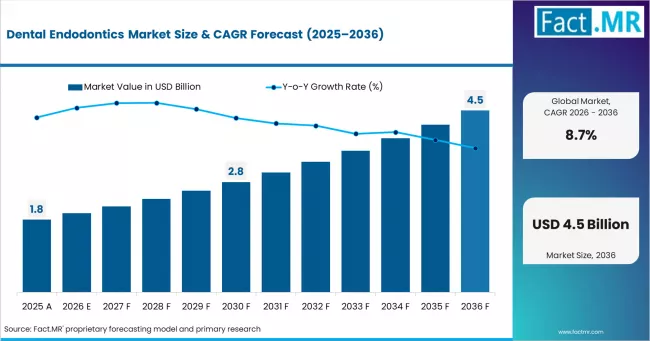
Dental Endodontics Market Market Value Analysis | Source: Fact.MR
Summary of Dental Endodontics Market
- Market Snapshot
- In 2025, the global Dental Endodontics Market was valued at approximately USD 1.8 billion.
- The market is estimated to reach USD 2.0 billion in 2026 and is projected to attain USD 4.5 billion by 2036
- The dental endodontics market is likely to expand at a CAGR of 8.7% during the forecast period.
- The market is anticipated to create an absolute dollar opportunity of USD 2.5 billion between 2026 and 2036.
- Dental Endodontic Instruments account for 58.0% of market share in 2026.
- China (11.7%) and India (10.9%) are the key growth markets during the forecast period
- Demand and Growth Drivers
- Rising global dental caries prevalence is increasing the patient volume requiring root canal treatment, expanding demand for endodontic instruments and consumables.
- Growing adoption of rotary NiTi file systems and electronic apex locators is improving procedural efficiency and clinical outcomes, driving equipment upgrade cycles in dental practices.
- Dental tourism growth in Asia Pacific and Latin America is expanding procedure volumes in price-competitive markets, increasing endodontic instrument and consumable procurement.
- Product and Segment View
- Dental endodontic instruments account for 58% of the product segment in 2026, with rotary file systems, apex locators, and obturation devices as the primary procurement categories.
- Dental clinics hold 52% of end-use demand in 2026, with private practices performing the majority of root canal procedures globally.
- Endodontic consumables account for the remaining 42% of the product segment, including irrigation solutions, sealers, gutta-percha points, and disposable accessories.
- Geography and Competitive Outlook
- China leads at 11.7% CAGR, driven by expanding dental clinic infrastructure, rising dental care awareness, and growing adoption of advanced endodontic instrumentation.
- North America and Europe remain the largest markets by value, with established endodontic practice standards and high procedure volumes.
- Dentsply Sirona holds 30% market share through its comprehensive endodontic portfolio spanning rotary systems, obturation devices, and consumables.
- Analyst Opinion
- The dental endodontics market is experiencing a technology-driven upgrade cycle as dental practitioners transition from manual stainless steel instruments to motorized NiTi rotary file systems that improve procedural speed and reduce instrument separation risk. This transition is most advanced in North America and Europe, with Asia Pacific and Latin America in earlier adoption stages, creating significant growth runway. The market structure favors integrated endodontic solution providers that offer motor systems, file sequences, obturation devices, and consumables as a coordinated workflow, as practitioners prefer system compatibility and training support from a single vendor.
Why is the Dental Endodontics Market Growing?
- Dental caries prevalence remains high globally, sustaining the patient volume requiring root canal treatment and driving endodontic instrument demand.
- Technology transition from manual to motorized rotary systems is creating equipment upgrade cycles across dental practices in emerging markets.
- Dental insurance coverage expansion and dental tourism growth are increasing procedure accessibility and volume in previously underserved markets.
The dental endodontics market grows through the combination of sustained root canal procedure volumes and the ongoing technology transition from manual to motorized instrumentation. Dental caries affects a substantial share of the global population, and root canal treatment remains the primary alternative to tooth extraction for salvaging teeth with pulp disease.
The technology upgrade cycle is the primary value growth driver. Motorized rotary NiTi file systems reduce procedure time, improve canal shaping consistency, and lower the risk of instrument separation compared to manual stainless steel files. As these systems become more affordable and training programs expand, adoption is accelerating in dental practices across Asia Pacific, Latin America, and the Middle East.
Segment-wise Analysis of the Dental Endodontics Market
- Endodontic instruments lead at 58% share in 2026, with rotary file systems and apex locators as primary categories.
- Dental clinics hold 52% of end-use demand in 2026, performing the majority of root canal procedures.
- Consumables account for 42% of the product segment, with recurring demand for irrigation solutions, sealers, and gutta-percha.
The market is segmented by product type (endodontic instruments, endodontic consumables) and end use (dental clinics, dental hospitals, dental academic and research institutes, other end users).
Which Product Segment Leads the Dental Endodontics Market?
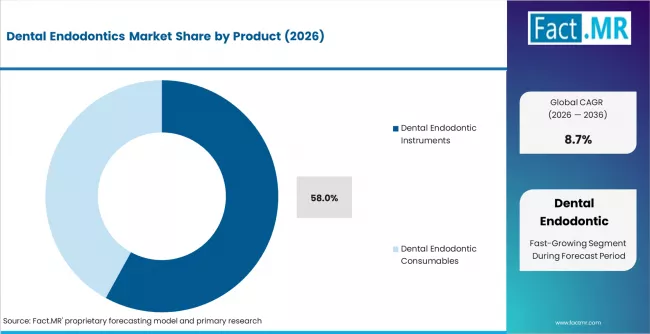
Dental Endodontics Market Analysis By Product | Source: Fact.MR
Dental endodontic instruments hold 58% of the product segment in 2026. Rotary file systems represent the largest instrument category, with NiTi files increasingly replacing manual stainless steel instruments. Apex locators, endodontic motors, and obturation devices complete the instrument portfolio. The segment benefits from equipment upgrade cycles and technology transition in emerging market dental practices.
Which End Use Drives the Largest Demand?
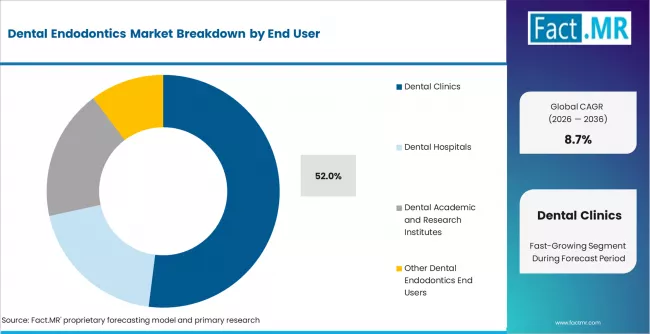
Dental Endodontics Market Analysis By End User | Source: Fact.MR
Dental clinics hold 52% of end-use demand in 2026. Private dental practices perform the majority of root canal procedures globally, with general dentists and endodontists procuring instruments and consumables through dental supply distributors. Dental hospitals contribute the second-largest share, with academic institutions and research facilities serving as early adopters of new endodontic technologies.
Key Growth Drivers, Constraints, and Market Scope
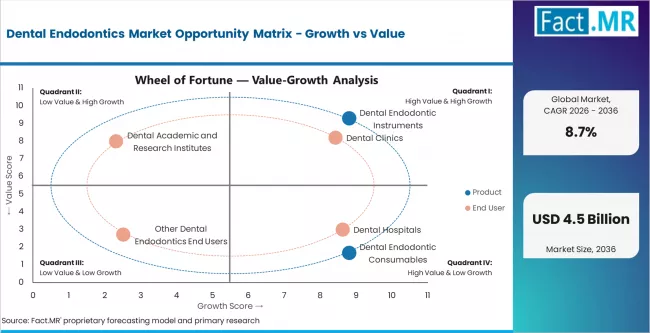
Dental Endodontics Market Opportunity Matrix Growth Vs Value | Source: Fact.MR
- High dental caries prevalence sustains root canal procedure volumes and endodontic instrument demand.
- Technology transition from manual to motorized systems creates equipment upgrade cycles.
- Instrument cost premiums for NiTi rotary systems constrain adoption in price-sensitive dental markets.
The dental endodontics market is shaped by dental caries epidemiology, root canal procedure trends, endodontic technology adoption, and dental healthcare infrastructure development.
Growth Drivers
Demand is shaped by sustained dental caries prevalence, technology transition from manual to rotary instrumentation, and expanding dental care access in emerging markets. Dental insurance coverage growth and dental tourism are increasing procedure volumes across price-competitive markets.
Constraints
NiTi rotary system cost premiums limit adoption in price-sensitive practices. Instrument learning curves require training investment for practitioners transitioning from manual techniques. Single-use instrument mandates in some markets increase per-procedure costs.
Opportunities
Emerging market dental clinic construction creates the largest new equipment procurement opportunity. Reciprocating file systems offering simplified protocols are accelerating adoption among general dentists. Digital endodontics integrating CBCT imaging with motorized instrumentation represents a premium technology tier.
Regional Outlook Across Key Markets
.webp "Top Country Growth Comparison Dental Endodontics Market Cagr (2026 2036)")
Top Country Growth Comparison Dental Endodontics Market Cagr (2026 2036) | Source: Fact.MR
- China leads at 11.7% CAGR, driven by dental clinic expansion and growing adoption of advanced endodontic instrumentation.
- India follows at 10.9% CAGR, reflecting expanding dental infrastructure and increasing root canal treatment volumes.
- Germany records 10.0% CAGR, supported by established endodontic standards and technology adoption.
- USA grows at 8.3% CAGR, with mature procedure volumes and premium instrument adoption.
Country CAGR Table
| Country | CAGR (%) |
|---|---|
| China | 11.7% |
| India | 10.9% |
| Germany | 10.0% |
| Brazil | 9.1% |
| USA | 8.3% |
| UK | 7.4% |
| Japan | 6.5% |
Source: Fact.MR analysis. Updated Apr 24, 2026
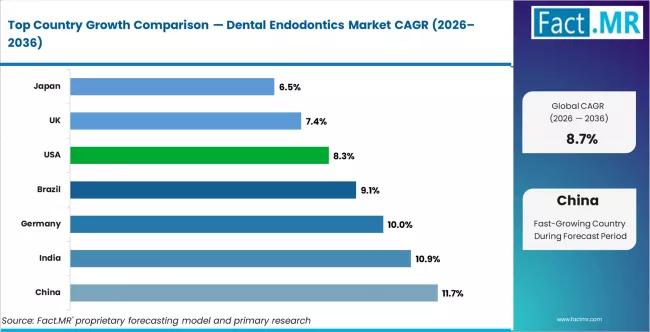
Dental Endodontics Market Cagr Analysis By Country | Source: Fact.MR
Regional demand reflects dental caries prevalence, dental infrastructure maturity, endodontic technology adoption rates, and dental healthcare financing mechanisms.
Market Outlook in China
The China dental endodontics market is projected to grow at a CAGR of 11.7% through 2036. Demand is driven by rapid dental clinic expansion, rising dental care awareness, and growing adoption of motorized rotary systems replacing manual instrumentation.
- Dental clinic expansion creates new instrument procurement demand.
- Rising dental care awareness increases root canal treatment volumes.
- Rotary system adoption accelerates equipment upgrade cycles.
Demand Trends in India
The India dental endodontics market is projected to grow at a CAGR of 10.9% through 2036. Growth reflects expanding dental infrastructure, increasing procedure volumes, and gradual technology transition toward motorized endodontic systems.
- Dental infrastructure expansion broadens equipment procurement.
- Procedure volume growth sustains instrument and consumable demand.
- Technology transition creates upgrade cycle opportunities.
USA Market Outlook
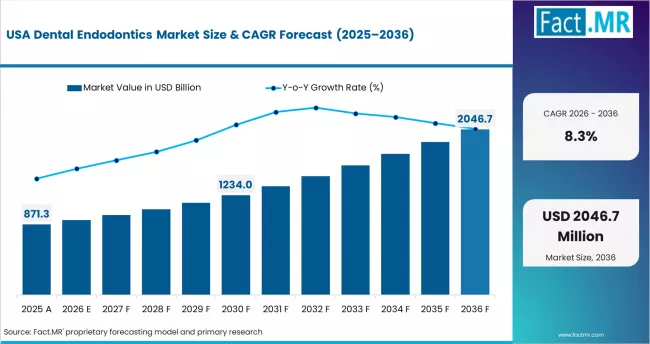
Dental Endodontics Market Country Value Analysis | Source: Fact.MR
The USA dental endodontics market is projected to grow at a CAGR of 8.3% through 2036. Demand is shaped by stable root canal procedure volumes, premium instrument adoption, and ongoing technology advancement in rotary and reciprocating systems.
- Stable procedure volumes sustain baseline instrument demand.
- Premium instrument adoption supports value growth.
- Technology advancement drives equipment upgrade cycles.
Germany Market Assessment
The Germany dental endodontics market is projected to grow at a CAGR of 10.0% through 2036. Demand is supported by established endodontic practice standards, advanced technology adoption, and comprehensive dental insurance coverage.
- Established practice standards support advanced instrument adoption.
- Insurance coverage ensures patient access to root canal treatment.
- Technology leadership drives early adoption of new endodontic systems.
Competitive Benchmarking and Company Positioning
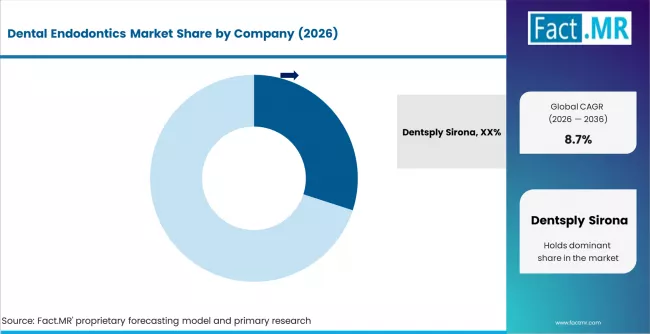
Dental Endodontics Market Analysis By Company | Source: Fact.MR
- Dentsply Sirona holds 30% market share through its comprehensive endodontic portfolio including ProTaper, WaveOne, and related systems.
- Danaher (through its dental segment) and Ivoclar Vivadent compete through integrated endodontic solutions and strong dental distribution.
- Competition is shaped by file system performance, procedural workflow integration, training support, and distribution channel coverage.
The competitive landscape is led by Dentsply Sirona's dominant endodontic portfolio. Danaher (KaVo Kerr) and Mani compete through file system innovation and competitive pricing. Regional manufacturers in Japan and India serve local markets with cost-competitive alternatives.
Strategic priorities include developing next-generation NiTi alloy file systems with improved flexibility and fracture resistance, building digital endodontic workflow integrations, expanding training programs for motorized system adoption, and strengthening distribution in emerging market dental supply channels.
Competitive Benchmarking
| Company | Product Portfolio | Technology | Training Support | Geographic Reach |
|---|---|---|---|---|
| Dentsply Sirona | Comprehensive | Leading | Extensive | Global |
| Danaher | Broad | Advanced | Strong | Global |
| Mani Inc. | Focused | Competitive | Moderate | Asia/Global |
| Ivoclar Vivadent | Moderate | Advanced | Strong | Europe/Global |
| Ultradent | Focused | Competitive | Moderate | Americas/Global |
Source: Fact.MR analysis. Updated Apr 24, 2026
Recent Industry Developments
- Dentsply Sirona launched an updated ProTaper Ultimate file system in 2025, featuring improved NiTi alloy composition for enhanced flexibility and fracture resistance.
- Mani Inc. expanded its rotary file distribution in Southeast Asia and Africa in early 2026, targeting cost-sensitive dental markets transitioning from manual instrumentation.
- FKG Dentaire introduced a new reciprocating file system in 2025, targeting simplified endodontic workflows for general dental practitioners.
Leading Companies Shaping the Dental Endodontics Market
-
Major Players
- Dentsply Sirona
- Danaher Corporation
- Ivoclar Vivadent
- Mani, Inc.
- Ultradent Products Inc.
-
Emerging Players
- Peter Brasseler Holdings LP
- Septodont Holdings
- FKG Dentaire S.A.
- Coltene Holding AG
- Henry Schein Inc.
Sources and Research References
- World Health Organization (WHO). Global oral health epidemiology data.
- FDI World Dental Federation. Dental practice and procedure statistics.
- Dentsply Sirona. Annual reports and endodontic portfolio disclosures.
- American Association of Endodontists (AAE). Clinical practice guidelines and procedure data.
- International Dental Federation. Global dental workforce and infrastructure data.
- Primary interviews with endodontists, general dental practitioners, dental equipment distributors, and dental school faculty.
This bibliography is provided for reader reference. The full report contains the complete reference list.
Key Questions This Report Addresses
- What is the current and projected size of the dental endodontics market through 2036?
- What CAGR is expected for the dental endodontics market between 2026 and 2036?
- Which product type holds the largest market share in 2026?
- Which end-use segment accounts for the highest demand in 2026?
- What factors are shaping demand for dental endodontic products globally?
- Which countries are projected to show the fastest growth through 2036?
- How is the competitive landscape structured and who are the leading companies?
- How does Fact.MR estimate and validate the market forecast?
Dental Endodontics Market Definition
The dental endodontics market covers instruments, consumables, and equipment used in root canal treatment and other endodontic procedures. The market spans rotary and reciprocating file systems, apex locators, obturation devices, irrigation solutions, sealers, and related accessories distributed to dental clinics, hospitals, and academic institutions.
Dental Endodontics Market Inclusions
The scope covers global and regional market size and forecasts for 2026 to 2036 across product type, end use, and region. It includes demand analysis based on dental caries prevalence, root canal procedure volumes, and endodontic technology adoption patterns.
Dental Endodontics Market Exclusions
The scope excludes general dental instruments not specific to endodontic procedures, dental implant systems, orthodontic devices, and dental imaging equipment classified as separate device categories.
Dental Endodontics Market Research Methodology
- Primary research includes interviews with endodontists, general dental practitioners, dental equipment distributors, and dental school faculty.
- Desk research draws on dental caries epidemiology, root canal procedure statistics, device regulatory databases, and company financial disclosures.
- Market sizing uses a demand-side model validated through procedure volume cross-checks, instrument utilization rates, and pricing benchmarks.
- Data validation involves reconciliation with dental association statistics and expert panel review.
Segmentation
Scope of Analysis
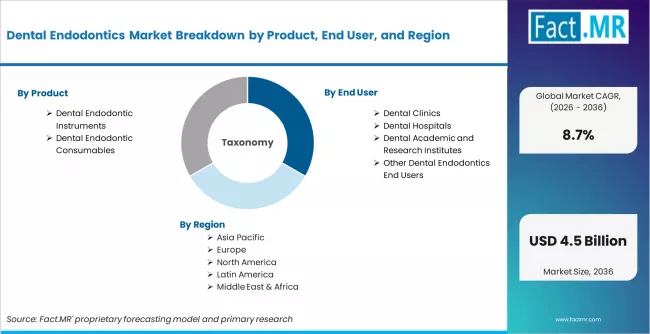
Dental Endodontics Market Breakdown By Product, End User, And Region | Source: Fact.MR
| Parameter | Details |
|---|---|
| Quantitative Units | USD 2.0 billion to USD 4.5 billion, at a CAGR of 8.7% |
| Market Definition | Covers instruments, consumables, and equipment for root canal treatment including rotary file systems, apex locators, obturation devices, and related accessories. |
| Regions Covered | North America, Latin America, Europe, East Asia, South Asia and Pacific, Middle East and Africa |
| Countries Covered | USA, China, India, Germany, Brazil, UK, Japan, and 30+ countries |
| Key Companies | Dentsply Sirona, Danaher, Ivoclar Vivadent, Mani, Ultradent, Peter Brasseler, Septodont, FKG Dentaire, Coltene, Henry Schein |
| Forecast Period | 2026 to 2036 |
| Approach | Hybrid demand-side methodology built on dental caries epidemiology, root canal procedure volumes, instrument utilization rates, and primary interviews across endodontists, dental practitioners, and distributors. |
Source: Fact.MR analysis. Updated Apr 24, 2026
Analysis by Product Type, End User, and Region
-
Dental Endodontics Market Market Segmented by Product:
- Dental Endodontic Instruments
- Endodontic Scalers & Lasers
- Motors
- Apex Locators
- Machine-assisted Obturation Systems
- Others
- Dental Endodontic Consumables
- Obturation
- Shaping and Cleaning
- Access Cavity Preparation
- Dental Endodontic Instruments
-
Dental Endodontics Market Market Segmented by End User:
- Dental Clinics
- Dental Hospitals
- Dental Academic and Research Institutes
- Other Dental Endodontics End Users
-
Dental Endodontics Market Market by Region:
- North America
- USA
- Canada
- Mexico
- Latin America
- Brazil
- Chile
- Rest of Latin America
- Western Europe
- Germany
- UK
- Italy
- Spain
- France
- Nordic
- BENELUX
- Rest of Western Europe
- Eastern Europe
- Russia
- Poland
- Hungary
- Balkan & Baltic
- Rest of Eastern Europe
- East Asia
- China
- Japan
- South Korea
- South Asia and Pacific
- India
- ASEAN
- Australia & New Zealand
- Rest of South Asia and Pacific
- Middle East & Africa
- Kingdom of Saudi Arabia
- Other GCC Countries
- Turkiye
- South Africa
- Other African Union
- Rest of Middle East & Africa
- North America
Frequently Asked Questions
What is the size of the dental endodontics market in 2026?
What will be the size of the dental endodontics market in 2036?
How much will the dental endodontics market grow between 2026 and 2036?
What are the key product types in the dental endodontics market?
Which end-use segment will contribute significant share in the dental endodontics market in 2026?
Which country is the fastest growing market for dental endodontics?
What does the dental endodontics market cover?
How does Fact.MR estimate and validate the market forecast?
Who worked on this report


Preview the report firsthand - request a free sample
Free SampleGet the brochure for pricing and purchase details
Download PDF