- Market Value (2025): USD 366.1 Mn
- Estimated Value (2026): USD 410 Mn
- Forecast Value (2036): USD 1273 Mn
- CAGR (2026-2036): 12.0%
What is the Enzymatic Protein Texturizers Market forecast to be worth by 2036?
USD 410 million in 2026 to USD 1273 million by 2036, at 12.0% CAGR.
- The enzymatic protein texturizers market crossed a valuation of USD 366.1 million in 2025.
- Demand is projected to increase from USD 410 million in 2026 to USD 1273 million by 2036.
- The market is forecast to record a 12.0% CAGR from 2026 to 2036 as meat analogue brands, bakery teams and dairy alternative formulators refine texture without changing the full recipe base.
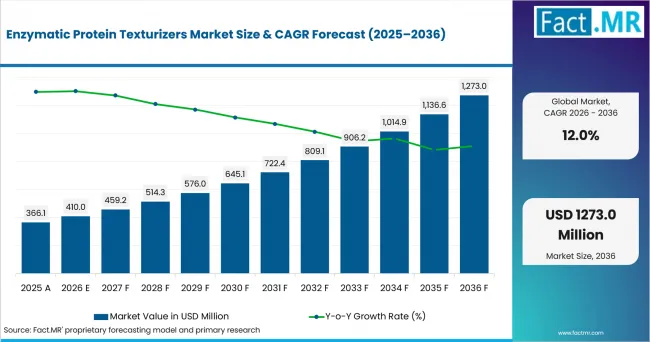
Enzymatic Protein Texturizers Market Value Analysis | Source: Fact.MR
What are the defining numbers behind Enzymatic Protein Texturizers Market growth?
USD 863 million absolute opportunity by 2036, led by Meat analogues, Soy and Transglutaminase.
- Demand Drivers in the Market
- Meat analogue brands need stronger binding in plant-based meat formulations so patties, nuggets and fillings keep shape during freezing, cooking and reheating.
- High-protein bakery developers need enzyme systems that improve crumb strength and slice resilience when protein fortification weakens dough structure.
- Dairy alternative formulators need better protein solubility and mouthfeel since grain and pulse bases often separate or feel chalky.
- USDA ERS reported on June 11, 2026 that inflation-adjusted U.S. food spending by consumers, businesses and government entities reached USD 2.51 trillion in 2025 (2025 dollars).
- Key Segments Analyzed
- By Enzyme Class: Transglutaminase is estimated to hold 40.0% share in 2026 due to its direct role in protein cross-linking and bite formation.
- By Protein Substrate: Soy is projected to account for 50.0% share in 2026 owing to established sourcing, familiar formulation behavior and wide use in analogues.
- By Texture Function: Binding-cohesion is anticipated to capture 39.0% share in 2026 as product teams use enzymes to reduce breakage during forming and cooking.
- By Application: Meat analogues are forecast to represent 51.0% share in 2026 supported by burger, sausage and formed-protein formats that need repeatable bite.
- Analyst Opinion at Fact.MR
- Shambhu Nath Jha, Principal Consultant at Fact.MR, states, "Texture is becoming a formulation proof point, not a late-stage fix. The market is expected to reward enzyme suppliers that show how a specific protein behaves under heat, shear and storage. Suppliers with credible trials should combine enzyme know-how with application testing that mirrors real plant or meat-processing lines."
- Strategic Implications
- Enzyme suppliers should publish substrate-specific dosage ranges so formulators know how soy, pea, wheat and mycoprotein respond before pilot trials.
- Plant-protein brands should test enzyme systems against bite, water release and reheating performance instead of relying only on bench texture scores.
- Contract manufacturers should document processing windows because enzyme performance changes with time, temperature and protein concentration.
- The Food Standards Agency announced £1.4 million on March 28, 2025 for an innovation hub to strengthen regulatory capability for innovative food technologies, including precision-fermented foods.
The UK is projected to post 14.7% CAGR through 2036 supported by alternative-protein formulation and retail interest in higher-protein foods. South Korea is anticipated to record 13.7% CAGR as export-oriented food processors adapt texture systems for K-food formats. Japan is estimated to advance at 13.3% CAGR due to meat-reference consumption and processed-food precision. The USA is forecast to reach 12.1% CAGR owing to large food spending and soybean availability. Germany is projected to record 9.5% CAGR as cost pressure moderates trials even while meat-substitute manufacturing remains visible.
How does the Enzymatic Protein Texturizers Market break down by segment?
Meat analogues lead Application at 51.0%; Soy leads Protein Substrate at 50.0%.
Which Enzyme Class dominates?
Transglutaminase holds 40.0% share in 2026.
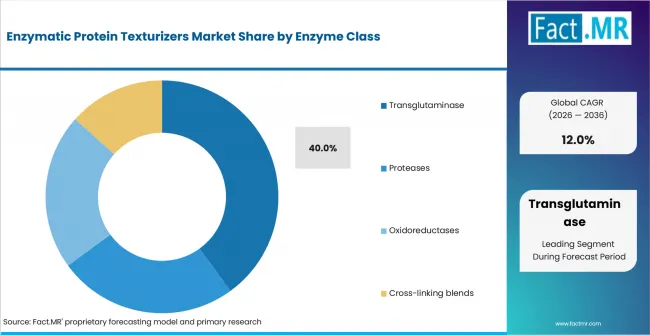
Enzymatic Protein Texturizers Market Analysis By Enzyme Class | Source: Fact.MR
Ajinomoto states that transglutaminase enables the cross-linking of protein molecules and that it formulated the enzyme into the ACTIVA® food-enzyme preparation. The company identifies transglutaminase as a protein-binding enzyme used to improve texture and physical properties in food applications, including plant-based proteins.
What leads the Protein Substrate segment?
Soy accounts for 50.0% share in 2026.
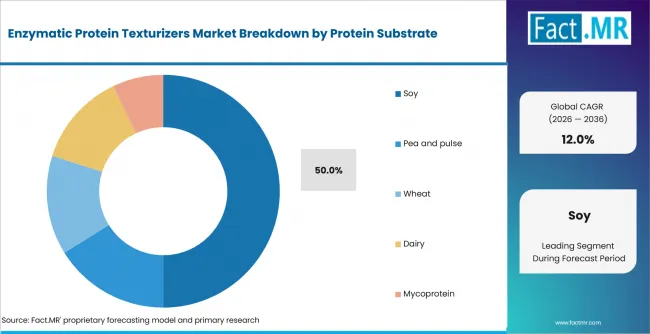
Enzymatic Protein Texturizers Market Analysis By Protein Substrate | Source: Fact.MR
Soy leads because it gives formulators an established protein base with predictable hydration, processing behavior and bite. The role of textured soy protein is especially visible in analogues that need a fibrous chew without relying on animal protein. Pea and pulse proteins are gaining formulation attention, but soy remains the default substrate for many high-volume trials.
How does Texture Function shape demand?
Binding-cohesion captures 39.0% share in 2026.
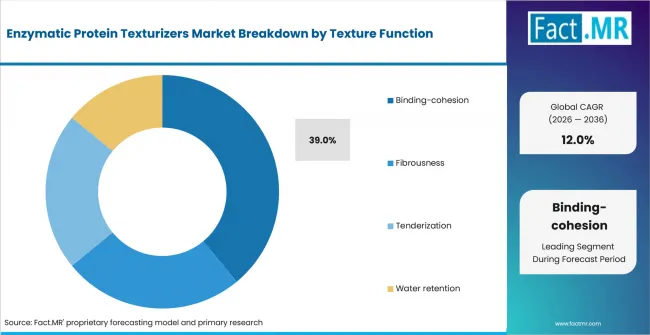
Enzymatic Protein Texturizers Market Analysis By Texture Function | Source: Fact.MR
Binding-cohesion leads because texture failure is often visible before flavor failure. A burger that cracks, a fillet that sheds water or a bakery item that crumbles creates a direct quality problem. Enzymatic cross-linking and controlled protein modification help developers hold shape while limiting the need for heavy gums or starch systems.
What supports Meat analogues within Application?
Meat analogues represent 51.0% share in 2026.
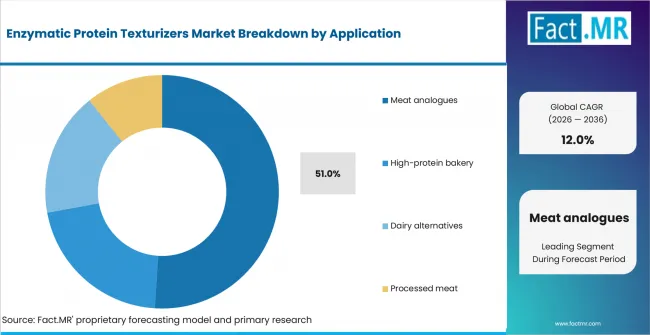
Enzymatic Protein Texturizers Market Analysis By Application | Source: Fact.MR
Meat analogues lead Application because they turn protein structure into a consumer-facing quality cue. In meat substitutes, the same patty or sausage has to survive forming, chilling, retail handling and cooking. Enzyme texturizers are therefore evaluated on bite recovery, bind strength and water control across the full production path.
What is accelerating Enzymatic Protein Texturizers Market adoption, and what is holding it back?
Demand is expected to rise through plant-protein reformulation and process-yield needs, while cost, labeling review and substrate variability constrain adoption.
| DRIVER | (~) % IMPACT ON CAGR | GEOGRAPHIC RELEVANCE | IMPACT TIMELINE |
|---|---|---|---|
| Meat analogue texture and bite improvement | +1.8% | North America, Western Europe, East Asia | Short term (<= 2 years) |
| High-protein bakery and snack formulation | +1.2% | USA, UK, Japan | Medium term (2-4 years) |
| Dairy alternative stability and mouthfeel | +0.9% | USA, UK, South Korea | Medium term (2-4 years) |
| Yield and cohesion needs in processed meat | +0.8% | USA, Germany, Japan | Long term (>= 4 years) |
- Meat analogue texture and bite improvement: Formulators use transglutaminase and blends when extrusion alone does not deliver clean bind or repeatable chew.
- High-protein bakery and snack formulation: Protein enrichment changes dough behavior, so bakery teams need enzymes that protect volume, crumb and softness.
- Dairy alternative stability and mouthfeel: Plant-based drinks and yogurts need enzyme routes that improve solubility and reduce grainy texture.
| OPPORTUNITY | (~) % IMPACT ON CAGR | GEOGRAPHIC RELEVANCE | IMPACT TIMELINE |
|---|---|---|---|
| Substrate-specific enzyme kits for soy and pulses | +1.0% | Global | Short term (<= 2 years) |
| Clean label reformulation in analogues | +0.8% | North America, Western Europe | Medium term (2-4 years) |
| Application-service bundles for smaller brands | +0.7% | Global | Long term (>= 4 years) |
- Substrate-specific enzyme kits: Suppliers are expected to gain trials when they pair enzyme products with protocol guidance for soy, pea, wheat and mycoprotein.
- Clean label reformulation: Texture systems that reduce dependence on heavy stabilizer stacks are anticipated to fit brand efforts around simpler ingredient panels.
- Application-service bundles: Smaller brands often lack enzyme expertise, making trials easier when suppliers provide pilot recipes and processing support.
| RESTRAINT | (~) % IMPACT ON CAGR | GEOGRAPHIC RELEVANCE | IMPACT TIMELINE |
|---|---|---|---|
| Ingredient-cost justification in price-sensitive foods | -0.6% | USA, Germany, UK | Short term (<= 2 years) |
| Labeling and regulatory review for new enzyme uses | -0.5% | North America, Europe, Japan | Medium term (2-4 years) |
| Variable behavior across plant-protein lots | -0.4% | Global | Long term (>= 4 years) |
- Ingredient-cost justification: Enzymes compete for formulation budget against flavors, stabilizers and protein ingredients, so adoption depends on measurable texture gain.
- Labeling and regulatory review: New enzyme uses need clear technical files, especially when applications move across dairy alternatives, meat analogues and bakery.
- Variable behavior across plant-protein lots: Crop variety, extraction method and protein concentration change enzyme response, forcing extra validation work.
Which countries are scaling the Enzymatic Protein Texturizers Market through 2036?
- The country comparison spans 5.2 percentage points between the UK and Germany across the forecast period.
- The UK remains 1.0 percentage point above South Korea.
- South Korea remains 0.4 percentage point above Japan.
- Japan remains 1.2 percentage points above the USA.
- The USA remains 2.6 percentage points above Germany.
Comparable CAGRs create different entry conditions due to protein sourcing, processed-food manufacturing, labeling review and retail price pressure. Full report coverage includes North America, Latin America, Western Europe, Eastern Europe, East Asia, South Asia & Pacific, Middle East & Africa.
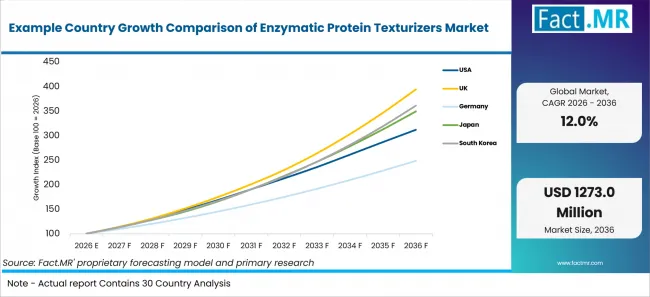
Example Country Growth Comparison Of Enzymatic Protein Texturizers Market | Source: Fact.MR
| Country | CAGR (2026-2036) |
|---|---|
| USA | 12.1% |
| UK | 14.7% |
| Germany | 9.5% |
| Japan | 13.3% |
| South Korea | 13.7% |
How is the UK scaling demand?
14.7% CAGR, supported by alternative-protein regulation and prepared-food formulation.
The UK’s growth is supported by changing protein consumption patterns and demand for formulated prepared foods. Defra’s Family Food FYE 2024 reported household meat purchases of 848 grams per person per week, down 1.1% from FYE 2023. Enzyme-based texturization is expected to gain relevance where manufacturers need improved binding, structure and eating quality in alternative-protein products. Adoption will still depend on formulation performance, regulatory review and the ability to reproduce texture consistently across commercial production.
How is South Korea developing demand?
13.7% CAGR, shaped by food exports and processed-protein innovation.
South Korea’s growth is supported by expanding food exports and continued innovation in processed-protein products. MAFRA reported provisional K-Food+ exports of USD 13.62 billion in 2025, up 5.1% year over year. This provides broad export-market context rather than direct evidence of enzyme-texturized protein demand. Food manufacturers are expected to evaluate enzyme systems where texture, binding and processing stability must be maintained across export-oriented products and varied regional formulations.
How does Japan perform?
13.3% CAGR, led by meat-reference consumption and precision food processing.
Japan’s growth reflects a mature food-processing base and strong emphasis on controlled protein functionality. MAFF reported a per-capita meat consumption indicator of 34.3 kilograms per year in FY2024, based on its annual net food supply measure. Amano Enzyme also states that Protein Glutaminase “Amano” 500 can modify protein functionality, including solubility, emulsification and foaming. These capabilities support formulation work in processed and alternative proteins where manufacturers need precise control over texture and functional performance.
What supports USA adoption?
12.1% CAGR, reinforced by food spending and soy-protein supply depth.
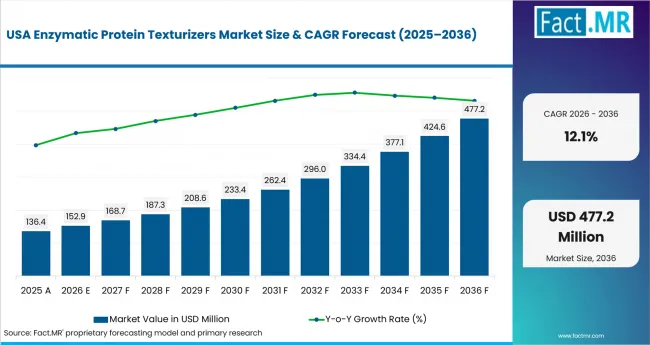
Enzymatic Protein Texturizers Market Country Value Analysis | Source: Fact.MR
The USA’s growth is supported by a large soybean supply base and established regulatory pathways for selected food enzymes. USDA NASS estimated 85.4 million acres of soybeans planted in 2026, up 5% from 2025. FDA GRN 1139 also covers one specific transglutaminase preparation for uses including plant-based meat analogues and baked goods, with FDA issuing a “no questions” response in July 2024.
What supports Germany adoption?
9.5% CAGR, supported by meat-substitute manufacturing and ready-meal production.
Germany’s growth is supported by an established meat-substitute manufacturing base and continued demand for formulated convenience foods. Destatis reported that Germany produced 124,900 tonnes of meat-substitute products in 2025, although output was 1.2% lower than in 2024. Enzyme-based texturization is expected to remain relevant where manufacturers need improved binding, chew and structural consistency in plant-based protein products. Adoption will depend on formulation economics, sensory performance and compatibility with existing processing lines.
Who leads the Enzymatic Protein Texturizers Market?
Ajinomoto remains closely associated with transglutaminase through the ACTIVA range, which the company describes as a food enzyme preparation for texture improvement. Its relevance is concentrated in meat, fish, dairy and plant-protein applications where binding and elasticity are central to product quality.
Novonesis offers a broad plant-based biosolutions portfolio and introduced Vertera® Velvet in May 2025 to improve foam, texture, protein functionality and stability in plant-based drinks. IFF supports high-protein bakery formulations through its protein and bakery solutions. Separately, in August 2025, IFF launched POWERFRESH® ACE 2000 in the U.S. as a bread fresh-keeping enzyme solution designed to improve softness, resilience and cohesiveness throughout shelf life.
Direct protein-texture solutions include Ajinomoto’s ACTIVA® transglutaminase preparations, Novonesis’ Vertera® solutions, Amano Enzyme’s PG-500 and AB Enzymes’ COROLASE® plant-protein hydrolysis portfolio. IFF also offers dedicated bakery enzymes, while dsm-firmenich’s Delvo®Plant enzyme portfolio is designed to improve taste, texture and mouthfeel in plant-based dairy alternatives.
Which companies are the key providers?
Key companies include Ajinomoto Co., Inc.; Novonesis; IFF; dsm-firmenich; Amano Enzyme Inc.; and AB Enzymes GmbH.
- Ajinomoto Co., Inc.
- Novonesis
- IFF
- dsm-firmenich
- Amano Enzyme Inc.
- AB Enzymes GmbH
Bibliography
- Amano Enzyme Inc. (2025, December 8). Protein Glutaminase “Amano” 500 and the new era of organic, non-GMO food solutions.
- Department for Environment, Food & Rural Affairs. (2025, November 6). Family Food FYE 2024. GOV.UK.
- dsm-firmenich. (2025, December 1). Why plant-based dairy is just getting started.
- Food Standards Agency. (2025, March 28). FSA announces £1.4 million funding for launch of new innovation hub.
- IFF. (2025, August 13). IFF launches POWERFRESH® ACE 2000, a bread fresh-keeping solution that ‘aces’ the shelf-life test.
- Ministry of Agriculture, Food and Rural Affairs. (2026, January 20). Exports of K-Food Plus reached USD 13.6 billion in 2025, up 5.1% year-over-year.
- Statistisches Bundesamt. (2026, May 18). Nach jahrelangem Anstieg: Fleischersatz-Produktion sinkt 2025 um 1,2 % gegenüber dem Vorjahr [After years of growth: Meat substitute production falls by 1.2% in 2025 compared with the previous year].
- U.S. Department of Agriculture, National Agricultural Statistics Service. (2026, June 30). Corn planted acreage down 3% from 2025, soybean acreage up 5% from last year.
- U.S. Food and Drug Administration. (2024, July 2). GRN No. 1139 [Transglutaminase enzyme preparation produced by Bacillus licheniformis carrying a gene encoding transglutaminase from Streptomyces mobaraensis].
This Report Addresses
- The report explains where enzymatic protein texturizers are used across enzyme class, protein substrate, texture function and application.
- Segment analysis identifies the leading subsegments and the formulation reasons product teams prioritize them.
- Country analysis examines the listed markets and the food-processing mechanisms supporting enzyme-based texture control.
- Competitive analysis reviews current suppliers across transglutaminase, plant-based biosolutions, protein deamidase and bakery enzyme platforms.
- Application analysis assesses how binding, fibrousness, tenderization and water retention influence purchase decisions.
What does the Enzymatic Protein Texturizers Market cover?
The Enzymatic Protein Texturizers Market covers food enzymes used to change how proteins bind, soften, hold water or form structure. It includes transglutaminase, proteases, oxidoreductases and blends used in soy, pea, wheat, dairy and mycoprotein systems. Adjacent coverage across the enzymes market and protein ingredients helps frame upstream supply.
The assessment covers food ingredients used in meat analogues, high-protein bakery, dairy alternatives and processed meat. It also considers cross-application learning from plant-based fish where cohesion and bite are harder to hold after freezing or cooking.
What is included in the scope?
The scope includes commercial enzyme preparations sold for protein texturizing, formulation support services and blended systems where enzymes are a central texture function. It includes clean label enzymes when the enzyme route supports simpler stabilizer systems or processing-aid positioning.
The scope covers enzyme-assisted binding, fibrousness development, tenderization and water retention when these functions are tied to food texture. It includes use in plant-based, dairy, bakery and animal-protein products.
What is excluded from the scope?
The scope excludes flavor-only enzymes, digestive enzymes, animal feed enzymes, non-food industrial enzymes and raw protein concentrates sold without texturizing functionality.
General hydrocolloids, starches, extrusion equipment and protein isolates are excluded when they are not sold or used as part of an enzymatic texturizing system.
How Was the Analysis Built?
The analysis draws on 120+ sources, 35+ company portfolios, 25+ countries, and more than 20 industry interviews.
- Primary Research: Primary research includes discussions with manufacturers, service providers, technology developers, distributors, end users, procurement teams, and subject-matter experts. These conversations examine purchasing priorities, product adoption, operational challenges, approval requirements, competitive positioning, and the factors that influence wider market acceptance.
- Desk Research: Desk research covers government statistics, regulatory publications, company filings, trade data, technical studies, industry associations, standards, public policy, and other authoritative sources. Every source used in the analysis is documented in the bibliography.
- Market Sizing and Forecasting: Market estimates combine historical performance, demand indicators, pricing and volume trends, segment shares, company participation, country-level growth, adoption patterns, investment activity, and barriers to market expansion.
- Data Validation and Update Cycle: Findings are validated by comparing primary interviews with public data, company activity, regulatory changes, trade patterns, and industry developments. Regular updates review new product launches, capacity changes, partnerships, approvals, procurement trends, and shifts in commercial adoption.
What is the report’s scope and coverage?
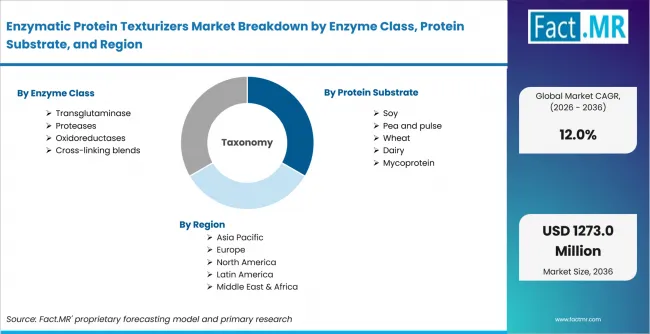
Enzymatic Protein Texturizers Market Breakdown By Enzyme Class, Protein Substrate, And Region | Source: Fact.MR
| Attribute | Details |
|---|---|
| Quantitative Units | USD million in 2026 to USD million by 2036 at a CAGR |
| Market Definition | Food enzyme systems used to modify protein texture, including cross-linking, proteolysis and protein-function improvement for plant-based and animal-protein formulations. |
| Enzyme Class | Transglutaminase; Proteases; Oxidoreductases; Cross-linking blends |
| Protein Substrate | Soy; Pea and pulse; Wheat; Dairy; Mycoprotein |
| Texture Function | Binding-cohesion; Fibrousness; Tenderization; Water retention |
| Application | Meat analogues; High-protein bakery; Dairy alternatives; Processed meat |
| Regions Covered | North America; Latin America; Western Europe; Eastern Europe; East Asia; South Asia & Pacific; Middle East & Africa |
| Countries Covered | USA; UK; Germany; Japan; South Korea |
| Key Companies Profiled | Ajinomoto Co., Inc.; Novonesis; IFF; dsm-firmenich; Amano Enzyme Inc.; AB Enzymes GmbH |
| Forecast Period | 2026 to 2036 |
| Approach | Hybrid top-down and bottom-up approach using enzyme-class adoption, substrate mix, texture-function intensity, application demand, country growth and provider portfolio review. |
How is the market segmented?
-
By Enzyme Class:
- Transglutaminase
- Proteases
- Oxidoreductases
- Cross-linking blends
-
By Protein Substrate:
- Soy
- Pea and pulse
- Wheat
- Dairy
- Mycoprotein
-
By Texture Function:
- Binding-cohesion
- Fibrousness
- Tenderization
- Water retention
-
By Application:
- Meat analogues
- High-protein bakery
- Dairy alternatives
- Processed meat
-
By Region:
- North America
- Latin America
- Western Europe
- Eastern Europe
- East Asia
- South Asia & Pacific
- Middle East & Africa