- Base Value(2025): 22.0 Bn
- Estimated Value(2026): 0.4 Bn
- Forecast Value (2036): 0.6 Bn
- CAGR (2026 - 2036): 4.1%
Europe Plastic Micronizer Market Size, Market Forecast and Outlook by Fact.MR
- The Europe plastic micronizer market surpassed a valuation of USD 0.3 billion in 2025.
- Demand is estimated to reach USD 0.4 billion in 2026 and is projected to rise to USD 0.6 billion by 2036.
- The market is forecast to record 4.1% CAGR from 2026 to 2036 as plastic recycling and controlled polymer powder processing support demand.
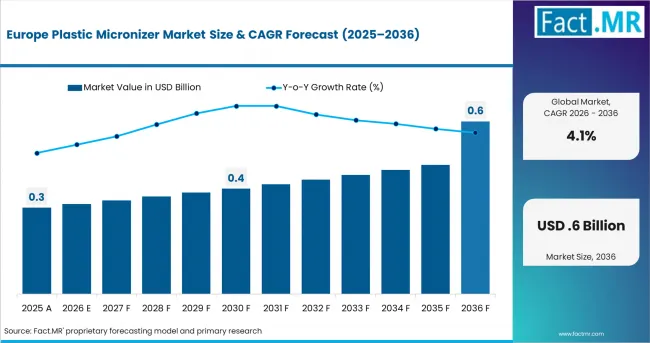
Europe Plastic Micronizer Market Value Analysis | Source: Fact.MR
| Metric | Details |
|---|---|
| Industry Size (2026) | USD 0.4 billion |
| Industry Value (2036) | USD 0.6 billion |
| CAGR (2026 to 2036) | 4.1% |
Summary of Europe Plastic Micronizer Market
- Demand Drivers in the Market
- Particle Control: Plastic processors need micronizers that deliver stable powder size. This supports better compounding and product consistency.
- Recycling Preparation: Recycling operators need finer output after coarse reduction. Controlled micronization can improve material reuse options.
- Process Efficiency: Chemical processors need dry grinding and classification systems that reduce contamination risk. Cleaner output improves downstream handling.
- Key Segments Analyzed
- By Separation Mixture: Liquid-liquid mixtures are projected to record 45.8% share in 2026 as processors need stronger separation control and consistent output quality.
- By Use Case: Plastic manufacturing leads because polymer powder production needs precise particle size. The segment is estimated to hold 56.4% share in 2026.
- By Product Type: Powder mills are projected to account for 42.6% share in 2026 because polymer processors need proven milling systems for stable powder output.
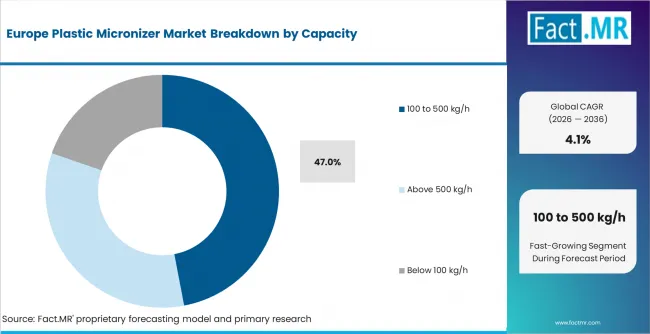
- By Capacity: Medium capacity systems lead because processors need flexibility between pilot-scale and full industrial throughput. The 100 to 500 kg/h range is expected to hold 47.0% share in 2026.
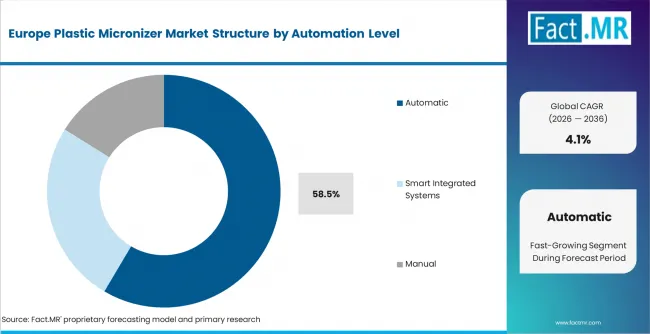
- By Automation Level: Automatic systems are anticipated to represent 58.5% share in 2026 because operators need lower manual handling and better process stability.
- By Geography: Poland plastic micronizer demand is forecast to grow at 5.0% CAGR from 2026 to 2036 as processing capacity and recycling-linked manufacturing improve.
- Analyst Opinion at Fact.MR
- Shambhu Nath Jha, Senior Analyst at Fact.MR, states, “Plastic micronizers are becoming precision assets inside polymer processing lines. Output quality depends on particle size control, feed stability and contamination management. Suppliers that prove process consistency and service depth will gain stronger demand across European processing sites.”
- Strategic Implications
- Particle Quality: Equipment suppliers need to prove output consistency across plastic grades. Poor particle distribution can weaken downstream performance.
- Service Response: Processors need fast spare parts and maintenance support. Machine downtime can interrupt powder production and compounding work.
- Automation Fit: Companies should match control systems with feed variability. Basic control can reduce process stability during mixed material runs.
Plastic micronizer demand rises as processors need fine powder output for plastic manufacturing and recycling. Eurostat reported that the EU recycled 42.1% of generated plastic packaging waste in 2023. [1] This keeps particle reduction equipment important because recycled polymer streams need better preparation before reuse.
Poland is forecast to grow at 5.0% CAGR from 2026 to 2036 as polymer processing and recycling capacity improve. Germany is projected to record 4.4% CAGR through high-precision plastics processing and machinery depth. Netherlands is likely to post 4.3% CAGR as innovation-led processing and recycling systems expand. France demand is set to rise at 4.2% CAGR through chemical and polymer processing modernization. Italy follows at 4.0% CAGR through machinery engineering and specialty plastic processing. Spain is estimated to grow at 3.9% CAGR by 2036 as industrial processing upgrades continue.
Segmental Analysis
Europe Plastic Micronizer Market Analysis by Separation Mixture
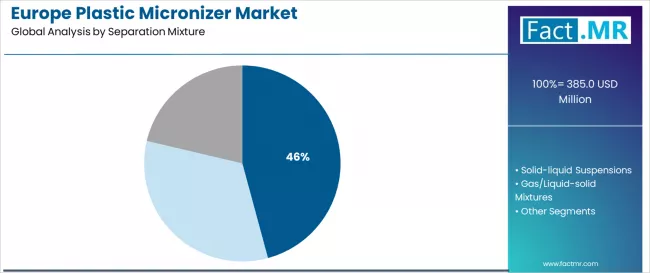
Europe Plastic Micronizer Market Analysis By Separation Mixture | Source: Fact.MR
Liquid-liquid mixtures are projected to hold 45.8% share in 2026. European processors use them for better separation control and steady particle quality. Solid-liquid suspensions support chemical processing and recycling. Gas/liquid-solid mixtures suit complex processes that need tighter control. Liquid-liquid systems lead because they reduce contamination risk and rework.
- Separation Control: Liquid-liquid systems support cleaner process handling. Weak separation can reduce material consistency.
- Suspension Handling: Solid-liquid suspensions need stable feed management. Poor control can raise cleaning and downtime needs.
- Complex Mixtures: Gas/liquid-solid systems serve demanding process setups. Buyers need better monitoring before scaling production.
Europe Plastic Micronizer Market Analysis by Use Case
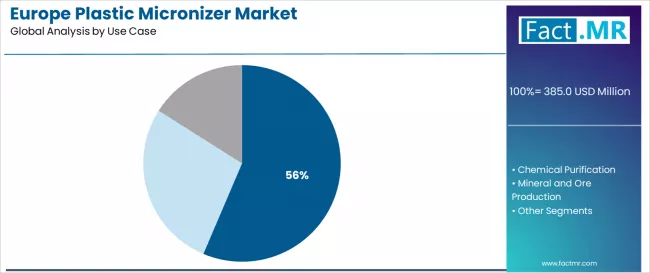
Europe Plastic Micronizer Market Analysis By Use Case | Source: Fact.MR
Plastic manufacturing leads because polymer powder production needs steady particle size across batches. Chemical purification uses micronizers for fine material control and cleaner processing. Mineral and ore production creates limited demand through specialty particle reduction. Plastic manufacturing is estimated to hold 56.4% share in 2026 because micronizers support compounding and recycled polymer preparation. Plastics Europe reported that circular plastics represented 15.4% of European plastics production in 2024. [2] This increases the need for equipment that can handle recycled and specialty polymer streams. Powder quality affects material flow and final product performance.
- Polymer Powder: Plastic manufacturing needs repeatable particle size. Inconsistent powder can affect compounding and downstream processing.
- Chemical Control: Chemical purification needs cleaner fine grinding. Contamination can reduce product acceptance.
- Mineral Use: Mineral and ore production supports selected micronizer demand. Equipment choice depends on hardness and throughput.
Europe Plastic Micronizer Market Analysis by Product Type
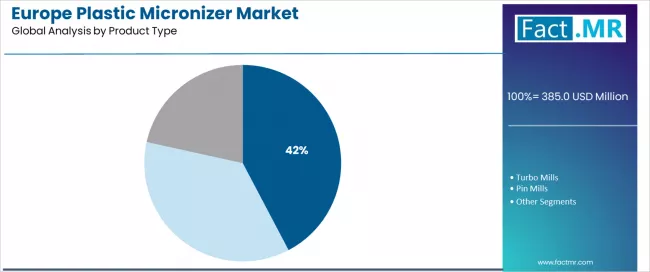
Europe Plastic Micronizer Market Analysis By Product Type | Source: Fact.MR
Powder mills are projected to hold 42.6% share in 2026 because polymer processors need reliable systems for fine powder output. Turbo mills support faster impact-based processing. Pin mills help with controlled fine grinding and dispersion. Powder mills lead because many plants prefer equipment with familiar operation and easier process checks. Turbo mills and pin mills gain demand in applications that need tighter control or higher throughput.
- Proven Output: Powder mills support predictable particle reduction. Processors prefer stable output over complex machine features.
- Impact Speed: Turbo mills support faster size reduction. They suit higher-energy processing tasks.
- Fine Control: Pin mills enable controlled fine grinding. They fit applications that need tighter particle distribution.
Europe Plastic Micronizer Market Analysis by Capacity
Europe Plastic Micronizer Market Analysis By Capacity | Source: Fact.MR
Medium-capacity systems lead because many European processors need flexible output without the cost of a large line. Small systems support pilot work and specialty production. High-capacity machines serve large plastic plants and recycling processors. The 100 to 500 kg/h range is projected to hold 47.0% share in 2026 as it balances production scale with manageable investment. Medium systems help processors test product changes and maintain steady output. Undersized machines can create bottlenecks as demand improves.
- Flexible Output: Medium-capacity systems support steady production and product trials. Operators can adjust more easily than with oversized systems.
- Pilot Need: Below 100 kg/h units support testing and specialty batches. They help processors validate material behavior.
- Scale Demand: Above 500 kg/h systems serve larger production lines. Strong service support is needed to protect uptime.
Europe Plastic Micronizer Market Analysis by Automation Level
Europe Plastic Micronizer Market Analysis By Automation Level | Source: Fact.MR
Automatic systems are anticipated to represent 58.5% share in 2026 because micronizing lines need lower manual handling and better process stability. Semi-automatic systems is useful for smaller processors. Manual systems serve limited or low-throughput applications. Automatic systems lead because operators need stable feeding and output monitoring. Automation improves control when feed behavior changes across plastic grades. Companies that delay automation may face higher labor dependency and less consistent output.
- Feed Stability: Automatic systems keep material flow steady. Better feed control improves powder quality.
- Process Monitoring: Smart controls help operators track machine performance. Early alerts can reduce stoppages.
- Cost Entry: Semi-automatic systems support lower-budget processors. They work well with predictable feed and smaller runs.
Europe Plastic Micronizer Market Drivers, Restraints, and Opportunities
Circular plastics goals and polymer process control are the main demand drivers. Demand for equipment that helps prepare plastic material for reuse and high-quality processing. Micronizers gain value because they improve particle control after coarse size reduction.
Capital cost and feed variability remain the main restraints. Plastic micronizers need careful setup because different polymers respond differently during fine grinding. Plastics Recyclers Europe reported 13.5 million tonnes of installed plastics recycling capacity in 2024, but also noted closures equal to around 0.3 million tonnes of capacity. [3] This shows that equipment demand can slow when recyclers face low utilization and weak economics.
Opportunities in the Europe Plastic Micronizer Market
- Recycled Polymer Powder: Plastic processors can use micronizers to improve powder consistency from recovered materials. This opportunity grows as circular plastics requirements rise.
- Smart Process Control: Equipment suppliers can add monitoring and automation to reduce output variation. Better controls help processors handle different plastic grades.
- Toll Processing Support: Toll processing helps manufacturers access micronized material without buying full equipment at the start.
Regional Analysis
Based on regional analysis, the Europe plastic micronizer market is segmented into Western Europe, Eastern Europe, Southern Europe and the UK.
| Country | CAGR |
|---|---|
| Poland | 5.0% |
| Germany | 4.4% |
| Netherlands | 4.3% |
| France | 4.2% |
| Italy | 4.0% |
| Spain | 3.9% |
Source: Fact.MR analysis based on forecast model and primary research.
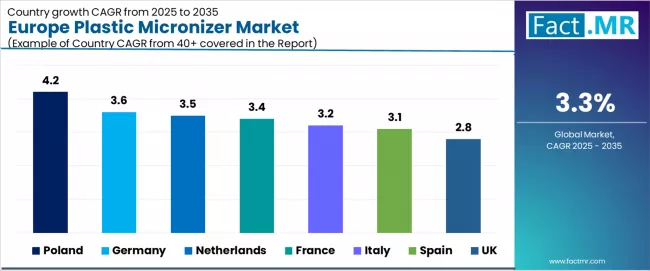
Europe Plastic Micronizer Market Cagr Analysis By Country | Source: Fact.MR
Eastern Europe Plastic Micronizer Market Analysis
Eastern Europe demand comes from polymer processing expansion and recycling-linked manufacturing upgrades. Poland leads because industrial sites need better equipment for plastic material preparation. Processors in the region often need practical systems that support reliability and cost control. Equipment suppliers gain when they combine installation support with operator training.
- Poland: Poland is forecast to grow at 5.0% CAGR from 2026 to 2036 as manufacturing capacity and recycling-linked processing improve. Plastic processors need micronizers that can turn polymer streams into steady powder for compounding and reuse. Faster growth is linked to equipment modernization and process upgrades. Suppliers with local service support can gain demand because processors need reliable uptime and operator help.
Western Europe Plastic Micronizer Market Analysis
Western Europe demand is more mature and tied to process quality and high-value polymer applications. Germany leads through engineering depth and advanced plastics processing. France and the Netherlands support demand through chemical processing and innovation-led production. Buyers in this region focus on output consistency and energy performance rather than basic equipment access.
- Germany: High-precision polymer processing supports micronizer demand in Germany. The country is forecast to record 4.4% CAGR through 2036 as processors upgrade grinding and classification systems. Germany also has a strong supplier base through companies such as Hosokawa Alpine and NETZSCH. Processors need machines that deliver uniform powder with low contamination risk. Service support and process testing will remain important in supplier selection.
- Netherlands: Innovation in processing and recycling supports demand in the Netherlands. Plastic micronizer demand in the Netherlands is forecast to grow at 4.3% CAGR by 2036. Processors need micronizers for smaller high-value lines and recycled polymer development. Demand is linked to testing and sustainability-focused production. Suppliers that support trials and scale-up can gain better project access.
- France: Polymer and chemical processing upgrades support demand in France. Plastic micronizer demand in France is forecast to grow at 4.2% CAGR over the forecast period. Producers need better particle size control for specialty materials and recycled plastics. Equipment selection often depends on energy use and steady output. Suppliers with automated systems and process support can gain stronger demand because French processors need stable quality across different applications.
Southern Europe Plastic Micronizer Market Analysis
Southern Europe demand is supported by specialty plastic processing and machinery engineering. Italy has strong machinery capability and a base of plastics processors. Spain supports demand through packaging and industrial processing upgrades. Companies in this region need practical systems that can handle multiple materials with lower maintenance pressure.
- Italy: Machinery engineering and specialty plastic processing support demand in Italy. Plastic micronizer demand in Italy is forecast to grow at 4.0% CAGR through 2036. Processors need micronizers for polymer compounding and powder preparation. Medium-capacity systems suit many local plants because they balance output with investment control. Suppliers with application support can gain repeat demand because product changeovers are common.
- Spain: Spain plastics processing and recycling base supports steady micronizer demand. Producers need better particle reduction for packaging materials and industrial plastic streams. Plastic micronizer demand in Spain is forecast to grow at 3.9% CAGR from 2026 to 2036. Equipment selection depends on cost and feed flexibility. Machines with simple maintenance and stable output can serve processors handling mixed materials.
Competitive Aligners for Market Players
Europe Plastic Micronizer Market Analysis By Company | Source: Fact.MR
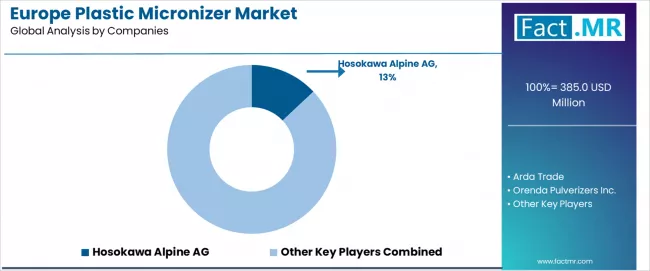
The Europe plastic micronizer market includes plastic pulverizer makers, recycling equipment suppliers and polymer processing equipment companies. Hosokawa Alpine AG competes through powder and particle processing systems. Orenda Pulverizers Inc. supplies pulverizing systems for plastic size reduction. Pallmann Maschinenfabrik GmbH & Co. KG supports grinding and pulverizing applications. Herbold Meckesheim GmbH offers recycling and size reduction equipment. ZERMA Zerkleinerungsmaschinenbau GmbH supports plastics grinding and recycling machinery.
Competition depends on stable output, machine uptime and service support. Plastic processors judge micronizers by particle consistency and ease of maintenance.
Supplier strength through 2036 will depend on testing and lifecycle service. Plastic manufacturers need validated powder output. Recycling operators need machines that can handle changing feed quality. Companies that combine grinding technology with application support can protect repeat demand.
Key Players in Europe Plastic Micronizer Market
- Hosokawa Alpine AG
- Orenda Pulverizers Inc.
- Pallmann Maschinenfabrik GmbH & Co. KG
- Herbold Meckesheim GmbH
- ZERMA Zerkleinerungsmaschinenbau GmbH
Bibliography
- [1] Eurostat. (2025, October 22). Plastic packaging waste in the EU: 35.3 kg per person. European Commission.
- [2] Plastics Europe. (2025). Plastics the Fast Facts 2025. Plastics Europe.
- [3] Plastics Recyclers Europe. (2025, November). Plastics recycling industry figures 2025. Plastics Recyclers Europe.
- [4] European Union. (2025). Regulation (EU) 2025/40 of the European Parliament and of the Council of 19 December 2024 on packaging and packaging waste. EUR-Lex.
This Report Addresses
- Strategic intelligence on Europe plastic micronizer demand across polymer processors and recyclers.
- Growth opportunity mapping across Poland and Germany plus the Netherlands and France.
- Segment analysis by separation mixture, use case, product type, capacity and automation level.
- Regional outlook covering polymer powder production, recycling pressure and process automation.
- Competitive analysis of Hosokawa Alpine, NETZSCH, FRITSCH, Orenda and Arda Trade.
- Product assessment covering powder mills, liquid-liquid mixtures, automatic systems and medium-capacity units.
- Market forecast built from Fact.MR’s baseline model with a revised 2026 to 2036 CAGR.
- Primary interviews, supplier checks and EU recycling source review support validation.
Europe Plastic Micronizer Market Definition
The Europe plastic micronizer market covers equipment used to reduce plastic materials into fine particles or powders. The scope includes turbo mills and pin mills used for polymer processing, recycling and chemical applications. The market differs from plastic shredding because micronizers create finer output after coarse reduction or pre-processing.
Europe Plastic Micronizer Market Inclusions
The scope includes micronizers used for liquid-liquid mixtures and solid-liquid suspensions. Systems used in plastic manufacturing, chemical purification and mineral production are counted. Powder mills and pin mills are included. Capacity ranges from below 100 kg/h to above 500 kg/h. Smart controls are included if sold as part of the micronizer system.
Europe Plastic Micronizer Market Exclusions
The scope excludes plastic shredders used only for coarse size reduction. General crushers and granulators are excluded if they do not support fine particle output. Washing lines and sorting systems are outside scope unless integrated with micronizing equipment. Laboratory mills are excluded unless used for pilot-scale plastic process development. Non-plastic micronizing systems are excluded.
Europe Plastic Micronizer Market Research Methodology
- Primary Research
- Primary research includes interviews with polymer processing heads and recycling plant managers. Chemical process engineers were reviewed for contamination control needs. Equipment distributors were checked for capacity and service assumptions.
- Desk Research
- Desk research reviewed EU recycling data and packaging regulation sources. Supplier product pages supported powder mill and fine grinding validation. Industry association sources were used to review plastic production and recycling pressure.
- Market-Sizing and Forecasting
- Forecasting uses separation mixture demand and use case adoption. Product type estimates reflect mill selection across plastic manufacturing and chemical processing. Capacity estimates are linked to throughput needs and plant scale.
- Data Validation and Update Cycle
- Forecasts were validated through equipment supplier checks and official EU data. Country assumptions were reviewed with plastic processing depth and recycling capacity signals. Competitive checks used company product evidence and process technology sources.
Scope of the Report
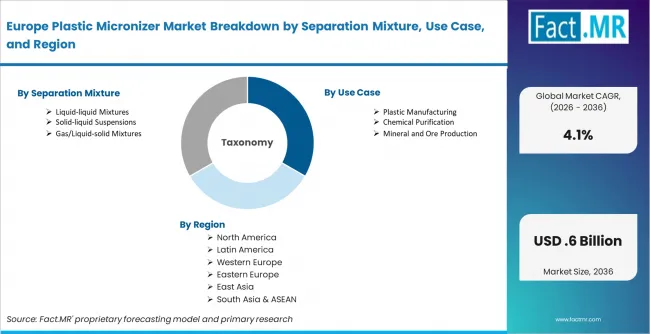
Europe Plastic Micronizer Market Breakdown By Separation Mixture, Use Case, And Region | Source: Fact.MR
| Attribute | Details |
|---|---|
| Quantitative Units | USD 0.40 billion in 2026 to USD 0.60 billion by 2036 at 4.10% CAGR |
| Market Definition | Equipment used to reduce plastic materials into fine particles or powders for processing and reuse. |
| Separation Mixture | Liquid-liquid Mixtures, Solid-liquid Suspensions, Gas/Liquid-solid Mixtures |
| Use Case | Plastic Manufacturing, Chemical Purification, Mineral and Ore Production |
| Product Type | Powder Mills, Turbo Mills, Pin Mills |
| Capacity | Below 100 kg/h, 100 to 500 kg/h, Above 500 kg/h |
| Automation Level | Manual, Semi-automatic, Automatic, Smart Integrated Systems |
| Regions Covered | Western Europe, Eastern Europe, Southern Europe, UK |
| Countries Covered | Poland, Germany, Netherlands, France, Italy, Spain, UK |
| Key Companies Profiled | Hosokawa Alpine AG, NETZSCH-Feinmahltechnik GmbH, FRITSCH GmbH, Orenda, Arda Trade |
| Forecast Period | 2026 to 2036 |
| Approach | Hybrid top-down and bottom-up model using mixture type demand, use case adoption and supplier validation. |
Europe Plastic Micronizer Market Analysis by Segments
-
By Separation Mixture:
- Liquid-liquid Mixtures
- Solid-liquid Suspensions
- Gas/Liquid-solid Mixtures
-
By Use Case:
- Plastic Manufacturing
- Chemical Purification
- Mineral and Ore Production
-
By Product Type:
- Powder Mills
- Turbo Mills
- Pin Mills
-
By Capacity:
- Below 100 kg/h
- 100 to 500 kg/h
- Above 500 kg/h
-
By Automation Level:
- Manual
- Semi-automatic
- Automatic
- Smart Integrated Systems
-
Region:
- Western Europe
- Germany
- France
- Netherlands
- Southern Europe
- Italy
- Spain
- Eastern Europe
- Poland
- Czech Republic
- Romania
- United Kingdom
- England
- Scotland
- Wales
- Western Europe