- Base Value(2025): 346.8 Mn
- Estimated Value(2026): 361.0 Mn
- Forecast Value (2036): 539.6 Mn
- CAGR (2026 - 2036): 4.1%
Europe Conveyor Screen Market Size, Market Forecast and Outlook by Fact.MR
- The Europe conveyor screen market valuation stood at USD 346.8 million in 2025.
- Demand is estimated to reach USD 361.0 million in 2026 and is expected to rise to USD 539.6 million by 2036.
- The market is forecast to record 4.1% CAGR from 2026 to 2036 as wastewater treatment and waste management sites increase front-end separation needs.
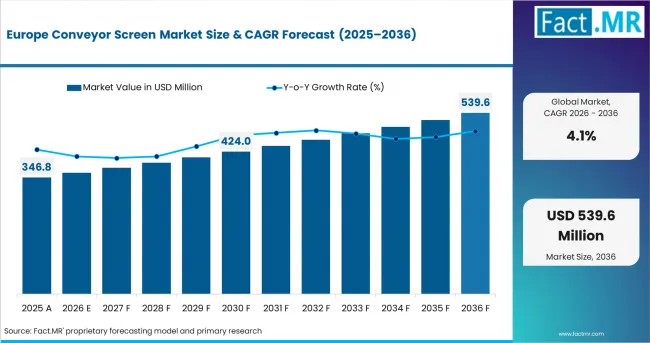
Europe Conveyor Screen Market Value Analysis | Source: Fact.MR
| Metric | Details |
|---|---|
| Industry Size (2026) | USD 361.0 million |
| Industry Value (2036) | USD 539.6 million |
| CAGR (2026 to 2036) | 4.1% |
Source: Fact.MR analysis. Updated Jun 3, 2026
Summary of Europe Conveyor Screen Market
- Demand Drivers in the Market
- Wastewater Compliance: Municipal utilities need screening equipment to protect treatment lines. Updated EU wastewater rules are increasing demand for reliable pretreatment systems.
- Industrial Pretreatment: Industrial facilities use screens to remove solids before discharge or reuse. Better debris control helps reduce process disruption.
- Maintenance Reduction: Plant operators prefer screens that clog less and need less manual cleaning. Lower intervention improves safety and keeps plants running longer.
- Key Segments Analyzed
- By Material Type: Plastic screens are projected to record 52.0% share in 2026 as wastewater sites use lighter and corrosion-resistant screen formats.
- By Application: Industrial water treatment leads because factories need solids removal before process water handling. The segment is estimated to hold 48.0% share in 2026.
- By Screen Type: Screw screens are projected to account for 36.0% share in 2026 because compact equipment can screen and move captured solids in one system.
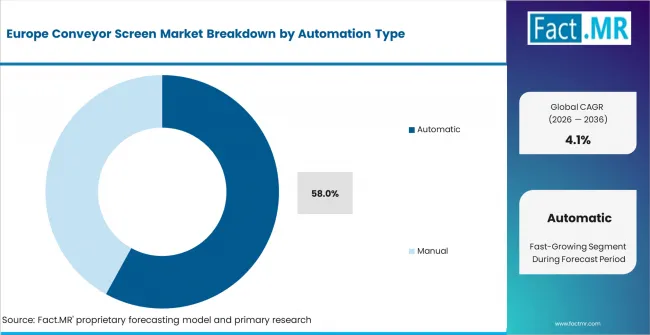
- By Automation Type: Automatic systems lead because utilities need lower manual cleaning and better process continuity. The segment is expected to hold 58.0% share in 2026.
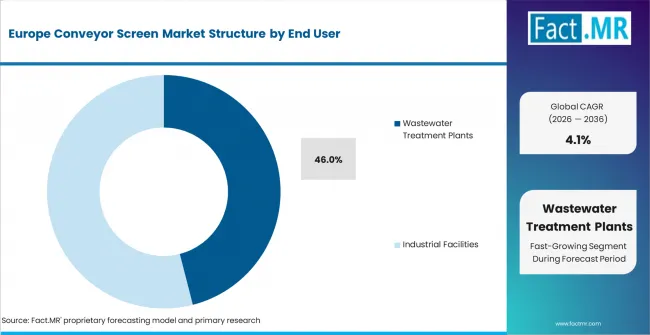
- By End User: Wastewater treatment plants are anticipated to represent 46.0% share in 2026 because screening is one of the first mechanical treatment steps.
- By Geography: Germany conveyor screen demand is forecast to grow at 4.6% CAGR from 2026 to 2036 as treatment plants upgrade pretreatment and pumping assets.
- Analyst Opinion at Fact.MR
- Shambhu Nath Jha, Senior Analyst at Fact.MR, states, “Conveyor screens are becoming reliability assets in wastewater and waste handling systems. Operators need equipment that removes solids with less clogging and fewer manual interventions. Suppliers that prove screen durability, service access and easy cleaning will gain stronger demand across Europe.”
- Strategic Implications
- Clog Control: Conveyor screen suppliers need designs that manage fibrous and sticky solids. Poor handling can stop upstream treatment flow.
- Service Readiness: Utilities need quick access to spare parts and technical support. Slow service can affect plant reliability.
- Material Selection: Operators should choose screen materials based on wastewater chemistry. Poor material choice can reduce equipment life.
Conveyor screen demand is rising as treatment plants and waste facilities need better solid removal before wastewater moves to the next stage. Screening equipment reduces pressure on downstream systems.
Municipal and industrial facilities are moving from basic screens to equipment that clogs less and is easier to maintain. Water quality pressure keeps screening and pretreatment systems important across urban treatment plants and industrial outlets.
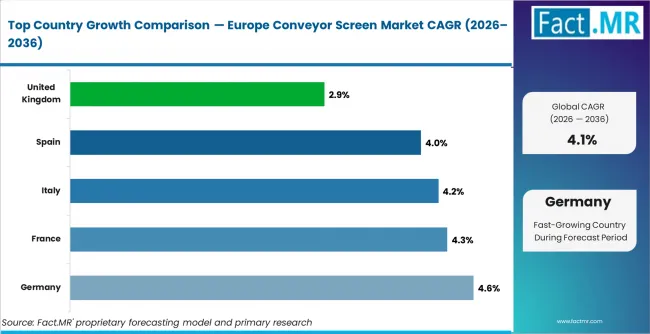
Germany is forecast to grow at 4.6% CAGR from 2026 to 2036 as water treatment upgrades and municipal infrastructure spending continue. France is projected to record 4.3% CAGR through wastewater compliance and industrial treatment demand. Italy is likely to post 4.2% CAGR as municipal plants modernize pretreatment assets. Spain follows at 4.0% CAGR through water scarcity and treatment-system pressure. The UK is estimated to grow at 2.9% CAGR by 2036 as utilities replace older screening equipment and improve network resilience.
Segmental Analysis
Europe Conveyor Screen Market Analysis by Material Type
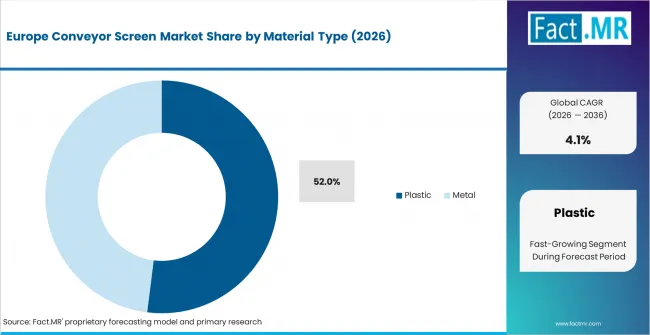
Europe Conveyor Screen Market Analysis By Material Type | Source: Fact.MR
Plastic screens are projected to record 52.0% share in 2026 because operators need corrosion resistance and lighter handling in wastewater channels. Metal screens are important for heavy-duty applications and abrasive solids. Plastic formats lead because wastewater plants need screens that work well in wet conditions and last longer. Material choice can affects clogging and maintenance cost.
- Plastic Resistance: Plastic screens work well in wet operating conditions and reduce corrosion risk. Utilities can use them for longer service in selected channels.
- Metal Strength: Metal screens handle heavier solids and tougher flow conditions. Industrial facilities use them for more demanding pretreatment work.
- Material Match: Screen selection should match water chemistry and debris type. Poor selection can increase cleaning and replacement pressure.
Europe Conveyor Screen Market Analysis by Application
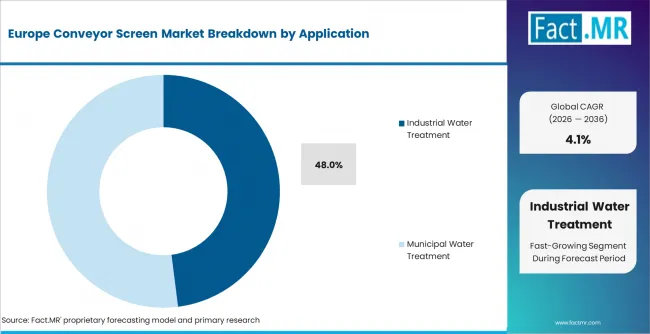
Europe Conveyor Screen Market Analysis By Application | Source: Fact.MR
Industrial water treatment leads because factories need remove solids before discharge or reuse. Municipal plants also need steady debris control. Reservoirs and power stations need intake protection. Industrial water treatment is estimated to hold 48.0% share in 2026 because process sites need reliable front-end screening. Industrial sites lead because downtime can affect production and compliance. Poor screening can allow solids to enter pumps and downstream equipment.
- Process Protection: Industrial screens remove solids before water handling steps. Better pretreatment protects pumps and treatment equipment.
- Municipal Flow: Municipal systems need continuous debris removal. Stable screening helps treatment plants avoid avoidable stoppages.
- Pumping Safety: Pumping stations need intake protection. Large solids can damage pumps and raise maintenance cost.
Europe Conveyor Screen Market Analysis by Screen Type
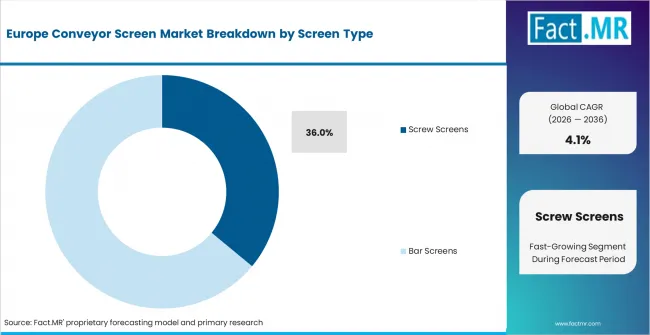
Europe Conveyor Screen Market Analysis By Screen Type | Source: Fact.MR
Screw screens are projected to account for 36.0% share in 2026 because they screen solids and moved them in compact layouts. Bar screens remove coarse debris at plant inlets. Drum screens support rotating separation in wastewater and process applications. Vibrating screens serve recycling and waste sorting applications. Screw screens lead because small and mid-sized plants need compact equipment that handles solids without a separate transfer step. Compact systems reduce layout complexity and maintenance points.
- Compact Screening: Screw screens combine capture and movement of solids. Smaller plants gain layout efficiency.
- Coarse Removal: Bar screens remove larger debris at inlet points. They protect pumps and early treatment assets.
- Rotating Separation: Drum screens support continuous flow separation. They fit sites that need steady screening without large channel changes.
Europe Conveyor Screen Market Analysis by Automation Type
Europe Conveyor Screen Market Analysis By Automation Type | Source: Fact.MR
Automatic systems lead as operators need steady screening with less manual work. Semi-automatic screens suit smaller plants that need partial control at lower cost. Manual systems remain useful for low-flow or backup use. Automatic systems are expected to hold 58.0% share in 2026 because treatment plants need continuous solids removal during changing inflow. Automation helps staff focus on supervision and maintenance rather than constant cleaning. Plants that delay automation may face higher labor pressure and safety risks.
- Continuous Operation: Automatic systems remove debris with less manual effort. Utilities gain better process stability.
- Cost Entry: Semi-automatic systems support lower investment. Smaller plants can improve screening without full automation.
- Safety Benefit: Automated movement reduces worker contact with screenings. Cleaner handling improves site conditions.
Europe Conveyor Screen Market Analysis by End User
Europe Conveyor Screen Market Analysis By End User | Source: Fact.MR
Wastewater treatment plants are anticipated to represent 46.0% share in 2026 because screening is a primary mechanical treatment step. Industrial facilities use screens for process water and discharge control. Municipal utilities use conveyor screens across pumping stations and collection networks. Recycling operators use screening systems for material separation. Wastewater plants lead because screens protect later treatment stages. Recycling remain important, but wastewater use creates steadier replacement demand. Utilities that delay screen upgrades can face clogging and downstream operating strain.
- Plant Protection: Wastewater facilities use screens before later treatment steps. Better solids removal protects plant efficiency.
- Utility Networks: Municipal operators install screens near critical flow points. Network resilience improves when debris is removed early.
- Recycling Sorting: Recycling operators use screens for material classification. Separation quality affects recovery value.
Europe Conveyor Screen Market Drivers, Restraints, and Opportunities
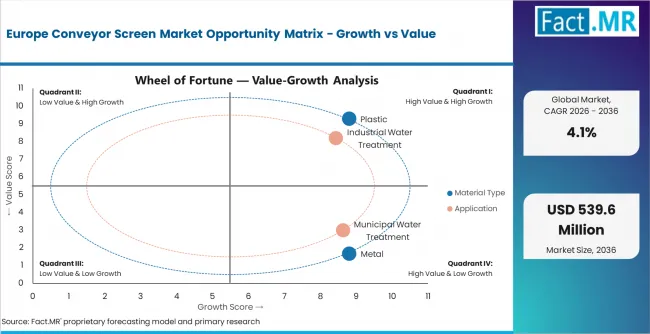
Europe Conveyor Screen Market Opportunity Matrix Growth Vs Value | Source: Fact.MR
Wastewater compliance and plant reliability are the main demand drivers. Conveyor screens remove solids before treatment equipment gets damage or clogging. Operators need better screening because stricter treatment rules make upstream failures more costly.
High maintenance needs and site-specific wastewater conditions remain the main restraints. Conveyor screens handle fibrous and abrasive solids. The main challenge is matching screen design, material, and cleaning access with actual flow conditions.
Opportunities in the Europe Conveyor Screen Market
- Automatic Pretreatment: Utilities can reduce manual cleaning through automatic conveyor screens. Stronger controls support stable plant operation.
- Industrial Water Reuse: Factories need screening before water reuse and discharge treatment. Suppliers can gain demand through compact and low-clog systems.
- Recycling Line Integration: Waste sorting plants need screening and conveying in connected layouts.
Regional Analysis
Based on regional analysis, the Europe conveyor screen market is segmented into Germany, France, Italy, Spain and the United Kingdom.
.webp "Top Country Growth Comparison Europe Conveyor Screen Market Cagr (2026 2036)")
Top Country Growth Comparison Europe Conveyor Screen Market Cagr (2026 2036) | Source: Fact.MR
| Country | CAGR |
|---|---|
| Germany | 4.6% |
| France | 4.3% |
| Italy | 4.2% |
| Spain | 4.0% |
| United Kingdom | 2.9% |
Source: Fact.MR analysis. Updated Jun 3, 2026
Source: Fact.MR analysis based on forecast model and primary research.
Europe Conveyor Screen Market Cagr Analysis By Country | Source: Fact.MR
Europe Conveyor Screen Market Analysis
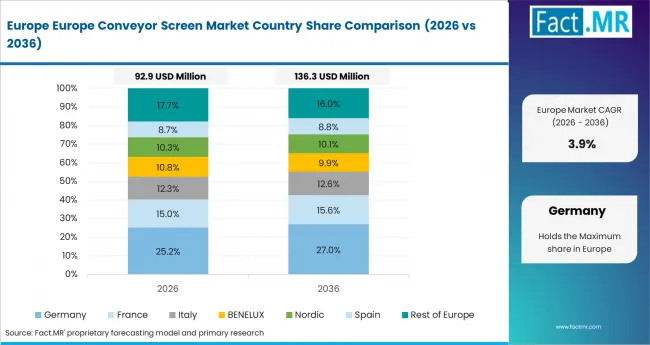
Europe Conveyor Screen Market Europe Country Market Share Analysis, 2026 & 2036 | Source: Fact.MR
- Germany: Germany leads through wastewater infrastructure depth and stronger equipment replacement discipline. Treatment plants need screens that reduce clogging and protect pumps during variable inflow. Germany is forecast to grow at 4.6% CAGR from 2026 to 2036 as plants upgrade pretreatment systems and older screens. Germany’s environment ministry states that around 97.0% of the population is connected to the public sewage system and wastewater is treated in around 9,000 treatment plants. [1] Local machinery suppliers support supplier better service coverage.
- France: France demand comes from municipal wastewater compliance and industrial pretreatment needs. Utilities need screens that handle varied solids loads and reduce manual cleaning. The French market is projected to record 4.3% CAGR by 2036 as treatment sites modernize front-end equipment. Suppliers with compact screw screens and service support can gain better access to municipal plants.
- Italy: Italy demand is tied to municipal wastewater treatment and industrial processing. Food and manufacturing sites need screens that remove solids before discharge or reuse steps. Conveyor screen demand in Italy is likely to post 4.2% CAGR from 2026 to 2036. The Blue Book 2025 notes that the revised wastewater directive has introduced stricter targets for wastewater quality in Italy. [2] Treatment operators need equipment that can handle sticky and fibrous solids with fewer blockages. Suppliers with reliable maintenance support can gain repeat work.
- Spain: Water scarcity and treatment pressure make pretreatment reliability important in Spain. Municipal operators require conveyor screens that protect pumping stations and treatment assets during variable flows. Conveyor screen demand in Spain is forecast to grow at 4.0% CAGR from 2026 to 2036. Wastewater upgrades and better solids handling at inlet points support demand. Equipment with low clogging risk and easy cleaning access can gain preference because maintenance resources differ across municipalities.
- United Kingdom: The United Kingdom market is driven by wastewater network upgrades and replacement of older treatment equipment. Utilities need screens that reduce clogging and protect downstream processes during storm events and variable wastewater loads. The UK is projected to record 2.9% CAGR from 2026 to 2036. Growth is slower than continental Europe, but replacement demand stays steady. Suppliers that offer durable screens and quick spare parts support can protect service demand.
Competitive Aligners for Market Players
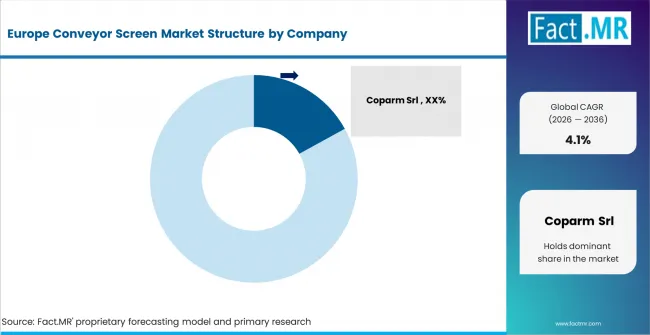
Europe Conveyor Screen Market Analysis By Company | Source: Fact.MR
The Europe conveyor screen market includes wastewater equipment suppliers and recycling machinery firms. Material handling specialists also serve this market. Coparm Srl supplies screening and conveyor systems for waste and recycling applications. JOEST GmbH + Co. KG provides screening and conveying equipment for industrial material handling. IFE Material Handling supports screening, magnetic separation and vibratory conveying systems. STADLER Anlagenbau GmbH supplies conveyor and waste handling technology. Günther Anlagenbau GmbH provides machinery for waste sorting and material processing lines.
Supplier strength through 2036 will depend on application-specific design and service support. Wastewater plants need compact screens with easier cleaning access. Industrial sites need equipment matched to solids type. Recycling operators prefer screen and conveyor systems that can handle mixed material flows. Companies with reliable screen design and maintenance support can protect repeat demand.
Key Players in Europe Conveyor Screen Market
- Coparm Srl
- JOEST GmbH + Co. KG
- IFE Material Handling
- STADLER Anlagenbau GmbH
- Günther Anlagenbau GmbH
Bibliography
- [1] Federal Ministry for the Environment, Climate Action, Nature Conservation and Nuclear Safety. (2026, February 11). General information on waste water treatment plants.
- [2] Fondazione Utilitatis, & Utilitalia. (2025, March). Blue Book 2025: Data on the water service in Italy. Fondazione Utilitatis.
- [3] TOMRA. (2025, March 11). TOMRA to showcase advanced sorting solutions for PPWR compliance at PRSE 2025. TOMRA.
- [4] European Environment Agency. (2025, September 29). 4.3 Waste recycling. European Environment Agency.
- [5] STADLER Anlagenbau GmbH. (2026, February 19). Rebuilt for resilience: STADLER completes reconstruction of the Sortierkontor Nord lightweight packaging plant in Bremen. STADLER Anlagenbau GmbH.
This Report Addresses
- Strategic intelligence on Europe conveyor screen demand across municipal and industrial treatment sites.
- Growth opportunity mapping across Germany and France plus Italy and Spain.
- Segment analysis by material type, application, screen type, automation type and end user.
- Regional outlook covering wastewater compliance and plant pretreatment upgrades.
- Competitive analysis of Bezner, EMO, Hunkeler Systeme, JOEST and IFE Material Handling.
- Product assessment covering plastic screens, industrial water treatment and automatic systems.
- Market forecast built from Fact.MR’s baseline model with a revised 2026 to 2036 CAGR.
- Primary interviews, supplier checks and EU water policy review support validation.
Europe Conveyor Screen Market Definition
The Europe conveyor screen market covers mechanical screening equipment used to remove solids from wastewater, process water and mixed waste streams. The scope includes screens that capture debris and move collected material through conveyor movement or screw transport. The market differs from general conveyor equipment because its main role is separation and solids handling before treatment or recovery.
Europe Conveyor Screen Market Inclusions
The scope includes metal and plastic conveyor screens used in municipal and industrial treatment. Bar screens and vibrating screens are counted. Systems used in wastewater treatment and recycling facilities are included. Automatic and semi-automatic screens are covered. Conveying and compacting systems are included when sold with screening equipment.
Europe Conveyor Screen Market Exclusions
The scope excludes general belt conveyors that do not screen or separate material. Mining screens are excluded unless used in waste or water treatment. Standalone compactors are outside scope when they are not linked to screening. Filtration membranes are excluded because they operate at a much finer separation level. General wastewater pumps are not counted as conveyor screens.
Europe Conveyor Screen Market Research Methodology
- Primary Research
- Primary research includes interviews with wastewater plant operators and municipal utility engineers. Industrial water treatment managers were reviewed for debris removal needs. Equipment distributors were checked for service and replacement assumptions.
- Desk Research
- Desk research reviewed EU wastewater rules and water quality sources. Supplier product pages supported screen type validation. Waste management equipment evidence helped review material and automation assumptions.
- Market-Sizing and Forecasting
- Forecasting uses material type demand and application adoption. Screen type estimates reflect installation patterns across wastewater and recycling sites. End-user demand is linked to treatment capacity and plant modernization.
- Data Validation and Update Cycle
- Forecasts were validated through supplier checks and official water policy evidence. Country assumptions were reviewed with wastewater compliance and water quality pressure. Service assumptions were checked through product and maintenance evidence.
Segmentation
Scope of the Report
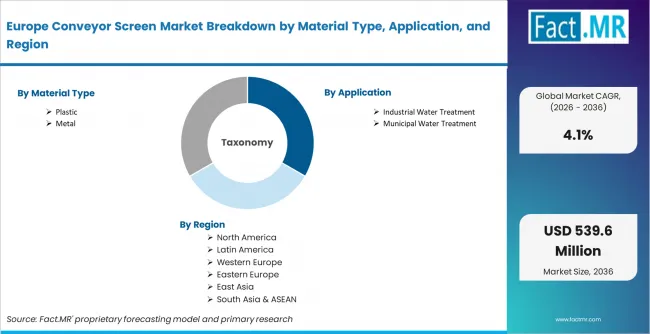
Europe Conveyor Screen Market Breakdown By Material Type, Application, And Region | Source: Fact.MR
| Attribute | Details |
|---|---|
| Quantitative Units | USD 361.0 million in 2026 to USD 539.6 million by 2036 at 4.1% CAGR |
| Market Definition | Mechanical screens that separate and convey solids from wastewater, process water and mixed waste streams. |
| Material Type | Metal, Plastic |
| Application | Industrial Water Treatment, Municipal Water Treatment, Reservoirs, Pumping Stations, Power Stations, Others |
| Screen Type | Bar Screens, Screw Screens, Drum Screens, Vibrating Screens |
| Automation Type | Manual, Semi-automatic, Automatic |
| End User | Wastewater Treatment Plants, Industrial Facilities, Municipal Utilities, Recycling Operators |
| Regions Covered | Europe |
| Countries Covered | Germany, France, Italy, Spain, United Kingdom |
| Key Companies Profiled | Bezner, EMO, Hunkeler Systeme, JOEST, IFE Material Handling |
| Forecast Period | 2026 to 2036 |
| Approach | Hybrid top-down and bottom-up model using material type demand, application use and supplier validation. |
Source: Fact.MR analysis. Updated Jun 3, 2026
Europe Conveyor Screen Market Analysis by Segments
-
By Material Type:
- Metal
- Plastic
-
By Application:
- Industrial Water Treatment
- Municipal Water Treatment
- Reservoirs
- Pumping Stations
- Power Stations
- Others
-
By Screen Type:
- Bar Screens
- Screw Screens
- Drum Screens
- Vibrating Screens
-
By Automation Type:
- Manual
- Semi-automatic
- Automatic
-
By End User:
- Wastewater Treatment Plants
- Industrial Facilities
- Municipal Utilities
- Recycling Operators
-
Region:
- Germany
- France
- Italy
- Spain
- United Kingdom
Frequently Asked Questions
How large is the Europe conveyor screen market in 2025?
What is the expected value of the Europe conveyor screen market in 2026?
What is the forecast value of the Europe conveyor screen market by 2036?
What CAGR is projected for the Europe conveyor screen market from 2026 to 2036?
Which material type leads the Europe conveyor screen market?
Why do plastic conveyor screens lead demand?
Which screen type leads the Europe conveyor screen market?
Which automation type leads the Europe conveyor screen market?
Which end user leads the Europe conveyor screen market?
Which country grows fastest in the Europe conveyor screen market?
Why is Germany important in the Europe conveyor screen market?
Why does France support conveyor screen demand?
Why does Italy support conveyor screen demand?
Why does Spain support conveyor screen demand?
Why does the UK support conveyor screen demand?
What drives Europe conveyor screen market demand?
What restrains Europe conveyor screen market demand?
How do conveyor screens support wastewater treatment plants?
How do conveyor screens support industrial facilities?
What is included in the Europe conveyor screen market scope?
What is excluded from the Europe conveyor screen market scope?
How does Fact.MR forecast Europe conveyor screen demand?
Who worked on this report


Preview the report firsthand - request a free sample
Free SampleGet the brochure for pricing and purchase details
Download PDF