The EV Chassis Megamolding Thermoplastics Market is analyzed across its key product, application and end-use segments, with the study covering market dynamics, regional trends and demand outlook, forecast 2026 to 2036.
By Fact.MR Automotive DeskLead analyst:
Shubham PatidarPublished :
Updated :
11 min read
Fact-checked under the Fact.MR editorial process
EV Chassis Megamolding Thermoplastics Market Forecast and Outlook 2026 to 2036
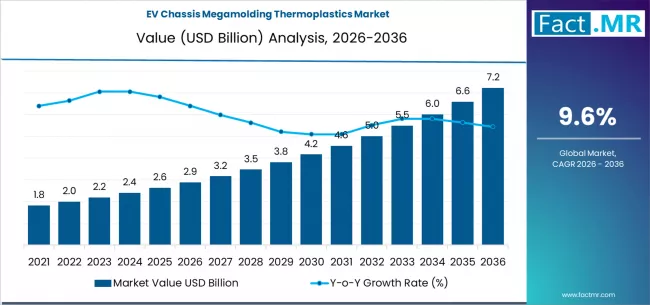
Projected to surge from USD 2.89 billion in 2026 to USD 7.23 billion by 2036 at a 9.6% CAGR, the global market for EV chassis megamolding thermoplastics signifies a foundational shift in automotive manufacturing, moving from an assembly of hundreds of metal parts to the integration of single, massive polymer components.
Ev Chassis Megamolding Thermoplastics Market Market Value Analysis | Source: Fact.MR
Summary of EV ChassisMegamoldingThermoplastics Market
Market Snapshot
Global EV chassismegamoldingthermoplastics market revenue stood at USD 2.89 billion in 2026 and is forecast to reach USD 7.23 billion by 2036.
At a 9.6% CAGR from 2026 to 2036, this market is set to expand ~2.5x in value, adding USD 4.34 billion in absolute opportunity.
Growth is being driven by a fundamental shift from multi-part metal assemblies tosingle-piecemegamoldedpolymer structures, transforming EV chassis manufacturing.
Megamoldingthermoplastics areemergingas next-generation structural materials, enabling lightweighting, cost reduction, and design flexibility in EV platforms.
Demand and Growth Drivers
Increasing demand for vehicle lightweighting to extend EV battery range is a primary driver of adoption.
Need for cost-efficient, high-volume manufacturing processes is accelerating the shift towardmegamoldingtechnologies.
Growing focus on reducing part complexity and assembly steps is supporting adoption of large integrated thermoplastic components.
Advancements in long-glass-fiberreinforced thermoplastics are enabling structural performance comparable to metals.
Expansion of electric vehicle production globally is reinforcing demand for scalable and efficient chassis manufacturing solutions.
Product and Segment View
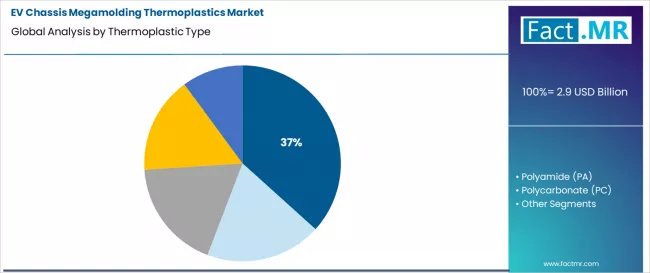
Polypropylene (PP) holds 37% of thermoplastic type share in 2026,emergingas the leading segment due to its balance of strength, weight, and cost efficiency.
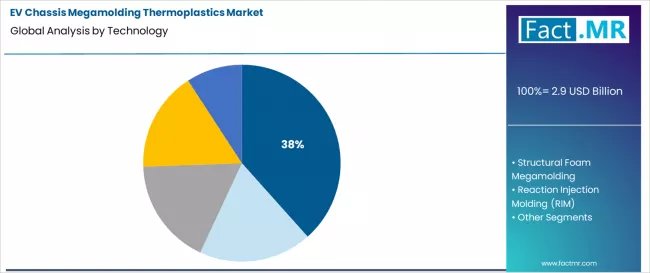
Injectionmegamoldingaccounts for 38% of technology share in 2026, positioning it as the dominant segment due to its scalability and precision.
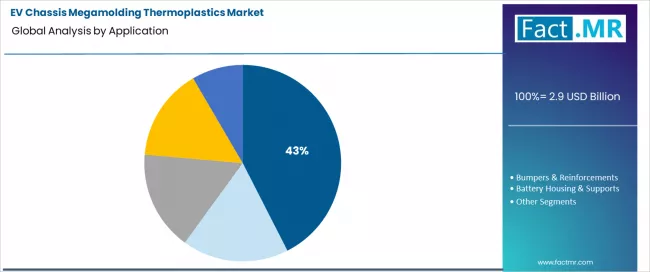
EV chassis structural parts account for 43% of application share in 2026, reflecting the core use of these materials in primary vehicle structures.
Key thermoplastic materials include:
Polypropylene (PP)
Polyamide (PA)
Polycarbonate (PC)
Thermoplastic olefins (TPO)
Geography and Competitive Outlook
Growth is supported across Asia Pacific, North America, and Europe, aligned with EV manufacturing hubs.
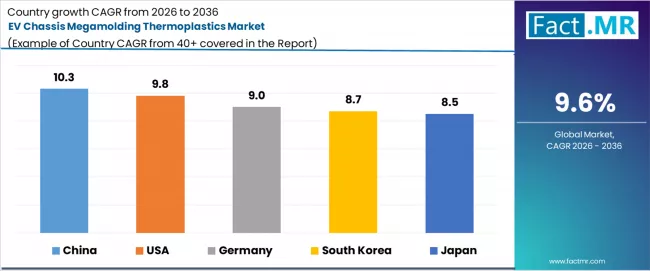
China (10.3% CAGR), United States (9.8%), Germany (9.0%), South Korea (8.7%), and Japan (8.5%) are key growth markets.
Market expansion is closely tied to:
EV production growth
lightweight material adoption
manufacturing process innovation
Competitive landscape includes companies specializing in advanced thermoplastics, polymer engineering, and automotive materials innovation.
EV ChassisMegamoldingThermoplastics Market — At a Glance
Attribute
Details
Market Value 2026
USD 2.89 billion
Market Value 2036
USD 7.23 billion
Absolute Dollar Opportunity 2026-2036
USD 4.34 billion
Total Growth 2026-2036
150.2%
CAGR 2026-2036
9.6%
Growth Multiple
~2.5x
Key Demand Theme
Transition toward single-piece, lightweight thermoplastic structures in EV chassis manufacturing
Leading Segment by Thermoplastic Type (2026)
Polypropylene (PP)
Segment Share (2026)
37%
Leading Segment by Technology (2026)
InjectionMegamolding
Segment Share (2026)
38%
Leading Segment by Application (2026)
EV Chassis Structural Parts
Segment Share (2026)
43%
Key Growth Regions
Asia Pacific, North America, Europe
Country CAGRs
China 10.3%, USA 9.8%, Germany 9.0%, South Korea 8.7%, Japan 8.5%
North America, Latin America, Europe, Asia Pacific, MEA
Source: Fact.MR analysis. Updated Apr 3, 2026
Evolution is driven by the need for vehicle lightweighting to extend battery range, coupled with the need for radical design freedom and cost reduction in electric vehicle production. Growth is underpinned by material innovations in long-glass-fiber reinforced thermoplastics like polypropylene and polyamide, which provide the necessary stiffness, impact resistance, and thermal stability for structural applications. China's 10.30% CAGR highlights its aggressive adoption of this disruptive manufacturing philosophy to achieve production scale and cost targets. This market represents more than a material substitution; it embodies the re-architecting of the vehicle body itself, fostering a new ecosystem where polymer chemists, molding machine manufacturers, and EV designers co-create the next generation of sustainable and efficient mobility.
North America, Latin America, Western Europe, Eastern Europe, East Asia, South Asia & Pacific, MEA
Source: Fact.MR analysis. Updated Apr 3, 2026
Segmental Analysis
By Thermoplastic Type, Which Material Balances Performance and Economics for Scale?
Ev Chassis Megamolding Thermoplastics Market Analysis By Thermoplastic Type | Source: Fact.MR
Polypropylene (PP) leads with a 37% share, favored for its exceptional value proposition in large-part molding. Its low density, good chemical resistance, and high flowability make it ideal for filling massive, intricate tools.
When reinforced with long glass or carbon fibers, PP composites achieve the structural rigidity required for semi-structural applications like front-end carriers, underbody shields, and interior cross-members. The material's relatively low cost and excellent recyclability align perfectly with the megamolding philosophy of producing affordable, sustainable, and lightweight integrated components at high volumes.
By Technology, Which Process is Defining the New Manufacturing Paradigm?
Ev Chassis Megamolding Thermoplastics Market Analysis By Technology | Source: Fact.MR
Injection megamolding is the predominant technology, holding a 38% share. This process utilizes colossal clamping forces (>5,000 tons) and specialized machinery to produce single-piece components that replace dozens of stamped and welded metal parts.
Its leadership is due to its unmatched ability to deliver high precision, excellent surface finish, and design integration in a single cycle. This technology reduces assembly time, capital investment in welding robots, and total part weight, establishing the core production method for the structural polymer revolution.
By Application, Where is Integration Having the Most Transformative Impact?
Ev Chassis Megamolding Thermoplastics Market Analysis By Application | Source: Fact.MR
EV chassis structural parts represent the largest application segment at 43%. This includes megamolded components like integrated battery tray frames, rear underbody structures, and platform cross-members.
These parts form the backbone of the vehicle's skateboard architecture, requiring exceptional mechanical performance to handle loads and ensure crash safety. The shift to thermoplastics here is the most significant, as it challenges the century-old dominance of steel and aluminum in the vehicle's core structure, enabling new possibilities in design, weight distribution, and production efficiency.
What are the Drivers, Restraints, and Key Trends of the EV Chassis Megamolding Thermoplastics Market?
The primary market driver is the existential need for lightweighting in EVs; every kilogram saved directly translates to extended range or allows for a smaller, cheaper battery pack. Megamolding with thermoplastics can reduce component weight by 30-50% compared to metal assemblies.
OEMs are under immense pressure to reduce manufacturing complexity and capital expenditure. Consolidating parts into single megamolded units slashes assembly steps, tooling costs, and supply chain logistics. The technology also enables faster design iterations and platform flexibility, crucial in the fast-paced EV market.
A significant market restraint is the enormous initial capital investment required for megamolding presses, which can exceed $10 million per machine, and the corresponding mega-tools. This creates a high barrier to entry and concentrates capability among large Tier-1 suppliers or vertically integrated OEMs.
There is also a knowledge gap in designing for these large, anisotropic thermoplastic parts, requiring new simulation tools and engineering expertise distinct from metal stamping. Furthermore, the long-term durability and repairability of these integrated plastic structures in real-world collision scenarios are still being validated, influencing insurer and consumer acceptance.
Key trends include the development of tailored material blends where fiber orientation and density are optimized within a single part during molding to meet localized stress requirements. There is a strong movement towards hybrid molding processes that combine different materials (or insert metal reinforcements in one shot.
The integration of smart manufacturing sensors directly into molds for real-time process and quality control is emerging. Additionally, the push for circularity is driving R&D into high-performance grades containing significant percentages of PCR content suitable for structural applications.
Analysis of the EV Chassis Megamolding Thermoplastics Market by Key Countries
Ev Chassis Megamolding Thermoplastics Market Cagr Analysis By Country | Source: Fact.MR
Country
CAGR (2026-2036)
China
10.30%
USA
9.80%
Germany
9.00%
South Korea
8.70%
Japan
8.50%
Source: Fact.MR analysis. Updated Apr 3, 2026
How is China's Vertical Integration and Speed-to-Market Strategy Driving Adoption?
China's leading 10.30% CAGR stems from its unique capacity for vertical integration within new EV brands, where material sourcing, part design, and megamolding production are often coordinated under one corporate umbrella. This allows for breathtakingly fast implementation of new vehicle architectures built around polymer megastructures.
Chinese manufacturers are leveraging this integrated model not just for cost reduction, but as a core competitive differentiator, enabling them to launch vehicles with high structural innovation at a pace unmatched in traditional automotive regions.
What is the Impact of the USA's Focus on Manufacturing Reshoring and Strategic Material Independence?
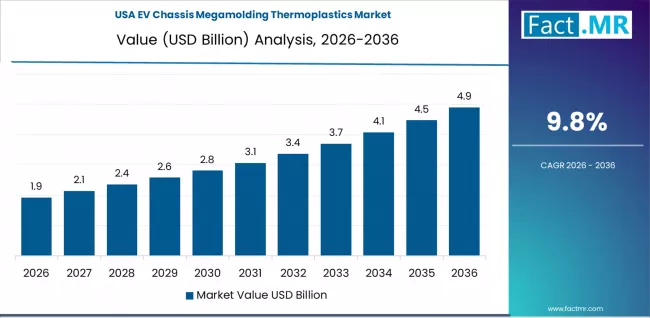
Ev Chassis Megamolding Thermoplastics Market Country Value Analysis | Source: Fact.MR
The USA's 9.80% growth is fueled by a concerted push to reshore advanced manufacturing and secure supply chains for critical EV components. Investments in domestic megamolding capacity are seen as strategic, reducing dependency on imported metal sub-assemblies.
The strong presence of material science leaders and a focus on developing bio-based or recycled-content engineering thermoplastics creates a synergy, aiming to establish a closed-loop, domestic ecosystem for next-generation vehicle structures that aligns with national industrial and sustainability policies.
Why is Germany's Philosophy of "Wertarbeit" (Quality Workmanship) Influencing Technical Demands?
Germany's 9.00% CAGR reflects the application of its engineering ethos to megamolding. The focus is less on pure cost and more on achieving superlative material consistency, near-zero defect rates, and flawless surface aesthetics, even for large underbody parts.
German OEMs and suppliers are pioneering the use of megamolding for premium vehicle applications, demanding materials and processes that deliver a perceived quality and precision synonymous with their brands, thereby elevating the technology from a cost-saver to an enabler of premium vehicle attributes.
How is South Korea's Design-Led Approach and Urban Mobility Focus Shaping Applications?
South Korea's 8.70% growth is propelled by its design-centric automotive industry and its focus on compact and urban electric mobility solutions. Korean OEMs utilize megamolding to achieve radical design forms and maximize interior space in smaller vehicle footprints.
The application focus extends to creating highly integrated, aesthetically cohesive front and rear ends that combine bumper, grille, and lighting functions into single complex molded units, blending safety, style, and manufacturing efficiency for the urban EV market.
What Role does Japan's Mastery of Miniaturization and Multi-Material Integration Play?
Japan's 8.50% growth is driven by its unparalleled expertise in miniaturization and precision hybrid manufacturing. Japanese suppliers excel at insert and over-molding technologies within a megamolding context, seamlessly integrating metal brackets, threaded inserts, or electronic components into large plastic parts during a single cycle.
This focus maximizes functionality and assembly savings for complex, densely packaged vehicle architectures, particularly in compact EVs where space optimization is paramount and every component must serve multiple purposes.
Competitive Landscape of the EV Chassis Megamolding Thermoplastics Market
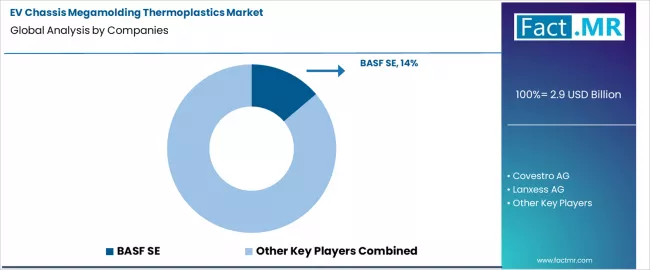
Ev Chassis Megamolding Thermoplastics Market Analysis By Company | Source: Fact.MR
The competitive landscape is characterized by deep collaboration between global materials science corporations and tier-one automotive suppliers with megamolding capabilities. Competition hinges on developing proprietary polymer formulations with optimized flow, crystallization, and reinforcement characteristics for mega-tools.
Success is defined by securing "platform-level" partnerships with OEMs, co-engineering material and part solutions for specific vehicle architectures, and building an extensive library of simulation data and real-world validation to de-risk adoption. The ability to provide global technical support and localized compounding capacity is also a key differentiator.
Key Players in the EV Chassis Megamolding Thermoplastics Market
BASF SE
Covestro AG
Lanxess AG
SABIC
Celanese Corporation
References
Ashby, M. F. (2023). Materials and sustainable development (2nd ed.). Butterworth-Heinemann.
Biron, M. (2022). Thermoplastics and thermoplastic composites (3rd ed.). William Andrew.
Ehrenstein, G. W. (2021). Polymeric materials: Structure, properties, applications. Hanser Publishers.
Harper, C. A., & Petrie, E. M. (2023). Plastics materials and processes: A concise encyclopedia. Wiley.
International Energy Agency. (2024). Global EV Outlook 2024: Trends and developments in electric vehicle markets. IEA.
Mallick, P. K. (2022). Materials, design and manufacturing for lightweight vehicles (2nd ed.). Woodhead Publishing.
Rosato, D. V., & Rosato, M. G. (2021). Injection molding handbook (4th ed.). Springer.Strong, A. B. (2022). Plastics: Materials and processing (4th ed.). Pearson.
Truckenbrodt, T., & Hora, P. (2023). Simulation of injection molding: Process optimization and part design. Hanser Publishers.
Ward, I. M., & Sweeney, J. (2022). An introduction to the mechanical properties of solid polymers (3rd ed.). Wiley.
BASF SE, Covestro AG, LANXESS AG, Sabic, Celanese Corporation
Additional Analysis
Warpage and shrinkage prediction/control in mega-parts; long-term creep behavior under continuous load; crash energy management and failure mode analysis vs. metals; bonding and joining techniques for megamolded assemblies; lifecycle assessment comparing megamolded polymer vs. multi-part metal structures; total cost of ownership analysis for megamolding production systems.
Source: Fact.MR analysis. Updated Apr 3, 2026
Market by Segments
Thermoplastic Type :
Polypropylene (PP)
Polyamide (PA)
Polycarbonate (PC)
Thermoplastic Olefins (TPO)
Others
Technology :
Injection Megamolding
Structural Foam Megamolding
Reaction Injection Molding (RIM)
Insert & Over-Molding
Others
Application :
EV Chassis Structural Parts
Bumpers & Reinforcements
Battery Housing & Supports
Crash Management Systems
Others
Region :
North America
USA
Canada
Latin America
Brazil
Mexico
Argentina
Rest of Latin America
Western Europe
Germany
UK
France
Spain
Italy
BENELUX
Rest of Western Europe
Eastern Europe
Russia
Poland
Czech Republic
Rest of Eastern Europe
East Asia
China
Japan
South Korea
Rest of East Asia
South Asia & Pacific
India
ASEAN
Australia
Rest of South Asia & Pacific
MEA
Saudi Arabia
UAE
Turkiye
Rest of MEA
Questions Answered
Frequently Asked Questions
How big is the ev chassis megamolding thermoplastics market in 2026?
The global ev chassis megamolding thermoplastics market is estimated to be valued at USD 2.9 billion in 2026.
What will be the size of ev chassis megamolding thermoplastics market in 2036?
The market size for the ev chassis megamolding thermoplastics market is projected to reach USD 7.2 billion by 2036.
How much will be the ev chassis megamolding thermoplastics market growth between 2026 and 2036?
The ev chassis megamolding thermoplastics market is expected to grow at a 9.6% CAGR between 2026 and 2036.
What are the key product types in the ev chassis megamolding thermoplastics market?
The key product types in ev chassis megamolding thermoplastics market are polypropylene (pp), polyamide (pa), polycarbonate (pc), thermoplastic olefins (tpo) and others.
Which technology segment to contribute significant share in the ev chassis megamolding thermoplastics market in 2026?
In terms of technology, injection megamolding segment to command 38.4% share in the ev chassis megamolding thermoplastics market in 2026.