- Market Value (2025): USD 0.9 Bn
- Estimated Value (2026): USD 1.0 Bn
- Forecast Value (2036): USD 3.7 Bn
- CAGR (2026-2036): 13.6%
What is the Extended-Life Battery Coatings Market forecast to be worth by 2036?
USD 1.0 billion in 2026 to USD 3.7 billion by 2036, at a 13.6% CAGR.
- The Extended-Life Battery Coatings Market reached USD 0.9 billion in 2025.
- Demand is projected to increase from USD 1.0 billion in 2026 to USD 3.7 billion by 2036.
- The market is forecast to record a 13.6% CAGR from 2026 to 2036 as food manufacturers and packaging converters seek longer usable shelf life with controlled barrier performance.
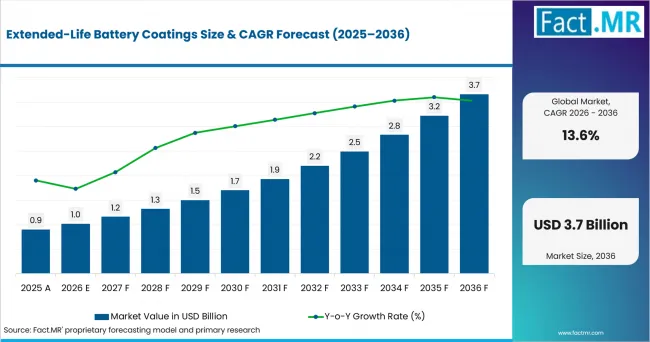
Extended Life Battery Coatings Value Analysis | Source: Fact.MR
What are the defining numbers behind Extended-Life Battery Coatings Market growth?
USD 2.6 billion absolute opportunity by 2036, led by Flexible film, Oxygen barrier, Nanoclay, and Fresh produce.
- Demand Drivers in the Market
- Food processors need packaging surfaces that limit oxygen entry because oxidation can alter flavor, color, and product stability before the intended use-by period.
- Fresh-produce packers need moisture and gas control supported by films or coatings that balance protection with the respiration needs of packed fruit and vegetables.
- Meat and seafood processors need stable active-barrier performance owing to their sensitivity to oxygen exposure and the commercial value of controlling quality loss during distribution.
- Packaging converters need functional layers that remain compatible with high-volume converting and sealing operations so shelf-life features avoid requiring a completely separate pack format.
- Key Segments Analyzed
- By Nanomaterial Platform: Nanoclay is expected to hold 27.0% share in 2026 because platelet structures are used to increase diffusion path length within polymer barrier systems.
- By Shelf-Life Mechanism: Oxygen barrier is projected to account for 33.0% share in 2026 as packaged foods often require control of oxygen ingress or residual oxygen.
- By Life-Extension Mechanism: Flexible film is anticipated to capture 37.0% share in 2026 due to broad use across pouches, wraps, and lidding structures.
- By Food Application: Fresh produce is estimated to represent 27.0% share in 2026 owing to moisture loss, respiration, and post-harvest quality constraints.
- Analyst Opinion at Fact.MR
- Shambhu Nath Jha, Principal Consultant at Fact.MR, states, “Commercial value depends on how well the functional layer performs within the intended package structure. Supplier positioning is strengthened by documented shelf-life performance, processing compatibility, and clear food-contact documentation.”
- Strategic Implications
- Coating formulators should document oxygen and moisture performance under the temperature and humidity ranges used by target food applications.
- Film converters should validate sealability and optical properties after adding nanomaterial or active-barrier functionality to the structure.
- Food manufacturers should compare shelf-life gains against package-line compatibility and food-contact requirements before moving a formulation into commercial production.
- Material suppliers should support recyclability and downgauging work where functional coatings allow a package to meet protection targets with less complex structures.
Poland is forecast to record 17.5% CAGR through 2036 as food output expands. South Korea is expected to post 14.6% as export-oriented food activity raises package-performance needs. The USA is projected at 13.4%, Germany at 12.7%, and Japan at 12.4% as food-processing scale supports barrier and shelf-life functions.
How does the Extended-Life Battery Coatings Market break down by segment?
Flexible film leads at 37.0%; Oxygen barrier leads at 33.0%.
Which Nanomaterial Platform dominates?
Nanoclay is expected to hold 27.0% share in 2026.
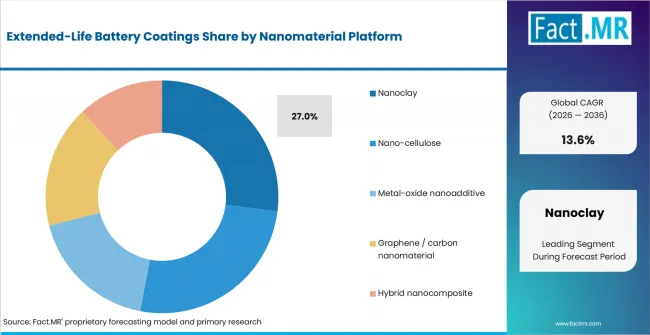
Extended Life Battery Coatings Analysis By Nanomaterial Platform | Source: Fact.MR
Nanoclay leads the platform mix because dispersed platelets can create a more tortuous path for gases moving through a polymer layer. Nano-cellulose offers a fiber-based route where stiffness and barrier behavior can be combined. Metal-oxide nanoadditives support light or gas-control functions when used in suitable matrices. Graphene and carbon nanomaterials remain relevant where very low loadings are evaluated for mechanical or barrier gains. Hybrid nanocomposites combine more than one reinforcement approach to balance processing and protection.
What leads the Shelf-Life Mechanism segment?
Oxygen barrier is projected to account for 33.0% share in 2026.
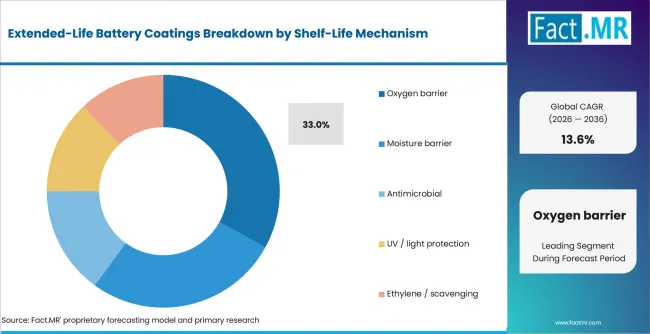
Extended Life Battery Coatings Analysis By Shelf Life Mechanism | Source: Fact.MR
Oxygen barrier leads because oxygen exposure can accelerate oxidation and quality loss across many packaged foods. Moisture barrier is selected where water gain or loss affects texture and stability. Antimicrobial systems target surface or headspace conditions that contribute to spoilage. UV and light protection is relevant for light-sensitive ingredients or products. Ethylene and scavenging functions address specific gases inside a pack, especially where ripening or residual oxygen influences shelf life.
How does Life-Extension Mechanism shape demand?
Flexible film is anticipated to capture 37.0% share in 2026.
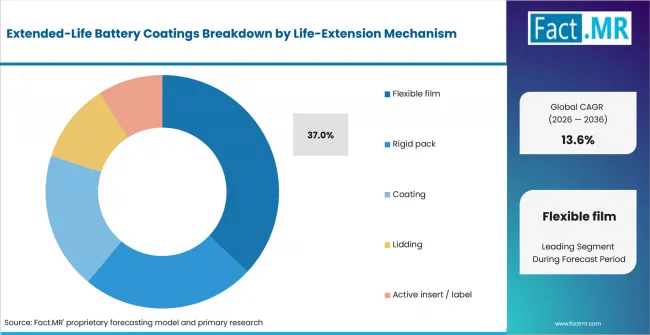
Extended Life Battery Coatings Analysis By Life Extension Mechanism | Source: Fact.MR
Flexible film leads because it serves high-volume pouches, wraps, bags, and lidding structures while allowing a functional layer to be applied across a broad surface. Rigid packs provide a more stable geometry for trays and containers. Coating-only systems can add barrier performance to paper or polymer substrates. Lidding concentrates function at the package closure. Active inserts and labels offer a separate route when the active chemistry is better isolated from the structural package.
What supports Fresh produce within Food Application?
Fresh produce is estimated to represent 27.0% share in 2026.
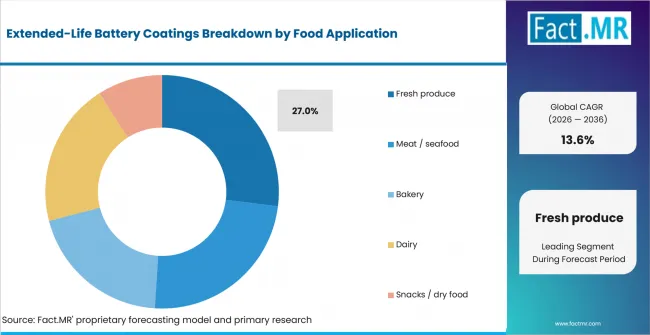
Extended Life Battery Coatings Analysis By Food Application | Source: Fact.MR
Fresh produce leads because harvested fruit and vegetables continue to respire and lose moisture after packing. Packaging must therefore manage gas exchange without creating damaging condensation or excessive dehydration. Meat and seafood require tight oxygen and contamination control. Bakery applications focus more heavily on moisture and mold-related shelf life. Dairy packaging often combines light and oxygen protection. Snacks and dry foods depend on moisture and oxygen barriers to preserve crispness and flavor.
What is accelerating Extended-Life Battery Coatings Market adoption, and what is holding it back?
Shelf-life protection and package-efficiency goals drive it; formulation complexity and end-of-life constraints restrain it.
Drivers Impact Analysis
| DRIVER | (~) % IMPACT ON CAGR | GEOGRAPHIC RELEVANCE | IMPACT TIMELINE |
|---|---|---|---|
| Food-loss reduction and shelf-life protection | Qualitative | Global | Short term (<= 2 years) |
| Oxygen and moisture barrier requirements | Qualitative | Global | Short term (<= 2 years) |
| Flexible-packaging integration | Qualitative | North America, Europe, East Asia | Medium term (2-4 years) |
| Nanomaterial-enabled downgauging | Qualitative | Europe, East Asia | Medium term (2-4 years) |
| Active packaging functions | Qualitative | Global | Long term (>= 4 years) |
Opportunity Impact Analysis
| OPPORTUNITY | (~) % IMPACT ON CAGR | GEOGRAPHIC RELEVANCE | IMPACT TIMELINE |
|---|---|---|---|
| Recyclable high-barrier structures | Qualitative | Europe, North America | Medium term (2-4 years) |
| Fresh-produce shelf-life systems | Qualitative | Global | Short term (<= 2 years) |
| Active oxygen-control layers | Qualitative | North America, Europe, East Asia | Medium term (2-4 years) |
| Paper and fiber barrier coatings | Qualitative | Europe, North America | Long term (>= 4 years) |
Restraints Impact Analysis
| RESTRAINT | (~) % IMPACT ON CAGR | GEOGRAPHIC RELEVANCE | IMPACT TIMELINE |
|---|---|---|---|
| Food-contact and migration qualification | Qualitative | Global | Short term (<= 2 years) |
| Dispersion and coating-process complexity | Qualitative | Global | Medium term (2-4 years) |
| Recycling compatibility of functional layers | Qualitative | Europe, North America, East Asia | Medium term (2-4 years) |
| Application-specific shelf-life validation | Qualitative | Global | Long term (>= 4 years) |
Which countries are scaling the Extended-Life Battery Coatings Market through 2036?
- The displayed country range spans 5.1 percentage points from Poland at 17.5% to Japan at 12.4% across the forecast period.
- Poland remains 2.9 percentage points above South Korea as food-product output and packaging-system modernization support faster expansion.
- South Korea remains 1.2 percentage points above the USA as export-oriented food activity raises the value of shelf-life performance.
- The USA remains 0.7 percentage point above Germany as large packaged-food volumes sustain broad coating and additive use.
- Germany remains 0.3 percentage point above Japan as prepared-food production supports recurring barrier requirements.
- Japan closes the displayed range at 12.4% as high-value food processing keeps package protection central to product quality.
Comparable CAGRs create different entry conditions across food mix, converting scale, package formats, and official recovery systems. Full report coverage includes North America, Latin America, Western Europe, Eastern Europe, East Asia, South Asia & Pacific, and Middle East & Africa.
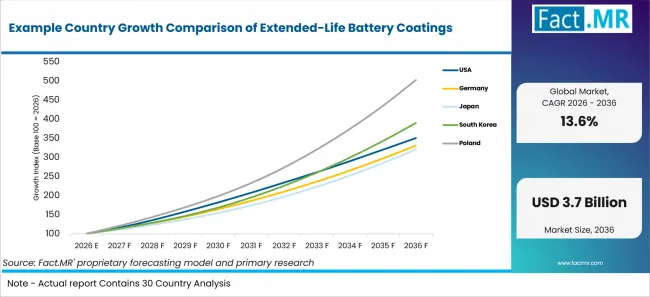
Example Country Growth Comparison Of Extended Life Battery Coatings | Source: Fact.MR
| Country | CAGR (2026-2036) |
|---|---|
| USA | 13.4% |
| Germany | 12.7% |
| Japan | 12.4% |
| South Korea | 14.6% |
| Poland | 17.5% |
What supports USA adoption?
13.4% CAGR, supported by the scale of food spending and the value attached to shelf-life protection.
U.S. food brands operate across a large packaged-food base where oxygen and moisture control can protect product quality during retail distribution. In April 2025, the U.S. Environmental Protection Agency reported an estimated annual consumer food-waste cost of USD 728 per person, based on 2023 data. Shelf-life coatings therefore compete on measurable protection that fits established filling and sealing systems. Flexible-film compatibility is expected to remain especially relevant across produce, meat, bakery, dairy, and dry-food formats.
How is Germany scaling demand?
12.7% CAGR, shaped by prepared-food production and detailed package-performance requirements.
German food manufacturers place a premium on barrier consistency across prepared foods that move through retail and refrigerated channels. In January 2026, the Federal Statistical Office reported 1.7 million tonnes of ready meals produced in Germany during 2024. That production base supports recurring use of oxygen and moisture barriers across trays, films, and coated structures. Suppliers are expected to gain attention where coating performance remains stable after forming, sealing, and storage.
How does Japan perform?
12.4% CAGR, led by a high-value food-processing base and precise package-performance needs.
Japanese food processors manage shelf-life performance across frozen foods, beverages, seafood, prepared meals, and other packaged categories. In April 2026, the USDA Foreign Agricultural Service reported that Japan’s food-processing sector stood at USD 174 billion in 2025. That scale supports demand for barrier layers and active functions that preserve quality while fitting established package formats. Formulations with predictable activity across the intended shelf life are expected to receive greater commercial attention.
What is supporting South Korea’s adoption?
14.6% CAGR, driven by export-oriented food activity and the need for consistent package protection.
South Korean food exporters require packaging that maintains product quality across storage and longer distribution routes. In January 2026, the Ministry of Agriculture, Food and Rural Affairs reported K-Food+ exports of USD 13.62 billion in 2025. Export growth increases the value of oxygen control, moisture management, and stable sealing performance across packaged foods. Coating suppliers are expected to benefit when functional layers integrate cleanly with high-volume film and rigid-pack production.
How is Poland developing demand?
17.5% CAGR, backed by rising food-product output and expanding packaging conversion activity.
Poland combines a broad food-processing base with expanding packaged-food distribution across domestic and European channels. In July 2026, Statistics Poland reported that the value of sold production of food products at constant prices increased by 5.4% in 2025 compared with 2024; the data cover entities employing 10 or more persons. Higher food output expands the volume of packages requiring moisture, oxygen, and shelf-life control. Converter-ready coatings are expected to gain preference where they preserve line speed and deliver repeatable performance on familiar film or paper structures.
Who leads the Extended-Life Battery Coatings Market?
The report profiles Arkema, Syensqo, Daikin Industries, BASF, and NanoXplore. Arkema, Syensqo, Daikin Industries, BASF participate through packaging-related oxygen-scavenging, barrier, UV, or antifog solutions, while NanoXplore contributes an adjacent graphene-enhanced plastic-film technology example.
BASF addresses flexible barrier-packaging applications through its ecovio® portfolio. In April 2026, BASF announced an expanded ecovio portfolio for flexible packaging that includes grades suitable for extrusion coating, film and sheet extrusion, and lamination. The portfolio provides adjustable barriers against grease, oil, waxes, and liquids, together with high barriers against oxygen and moisture. BASF also positions the portfolio around end-of-life options such as organic and paper recycling, including certified home-compostable grades for food and other FMCG packaging.
NanoXplore provides an adjacent example focused on mechanical performance in plastic films. On June 15, 2026, NanoXplore and Techmer PM announced the commercial launch of GrapheneBlack xGnP™ Masterbatch for high-performance plastic-film applications. The companies reported more than a 70% improvement in mechanical strength and potential film-thickness reductions of up to 20% while maintaining tensile, tear, and puncture performance. The announcement supports the material's mechanical-strength and downgauging capabilities in plastic films; food-contact suitability, oxygen- or moisture-barrier performance, and shelf-life extension would require application-specific evidence.
Which companies are the key providers?
Key companies include Arkema; Syensqo; Daikin Industries; BASF; and NanoXplore.
- Arkema
- Syensqo
- Daikin Industries
- BASF
- NanoXplore
Bibliography
- U.S. Environmental Protection Agency. (2025, April 4). Estimating the cost of food waste to American consumers.
- Statistisches Bundesamt (Destatis). (2026, January 14). Produktion von Fertiggerichten binnen fünf Jahren mengenmäßig um 25,6 % gestiegen.
- Aoki, S. (2026, April 1). Food processing ingredients annual (Report No. JA2026-0012). U.S. Department of Agriculture, Foreign Agricultural Service.
- Ministry of Agriculture, Food and Rural Affairs. (2026, January 20). Exports of K-Food Plus reached USD 13.6 billion in 2025, up 5.1% year-over-year.
- Statistics Poland. (2026, July 13). Production of industrial products in 2025.
- BASF. (2026, April 29). New ecovio® portfolio for flexible packaging: Multiple barrier options combined with organic or paper recycling.
- NanoXplore Inc. (2026, June 15). NanoXplore and Techmer PM launch revolutionary GrapheneBlack xGnP™ masterbatch for high-performance plastic films.
This Report Addresses
- The report explains how nanomaterial platform and shelf-life mechanism influence the performance requirements for functional food-packaging coatings and additives.
- Segment analysis identifies the leading subsegments and explains the operating reasons behind their 2026 shares.
- Country analysis compares the five country growth rates with official 2025 or 2026 evidence on consumer food-waste cost, prepared-food production, food-processing activity, food exports, and industrial food-product output.
- Competitive analysis reviews the profiled companies against current barrier, active-packaging, additive, or nanomaterial activities across current product and technology activity.
- Application analysis considers fresh produce, meat and seafood, bakery, dairy, and snacks or dry food within the defined shelf-life scope.
What does the Extended-Life Battery Coatings Market cover?
The Extended-Life Battery Coatings Market covers functional coating and additive technologies represented by the defined segmentation. It includes nanoclay, nano-cellulose, metal-oxide nanoadditives, graphene or carbon nanomaterials, and hybrid nanocomposites used in packaging structures.
Coverage includes flexible films, rigid packs, coatings, lidding, and active inserts or labels across fresh produce, meat and seafood, bakery, dairy, and snacks or dry food.
What is included in the scope?
The scope includes functional coatings, masterbatch-compatible additives, and active-package components whose primary role is barrier improvement or shelf-life extension in food packaging.
Commercial evidence covers packaging additives, barrier coatings, oxygen-control products, and graphene-enhanced film masterbatches relevant to the report’s packaging-material analysis.
What is excluded from the scope?
The scope excludes ordinary decorative coatings outside shelf-life applications, general barrier coatings unrelated to the defined food-packaging segmentation, and package machinery sold as standalone equipment. Raw preservatives added directly to food are outside the package-function boundary.
General packaging films fall outside the scope when they lack the listed nanomaterial or shelf-life mechanisms. Revenue from unrelated plastics, chemicals, additives, or coatings is outside the market boundary.
How Was the Analysis Built?
The analysis draws on 120+ sources, 35+ company portfolios, 25+ countries, and more than 20 industry interviews.
- Primary Research: Primary research includes discussions with manufacturers, service providers, technology developers, distributors, end users, and subject-matter experts. These conversations examine purchasing priorities, product adoption, operational challenges, approval requirements, competitive positioning, and the factors that influence wider market acceptance.
- Desk Research: Desk research covers government statistics, regulatory publications, company filings, trade data, technical studies, industry associations, standards, public policy, and other authoritative sources. Every source used in the analysis is documented in the bibliography.
- Market Sizing and Forecasting: Market estimates combine historical performance, demand indicators, pricing and volume trends, segment shares, company participation, country-level growth, adoption patterns, investment activity, and barriers to market expansion.
- Data Validation and Update Cycle: Findings are validated by comparing primary interviews with public data, company activity, regulatory changes, trade patterns, and industry developments. Regular updates review new product launches, capacity changes, partnerships, approvals, and shifts in commercial adoption.
What is the report’s scope and coverage?
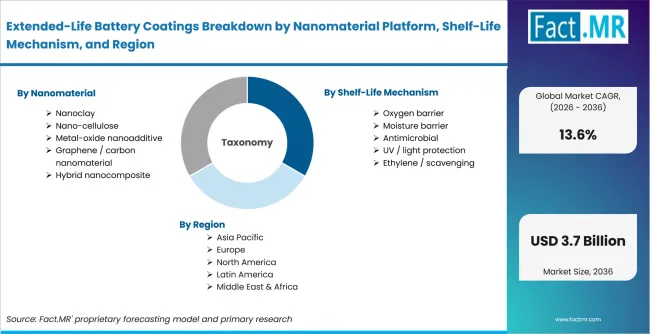
Extended Life Battery Coatings Breakdown By Nanomaterial Platform, Shelf Life Mechanism, And Region | Source: Fact.MR
| Attribute | Details |
|---|---|
| Quantitative Units | USD Billion |
| Market Definition | Functional coating and additive systems in the defined scope that use nanomaterials, barrier functions, scavenging, antimicrobial action, or light protection to extend the usable shelf life of packaged food. |
| Nanomaterial Platform | Nanoclay; Nano-cellulose; Metal-oxide nanoadditive; Graphene / carbon nanomaterial; Hybrid nanocomposite |
| Shelf-Life Mechanism | Oxygen barrier; Moisture barrier; Antimicrobial; UV / light protection; Ethylene / scavenging |
| Life-Extension Mechanism | Flexible film; Rigid pack; Coating; Lidding; Active insert / label |
| Food Application | Fresh produce; Meat / seafood; Bakery; Dairy; Snacks / dry food |
| Regions Covered | North America; Latin America; Western Europe; Eastern Europe; East Asia; South Asia & Pacific; Middle East & Africa |
| Countries Profiled | USA; Germany; Japan; South Korea; Poland |
| Key Companies Profiled | Arkema; Syensqo; Daikin Industries; BASF; NanoXplore |
| Forecast Period | 2026 to 2036 |
| Approach | Hybrid top-down and bottom-up review using food-output indicators, packaging applications, segment shares, company participation, country growth, and official food-production, export, and consumer food-waste evidence. |
How is the market segmented?
-
By Nanomaterial Platform
- Nanoclay
- Nano-cellulose
- Metal-oxide nanoadditive
- Graphene / carbon nanomaterial
- Hybrid nanocomposite
-
By Shelf-Life Mechanism
- Oxygen barrier
- Moisture barrier
- Antimicrobial
- UV / light protection
- Ethylene / scavenging
-
By Life-Extension Mechanism
- Flexible film
- Rigid pack
- Coating
- Lidding
- Active insert / label
-
By Food Application
- Fresh produce
- Meat / seafood
- Bakery
- Dairy
- Snacks / dry food
-
By Region
- North America
- Latin America
- Western Europe
- Eastern Europe
- East Asia
- South Asia & Pacific
- Middle East & Africa