- Market Value (2025): USD 6.3 Bn
- Estimated Value (2026): USD 6.56 Bn
- Forecast Value (2036): USD 9.9 Bn
- CAGR (2026-2036): 4.2%
What is the External Hard Disk Market forecast to be worth by 2036?
USD 6.6 billion in 2026 to USD 9.9 billion by 2036 at a 4.2% CAGR.
- The valuation of the external hard disk market was USD 6.3 billion in 2025, with portable backup drives and desktop archive units forming the bulk of revenue across personal and business buyers.
- Revenue will grow from USD 6.56 billion in 2026 to USD 9.9 billion by 2036 as households and small organizations keep offline copies of files that no longer fit on their primary devices.
- A 4.2% CAGR reflects a mature product whose value per unit keeps rising, since buyers trade up to higher capacities and faster interfaces each time they replace a drive.
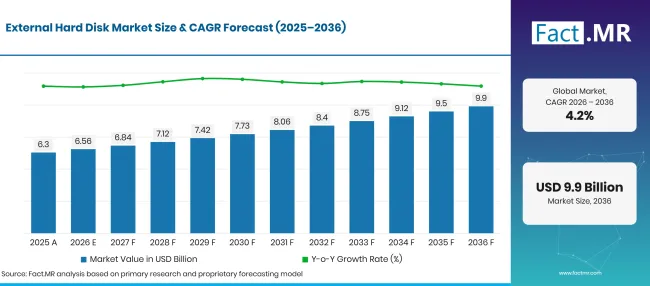
External Hard Disk Market Forecast Global | Source: Fact.MR
| Year | Basis | Market Value (USD billion) |
|---|---|---|
| 2025 | Actual | 6.3 |
| 2026 | Estimate | 6.56 |
| 2036 | Forecast | 9.9 |
| CAGR 2026 to 2036 | Forecast period | 4.2% |
Source: Fact.MR analysis. Updated Nov 9, 2026
What are the defining numbers behind External Hard Disk Market growth?
The 2026 to 2036 period adds USD 3.3 billion in new value, concentrated in multi-terabyte portable drives, USB 3.0 models and online sales to personal users.
- Demand Drivers in the Market
- Public cyber guidance keeps the external drive in the backup toolkit. The UK National Cyber Security Centre advises small organisations to back up data to an external device such as a USB stick or external hard drive if they lack a reliable internet connection [1].
- Cyber incidents push firms to hold separate recovery copies. The UK Cyber Security Breaches Survey 2025/2026 found that 43% of businesses and 28% of charities reported a breach or attack in the previous 12 months [2]. A disconnected drive cannot be encrypted by malware that reaches the network, which keeps it relevant for ransomware recovery plans.
- Content files are getting heavier. 4K video, raw photo formats and modern game titles each take far more space than older formats. Portable drives let them move and store this material without paying monthly fees.
- Small offices value low cost per terabyte. Accountants, architects and clinics archive years of records on desktop drives, where a single unit can hold what would cost a recurring subscription in the cloud.
- Key Segments Analyzed
- By Storage Capacity: 1TB to 5TB will hold 42.5% share in 2026, since this range covers a typical household photo and document library at a price most buyers accept.
- By Connectivity: USB 3.0 will account for 44.8% of 2026 value, as almost every laptop, desktop and console still carries a compatible port.
- By End-User: Personal will capture 51.3% in 2026, given that individuals buy drives for media libraries, game storage and home backups.
- By Distribution Channel: Online Stores will take 58.7% of 2026 sales because shoppers compare capacity, speed and price across brands on one screen.
- Analyst Opinion at Fact.MR
- Shambhu Nath Jha, Principal Consultant at Fact.MR, states, “The external hard disk has become the offline insurance policy for people and small firms who no longer trust a single copy in the cloud. Unit volumes will stay steady, but value will grow as buyers move to multi-terabyte drives and USB-C connections. Brands that pair reliable mechanisms with simple backup software and wide online listings will hold shelf space as portable SSDs take the speed-sensitive end of demand.”
- Strategic Implications
- Manufacturers should widen 4TB to 6TB portable lines and add USB-C cables in the box, because buyers now judge a drive on whether it plugs into a phone, a console and a laptop without adapters.
- Retailers and e-commerce platforms should publish clear capacity, interface and warranty filters, since shoppers comparing similar drives decide on those three details.
- Business buyers should keep at least one rotated external copy of critical records off the network, which protects recovery options when cloud accounts or servers are compromised.
- Investors should favor suppliers that also sell backup software and rugged models, as these features lift selling prices in a category where basic drives compete hard on cost.
Germany heads the five-country group at 4.8%, where firms that already rely on cloud services still keep local archive copies for compliance and recovery. Brazil follows at 4.4%, 0.4 points behind, with a large and still expanding online population that is starting to buy dedicated storage for phones and PCs. The United States, at 4.0%, trails Brazil by the same margin because a mature base of creators and gamers mostly replaces drives instead of buying a first one. Online habits in the United Kingdom are intense, yet its 3.6% pace stays 0.4 points under the US rate as cloud backup is widely used by firms. Japan closes the range at 3.2%, as heavy smartphone use and high enterprise cloud adoption limit growth to replacement and archive purchases.
How does the External Hard Disk Market break down by segment?
1TB to 5TB will lead Storage Capacity at 42.5%; USB 3.0 will head Connectivity at 44.8%; Personal will hold End-User at 51.3%; Online Stores will lead Distribution Channel at 58.7% in 2026.
Which Storage Capacity leads?
1TB to 5TB holds 42.5% of 2026 sales.
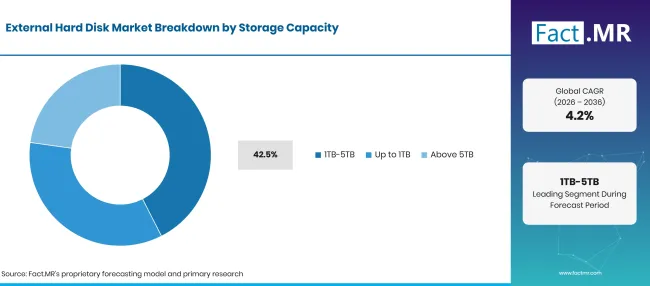
External Hard Disk Market Breakdown Storage Capacity | Source: Fact.MR
| Storage Capacity | Share (2026) |
|---|---|
| 1TB to 5TB (Leading segment) | 42.5% |
| Other segments combined | 57.5%* |
| Total | 100.0% |
Source: Fact.MR analysis. Updated Nov 9, 2026
Most buyers want enough room for a few years of photos, documents and system backups without paying for capacity they will not fill. Drives from 1TB to 5TB meet that need in a 2.5-inch case that runs from a single USB cable. Owners of cameras and phones who shoot high-resolution files, a trend tracked in digital imaging products, tend to settle at 2TB or 4TB. Drives up to 1TB now serve mainly price-driven buyers and bundled promotions. Units above 5TB are usually 3.5-inch desktop models with their own power supply. Video editors and media collectors pick them for long-term archives.
What supports USB 3.0 within Connectivity?
USB 3.0 accounts for 44.8% of 2026 revenue.
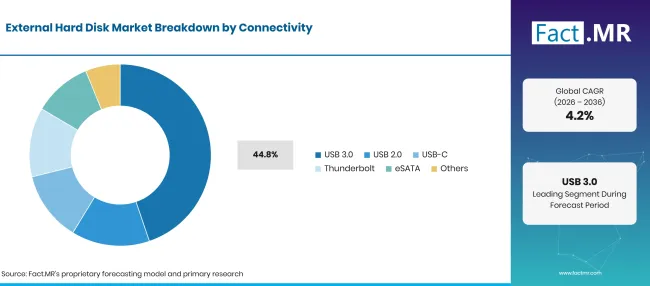
External Hard Disk Market Breakdown Connectivity | Source: Fact.MR
| Connectivity | Share (2026) |
|---|---|
| USB 3.0 (Leading segment) | 44.8% |
| Other segments combined | 55.2%* |
| Total | 100.0% |
Source: Fact.MR analysis. Updated Nov 9, 2026
Compatibility drives this choice. A USB 3.0 drive works with older desktops, current laptops, televisions and game consoles, and it transfers files far faster than USB 2.0 models. The cable itself is a commodity part covered in wire and cable supply. USB-C is gaining share as laptops and phones drop the older Type-A port, and many brands now ship both cable types with the same drive. Thunderbolt serves creative professionals who chain several desktop drives to one workstation.
How does End-User shape demand?
Personal users represent 51.3% of 2026 demand.
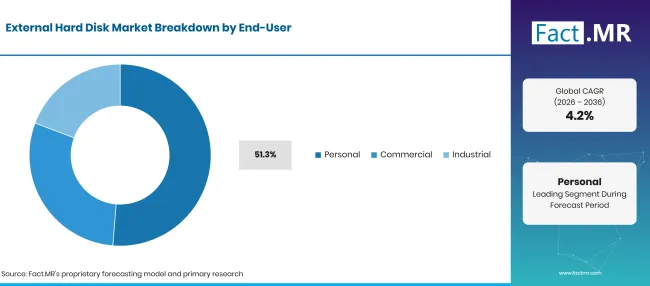
External Hard Disk Market Breakdown End User | Source: Fact.MR
| End-User | Share (2026) |
|---|---|
| Personal (Leading segment) | 51.3% |
| Other segments combined | 48.7%* |
| Total | 100.0% |
Source: Fact.MR analysis. Updated Nov 9, 2026
Individuals collect files faster than they delete them. Family photos, downloaded films, game libraries and student coursework all pile up on devices with fixed internal storage. A plug-in drive is a one-time purchase that keeps private files out of third-party accounts. Commercial buyers use external drives for supplementary backups and project handovers. Cloud use differs sharply by firm size: Eurostat data show that 84.7% of large EU enterprises bought paid cloud services in 2025, against 49.3% of small enterprises [3]. That gap leaves many small firms relying on local drives. Industrial users keep copies of machine logs and footage from systems such as CCTV cameras.
What leads the Distribution Channel segment?
Online Stores take 58.7%of 2026 purchases.
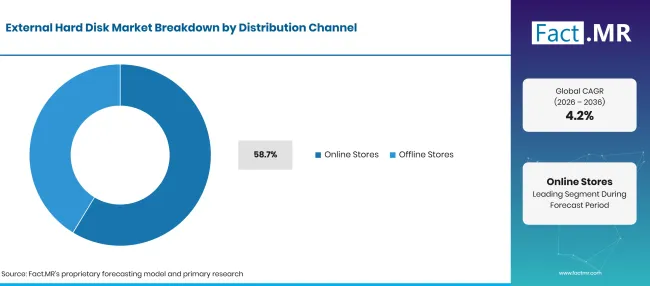
External Hard Disk Market Breakdown Distribution Channel | Source: Fact.MR
| Distribution Channel | Share (2026) |
|---|---|
| Online Stores (Leading segment) | 58.7% |
| Other segments combined | 41.3%* |
| Total | 100.0% |
Source: Fact.MR analysis. Updated Nov 9, 2026
Shoppers buying storage want to compare many near-identical products quickly. Web stores list dozens of capacities and brands with prices, ratings and delivery dates side by side. Offline stores still serve urgent buyers and those who want to see a rugged case before paying. Electronics chains and office supply outlets carry a narrower range, usually the most popular capacities.
What is accelerating External Hard Disk Market adoption, and what is holding it back?
Growing personal data and the need for an offline copy keep demand moving, especially for portable multi-terabyte models. Cloud services are the main brake: Eurostat reported that 52.7% of EU enterprises used paid cloud services in 2025, with 71.5% of those users storing files there [4]. Portable SSDs also win buyers who value speed and shock resistance, while the risk of mechanical failure deters some users.
Drivers Impact Analysis
| DRIVER | (~) % IMPACT ON CAGR | GEOGRAPHIC RELEVANCE | IMPACT TIMELINE |
|---|---|---|---|
| Growing personal photo, video and game libraries | +1.5% | Global | Long term (>=4 years) |
| Need for offline backup copies against ransomware and data loss | +1.2% | Global | Medium term (2-4 years) |
| Archive and project storage in small and mid-sized businesses | +0.8% | North America, Western Europe, East Asia | Medium term (2-4 years) |
| Wider choice of multi-terabyte portable drives | +0.5% | Global | Long term (>=4 years) |
| Broader online retail reach | +0.2% | Global | Short term (<=2 years) |
Source: Fact.MR analysis. Updated Nov 9, 2026
Opportunity Impact Analysis
| OPPORTUNITY | (~) % IMPACT ON CAGR | GEOGRAPHIC RELEVANCE | IMPACT TIMELINE |
|---|---|---|---|
| Rugged drives for field, travel and outdoor use | +0.5% | Global | Medium term (2-4 years) |
| High-capacity desktop drives for creators and studios | +0.4% | North America, Western Europe, East Asia | Long term (>=4 years) |
| USB-C drives that connect to phones, tablets and new laptops | +0.2% | Global | Medium term (2-4 years) |
| Online sales growth in emerging consumer markets | +0.1% | Latin America, South Asia & Pacific, Middle East & Africa | Long term (>=4 years) |
Source: Fact.MR analysis. Updated Nov 9, 2026
Restraints Impact Analysis
| RESTRAINT | (~) % IMPACT ON CAGR | GEOGRAPHIC RELEVANCE | IMPACT TIMELINE |
|---|---|---|---|
| Substitution by cloud storage and subscription backup | -0.5% | Global | Long term (>=4 years) |
| Falling prices of portable SSDs | -0.4% | Global | Medium term (2-4 years) |
| Mechanical failure and damage from drops | -0.2% | Global | Medium term (2-4 years) |
| Data loss or theft from unencrypted drives | -0.1% | Global | Long term (>=4 years) |
Source: Fact.MR analysis. Updated Nov 9, 2026
Which countries are scaling the External Hard Disk Market through 2036?
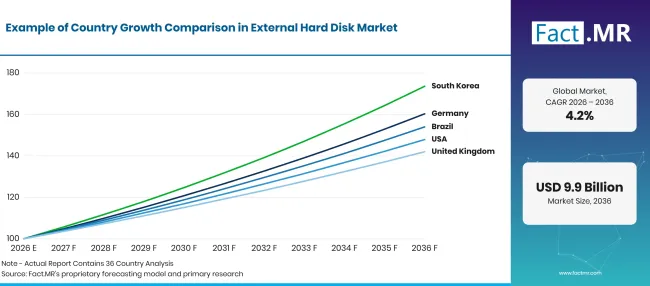
External Hard Disk Market Growth Index | Source: Fact.MR
| Country | CAGR (2026 to 2036) |
|---|---|
| Germany | 4.8% |
| Brazil | 4.4% |
| United States | 4.0% |
| United Kingdom | 3.6% |
| Japan | 3.2% |
Source: Fact.MR analysis. Updated Nov 9, 2026
What supports adoption in Germany?
4.8% CAGR, driven by business archiving needs and careful data protection habits.
German firms combine cloud use with local copies. Destatis reported that 54% of companies with at least 10 employees used paid cloud services in 2025, and 71% of those cloud users stored data there [5]. Strict record retention rules and caution about where data is held lead many of these firms to keep a second copy on hardware they own. Engineering offices archive drawings on desktop drives, while households buy portable units for photos.
How is Brazil developing demand?
4.4% CAGR, backed by a widening online population and price-sensitive buying.
Internet use now reaches most of the country. IBGE reported that 90.5% of Brazilians aged 10 or over, or 168.7 million people, used the internet in 2025 [6]. Many of these users rely on phones with limited storage and prepaid data plans, so moving photos and videos to a local drive is cheaper than paying for cloud space. Online marketplaces bring the same models to smaller cities, often with instalment plans.
What is shaping adoption in the United States?
4.0% CAGR, helped by creators, gamers and online purchasing.
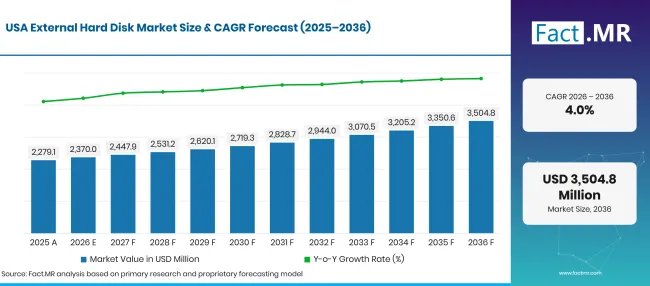
External Hard Disk Market Forecast Usa | Source: Fact.MR
American buyers are heavy users of e-commerce. The U.S. Census Bureau reported that online sales were 17.1% of total retail sales in the second quarter of 2026, worth USD 340.2 billion on a seasonally adjusted basis [7]. Video editors, photographers and console gamers form the core of demand. Replacement buying outweighs first-time purchases, which keeps growth below Brazil.
How is the United Kingdom developing demand?
3.6% CAGR, reflecting intense online activity and creative sector storage needs.
People in the UK spend a large share of the day on connected devices. Ofcom found that UK adults spent about 4.5 hours a day online in 2025, 10 minutes more than a year earlier [8]. Film, music and design studios in London and Manchester keep shoot footage and project masters on desktop and Thunderbolt drives. Wide use of cloud backup by firms keeps business demand modest, so household and creative buyers set the pace.
What supports Japan’s adoption?
3.2% CAGR, as replacement demand from households and offices keeps sales steady.
Japan’s device base is mature. The Ministry of Internal Affairs and Communications reported that 91.8% of households owned a smartphone, and that more than 80% of enterprises used cloud services, in its Communications Usage Trend Survey released in May 2026 [9]. High cloud use limits new business demand, but households still buy external drives to record TV programmes and back up PCs. Compact, quiet drives that work with recorders and consoles sell well.
Who leads the External Hard Disk Market?
Competition splits into two tiers. Seagate, Western Digital and Toshiba design and build their own disk mechanisms, which lets them launch new capacities first and control cost per terabyte. Toshiba refreshed its Canvio Flex and Canvio Gaming portable drives in January 2025 in 1TB, 2TB and 4TB versions with USB Type-C and Type-A cables [10].
Western Digital added 26TB G-DRIVE and G-DRIVE PROJECT desktop drives for creative professionals in March 2025 [11]. Seagate introduced One Touch desktop drives in 8TB, 20TB and 24TB versions in April 2026 [12]. A second tier of brands, including Transcend, ADATA, Buffalo and Silicon Power, buys mechanisms and competes on rugged cases, design, regional distribution and price. Success through 2036 will hinge on how well each brand balances higher capacity, USB-C readiness and reliability as portable SSDs take the speed-sensitive end of demand.
Which companies are the key providers?
Key companies in the External Hard Disk Market include Seagate, Western Digital, Toshiba, Transcend, ADATA, Buffalo and Silicon Power.
- Seagate
- Western Digital
- Toshiba
- Transcend
- ADATA
- Buffalo
- Silicon Power
Bibliography
- [1] National Cyber Security Centre. (2026, April 9). Backing up your data.
- [2] Department for Science, Innovation and Technology. (2026, April 30). Cyber security breaches survey 2025/2026.
- [3] Eurostat. (2026, January). Cloud computing: statistics on the use by enterprises.
- [4] Eurostat. (2026, February 3). 53% EU enterprises used paid cloud services in 2025.
- [5] Statistisches Bundesamt (Destatis). (2025, November 24). Jedes zweite Unternehmen nutzt kostenpflichtige Cloud-Services.
- [6] Brazilian Institute of Geography and Statistics (IBGE). (2026, July 2). Proportion of Internet users in Brazil exceeded 90% of population aged 10 or over, in 2025.
- [7] U.S. Census Bureau. (2026, August 18). Quarterly Retail E-Commerce Sales: 2nd Quarter 2026.
- [8] Ofcom. (2025, December 10). From apps to AI search: how the UK goes online in 2025.
- [9] Ministry of Internal Affairs and Communications, Japan. (2026, May 29). Results of the 2025 Communications Usage Trend Survey.
- [10] Toshiba. (2025, January 14). Toshiba Unveils New Canvio Flex and Canvio Gaming 2.5" Portable Hard Drives.
- [11] Western Digital. (2025, March 11). Western Digital Boosts Capacity for NAS, Creative Professionals and Content Creators.
- [12] Seagate. (2026, April 23). Seagate Introduces Storage Built for Consumer Data Explosion.
This Report Answers
- How is revenue split across capacity bands, and why do 1TB to 5TB drives hold the biggest slice?
- Which interfaces will buyers choose as USB-C replaces Type-A ports on new laptops?
- What role do personal users play compared with commercial and industrial buyers?
- How far have online stores moved ahead of physical retail for storage purchases?
- Why do Germany, Brazil, the United States, the United Kingdom and Japan grow at different rates?
- How do drive makers and brand owners compete as cloud services and portable SSDs gain users?
What does the External Hard Disk Market cover?
This study tracks external hard disk drives that store, transfer and back up data outside the internal storage of computers, consoles and other host devices. Portable 2.5-inch drives and desktop 3.5-inch drives are the two main product forms.
Revenue is measured at the manufacturer level in USD billion across capacity bands, interfaces, end users and sales channels. Values cover the complete drive sold under a brand, including its enclosure, cable and bundled backup software.
What is included in the scope?
Portable and desktop external hard disk drives sold for backup, file transfer and archiving are included.
Drives in every capacity band, from up to 1TB to above 5TB, with USB 2.0, USB 3.0, USB-C, Thunderbolt, eSATA or other interfaces are counted. Rugged, water-resistant and hardware-encrypted external hard drives are part of the market. Sales to personal, commercial and industrial users through online and offline stores are covered.
What is excluded from the scope?
Internal hard disk drives fitted inside PCs, servers and recorders are excluded.
Portable SSDs, USB flash drives, memory cards and chips such as those in serial NOR flash are not counted. Network-attached storage, enterprise arrays and systems covered in storage area networks fall outside the boundary. Cloud backup subscriptions and the infrastructure tracked in data center capacity are excluded, along with data recovery services.
How Was the Analysis Built?
The analysis draws on 120+ sources, 35+ company portfolios, 25+ countries, and more than 20 industry interviews.
- Primary Research: Primary research includes discussions with manufacturers, service providers, technology developers, distributors, end users, and subject-matter experts. These conversations examine purchasing priorities, product adoption, operational challenges, approval requirements, competitive positioning, and the factors that influence wider market acceptance.
- Desk Research: Desk research covers government statistics, regulatory publications, company filings, trade data, technical studies, industry associations, standards, public policy, and other authoritative sources. Every source used in the analysis is documented in the bibliography.
- Market Sizing and Forecasting: Market estimates combine historical performance, demand indicators, pricing and volume trends, segment shares, company participation, country-level growth, adoption patterns, investment activity, and barriers to market expansion.
- Data Validation and Update Cycle: Findings are validated by comparing primary interviews with public data, company activity, regulatory changes, trade patterns, and industry developments. Regular updates review new product launches, capacity changes, partnerships, approvals, and shifts in commercial adoption.
Segmentation
What is the report’s scope and coverage?
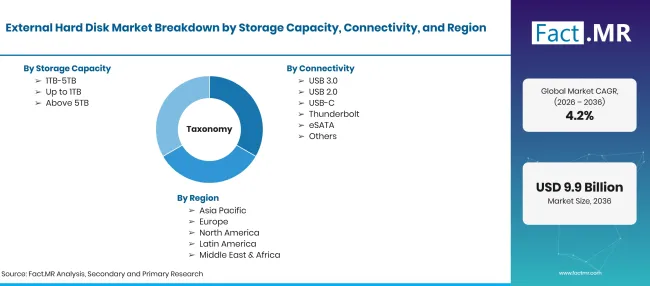
External Hard Disk Market Taxonomy | Source: Fact.MR
| Attribute | Details |
|---|---|
| Quantitative Units | USD billion |
| Market Definition | External hard disks are portable or desktop storage devices that use magnetic hard disk drive technology to store, transfer and back up data through an external interface. |
| Storage Capacity | 1TB to 5TB; Up to 1TB; Above 5TB |
| Connectivity | USB 3.0; USB 2.0; USB-C; Thunderbolt; eSATA; Others |
| End-User | Personal; Commercial; Industrial |
| Distribution Channel | Online Stores; Offline Stores |
| Regions Covered | North America; Latin America; Western Europe; Eastern Europe; East Asia; South Asia & Pacific; Middle East & Africa |
| Countries Covered | Germany; Brazil; United States; United Kingdom; Japan |
| Companies Profiled | Seagate; Western Digital; Toshiba; Transcend; ADATA; Buffalo; Silicon Power |
| Forecast Period | 2026 to 2036 |
| Approach | Hybrid top-down and bottom-up model built from device shipments, capacity mix, interface adoption, end-user demand, channel mix and manufacturer portfolio review. |
Source: Fact.MR analysis. Updated Nov 9, 2026
How is the market segmented?
-
By Storage Capacity
- 1TB to 5TB
- Up to 1TB
- Above 5TB
-
By Connectivity
- USB 3.0
- USB 2.0
- USB-C
- Thunderbolt
- eSATA
- Others
-
By End-User
- Personal
- Commercial
- Industrial
-
By Distribution Channel
- Online Stores
- Offline Stores
-
By Region
- North America
- Latin America
- Western Europe
- Eastern Europe
- East Asia
- South Asia & Pacific
- Middle East & Africa
Frequently Asked Questions
How large is the external hard disk market in 2026?
What growth rate will the external hard disk market record?
Which storage capacity leads?
Which connectivity type leads?
Which end-user leads?
Which distribution channel leads?
Which country will grow quickest?
Who are the main companies?
What holds the market back?
Who worked on this report


Preview the report firsthand - request a free sample
Free SampleGet the brochure for pricing and purchase details
Download PDF