- Market Value (2025): USD 3.08 Bn
- Estimated Value (2026): USD 3.29 Bn
- Forecast Value (2036): USD 6.31 Bn
- CAGR (2026-2036): 6.7%
What is the Serial NOR Flash Market forecast to be worth by 2036?
USD 3.29 billion in 2026 to USD 6.31 billion by 2036, at a 6.73% CAGR.
- Serial NOR Flash generated USD 3.08 billion in estimated revenue in 2025.
- Fact.MR expects the market to reach USD 3.29 billion in 2026 and USD 6.31 billion by 2036.
- The implied CAGR is 6.7% over 2026–2036. Larger firmware and more attention to secure updates are adding value to code-storage devices.
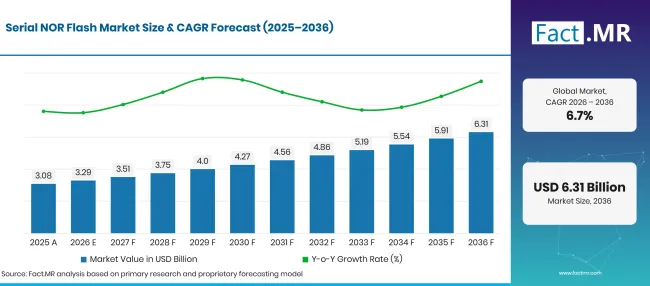
Factmr Serial Nor Flash Market Forecast Global | Source: Fact.MR
| Year | Basis | Market Value (USD billion) |
|---|---|---|
| 2025 | Historical estimate | 3.08 |
| 2026 | Estimate | 3.29 |
| 2036 | Forecast | 6.31 |
| CAGR 2026 to 2036 | Forecast period | 6.7% |
Source: Fact.MR analysis. Updated Oct 22, 2026
What are the defining numbers behind Serial NOR Flash Market growth?
The forecast adds USD 3.02 billion in annual revenue by 2036. Standard Serial NOR Flash makes up 61.4% of 2026 sales and OEM customers account for 82.3%. Once a chip becomes part of a released equipment design, continuity of specification and supply can be as important as the quoted unit price.
- Demand Drivers in the Market
- An interrupted software update can create an expensive field-service problem even when the memory chip costs very little. NIST's August 2025 revision addressed update integrity and recovery from disruptive changes. [11] Equipment designers consequently have reason to retain trusted firmware and verify new code before activating it. Those needs can favour well-documented NOR configurations, although they do not require one particular flash device in every connected product.
- Serial NOR retains a useful position where a processor must start promptly and read code predictably. Micron's fiscal 2025 filing identifies boot and execute-in-place code among NOR applications. Capacity and access behaviour therefore need separate evaluation. A device can use the NAND Flash Market for substantial data storage while retaining NOR for essential instructions. Larger files will favour higher-density serial parts only where keeping those instructions on NOR still serves the system design. [9]
- Interface development gives suppliers a route to higher-value products without abandoning serial connections. Infineon's 2025 SEMPER octal documentation describes 512 Mb and 1 Gb devices using the JEDEC xSPI interface. Such products address designs that have outgrown the read performance of an older connection. The sale depends on host-controller support and board behaviour. A faster chip specification has little commercial value if the rest of the platform prevents the customer from using it. [4]
- A second source becomes commercially useful when the replacement part survives the customer's software and protection tests. Linux's SPI NOR framework can discover many device characteristics through standard parameter tables. Its documentation also identifies cases that still need device-specific corrections. In the Microcontroller Market, this distinction affects how easily an equipment maker can change external memory. Vendors that provide accurate discovery data and dependable integration support can reduce the engineering cost of being added to an approved purchasing list. [15]
- Key Segments Analyzed
- By Type: Standard Serial NOR Flash represents 61.4% of 2026 revenue. Established code images still support a large business below the highest density classes.
- By Application: Consumer Electronics holds 34.2% in 2026. Compact devices require careful control of memory power and package size.
- By Density: 1Mb-16Mb contributes 40.5% in 2026. Small firmware and configuration tasks sustain demand without requiring a large storage array.
- By End-User: OEMs account for 82.3% in 2026. Qualification and incorporation into original equipment determine most component purchases.
- Analyst Opinion at Fact.MR
- Shambhu Nath Jha, Lead Consultant, Fact.MR
- The decision about serial NOR should be made with the firmware engineer in the room. Capacity, write endurance, protection settings and recovery after a failed update all influence whether a part is suitable. Procurement is in a stronger position once those points are settled and an approved alternative is available. Selling a larger chip merely because firmware might grow is a weak argument. A supplier earns a place in the design by helping the manufacturer keep the product serviceable for years.
- Strategic Implications
- In automotive equipment, begin with the safety role of the stored code. Infineon's SEMPER octal family was developed with ISO 26262 functional-safety requirements in mind. [4] Customers in the Automotive Semiconductor Market still need to decide how faults are detected and how the host system responds. A chip's safety features do not make the complete vehicle function safe by themselves.
- Check power requirements against the controller's real operating pattern. GigaDevice lists serial NOR options in 1.2 V as well as established voltage families. [3] Designers buying for an IoT Microcontroller Market application should compare the memory's active and standby behaviour with their firmware access pattern, not assume a lower supply voltage guarantees longer battery life.
- Separate certified cryptographic functions from broad security claims. NIST's validation register records defined capabilities for SEMPER Secure NOR hardware. [10] A manufacturer should say which functions the device provides and which remain the host's responsibility. Strong documentation helps an equipment customer assess the product without implying that certification of one component covers the entire system.
- Support should continue after the original design win. The firmware may expand, a customer may add security updates, or a buyer may want a second approved source. Renesas publishes longevity information for relevant serial NOR products. [14] Suppliers can make continuity planning part of the initial contract instead of leaving a future redesign to an equipment maker under pressure.
Germany records the fastest forecast growth among the five country markets. Its opportunity centres on demanding equipment specifications. Brazil places greater weight on telecom product conformity. The United States and United Kingdom offer different update-support requirements while Japan is making connected-product security more visible in purchasing.
How does the Serial NOR Flash Market break down by segment?
Type and density describe the same devices from two perspectives. Application identifies the equipment function while end-user separates original production from replacement demand. These views should guide account selection without adding the same component revenue more than once.
Why do standard serial devices retain the larger revenue base?
Standard Serial NOR Flash accounts for 61.4% of 2026 revenue because many established firmware tasks remain within familiar device classes.
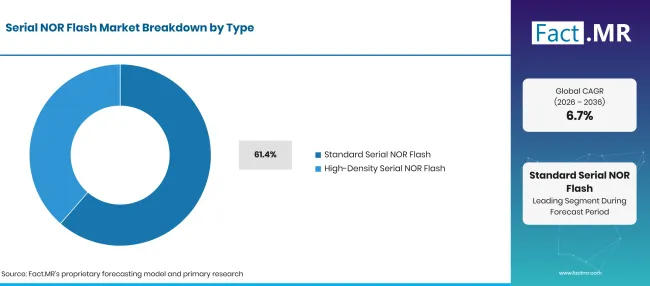
Factmr Serial Nor Flash Market Breakdown Type | Source: Fact.MR
| Type | Share (2026) |
|---|---|
| Standard Serial NOR Flash | 61.4% |
| High-Density Serial NOR Flash | 38.6% |
| Total | 100.0% |
Source: Fact.MR analysis. Updated Oct 22, 2026
The standard category covers devices through 64 Mb while high-density products begin at 128 Mb. Within either group the interface can change independently of capacity. GigaDevice's portfolio illustrates how several serial protocols and voltage choices can serve the same broad density range. A customer moving to quad access does not necessarily need a larger array. Sales teams should establish the code requirement first and then select the connection that meets the required access time. [3] For an established design the practical attraction of a standard part is the limited amount of work needed to retain it. A new purchase follows the approved hardware specification. Higher-density products need a clear reason to displace that position, such as a larger executable image or an additional recovery image.
What sustains consumer-electronics demand for serial NOR?
Consumer Electronics contributes 34.2% of market revenue in 2026 as portable and connected products retain dedicated code-storage requirements.
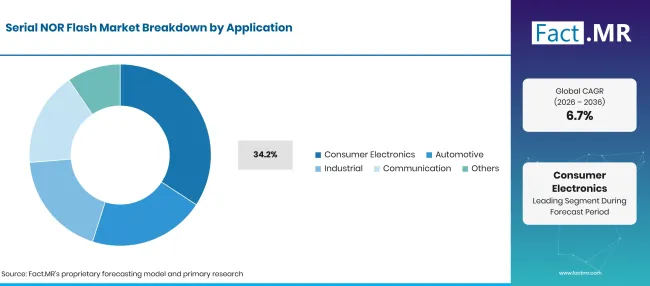
Factmr Serial Nor Flash Market Breakdown Application | Source: Fact.MR
| Application | Share (2026) |
|---|---|
| Consumer Electronics | 34.2% |
| Other segments combined | 65.8% |
| Total | 100.0% |
Source: Fact.MR analysis. Updated Oct 22, 2026
A consumer product has little room for unnecessary capacity or board area. XMC describes its serial NOR offer for portable electronics around low power and compact packaging. This puts component selection close to the battery and mechanical design. Automotive customers give greater weight to documented failure behaviour. Industrial equipment makers may instead value continued access to a qualified part. Those differing purchasing priorities allow specialist products to earn revenue alongside the large consumer-electronics base. [17] The attractive consumer account combines a repeatable hardware design with continued software support. A short burst of device demand can bring volume quickly. It offers less protection to the supplier when the next product generation can absorb code storage into another component or adopt a different memory arrangement.
Why does the 1Mb-16Mb range remain commercially important?
The 1Mb-16Mb density range holds 40.5% of 2026 revenue. Modest code and configuration requirements keep low-capacity products relevant.
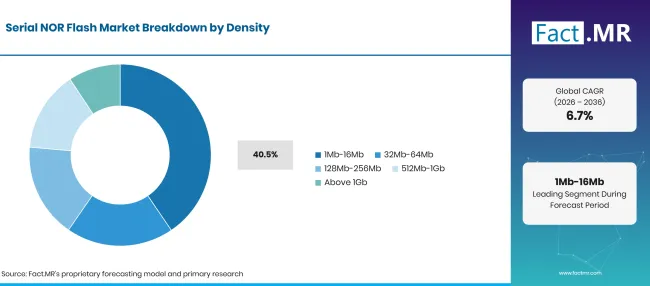
Factmr Serial Nor Flash Market Breakdown Density | Source: Fact.MR
| Density | Share (2026) |
|---|---|
| 1Mb-16Mb | 40.5% |
| Other segments combined | 59.5% |
| Total | 100.0% |
Source: Fact.MR analysis. Updated Oct 22, 2026
Microchip's in-production SST26VF040A is a 4 Mbit serial device with quad access and defined write protection. It shows why low capacity should not be equated with an obsolete interface. Small controllers can need quick access to a limited instruction set. Paying for a much larger array may add little value to that function. The relevant comparison includes the cost of integrating the memory and the behaviour required during a power interruption. [8] Higher-density purchasing becomes more attractive when a customer needs to retain several code images or larger executable content. Capacity units remain material to the decision: the density categories are expressed in megabits and gigabits. They should not be read as megabytes and gigabytes.
Why do OEM purchases outweigh the replacement business?
OEMs account for 82.3% of 2026 sales because serial NOR is normally selected during equipment design and ordered for original production.
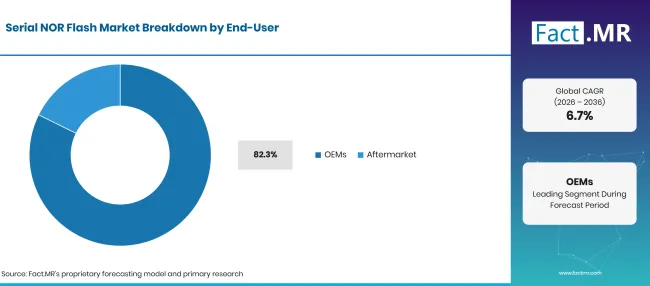
Factmr Serial Nor Flash Market Breakdown End User | Source: Fact.MR
| End-User | Share (2026) |
|---|---|
| OEMs | 82.3% |
| Aftermarket | 17.7% |
| Total | 100.0% |
Source: Fact.MR analysis. Updated Oct 22, 2026
An OEM design win links the memory vendor to a continuing production requirement. Replacement demand follows a different route because the purchased device must suit an existing board and its programmed content. ISSI's published memory support offer includes serial NOR across long-lived applications. That approach is commercially relevant where equipment support extends beyond the original production run. In this report aftermarket covers replacement components and service inventory, including supply for board repair rather than consumer upgrades. [6] The contract should therefore distinguish production demand from service stock. Keeping an approved device available can avoid a later redesign. Carrying too much inventory creates its own cost. The supplier and equipment maker need an agreed service horizon that fits the expected installed base. Segment shares are Fact.MR estimates. Other segments combined represent the balance of each category.
What is accelerating Serial NOR Flash Market adoption, and what is holding it back?
Two things can raise revenue in this market: more devices needing code storage and a greater value placed on the memory in each device. A secure recovery architecture may justify a more capable part even when the program is small. Higher densities are useful when firmware grows, but qualification costs and the availability of software support limit how quickly customers can switch. Price changes in commodity memory do not tell the whole story for components tied to long-life embedded designs.
Drivers Impact Analysis
| DRIVER | (~) % IMPACT ON CAGR | GEOGRAPHIC RELEVANCE | IMPACT TIMELINE |
|---|---|---|---|
| Protected firmware updates and recovery images | +1.4% | United States and European equipment markets | Medium term (2 to 4 years) |
| Larger executable code in automotive controllers | +1.1% | Germany, Japan and global vehicle programmes | Medium term (2 to 4 years) |
| Higher-throughput octal serial interfaces | +0.8% | Advanced embedded processing designs | Medium term (2 to 4 years) |
| Connected consumer-device code storage | +0.7% | Global electronics supply chains | Short term (up to 2 years) |
| Requalification of dependable secondary sources | +0.3% | Industrial and communications OEMs | Short term (up to 2 years) |
Source: Fact.MR analysis. Updated Oct 22, 2026
Opportunity Impact Analysis
| OPPORTUNITY | (~) % IMPACT ON CAGR | GEOGRAPHIC RELEVANCE | IMPACT TIMELINE |
|---|---|---|---|
| Authenticated access within serial flash devices | +0.9% | Security-sensitive embedded equipment | Long term (4 years or more) |
| Low-voltage memory matched to newer processors | +0.5% | Wearables and compact connected products | Medium term (2 to 4 years) |
| Qualified high-density recovery configurations | +0.8% | Automotive and industrial control | Medium term (2 to 4 years) |
| Committed service-stock and migration programmes | +0.2% | Long-lived equipment accounts | Long term (4 years or more) |
Source: Fact.MR analysis. Updated Oct 22, 2026
Restraints Impact Analysis
| RESTRAINT | (~) % IMPACT ON CAGR | GEOGRAPHIC RELEVANCE | IMPACT TIMELINE |
|---|---|---|---|
| Integration of code storage into alternative devices | -1.0% | Cost-sensitive embedded platforms | Long term (4 years or more) |
| Price erosion in interchangeable low-density parts | -0.9% | High-volume consumer electronics | Short term (up to 2 years) |
| Controller and firmware changes required for migration | -0.6% | Existing OEM designs | Medium term (2 to 4 years) |
| Slow conversion of qualification into production orders | -0.4% | Automotive and industrial equipment | Medium term (2 to 4 years) |
Source: Fact.MR analysis. Updated Oct 22, 2026
Which countries are scaling the Serial NOR Flash Market through 2036?
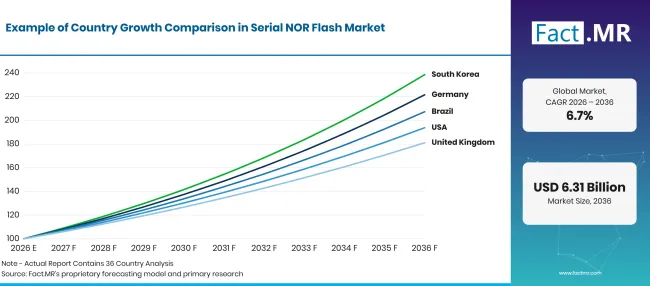
Factmr Serial Nor Flash Market Growth Index | Source: Fact.MR
| Country | CAGR (2026 to 2036) |
|---|---|
| Germany | 8.28% |
| Brazil | 7.56% |
| United States | 6.8% |
| United Kingdom | 6.12% |
| Japan | 5.40% |
Source: Fact.MR analysis. Updated Oct 22, 2026
Where can German equipment programmes justify more capable code storage?
8.28% CAGR. Firmware protection and documented fault handling support the higher-value opportunity.
German equipment manufacturers increasingly have to document how connected products remain secure through their service life. ENISA's February 2025 work addresses links between the Cyber Resilience Act and conformity assessment. [2] This does not mandate serial NOR, but it gives firmware teams a reason to explain how their devices store and recover trusted code.
Germany's Serial NOR Flash Market is forecast to grow 7.98% annually. Component suppliers with clear protection, recovery and support documentation are well placed for industrial design reviews. A generic cybersecurity slogan is less helpful than a working demonstration of how a controller recovers after an interrupted update.
How does telecom conformity shape Brazil's purchasing route?
7.56% CAGR. Approved equipment configurations give memory suppliers a specific route to repeat orders.
Brazil's Anatel 2025–2029 telecommunications plan discusses cybersecurity activities in product conformity assessment, including firmware and stored-file analysis. [1] That makes the approved hardware-software combination important. Substituting memory in a production device may require more validation than the price difference suggests.
Brazil's projected 7.56% CAGR will be earned through equipment makers and their manufacturing partners. A serial NOR distributor needs reliable part traceability and access to the approved device revision. Growth in telecom connections is only context; it is not a count of additional memory chips.
Why does recovery planning matter to U.S. embedded-memory customers?
6.8% CAGR. Avoiding equipment disruption raises the value of a dependable update architecture.
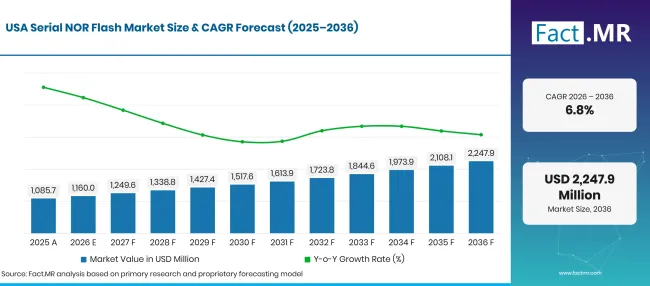
Factmr Serial Nor Flash Market Forecast Usa | Source: Fact.MR
NIST's 2025 control-catalog revisions give U.S. equipment teams reasons to examine software integrity and system recovery after failed deployments. [11] Serial NOR suppliers can support that work with documented protection functions and a clear boot or recovery sequence, provided those features match the host controller.
The U.S. market is forecast to grow at 6.84%. Where equipment is expensive to service, validating a dependable flash component can be worth far more than the chip's purchase price. The opportunity depends on actual embedded designs, not a direct relationship between cloud investment and NOR-chip shipments.
What does a published update period change for UK device suppliers?
6.12% CAGR. Support commitments make the future firmware requirement part of the initial product decision.
UK guidance updated in March 2025 requires manufacturers of covered connected products to publish minimum security-update periods. [12] Such commitments bring future firmware size and support needs into today's component decision. The regulation does not set one universal period or require manufacturers to use NOR flash.
UK demand is projected to rise 6.12% annually. Suppliers can earn business by explaining capacity headroom, qualified replacements and how long a part can be supplied. These details help a device maker avoid promising support that its hardware will later struggle to deliver.
How is Japan making connected-product security visible to buyers?
5.40% CAGR. Security labelling strengthens the case for documented component choices.
Japan's IPA began issuing JC-STAR one-star conformity labels in May 2025. Its first announcement covered 26 applications from 11 companies and 477 product model numbers. [5] The label applies to connected products rather than individual flash devices, but it gives their manufacturers another reason to document component-level security choices.
Japan's 5.40% growth forecast is supported by equipment programmes that take security and maintenance seriously. The decisive question for a NOR supplier is what its memory contributes to the approved product and how reliably that specification can be maintained. JC-STAR label counts are not shipment figures for flash chips.
Who leads the Serial NOR Flash Market?
Competition has room for both manufacturing scale and specialised firmware functions. Winbond's 2025 annual report describes expansion of its NOR portfolio using 45 nm process technology. The purchasing value of process development lies in the resulting device offer and dependable supply. It should be judged against the customer's approved specification. [16]
Macronix introduced ArmorBoot MX76 in August 2025 with authentication and secure-update features. The announcement stated that sampling had begun and production was scheduled later that year. Its commercial pitch is closely tied to the boot function. Infineon's secure NOR capabilities are also documented in NIST's algorithm register. These offers illustrate differentiation through particular security functions rather than a general increase in storage capacity. [7] [10]
The wider supplier base serves different density and voltage requirements. Puya publishes serial NOR ranges for industrial and automotive applications. Renesas and Microchip retain identifiable serial-flash product families. Buyers should compare the exact device and its supported life rather than treating corporate portfolio breadth as proof of interchangeability. A qualified alternative that is easy to maintain can win business even when its headline specifications are similar. [13] [14] [8]
Which companies are the key providers?
- Winbond Electronics Corporation
- Macronix International Co., Ltd.
- GigaDevice Semiconductor Inc.
- Infineon Technologies AG
- Micron Technology Inc.
- Microchip Technology Inc.
- Renesas Electronics Corporation
- Integrated Silicon Solution Inc.
- Puya Semiconductor
- XMC (Wuhan Xinxin Semiconductor)
Bibliography
- [1] Agência Nacional de Telecomunicações. (2026). Structural Plan for Telecommunications Networks 2025-2029 (PERT) [English edition].
- [2] European Union Agency for Cybersecurity. (2025, February 26). Cyber Resilience Act implementation via EUCC and its applicable technical elements.
- [3] GigaDevice Semiconductor Inc. (n.d.). SPI NOR flash [Product portfolio].
- [4] Infineon Technologies AG. (2025, August 7). S28HS512T, S28HS01GT, S28HL512T, S28HL01GT: 512 Mb/1 Gb SEMPER flash, octal interface [Datasheet].
- [5] Information-technology Promotion Agency. (2025, May 21). JC-STAR begins issuing STAR-1 conformance labels [Press release in Japanese].
- [6] Integrated Silicon Solution, Inc. (2026, May 20). Long-term support memory solutions.
- [7] Macronix International Co., Ltd. (2025, August 6). Macronix introduces cutting-edge secure-boot NOR flash memory.
- [8] Microchip Technology Inc. (n.d.). SST26VF040A [Product record].
- [9] Micron Technology, Inc. (2025). Form 10-K for the fiscal year ended August 28, 2025. U.S. Securities and Exchange Commission.
- [10] National Institute of Standards and Technology. (2024). SEMPER Secure NOR Flash: Cryptographic Algorithm Validation Program record A5155.
- [11] National Institute of Standards and Technology. (2025, August 27). NIST revises security and privacy control catalog to improve software update and patch releases.
- [12] Office for Product Safety and Standards. (2025, March 17). Regulations: Consumer connectable product security. UK Government.
- [13] Puya Semiconductor (Shanghai) Co., Ltd. (n.d.). SPI NOR flash [Product portfolio].
- [14] Renesas Electronics Corporation. (n.d.). Product selector: Non-volatile memory.
- [15] The Linux Kernel Development Community. (n.d.). SPI NOR framework. The Linux Kernel documentation.
- [16] Winbond Electronics Corporation. (2026). 2025 annual report.
- [17] Wuhan Xinxin Semiconductor Manufacturing Co., Ltd. (n.d.). Consumer electronics: SPI NOR flash applications.
This Report Answers
- When does a larger firmware image justify high-density serial NOR?
- How do host interfaces limit the value of a faster memory device?
- Which security capabilities help suppliers qualify for demanding equipment designs?
- What keeps the 1Mb-16Mb range relevant to modern electronics?
- How do original production orders differ from aftermarket service demand?
- Where do national product-security requirements affect the customer conversation?
What does the Serial NOR Flash Market cover?
The report assesses Serial NOR Flash Market revenue from 2026 to 2036 across product type and density. Application and end-user views describe the same component sales. Country forecasts cover Germany and Brazil together with the United States and United Kingdom. Japan completes the five-country comparison.
What is included in the scope?
Revenue includes discrete serial NOR devices supplied for original equipment and qualified replacement use. Standard and high-density products are counted once. Embedded code storage and small persistent-data functions remain within scope where the purchased component is serial NOR flash.
What is excluded from the scope?
Parallel NOR and all NAND technologies are excluded. Finished equipment and software services do not form part of component revenue. Embedded flash that is inseparable from a microcontroller is outside scope. Firmware updates themselves and the value of complete replacement boards are not counted as serial NOR sales.
How Was the Analysis Built?
The analysis draws on 120+ sources, 35+ company portfolios, 25+ countries, and more than 20 industry interviews.
- Primary Research: Primary research includes discussions with manufacturers, service providers, technology developers, distributors, end users, and subject-matter experts. These conversations examine purchasing priorities, product adoption, operational challenges, approval requirements, competitive positioning, and the factors that influence wider market acceptance.
- Desk Research: Desk research covers government statistics, regulatory publications, company filings, trade data, technical studies, industry associations, standards, public policy, and other authoritative sources. Every source used in the analysis is documented in the bibliography.
- Market Sizing and Forecasting: Market estimates combine historical performance, demand indicators, pricing and volume trends, segment shares, company participation, country-level growth, adoption patterns, investment activity, and barriers to market expansion.
- Data Validation and Update Cycle: Findings are validated by comparing primary interviews with public data, company activity, regulatory changes, trade patterns, and industry developments. Regular updates review new product launches, capacity changes, partnerships, approvals, and shifts in commercial adoption.
Segmentation
What is the report’s scope and coverage?
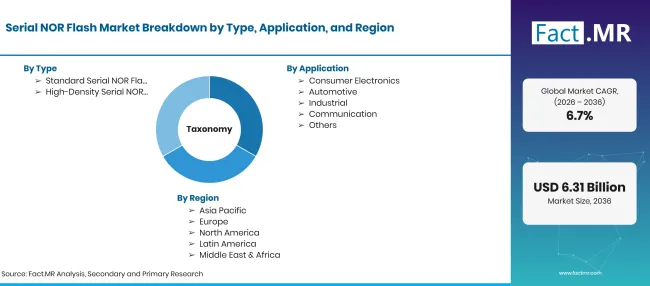
Factmr Serial Nor Flash Market Taxonomy | Source: Fact.MR
| Attribute | Details |
|---|---|
| Quantitative Units | USD billion in 2025, 2026 and 2036; CAGR for 2026 to 2036 |
| Market Definition | Discrete serial NOR flash components used to store executable code and limited persistent data in the listed applications. Standard products cover devices through 64 Mb and high-density products begin at 128 Mb. Parallel NOR and NAND are excluded. |
| Type | Standard Serial NOR Flash; High-Density Serial NOR Flash |
| Application | Consumer Electronics; Automotive; Industrial; Communication; Others |
| Density | 1Mb-16Mb; 32Mb-64Mb; 128Mb-256Mb; 512Mb-1Gb; Above 1Gb |
| End-User | OEMs; Aftermarket |
| Regions Covered | North America; Latin America; Western Europe; Eastern Europe; East Asia; South Asia & Pacific; Middle East & Africa |
| Countries Covered | Germany; Brazil; United States; United Kingdom; Japan |
| Companies Profiled | Winbond Electronics Corporation; Macronix International Co., Ltd.; GigaDevice Semiconductor Inc.; Infineon Technologies AG; Micron Technology Inc.; Microchip Technology Inc.; Renesas Electronics Corporation; Integrated Silicon Solution Inc.; Puya Semiconductor; XMC (Wuhan Xinxin Semiconductor) |
| Forecast Period | 2026 to 2036 |
| Approach | Assessment of firmware access requirements and recovery designs alongside interface support, qualification obligations and serial-memory supplier portfolios. |
Source: Fact.MR analysis. Updated Oct 22, 2026
How is the market segmented?
-
By Type
- Standard Serial NOR Flash
- High-Density Serial NOR Flash
-
By Application
- Consumer Electronics
- Automotive
- Industrial
- Communication
- Others
-
By Density
- 1Mb-16Mb
- 32Mb-64Mb
- 128Mb-256Mb
- 512Mb-1Gb
- Above 1Gb
-
By End-User
- OEMs
- Aftermarket
-
By Region
- North America
- Latin America
- Western Europe
- Eastern Europe
- East Asia
- South Asia & Pacific
- Middle East & Africa
Frequently Asked Questions
How big is the Serial NOR Flash Market in 2026?
What is the forecast CAGR?
Which product type leads the market?
Why does a device use NOR alongside NAND?
Which country has the fastest forecast growth?
Who worked on this report


Preview the report firsthand - request a free sample
Free SampleGet the brochure for pricing and purchase details
Download PDF