Fall Protection Market (2026 - 2036)

Fall Protection Market is segmented by Type (Soft Goods, Hard Goods, and Others), End Use (Construction, Manufacturing, Oil and Gas, Chemicals, Food, Pharmaceuticals, Healthcare, Transportation, Mining, and Others), and Region. Forecast for 2026 to 2036.

Core Findings

    Fall Protection Market Forecast and Outlook By Fact.MR

    In 2025, the fall protection market was valued at USD 3.5 billion. Based on Future Market Insights' analysis, demand for fall protection equipment is estimated to grow to USD 3.7 billion in 2026 and USD 7.3 billion by 2036. FMI projects a CAGR of 7.0% during the forecast period.

    Between 2026 and 2036, the market is projected to create an absolute dollar opportunity of USD 3.6 billion. This represents a near-doubling of market value, reflecting both enforcement-driven replacement demand across construction and industrial sectors and premium technology adoption in North America and Europe. Structural constraints include inconsistent enforcement of fall protection mandates in price-sensitive developing markets and the relatively long replacement cycles of hard goods categories.

    Steve Blanco, President and CEO of MSA Safety "We’re not the low cost, but we are typically the best when it comes to cost of ownership over the long term... As we advance our Accelerate strategy to drive profitable growth, we expect to continue to deliver annual free cash flow conversion in the 90 to 100% range."

    Country growth reflects construction sector expansion, occupational safety regulation enforcement, and industrial infrastructure investment. China leads at 8.0% CAGR, driven by large-scale infrastructure project pipelines and tightening enforcement of GB safety standards on construction sites. India follows at 7.8%, supported by the rapid expansion of organised construction under the National Infrastructure Pipeline and growing OSHA-equivalent enforcement by the Ministry of Labour. Germany posts 7.4% as EU OSHA directives and industry 4.0 construction safety programmes drive premium connected harness adoption. Brazil registers 7.0% tied to expanding infrastructure investment under the PAC programme and NR-35 regulatory enforcement at height work operations. The United States grows at 6.8%, the most mature market, sustained by OSHA enforcement consistency and premium smart safety equipment adoption.
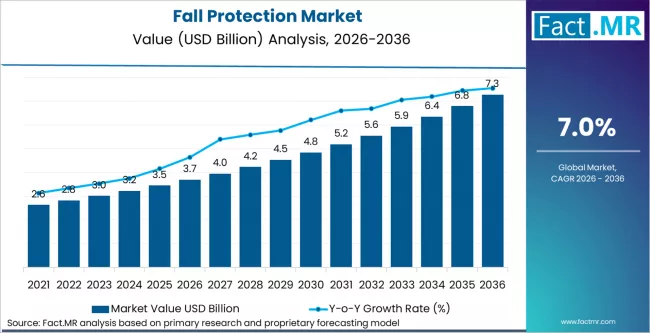
    Fall Protection Market Market Value Analysis

    Metric Value
    Estimated Value in 2026 USD 3.7 billion
    Forecast Value in 2036 USD 7.3 billion
    Forecast CAGR (2026 to 2036) 7.0%

    Market Definition

    The fall protection market includes personal protective equipment and engineered systems used to prevent or arrest falls from height in construction, industrial, and commercial workplaces.

    Market Inclusions

    Includes global and regional revenue forecasts from 2026 to 2036 by type and end use across construction, manufacturing, oil and gas, chemicals, food, pharmaceuticals, healthcare, transportation, mining, and others.

    Market Exclusions

    Excludes permanent building guardrails, general PPE without fall arrest function, safety training services, inspection services, and recreational climbing equipment.

    Research Methodology

    • Primary Research: Interviews with safety equipment distributors, construction safety managers, HSE directors, PPE procurement officers, installers, and regulatory officials across North America, Europe, and Asia Pacific.
    • Desk Research: Sources include OSHA data, EU OSHA publications, labour ministry regulations, OEM reports, construction output data, and safety standard updates from 2024-2025.
    • Market Sizing and Forecasting: A hybrid top-down and bottom-up model using workforce-at-height estimates, equipment adoption rates, pricing data, and product replacement cycles.
    • Data Validation and Update Cycle: Results validated using OEM revenues, distributor sales data, OSHA citation statistics, and construction workforce data with annual forecast updates.

    Summary

    • Market Definition
      • Fall protection equipment includes harnesses, lanyards, lifelines, anchors, and guardrail systems used to protect workers operating at height.
    • Demand Drivers
      • OSHA fall protection violations remain the most cited workplace safety issue in the U.S., sustaining compliance-driven equipment demand.
      • Infrastructure expansion in China and India is increasing first-time adoption of fall protection equipment in construction projects.
      • Smart harness systems with IoT fall detection and worker tracking are creating a premium product segment in developed markets.
    • Key Segments Analyzed
      • By Type: Soft goods hold about 60% share in 2026 due to essential system use and recurring replacement demand.
      • By End Use: Construction leads with around 37% share in 2026 due to high at-height work activity and strict safety regulations.
      • By Geography: China records the fastest growth, while North America leads revenue due to premium equipment adoption.
    • Analyst Opinion at FACT.MR
      • Shambhu Nath Jha, Principal Consultant at Fact.MR, states that CXOs will find the market’s 7.0% CAGR through 2036 supported by regulatory enforcement, infrastructure investment, and connected safety technology adoption.
    • Strategic Implications
      • Manufacturers should invest in IoT-enabled smart harness systems and subscription-based safety monitoring platforms.
      • Distributors in China and India should offer compliance audit and certification support along with equipment supply.
      • Companies should develop lightweight ergonomic soft goods suited for long-duration use in hot climate construction markets.
    • Methodology
      • Market sizing used at-height workforce estimates and equipment spending per worker validated with OEM revenue data.
      • OSHA statistics, EU safety directives, and national safety regulations from 2024-2025 supported compliance demand analysis.
      • Forecasts incorporated construction output, workforce data, adoption surveys, and interviews with HSE managers and installers.

    Segmental Analysis

    Fall Protection Market Analysis by Type
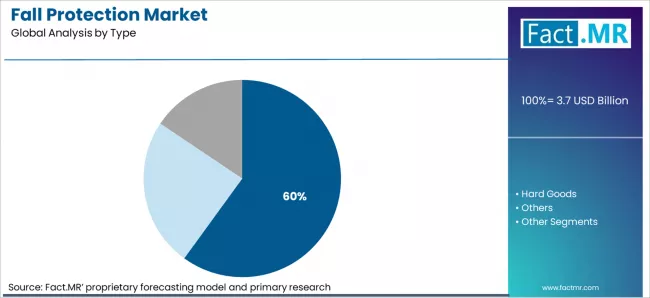
    Fall Protection Market Analysis By Type

    Based on FACT.MR analysis, soft goods are expected to hold around 60% share in 2026 due to their essential role in fall arrest systems and mandatory replacement requirements.

    • MSA Safety Connected Harness Platform: In 2025, MSA Safety integrated fall detection sensors and worker monitoring connectivity into its V-GARD H1 harness platform. [4]
    • 3M Fall Protection Smart Lanyard Development: In 2024, 3M launched the DBI-SALA Smart Lanyard featuring shock-load indicators and digital inspection tracking. [5]
    • Soft Goods Replacement Cycle Demand Trend: Distributor data from 2024 showed fall protection soft goods among the fastest-moving safety equipment categories due to replacement demand from contractors. [6]

    Fall Protection Market Analysis by End Use
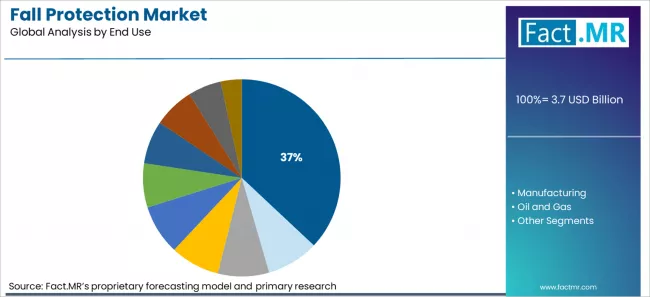
    Fall Protection Market Analysis By End Use

    Based on FACT.MR analysis, construction is projected to hold about 37% share in 2026 because of the sector’s high exposure to at-height work and strict safety regulations.

    • FallTech Construction Sector Investment: In 2025, FallTech expanded its construction harness and anchor systems designed for OSHA 1926.502 compliance. [7]
    • Petzl Industrial Sector Technology: In 2024, Petzl launched an updated VERTEX VENT industrial harness with improved ergonomics for long-duration industrial use. [8]
    • Mining and Oil and Gas Harness Adoption Trend: Honeywell reported strong growth in fall protection equipment orders from mining and oil and gas sectors driven by HSE upgrades and ISO 45001 compliance. [9]

    Drivers, Restraints, and Opportunities

    FACT.MR analysts observe that the fall protection market has evolved from a compliance-driven PPE segment into a core workplace safety infrastructure category. Growth is supported by strict regulatory enforcement creating recurring replacement demand, along with expanding construction activity in emerging economies generating first-time equipment adoption.

    The market shows a divide between high-volume soft goods and premium connected safety technologies. Traditional harnesses and lanyards face price pressure from low-cost manufacturers, while IoT-enabled smart harness systems command higher prices and introduce recurring monitoring service revenue.

    • OSHA and EU OSHA Enforcement Compliance Pressure: OSHA cited fall protection violations over 7,000 times in FY2024, keeping it the most cited workplace safety standard. EU OSHA campaigns in 2024 also increased inspections across construction sites, strengthening equipment compliance demand. [1]
    • China GB Safety Standard Enforcement Tightening: Updated Chinese construction safety supervision rules in 2024 require certified fall protection systems for buildings above two storeys, increasing procurement among major construction firms. [2]
    • Smart Connected Harness Technology Emergence: MSA Safety expanded its Connected Worker platform in 2025 with real-time fall detection and monitoring features, while Honeywell also expanded connected safety wearables adoption in industrial sectors. [3]

    Regional Analysis

    The fall protection market is analysed across Asia Pacific, Europe, North America, Latin America, and Middle East and Africa, covering 40-plus countries with distinct demand profiles shaped by construction sector activity, occupational safety regulation enforcement intensity, at-height workforce scale, and smart safety technology adoption. The full report offers market attractiveness analysis based on regulatory enforcement timelines and construction investment pipelines.
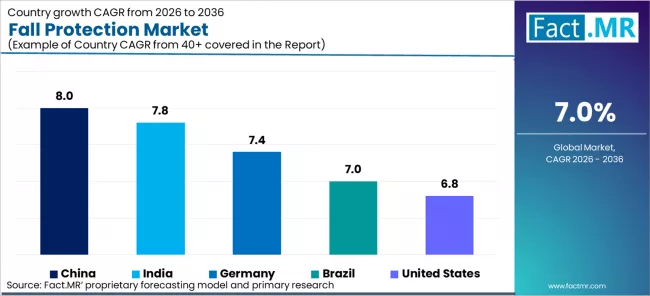
    Fall Protection Market Cagr Analysis By Country

    Country CAGR (2026-2036)
    China 8.0%
    India 7.8%
    Germany 7.4%
    Brazil 7.0%
    United States 6.8%

    Source: Fact.MR (FACT.MR) analysis, based on proprietary forecasting model and primary research

    Asia Pacific Fall Protection Market Analysis
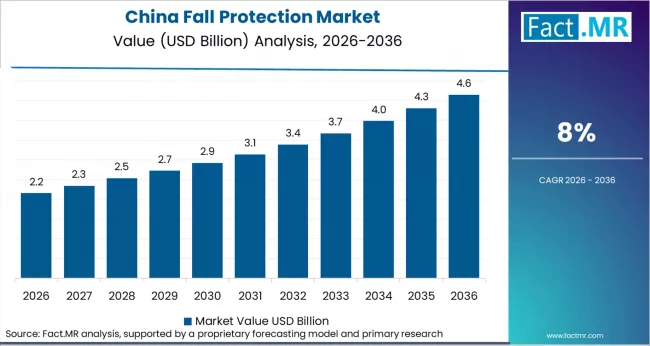
    Fall Protection Market Country Value Analysis

    Asia Pacific is the fastest-growing region for fall protection equipment due to large construction activity in China and India and stronger safety regulation enforcement. Global OEMs lead premium equipment supply while regional manufacturers compete in mid-range segments.

    • China: Demand for fall protection equipment in China is projected to grow at about 8.0% CAGR through 2036. Tightened GB safety standards and rising construction inspections are increasing procurement of certified harness and safety systems across large infrastructure projects.
    • India: Demand for fall protection equipment in India is expected to expand at nearly 7.8% CAGR through 2036. Expanding infrastructure projects and updated work-at-height safety rules are driving first-time safety equipment adoption among contractors.

    FACT.MR's Asia Pacific analysis of the fall protection market covers China, Japan, South Korea, India, Australia and New Zealand, ASEAN, and Rest of Asia Pacific. Readers can find country CAGR forecasts, construction safety regulation timelines, at-height workforce data, and OEM competitive positioning.

    Europe Fall Protection Market Analysis

    Europe represents a mature and highly regulated fall protection market supported by strict workplace safety standards and consistent compliance enforcement.

    • Germany: Demand for fall protection equipment in Germany is forecast to grow at around 7.4% CAGR through 2036. Updated DGUV safety rules and expanding wind energy installation projects are driving demand for certified harness and anchor systems.

    FACT.MR's European analysis of the fall protection market covers Germany, France, the United Kingdom, Italy, Spain, the Netherlands, the Nordics, and Rest of Europe. Readers can find EU OSHA directive impact analysis, EN ISO standard updates, smart safety adoption data, and country growth forecasts.

    North America Fall Protection Market Analysis

    North America remains the largest revenue market due to strict OSHA enforcement, a large construction workforce, and growing adoption of connected safety technology.

    • United States: Demand for fall protection equipment in the United States is projected to rise at about 6.8% CAGR through 2036. Continuous OSHA enforcement and strong adoption of smart safety harness systems are sustaining equipment replacement demand.

    FACT.MR's North American analysis of the fall protection market covers the United States, Canada, and Mexico. Readers can find OSHA enforcement impact data, technology adoption trends, construction demand timelines, and country forecasts by product type.

    Latin America Fall Protection Market Analysis

    Latin America is an emerging fall protection market driven by infrastructure investment and strengthening occupational safety regulations.

    • Brazil: Demand for fall protection equipment in Brazil is projected to grow at approximately 7.0% CAGR through 2036. NR-35 regulation enforcement and large infrastructure programmes are increasing procurement of certified fall protection systems.

    FACT.MR's Latin American analysis of the fall protection market covers Brazil, Chile, Ecuador, and Rest of Latin America. Readers can find NR-35 regulation impact data, infrastructure workforce safety investment trends, and country-level forecasts by type and end use.

    Competitive Aligners for Market Players
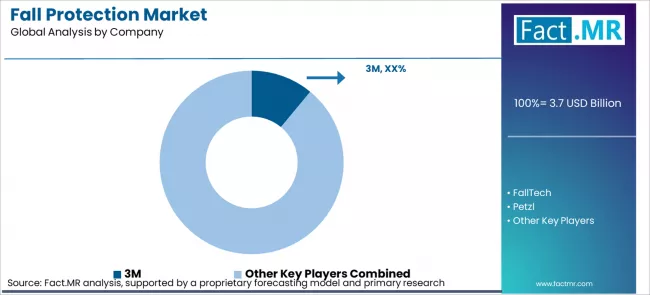
    Fall Protection Market Analysis By Company

    The global fall protection market is moderately concentrated in the premium safety equipment tier and highly fragmented in the mid-range and economy segments. MSA Safety, 3M, Honeywell International, and Petzl hold the largest global positions by revenue across harness, lifeline, and anchor system categories. Their strength comes from broad product portfolios covering every application from general construction to specialised oil and gas and utilities maintenance, strong safety distributor networks, and increasingly from connected safety platform offerings that create longer-term customer relationships beyond single equipment transactions.

    Chinese OEMs including local harness manufacturers are expanding competitively in the mid-range construction segment in Asia, Africa, and Latin America by offering certified products at lower cost. Technology differentiation through IoT-enabled fall detection, worker monitoring, and digital inspection platforms represents the primary competitive lever in premium segments where MSA Safety and Honeywell are building safety-as-a-service revenue streams beyond hardware. Werner Co. and Guardian Fall compete effectively in the North American construction market through jobsite-oriented anchor and horizontal lifeline system specialisation.

    Large construction and industrial customers manage supplier dependency by maintaining approved vendor lists with two to three competing fall protection equipment suppliers per category, which limits single-supplier pricing power in commodity soft goods. However, connected safety platform customers show higher switching costs once workers and safety managers are trained on specific monitoring ecosystems, creating a structural advantage for first-mover platform providers at large job sites and enterprise HSE programmes.

    Key Players

    • 3M
    • FallTech
    • Petzl
    • SKYLOTEC
    • Werner Co.
    • Guardian Fall
    • MSA Safety
    • Honeywell International
    • W.W. Grainger Inc.
    • Gravitec Systems Inc.

    Fall Protection Market by Segments

    By Type:

    • Soft Goods
    • Hard Goods
    • Others

    By End Use:

    • Construction
    • Manufacturing
    • Oil and Gas
    • Chemicals
    • Food
    • Pharmaceuticals
    • Healthcare
    • Transportation
    • Mining
    • Others

    By Region:

    • North America
      • United States
      • Canada
      • Mexico
    • Latin America
      • Brazil
      • Chile
      • Ecuador
      • Rest of Latin America
    • Western Europe
      • Germany
      • United Kingdom
      • France
      • Italy
      • Spain
      • Nordic
      • BENELUX
      • Rest of Western Europe
    • Eastern Europe
      • Russia
      • Poland
      • Hungary
      • Balkan and Baltic
      • Rest of Eastern Europe
    • East Asia
      • China
      • Japan
      • South Korea
    • South Asia and Pacific
      • India
      • ASEAN
      • Australia and New Zealand
      • Rest of South Asia and Pacific
    • Middle East and Africa
      • Kingdom of Saudi Arabia
      • Other GCC Countries
      • Turkey
      • South Africa
      • Other African Union
      • Rest of Middle East and Africa

    Scope of Report

    Quantitative Units USD 3.7 billion (2026) to USD 7.3 billion (2036), at a CAGR of 7.0%
    Market Definition Personal fall arrest systems and engineered fall prevention equipment including harnesses, lanyards, SRLs, anchors, lifelines, and guardrail systems protecting at-height workers across construction, industrial, and commercial sectors.
    Type Segmentation Soft Goods (60%), Hard Goods, Others
    End Use Segmentation Construction (37%), Manufacturing, Oil and Gas, Chemicals, Food, Pharmaceuticals, Healthcare, Transportation, Mining, Others
    Application Coverage Personal fall arrest, work positioning, rope access, horizontal lifeline systems, leading edge protection, tower climbing, and confined space at-height operations.
    Regions Covered Asia Pacific, Europe, North America, Latin America, Middle East and Africa
    Countries Covered China, Japan, South Korea, India, Australia and New Zealand, ASEAN, Rest of South Asia and Pacific, Germany, UK, France, Italy, Spain, Nordic, BENELUX, Rest of Western Europe, Russia, Poland, Hungary, Balkan and Baltic, USA, Canada, Mexico, Brazil, Chile, Ecuador, Rest of Latin America, Saudi Arabia, GCC, Turkey, South Africa, Rest of MEA
    Key Companies Profiled 3M, FallTech, Petzl, SKYLOTEC, Werner Co., Guardian Fall, MSA Safety, Honeywell International, W.W. Grainger Inc., Gravitec Systems Inc.
    Forecast Period 2026 to 2036
    Approach Hybrid top-down and bottom-up model using at-height workforce estimates, equipment adoption rates, average unit prices by type, replacement cycles, and primary interviews with safety managers, distributors, and OEM executives.

    Bibliography

    • [1] U.S. Occupational Safety and Health Administration. (2024). Top 10 Most Cited Standards FY2024: Fall Protection General Requirements Remain Number One Citation. OSHA Enforcement Data. October 2024. osha.gov
    • [2] Ministry of Housing and Urban-Rural Development, People's Republic of China. (2024). Updated Construction Site Safety Supervision Guidelines: GB 5725 Fall Protection Standard Enforcement Requirements. MOHURD Publications. August 2024. mohurd.gov.cn
    • [3] MSA Safety Incorporated. (2025). Press Release: Connected Worker Platform Expansion with Fall Detection and Worker Monitoring Integration in V-GARD H1 Harness System. February 2025. msasafety.com
    • [4] MSA Safety Incorporated. (2025). Annual Report 2024: Connected Worker Fall Protection Platform Adoption Growth in Construction and Oil and Gas Sectors. March 2025. msasafety.com
    • [5] 3M Company. (2024). Product Launch Release: DBI-SALA Smart Lanyard Series with Embedded Shock-Load Indicators and Digital Inspection Tracking. October 2024. 3m.com
    • [6] W.W. Grainger Inc. (2024). Q3 2024 Earnings Call Transcript: Safety Products Category Performance and Fall Protection Velocity Commentary. October 2024. investor.grainger.com
    • [7] FallTech. (2025). Product Catalogue Update: New Tower Climbing Harness Configurations and Jobsite Anchor Systems for OSHA 1926.502 Compliance. January 2025. falltech.com
    • [8] Petzl. (2024). Product Launch: VERTEX VENT Industrial Harness with Ergonomic Design and Quick-Connect Lifeline Compatibility for Oil and Gas and Utilities Applications. June 2024. petzl.com

    This Report Addresses

    • Strategic intelligence on OSHA and EU OSHA enforcement-driven replacement demand, smart connected harness technology adoption, construction sector expansion in China and India, and infrastructure-linked fall protection procurement in Brazil and Germany.
    • Market forecast from USD 3.7 billion in 2026 to USD 7.3 billion by 2036 at 7.0% CAGR, segmented by type, end use, and region.
    • Growth opportunity mapping across China GB standard enforcement, India NIP construction workforce safety, Brazil NR-35 regulation compliance, and North America connected safety platform adoption.
    • Country CAGR outlook for China 8.0%, India 7.8%, Germany 7.4%, Brazil 7.0%, and United States 6.8%, with key safety regulation and construction sector demand drivers per country.
    • Competitive analysis of MSA Safety, 3M, Honeywell, Petzl, SKYLOTEC, and FallTech covering product portfolios, technology capabilities, distribution networks, and connected safety platform positioning.
    • Technology tracking including IoT-enabled fall detection harnesses, smart lanyard inspection platforms, connected worker monitoring systems, and lightweight composite anchor technologies.
    • Regulatory analysis covering OSHA 1926 subpart M, EU OSHA Work at Height Directive, China GB 5725 standard, India Construction Safety Rules, Brazil NR-35, and Germany DGUV Regel 101-004 update.
    • Report delivered in PDF, Excel datasets, PowerPoint summary, and dashboard formats supported by OSHA records, OEM disclosures, and primary research interviews.

    Table of Content

    1. Executive Summary
      • Global Market Outlook
      • Demand to side Trends
      • Supply to side Trends
      • Technology Roadmap Analysis
      • Analysis and Recommendations
    2. Market Overview
      • Market Coverage / Taxonomy
      • Market Definition / Scope / Limitations
    3. Research Methodology
      • Chapter Orientation
      • Analytical Lens and Working Hypotheses
        • Market Structure, Signals, and Trend Drivers
        • Company Annual and Sustainability Reports
        • Peer-reviewed Journals and Academic Literature
        • Corporate Websites, Product Literature, and Technical Notes
        • Earnings Decks and Investor Briefings
        • Statutory Filings and Regulatory Disclosures
        • Technical White Papers and Standards Notes
        • Trade Journals, Industry Magazines, and Analyst Briefs
        • Conference Proceedings, Webinars, and Seminar Materials
        • Government Statistics Portals and Public Data Releases
        • Press Releases and Reputable Media Coverage
        • Specialist Newsletters and Curated Briefings
        • Sector Databases and Reference Repositories
        • FMR Internal Proprietary Databases and Historical Market Datasets
        • Subscription Datasets and Paid Sources
        • Social Channels, Communities, and Digital Listening Inputs
        • Additional Desk Sources
      • Expert Input and Fieldwork (Primary Evidence)
        • Primary Modes
          • Qualitative Interviews and Expert Elicitation
          • Quantitative Surveys and Structured Data Capture
          • Blended Approach
        • Why Primary Evidence is Used
        • Field Techniques
          • Interviews
          • Surveys
          • Focus Groups
          • Observational and In-context Research
          • Social and Community Interactions
        • Stakeholder Universe Engaged
          • C-suite Leaders
          • Board Members
          • Presidents and Vice Presidents
          • R&D and Innovation Heads
          • Technical Specialists
          • Domain Subject-matter Experts
          • Scientists
          • Physicians and Other Healthcare Professionals
        • Governance, Ethics, and Data Stewardship
          • Research Ethics
          • Data Integrity and Handling
      • Tooling, Models, and Reference Databases
    4. Data Engineering and Model Build
      • Data Acquisition and Ingestion
      • Cleaning, Normalisation, and Verification
      • Synthesis, Triangulation, and Analysis
    5. Quality Assurance and Audit Trail
    6. Market Background
      • Market Dynamics
        • Drivers
        • Restraints
        • Opportunity
        • Trends
      • Scenario Forecast
        • Demand in Optimistic Scenario
        • Demand in Likely Scenario
        • Demand in Conservative Scenario
      • Opportunity Map Analysis
      • Product Life Cycle Analysis
      • Supply Chain Analysis
      • Investment Feasibility Matrix
      • Value Chain Analysis
      • PESTLE and Porter’s Analysis
      • Regulatory Landscape
      • Regional Parent Market Outlook
      • Production and Consumption Statistics
      • Import and Export Statistics
    7. Global Market Analysis 2021 to 2025 and Forecast, 2026 to 2036
      • Historical Market Size Value (USD Million) Analysis, 2021 to 2025
      • Current and Future Market Size Value (USD Million) Projections, 2026 to 2036
        • Y to o to Y Growth Trend Analysis
        • Absolute $ Opportunity Analysis
    8. Global Market Pricing Analysis 2021 to 2025 and Forecast 2026 to 2036
    9. Global Market Analysis 2021 to 2025 and Forecast 2026 to 2036, By Type
      • Introduction / Key Findings
      • Historical Market Size Value (USD Million) Analysis By Type , 2021 to 2025
      • Current and Future Market Size Value (USD Million) Analysis and Forecast By Type , 2026 to 2036
        • Soft Goods
        • Hard Goods
        • Others
      • Y to o to Y Growth Trend Analysis By Type , 2021 to 2025
      • Absolute $ Opportunity Analysis By Type , 2026 to 2036
    10. Global Market Analysis 2021 to 2025 and Forecast 2026 to 2036, By End Use
      • Introduction / Key Findings
      • Historical Market Size Value (USD Million) Analysis By End Use, 2021 to 2025
      • Current and Future Market Size Value (USD Million) Analysis and Forecast By End Use, 2026 to 2036
        • Construction
        • Manufacturing
        • Oil and Gas
        • Chemicals
        • Food
        • Pharmaceuticals
        • Healthcare
        • Transportation
        • Mining
        • Others
      • Y to o to Y Growth Trend Analysis By End Use, 2021 to 2025
      • Absolute $ Opportunity Analysis By End Use, 2026 to 2036
    11. Global Market Analysis 2021 to 2025 and Forecast 2026 to 2036, By Region
      • Introduction
      • Historical Market Size Value (USD Million) Analysis By Region, 2021 to 2025
      • Current Market Size Value (USD Million) Analysis and Forecast By Region, 2026 to 2036
        • North America
        • Latin America
        • Western Europe
        • Eastern Europe
        • East Asia
        • South Asia and Pacific
        • Middle East & Africa
      • Market Attractiveness Analysis By Region
    12. North America Market Analysis 2021 to 2025 and Forecast 2026 to 2036, By Country
      • Historical Market Size Value (USD Million) Trend Analysis By Market Taxonomy, 2021 to 2025
      • Market Size Value (USD Million) Forecast By Market Taxonomy, 2026 to 2036
        • By Country
          • USA
          • Canada
          • Mexico
        • By Type
        • By End Use
      • Market Attractiveness Analysis
        • By Country
        • By Type
        • By End Use
      • Key Takeaways
    13. Latin America Market Analysis 2021 to 2025 and Forecast 2026 to 2036, By Country
      • Historical Market Size Value (USD Million) Trend Analysis By Market Taxonomy, 2021 to 2025
      • Market Size Value (USD Million) Forecast By Market Taxonomy, 2026 to 2036
        • By Country
          • Brazil
          • Chile
          • Rest of Latin America
        • By Type
        • By End Use
      • Market Attractiveness Analysis
        • By Country
        • By Type
        • By End Use
      • Key Takeaways
    14. Western Europe Market Analysis 2021 to 2025 and Forecast 2026 to 2036, By Country
      • Historical Market Size Value (USD Million) Trend Analysis By Market Taxonomy, 2021 to 2025
      • Market Size Value (USD Million) Forecast By Market Taxonomy, 2026 to 2036
        • By Country
          • Germany
          • UK
          • Italy
          • Spain
          • France
          • Nordic
          • BENELUX
          • Rest of Western Europe
        • By Type
        • By End Use
      • Market Attractiveness Analysis
        • By Country
        • By Type
        • By End Use
      • Key Takeaways
    15. Eastern Europe Market Analysis 2021 to 2025 and Forecast 2026 to 2036, By Country
      • Historical Market Size Value (USD Million) Trend Analysis By Market Taxonomy, 2021 to 2025
      • Market Size Value (USD Million) Forecast By Market Taxonomy, 2026 to 2036
        • By Country
          • Russia
          • Poland
          • Hungary
          • Balkan & Baltic
          • Rest of Eastern Europe
        • By Type
        • By End Use
      • Market Attractiveness Analysis
        • By Country
        • By Type
        • By End Use
      • Key Takeaways
    16. East Asia Market Analysis 2021 to 2025 and Forecast 2026 to 2036, By Country
      • Historical Market Size Value (USD Million) Trend Analysis By Market Taxonomy, 2021 to 2025
      • Market Size Value (USD Million) Forecast By Market Taxonomy, 2026 to 2036
        • By Country
          • China
          • Japan
          • South Korea
        • By Type
        • By End Use
      • Market Attractiveness Analysis
        • By Country
        • By Type
        • By End Use
      • Key Takeaways
    17. South Asia and Pacific Market Analysis 2021 to 2025 and Forecast 2026 to 2036, By Country
      • Historical Market Size Value (USD Million) Trend Analysis By Market Taxonomy, 2021 to 2025
      • Market Size Value (USD Million) Forecast By Market Taxonomy, 2026 to 2036
        • By Country
          • India
          • ASEAN
          • Australia & New Zealand
          • Rest of South Asia and Pacific
        • By Type
        • By End Use
      • Market Attractiveness Analysis
        • By Country
        • By Type
        • By End Use
      • Key Takeaways
    18. Middle East & Africa Market Analysis 2021 to 2025 and Forecast 2026 to 2036, By Country
      • Historical Market Size Value (USD Million) Trend Analysis By Market Taxonomy, 2021 to 2025
      • Market Size Value (USD Million) Forecast By Market Taxonomy, 2026 to 2036
        • By Country
          • Kingdom of Saudi Arabia
          • Other GCC Countries
          • Turkiye
          • South Africa
          • Other African Union
          • Rest of Middle East & Africa
        • By Type
        • By End Use
      • Market Attractiveness Analysis
        • By Country
        • By Type
        • By End Use
      • Key Takeaways
    19. Key Countries Market Analysis
      • USA
        • Pricing Analysis
        • Market Share Analysis, 2025
          • By Type
          • By End Use
      • Canada
        • Pricing Analysis
        • Market Share Analysis, 2025
          • By Type
          • By End Use
      • Mexico
        • Pricing Analysis
        • Market Share Analysis, 2025
          • By Type
          • By End Use
      • Brazil
        • Pricing Analysis
        • Market Share Analysis, 2025
          • By Type
          • By End Use
      • Chile
        • Pricing Analysis
        • Market Share Analysis, 2025
          • By Type
          • By End Use
      • Germany
        • Pricing Analysis
        • Market Share Analysis, 2025
          • By Type
          • By End Use
      • UK
        • Pricing Analysis
        • Market Share Analysis, 2025
          • By Type
          • By End Use
      • Italy
        • Pricing Analysis
        • Market Share Analysis, 2025
          • By Type
          • By End Use
      • Spain
        • Pricing Analysis
        • Market Share Analysis, 2025
          • By Type
          • By End Use
      • France
        • Pricing Analysis
        • Market Share Analysis, 2025
          • By Type
          • By End Use
      • India
        • Pricing Analysis
        • Market Share Analysis, 2025
          • By Type
          • By End Use
      • ASEAN
        • Pricing Analysis
        • Market Share Analysis, 2025
          • By Type
          • By End Use
      • Australia & New Zealand
        • Pricing Analysis
        • Market Share Analysis, 2025
          • By Type
          • By End Use
      • China
        • Pricing Analysis
        • Market Share Analysis, 2025
          • By Type
          • By End Use
      • Japan
        • Pricing Analysis
        • Market Share Analysis, 2025
          • By Type
          • By End Use
      • South Korea
        • Pricing Analysis
        • Market Share Analysis, 2025
          • By Type
          • By End Use
      • Russia
        • Pricing Analysis
        • Market Share Analysis, 2025
          • By Type
          • By End Use
      • Poland
        • Pricing Analysis
        • Market Share Analysis, 2025
          • By Type
          • By End Use
      • Hungary
        • Pricing Analysis
        • Market Share Analysis, 2025
          • By Type
          • By End Use
      • Kingdom of Saudi Arabia
        • Pricing Analysis
        • Market Share Analysis, 2025
          • By Type
          • By End Use
      • Turkiye
        • Pricing Analysis
        • Market Share Analysis, 2025
          • By Type
          • By End Use
      • South Africa
        • Pricing Analysis
        • Market Share Analysis, 2025
          • By Type
          • By End Use
    20. Market Structure Analysis
      • Competition Dashboard
      • Competition Benchmarking
      • Market Share Analysis of Top Players
        • By Regional
        • By Type
        • By End Use
    21. Competition Analysis
      • Competition Deep Dive
        • 3M
          • Overview
          • Product Portfolio
          • Profitability by Market Segments (Product/Age /Sales Channel/Region)
          • Sales Footprint
          • Strategy Overview
            • Marketing Strategy
            • Product Strategy
            • Channel Strategy
        • FallTech
        • Petzl
        • SKYLOTEC
        • Werner Co.
        • Guardian Fall
        • MSA Safety
        • Honeywell International
        • W.W. Grainger Inc.
        • Gravitec Systems Inc.
    22. Assumptions & Acronyms Used

    List Of Table

    • Table 1: Global Market Value (USD Million) Forecast by Region, 2021 to 2036
    • Table 2: Global Market Value (USD Million) Forecast by Type, 2021 to 2036
    • Table 3: Global Market Value (USD Million) Forecast by End Use, 2021 to 2036
    • Table 4: North America Market Value (USD Million) Forecast by Country, 2021 to 2036
    • Table 5: North America Market Value (USD Million) Forecast by Type, 2021 to 2036
    • Table 6: North America Market Value (USD Million) Forecast by End Use, 2021 to 2036
    • Table 7: Latin America Market Value (USD Million) Forecast by Country, 2021 to 2036
    • Table 8: Latin America Market Value (USD Million) Forecast by Type, 2021 to 2036
    • Table 9: Latin America Market Value (USD Million) Forecast by End Use, 2021 to 2036
    • Table 10: Western Europe Market Value (USD Million) Forecast by Country, 2021 to 2036
    • Table 11: Western Europe Market Value (USD Million) Forecast by Type, 2021 to 2036
    • Table 12: Western Europe Market Value (USD Million) Forecast by End Use, 2021 to 2036
    • Table 13: Eastern Europe Market Value (USD Million) Forecast by Country, 2021 to 2036
    • Table 14: Eastern Europe Market Value (USD Million) Forecast by Type, 2021 to 2036
    • Table 15: Eastern Europe Market Value (USD Million) Forecast by End Use, 2021 to 2036
    • Table 16: East Asia Market Value (USD Million) Forecast by Country, 2021 to 2036
    • Table 17: East Asia Market Value (USD Million) Forecast by Type, 2021 to 2036
    • Table 18: East Asia Market Value (USD Million) Forecast by End Use, 2021 to 2036
    • Table 19: South Asia and Pacific Market Value (USD Million) Forecast by Country, 2021 to 2036
    • Table 20: South Asia and Pacific Market Value (USD Million) Forecast by Type, 2021 to 2036
    • Table 21: South Asia and Pacific Market Value (USD Million) Forecast by End Use, 2021 to 2036
    • Table 22: Middle East & Africa Market Value (USD Million) Forecast by Country, 2021 to 2036
    • Table 23: Middle East & Africa Market Value (USD Million) Forecast by Type, 2021 to 2036
    • Table 24: Middle East & Africa Market Value (USD Million) Forecast by End Use, 2021 to 2036

    List Of Figures

    • Figure 1: Global Market Pricing Analysis
    • Figure 2: Global Market Value (USD Million) Forecast 2021 to 2036
    • Figure 3: Global Market Value Share and BPS Analysis by Type, 2026 and 2036
    • Figure 4: Global Market Y to o to Y Growth Comparison by Type, 2026 to 2036
    • Figure 5: Global Market Attractiveness Analysis by Type
    • Figure 6: Global Market Value Share and BPS Analysis by End Use, 2026 and 2036
    • Figure 7: Global Market Y to o to Y Growth Comparison by End Use, 2026 to 2036
    • Figure 8: Global Market Attractiveness Analysis by End Use
    • Figure 9: Global Market Value (USD Million) Share and BPS Analysis by Region, 2026 and 2036
    • Figure 10: Global Market Y to o to Y Growth Comparison by Region, 2026 to 2036
    • Figure 11: Global Market Attractiveness Analysis by Region
    • Figure 12: North America Market Incremental Dollar Opportunity, 2026 to 2036
    • Figure 13: Latin America Market Incremental Dollar Opportunity, 2026 to 2036
    • Figure 14: Western Europe Market Incremental Dollar Opportunity, 2026 to 2036
    • Figure 15: Eastern Europe Market Incremental Dollar Opportunity, 2026 to 2036
    • Figure 16: East Asia Market Incremental Dollar Opportunity, 2026 to 2036
    • Figure 17: South Asia and Pacific Market Incremental Dollar Opportunity, 2026 to 2036
    • Figure 18: Middle East & Africa Market Incremental Dollar Opportunity, 2026 to 2036
    • Figure 19: North America Market Value Share and BPS Analysis by Country, 2026 and 2036
    • Figure 20: North America Market Value Share and BPS Analysis by Type, 2026 and 2036
    • Figure 21: North America Market Y to o to Y Growth Comparison by Type, 2026 to 2036
    • Figure 22: North America Market Attractiveness Analysis by Type
    • Figure 23: North America Market Value Share and BPS Analysis by End Use, 2026 and 2036
    • Figure 24: North America Market Y to o to Y Growth Comparison by End Use, 2026 to 2036
    • Figure 25: North America Market Attractiveness Analysis by End Use
    • Figure 26: Latin America Market Value Share and BPS Analysis by Country, 2026 and 2036
    • Figure 27: Latin America Market Value Share and BPS Analysis by Type, 2026 and 2036
    • Figure 28: Latin America Market Y to o to Y Growth Comparison by Type, 2026 to 2036
    • Figure 29: Latin America Market Attractiveness Analysis by Type
    • Figure 30: Latin America Market Value Share and BPS Analysis by End Use, 2026 and 2036
    • Figure 31: Latin America Market Y to o to Y Growth Comparison by End Use, 2026 to 2036
    • Figure 32: Latin America Market Attractiveness Analysis by End Use
    • Figure 33: Western Europe Market Value Share and BPS Analysis by Country, 2026 and 2036
    • Figure 34: Western Europe Market Value Share and BPS Analysis by Type, 2026 and 2036
    • Figure 35: Western Europe Market Y to o to Y Growth Comparison by Type, 2026 to 2036
    • Figure 36: Western Europe Market Attractiveness Analysis by Type
    • Figure 37: Western Europe Market Value Share and BPS Analysis by End Use, 2026 and 2036
    • Figure 38: Western Europe Market Y to o to Y Growth Comparison by End Use, 2026 to 2036
    • Figure 39: Western Europe Market Attractiveness Analysis by End Use
    • Figure 40: Eastern Europe Market Value Share and BPS Analysis by Country, 2026 and 2036
    • Figure 41: Eastern Europe Market Value Share and BPS Analysis by Type, 2026 and 2036
    • Figure 42: Eastern Europe Market Y to o to Y Growth Comparison by Type, 2026 to 2036
    • Figure 43: Eastern Europe Market Attractiveness Analysis by Type
    • Figure 44: Eastern Europe Market Value Share and BPS Analysis by End Use, 2026 and 2036
    • Figure 45: Eastern Europe Market Y to o to Y Growth Comparison by End Use, 2026 to 2036
    • Figure 46: Eastern Europe Market Attractiveness Analysis by End Use
    • Figure 47: East Asia Market Value Share and BPS Analysis by Country, 2026 and 2036
    • Figure 48: East Asia Market Value Share and BPS Analysis by Type, 2026 and 2036
    • Figure 49: East Asia Market Y to o to Y Growth Comparison by Type, 2026 to 2036
    • Figure 50: East Asia Market Attractiveness Analysis by Type
    • Figure 51: East Asia Market Value Share and BPS Analysis by End Use, 2026 and 2036
    • Figure 52: East Asia Market Y to o to Y Growth Comparison by End Use, 2026 to 2036
    • Figure 53: East Asia Market Attractiveness Analysis by End Use
    • Figure 54: South Asia and Pacific Market Value Share and BPS Analysis by Country, 2026 and 2036
    • Figure 55: South Asia and Pacific Market Value Share and BPS Analysis by Type, 2026 and 2036
    • Figure 56: South Asia and Pacific Market Y to o to Y Growth Comparison by Type, 2026 to 2036
    • Figure 57: South Asia and Pacific Market Attractiveness Analysis by Type
    • Figure 58: South Asia and Pacific Market Value Share and BPS Analysis by End Use, 2026 and 2036
    • Figure 59: South Asia and Pacific Market Y to o to Y Growth Comparison by End Use, 2026 to 2036
    • Figure 60: South Asia and Pacific Market Attractiveness Analysis by End Use
    • Figure 61: Middle East & Africa Market Value Share and BPS Analysis by Country, 2026 and 2036
    • Figure 62: Middle East & Africa Market Value Share and BPS Analysis by Type, 2026 and 2036
    • Figure 63: Middle East & Africa Market Y to o to Y Growth Comparison by Type, 2026 to 2036
    • Figure 64: Middle East & Africa Market Attractiveness Analysis by Type
    • Figure 65: Middle East & Africa Market Value Share and BPS Analysis by End Use, 2026 and 2036
    • Figure 66: Middle East & Africa Market Y to o to Y Growth Comparison by End Use, 2026 to 2036
    • Figure 67: Middle East & Africa Market Attractiveness Analysis by End Use
    • Figure 68: Global Market - Tier Structure Analysis
    • Figure 69: Global Market - Company Share Analysis

    - FAQs -

    How large is the fall protection market in 2025?

    The market was valued at USD 3.5 billion in 2025.

    What will the market size be in 2026?

    The market is estimated to reach USD 3.7 billion in 2026.

    What is the projected market size by 2036?

    The market is projected to reach USD 7.3 billion by 2036, creating a USD 3.6 billion absolute dollar opportunity over the forecast period.

    What is the expected CAGR?

    The forecast CAGR from 2026 to 2036 is 7.0%.

    Which type segment leads the market?

    Soft goods lead with approximately 60% share in 2026.

    Which end use segment dominates?

    Construction dominates with approximately 37% share in 2026.

    Which country shows the fastest growth?

    China leads at 8.0% CAGR through 2036, driven by infrastructure project scale and tightening enforcement of GB safety standards on construction sites.

    What is the expected CAGR for India?

    India is projected to grow at 7.8% CAGR through 2036.

    What role does connected safety technology play?

    Smart harness platforms with IoT-enabled fall detection and worker monitoring create premium product tiers commanding 3x to 5x unit price premiums.

    What is the primary restraint?

    Inconsistent enforcement of fall protection mandates in price-sensitive developing markets and the relatively long replacement cycles of hard goods categories are the main structural constraints on market growth.

    Fall Protection Market