- Base Value(2025): 82.9 Bn
- Estimated Value(2026): 87.6 Bn
- Forecast Value (2036): 152.0 Bn
- CAGR (2026 - 2036): 5.7%
Farm Tractors Market Forecast and Outlook By Fact.MR
- In 2025, the farm tractors market was valued at USD 82.9 billion.
- Based on Fact.MR analysis, demand for farm tractors is estimated to grow to USD 87.6 billion in 2026 and USD 152.0 billion by 2036.
- FACT.MR projects a CAGR of 5.7% during the forecast period.
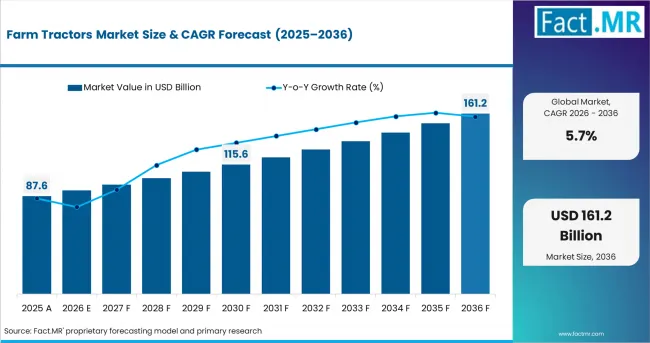
Farm Tractors Market Market Value Analysis | Source: Fact.MR
| Metric | Value |
|---|---|
| Estimated Value in 2026 | USD 87.6 billion |
| Forecast Value in 2036 | USD 152.0 billion |
| Forecast CAGR (2026 to 2036) | 5.7% |
Source: Fact.MR analysis. Updated May 21, 2026
Summary of Farm Tractors Market
- Market Definition
- The market covers self-propelled agricultural tractor units across diesel, electric, hybrid, and alternative fuel types, in horsepower ranges from sub-40 HP to above-200 HP, sold globally for field, transport, and implement-driven farm operations.
- Demand Drivers
- India's Sub-Mission on Agricultural Mechanisation disbursed subsidies to over 2.1 million smallholder farmers in 2024, directly increasing tractor purchases across Tier-2 and Tier-3 rural markets.
- Brazil's MODERFROTA rural credit programme financed a record number of tractor units in 2024, supporting commercial soy and sugarcane farm equipment renewal across Mato Grosso and Paraná states.
- China's National Agricultural Mechanisation Development Programme updated mechanisation coverage targets in 2024, mandating tractor fleet expansion across Northeast China's grain belt provinces.
- Key Segments Analyzed
- By Tractor Type: Utility tractors lead with approximately 35% share in 2026, preferred across small and mid-size farms globally for versatility across multiple field operations.
- By Horsepower: 40–100 HP tractors hold approximately 38% share in 2026, widely adopted across developing markets for row cropping, plowing, and transport applications.
- By Drive Type: 2WD configurations hold approximately 62% share in 2026, dominant due to affordability and strong adoption in cost-sensitive emerging economy farm markets.
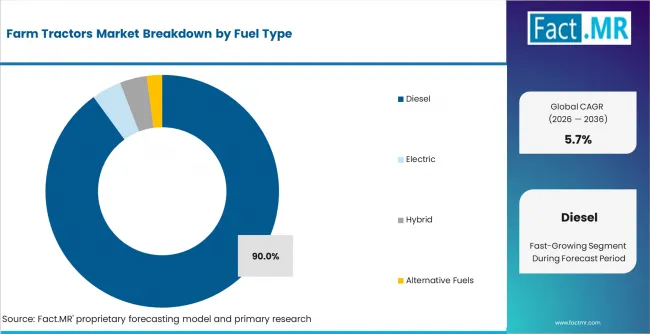
- By Fuel Type: Diesel tractors hold approximately 90% share in 2026, driven by proven reliability, wide service network depth, and established fuel availability across all markets.
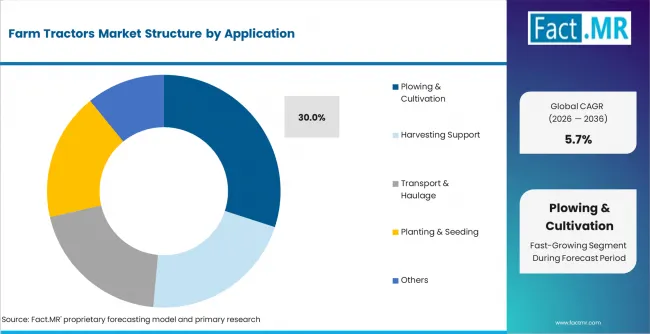
- By Application: Plowing and cultivation leads with approximately 30% share in 2026, the primary field activity driving tractor procurement across all geographies.
- By Geography: India leads at 6.8% CAGR, driven by government subsidy expansion and rising rural farm mechanization uptake.
- Analyst Opinion at FACT.MR
- Shambhu Nath Jha, Principal Consultant at Fact.MR, opines, ' CXOs will observe a dual-track market dynamic. Subsidy-driven diesel tractor demand in India and Brazil continues to outperform mature regions. These markets are driven by affordability and government support. At the same time, a premium upgrade cycle is emerging in Europe and North America. Demand is shifting toward electric, GPS-integrated, and precision-enabled tractors.’
- Strategic Implications
- Prioritise product localisation and dealer network expansion in India and Brazil to capture subsidy-linked volume growth in the 40–100 HP utility segment during 2026 to 2028.
- Accelerate GPS-integration and telematics platform rollout in European and North American tractor lines to retain commercial farm buyers upgrading from standard diesel to precision-capable models.
- Develop partnership frameworks with national agricultural banks and rural credit programmes in India, Brazil, and China to embed tractor financing directly within government mechanisation subsidy disbursement channels.
- Methodology
- Market sizing uses OEM revenue disclosures and national tractor registration data, validated with 2024–2025 farm equipment production and retail sales benchmarks.
- Analysis includes India PMKSY mechanisation data, Brazil ANFAVEA statistics, USDA farm equipment reports, and China national mechanisation programme documents.
- Forecasts incorporate farm mechanisation penetration trends, government subsidy disbursement projections, and expert interviews with tractor dealer network managers.
The market is expected to generate USD 69.1 billion in incremental revenue over the forecast period. Growth is structural and policy-driven. Farm mechanisation programmes and government subsidies are sustaining demand. Commercial agriculture expansion is also supporting equipment sales. However, high upfront costs remain a barrier in smallholder markets. Diesel price volatility continues to impact operating economics.
Procurement patterns are shifting toward precision-enabled tractors. Buyers are prioritising GPS integration, telematics, and productivity-linked features. Mahindra & Mahindra and AGCO Corporation are investing in smart tractor platforms. Large farms in emerging markets are adopting digital fleet management and financing models tied to output efficiency.
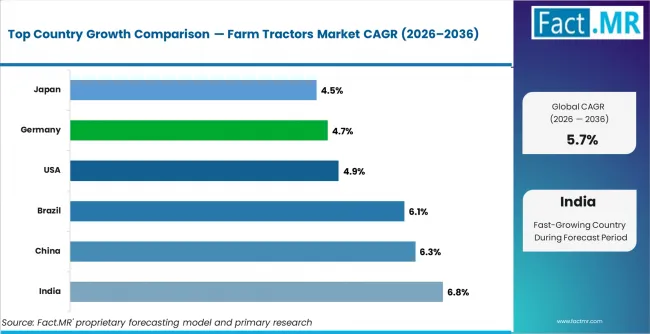
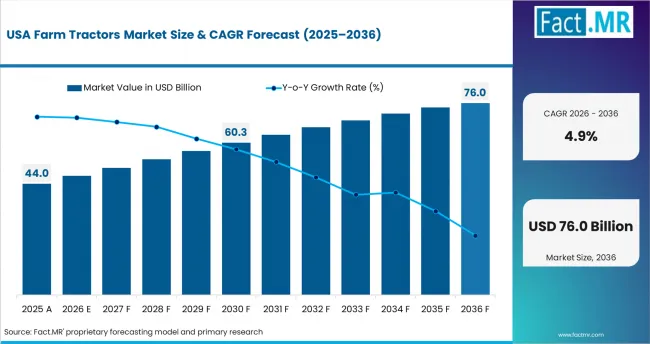
India leads with 6.8% CAGR through 2036, supported by subsidy expansion and rural credit access. China follows at 6.3%, driven by national mechanisation programmes and state procurement. Brazil grows at 6.1%, supported by commercial farming expansion and credit availability. The United States records 4.9%, driven by replacement demand and precision farming adoption. Germany posts 4.7%, supported by high-tech agricultural operations. Japan records 4.5%, driven by compact and automated tractor demand.
Segmental Analysis
Farm Tractors Market Analysis by Tractor Type
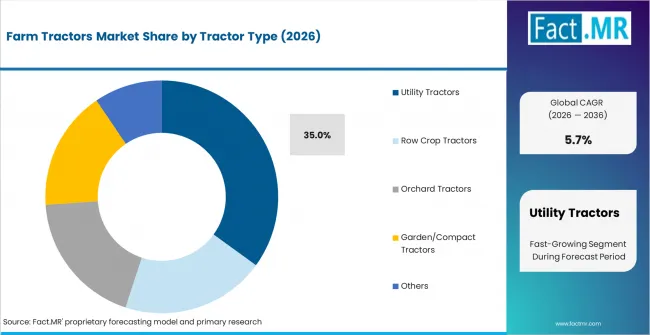
Farm Tractors Market Analysis By Tractor Type | Source: Fact.MR
Based on FACT.MR's farm tractors market report, utility tractors are estimated to hold approximately 35% share in 2026. They lead due to multi-task versatility across plowing, cultivation, transport, and implement operations, making them the preferred single-purchase for smallholder and mid-size farm operations globally.
- Mahindra Product Expansion: Mahindra & Mahindra launched its OJA utility tractor range in 2024, targeting smallholder farmers in India with 25–45 HP models optimised for paddy and vegetable cultivation. The OJA series expanded to 1,200 dealerships across six Indian states by Q3 2024. [1]
- CNH Industrial Row Crop Investment: CNH Industrial's New Holland Agriculture launched updated T6 row crop tractor models in 2025 with enhanced headland management and GPS-linked variable rate application for commercial corn and soy farms in the United States and Brazil. [2]
- Compact Tractor Trend: Kubota Corporation reported a 12% increase in compact and sub-compact tractor sales in North America in 2024, driven by hobby farm, equestrian property, and rural residential demand for sub-25 HP garden and orchard tractor formats. [3]
Farm Tractors Market Analysis by Horsepower
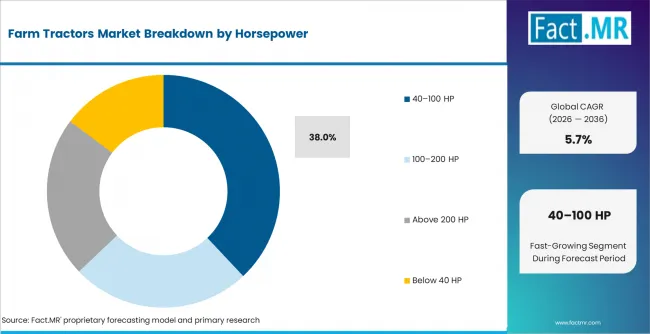
Farm Tractors Market Analysis By Horsepower | Source: Fact.MR
Based on FACT.MR's report, 40–100 HP tractors hold approximately 38% share in 2026. This band dominates because it covers the widest range of farm sizes and operations from developing market smallholder fields to commercial row cropping.
- Escorts Group Financing: Escorts Kubota Limited partnered with State Bank of India in 2024 to offer zero-down-payment tractor financing for 45–75 HP utility models under India's Kisan Credit Card scheme, lowering cost barriers for 40–100 HP adoption among smallholder farmers in Uttar Pradesh and Punjab. [4]
- AGCO High HP Launch: AGCO Corporation launched its Fendt 900 Vario above-200 HP series with updated VarioGrip tyre pressure management and section control in 2025 for large commercial grain farms in Europe and North America, targeting the premium high-HP replacement cycle. [5]
- HP Band Adoption Trend: India tractor industry data from the Tractor Manufacturers Association reported that 41–50 HP tractors accounted for over 45% of total tractor sales in India in 2024, confirming the 40–100 HP band dominance in the world's largest tractor market by volume. [6]
Farm Tractors Market Analysis by Drive Type
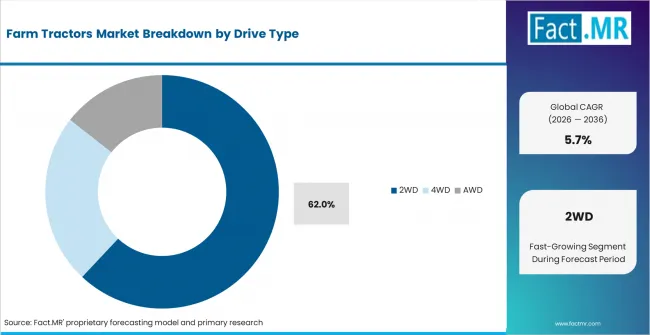
Farm Tractors Market Analysis By Drive Type | Source: Fact.MR
Based on FACT.MR's report, 2WD tractors hold approximately 62% share in 2026. They dominate because of significantly lower purchase price and simpler service requirements in price-sensitive markets.
- Mahindra 4WD Expansion: Mahindra & Mahindra expanded its 4WD tractor line under the Novo series in 2024, targeting commercial farmers in Madhya Pradesh and Rajasthan transitioning from 2WD to 4WD formats as farm sizes consolidate under land-leasing arrangements. [7]
- New Holland AWD Technology: New Holland Agriculture introduced its updated TerraGlide AWD suspension system on the T7 Heavy Duty range in 2025, targeting large European arable farms requiring enhanced field traction without soil compaction penalties. [8]
- 2WD Market Retention Trend: Brazil ANFAVEA data for 2024 confirmed that 2WD tractors retained over 55% share of total tractor registrations, driven by smallholder farmer cost constraints and the prevalence of flat terrain soy and corn cultivation in Southern Brazil states. [9]
Farm Tractors Market Analysis by Fuel Type
Farm Tractors Market Analysis By Fuel Type | Source: Fact.MR
Based on FACT.MR's report, diesel tractors hold approximately 90% share in 2026. Diesel dominates because of proven performance, wide fuel availability, established service networks, and cost competitiveness in developing markets.
- CNH Electric Tractor Launch: CNH Industrial launched the New Holland T4 Electric Power tractor in commercial volumes across European markets in 2024, targeting fruit and vegetable farmers seeking zero-emission orchard and vineyard operations under EU Common Agricultural Policy green requirements. [10]
- Kubota Hybrid Development: Kubota Corporation announced its hybrid diesel-electric drivetrain platform for 60–80 HP utility tractors in 2025, targeting Japanese domestic market farmers under Japan's Green Food System Strategy incentive programme for low-emission agricultural machinery. [11]
- Diesel Market Retention: Tractor Manufacturers Association India data confirmed diesel engines powered over 99% of tractors sold in India in 2024, reflecting fuel infrastructure depth, low maintenance cost requirements, and farmer preference for proven engine reliability across Indian farm conditions.
Farm Tractors Market Analysis by Application
Farm Tractors Market Analysis By Application | Source: Fact.MR
Based on FACT.MR's report, plowing and cultivation holds approximately 30% share in 2026. It leads as the primary field preparation activity that drives initial tractor purchase decisions.
- AGCO Precision Cultivation: AGCO Corporation launched Fendt's Momentum precision planting platform integration with Fendt utility tractors in 2024, enabling GPS-guided variable rate seeding and cultivation for North American and European commercial row crop operations. [5]
- Claas Harvesting Integration: Claas KGaA mbH expanded its tractor-harvester digital integration platform CEMOS in 2025, enabling real-time operational data exchange between Axion tractor units and Lexion combine harvesters for optimised in-field logistics on large German and French grain farms.
- Transport Application Growth: India's National Horticulture Mission 2024 report noted a 17% increase in tractor-trailer transport for fresh produce logistics, confirming growing tractor use beyond field operations into last-mile rural supply chain transport across major horticultural states.
Drivers, Restraints, and Opportunities
Farm Tractors Market Opportunity Matrix Growth Vs Value | Source: Fact.MR
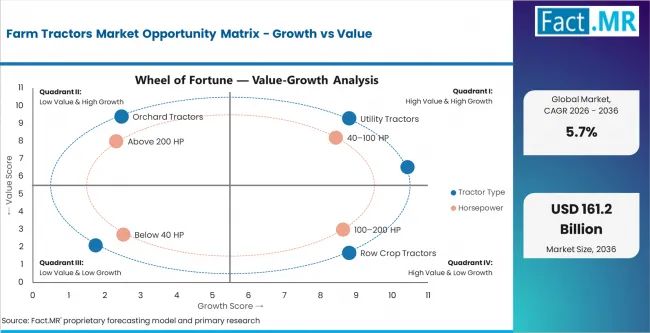
FACT.MR analysts observe the farm tractors market is a structurally expanding category anchored by global agricultural productivity mandates and government mechanisation programmes.
The market shows clear divergence between volume-driven emerging market segments and value-driven premium segments. Standard diesel 2WD tractors face margin pressure in cost-competitive markets.
- Government Subsidy Mandates: India's Ministry of Agriculture updated Sub-Mission on Agricultural Mechanisation (SMAM) guidelines in 2024, expanding subsidy eligibility for tractors up to 60 HP for smallholder farmers in 16 states.
- Precision Farming Adoption: The USDA Farm Service Agency expanded precision agriculture equipment cost-share programmes under the 2024 Inflation Reduction Act conservation provisions, supporting GPS-enabled tractor upgrades on commercial farms.
- Brazil Commercial Farm Expansion: Brazil's ANFAVEA reported record tractor registrations of over 75,000 units in 2024, driven by MODERFROTA programme credit releases and commercial farm acreage expansion in Mato Grosso.
Regional Analysis
The farm tractors market is assessed across North America, Europe, Asia Pacific, Latin America, and Middle East and Africa, covering 40+ countries with demand shaped by farm mechanisation policy intensity, government subsidy programme scale, commercial farm structure, and tractor financing availability. The full report offers market attractiveness analysis by region and country.
.webp "Top Country Growth Comparison Farm Tractors Market Cagr (2026 2036)")
Top Country Growth Comparison Farm Tractors Market Cagr (2026 2036) | Source: Fact.MR
| Country | CAGR (2026 to 2036) |
|---|---|
| India | 6.8% |
| China | 6.3% |
| Brazil | 6.1% |
| United States | 4.9% |
| Germany | 4.7% |
| Japan | 4.5% |
Source: Fact.MR analysis. Updated May 21, 2026
Source: Fact.MR (FACT.MR) analysis, based on proprietary forecasting model and primary research
Farm Tractors Market Cagr Analysis By Country | Source: Fact.MR
Asia Pacific Farm Tractors Market Analysis
Asia Pacific is the highest-volume and highest-growth regional market, anchored by government-driven mechanisation mandates in India and large-scale state procurement programmes in China.
- India: Subsidy-driven mechanisation expansion supports 6.8% CAGR through 2036, making India the fastest-growing country market globally. The Ministry of Agriculture and Farmers Welfare disbursed SMAM subsidies covering 40–60 HP tractor purchases to over 2.1 million smallholder farmers across 16 states during 2024, with Haryana and Punjab adding new subsidy beneficiary categories. India's Tractor Manufacturers Association reported total tractor sales of over 960,000 units in the April 2024 to March 2025 fiscal year, the highest volume in market history.
- China: State-mandated mechanisation coverage expansion supports 6.3% CAGR through 2036. China's Ministry of Agriculture and Rural Affairs updated the National Agricultural Mechanisation Development Plan in 2024, mandating above-90% mechanisation coverage for staple grain crops across Northeast and North China Plain provinces. The central government allocated CNY 24 billion in agricultural machinery purchase subsidies for 2024, with tractors above 100 HP prioritised for large-scale state farm procurement.
- Japan: Precision agriculture technology adoption and aging farmer replacement cycles support 4.5% CAGR through 2036. Japan's Ministry of Agriculture, Forestry and Fisheries updated the Green Food System Strategy mechanisation incentives in 2024, providing subsidies for hybrid-electric and GPS-enabled compact tractors under the Smart Agriculture acceleration programme.
FACT.MR's analysis of the farm tractors market in Asia Pacific covers China, India, Japan, South Korea, ASEAN, and Australia and New Zealand. Readers can find mechanisation subsidy programme data, government procurement volumes, and tractor adoption trends by HP band and country.
Latin America Farm Tractors Market Analysis
Latin America is the fastest-growing regional market outside Asia, anchored by Brazil's record commercial farm expansion and MODERFROTA credit programme. Commercial soy, corn, and sugarcane operations in Brazil dominate procurement of above-100 HP tractors.
- Brazil: Record commercial farm credit expansion supports 6.1% CAGR through 2036. Brazil ANFAVEA reported total tractor registrations of 75,342 units in 2024, a 6% increase over 2023, driven by MODERFROTA programme credit disbursements supporting 60–180 HP tractor renewal on large commercial farms in Mato Grosso, Paraná, and Goiás states. The Brazilian Development Bank (BNDES) extended ABC+ Agro programme low-interest loans for precision-enabled tractor procurement in 2024, supporting adoption of GPS-guided and variable-rate-capable models among commercial grain farmers.
FACT.MR's analysis of the farm tractors market in Latin America covers Brazil, Argentina, Colombia, and Rest of Latin America. Readers can find MODERFROTA programme data, BNDES agricultural financing trends, and tractor registration volumes by state.
North America Farm Tractors Market Analysis
Farm Tractors Market Country Value Analysis | Source: Fact.MR
North America is a precision farming upgrade and fleet replacement market. USDA conservation programme cost-share funding and large commercial farm consolidation sustain demand for high-HP and GPS-enabled tractor models.
- United States: Precision farming upgrade cycles and farm consolidation support 4.9% CAGR through 2036. The USDA Natural Resources Conservation Service expanded EQIP programme cost-share for precision agriculture equipment in 2024, covering GPS-enabled and variable-rate tractor system upgrades on commercial crop farms across the Corn Belt and Great Plains.
FACT.MR's analysis of the farm tractors market in North America covers the United States, Canada, and Mexico. Readers can find USDA EQIP programme data, farm consolidation trends, precision farming adoption benchmarks, and HP band registration volumes.
Europe Farm Tractors Market Analysis
Farm Tractors Market Europe Country Market Share Analysis, 2026 & 2036 | Source: Fact.MR
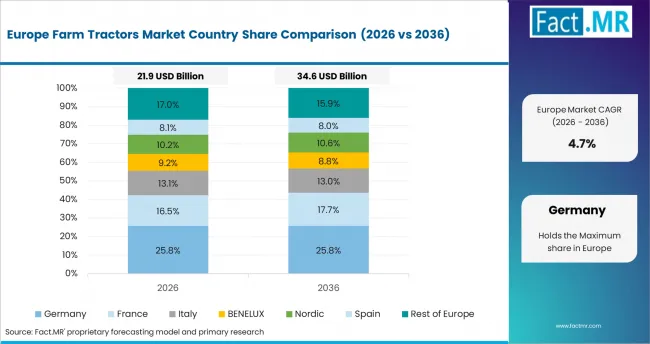
Europe is the technology benchmark region for precision agriculture and emission-regulated tractor platforms. EU Common Agricultural Policy requirements and national agricultural ministry mechanisation funding shape demand.
- Germany: High-technology farm mechanisation and export-oriented agriculture support 4.7% CAGR through 2036. The German Federal Ministry of Food and Agriculture (BMEL) updated Agrarinvestitionsförderungsprogramm (AFP) mechanisation subsidies in 2024, expanding co-funding for precision-capable tractor platforms above 100 HP for commercial grain and livestock farm operators.
- United Kingdom: Post-Brexit agricultural transition funding and sustainable farming incentives support stable demand ahead of the 4.7% CAGR trajectory. The UK Department for Environment, Food and Rural Affairs (DEFRA) expanded the Farming Equipment and Technology Fund (FETF) in 2024, providing grants for GPS-enabled tractor precision systems and automated steering retrofits.
FACT.MR's analysis of the farm tractors market in Europe covers Germany, France, the UK, Italy, Spain, Netherlands, and Rest of Europe. Readers can find EU CAP mechanisation subsidy data, CEMA tractor registration statistics, and precision agriculture adoption benchmarks by country.
Competitive Aligners for Market Players
Farm Tractors Market Analysis By Company | Source: Fact.MR
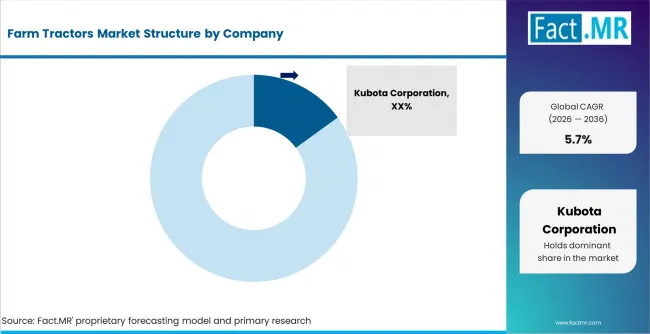
The farm tractors market is no longer just about selling more units. Competition is increasingly shaped by how well companies align with changing farm economics and technology needs. Large manufacturers such as Mahindra & Mahindra, John Deere, AGCO Corporation, and CNH Industrial are adjusting their strategies accordingly.
One clear shift is toward precision agriculture. Farmers, especially large commercial operators, want tractors that do more than basic field work. GPS guidance, telematics, and data-driven farming tools are becoming standard expectations. Companies that can integrate these features seamlessly into their platforms are gaining a strong edge.
At the same time, affordability still matters in emerging markets. In countries like India and Brazil, success depends on offering reliable, cost-effective tractors backed by financing and service support. This is where companies with strong dealer networks and rural financing partnerships are outperforming competitors. Another important aligner is electrification and sustainability. While diesel tractors still dominate, there is growing interest in electric and hybrid models, particularly in Europe and North America. Manufacturers investing early in these technologies are positioning themselves for future regulatory shifts.
Customer relationships are also evolving. Buyers increasingly prefer long-term partnerships that include maintenance, digital support, and fleet management solutions. This is pushing companies to move beyond product sales toward service-led models. In this market, the winners will be those who balance technology innovation with cost efficiency and strong on-ground support.
Key Players
- Kubota Corporation
- Mahindra & Mahindra Ltd.
- Claas KGaA mbH
- Antonio Carraro
- Escorts Group
- Force Motors Ltd.
- New Holland Agriculture
- Yanmar Co., Ltd.
- Indo Farm Equipment Limited
- AGCO Corporation
- Argo Tractors S.p.A
- CNH Industrial Österreich GmbH
Bibliography
- [1] Mahindra & Mahindra Ltd. (2024). Product Launch Announcement: OJA Utility Tractor Range 25–45 HP Launch Across Smallholder Farm Segments in India Including Dealer Network Expansion to 1,200 Outlets Across Six States. mahindra.com/newsroom
- [2] CNH Industrial N.V. (2025). Product Launch: New Holland T6 Row Crop Tractor Updated Models with GPS-Linked Variable Rate Application and Headland Management for Commercial Corn and Soy Farm Operations in the United States and Brazil. cnhindustrial.com/investors
- [3] Kubota Corporation. (2024). Annual Report 2024: North America Sub-Compact and Compact Tractor Sales Growth Including Segment Performance and Hobby Farm Demand Trends for Sub-25 HP Garden and Orchard Tractor Formats. kubota.com/ir
- [4] Escorts Kubota Limited. (2024). Corporate Announcement: Partnership with State Bank of India for Zero-Down-Payment Kisan Credit Card Tractor Financing for 45–75 HP Utility Models in Uttar Pradesh and Punjab. escortskubota.com/investor-relations
- [5] AGCO Corporation. (2025). Product Launch: Fendt 900 Vario Series Updated with VarioGrip Tyre Pressure Management and Section Control for Large Commercial Grain Farms in Europe and North America. agcocorp.com/newsroom
- [6] Tractor Manufacturers Association India. (2024). Annual Tractor Industry Statistics 2024–25: Total Tractor Sales Volume, HP Band Distribution, and Fuel Type Share Analysis for the Indian Domestic Tractor Market. tractorsmanufacturers.com/statistics
- [7] Mahindra & Mahindra Ltd. (2024). Product Update: Novo Series 4WD Tractor Expansion Targeting Commercial Farmers in Madhya Pradesh and Rajasthan Under Land-Leasing Farm Consolidation Programme. mahindra.com/farmequipment
- [8] CNH Industrial N.V. (2025). Technical Launch: New Holland T7 Heavy Duty with Updated TerraGlide AWD Suspension System for Large European Arable Farms Targeting Enhanced Field Traction and Reduced Soil Compaction. newholland.com/news
- [9] ANFAVEA – Brazilian Automotive Industry Association. (2024). Annual Tractor Registration Statistics 2024: Total Registrations by Drive Type, HP Band, and State Including MODERFROTA Programme Impact Analysis. anfavea.com.br/estatisticas
- [10] CNH Industrial N.V. (2024). Commercial Launch: New Holland T4 Electric Power Zero-Emission Tractor for European Fruit and Vegetable Farming Under EU Common Agricultural Policy Green Incentive Requirements. newholland.com/electric
- [11] Kubota Corporation. (2025). Technology Announcement: Hybrid Diesel-Electric Drivetrain Platform for 60–80 HP Utility Tractors Under Japan's Green Food System Strategy Low-Emission Agricultural Machinery Incentive Programme. kubota.com/news
This Report Addresses
- Strategic insights across India, China, Brazil, the United States, Germany, and Japan. Covers utility, row crop, orchard, and compact tractor demand by HP, drive type, and fuel type.
- Market forecast from USD 87.6 billion in 2026 to USD 152.0 billion by 2036 at a CAGR of 5.7%.
- Opportunity mapping across India SMAM subsidy expansion, Brazil MODERFROTA credit growth, China national mechanisation programme procurement, US EQIP precision farming upgrades, and Germany AFP mechanisation grants.
- Segment analysis by tractor type, horsepower, drive type, fuel type, and application. Covers global and regional markets with country-level CAGR forecasts.
- Regional outlook across Asia Pacific, Latin America, North America, and Europe. Focus on government subsidy programmes, commercial farm procurement, and precision farming adoption trends.
- Competitive analysis of Kubota, Mahindra & Mahindra, AGCO, CNH Industrial, and Claas. Focus on subsidy programme qualification, dealer network depth, and precision agriculture platform integration.
- Regulatory analysis covering India SMAM guidelines, Brazil MODERFROTA rules, EU CAP mechanisation funding frameworks, USDA EQIP cost-share provisions, and China national mechanisation programme mandates.
- Report delivered in PDF, Excel, and presentation formats. Supported by validated data and expert interviews with tractor dealer network and cooperative procurement managers.
Farm Tractors Market Definition
The farm tractors market includes self-propelled agricultural vehicles delivering engine-powered tractive force for field operations, load transport, and implement attachment across small, mid-size, and large commercial farms. Key products are diesel, electric, and hybrid-fuel tractors across sub-40 HP to above-200 HP power ranges.
Farm Tractors Market Inclusions
Covers global and regional forecasts from 2026 to 2036 by tractor type, horsepower, drive type, fuel type, and application. Includes utility, row crop, orchard, and compact tractors in diesel, electric, hybrid, and alternative fuel variants across 2WD, 4WD, and AWD drive configurations.
Farm Tractors Market Exclusions
Excludes combine harvesters, self-propelled sprayers, and ride-on lawn mowers. Finished farm machinery attachments and implements sold separately are not included. Autonomous robotic field platforms not using a tractor chassis and construction wheeled loaders are also excluded. Focus remains on standalone tractor units for agricultural field use.
Farm Tractors Market Research Methodology
- Primary Research
- Interviews with tractor dealership procurement managers, farm cooperative buyers, agricultural ministry mechanisation programme administrators, and tractor OEM product managers across India, China, the United States, Brazil, Germany, and Japan.
- Desk Research
- Uses tractor OEM annual filings, India PMKSY and sub-mission mechanisation data, USDA farm equipment reports, Brazil ANFAVEA tractor sales data, Germany VDMA farm equipment statistics, and 2024–2025 global tractor production and registration databases.
- Market Sizing and Forecasting
- Hybrid model using tractor OEM revenues, country-level tractor registration volumes, average selling prices by horsepower band and fuel type, government subsidy programme disbursement volumes, and commercial farm credit financing benchmarks.
- Data Validation and Update Cycle
- Validated using OEM revenue disclosures, national tractor registration statistics, and farm mechanisation programme procurement volumes. Supported by expert interviews with agricultural cooperative procurement officers and tractor dealer networks.
Segmentation
Scope of Report
Farm Tractors Market Breakdown By Tractor Type, Horsepower, And Region | Source: Fact.MR
| Attribute | Details |
|---|---|
| Quantitative Units | USD 87.6 billion (2026) to USD 152.0 billion (2036), at a CAGR of 5.7% |
| Market Definition | Self-propelled agricultural tractor units in diesel, electric, hybrid, and alternative fuel types across sub-40 HP to above-200 HP power ranges, covering 2WD, 4WD, and AWD drive configurations, sold globally for field, transport, and implement-driven farm operations. |
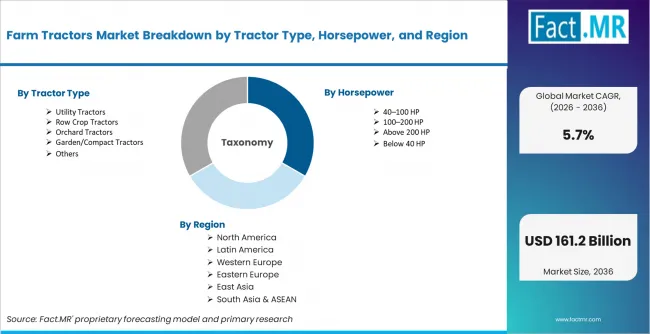
| Tractor Type Segmentation | Utility Tractors, Row Crop Tractors, Orchard Tractors, Garden/Compact Tractors, Others |
| Horsepower Segmentation | Below 40 HP, 40–100 HP, 100–200 HP, Above 200 HP |
| Drive Type Segmentation | 2WD, 4WD, AWD |
| Fuel Type Segmentation | Diesel, Electric, Hybrid, Alternative Fuels |
| Application Segmentation | Plowing & Cultivation, Harvesting Support, Transport & Haulage, Planting & Seeding, Others |
| Application Coverage | Smallholder subsidy-linked procurement, commercial farm fleet renewal, government mechanisation programme supply, precision farming upgrade cycles, and orchard/vineyard specialised operations. |
| Regions Covered | North America, Europe, Asia Pacific, Latin America, Middle East and Africa |
| Countries Covered | USA, Canada, Mexico, Germany, UK, France, Italy, Spain, Netherlands, Nordic, BENELUX, China, Japan, South Korea, India, ASEAN, Australia and New Zealand, Brazil, Argentina, Colombia, Saudi Arabia, GCC, Turkey, South Africa, Rest of MEA |
| Key Companies Profiled | Kubota Corporation, Mahindra & Mahindra Ltd., Claas KGaA mbH, Antonio Carraro, Escorts Group, Force Motors Ltd., New Holland Agriculture, Yanmar Co. Ltd., Indo Farm Equipment Limited, AGCO Corporation, Argo Tractors S.p.A, CNH Industrial Österreich GmbH |
| Forecast Period | 2026 to 2036 |
| Approach | Hybrid top-down and bottom-up model using tractor OEM revenues, national registration data, government subsidy disbursement volumes, average selling prices by HP band and fuel type, and primary interviews with tractor dealer and cooperative procurement managers. |
Source: Fact.MR analysis. Updated May 21, 2026
Farm Tractors Market By Segment
-
By Tractor Type
- Utility Tractors
- Row Crop Tractors
- Orchard Tractors
- Garden/Compact Tractors
- Others
-
By Horsepower
- Below 40 HP
- 40–100 HP
- 100–200 HP
- Above 200 HP
-
By Drive Type
- 2WD
- 4WD
- AWD
-
By Fuel Type
- Diesel
- Electric
- Hybrid
- Alternative Fuels
-
By Application
- Plowing & Cultivation
- Harvesting Support
- Transport & Haulage
- Planting & Seeding
- Others
-
By Region
- North America
- United States
- Canada
- Mexico
- Latin America
- Brazil
- Argentina
- Colombia
- Rest of Latin America
- Western Europe
- Germany
- United Kingdom
- France
- Italy
- Spain
- Netherlands
- Nordic Countries
- BENELUX
- Rest of Western Europe
- Eastern Europe
- Russia
- Poland
- Hungary
- Balkan and Baltic
- Rest of Eastern Europe
- East Asia
- China
- Japan
- South Korea
- South Asia and Pacific
- India
- ASEAN
- Australia and New Zealand
- Rest of South Asia and Pacific
- Middle East and Africa
- Kingdom of Saudi Arabia
- Other GCC Countries
- Turkey
- South Africa
- Rest of Middle East and Africa
- North America
Frequently Asked Questions
How large is the global farm tractors market in 2025?
What will the market size be in 2026?
What is the projected market size by 2036?
What is the expected CAGR from 2026 to 2036?
Which tractor type is poised to lead the market?
Which horsepower segment holds the largest share?
Which fuel type dominates the farm tractors market?
Which country shows the fastest growth?
What are farm tractors used for?
What drives demand in this market?
Who are the key players in the market?
Who worked on this report


Preview the report firsthand - request a free sample
Free SampleGet the brochure for pricing and purchase details
Download PDF