- Base Value(2025): 11.2 Bn
- Estimated Value(2026): 12.5 Bn
- Forecast Value (2036): 37.5 Bn
- CAGR (2026 - 2036): 11.6%
Autonomous Farm Equipment Market Forecast and Outlook By Fact.MR
The global autonomous farm equipment market was valued at USD 11.2 billion in 2025. Fact.MR estimates it at USD 12.5 billion in 2026 and projects expansion to USD 37.5 billion by 2036, adding USD 25.0 billion in absolute incremental value over the forecast decade.
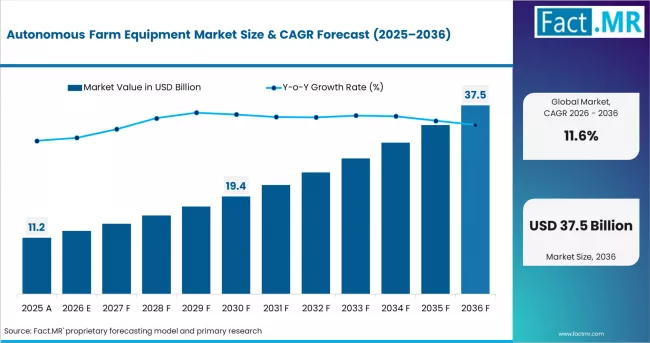
Autonomous Farm Equipment Market Market Value Analysis | Source: Fact.MR
Summary of Autonomous Farm Equipment Market
- Market Snapshot
- Global autonomous farm equipment market revenue stood at USD 12.5 billion in 2026 and is forecast to reach USD 37.5 billion by 2036.
- At a 11.6% CAGR from 2026 to 2036, this market is set to expand ~3x in value, adding USD 25.0 billion in absolute opportunity.
- Growth is being driven by increasing integration of autonomous operations into farming practices, supported by mechanization and digital agriculture adoption.
- The market is transitioning toward AI- and IoT-enabled precision agriculture ecosystems, where autonomous equipment enables continuous, high-efficiency operations independent of labor constraints.
- Demand and Growth Drivers
- Labor shortages and increasing labor costs in agriculture are accelerating adoption of autonomous machinery.
- Growing emphasis on efficient resource utilization and sustainable farming practices is driving demand for precision-enabled autonomous systems.
- Increasing penetration of precision agriculture technologies (GPS, sensors, automation systems) is expanding application scope.
- Strong need for:
- Higher yield optimization
- Reduced production cost
- Continuous operations irrespective of weather/time constraints
- Integration of AI, IoT, robotics, and navigation systems is enhancing operational accuracy and decision-making efficiency.
- Product and Segment View
- Autonomous tractors account for 38.4% of market share by 2026, emerging as the leading segment due to their extensive use across core farming activities.
- Partially autonomous equipment holds 66.1% of market share by 2036, driven by flexibility of manual or remote operation alongside automation.
- Key product categories include:
- Autonomous tractors
- Harvesting equipment
- UAVs and aerial systems
- Irrigation and planting systems
- These systems enable:
- High-precision field operations
- Real-time data collection (soil, crop conditions)
- Reduced human intervention with improved consistency
- Geography and Competitive Outlook
- North America accounts for 32% of global market share in 2026, making it the leading regional market, supported by large-scale farming operations and high mechanization levels.
- East Asia emerges as a high-growth region, with strong adoption in Japan and rapid scaling in China supported by government-led agricultural modernization initiatives.
- Key companies include:
- Deere & Company
- AGCO Corporation
- CNH Industrial
- Kubota Corporation
- Trimble Inc.
- Mahindra & Mahindra
- Yanmar Holdings
- Autonomous Tractor Corporation
- Raven Industries
- Ag Leader Technology
Autonomous Farm Equipment Market — At a Glance
| Attribute | Details |
|---|---|
| Market Value (2026) | USD 12.5 billion |
| Market Value (2036) | USD 37.5 billion |
| Absolute Dollar Opportunity | USD 25.0 billion |
| Total Growth (%) | 200% |
| CAGR | 11.6% |
| Growth Multiple | 3x |
| Key Demand Theme | Increasing adoption of AI-enabled autonomous machinery to improve efficiency, reduce labor dependency, and optimize agricultural output |
| Leading Segment (2026) | Autonomous Tractors |
| Segment Share | 38.4% |
| Leading Technology Segment (2036) | Partially Autonomous Equipment |
| Segment Share | 66.1% |
| Key Growth Regions | East Asia, North America |
| Key Countries | South Korea, Japan |
| Segmentation by Technology | Fully Autonomous , Partially Autonomous |
| Segmentation by Application | Agricultural Farms, Dairy Farms (Livestock Management), Greenhouses and Indoor Farms, Horticulture, Agroforestry, Fruit Orchards, Landscaping and Turf Management, Vineyards |
| Segmentation by Region | North America, Western Europe, East Asia, South Asia & Pacific, Latin America, Eastern Europe, MEA |
Source: Fact.MR analysis. Updated Apr 14, 2026
Over 11% CAGR in a capital equipment market of this size is significant, especially when compared with legacy equipment used in farm operations. The agricultural labor market in every key farming economy is tightening not cyclically, but structurally. Rural-to-urban migration is removing agricultural workers from the supply pool at rates that outpace any realistic wage-based retention strategy. In the United States, the average age of a farm operator is USD 58. In Japan, it is USD 67. In Germany it USD 56. The workforce succession math is paving way for autonomous farm equipment adoption.
With current trends in population growth and consumption patterns, global food demand is forecast to rise by about 50% by 2050. Meanwhile, the amount of usable arable land available globally is effectively static. Gleaning more productivity out of the same land base means precise variable-rate planting, precision nutrient distribution, constant soil testing, timing of harvest at optimal maturity levels. Automation using continuous sensing systems and decision-making capabilities from artificial intelligence cannot be matched in reliability by manually operated machinery. This is the reason why procurement decisions of such systems are made on large-scale agriculture operations.
Equipment Type Analysis: Where Adoption Is Fast and Where It Is Slow
Autonomous Tractors: Dominant but Slower-Growing
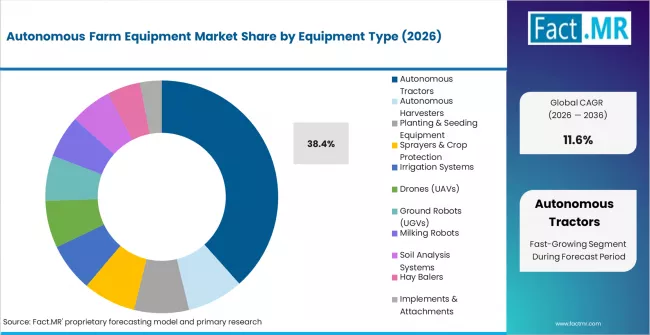
Autonomous Farm Equipment Market Analysis By Equipment Type | Source: Fact.MR
Autonomous tractors hold the largest market share at 38.4% in 2026 but are projected to see share compression to 34.1% by 2036 as robotic harvesters and UAVs grow faster. This is not a narrative of tractor market decline the absolute revenue in autonomous tractors is growing substantially it is a story of faster growth in adjacent categories. John Deere's 8R autonomous tractor, launched commercially in 2022, is the reference point for what full autonomy means in row crop agriculture: GPS-guided field navigation, automatic headland turning, obstacle detection and avoidance, remote monitoring via Operations Center, and tillage implement control without a cab operator. The demonstrated field efficiency is approximately 96% of human operator performance in standardized field conditions, with the critical operational advantage of running continuous 24-hour shifts during time-critical planting and harvest windows.
Agricultural Drones (UAVs): Volume Leader by Unit Count
Agricultural UAVs are the highest unit volume category in the market and the most democratized in terms of farm size accessibility. A USD 15,000-30,000 agricultural spraying drone is within financial reach of a 100-hectare operation in a way that a USD 400,000 autonomous tractor is not. DJI Agriculture's Agras series holds the dominant position in the agricultural UAV market globally, with particularly strong penetration in China (where the government has actively subsidized adoption), Japan (where aged rural populations and small field parcels make drone application practically superior to ground equipment), and Southeast Asia.
10-Year Total Cost of Ownership: The Economics That Drive Autonomous Equipment Adoption
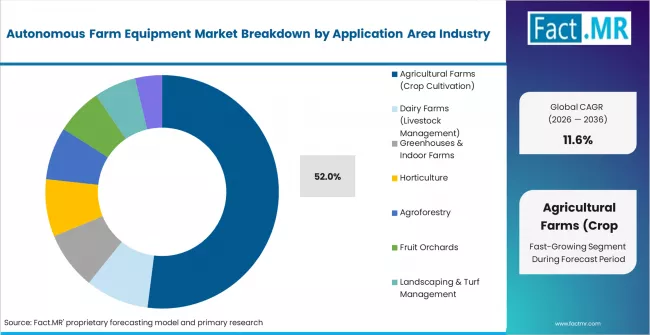
Autonomous Farm Equipment Market Analysis By Application Area | Source: Fact.MR
Autonomous farm equipment is selected on the basis of comparing total cost of ownership (TCO). Conventional farm equipment incurs most of its cost as a consequence of having high labor requirements with a need to employ two experienced personnel who would operate it. They earn between USD 65,000 and USD 85,000 annually each. Moreover, the cost also includes extra payments made during overtime associated with planting and harvesting. It has been also observed that conventional machines require up to 15–25% more fuel than autonomous machines. On top of that, higher maintenance costs, as well as crop losses associated with improper timing of operations, add to the expense of conventional machinery. Hence, total cost of ownership for conventional equipment comes to USD 170,000–180,000 annually.
Autonomous farm equipment, however, requires a much higher initial capital outlay of USD 450,000 to USD 520,000, but the ongoing expenses are greatly reduced. Thus, for example, autonomous machinery requires only one part-time supervisor and consumes 18-24% less fuel due to enhanced performance. What is more important, the cost of precision agriculture technology, including variable-rate technology and improved field navigation, brings about additional savings of USD 20,000–35,000 annually. Therefore, it will take approximately 3.8 years before autonomous equipment becomes economic than conventional one.
It means that there is a strong commercial advantage associated with switching to autonomous equipment. Namely, at least for the grain, oilseed, and row crops, it is advantageous starting from about 400-500-hectare farms and above the present price level. That is why the main problem for farms that exceed this size threshold lies not in the inability to recognize the advantages of autonomous machinery, but in its availability to be produced by the manufacturer.
Agricultural Labor Shortage: The Structural Demand Engine That No Policy Can Fully Reverse
An agricultural labor shortage is different from other forms of demand drivers analyzed by market experts. It is neither cyclic, nor discretionary, nor does it allow any kind of conventional market response such as increasing wages in order to attract more employees. The workforce just isn’t there, and there are no pipelines in place that will supply replacement labor in the future. This is a condition that will define agriculture business economics for at least the next two to three decades.
The numbers are specific and consequential. The U.S. agricultural sector faces an estimated annual labor shortfall of 240,000 seasonal workers a gap that has been persistent for over a decade and that H-2A visa program expansion has only partially addressed. In the EU, the agricultural workforce declined approximately 25% between 2005 and 2023, with the steepest drops in Germany, France, and the Netherlands. Japan's agricultural workforce has fallen below 2 million for the first time since records began, from a peak exceeding 14 million in the 1950s. These are not recovering.
The crops most acutely affected are are those that need manual labor at harvesting time: soft fruits, wine grapes, tree fruits, and salad vegetables.
The crops most acutely affected are those requiring skilled manual labor at harvest: soft fruits, wine grapes, tree fruits, and salad vegetables. These are also the highest-value crops per hectare which is why the economic case for robotic harvester investment is strongest precisely where the labor shortage pain is most acute. A strawberry operation in California or Kent losing 20-30% of its crop to labor unavailability during peak harvest is not facing a supply chain disruption; it is facing an existential business risk. An autonomous harvesting robot operating at 80% of human picking efficiency but running continuously for the entire harvest window is not a compromise it is the only commercially viable option.
The Farm Operator Age Crisis and Succession Problem
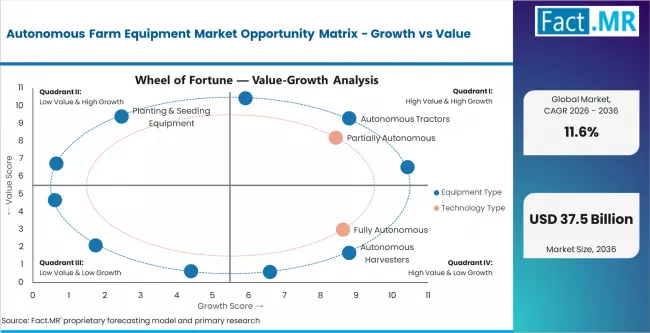
Autonomous Farm Equipment Market Opportunity Matrix Growth Vs Value | Source: Fact.MR
In the United States, only 8% of principal farm operators are under 35. In the EU, fewer than 11% of farm managers are under 40. The farms being operated by today's 58-year-old average operator will face ownership transition within the next decade, and the successors if they exist are increasingly financial investors, agri-corporations, or family members with professional careers in other sectors who cannot and will not operate machinery themselves.
Autonomous equipment addresses the succession problem directly. A farm that operates with a small crew of supervisors managing autonomous systems rather than requiring trained operators for every machine survives a generational transition without losing operational capability. For the institutional investors and agri-corporations acquiring farmland at accelerating rates (institutional farmland ownership in the U.S. has grown from approximately 2% to over 8% of total agricultural land in a decade), autonomous equipment is not a productivity upgrade. It is the operational prerequisite that makes the asset class viable as an investment.
| Growth Driver | Demand Impact | Time Horizon | Where It Shows Up | Fact.MR Insight |
|---|---|---|---|---|
| Labor shortage in agriculture | High | Short–Long Term | North America, Europe, Japan | Structural driver; aging workforce and labor scarcity accelerating automation adoption |
| Precision agriculture adoption | High | Mid–Long Term | North America, Europe, China | Yield optimization and input cost reduction driving sustained equipment demand |
| Government support & subsidies | High | Mid Term | U.S., EU, India, China | Policy-backed demand via farm mechanization programs and smart farming incentives |
| Rising farm consolidation | High | Mid–Long Term | U.S., Brazil, Australia | Large farms driving higher ROI on autonomous equipment investments |
| Increasing input cost pressure | High | Short–Mid Term | Global | Fuel, fertilizer, and labor cost inflation pushing automation for efficiency gains |
| Electrification & sustainability push | Medium | Mid–Long Term | Europe, North America | Decarbonization trends supporting electric and low-emission autonomous equipment |
| Drone-based farming adoption | Medium–High | Short–Mid Term | Asia-Pacific, LATAM | Rapid uptake in spraying and monitoring due to lower entry cost |
| Robotics in specialty crops | Medium | Mid–Long Term | Europe, U.S. (orchards, vineyards) | High-value crops driving adoption of autonomous weeders and harvesters |
Source: Fact.MR analysis. Updated Apr 14, 2026
Farm Size Adoption Gap: Why Autonomous Equipment is Still a Large-Farm Product
The single most important constraint on autonomous farm equipment market growth through 2030 is farm size economics. The payback period on autonomous equipment investment scales inversely and non-linearly with farm size and at the current equipment price points, autonomous systems are commercially justifiable only above a farm size threshold that excludes the majority of the world's farm operators.
The arithmetic is straightforward. A fully autonomous tractor system hardware, software subscription, connectivity costs approximately USD 350,000-500,000 per unit at current market pricing. On a 500-hectare grain farm operating the equivalent of two conventional tractor systems, the annual labor and operational cost savings (reduced operator wages, fuel efficiency gains, input optimization) generate approximately USD 80,000-120,000 per year.
This economics gap has a direct market structure implication: the commercially addressable market for autonomous farm equipment through 2030 is concentrated in the approximately 1.8% of global farm operations that exceed 200 hectares a farm size threshold above which payback periods become commercially viable. This 1.8% of farms, however, accounts for approximately 65% of global agricultural output by value, which is why the market is both commercially significant and volume-constrained simultaneously.
What Closes the Farm Size Gap?
Three developments will expand the addressable farm size threshold downward through the forecast period. First, equipment cost deflation: the hardware cost trajectory for LiDAR, compute, and machine vision components is following historical patterns of semiconductor-adjacent hardware cost compression. Fact.MR projects that full autonomous tractor system pricing will reach USD 150,000-200,000 by 2032, which brings the payback threshold down to approximately 150-200 hectares meaningfully expanding the addressable farm population.
Regulatory and Type-Approval Landscape: Where Can Autonomous Equipment Actually Operate?
It should be noted that regulations represent one of the crucial factors in the success of autonomous farm equipment since they determine not only the certification process but also whether the equipment can function autonomously in practice or needs to work in semi-autonomous mode. It is important to note that unlike conventional agricultural machinery, restrictions placed by regulators can limit equipment's ability to operate unattended.
In the US, the lack of an integrated federal policy has led to a disparate and regionalized strategy. Midwest regions like Kansas and Iowa are comparatively liberal, allowing self-regulated activities on private farms, while more intricate policies in jurisdictions like California have created confusion. On the other hand, for aerial systems, the Federal Aviation Authority’s Part 107 enforces a VLOS, constraining the size of the operation. The expected BVLOS policy (2026-2027) would open opportunities for a wide-scale deployment of drone agriculture using multiple UAVs.
On the contrary, the move to the Machinery Regulation (EU) 2023/1230 has set up rigorous safety standards and type-approvals for agricultural machinery, which includes monitoring systems and emergency plans in case of unmanned activity. Despite permitting the in-field movement on private property, the cross-field mobility through public roads is heavily regulated.
Japan is a prime example of a forward-thinking regulatory framework that is supported by a governmental initiative. With safety guidelines, it aims to expedite the process due to labor shortages. However, emerging markets such as India and Brazil are still in their infancy, allowing relatively lax policies and lower barriers for private land usage.
Regional Analysis
Dynamics of regional commercial demand for autonomous farm equipment are influenced by interplay of such factors as state of the labor market, structure of farms' size, policies of governments, and digital infrastructure readiness, rather than farm output or agricultural GDP. In terms of commercial demand, it is the markets with the highest labor shortages, the largest average size of farms, and the highest level of government support that exhibit the strongest demand. However, such factors do not always coincide.
.webp "Top Country Growth Comparison Autonomous Farm Equipment Market Cagr (2026 2036)")
Top Country Growth Comparison Autonomous Farm Equipment Market Cagr (2026 2036) | Source: Fact.MR
CAGR Table:
| Country | CAGR (%) |
|---|---|
| Germany | 6.80% |
| U.S. | 9.60% |
| Australia | 11.20% |
| China | 13.80% |
| Brazil | 14.40% |
| India | 16.20% |
Source: Fact.MR analysis. Updated Apr 14, 2026
Source: Fact MR (FMR) analysis, based on proprietary forecasting model and primary research.
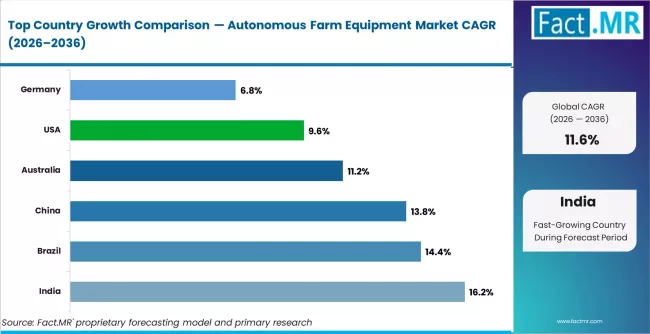
Autonomous Farm Equipment Market Cagr Analysis By Country | Source: Fact.MR
North America: Largest Market, Shifting to High-Specification Systems
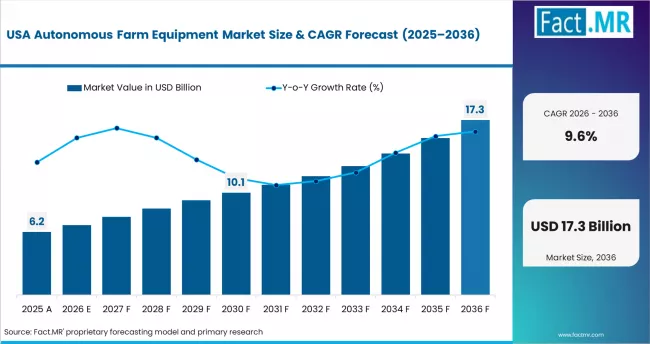
Autonomous Farm Equipment Market Country Value Analysis | Source: Fact.MR
North America accounts for approximately 32% of global autonomous farm equipment revenue in 2026, anchored by large-scale grain, oilseed, and cotton operations in the U.S. Midwest and Canadian Prairies where farm size economics are strongly favorable and labor market conditions are among the most acute in the developed world. The U.S. at 9.6% CAGR is growing from a substantial base; the primary demand driver is transitioning from early adopter farmers investing in first-generation autonomous systems to mainstream adoption on large-scale operations as the John Deere 8R autonomous platform and competitor equivalents complete their commercial rollouts.
Canada's large Prairie grain farms with average operation sizes in the thousands of hectares represent some of the most favorable autonomous equipment economics in the world. Equipment operating 1,500-2,000 hours annually across 3,000+ hectare grain operations achieves payback periods under two years at current pricing. The constraint is supply: John Deere and CNH order books for large autonomous systems are backlogged, reflecting demand that currently outstrips manufacturing capacity.
Western Europe: Regulatory-Driven Transition
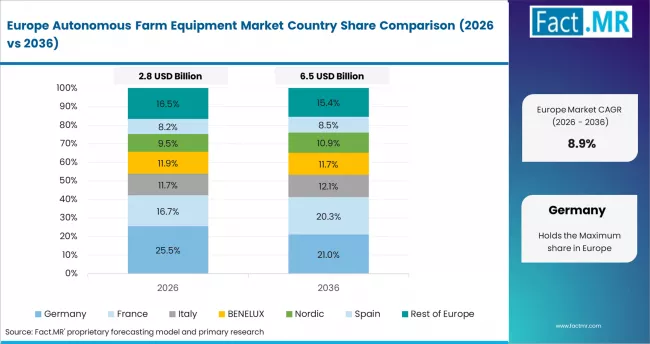
Autonomous Farm Equipment Market Europe Country Market Share Analysis, 2026 & 2036 | Source: Fact.MR
Western Europe at approximately 18% of global revenue is a market defined by the tension between strong agronomic and labor economics rationale for autonomous adoption and a regulatory environment that is still finalizing its type-approval frameworks. Germany (6.8% CAGR) has the most developed regulatory framework and the most commercially active autonomous equipment market in the EU, driven by large grain farms in former East Germany, wine growing operations in Baden-Wurtemberg, and a precision agriculture innovation ecosystem centered around Munich and Berlin. France, the UK post-Brexit (where EU Machinery Regulation does not apply directly), and the Netherlands are the other significant markets.
The EU's Farm to Fork Strategy target of reducing pesticide use by 50% by 2030 is a policy driver for autonomous precision spraying adoption that has no direct equivalent in other major agricultural markets. Machine-vision-guided autonomous sprayers that apply herbicide and pesticide only where target weeds or pests are detected are the technology response to this policy target and the policy creates a regulatory pull for this specific application that accelerates adoption beyond what labor economics alone would drive.
East Asia: Japan Leading, China Scaling Rapidly
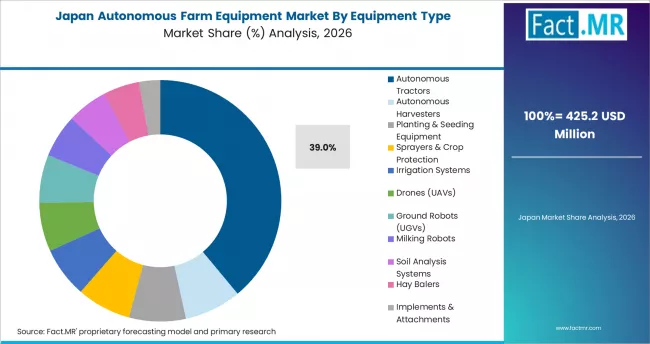
Autonomous Farm Equipment Market Japan Market Share Analysis By Equipment Type | Source: Fact.MR
Japan's autonomous equipment adoption rate relative to its farm size profile is the highest in Asia and among the highest globally a direct consequence of its regulatory proactivity, government subsidy programs, and the severity of its agricultural labor crisis. The average Japanese farm is small (1.5 hectares nationally), which should make the economics unfavorable but government subsidization of up to 50% of autonomous equipment purchase cost for smallholder cooperatives, combined with cooperative ownership structures that pool field operations, has made autonomous equipment economically accessible at farm sizes that would be commercially unviable in other markets.
China at 13.8% CAGR is a market in rapid scaling, driven by government-mandated agricultural modernization programs under the Made in China 2025 framework and its agricultural extensions. DJI Agriculture has built a dominant domestic UAV position its Agras T40 and T50 systems account for an estimated 70%+ of agricultural drone spraying operations in China. Ground-based autonomous equipment adoption is growing from a lower base, constrained by the fragmented smallholder structure of Chinese agriculture outside the large state farm operations in Heilongjiang and Xinjiang.
South Asia & Pacific: India as the Formation Story, Australia as Premium Market
India at 16.2% CAGR leads the global growth table. The driver is not farm size economics Indian average farm size is approximately 1.4 hectares, which makes individual autonomous tractor ownership commercially nonviable for the majority of farmers. The demand is being built through three specific channels: government subsidy programs (the PM-KISAN and SMAM schemes covering up to 80% of autonomous equipment cost for smallholder purchases), custom hiring centers that deploy autonomous equipment on fee-for-service to multiple small farms, and large corporate farming operations in Punjab, Haryana, and Madhya Pradesh where farm aggregation has produced commercially viable scale.
Australia contributes premium-value demand from its vast grain, cotton, and sugar cane operations in Western Australia, Queensland, and New South Wales. Average agricultural operation sizes in Australian broadacre farming frequently exceed 5,000 hectares among the largest in the world creating autonomous equipment economics that are exceptionally favorable. The constraint is connectivity: satellite-based connectivity (Starlink adoption has been rapid among Australian agricultural operations) is addressing the rural broadband infrastructure gap that historically limited precision agriculture adoption.
Latin America: Brazil as the Growth Engine
Brazil at 14.4% CAGR is the dominant Latin American market and one of the most commercially significant globally. The Cerrado region's large-scale soy, corn, and sugarcane operations many exceeding 10,000 hectares under single management present autonomous equipment economics that rival the most favorable markets globally. CNH Industrial and AGCO both have significant manufacturing presence in Brazil and have accelerated their autonomous equipment product rollouts for the Brazilian market. The agricultural technology ecosystem in Mato Grosso and Sao Paulo states has developed its own indigenous precision agriculture technology companies, some of which are integrating with global OEM systems and others of which are developing Brazil-specific autonomous solutions.
Competitive Landscape
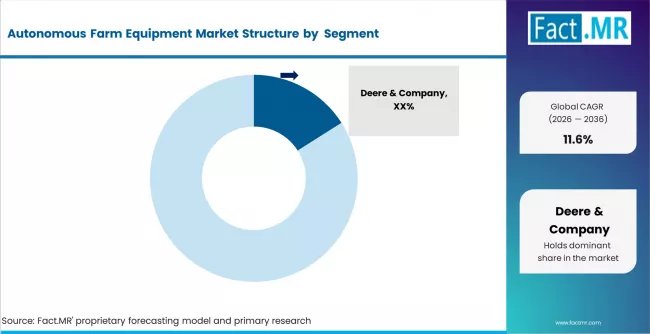
Autonomous Farm Equipment Market Analysis By Company | Source: Fact.MR
How OEMs Are Competing in the Autonomous Farm Equipment Market
Market Growth to Market Reality: Competitive Dynamics among the Leading Players in the Autonomous Farm Equipment Market The autonomous farm equipment market is witnessing a shift from growth-oriented trends towards execution-driven realities. Instead of being solely concerned with market growth potential and CAGR projections, leading companies like Deere & Company, AGCO Corporation, and CNH Industrial have become focused on maximizing operational visibility and profitability.
Market attractiveness is currently characterized by short-term indicators such as backlog and order volumes, demand at the dealer level, and lead times for production, rather than long-term growth. On another front, pricing trends in different equipment categories, levels of automation, and geographic markets are becoming pivotal in driving margins and product differentiation strategies. Similarly, the importance of channel relationships and distribution strategies continues to hold ground, and distribution strength and aftermarket opportunities often play a greater role than the unique features of a particular piece of equipment in shaping competition.
Value pools are also shifting towards service agreements, recurring revenue models based on spare parts, and precision agriculture software platforms. In terms of demand, there is increasing evidence of heterogeneity in the buyer segment, with the market comprising various customer types such as corporate farms, cooperatives, and contractors, each displaying distinct buying behavior and financing needs. The availability of financing services, leasing and subsidies, emerges as one of the key determinants in unlocking market adoption and penetration, especially in developing economies. As far as product-market fit goes, it appears that automation is most valuable for high economic-yield and labor-intensive crops, meaning that investments should target specific regions and markets. As the market expands its scope to include small scale farms through retrofitting and autonomy-as-a-service, the number of players competing within it will increase. Supply side factors, such as component dependency and manufacturing capacity will also be instrumental in defining competitive dynamics, as will regulation.
OEM vs. Startup Competitive Dynamics: A Market Being Contested on Two Fronts
The competitive landscape in autonomous farm equipment is not a simple story of established OEMs defending market share against agri-tech startup challengers. The dynamics are more nuanced: while the two camps compete in some areas, there are others where OEMs do not compete against their startups at all. In order to understand what is really going on, one needs to know where the battles are taking place.
Established OEMs: Equipment Ecosystem and Data Platform Defense
John Deere holds 18.4% of global autonomous farm equipment revenue in 2026 a position built on six decades of equipment market leadership, a dealer network with over 5,000 locations globally, and an equipment financing capability that allows it to offer customers purchase terms no startup can match. Its autonomous equipment strategy is built around the Operations Center data platform, which creates ecosystem lock-in by accumulating farm-specific agronomic data that becomes increasingly valuable as a decision-making resource over time. A farmer with eight years of planting, yield, soil sampling, and equipment performance data stored in John Deere's Operations Center faces a genuine switching cost: moving to a competitor's equipment means either losing that data history or managing complex data migration that most farmers are not equipped to execute.
CNH Industrial's competitive position across Case IH and New Holland brands is anchored in its global distribution reach particularly strong in Brazil, Eastern Europe, and Australia and its AFS (Advanced Farming Systems) precision agriculture platform. AGCO's Fuse platform and Kubota's K-Connect system represent equivalent strategies from competing OEMs. The shared assumption in all these platform strategies is that the long-term competitive moat in autonomous agriculture is the data and software layer, not the equipment hardware. All four major OEMs are investing in software engineering talent at rates that would have seemed implausible for traditional equipment manufacturers a decade ago.
Agri-Tech Startups: Precision, Retrofit, and Subscription Attack
Startup challengers are not attempting to out-invest OEMs in equipment manufacturing. They are attacking on specific dimensions where the large OEMs are structurally disadvantaged: software development velocity, business model innovation, and willingness to work with existing equipment rather than requiring new hardware purchases.
Monarch Tractor has built its commercial position specifically around the electric autonomous tractor market segment a segment that incumbent OEMs, with their existing diesel powertrain manufacturing investments, have been slow to pursue aggressively. Its Mk V tractor positions itself as an electric-first autonomous platform designed from the ground up for autonomous operation, rather than a conventional tractor with autonomous features bolted on. The commercial traction has been sufficient to attract significant venture investment and meaningful commercial orders from wine grape and orchard operators where electric operation delivers genuine advantages (orchard air quality, lower noise for residential-adjacent operations).
Sabanto and EarthSense represent a different startup strategy: retrofitting existing conventional tractors with autonomous operation capability. Sabanto's approach of providing autonomous operation as a service where farmers pay per-hour for autonomous tractor operation rather than purchasing the autonomous system is a business model innovation that bypasses the capital expenditure barrier entirely. A USD 350,000 autonomous tractor becomes a USD 45-65 per hour service, which is comparable to conventional skilled operator cost in the U.S. Midwest. This subscription model is attracting adoption from mid-scale farmers who cannot justify equipment purchase economics but can justify autonomous operation at operator-equivalent cost.
Recent Industry Developments
- Daedong – AI Autonomous Tractor Launch (April 2026)
Daedong introduced its first AI-powered tractor, positioning it as the world’s first commercially available vision-based autonomous farming machine. The tractor leverages artificial intelligence and advanced vision systems to enable fully autonomous field operations without reliance on GPS, marking a significant advancement in smart agriculture. The launch reflects Daedong’s strategic push toward AI-driven farm equipment and aims to address labor shortages while improving operational efficiency in agriculture. - AGCO – Autonomous & Precision Solutions Showcase at Commodity Classic (February 2026)
AGCO announced it will showcase a comprehensive portfolio of autonomous, retrofit, and precision agriculture solutions at the 2026 Commodity Classic in San Antonio, Texas. The exhibition will feature its key brands—Fendt, Massey Ferguson, and PTx—across more than 24,000 square feet, highlighting next-generation machinery, smart farming technologies, and advanced autonomy systems. (AGCO) [2] - SLC Agrícola – Autonomous Crop Sprayer Expansion with Pyka (January 2026)
Brazilian agribusiness leader SLC Agrícola expanded its partnership with US-based robotics company Pyka to scale deployment of autonomous crop-spraying aircraft across multiple farms. Following a successful pilot during the previous growing season, the company placed a follow-on order for Pyka’s Pelican 2 unmanned aircraft to enhance productivity and operational efficiency. The solution enables large-scale aerial spraying with lower operating costs and improved spray precision, while supporting night-time application—an important advantage for pesticide effectiveness. (SLC Agrícola) [3] - Kubota – CES 2026 Autonomous & Smart Farming Showcase (January 2026)
Kubota Corporation announced its participation in CES 2026, where it showcased next-generation autonomous and smart agriculture technologies under the theme “Smart Innovation For You.” The exhibit focused on solutions for specialty crop farming, highlighting Kubota’s strategic push toward automation, precision agriculture, and sustainable food production. (Kubota) [4] - Kubota – Next-Gen KFAST Autonomous Sprayer (November 2025)
Kubota unveiled the next-generation KFAST, a fully autonomous sprayer designed for specialty crops such as orchards and plantations, at Agritechnica 2025. The system integrates precision spraying, intelligent navigation (RTK GPS + LiDAR), and digital farm management to enable fully autonomous operations with minimal human intervention. (Kubota) [5] - Bonsai Robotics – Acquisition of farm-ng (July 2025)
Bonsai Robotics acquired US-based agtech startup farm-ng to accelerate the development of “AI-first” autonomous farming machines, combining advanced computer vision software with modular robotic hardware. The deal brings together Bonsai’s expertise in vision-based autonomy and farm-ng’s electric robotic platforms, enabling integrated solutions for a wide range of agricultural tasks across crops and environments. (Bonsai Robotics) [6]
Key Players of the Autonomous Farm Equipment Market
- Autonomous Farm Equipment Manufacturers
- Deere & Company
- Escorts Ltd.
- Kubota Corp
- Monarch tractors
- Raven industries
- Yanmar holding co., Ltd.
- Bobcat (a Doosan company)
- Claas KGaA GmbH
- Mahindra & Mahindra Ltd.
- Technology Providers
- AG Leader Technology, Inc.
- Agjunction Inc.
- Autonomous solution Inc.
- Autonomous tractor corp.
- Bear Flag robotics
- KENDRION
- NovAtel Inc. (Hexagon)
Research Methodology
The Fact.MR study on the autonomous farm equipment market is based on a combination of primary research, secondary research, and quantitative demand modeling across multiple segments. Secondary research sources include data from agricultural bodies such as the Food and Agriculture Organization (FAO), policy frameworks from the U.S. Department of Agriculture (USDA), European Commission agriculture and machinery regulations, UAV guidelines from aviation authorities (e.g., FAA), and financial disclosures of leading agricultural equipment manufacturers such as Deere & Company, AGCO Corporation, CNH Industrial, Kubota Corporation, and Mahindra & Mahindra.
Primary research involved interviews with key industry stakeholders, including farm owners, agribusiness operators, equipment distributors, precision agriculture specialists, agri-tech solution providers, and executives from OEMs across North America, Europe, and Asia-Pacific. These insights provide ground-level validation on adoption trends, purchasing behavior, ROI expectations, and operational challenges that are not fully captured through secondary sources.
Market sizing follows a bottom-up approach, based on equipment-wise volume estimates, farm size distribution, adoption rates of autonomous technologies, replacement cycles, and average selling prices across segments. This methodology ensures higher accuracy in a multi-segment market where demand drivers vary significantly by equipment type, application, and region, compared to top-down estimations.
Analyst Opinion
The autonomous farm equipment market is at a critical transition phase, driven by the convergence of enabling technologies and structural demand drivers. Key barriers such as high upfront costs, technological limitations, and regulatory uncertainties are gradually being addressed through advancements in AI, sensor technologies, and supportive policy frameworks. At the same time, labor shortages, rising input costs, and the need for precision farming are accelerating adoption. The market is shifting from pilot deployments to early commercialization, and the key question for stakeholders is not whether adoption will scale, but which companies can effectively integrate technology, economics, and distribution to capture long-term value.
Strategic Insights
- The retrofit market is the underserved volume opportunity: New autonomous equipment economics favor large farms above 400-500 hectares. The 200-400 hectare mid-scale farm segment which represents substantial global acreage is commercially accessible only through retrofit or equipment-as-a-service models. Manufacturers and agri-tech companies that build commercially viable retrofit and subscription offerings for this segment will access a market pool that pure new-equipment strategies cannot reach.
- BVLOS regulatory approval is the UAV market inflection trigger: The agricultural UAV market in North America and Western Europe is constrained below its commercial potential by BVLOS restrictions that prevent fully autonomous multi-drone swarm operations. FAA BVLOS rulemaking completion (anticipated 2026-2027) will be a commercial inflection event for agricultural UAV operators in the U.S. Equipment manufacturers should be building the BVLOS-ready fleet management and airspace deconfliction capabilities now, not after the regulation changes.
- Robotic harvesting technology investment is commercially urgent: The agricultural labor shortage in high-value fruit and vegetable crops is creating commercial demand for robotic harvesting at performance levels (60-75% success rate) that would not have been acceptable a decade ago. Companies that achieve 85%+ success rates across two or three crop types will be in a strongly differentiated commercial position by 2028-2030. The window for achieving that technical leadership is current not post-2030.
The data platform is the long-term moat: Equipment hardware is becoming commoditizable. The AI models trained on fleet-wide agronomic data and the switching costs created by years of farm-specific operational history are the competitive advantages that will prove most durable. OEMs that treat their data platforms as separate business units with dedicated commercial development, rather than as marketing features for equipment sales, will generate the highest long-term enterprise value from their autonomous equipment investments.
Autonomous Farm Equipment Market Key Segments
-
By Equipment Type:
- Autonomous Tractors
- Row crop tractors
- Orchard / vineyard tractors
- Compact / utility tractors
- Articulated tractors
- Autonomous Harvesters
- Combine harvesters
- Forage harvesters
- Specialty crop harvesters
- Planting & Seeding Equipment
- Seed drills
- Precision planters
- Transplanters
- Sprayers & Crop Protection
- Boom sprayers
- Spot spraying robots
- Weeding robots (mechanical / AI-based)
- Irrigation Systems
- Autonomous pivots
- Smart irrigation robots
- Drones (UAVs)
- Spraying drones
- Monitoring / imaging drones
- Ground Robots (UGVs)
- Field robots
- Multi-purpose robotic platforms
- Milking Robots
- Automatic milking systems (AMS)
- Robotic dairy management systems
- Soil Analysis Systems
- Autonomous soil sampling robots
- Sensor-based soil monitoring systems
- Hay Balers
- Autonomous round balers
- Autonomous square balers
- Implements & Attachments
- Ploughs
- Cultivators
- Fertilizer spreaders
- Autonomous Tractors
-
By Technology:
- Fully Autonomous
- Partially Autonomous
-
By Application Area:
- Agricultural Farms
- Dairy Farms (Livestock Management)
- Greenhouses and Indoor Farms
- Horticulture
- Agroforestry
- Fruit Orchards
- Landscaping and Turf Management
- Vineyards
-
By Region:
- North America
- U.S.
- Canada
- Mexico
- Latin America
- Brazil
- Argentina
- Chile
- Rest of Latin America
- Western Europe
- Germany
- Italy
- France
- U.K.
- Spain
- Norway
- Sweden
- Denmark
- Belgium
- Nordic Countries
- Rest of Western Europe
- Eastern Europe
- Russia
- Hungary
- Poland
- CIS Countries
- Balkan & Baltic Countries
- Rest of Eastern Europe
- East Asia
- China
- Japan
- South Korea
- South Asia & Pacific
- India
- ASEAN
- Australia & New Zealand
- Rest of South Asia
- Middle East & Africa
- Kingdom of Saudi Arabia
- Other GCC Countries
- Turkiye
- South Africa
- Other African Union
- Rest of MEA
- North America
Cross-Sectional Demand Interplay & Technology Alignment in Autonomous Farm Equipment Market
According to the cross-sectional analysis conducted by Fact.MR, the autonomous farm equipment industry exhibits significant interdependency among equipment types, degrees of autonomy, and use cases based on agricultural activities. As far as equipment categories are concerned, autonomous tractors, harvesters, drones, and implements constitute the key components of equipment. Nonetheless, their usage depends on the farm size, crops grown, and complexity of activities performed. Specifically, large-scale farms specializing in growing row crops use powerful autonomous tractors, while smaller farms engaged in growing specialist crops or horticultural crops utilize robots and drones for carrying out spraying and monitoring activities.
As concerns technology, degrees of autonomy are highly correlated with sensors and connectivity. Thus, fully autonomous vehicles are equipped with advanced GNSS-RTK positioning technologies and LiDAR sensors together with artificial intelligence perception capabilities in regions where there are no restrictions in terms of regulations and safety requirements. Semi-autonomous machines remain popular in cost-conscious markets or in regions with strict regulation in place, which means that camera-based sensors and operator assistance are used. In relation to operations and deployment, new precision agriculture facilities opt for high autonomy and integrated solutions, whereas retrofits are usually equipped with autonomy kits allowing converting conventional vehicles into semi-autonomous ones. In addition to hardware, software and service components such as farm management platforms, telematics, and autonomy-as-a-service models are gaining importance, particularly in labor-constrained regions.
Case Study: Go-to-Market Strategy Design for an Asian Autonomous Farm Equipment Manufacturer Entering North America
One of the leading manufacturers of agricultural machinery in East Asia, specializing in small-sized autonomous tractors and robotic equipment in Japan and South Korea, contracted Fact.MR for designing their go-to-market strategy for North America. The company had designed competitively priced semi-autonomous and autonomous vehicles but had to contend with three primary issues: low brand awareness in North America, mismatch between product offerings and requirements for large-scale farms in the US, and a lack of clarity about the channel strategy in a distributor-dominated market environment.
Fact.MR initiated the engagement with an extensive market segmentation exercise along with benchmarking against competitors in both the United States and Canada, considering factors such as the size distribution of farms, crops planted, and degree of mechanization. A hybrid market approach was developed that would involve partnering with regional distributors as well as piloting the products among large farming cooperatives. Meanwhile, Fact.MR recommended a unique equipment as a service (EaaS) model. A product-market fit assessment identified the need for portfolio repositioning rather than full redesign. Fact.MR recommended prioritizing mid-sized autonomous tractors (100–150 HP) for specialty crops, orchards, and mixed farming operations in California, Washington, and parts of the Midwest, where labor shortages are acute and field sizes are compatible with the client’s platforms.
Channel strategy analysis indicated that direct market entry would face resistance due to the dominance of established dealer networks. A hybrid go-to-market model was designed, combining partnerships with regional equipment dealers and pilot-based deployments with large farming cooperatives. In parallel, Fact.MR advised introducing an Equipment-as-a-Service (EaaS) model to reduce upfront adoption barriers and differentiate from incumbents. The strategy roadmap involved geographically phasing out their introduction into North America, adapting their product offering according to local demands (incorporating telematics and regulatory considerations), and forming strategic partnerships. This approach enabled the client to align its technology strengths with North American demand conditions while mitigating entry risks and accelerating commercialization timelines.
Bibliographies
- [1] News1 Korea, “Daedong launches AI-based autonomous tractor using vision technology,” News1, Apr. 2026.
- [2] AGCO Corporation, “AGCO brands showcase innovations and autonomous solutions at 2026 Commodity Classic,” AGCO Investor News, Feb. 2026.
- [3] AgFunderNews, “Brazilian ag giant SLC Agrícola scales use of unmanned crop sprayers with Pyka,” AgFunderNews, Jan. 22, 2026.
- [4] Kubota Corporation, “Kubota exhibits at CES 2026 showcasing autonomous and smart agriculture solutions,” Kubota News, Jan. 7, 2026.
- [5] Kubota Group Europe, “Next-gen KFAST is here: Kubota’s smarter, faster autonomous sprayer for specialty crops,” Kubota Group Europe News, Nov. 2025.
- [6] AgFunderNews, “Bonsai Robotics acquires farm-ng to herald new era of AI-first machines that will transform crop management,” AgFunderNews, July 2025
Autonomous Farm Equipment Market Definition
The Autonomous Farm Equipment Market refers to the global designing, production, and application of farm machinery systems that have the capability to conduct agricultural processes with minimal or no continuous presence of human operators onboard. This includes both completely autonomous systems (unattended operation without any human operator either onboard or in proximity), semi-autonomous systems (with onboard human supervisors without any control), and guided systems (onboard human operator but with considerable operations being automated).
Scope of the market includes autonomous/semi-autonomous tractors/powered units, autonomous agricultural UAV/drone systems for application, seeding, scouting, and mapping operations, robotic harvesters, autonomous seeders/planters, autonomous spraying and application systems, and autonomous soil sensor/crop scouting,
Autonomous Farm Equipment Market Inclusions
- Segmentation by Equipment Type, Technology, Application, and Region with country-level coverage (U.S., Europe, Asia-Pacific, LATAM).
- Competitive analysis covering market share, product portfolio, autonomy level, and digital/AI capabilities.
- Regulatory assessment including autonomous equipment policies, UAV regulations, and compliance frameworks.
- Technology assessment including AI, computer vision, GPS/RTK, LiDAR, IoT, and autonomous navigation systems.
- End-user and adoption analysis across large-scale farms, medium farms, smallholder farms, agribusiness companies, and contract farming/service providers
- Application-level assessment covering land preparation, planting, spraying, harvesting, weeding, irrigation, soil monitoring, and livestock automation (e.g., milking robots).
Autonomous Farm Equipment Market Market Exclusions
- Conventional (non-autonomous) agricultural machinery without embedded automation, AI, or autonomous navigation capabilities
- General-purpose drones or UAVs not specifically designed for agricultural applications such as spraying, monitoring, or mapping.
- Standalone sensors, GPS devices, or IoT hardware sold independently without integration into autonomous farm equipment solutions
- Consumer-grade smart farming tools or mobile applications without integration into autonomous equipment ecosystems
- Industrial or construction autonomous equipment not intended for agricultural use cases.
Segmentation
Report Scope
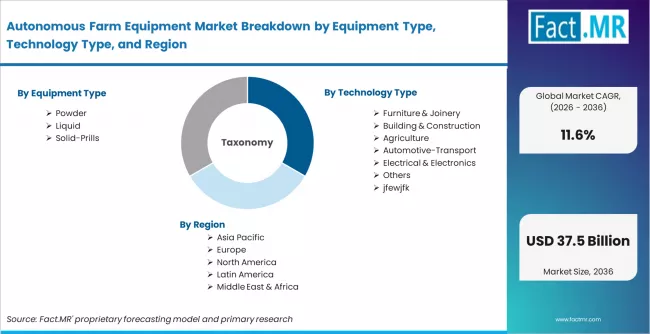
Autonomous Farm Equipment Market Breakdown By Equipment Type, Technology Type, And Region | Source: Fact.MR
| Metric | Value |
|---|---|
| Quantitative Units | USD 1.3 billion (2025) to USD 37.5 billion (2036), at a CAGR of 11.6% |
| Market Definition | Autonomous and semi-autonomous agricultural machinery systems, including hardware, embedded software, and connectivity subscriptions. Covers tractors, UAVs, robotic harvesters, seeding systems, sprayers, and autonomous scouting platforms. |
| By Equipment Type | Autonomous Tractors, Autonomous Harvesters, Planting & Seeding Equipment, Sprayers & Crop Protection, Irrigation Systems, Drones (UAVs), Ground Robots (UGVs), Milking Robots,Soil Analysis Systems, Hay Balers, Implements & Attachments |
| Segmentation by Technology | Fully Autonomous , Partially Autonomous |
| Segmentation by Application | Agricultural Farms, Dairy Farms (Livestock Management), Greenhouses and Indoor Farms, Horticulture, Agroforestry, Fruit Orchards, Landscaping and Turf Management, Vineyards |
| Regions Covered | North America, Western Europe, East Asia, South Asia & Pacific, Latin America, Eastern Europe, Middle East & Africa |
| Countries Covered | U.S., Canada, Germany, France, UK, Japan, China, South Korea, India, Brazil, Australia, Argentina |
| Key Companies Profiled | John Deere, CNH Industrial, AGCO, Kubota, Trimble, DJI Agriculture, Monarch Tractor, Sabanto, Naio Technologies |
| Forecast Period | 2026 to 2036 |
| Research Approach | Bottom-up demand modeling by equipment type, farm size, and region; primary interviews with farm operators, OEM product managers, agri-tech startup executives, and agricultural policy officials; equipment order book analysis; regulatory document review across 12 jurisdictions; farm economics TCO modeling by operation type. |
Source: Fact.MR analysis. Updated Apr 14, 2026
Frequently Asked Questions
What is the current size of the global Autonomous Farm Equipment Market?
How large will the market be by 2036?
What is the expected growth rate of the market?
Which equipment type is growing fastest?
Why is farm size such a critical adoption variable?
Which country is expected to show the highest growth rate in the market?
What is the regulatory situation for autonomous farm equipment in the EU?
What is the retrofit opportunity and why is it underestimated?
What is the long-term competitive structure of this market?
Who worked on this report


Preview the report firsthand - request a free sample
Free SampleGet the brochure for pricing and purchase details
Download PDF