- Market Value (2025): USD 786.8 Mn
- Estimated Value (2026): USD 823.8 Mn
- Forecast Value (2036): USD 1309.0 Mn
- CAGR (2026-2036): 4.7%
What is the Field-Mount Temperature Transmitters Market forecast to be worth by 2036?
USD 823.8 million in 2026 to USD 1,309.0 million by 2036 at a 4.7% CAGR.
- The field-mount temperature transmitters market was valued at USD 786.8 million in 2025, with RTD temperature transmitters making up the largest share among product types.
- Industrial operators upgrading temperature measurement systems will lift revenue from USD 823.8 million in 2026 to USD 1,309.0 million by 2036.
- Through 2036, the market will compound at 4.7% CAGR, as process industries modernize instrumentation and prioritize reliable temperature monitoring.
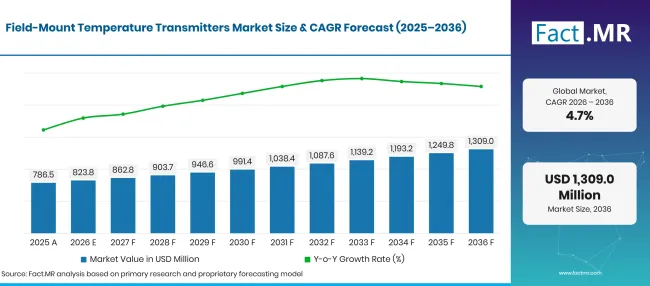
Mount Temperature Transmitters Market Forecast Global | Source: Fact.MR
| Year | Basis | Market Value (USD million) |
|---|---|---|
| 2025 | Actual | 786.8 |
| 2026 | Estimate | 823.8 |
| 2036 | Forecast | 1,309.0 |
| CAGR (2026–2036) | Forecast period | 4.7% |
Source: Fact.MR analysis. Updated Oct 28, 2026
What are the defining numbers behind Field-Mount Temperature Transmitters Market growth?
Between 2026 and 2036, the market will gain USD 485.2 million as industrial facilities replace aging instruments, tighten process monitoring, and connect temperature transmitters more closely with plant control systems.
- Demand Drivers in the Market
- Industrial process control requirements are driving demand for field-mount temperature transmitters. Oil and gas refineries and chemical plants rely on accurate temperature readings to maintain process stability, manage operating risks, and meet production specifications. These needs support continued investment in dependable field instrumentation.
- The need for precise and stable measurements strengthens demand for RTD temperature transmitters. Thermocouple and universal transmitters serve processes with different temperature ranges and sensor requirements, giving industrial buyers flexibility to select instruments suited to specific operating conditions.
- Compatibility with existing control infrastructure influences purchasing decisions. Industrial facilities often prioritize transmitters that integrate with established plant systems to avoid costly changes to control networks. Modernization projects also create opportunities for digital communication technologies, including fieldbus and wireless solutions.
- Expansion and modernization across power generation, food processing, and water treatment increase the need for consistent temperature monitoring. Operators use field instruments to maintain product quality, track process performance, and reduce disruptions caused by inaccurate readings.
- Harsh operating conditions and the cost of unplanned downtime encourage investment in durable field-mount equipment. Reliable transmitters with suitable enclosure protection and diagnostic functions help industrial facilities manage maintenance demands and sustain operations in challenging plant environments.
- Key Segments Analyzed
- By Product Type: RTD Temperature Transmitters represent 42.3% of the market in 2026, owing to their suitability for industrial applications that demand stable and accurate temperature readings.
- By Communication Protocol: HART commands a 38.4% share in 2026, reflecting its continued use across established industrial instrumentation and process-control networks.
- By End-User Industry: Oil & Gas contributes 24.8% of the market in 2026, driven by temperature monitoring needs across processing, refining, and related operations.
- Analyst Opinion at Fact.MR
- Shambhu Nath Jha, Principal Consultant at Fact.MR, states, “The field-mount temperature transmitters market will continue to expand as industrial facilities replace aging instrumentation and strengthen process monitoring. Rising requirements for accurate temperature measurement, operational consistency, and equipment reliability are driving demand across oil and gas, chemical processing, and power generation.”
- Strategic Implications
- Measurement precision, flexible sensor support, and rugged enclosure design give manufacturers a stronger position in demanding industrial environments.
- Existing communication networks influence transmitter replacement decisions. Buyers need to confirm compatibility with HART, Foundation Fieldbus, and Profibus before upgrading installed instrumentation.
- Distributors gain a competitive advantage by combining product availability with calibration services, installation guidance, and replacement options tailored to plant requirements.
- Growing adoption of plant-wide monitoring systems creates opportunities for instrumentation companies. Transmitters offering straightforward connectivity and effective diagnostics help operators improve process visibility and maintenance efficiency.
Germany leads at 5.9% CAGR on control modernization. The United States follows at 5.5% on oil, gas, chemicals and power. Brazil posts 5.1% as plants renew monitoring equipment. Japan grows 4.4% on production measurement needs. The United Kingdom adds 3.4% via process upgrades.
How does the Field-Mount Temperature Transmitters Market break down by segment?
RTD Temperature Transmitters lead Product Type at 42.3%; HART heads Communication Protocol at 38.4%; Oil & Gas holds first place in End-User Industry at 24.8%.
Which Product Type leads?
RTD Temperature Transmitters take 42.3% of 2026 market value.
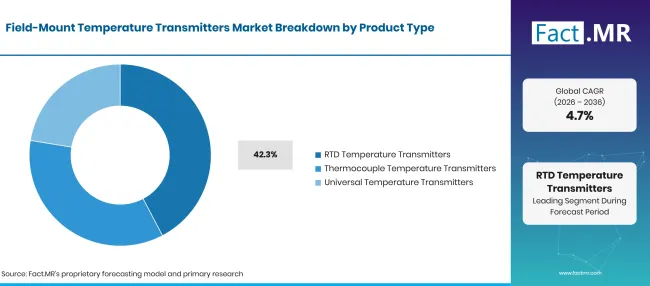
Field Mount Temperature Transmitters Market Breakdown Product Type | Source: Fact.MR
| Product Type | Share (2026) |
|---|---|
| RTD Temperature Transmitters (Leading segment) | 42.3% |
| Other segments combined | 57.7%* |
| Total | 100.0% |
Source: Fact.MR analysis. Updated Oct 28, 2026
RTD temperature transmitters lead the segment because industrial facilities value their measurement stability, accuracy, and dependable performance in routine process monitoring. These instruments suit applications where consistent temperature readings help maintain product quality, control operating conditions, and prevent process deviations.
Their established use across oil and gas, chemical processing, power generation, and manufacturing also supports wider adoption. Thermocouple and universal transmitters serve specific temperature ranges and sensor requirements, while RTD models remain a common choice for applications prioritizing precise, repeatable measurements.
What supports HART within Communication Protocol?
HART represents 38.4% of 2026 market value.
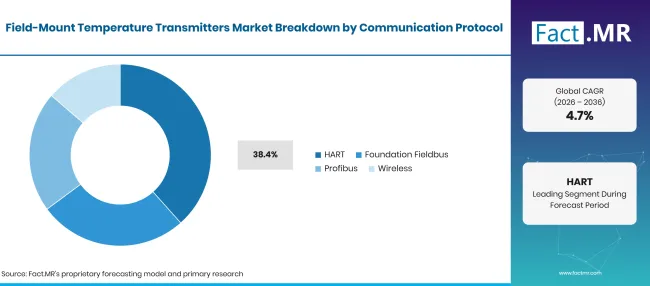
Field Mount Temperature Transmitters Market Breakdown Communication Protocol | Source: Fact.MR
| Communication Protocol | Share (2026) |
|---|---|
| HART (Leading segment) | 38.4% |
| Other segments combined | 61.6%* |
| Total | 100.0% |
Source: Fact.MR analysis. Updated Oct 28, 2026
Compatibility with existing industrial control systems gives HART a strong position in the communication protocol segment. Many process plants already use HART-enabled instruments, making upgrades easier without major changes to established infrastructure. The protocol also allows operators to access measurement data and device diagnostics alongside standard analog signals, helping maintenance teams identify issues and manage equipment performance.
Foundation Fieldbus, Profibus, and wireless communication serve specific network designs and modernization needs, while HART remains a practical choice for facilities seeking reliable connectivity and cost-conscious instrumentation upgrades.
How does End-User Industry shape demand?
Oil & Gas moves 24.8% of 2026 market value.
| End-User Industry | Share (2026) |
|---|---|
| Oil & Gas (Leading segment) | 24.8% |
| Other segments combined | 75.2%* |
| Total | 100.0% |
Source: Fact.MR analysis. Updated Oct 28, 2026
Continuous temperature monitoring is essential across oil and gas operations, where refining, gas processing, and pipeline activities depend on controlled operating conditions. Field-mount temperature transmitters help operators track process temperatures, maintain equipment performance, and identify deviations before they disrupt production.
Harsh operating environments and strict process safety requirements further increase the need for reliable instrumentation. Although chemical processing, power generation, food production, and water treatment also require temperature control, the extensive monitoring needs across oil and gas facilities give this industry a leading position in market demand.
What is accelerating Field-Mount Temperature Transmitters Market adoption, and what is holding it back?
Industrial automation, replacement of aging instruments, and the need for reliable temperature measurement keep demand moving toward field-mount transmitters. Integration challenges, installation costs, and the need to maintain compatibility with existing control infrastructure may delay a share of purchasing decisions.
Drivers Impact Analysis
| DRIVER | (~) % IMPACT ON CAGR | GEOGRAPHIC RELEVANCE | IMPACT TIMELINE |
|---|---|---|---|
| Plants replacing aging temperature transmitters | +1.5% | Global | Short term (≤ 2 years) |
| Growing automation and process monitoring needs | +1.1% | Global | Medium term (2–4 years) |
| Need for accurate, stable readings in critical processes | +0.8% | Global | Medium term (2–4 years) |
| Easier connection of field instruments to existing plant networks | +0.5% | Global | Medium term (2–4 years) |
Source: Fact.MR analysis. Updated Oct 28, 2026
Opportunity Impact Analysis
| OPPORTUNITY | (~) % IMPACT ON CAGR | GEOGRAPHIC RELEVANCE | IMPACT TIMELINE |
|---|---|---|---|
| Swapping older instruments for digitally connected transmitters | +0.6% | Global | Medium term (2–4 years) |
| Wireless monitoring at points that are hard to wire | +0.5% | Global | Medium to long term |
| Universal transmitters that work with many sensor types | +0.3% | Global | Medium term (2–4 years) |
| Linking transmitters to plant monitoring and diagnostic systems | +0.2% | Global | Long term (≥ 4 years) |
Source: Fact.MR analysis. Updated Oct 28, 2026
Restraints Impact Analysis
| RESTRAINT | (~) % IMPACT ON CAGR | GEOGRAPHIC RELEVANCE | IMPACT TIMELINE |
|---|---|---|---|
| Installation and commissioning costs during upgrades | -0.3% | Global | Short term (≤ 2 years) |
| Compatibility problems with legacy control systems and protocols | -0.2% | Global | Short to medium term |
| Ongoing calibration and maintenance work | -0.2% | Global | Medium term (2–4 years) |
| Delayed capital spending at industrial facilities | -0.1% | Global | Short term (≤ 2 years) |
Source: Fact.MR analysis. Updated Oct 28, 2026
Which countries are scaling the Field-Mount Temperature Transmitters Market through 2036?
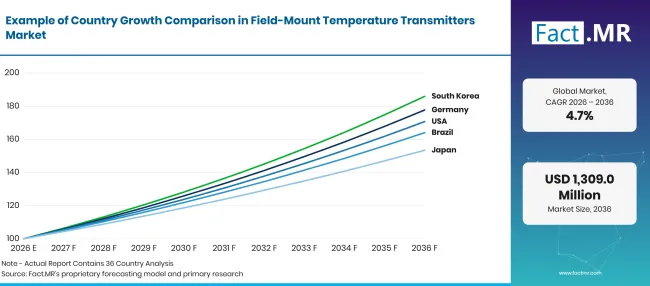
Factmr Field Mount Temperature Transmitters Market Growth Index | Source: Fact.MR
| Country | CAGR (2026 to 2036) |
|---|---|
| Germany | 5.9% |
| Brazil | 5.1% |
| United States | 5.5% |
| United Kingdom | 3.4% |
| Japan | 4.4% |
Source: Fact.MR analysis. Updated Oct 28, 2026
What supports Germany’s adoption?
Germany’s strong industrial base and ongoing factory modernization sustain demand for field-mount temperature transmitters. Chemical plants, energy facilities, and manufacturers rely on accurate process measurements to maintain production standards and equipment reliability.
Destatis reported industrial production in December 2025 at 0.6% below the prior year, yet output over October to December ran 0.9% above the previous three months [1]. Replacement of older instruments and upgrades to automated control systems create further opportunities for compatible, high-performance transmitters.
How is Brazil developing demand?
Brazil’s energy and industrial processing sectors require dependable temperature monitoring across production and refining operations. IBGE reported that seasonally adjusted industrial production fell 1.2% in December 2025 from November, while output was 0.4% above December 2024 [2].
Investment in plant equipment, replacement of aging instruments, and improvements to process control encourage purchases of field-mount transmitters. Ease of installation and manageable maintenance requirements also influence equipment selection.
What is supporting the United States’ adoption?
The extensive oil and gas infrastructure across the United States creates sustained demand for reliable temperature measurement. According to the U.S. Energy Information Administration, operable atmospheric distillation capacity at U.S. refineries stood at 18.2 million barrels per calendar day on January 1, 2026, about 1% lower than a year earlier [5].
Chemical processors, power plants, and manufacturers also use transmitters to monitor critical operating conditions. Instrument replacement, automation projects, and integration with industrial monitoring systems further contribute to market growth.
How is the United Kingdom scaling demand?
Modernization of established process facilities is creating demand for field-mount temperature transmitters across the United Kingdom.
ONS data show total UK manufacturers’ product sales of £452.0 billion in 2025, down 1.8% from 2024, with food the largest division at 22.9% [4]. Manufacturers in chemicals, energy, and food processing require dependable measurements to maintain operating standards. Replacement cycles and control-system upgrades encourage purchases, particularly when new instruments work with existing plant infrastructure.
How does Japan perform?
Japan’s emphasis on manufacturing precision and production reliability supports demand for field-mount temperature transmitters. METI’s revised report put the seasonally adjusted production index at 101.8 in December 2025, a 0.1% dip from November [3].
Industrial operators need consistent measurements to maintain process quality and limit production interruptions. Replacement of installed instrumentation and upgrades to automated control systems sustain purchasing activity across manufacturing and process industries.
Who leads the Field-Mount Temperature Transmitters Market?
Competition in the field-mount temperature transmitters market centers on measurement accuracy, sensor support, communication protocols, and integration with industrial control systems. Emerson Electric Co., ABB Ltd., Siemens AG, and Honeywell International Inc. offer industrial automation and process control technologies, including temperature measurement solutions.
Yokogawa Electric Corporation and Endress+Hauser Group serve process industries through temperature instrumentation and related measurement systems. WIKA Alexander Wiegand SE & Co. KG specializes in temperature and pressure measurement, while PR electronics A/S focuses on signal conditioning and isolation. Moore Industries International, Inc. offers temperature transmitters and industrial signal interface products, and Azbil Corporation serves automation and measurement applications.
Which companies are the key providers?
Key companies include Emerson Electric Co.; ABB Ltd.; Siemens AG; Honeywell International Inc.; Yokogawa Electric Corporation; Endress+Hauser Group; WIKA Alexander Wiegand SE & Co. KG; PR electronics A/S; Moore Industries International, Inc.; and Azbil Corporation.
- Emerson Electric Co.
- ABB Ltd.
- Siemens AG
- Honeywell International Inc.
- Yokogawa Electric Corporation
- Endress+Hauser Group
- WIKA Alexander Wiegand SE & Co. KG
- PR electronics A/S
- Moore Industries International, Inc.
- Azbil Corporation
Bibliography
- [1] Statistisches Bundesamt (Destatis). (2026, February 6). Production in December 2025: -1.9% on the previous month. Destatis source
- [2]Instituto Brasileiro de Geografia e Estatística. (2026, February 3). Industrial output retreats 1.2% in December. https://agenciadenoticias.ibge.gov.br/agencia-sala-de-imprensa/2013-agencia-de-noticias/releases/45788-producao-industrial-recua-1-2-em-dezembroIBGE source
- [3] Ministry of Economy, Trade and Industry. (2026, February 16). Indices of Industrial Production: Revised report for December 2025. Government of Japan. METI source
- [4] Office for National Statistics. (2026, July 24). UK manufacturers’ sales by product: 2025. ONS source
- [5] U.S. Energy Information Administration. (2026, June 29). U.S. refining capacity decreased during 2025. https://www.eia.gov/todayinenergy/detail.php?id=67807EIA source
This Report Answers
- Market revenue is forecast to rise from USD 823.8 million in 2026 to USD 1,309.0 million by 2036.
- RTD Temperature Transmitters, HART, and Oil & Gas lead their respective segments based on the 2026 shares.
- Industrial automation, measurement reliability, and instrumentation replacement influence demand across process industries.
- Country-level CAGRs explain differences in the growth outlook for Germany, Brazil, the United States, the United Kingdom, and Japan.
- Industrial automation companies and specialist instrumentation manufacturers compete on measurement performance, sensor compatibility, communication options, and integration requirements.
What does the Field-Mount Temperature Transmitters Market cover?
Field-mount temperature transmitters convert readings from temperature sensors into signals used by industrial monitoring and control systems. Their role extends across oil and gas operations, chemical processing, food and beverage production, power generation, and water and wastewater treatment, where dependable temperature data helps maintain process stability and product quality.
The study considers field-mount transmitters by supported sensor inputs, including RTD-compatible, thermocouple-compatible, and universal-input models. These types require mutually exclusive classification rules to avoid double counting. It also evaluates communication protocols, including HART, Foundation Fieldbus, Profibus, wireless technologies, and other options. The market assessment covers the 2026–2036 period.
What is included in the scope?
The analysis focuses on field-mount temperature transmitters used in industrial temperature measurement and process control.
It examines demand across the specified product categories, communication protocols, end-user industries, and geographic markets, alongside the competitive positions of the identified manufacturers.
Market considerations include the replacement of installed instruments, compatibility with existing control networks, sensor requirements, and the integration of temperature measurement equipment into industrial automation systems. These factors help explain purchasing priorities across different operating environments.
What is excluded from the scope?
Standalone temperature sensors without transmitter functionality are excluded. Head-mount and panel-mount transmitters also fall outside the assessment unless they form part of a qualifying field-mount product offering.
Programmable logic controllers, distributed control systems, unrelated process instruments, and general industrial automation equipment are not counted as part of the market. Their relevance is limited to situations in which system compatibility or integration requirements influence decisions concerning field-mount temperature transmitters.
How Was the Analysis Built?
The assessment considers public research, company portfolios, industry data, and geographic demand indicators. Quantities of source documents and interviews require confirmation from internal research records.
- Primary Research: Primary research includes discussions with manufacturers, service providers, technology developers, distributors, end users, and subject-matter experts. These conversations examine purchasing priorities, product adoption, operational challenges, approval requirements, competitive positioning, and the factors that influence wider market acceptance.
- Desk Research: Desk research covers government statistics, regulatory publications, company filings, trade data, technical studies, industry associations, standards, public policy, and other authoritative sources. Every source used in the analysis is documented in the bibliography.
- Market Sizing and Forecasting: Market estimates combine historical performance, demand indicators, pricing and volume trends, segment shares, company participation, country-level growth, adoption patterns, investment activity, and barriers to market expansion.
- Data Validation and Update Cycle: Findings are validated by comparing primary interviews with public data, company activity, regulatory changes, trade patterns, and industry developments. Regular updates review new product launches, capacity changes, partnerships, approvals, and shifts in commercial adoption.
Segmentation
What is the report’s scope and coverage?
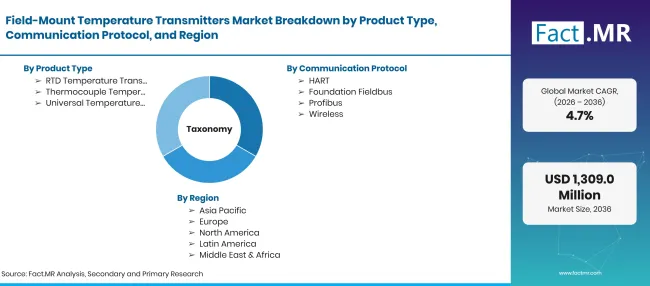
Field Mount Temperature Transmitters Market Taxonomy | Source: Fact.MR
| Attribute | Details |
|---|---|
| Quantitative Units | USD million |
| Market Definition | Field-mount temperature transmitters used to convert temperature sensor signals into outputs for industrial monitoring and process control. |
| Product Type | RTD Temperature Transmitters; Thermocouple Temperature Transmitters; Universal Temperature Transmitters |
| Communication Protocol | HART; Foundation Fieldbus; Profibus; Wireless; Others |
| End-User Industry | Oil & Gas; Chemical; Food & Beverage; Power Generation; Water & Wastewater; Others |
| Regions Covered | North America; Latin America; Western Europe; Eastern Europe; East Asia; South Asia & Pacific; Middle East & Africa |
| Countries Covered | Germany; Brazil; United States; United Kingdom; Japan |
| Companies Profiled | Emerson Electric Co.; ABB Ltd.; Siemens AG; Honeywell International Inc.; Yokogawa Electric Corporation; Endress+Hauser Group; WIKA Alexander Wiegand SE & Co. KG; PR electronics A/S; Moore Industries International, Inc.; Azbil Corporation |
| Forecast Period | 2026 to 2036 |
| Approach | Market assessment using the market value, segment shares, country growth rates, product categories, communication protocols, end-user industries, and company portfolio review. |
Source: Fact.MR analysis. Updated Oct 28, 2026
How is the market segmented?
-
By Product Type
- RTD Temperature Transmitters
- Thermocouple Temperature Transmitters
- Universal Temperature Transmitters
-
By Communication Protocol
- HART
- Foundation Fieldbus
- Profibus
- Wireless
- Others
-
By End-User Industry
- Oil & Gas
- Chemical
- Food & Beverage
- Power Generation
- Water & Wastewater
- Others
-
By Region
- North America
- Latin America
- Western Europe
- Eastern Europe
- East Asia
- South Asia & Pacific
- Middle East & Africa
Frequently Asked Questions
How large is the Field-Mount Temperature Transmitters Market in 2026?
What is the CAGR of the Field-Mount Temperature Transmitters Market from 2026 to 2036?
Which product type leads the Field-Mount Temperature Transmitters Market?
Which communication protocol leads the Field-Mount Temperature Transmitters Market?
Which end-user industry leads the Field-Mount Temperature Transmitters Market?
Which country will grow the most in the Field-Mount Temperature Transmitters Market?
Who are the main companies in the Field-Mount Temperature Transmitters Market?
Who worked on this report


Preview the report firsthand - request a free sample
Free SampleGet the brochure for pricing and purchase details
Download PDF