- Market Value (2025): USD 5.85 Bn
- Estimated Value (2026): USD 6.08 Bn
- Forecast Value (2036): USD 8.98 Bn
- CAGR (2026-2036): 4.0%
What is the Lubricants for Mining and Quarry Applications Market forecast to be worth by 2036?
USD 6.1 Billion in 2026 to USD 9.0 Billion by 2036 at a 4.0% CAGR.
- At USD 5.85 Billion in 2025, the lubricants for mining and quarry applications market drew strong underlying demand from global mineral extraction, copper and critical mineral electrification booms, and infrastructure aggregate quarrying.
- Sales will expand from USD 6.08 Billion in 2026 to USD 8.98 Billion by 2036 as mining conglomerates transition toward extended-drain synthetic hydraulic oils, energy-efficient gear lubricants, and environmentally acceptable bio-lubricants.
- Compounding at a steady 4.0% CAGR over the 2026 to 2036 forecast window, market expansion is propelled by rising global mineral demand, mechanization of underground mining fleets, and stricter corporate ESG sustainability mandates.
Market revenue reflects steady operational spending across resource extraction infrastructure. Heavy excavators, wheel loaders, and 400-ton haul trucks require steady hydrodynamic lubrication to protect gears and bearings from seizure during continuous shifts. A single unplanned transmission or pump failure on an open-pit shovel can halt ore movement and cause substantial production delays, so operators treat lubricant selection as a preventive maintenance priority rather than a routine consumable cost.
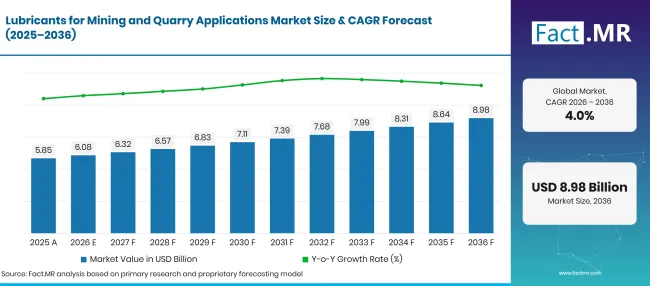
Lubricants For Mining And Quarry Applications Market Forecast Global | Source: Fact.MR
| Year | Basis | Market Value (USD Billion) |
|---|---|---|
| 2025 | Actual | 5.85 |
| 2026 | Estimate | 6.08 |
| 2036 | Forecast | 8.98 |
| CAGR 2026 to 2036 | Forecast period | 4.0% |
Source: Fact.MR analysis. Updated Oct 28, 2026
What are the defining numbers behind Lubricants for Mining and Quarry Applications Market growth?
Between 2026 and 2036, the lubricants for mining and quarry applications sector will generate an absolute dollar opportunity of USD 2.9 Billion, supported by copper and critical mineral extraction, demanding operating conditions, and wider adoption of fluid condition monitoring systems.
- Demand Drivers in the Market
- The U.S. Geological Survey's 2025 summary covers more than 90 individual minerals and materials and provides early 2024 world mineral-production data [1]. This coverage is important because different commodities impose distinct shock-load, dust, temperature, and contamination demands on mining engines, drivetrains, crushers, conveyors, and hydraulic systems.
- MSHA's January-December 2025 preliminary publication reports injuries, employment, employee hours, production, work locations, and accident classifications across operator and contractor tables [2]. Linking oil analysis and contamination findings with maintenance and operating records gives mine operators a stronger basis for preventing avoidable equipment failures.
- The IEA reported in 2026 that demand for key energy minerals had grown by close to 10% per year in recent years and that lithium demand increased by around 25% per year over the preceding two years [3]. Higher extraction and processing intensity extends equipment operating hours, increasing demand for oxidation-stable lubricants and condition-based drain intervals.
- MSHA's final 2025 quarterly-statistics page, updated on October 16, 2026, provides separate operator and contractor datasets for injuries, employment, work hours, production, work location, and accident classification [4]. Lubricant suppliers can use this reporting structure to position sampling, filtration, and fluid-management services as measurable reliability controls rather than standalone consumables.
- The IEA found that lithium demand rose by nearly 30% in 2024, while demand for nickel, cobalt, graphite, and rare earths increased by 6% to 8% [5]. This expansion raises equipment run-hours across loading, hauling, crushing, and processing assets, making wear protection and lubricant cleanliness more commercially important.
- Key Segments Analyzed
- By Product Type: Hydraulic Oils lead the category with a 38.6% share in 2026, serving as the primary fluid medium powering high-pressure cylinders and drive circuits on excavators and heavy loaders.
- By Application: Surface Mining generates 52.4% of total application demand in 2026, supported by open-pit copper, iron ore, and gold extraction sites running large mobile equipment fleets.
- By Equipment Type: Excavators represent the primary equipment category, capturing 28.3% of 2026 value due to large hydraulic reservoir capacities and high fluid circulation rates.
- By Distribution Channel: Aftermarket channels dominate commercial volume with a 61.8% share in 2026, supported by routine fluid replenishment, planned maintenance intervals, and site bulk supply contracts.
- Analyst Opinion at Fact.MR
- Shambhu Nath Jha, Principal Consultant at Fact.MR, states, "The mining and quarry lubrication sector has moved from transactional purchasing toward an equipment reliability model. Mining operators manage production machines worth tens of millions of dollars in remote locations where supply delays interrupt output. Major mining companies increasingly work with energy suppliers and lubricant formulators to place bulk storage and automated fluid sensors directly at mine sites. These sensors track dielectric properties, viscosity changes, and wear particle counts during normal operation. Rather than following fixed calendar drain intervals, maintenance teams are shifting to condition-based oil changes that can extend fluid service life safely. Tighter environmental standards near sensitive watersheds also encourage adoption of readily biodegradable synthetic ester and polyalkylene glycol hydraulic fluids across aggregate quarries and surface pits."
- Strategic Implications
- Lubricant formulators should partner directly with mining equipment manufacturers to develop factory-fill fluids with additive packages suited for electric and hybrid haulage equipment.
- Mine maintenance teams should maintain clean, climate-controlled bulk fluid storage with desiccant breathers to prevent dust and moisture contamination before refilling machinery.
- Distributors should bundle heavy-duty lubricants with mobile filtration systems to clean hydraulic fluids during scheduled maintenance stops.
- Formulators need to expand biodegradable, low-toxicity hydraulic fluid offerings that meet environmental standards for quarries near groundwater aquifers and municipal watersheds.
German mining and quarry lubricant consumption will expand at 4.1% CAGR through 2036, supported by aggregate extraction modernization and European environmental safety standards.
How does the Lubricants for Mining and Quarry Applications Market break down by segment?
Hydraulic Oils lead Product Type at 38.6%, Surface Mining leads Application at 52.4%, Excavators command Equipment Type at 28.3%, and Aftermarket dominates Distribution Channel at 61.8% in 2026.
Which Product Type dominates?
Hydraulic Oils capture 38.6% of 2026 product value.
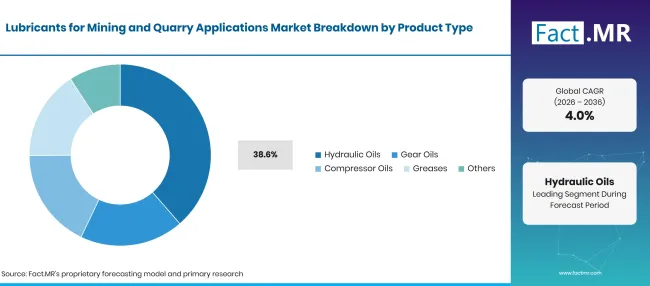
Lubricants For Mining And Quarry Applications Market Breakdown Product Type | Source: Fact.MR
Hydraulic oils represent the single largest product class within the mining and quarry sector, transmitting fluid power to booms, buckets, steering cylinders, and swing drives on heavy excavation machinery. Open-pit mining shovels and hydraulic excavators operate at system pressures between 350 and 420 bar, circulating thousands of liters of fluid per minute through valve blocks and high-pressure piping. Under these severe duty cycles, hydraulic fluids must provide consistent anti-wear protection, rapid air release to avoid pump cavitation, and thermal stability to prevent varnish on close-tolerance control valves. Underground mining operations require fire-resistant fluids such as HFC water-glycols and HFD-U synthetic polyol esters to prevent ignition if a ruptured line sprays onto hot engine components. Equipment operators routinely connect hydraulic systems with heavy-duty industrial slurry pumps and pressurized fluid flow management assemblies to maintain steady processing flow through beneficiation plants.
| Product Type | Share (2026) |
|---|---|
| Hydraulic Oils (Leading segment) | 38.6% |
| Other segments combined | 61.4%* |
| Total | 100.0% |
Source: Fact.MR analysis. Updated Oct 28, 2026
Which Application leads the market?
Surface Mining generates 52.4% of 2026 application demand.
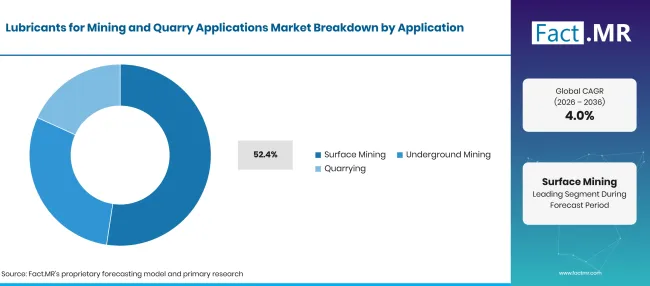
Lubricants For Mining And Quarry Applications Market Breakdown Application | Source: Fact.MR
Surface mining represents the predominant commercial application for heavy machinery lubricants, covering open-pit operations, strip mines, and quarries producing copper, iron ore, bauxite, and industrial aggregates. These sites depend on fleets of 200-ton to 400-ton haul trucks and large shovels moving high tonnage over unpaved roads with heavy dust exposure. Drivetrains, differentials, and wheel hub planetary gears operate under continuous high torque and elevated operating temperatures. Lubricant suppliers set up bulk storage tanks and mobile service trucks to top up fluid reservoirs in the pit, reducing equipment downtime away from active benches. In dewatering and slurry transfer circuits, operators combine specialized mineral extraction fluids and high-pressure steel piping circuits to control wear and maintain line integrity.
| Application | Share (2026) |
|---|---|
| Surface Mining (Leading segment) | 52.4% |
| Other segments combined | 47.6%* |
| Total | 100.0% |
Source: Fact.MR analysis. Updated Oct 28, 2026
Which Equipment Type captures the largest share?
Excavators account for 28.3% of 2026 equipment revenue.
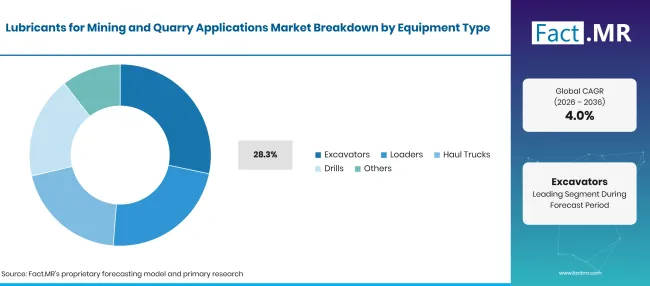
Lubricants For Mining And Quarry Applications Market Breakdown Equipment Type | Source: Fact.MR
Hydraulic and electric excavators form the primary consuming equipment category across surface mines and quarry sites. Because an excavator digs blasted rock from the bench and loads haul trucks, machine reliability directly determines daily pit throughput. These production units house hydraulic fluid reservoirs holding between 1,000 and 5,000 liters of anti-wear oil. Rapid bucket cycling generates pressure spikes and shear stress on pumps, valve spools, and cylinder packings. Slew rings, track rollers, and bucket pins depend on automated grease systems applying water-resistant moly grease to withstand heavy pin loads without squeeze-out. Maintenance crews inspect flexible hydraulic high-pressure hoses and heavy haul truck chassis assemblies to detect minor fluid leaks before line failure occurs.
| Equipment Type | Share (2026) |
|---|---|
| Excavators (Leading segment) | 28.3% |
| Other segments combined | 71.7%* |
| Total | 100.0% |
Source: Fact.MR analysis. Updated Oct 28, 2026
What is accelerating Lubricants for Mining and Quarry Applications Market adoption, and what is holding it back?
Demand growth is supported by mineral extraction activity, shifting preferences toward high-durability synthetic oils, and adoption of in-line condition sensors, while volatile base oil costs and extended drain intervals temper overall replenishment volume.
Drivers Impact Analysis
| DRIVER | (~) % IMPACT ON CAGR | GEOGRAPHIC RELEVANCE | IMPACT TIMELINE |
|---|---|---|---|
| Soaring global extraction of critical minerals for clean energy technologies and electric vehicles | +1.3% | North America, Latin America, East Asia | Short term (<= 2 years) |
| Shift from mineral oils to Group III and synthetic PAO fluids to extend component fatigue life | +1.0% | Global | Short term (<= 2 years) |
| Stringent underground safety mandates requiring non-combustible, fire-resistant hydraulic fluids | +0.8% | North America, Western Europe | Short term (<= 2 years) |
| Rapid deployment of on-board telematics and in-line fluid condition monitoring sensors | +0.6% | North America, Western Europe | Medium term (2-4 years) |
| Growth of large-scale infrastructure aggregate, limestone, and granite quarrying projects | +0.5% | East Asia, South Asia & Pacific | Medium term (2-4 years) |
| OEM factory-fill agreements specifying high-viscosity synthetic fluids for new machine deliveries | +0.4% | Global | Long term (>= 4 years) |
Source: Fact.MR analysis. Updated Oct 28, 2026
Opportunity Impact Analysis
| OPPORTUNITY | (~) % IMPACT ON CAGR | GEOGRAPHIC RELEVANCE | IMPACT TIMELINE |
|---|---|---|---|
| Formulation of high-performance biodegradable synthetic esters for environmentally sensitive sites | +0.7% | Western Europe, North America | Medium term (2-4 years) |
| On-site closed-loop oil re-refining and circular lubricant reclamation service contracts | +0.5% | Western Europe, North America | Long term (>= 4 years) |
| Tailored lubrication chemistries for next-generation electric battery-powered haul truck fleets | +0.4% | North America, East Asia | Medium term (2-4 years) |
| Bundled long-term fluid management agreements incorporating automated dispensing infrastructure | +0.3% | Latin America, South Asia & Pacific | Long term (>= 4 years) |
Source: Fact.MR analysis. Updated Oct 28, 2026
Restraints Impact Analysis
| RESTRAINT | (~) % IMPACT ON CAGR | GEOGRAPHIC RELEVANCE | IMPACT TIMELINE |
|---|---|---|---|
| Extended fluid drain intervals and advanced filtration reducing annual volumetric turnover | -0.5% | Global | Long term (>= 4 years) |
| Severe crude oil price volatility impacting synthetic and mineral base oil manufacturing costs | -0.4% | Global | Short term (<= 2 years) |
| Extreme contamination in harsh mine environments causing premature fluid discard | -0.3% | Latin America, South Asia & Pacific | Short term (<= 2 years) |
| High initial cost premium of synthetic and bio-based lubricants over mineral formulations | -0.3% | Global | Medium term (2-4 years) |
Source: Fact.MR analysis. Updated Oct 28, 2026
Which countries are scaling the Lubricants for Mining and Quarry Applications Market through 2036?
Investment across major mining regions, development of critical mineral deposits, and ongoing fleet upgrades in commercial quarries shape country-level lubricant consumption through 2036.
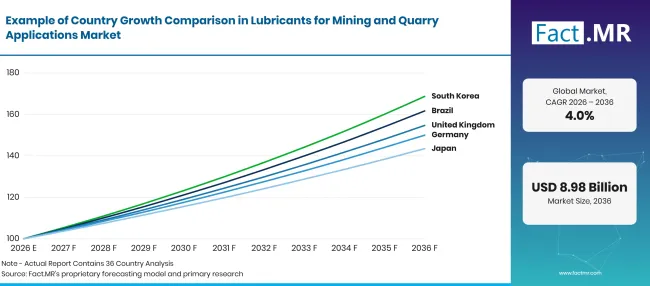
Lubricants For Mining And Quarry Applications Market Growth Index | Source: Fact.MR
| Country | CAGR (2026 to 2036) |
|---|---|
| Germany | 4.1% |
| Brazil | 4.9% |
| United States | 3.0% |
| United Kingdom | 4.5% |
| Japan | 3.7% |
Source: Fact.MR analysis. Updated Oct 28, 2026
What supports Germany's adoption?
4.1% CAGR, driven by aggregate quarrying modernization, potash mining, and advanced bio-based lubricant adoption.
The 2025 USGS report provides 5-year salient statistics and world production data for more than 90 mineral commodities [6]. Germany's industrial quarrying and potash mining operations favor synthetic formulations that deliver documented viscosity stability and wear protection under cold-weather and heavy-load conditions.
How does Brazil perform?
4.9% CAGR, powered by massive open-pit iron ore extraction, bauxite mining, and major mobile equipment fleet modernizations.
The USGS 2025 data release contains salient production statistics for more than 90 nonfuel mineral commodities [7]. Brazil's large-scale iron ore and bauxite operations in Pará and Minas Gerais require specialized heavy-duty greases and high-viscosity gear lubricants that withstand humid tropical climates and heavy ore tonnages.
What is supporting United States adoption?
3.0% CAGR, anchored by massive surface coal, copper, aggregate quarrying, and advanced condition-monitoring adoption.
MSHA's 2025 annual publication separates operator and contractor data and tracks injuries, hours worked, production, and work locations across mining sectors [8]. Mining and aggregate producers in the United States rely on fluid sampling programs and filtration controls to maintain uptime across high-capacity excavators and truck fleets.
How is the United Kingdom developing demand?
4.5% CAGR, centered on hard-rock coastal quarries, aggregate supply for national infrastructure, and high equipment compliance.
The IEA reported that demand for key energy minerals such as nickel, cobalt, and rare earths grew 6% to 8% in 2024 [9]. British quarry operators and coastal aggregate suppliers rely on synthetic hydraulic fluids and biodegradable lubricants that satisfy local environmental rules while handling hard-rock crushing and washing operations.
How is Japan scaling demand?
3.7% CAGR, underpinned by limestone quarrying automation, cement raw material extraction, and high-precision machinery maintenance.
The IEA reported that energy applications accounted for approximately 75% of demand growth for key minerals in 2025 [10]. Japanese limestone quarrying and cement processing facilities prioritize automated lubrication systems and high-purity synthetic oils to maintain tight equipment tolerances and support automated plant cycles.
Who leads the Lubricants for Mining and Quarry Applications Market?
Leading suppliers in the mining and quarry lubricants market include integrated petroleum majors, national oil companies, and specialized industrial lubricant manufacturers. Major producers compete through dedicated base oil refining capacity, proprietary additive formulations, and distribution networks capable of delivering bulk products to remote mine sites. Energy majors work directly with heavy equipment manufacturers such as Caterpillar, Komatsu, Liebherr, and Hitachi to qualify factory-fill and service fluids against OEM warranty requirements.
Competition in the industry centers on fluid management and equipment support rather than drum delivery alone. Leading suppliers run on-site mobile testing units that provide spectrographic oil analysis, checking wear metals, soot accumulation, and fluid breakdown to support scheduled maintenance. Chemical formulators continue to introduce zinc-free hydraulic oils, fire-resistant synthetic fluids, and heavy-tack calcium sulfonate complex greases. Companies also supply lubricants suited for off-highway vehicle powertrain assemblies and fluid tracking systems used at bulk mineral loading terminals.
Which companies are the key providers?
Key companies include ExxonMobil; Shell; Chevron; TotalEnergies; BP; Fuchs Petrolub; Petro-Canada Lubricants; Klüber Lubrication; Castrol; Sinopec.
- ExxonMobil
- Shell
- Chevron
- TotalEnergies
- BP
- Fuchs Petrolub
- Petro-Canada Lubricants
- Klüber Lubrication
- Castrol
- Sinopec
Bibliography
- [1] U.S. Geological Survey. (2025). Mineral commodity summaries 2025 (Version 1.2).
- [2] Mine Safety and Health Administration. (2026). Mine injury and worktime, quarterly: January-December 2025 preliminary.
- [3] International Energy Agency. (2026). Market overview. In Global critical minerals outlook 2026.
- [4] Mine Safety and Health Administration. (2026, October 16). Mine injury and worktime quarterly statistics.
- [5] International Energy Agency. (2025). Executive summary. In Global critical minerals outlook 2025.
- [6] U.S. Geological Survey. (2025). Mineral commodity summaries 2025 (Version 1.2). https://doi.org/10.3133/mcs2025
- [7] U.S. Geological Survey. (2025, January 31). Mineral commodity summaries 2025 data release (Version 2.0).
- [8] Mine Safety and Health Administration. (2026). Mine injury and worktime, quarterly: January-December 2025 preliminary.
- [9] International Energy Agency. (2025). Executive summary. In Global critical minerals outlook 2025.
- [10] International Energy Agency. (2026). Market overview. In Global critical minerals outlook 2026.
This Report Answers
- The study analyzes how mineral, synthetic polyalphaolefin, and bio-based ester lubricants differ across extreme-pressure film strength, oxidation resistance, shear stability, and total operating cost.
- Product breakdown evaluates commercial demand across hydraulic fluids, heavy-duty industrial gear oils, rotary screw compressor oils, and multi-purpose lithium and calcium sulfonate greases.
- Application mapping quantifies consumption patterns across large-scale open-pit surface mines, deep underground stoping operations, and civil aggregate quarries.
- Equipment analysis details fluid capacity requirements, drain intervals, and operating temperatures across ultra-class excavators, large wheel loaders, rigid haul trucks, and rotary blasthole drills.
- Country performance evaluations deliver granular ten-year growth forecasts across Germany, Brazil, the United States, the United Kingdom, and Japan, linking fluid sales to national mineral production and fleet investments.
- Competitive profiling examines the refinery blending assets, OEM factory-fill relationships, on-site fluid analysis programs, and sustainability initiatives of the ten leading global mining lubricant suppliers.
What does the Lubricants for Mining and Quarry Applications Market cover?
The lubricants for mining and quarry applications market covers all formulated lubricating oils, functional fluids, and semi-solid greases engineered to reduce mechanical friction, protect against abrasive wear, prevent corrosion, and dissipate heat within heavy machinery operating in mineral extraction and quarrying environments. Operating under punishing physical profiles characterized by heavy shock loads, abrasive dust, high moisture ingress, and wide temperature swings, these specialized fluids protect critical mechanical sub-systems including hydraulic actuators, planetary wheel reductions, differentials, gearboxes, dragline hoist ropes, and diesel engines. Market scope tracks lubricant consumption across surface open-pit mining, underground shaft and decline mining, non-metallic aggregate quarrying, and mineral processing mills. Processing plants routinely deploy plant heat dissipation circuits and in-line lubricant condition sensors to monitor fluid operating temperatures and contamination levels.
Financial valuations evaluate wholesale and brand-level revenues derived from the sale of finished industrial lubricants, mobile equipment fluids, and specialty greases to mining corporations, contract mining fleets, quarry operators, and equipment dealerships. The scope covers bulk delivery by road tanker, intermediate bulk containers (IBCs), standard 208-liter steel drums, and portable grease cartridges. Factory-fill initial fluid fills delivered with new machinery and aftermarket replenishment fluids are fully measured.
What is included in the scope?
Included in the report's coverage are high-viscosity anti-wear hydraulic oils, fire-resistant water-glycol and synthetic ester hydraulic fluids, industrial closed-gear oils, open-gear lubricants, heavy-duty transmission and drivetrain oils, rotary screw and reciprocating air compressor oils, and multi-purpose extreme-pressure greases (lithium complex, calcium sulfonate, aluminum complex). Basestock categories encompass Group I, Group II, Group III hydrocracked oils, Group IV polyalphaolefins, synthetic esters, and polyalkylene glycols.
The analytical perimeter accounts for specialized additive chemistry packages, including organo-molybdenum friction modifiers, zinc dialkyldithiophosphate (ZDDP) anti-wear agents, and tackifiers designed to resist water wash-off in wet pit conditions.
Geographic coverage is comprehensive, tracking market performance across North America, Latin America, Western Europe, Eastern Europe, East Asia, South Asia & Pacific, and the Middle East & Africa. Channel mapping covers commercial transactions flowing through direct corporate bulk delivery contracts, authorized national industrial chemical distributors, local mining supply houses, and equipment dealership service centers.
What is excluded from the scope?
Excluded from market scope are general-purpose automotive lubricants formulated strictly for on-highway passenger cars and light commercial vehicles that do not operate on active mining concessions. Similarly, marine bunker fuel oils, marine cylinder lubricants used on oceangoing cargo ships, and aviation turbine engine oils are excluded from primary mining lubricant totals. Solid dry-film coatings, graphite block lubricants for rail tracks, and specialized drilling muds utilized purely as downhole drilling fluids rather than machine lubricants fall outside the report's revenue boundary.
Furthermore, post-consumer recycled waste oil collection and hazardous chemical waste disposal services are excluded from primary product sales calculations. Stationary electricity turbine oils used in grid-scale municipal power plants located off-site from mining operations are also excluded.
How Was the Analysis Built?
The analysis draws on 120+ sources, 35+ company portfolios, 25+ countries, and more than 20 industry interviews.
- Primary Research: Primary research includes discussions with manufacturers, service providers, technology developers, distributors, end users, and subject-matter experts. These conversations examine purchasing priorities, product adoption, operational challenges, approval requirements, competitive positioning, and the factors that influence wider market acceptance.
- Desk Research: Desk research covers government statistics, regulatory publications, company filings, trade data, technical studies, industry associations, standards, public policy, and other authoritative sources. Every source used in the analysis is documented in the bibliography.
- Market Sizing and Forecasting: Market estimates combine historical performance, demand indicators, pricing and volume trends, segment shares, company participation, country-level growth, adoption patterns, investment activity, and barriers to market expansion.
- Data Validation and Update Cycle: Findings are validated by comparing primary interviews with public data, company activity, regulatory changes, trade patterns, and industry developments. Regular updates review new product launches, capacity changes, partnerships, approvals, and shifts in commercial adoption.
Segmentation
What is the report’s scope and coverage?
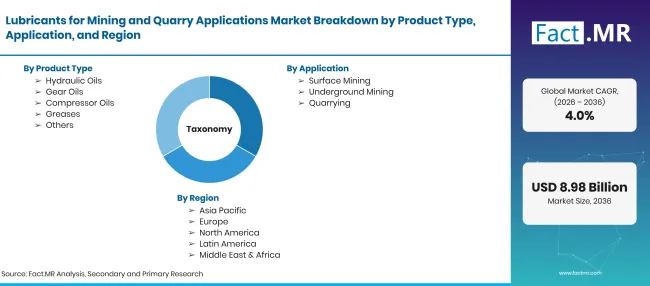
Lubricants For Mining And Quarry Applications Market Taxonomy | Source: Fact.MR
| Attribute | Details |
|---|---|
| Quantitative Units | USD Billion |
| Market Definition | Lubricants for mining and quarry applications comprise heavy-duty hydraulic oils, gear lubricants, compressor oils, transmission fluids, and extreme-pressure greases formulated from mineral, synthetic, and bio-based basestocks to protect stationary and mobile extraction equipment. Market valuation is recorded at the lubricant manufacturer and brand wholesale realization tier. |
| Product Type | Hydraulic Oils; Gear Oils; Compressor Oils; Greases; Others |
| Application | Surface Mining; Underground Mining; Quarrying |
| Equipment Type | Excavators; Loaders; Haul Trucks; Drills; Others |
| Distribution Channel | Aftermarket; OEMs |
| Regional Coverage | North America; Latin America; Western Europe; Eastern Europe; East Asia; South Asia & Pacific; Middle East & Africa |
| Key Countries Analyzed | Germany; Brazil; United States; United Kingdom; Japan |
| Key Players Profiled | ExxonMobil; Shell; Chevron; TotalEnergies; BP; Fuchs Petrolub; Petro-Canada Lubricants; Klüber Lubrication; Castrol; Sinopec |
| Historical Base Year | 2025 (USD 5.8 Billion) |
| Forecast Timeframe | 2026 (USD 6.1 Billion) to 2036 (USD 9.0 Billion) |
Source: Fact.MR analysis. Updated Oct 28, 2026
How is the market segmented?
-
By Product Type
- Hydraulic Oils
- Gear Oils
- Compressor Oils
- Greases
- Others
-
By Application
- Surface Mining
- Underground Mining
- Quarrying
-
By Equipment Type
- Excavators
- Loaders
- Haul Trucks
- Drills
- Others
-
By Distribution Channel
- Aftermarket
- OEMs
-
By Region
- North America
- Latin America
- Western Europe
- Eastern Europe
- East Asia
- South Asia & Pacific
- Middle East & Africa
Frequently Asked Questions
How big is the lubricants for mining and quarry applications market in 2026?
What is the CAGR of the lubricants for mining and quarry applications market from 2026 to 2036?
Which product type leads the lubricants for mining and quarry applications market?
Which application accounts for the highest market share?
Which equipment type commands the largest lubricant consumption?
Which distribution channel dominates market sales?
Which country will expand at the fastest rate through 2036?
Who are the key players in the lubricants for mining and quarry applications market?
Who worked on this report


Preview the report firsthand - request a free sample
Free SampleGet the brochure for pricing and purchase details
Download PDF