- Market Value (2025): USD 161.9 Mn
- Estimated Value (2026): USD 176.0 Mn
- Forecast Value (2036): USD 405.0 Mn
- CAGR (2026-2036): 8.7%
What is the Filtration Pilot Units Market forecast to be worth by 2036?
USD 176.0 million in 2026 to USD 405.0 million by 2036 at 8.7% CAGR.
- The Filtration Pilot Units Market crossed a valuation of USD 161.9 million in 2025. Demand was supported by steady use across pharma and chemical pilot work. Food processing and water treatment trials added further demand.
- Demand is projected to increase from USD 176.0 million in 2026 to USD 405.0 million by 2036.
- The market is forecast to record an 8.7% CAGR from 2026 to 2036 as scale-up validation becomes a routine step before full plant design.
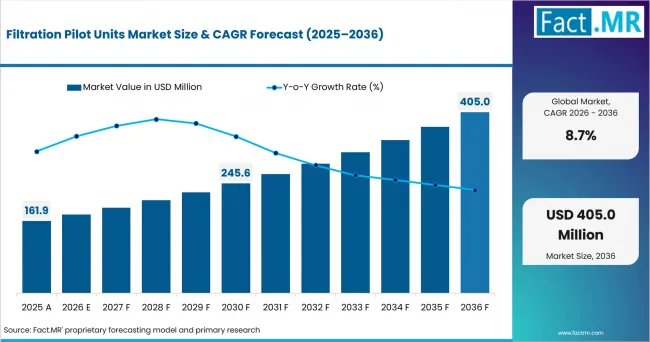
Filtration Pilot Units Market Value Analysis | Source: Fact.MR
What are the defining numbers behind Filtration Pilot Units Market growth?
USD 229.0 million absolute opportunity is expected by 2036.
- Demand Drivers in the Market
- Pilot tests help companies measure how quickly liquid passes through the filter, how fast buildup occurs and how much product can be recovered before they invest in full-size equipment.
- Changeable test sections allow engineers to compare different membrane materials, flow setups and pressure levels within the same trial.
- Contract manufacturers and equipment companies are likely to keep flexible pilot units available for short tests and changing customer projects.
- Water utilities can use pilot trials to see how a treatment process works with local raw water before they approve a full-size system.
- Key Segments Analyzed
- By Filtration Technology: Membrane (UF/MF/NF/RO) is expected to hold 33.0% share in 2026 supported by the need to track flux loss, fouling and cleaning recovery before scale-up.
- By Application: Process Development is projected to account for 30.0% share in 2026 owing to its role in setting operating limits before larger skid trials begin.
- By Scale: Bench-top Units are anticipated to capture 28.0% share in 2026 due to their suitability for early testing when feed volume is limited.
- By Industry: Pharmaceuticals are estimated to represent 30.0% share in 2026 attributable to documented filtration requirements across biologic process development.
- By End User: R&D Departments are forecast to hold 31.0% share in 2026 driven by repeated testing across new molecules, feedstocks and separation routes.
- Analyst Opinion at Fact.MR
- Shambhu Nath Jha, Senior Analyst at Fact.MR, states, “A filtration pilot unit is useful when its test results can guide the design of the full-size system. Engineers study how quickly flow drops, how much product is recovered and how well the unit responds to cleaning when the same feed is used throughout the trial. Units that allow easy filter changes and provide clear readings are expected to see wider use. Good pilot results also help companies choose the right membrane size, pump capacity and operating pressure with less risk during scale-up.”
- Strategic Implications
- Engineers are often willing to pay more for a unit that behaves like the larger setup. A small skid that only proves the basic idea of filtration has less value.
- Research departments are likely to prefer pilots that work with different filter modules, pumps and sensors. This allows one unit to support several tests within the same budget period.
- Rentals can make pilot testing more affordable for food, chemical and water companies. A successful short trial can also support the decision to buy a larger system later.
- Equipment companies are more likely to receive repeat orders when seals, housings and cassettes arrive on time. Help with sensor checks and setup also adds value.
In June 2025, Alfa Laval announced that ScaleUp Bio had chosen its separation and membrane equipment for two food-grade precision-fermentation sites in Tuas, Singapore. The project includes one MultiSystem membrane filtration system and two PilotUnit Multi units. These systems support trials for microfiltration, ultrafiltration, nanofiltration and reverse osmosis. Alfa Laval also said that one of the sites can handle fermentation volumes ranging from 100 to 10,000 liters.
UAE is estimated to post a 9.4% CAGR through 2036. USA is anticipated to advance at an 8.7% CAGR from 2026 to 2036. Japan is forecast to record an 8.6% CAGR by 2036. UK is projected to post an 8.4% CAGR through 2036. Germany is estimated to record an 8.1% CAGR by 2036.
How does the Filtration Pilot Units Market break down by segment?
Membrane (UF/MF/NF/RO) is projected to lead Filtration Technology at 33.0% share in 2026. Process development is estimated to lead Application at 30.0% share in 2026.
Why does Membrane Filtration lead Technology?
Membrane filtration is projected to account for 33.0% share in 2026.
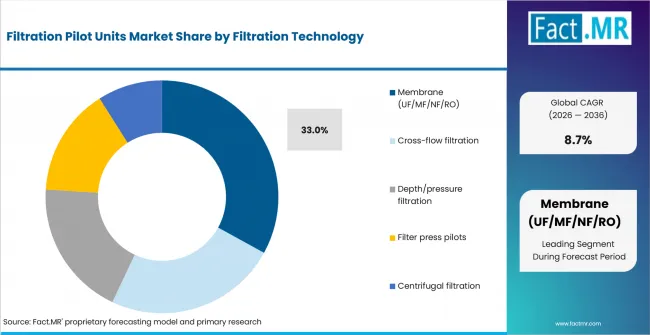
Filtration Pilot Units Market Analysis By Filtration Technology | Source: Fact.MR
These trials show how the feed behaves when pressure is applied. UF and MF are commonly used to remove solids while keeping the main product in the process. NF and RO are used when finer separation or stronger concentration is needed. Pilot testing also helps engineers compare flow loss, filtered-liquid quality and cleaning results before choosing the membrane size for a larger system.
Why does Process Development lead Application?
Process Development is anticipated to represent 30.0% share in 2026.
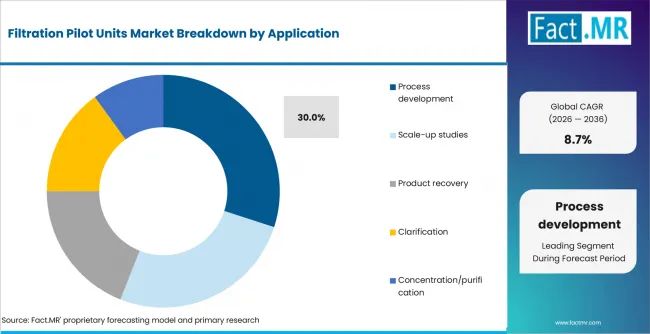
Filtration Pilot Units Market Analysis By Application | Source: Fact.MR
At this stage, companies check whether the planned separation process works well enough for wider use. Pilot units help engineers set the right pressure, flow rate and cleaning steps before more money or material is committed. The results then guide equipment size, product recovery goals and the move to a larger system.
Why are Bench-top Units widely used?
Bench-top Units are forecast to capture 28.0% share in 2026.
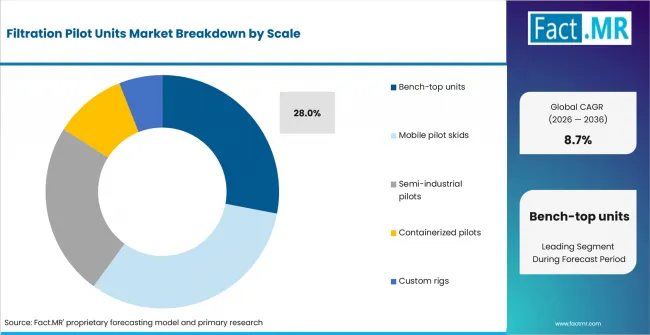
Filtration Pilot Units Market Analysis By Scale | Source: Fact.MR
These units are useful during early testing when only a small amount of feed is available. Researchers can compare different membranes or filter materials without planning a full pilot study. Their small size also makes repeated laboratory trials easier. Mobile skids become more useful later when the process must be tested at the actual site.
What supports the position of Pharmaceuticals?
Pharmaceuticals are estimated to make up 30.0% share in 2026.
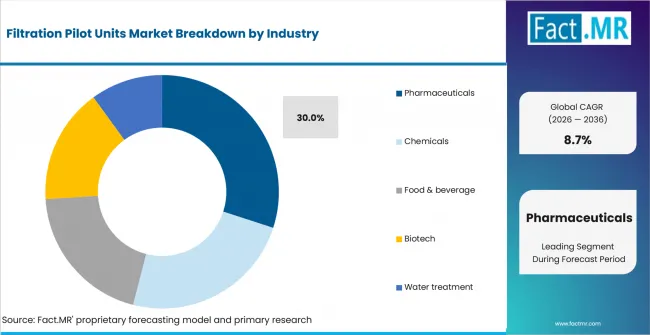
Filtration Pilot Units Market Analysis By Industry | Source: Fact.MR
Filtration has a direct effect on product output, quality and contamination control in drug and biologic production. Pilot trials help engineers check how much protein is retained and whether pumping damages the product. They also show how well the system responds to cleaning before the process moves to a larger unit. Clear test records are important when filtration becomes part of a closely controlled production process.
Why do R&D Departments lead End User demand?
R&D Departments are projected to account for 31.0% share in 2026.
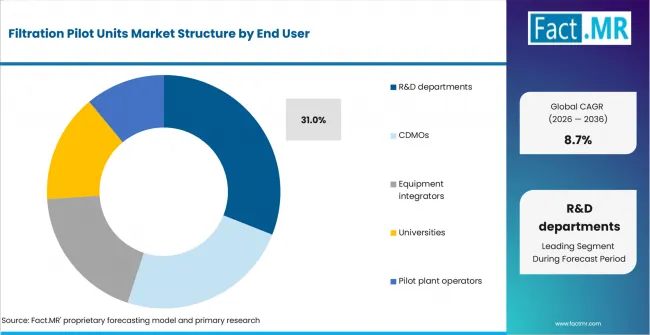
Filtration Pilot Units Market Analysis By End User | Source: Fact.MR
Research departments use pilot units for several projects instead of one fixed production task. They test new raw materials, separation methods and operating settings before sharing their findings with engineering or production staff. Units with changeable parts and clear sensor readings can support many studies, which makes them more useful within research budgets.
What is accelerating Filtration Pilot Units Market adoption, and what is holding it back?
Scale-up risk reduction is anticipated to expand Filtration Pilot Units Market demand. Limited scale similarity is expected to restrain adoption where bench results do not predict production behavior.
Drivers Impact Analysis
| DRIVER | (~) % IMPACT ON CAGR | GEOGRAPHIC RELEVANCE | IMPACT TIMELINE |
|---|---|---|---|
| Scale-up risk reduction | +2.5% | Pharma, chemicals and food | Short term (<=2 years) |
| New membrane evaluation | +1.8% | Water and biotech | Short term (<=2 years) |
| Process-development outsourcing | +1.3% | USA and Europe | Medium term (2-4 years) |
| Water-treatment validation | +0.8% | Municipal water | Short term (<=2 years) |
Source: Fact.MR analysis. Updated Jul 21, 2026
- Scale-up risk reduction: Pilot work is expected to reduce the risk of choosing the wrong membrane area, pump range or cleaning sequence. This is most visible when the feed stream changes between campaigns.
- New membrane evaluation: Module trials are anticipated to support direct comparisons across UF and MF options. NF and RO testing add further selection evidence. Side-by-side runs make the cost of fouling easier to see before purchase.
- Process-development outsourcing: CDMOs and equipment integrators are projected to need pilot assets for client programs with different feed streams. Shared equipment raises demand for fast changeover and clear cleaning records.
- Water-treatment validation: Utilities are expected to prefer local pilot evidence when raw-water chemistry changes by season. EPA guidance notes that pilot-scale studies evaluate filtration rate, media depth and filter washing conditions.
Opportunity Impact Analysis
| OPPORTUNITY | (~) % IMPACT ON CAGR | GEOGRAPHIC RELEVANCE | IMPACT TIMELINE |
|---|---|---|---|
| Rental and demonstration fleets | +1.5% | China and UAE | Short term (<=2 years) |
| Automated data capture | +1.1% | USA, UK and Germany | Medium term (2-4 years) |
| Hybrid filtration pilots | +0.8% | Japan and Germany | Medium term (2-4 years) |
| Application centers and test labs | +0.7% | USA and Singapore-linked food innovation | Long term (>=4 years) |
Source: Fact.MR analysis. Updated Jul 21, 2026
- Rental and demonstration fleets: Rental access is expected to help plants run a trial before a capital request is approved. GEA states that its membrane filtration pilot units are available for rental and global shipment.
- Automated data capture: Built-in records are projected to make pilot results easier to compare across trials. FDA’s 2025 draft guidance discusses using process models inside manufacturing control strategies.
- Hybrid filtration pilots: Combination trials are anticipated to gain attention where filtration sits beside adsorption, clarification or concentration. This helps teams test a process train before fixed equipment is selected.
- Application centers and test labs: Food and biotech developers are expected to use partner facilities when they lack their own pilot infrastructure. GEA’s July 2025 Janesville center includes pilot lines, membrane filtration and lab support.
Restraints Impact Analysis
| RESTRAINT | (~) % IMPACT ON CAGR | GEOGRAPHIC RELEVANCE | IMPACT TIMELINE |
|---|---|---|---|
| Limited scale similarity | -1.9% | Global | Short term (<=2 years) |
| Cleaning and cross-contamination | -1.4% | Global | Medium term (2-4 years) |
| Project-based demand | -1.0% | Global | Medium term (2-4 years) |
| Specialist operator availability | -0.7% | USA, UK, Germany and Japan | Long term (>=4 years) |
Source: Fact.MR analysis. Updated Jul 21, 2026
- Limited scale similarity: A bench unit is expected to mislead the team when channel geometry and hold-up volume do not resemble the larger system. The risk is highest for feeds that foul quickly.
- Cleaning and cross-contamination: Shared pilot assets require careful material tracking and cleaning records. Pharma and biotech users are expected to reject a unit if residue control is unclear.
- Project-based demand: Purchases are projected to stay uneven because many studies are tied to R&D gates. A manufacturer may see strong interest for months and then wait for the next development cycle.
- Specialist operator availability: Pilot studies need people who understand membranes and pumps. Sensor review and sampling discipline are needed as well. Labor gaps are expected to slow adoption in sites without a process-development team.
Which countries are scaling Filtration Pilot Units Market fastest?
A global growth rate represents the weighted average of all markets included in the analysis. It therefore does not need to match the rate recorded by every country shown in the comparison. China and the UAE are positioned above the 8.7% global rate, while Japan, the United Kingdom and Germany remain below it. The six countries presented are illustrative examples, and their comparison with the worldwide figure makes this difference visible.
- The countries are distinguished less by their CAGRs and more by the type of pilot work supporting filtration-unit demand.
- The UAE takes a more water-focused path. Desalination, reuse and industrial process-water projects require pilot testing against local feed conditions before membrane area and cleaning plans are finalized.
- The USA and Japan remain closely aligned but develop through different operating requirements. USA demand comes from bioprocess development and contract manufacturing, where pilot results support equipment specifications and manufacturing records.
- Japan places more weight on careful characterization and product consistency before capital approval. The United Kingdom develops through life-science research and regulated water projects, while Germany relies on methodical trials across established chemical and pharmaceutical operations.
- Markets with broadly similar CAGRs can therefore follow substantially different development paths. Sample availability, rental access, specialist staffing and the quality of pilot records influence how quickly a trial moves into full-scale equipment selection.
The full report examines these dynamics for every market included in the study. It provides country-level CAGR analysis across North America, Latin America, Europe, East Asia, South Asia, Oceania, and the Middle East and Africa.
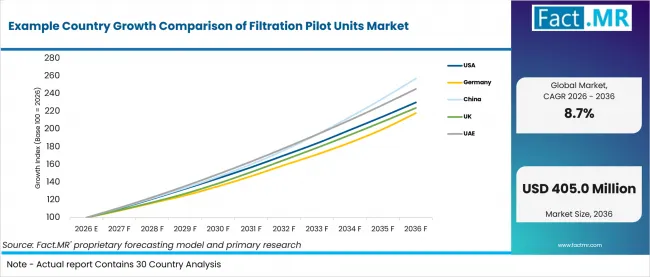
Example Country Growth Comparison Of Filtration Pilot Units Market | Source: Fact.MR
| COUNTRY | CAGR from 2026 to 2036 |
|---|---|
| UAE | 9.4% |
| USA | 8.7% |
| Japan | 8.6% |
| UK | 8.4% |
| Germany | 8.1% |
Source: Fact.MR analysis. Updated Jul 21, 2026
Where is the UAE finding new project activity?
9.4% CAGR, driven by desalination tests and checks on industrial water treatment.
Water conditions in the UAE can vary from one site to another, so testing is important before a membrane system is ordered. Pilot units allow engineers to study filter buildup and cleaning results with water taken from the actual site. New industrial projects also create smaller water-treatment studies where rental units are easier and less costly than permanent testing facilities.
What keeps the USA market active?
8.7% CAGR, tied to bioprocess development and contract manufacturing work.
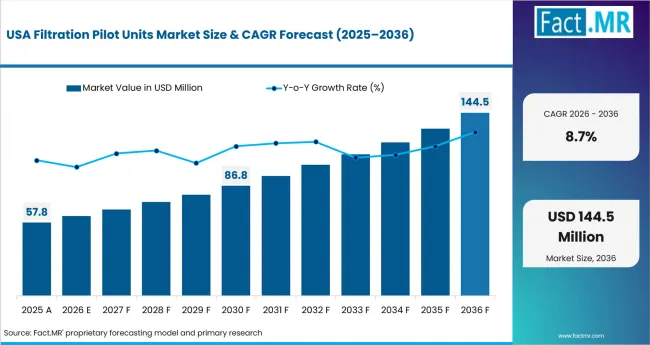
Filtration Pilot Units Market Country Value Analysis | Source: Fact.MR
The USA has many companies moving filtration processes from laboratory trials into full production. Pilot units record pressure, recovery and cleaning results that help engineers prepare equipment plans and operating instructions. Contract manufacturers also create repeat demand because one pilot unit can be used for several customer projects with different feed materials.
Why does Japan maintain a technically demanding market?
8.6% CAGR, shaped by careful testing before larger systems are approved.
Pharmaceutical and high-purity manufacturers in Japan closely check product recovery and cleaning results before investing in larger equipment. Pilot trials reduce the chance that development work will have to be repeated later. Food companies also use these units to study membrane performance while making sure the final product keeps the same taste, texture and quality.
How is the United Kingdom creating demand?
8.4% CAGR, backed by life-science development and water-treatment testing.
Companies in the United Kingdom often require clear test records before a filtration process moves to the engineering stage. Rental units and nearby service make short trials more practical for smaller research groups. Water projects also use pilot systems to confirm treatment results before larger equipment orders are approved.
What is sustaining Germany’s outlook?
8.1% CAGR, tied to advanced pilot units used across established industries.
Germany already has strong filtration knowledge in its chemical and pharmaceutical industries, so companies are not only testing whether the process works. They place greater value on units that can be changed for different studies and used across several projects. Accurate records of pressure, temperature and filtered-liquid quality also help these systems remain useful over a longer period.
Who leads the Filtration Pilot Units Market?
Sartorius and Pall, part of Danaher, have a strong position in bioprocess filtration. Alfa Laval and GEA also support projects in food, biotech and industrial processing from early trials through full-size installation.
Sartorius offers the Sartoflow 1000 for pilot work in ultrafiltration and diafiltration. Pall supports filtration trials across bioprocessing and industrial uses with different feed materials. Alfa Laval provides the PilotUnit Multi and MultiSystem for microfiltration, ultrafiltration, nanofiltration and reverse osmosis testing. GEA offers rental units, in-house trials and support when companies move from a pilot test to a larger system. Andritz adds filter press and crossflow equipment, while SPX Flow links filtration testing with wider food and dairy processing lines.
Through 2036, companies are expected to compete on how closely the pilot unit matches the planned production process. Customers are also likely to compare cleaning options, sensor accuracy, rental access and help with moving to a larger setup. Equipment makers that turn trial results into a clear full-size system plan are likely to gain more repeat business.
Which companies are the key providers?
Sartorius; Pall Corporation (Danaher); Alfa Laval; GEA Group; ANDRITZ; SPX FLOW.
- Sartorius
- Pall Corporation (Danaher)
- Alfa Laval
- GEA Group
- ANDRITZ
- SPX FLOW
Bibliography
- Pall Corporation. (2026, May 20). Pall to address a key decarbonization challenge with additively manufactured filtration. Pall Corporation.
- Alfa Laval. (2025, June 13). Alfa Laval plays key role in ScaleUp Bio’s drive to help Singapore hit vital target to secure next-generation food. Alfa Laval.
- GEA Group. (2025, July 18). GEA opens New Food technology center in the U.S. to boost alternative proteins’ scale-up. GEA Group.
- U.S. Food and Drug Administration. (2025, January 6). Considerations for complying with 21 CFR 211.110. U.S. Food and Drug Administration.
This Report Addresses
- The report provides strategic intelligence on Filtration Pilot Units Market across Filtration Technology and Application choices that shape purchasing decisions.
- Segment analysis covers Membrane (UF/MF/NF/RO) as the share leader within the 2026 market structure.
- Regional outlook evaluates China and UAE alongside USA and Japan. United Kingdom and Germany complete the growth comparison.
- Competitive analysis profiles Sartorius and Pall (Danaher) alongside Alfa Laval and GEA, followed by Andritz and SPX Flow.
- Use-case assessment covers the categories and applications that shape filtration pilot units market demand across the forecast period.
What does the Filtration Pilot Units Market cover?
Compact filtration systems used to test separation performance before a company commits to full-scale process equipment.
The Filtration Pilot Units Market covers bench-top units, mobile skids, semi-industrial pilots, containerized systems and custom test rigs. These units allow engineers to measure flow decline, product recovery, fouling and cleaning response under controlled conditions. Coverage includes membrane technologies such as microfiltration, ultrafiltration, nanofiltration and reverse osmosis. Cross-flow systems, pressure filtration, filter press pilots and centrifugal filtration are also included when used to generate process-development or scale-up evidence.
The market differs from full-scale filtration equipment since its commercial value comes from testing and design validation. Pilot units help companies choose membrane area, pump capacity, pressure range and cleaning steps before a larger system is ordered. Full production plants remain outside the boundary even when they use the same filtration technology.
What is included in the scope?
Filtration pilots used by pharmaceutical, chemical, food, biotechnology and water-treatment organizations are included.
The scope covers Filtration Technology and Application alongside Scale, Industry and End User. Process development, scale-up studies, product recovery, clarification and concentration or purification trials are covered. R&D departments, CDMOs, equipment integrators, universities and pilot-plant operators are included.
What is excluded from the scope?
Full production filtration plants and products that do not form a complete process-testing system remain outside the market.
The scope excludes laboratory syringe filters, standalone analytical instruments and filtration consumables sold without pilot equipment. Replacement membranes, cassettes and filter media are not counted separately within a complete pilot package. General laboratory testing and full commercial plant expenditure also remain outside the market value.
How Was the Analysis Built?
The analysis draws on 120+ sources, 35+ company portfolios, 25+ countries, and more than 20 industry interviews.
- Primary Research: Primary research includes discussions with manufacturers, service providers, technology developers, distributors, end users, procurement teams, and subject-matter experts. These conversations examine purchasing priorities, product adoption, operational challenges, approval requirements, competitive positioning, and the factors that influence wider market acceptance.
- Desk Research: Desk research covers government statistics, regulatory publications, company filings, trade data, technical studies, industry associations, standards, public policy, and other authoritative sources. Every source used in the analysis is documented in the bibliography.
- Market Sizing and Forecasting: Market estimates combine historical performance, demand indicators, pricing and volume trends, segment shares, company participation, country-level growth, adoption patterns, investment activity, and barriers to market expansion.
- Data Validation and Update Cycle: Findings are validated by comparing primary interviews with public data, company activity, regulatory changes, trade patterns, and industry developments. Regular updates review new product launches, capacity changes, partnerships, approvals, procurement trends, and shifts in commercial adoption.
Segmentation
What is the report's scope and coverage?
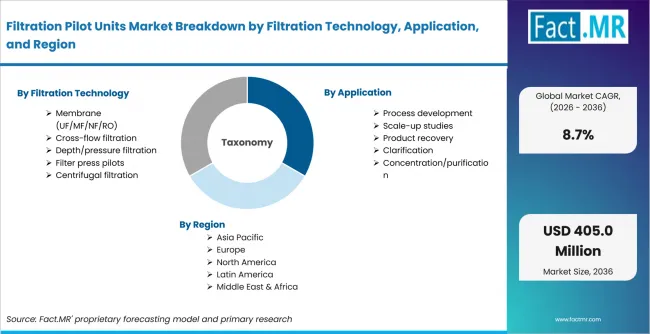
Filtration Pilot Units Market Breakdown By Filtration Technology, Application, And Region | Source: Fact.MR
| Attribute | Details |
|---|---|
| Quantitative Units | USD million in 2025; USD million in 2026; USD million by 2036; at a CAGR |
| Market Definition | A filtration pilot unit is a controlled smaller system used to test a filtration process before full-scale installation. |
| Filtration Technology | Membrane (UF/MF/NF/RO); Cross-flow filtration; Depth/pressure filtration; Filter press pilots; Centrifugal filtration |
| Application | Process development; Scale-up studies; Product recovery; Clarification; Concentration/purification |
| Scale | Bench-top units; Mobile pilot skids; Semi-industrial pilots; Containerized pilots; Custom rigs |
| Industry | Pharmaceuticals; Chemicals; Food & beverage; Biotech; Water treatment |
| End User | R&D departments; CDMOs; Equipment integrators; Universities; Pilot plant operators |
| Regions Covered | North America; Latin America; Europe; East Asia; South Asia & Oceania; Middle East & Africa |
| Countries Covered | USA; Canada; Brazil; Mexico; Germany; U.K.; France; Italy; Spain; South Korea; Japan; China; India; Australia & New Zealand; GCC Countries; South Africa; UAE |
| Key Companies Profiled | Sartorius; Pall (Danaher); Alfa Laval; GEA; Andritz; SPX Flow |
| Forecast Period | 2026 to 2036 |
| Approach | Hybrid top-down and bottom-up approach using demand indicators across Filtration Technology, Application, Scale, Industry, End User; country-level growth; company participation and adoption trends |
Source: Fact.MR analysis. Updated Jul 21, 2026
How is the market segmented?
-
By Filtration Technology:
- Membrane (UF/MF/NF/RO)
- Cross-flow filtration
- Depth/pressure filtration
- Filter press pilots
- Centrifugal filtration
-
By Application:
- Process development
- Scale-up studies
- Product recovery
- Clarification
- Concentration/purification
-
By Scale:
- Bench-top units
- Mobile pilot skids
- Semi-industrial pilots
- Containerized pilots
- Custom rigs
-
By Industry:
- Pharmaceuticals
- Chemicals
- Food & beverage
- Biotech
- Water treatment
-
By End User:
- R&D departments
- CDMOs
- Equipment integrators
- Universities
- Pilot plant operators
-
By Region:
- North America
- USA
- Canada
- Latin America
- Brazil
- Mexico
- Rest of Latin America
- Europe
- Germany
- U.K.
- France
- Italy
- Spain
- Rest of Europe
- East Asia
- South Korea
- Japan
- China
- South Asia & Oceania
- India
- Australia & New Zealand
- Rest of South Asia & Oceania
- Middle East & Africa
- GCC Countries
- South Africa
- UAE
- Rest of Middle East & Africa
- North America
Frequently Asked Questions
Which Filtration Technology leads the Filtration Pilot Units Market?
Which Application leads the Filtration Pilot Units Market?
Which Scale leads the Filtration Pilot Units Market?
Which Industry leads the Filtration Pilot Units Market?
Which End User leads the Filtration Pilot Units Market?
How does UAE perform in the Filtration Pilot Units Market?
How does USA perform in the Filtration Pilot Units Market?
What is the primary driver in the Filtration Pilot Units Market?
What is the main restraint in the Filtration Pilot Units Market?
Who worked on this report


Preview the report firsthand - request a free sample
Free SampleGet the brochure for pricing and purchase details
Download PDF