- Market Value (2025): USD 847.3 Mn
- Estimated Value (2026): USD 899.9 Mn
- Forecast Value (2036): USD 1643.2 Mn
- CAGR (2026-2036): 6.2%
What is the Fishing SUP Market forecast to be worth by 2036?
USD 899.9 million in 2026 to USD 1643.3 million by 2036 at a 6.2% CAGR.
- As per Fact.MR analysis, the Fishing SUP Market was valued at USD 847.3 million in 2025.
- Demand will grow from USD 899.9 million in 2026 to USD 1643.2 million by 2036.
- The forecast records a 6.2% CAGR from 2026 to 2036 due to growing participation in recreational fishing.
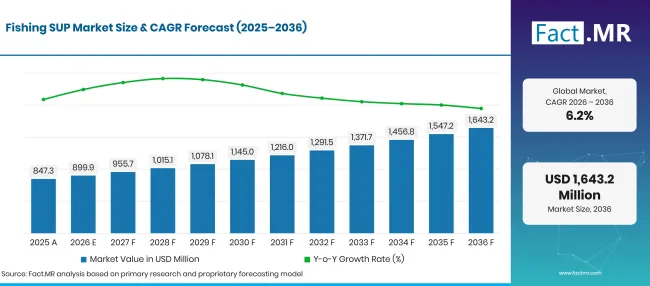
Fishing Sup Market Forecast Global | Source: Fact.MR
| Year | Basis | Market Value (USD million) |
|---|---|---|
| 2025 | Actual | 847.4 |
| 2026 | Estimate | 899.9 |
| 2036 | Forecast | 1643.2 |
| CAGR 2026 to 2036 | Forecast period | 6.2% |
Source: Fact.MR analysis. Updated Nov 5, 2026
What are the defining numbers behind Fishing SUP Market growth?
USD 743.4 million absolute opportunity between 2026 and 2036.
- Demand Drivers in the Market
- Recreational fishing participation creates a potential customer base for portable watercraft suitable for shallow and less accessible fishing locations. The American Sportfishing Association reported that 57 million Americans went fishing in 2025, down from 57.9 million in 2024, while saltwater participation reached a record 15.5 million [1]. These participation figures measure fishing generally rather than purchases of fishing SUPs.
- Interest in fishing tourism and outdoor recreation supports demand for specialized fishing equipment in Brazil. Brazil's Ministry of Tourism reported that sport fishing involves approximately 8 million participants and can generate up to R$3 billion annually [2].
- Fishing SUPs offer an alternative to larger boats and conventional fishing kayaks for anglers seeking portability and access to shallow waters. Wider decks, accessory mounts and storage arrangements can make paddleboards more suitable for fishing than standard recreational SUPs [3].
- Inflatable construction can support demand among consumers who need portable equipment that can be transported and stored without a roof rack or dedicated storage space. Fishing-oriented inflatable boards can also accommodate rod holders and gear attachments.
- Key Segments Analyzed
- By Product Type: Inflatable boards will account for 58.4% of the market in 2026, reflecting their portability and convenient storage.
- By Application: Recreational Fishing will lead with a 69.9% share in 2026, as individual anglers use SUPs for leisure fishing in inland and coastal waters.
- By Distribution Channel: Online Stores hold 41.9% share in 2026, supported by product comparisons and access to specialist brands.
- By End User: Individuals will represent 54.2% of the market in 2026, reflecting demand from personal and recreational anglers.
- Analyst Opinion at Fact.MR
- Shambhu Nath Jha, Principal Consultant at Fact.MR, states, “The fishing SUP manufacturers need to balance stability, portability and load capacity. Anglers require enough deck space for movement and casting, while rod holders, gear mounts and secure storage improve practical use. Brands that explain board capacity, suitable water conditions and accessory compatibility can help consumers distinguish fishing-specific models from general-purpose paddleboards.”
- Strategic Implications
- Manufacturers should prioritize board stability, sufficient load capacity and accessory mounting points suited to fishing activities.
- Inflatable SUP providers can differentiate products through reinforced construction, multiple air chambers and practical storage features.
- Retailers need to explain the differences between fishing-specific SUPs and standard recreational paddleboards.
- Online sellers must provide clear specifications for dimensions, weight capacity, construction and included fishing accessories.
- Fishing equipment brands can explore partnerships for rod holders, anchor systems, seats, coolers and other compatible accessories.
How does the Fishing SUP Market break down by segment?
Fact.MR finds that Inflatable boards lead Product Type with a 58.4% share; Recreational Fishing Leads Application with 69.9%; Online Stores Lead Distribution Channel with 41.9%; and Individuals lead End User with 54.2% in 2026.
Which Product Type dominates?
Inflatable is set to hold a 58.4% share in 2026.
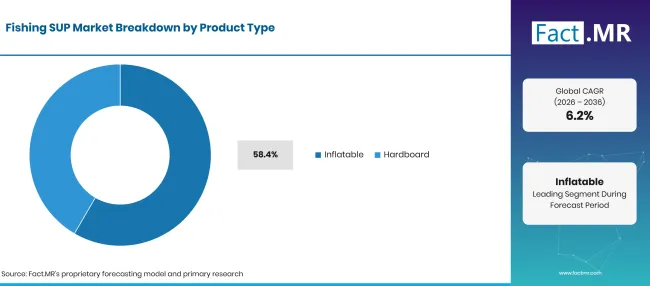
Fishing Sup Market Breakdown Product Type | Source: Fact.MR
| Product Type | Share (2026) |
|---|---|
| Inflatable (Leading segment) | 58.4% |
| Other segments combined | 41.6%* |
| Total | 100.0% |
Source: Fact.MR analysis. Updated Nov 5, 2026
Inflatable fishing SUPs appeal to anglers who need equipment that can be deflated, packed and transported in a vehicle. Their portability can reduce storage requirements for consumers who do not have space for a rigid board. Hardboards remain relevant for users who prioritize a rigid construction and do not need to pack their board between fishing trips.
What leads the Application segment?
Recreational Fishing is set to represent 69.9% of the market in 2026.
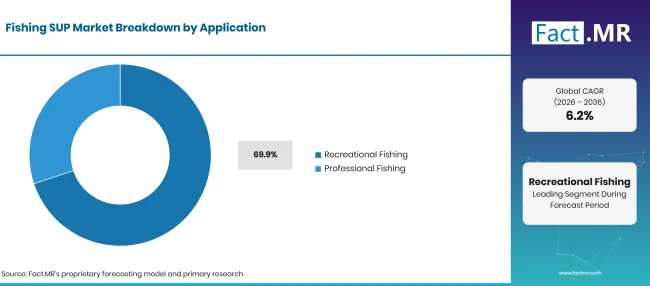
Fishing Sup Market Breakdown Application | Source: Fact.MR
| Application | Share (2026) |
|---|---|
| Recreational Fishing (Leading segment) | 69.9% |
| Other segments combined | 30.1%* |
| Total | 100.0% |
Source: Fact.MR analysis. Updated Nov 5, 2026
Recreational fishing represents the primary application for fishing SUPs as individuals use the boards for leisure outings on lakes, rivers and suitable coastal waters. The boards can provide access to shallow or less accessible fishing locations. Professional fishing represents a narrower application in which users may require greater load capacity, durable construction and equipment-mounting options for repeated use.
How does Distribution Channel shape demand?
Online Stores are likely to account for 41.9% of the market in 2026.
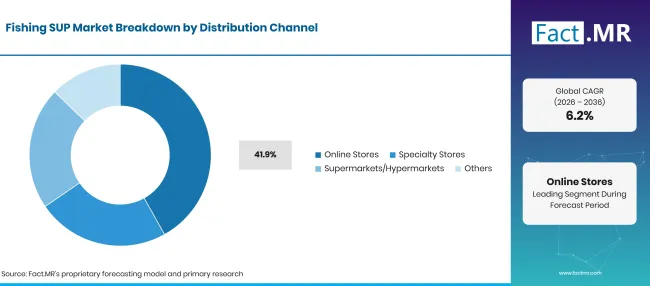
Fishing Sup Market Breakdown Distribution Channel | Source: Fact.MR
| Distribution Channel | Share (2026) |
|---|---|
| Online Stores (Leading segment) | 41.9% |
| Other segments combined | 58.1%* |
| Total | 100.0% |
Source: Fact.MR analysis. Updated Nov 5, 2026
Online stores allow consumers to compare board dimensions, construction, weight limits and included accessories before making a purchase. Specialist SUP and fishing websites can also provide product demonstrations and guidance on board selection. Specialty stores remain important because customers can seek advice on stability, fit and equipment compatibility before buying. Supermarkets and hypermarkets and other retail channels serve broader recreational equipment purchases.
Which End User accounts for the largest share?
Individuals are set to capture 54.2% of the market in 2026.
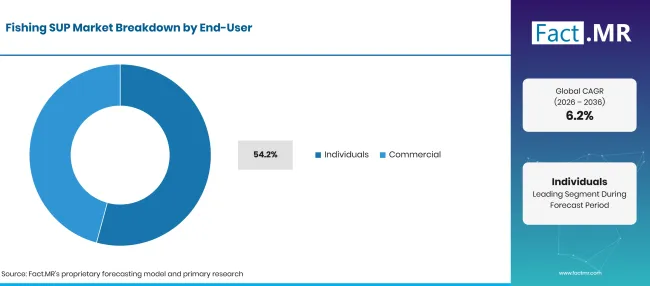
Fishing Sup Market Breakdown End User | Source: Fact.MR
| End User | Share (2026) |
|---|---|
| Individuals (Leading segment) | 54.2% |
| Other segments combined | 45.8%* |
| Total | 100.0% |
Source: Fact.MR analysis. Updated Nov 5, 2026
Individual buyers purchase fishing SUPs for personal recreation and leisure fishing. They generally assess portability, ease of setup, stability and storage capacity when selecting a board. Commercial buyers can include fishing tour operators, rental businesses and outdoor recreation providers that need equipment for repeated customer use. Commercial purchases may place greater emphasis on durability, maintenance requirements and replacement costs.
What is accelerating Fishing SUP Market growth, and what is holding it back?
Growing recreational fishing participation and demand for portable watercraft support market expansion, while safety concerns, seasonal use and competition from kayaks can restrict adoption.
Drivers Impact Analysis
| DRIVER | (~) % IMPACT ON CAGR | GEOGRAPHIC RELEVANCE | IMPACT TIMELINE |
|---|---|---|---|
| Growth in recreational fishing participation | +1.0% | North America, Europe, Latin America | Medium term (2–4 years) |
| Demand for portable and easy-to-store watercraft | +0.8% | Global | Short term (≤2 years) |
| Interest in shallow-water and inland fishing access | +0.7% | North America, Europe | Medium term (2–4 years) |
| Development of fishing-specific SUP accessories | +0.5% | Global | Medium term (2–4 years) |
| Growth of fishing tourism and outdoor recreation | +0.4% | Europe, Latin America, Asia | Long term (≥4 years) |
Source: Fact.MR analysis. Updated Nov 5, 2026
Opportunity Impact Analysis
| OPPORTUNITY | (~) % IMPACT ON CAGR | GEOGRAPHIC RELEVANCE | IMPACT TIMELINE |
|---|---|---|---|
| Wider inflatable boards with improved stability | +0.8% | Global | Medium term (2–4 years) |
| Integrated rod holders and modular gear mounts | +0.6% | North America, Europe | Short term (≤2 years) |
| Partnerships with fishing and outdoor retailers | +0.5% | Global | Medium term (2–4 years) |
| Rental and guided fishing SUP experiences | +0.4% | Europe, North America, Latin America | Long term (≥4 years) |
| Affordable fishing SUP packages for new users | +0.3% | Asia, Latin America | Medium term (2–4 years) |
Source: Fact.MR analysis. Updated Nov 5, 2026
Restraints Impact Analysis
| RESTRAINT | (~) % IMPACT ON CAGR | GEOGRAPHIC RELEVANCE | IMPACT TIMELINE |
|---|---|---|---|
| Safety concerns and stability limitations in changing water conditions | -0.8% | Global | Short term (≤2 years) |
| Competition from fishing kayaks and small boats | -0.6% | North America, Europe | Medium term (2–4 years) |
| Seasonal demand and weather dependency | -0.5% | Europe, North America, Japan | Medium term (2–4 years) |
| Limited availability of fishing-specific SUP models | -0.4% | Global | Short term (≤2 years) |
| High prices of premium boards and accessories | -0.3% | Global | Medium term (2–4 years) |
Source: Fact.MR analysis. Updated Nov 5, 2026
Which countries are scaling the Fishing SUP Market through 2036?
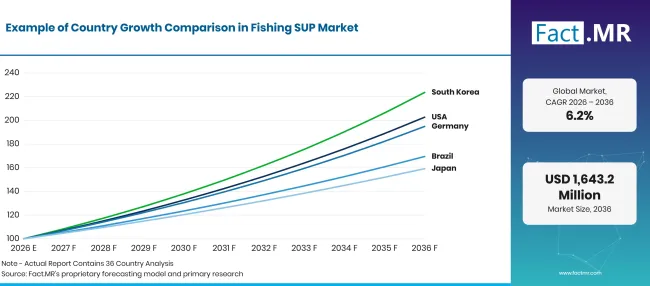
Fishing Sup Market Growth Index | Source: Fact.MR
| Country | CAGR (2026–2036) |
|---|---|
| Germany | 6.9% |
| Brazil | 5.4% |
| USA | 7.3% |
| UK | 4.4% |
| Japan | 4.8% |
Source: Fact.MR analysis. Updated Nov 5, 2026
What supports Germany's market growth?
6.9% CAGR, supported by an established recreational angling community and access to inland fishing waters.
Germany's lakes and rivers provide settings for recreational fishing, subject to local licensing and water-access rules. Fishing SUPs may appeal to anglers who value portability and stability in suitable sheltered waters. German aquaculture statistics measure commercial fish production rather than recreational angling participation, so they cannot substantiate estimates of fishing licences or club membership [4].
What is driving Brazil's market growth?
5.4% CAGR, shaped by the development of recreational fishing and fishing tourism.
Brazil's extensive river systems and fishing destinations create opportunities for recreational fishing equipment. The Ministry of Tourism reported that sport fishing involved approximately 8 million participants and could generate up to R$3 billion annually. The Ministry of Fisheries and Aquaculture also reported that approximately 323,000 recreational and sport fishing licences were issued in 2024. Fishing SUPs can appeal to users seeking portable equipment for suitable inland waters and guided fishing experiences [5].
What supports United States market growth?
7.3% CAGR, led by a large recreational fishing population and demand for versatile watercraft.
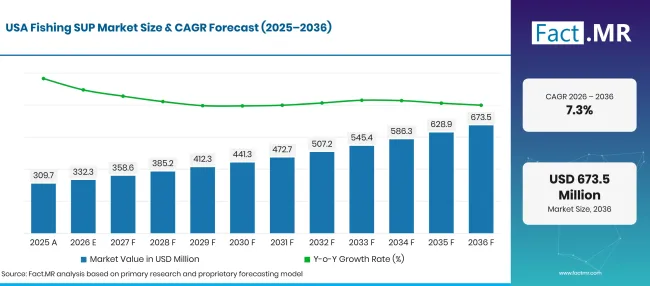
Fishing Sup Market Forecast Usa | Source: Fact.MR
The United States' outdoor recreation economy provides a strong commercial foundation for fishing-related equipment and watercraft. According to the U.S. Bureau of Economic Analysis, boating and fishing generated approximately USD 38.4 billion in value added in 2024, making it the largest conventional outdoor recreation activity in the country. Florida accounted for USD 4.4 billion of this contribution, followed by California at USD 3.3 billion and Texas at USD 3.0 billion, according to statistics released in March 2026 [7]. This economic activity creates opportunities for specialised watercraft such as fishing SUPs. Manufacturers can target recreational anglers seeking portable alternatives to conventional boats through stable board designs and integrated fishing accessories.
What is driving the United Kingdom market?
4.4% CAGR, backed by established sea-angling activity and opportunities for specialist recreational equipment.
The UK's recreational fishing sector provides a market for specialized equipment used in inland and coastal environments. The Centre for Environment, Fisheries and Aquaculture Science publishes annual estimates of recreational sea-angling participation and fishing activity across the UK. Its 2025 report, added to the government collection in July 2026, provides an updated evidence base for understanding sea-angling activity. Fishing SUP providers can target suitable sheltered waters and recreational users with portable board designs [6].
What supports Japan's market growth?
4.8% CAGR, driven by demand for outdoor recreation equipment and access to inland and coastal fishing locations.
Japan's coastline, lakes and rivers provide varied settings for recreational fishing. Fishing SUPs can serve users seeking a compact watercraft for suitable sheltered waters and short recreational outings. Demand will depend on board stability, portability, local water conditions and the availability of compatible fishing accessories. The market opportunity should be assessed alongside Japan's recreational fishing participation data rather than relying on commercial fisheries output as a proxy for SUP demand.
Who leads the Fishing SUP Market?
Fact.MR finds that NRS, BOTE, Starboard, Sea Eagle, Tower Paddle Boards, ISLE Surf & SUP, Aqua Marina and Imagine Surf are profiled across the stand-up paddleboard and recreational watercraft value chain.
NRS and Tower Paddle Boards are associated with inflatable paddleboard offerings. BOTE and Starboard offer paddleboards across recreational and performance-oriented categories. Sea Eagle participates in the wider paddle sports and watersports equipment industry. ISLE Surf & SUP focuses on paddleboards and related accessories, while Aqua Marina and Imagine Surf have offerings across paddleboards and other watersports equipment. Product portfolios should be evaluated for fishing-specific SUP models and integrated features before treating these companies as direct competitors in the fishing SUP market.
Commercial competition depends on board stability and construction quality as well as portability and fishing-specific functionality. Manufacturers need durable materials and reliable weight-bearing capacity. Anglers need practical features such as rod holders and tackle storage alongside mounting options for fishing accessories. Retailers need differentiated product offerings that address freshwater and saltwater fishing requirements.
Which companies are the key providers?
Key companies for competitive profiling are: NRS, BOTE, Starboard, Sea Eagle, Tower Paddle Boards, ISLE Surf & SUP, Aqua Marina, and Imagine Surf.
- NRS
- BOTE
- Starboard
- Sea Eagle
- Tower Paddle Boards
- ISLE Surf & SUP
- Aqua Marina
- Imagine Surf
Bibliography
- [1] American Sportfishing Association. (2026, July 29). 2026 Special Report on Fishing shows first decline in fishing participation since 2021.
- [2] Ministério do Turismo. (2025, December 26). Pesca esportiva ganha força com ações do Ministério do Turismo.
- [3] NRS. (2024, June 19). A beginner’s guide to stand-up paddleboard fly fishing.
- [4] Statistisches Bundesamt (Destatis). (2026, June 5). KORREKTUR: 1,2 % weniger Fisch aus Aquakulturen im Jahr 2025.
- [5] Ministério da Pesca e Aquicultura. (2026, February 23). Plano Nacional para o Desenvolvimento Sustentável da Pesca Amadora e Esportiva (PNPAE), 2024–2034.
- [6] Centre for Environment, Fisheries and Aquaculture Science. (2026, July 17). Sea Angling in the UK reports. GOV.UK.
- [7] U.S. Bureau of Economic Analysis. (2026, March 5). Outdoor Recreation Economic Statistics, U.S. and States, 2024.
This Report Answers
- The report examines the demand for stand-up paddleboards designed or adapted for recreational and professional fishing.
- Product analysis compares inflatable and hardboard fishing SUPs.
- Application analysis distinguishes recreational fishing from professional fishing.
- Distribution analysis compares online stores, specialty stores, supermarkets/hypermarkets and other sales channels.
- End-user analysis covers individuals and commercial buyers.
- Country analysis discusses Germany, Brazil, USA, UK and Japan alongside recreational fishing indicators.
- The competitive overview profiles the companies for the market assessment.
What does the Fishing SUP Market cover?
The market covers stand-up paddleboards designed or adapted for fishing activities in suitable inland and coastal waters. It includes inflatable and hardboard models used by recreational anglers and professional users. Product features may include wider decks, enhanced stability, rod-holder mounts, storage arrangements and accessory attachment points. The analysis considers sales through online stores, specialty retailers and other distribution channels.
What is included in the scope?
Included products are stand-up paddleboards marketed specifically for fishing or general-purpose SUPs sold with fishing-oriented configurations or adaptations.
The market covers inflatable and rigid boards purchased by individuals and commercial operators for fishing activities. Fishing-specific accessories are considered as product features or supporting equipment where relevant, but should not be counted as board revenue unless the market-sizing methodology explicitly includes them.
What is excluded from the scope?
The analysis excludes conventional fishing kayaks, motorized fishing boats, recreational paddleboards without fishing use or positioning, and fishing accessories sold independently of SUP boards.
It also excludes commercial fishing vessels and unrelated water sports equipment.
How Was the Analysis Built?
The analysis draws on 120+ sources, 35+ company portfolios, 25+ countries, and more than 20 industry interviews.
- Primary Research: Primary research includes discussions with manufacturers, service providers, technology developers, distributors, end users, and subject-matter experts. These conversations examine purchasing priorities, product adoption, operational challenges, approval requirements, competitive positioning, and the factors that influence wider market acceptance.
- Desk Research: Desk research covers government statistics, regulatory publications, company filings, trade data, technical studies, industry associations, standards, public policy, and other authoritative sources. Every source used in the analysis is documented in the bibliography.
- Market Sizing and Forecasting: Market estimates combine historical performance, demand indicators, pricing and volume trends, segment shares, company participation, country-level growth, adoption patterns, investment activity, and barriers to market expansion.
- Data Validation and Update Cycle: Findings are validated by comparing primary interviews with public data, company activity, regulatory changes, trade patterns, and industry developments. Regular updates review new product launches, capacity changes, partnerships, approvals, and shifts in commercial adoption.
Segmentation
What is the report's scope and coverage?
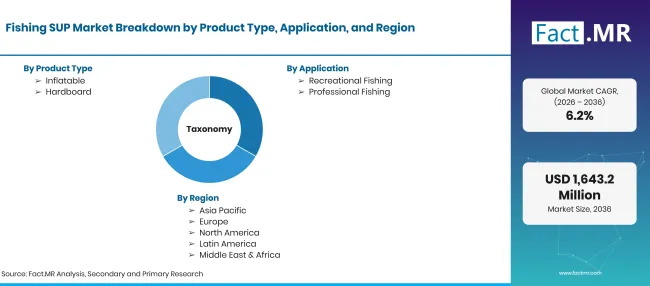
Fishing Sup Market Taxonomy | Source: Fact.MR
| Attribute | Details |
|---|---|
| Quantitative Units | USD million |
| Market Definition | The fishing SUP market comprises stand-up paddleboards specifically designed or equipped for recreational and professional fishing activities. These products include inflatable and rigid paddleboards featuring fishing-oriented configurations such as rod holders and tackle storage as well as accessory mounting systems and enhanced stability for carrying anglers and fishing equipment across freshwater and saltwater environments. |
| Product Type | Inflatable; Hardboard |
| Application | Recreational Fishing; Professional Fishing |
| Distribution Channel | Online Stores; Specialty Stores; Supermarkets/Hypermarkets; Others |
| End User | Individuals; Commercial |
| Regions Covered | North America; Latin America; Western Europe; Eastern Europe; East Asia; South Asia & Pacific; Middle East & Africa |
| Countries Covered | Germany; Brazil; USA; UK; Japan |
| Companies Profiled | NRS; BOTE; Starboard; Sea Eagle; Tower Paddle Boards; ISLE Surf & SUP; Aqua Marina; Imagine Surf |
| Forecast Period | 2026 to 2036 |
| Approach | Market segmentation and scenario-based analysis supported by fishing participation statistics and company product information |
Source: Fact.MR analysis. Updated Nov 5, 2026
How is the market segmented?
-
By Product Type
- Inflatable
- Hardboard
-
By Application
- Recreational Fishing
- Professional Fishing
-
By Distribution Channel
- Online Stores
- Specialty Stores
- Supermarkets/Hypermarkets
- Others
-
By End User
- Individuals
- Commercial
-
By Region
- North America
- Latin America
- Western Europe
- Eastern Europe
- East Asia
- South Asia & Pacific
- Middle East & Africa
Frequently Asked Questions
How big is the Fishing SUP Market in 2026?
What is the CAGR from 2026 to 2036?
Which product type has the largest share?
Which application leads the market?
Which distribution channel has the largest share?
Which end user has the largest share?
Which companies are covered?
Who worked on this report


Preview the report firsthand - request a free sample
Free SampleGet the brochure for pricing and purchase details
Download PDF