- Market Value (2025): USD 36.4 Bn
- Estimated Value (2026): USD 41.3 Bn
- Forecast Value (2036): USD 145.0 Bn
- CAGR (2026-2036): 13.4%
What is the Digital Fitness Market forecast to be worth by 2036?
USD 41.3 billion in 2026 to USD 145.0 billion by 2036 at a 13.4% CAGR.
- As per Fact.MR analysis, the digital fitness market was valued at USD 36.4 billion in 2025.
- Demand will grow from USD 41.3 billion in 2026 to USD 145.0 billion by 2036.
- The forecast records a 13.4% CAGR from 2026 to 2036 as consumers increasingly use connected devices and digital platforms to monitor fitness and exercise performance.
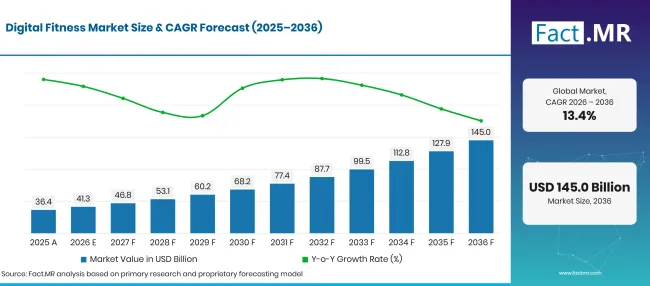
Digital Fitness Market Forecast Global | Source: Fact.MR
| Year | Basis | Market Value (USD billion) |
|---|---|---|
| 2025 | Actual | 36.4 |
| 2026 | Estimate | 41.3 |
| 2036 | Forecast | 145.0 |
| CAGR 2026 to 2036 | Forecast period | 13.4% |
Source: Fact.MR analysis. Updated Nov 5, 2026
What are the defining numbers behind Digital Fitness Market growth?
USD 103.7 billion absolute opportunity between 2026 and 2036.
- Demand Drivers in the Market
- Consumers increasingly use wearable technology to monitor exercise intensity, heart rate, steps, sleep and recovery. The American College of Sports Medicine ranked wearable technology as the leading fitness trend in its 2026 survey, reflecting its growing role in fitness programmes and personal activity tracking [1].
- Improvements in sensors and fitness analytics are encouraging consumers to move beyond basic step counting. Connected devices now offer more detailed performance indicators, including training load, recovery and activity intensity. This creates opportunities for manufacturers to differentiate products through more useful fitness insights.
- Companion applications strengthen the value of connected devices by organizing workout records and presenting activity trends. Sensor Tower reported 244 million worldwide downloads of wearable technology applications during the first three quarters of 2026, while in-app purchase revenue increased 30% to USD 139 million [2].
- Growing interest in personalized exercise programmes supports demand for devices that combine activity monitoring with coaching and performance feedback. Fitness professionals can use wearable data to support goal-setting and track changes in exercise behaviour.
- Key Segments Analyzed
- By Product Type: Smartwatches will account for 34.2% of the market in 2026, supported by their combination of fitness tracking, GPS, communication and health-monitoring functions.
- By Product Category: Hand Wear will lead with a 59.8% share in 2026, reflecting the widespread use of wrist-worn devices such as smartwatches and fitness bands.
- By Application: Smart Wearable Fitness Devices hold 57.1% share in 2026 as consumers use connected wearables for everyday activity monitoring and fitness management.
- Analyst Opinion at Fact.MR
- Shambhu Nath Jha, Principal Consultant at Fact.MR, states, “Digital fitness providers need to compete on the usefulness of the data their devices collect rather than relying only on additional tracking features. Manufacturers that combine reliable sensors with clear performance insights, comfortable designs and accessible applications can strengthen consumer engagement. Subscription pricing, device compatibility and data privacy will remain important considerations when expanding the user base.”
- Strategic Implications
- Manufacturers should improve sensor reliability, battery performance and compatibility with commonly used mobile operating systems.
- Digital platform providers need to make fitness data easier to understand through personalized dashboards, training summaries and practical recommendations.
- Sports technology companies can focus on specialized features for running, cycling, endurance training and recovery monitoring.
- Retailers and distributors must explain differences between basic activity trackers and advanced performance watches to help consumers select suitable devices.
- Service providers need to make subscription benefits clear and provide useful features that encourage continued engagement after the initial device purchase.
Germany is set to record a 15.4% CAGR through 2036. Brazil is projected to post 14.1%, followed by the USA at 12.7%. The UK market is estimated to advance at 11.4%, while Japan is forecast to grow at 10.1%.
How does the Digital Fitness Market break down by segment?
Fact.MR finds that Smartwatches lead Product Type with a 34.2% share; Hand Wear leads Product Category with 59.8%; and Smart Wearable Fitness Devices Lead Application with 57.1% in 2026.
Which Product Type dominates?
Smartwatches are set to hold a 34.2% share in 2026.
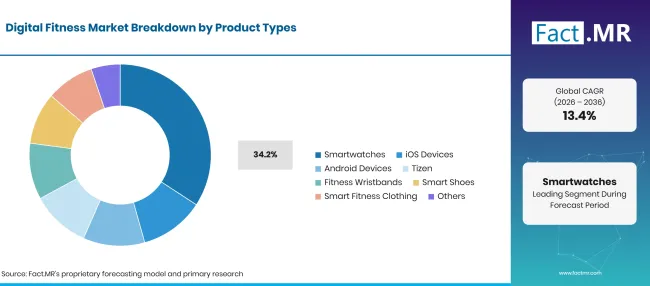
Digital Fitness Market Breakdown Product Types | Source: Fact.MR
| Product Type | Share (2026) |
|---|---|
| Smartwatches (Leading segment) | 34.2% |
| Other segments combined | 65.8%* |
| Total | 100.0% |
Source: Fact.MR analysis. Updated Nov 5, 2026
Smartwatches combine activity monitoring with GPS, workout recording, notifications and access to companion applications. Their ability to support different exercise routines makes them relevant to both everyday users and fitness enthusiasts. Fitness wristbands remain an alternative for consumers seeking simpler activity tracking, while smart shoes and fitness clothing serve more specialized performance-monitoring requirements.
What leads the Product Category segment?
Hand Wear is set to represent 59.8% of the market in 2026.
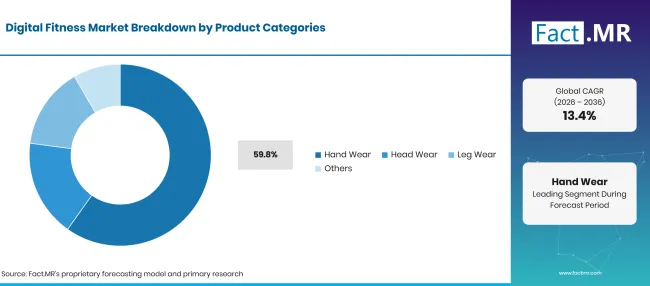
Digital Fitness Market Breakdown Product Categories | Source: Fact.MR
| Product Category | Share (2026) |
|---|---|
| Hand Wear (Leading segment) | 59.8% |
| Other segments combined | 40.2%* |
| Total | 100.0% |
Source: Fact.MR analysis. Updated Nov 5, 2026
Hand-worn devices include smartwatches and fitness wristbands that track movement, heart rate and workout activity. Their position on the wrist allows users to access activity information during exercise and throughout the day. Head Wear and Leg Wear products address more specialized tracking requirements, while other wearable formats provide additional options for sports and fitness monitoring.
How does Application shape demand?
Smart Wearable Fitness Devices are likely to account for a 57.1% share in 2026.
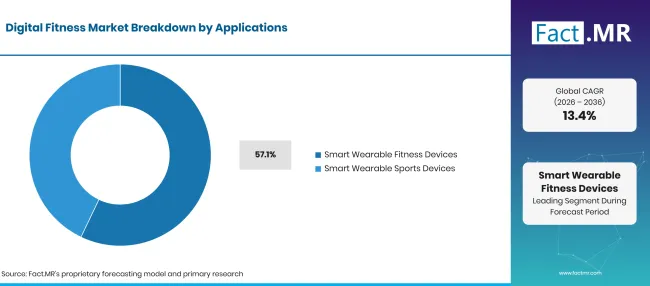
Digital Fitness Market Breakdown Applications | Source: Fact.MR
| Application | Share (2026) |
|---|---|
| Smart Wearable Fitness Devices (Leading segment) | 57.1% |
| Other segments combined | 42.9%* |
| Total | 100.0% |
Source: Fact.MR analysis. Updated Nov 5, 2026
Smart wearable fitness devices support daily activity monitoring and workout tracking while helping consumers manage their fitness goals. They enable users to measure movement patterns and evaluate progress over time. Smart wearable sports devices are designed to meet specific athletic performance requirements through features such as pace tracking and distance measurement. They also provide insights into training intensity and sport-specific performance metrics. These devices are particularly relevant to runners and cyclists as well as endurance athletes seeking to improve training efficiency and performance.
What is accelerating Digital Fitness Market growth, and what is holding it back?
Greater interest in personalized fitness tracking and connected applications supports demand, while device costs and concerns about data accuracy can restrict wider adoption.
Drivers Impact Analysis
| DRIVER | (~) % IMPACT ON CAGR | GEOGRAPHIC RELEVANCE | IMPACT TIMELINE |
|---|---|---|---|
| Rising interest in personal health and activity monitoring | +1.0% | Global | Medium term (2–4 years) |
| Integration of advanced sensors in wearable devices | +0.9% | North America, Europe, Asia | Medium term (2–4 years) |
| Growth of connected fitness applications | +0.7% | Global | Short term (≤2 years) |
| Demand for personalized training and recovery insights | +0.5% | North America, Europe | Medium term (2–4 years) |
| Expansion of sports and endurance tracking features | +0.4% | Global | Long term (≥4 years) |
Source: Fact.MR analysis. Updated Nov 5, 2026
Opportunity Impact Analysis
| OPPORTUNITY | (~) % IMPACT ON CAGR | GEOGRAPHIC RELEVANCE | IMPACT TIMELINE |
|---|---|---|---|
| AI-supported fitness coaching and personalized insights | +0.8% | North America, Europe, Asia | Medium term (2–4 years) |
| Development of smart clothing and specialized wearables | +0.6% | Global | Long term (≥4 years) |
| Subscription-based fitness analytics and premium features | +0.5% | North America, Europe | Medium term (2–4 years) |
| Integration with third-party fitness applications | +0.4% | Global | Short term (≤2 years) |
| Affordable fitness trackers for emerging markets | +0.3% | Asia, Latin America | Medium term (2–4 years) |
Source: Fact.MR analysis. Updated Nov 5, 2026
Restraints Impact Analysis
| RESTRAINT | (~) % IMPACT ON CAGR | GEOGRAPHIC RELEVANCE | IMPACT TIMELINE |
|---|---|---|---|
| High prices of advanced wearable devices | -0.8% | Global | Short term (≤2 years) |
| Concerns about personal health data privacy | -0.6% | Global | Medium term (2–4 years) |
| Variations in sensor accuracy across devices | -0.5% | Global | Medium term (2–4 years) |
| Limited battery life and device replacement costs | -0.4% | Global | Short term (≤2 years) |
| Compatibility limitations across operating systems and applications | -0.3% | Global | Medium term (2–4 years) |
Source: Fact.MR analysis. Updated Nov 5, 2026
Which countries are scaling the Digital Fitness Market through 2036?
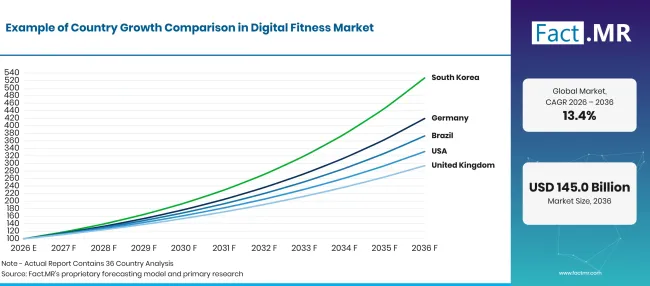
Digital Fitness Market Growth Index | Source: Fact.MR
| Country | CAGR (2026–2036) |
|---|---|
| Germany | 15.4% |
| Brazil | 14.1% |
| USA | 12.7% |
| UK | 11.4% |
| Japan | 10.1% |
Source: Fact.MR analysis. Updated Nov 5, 2026
What supports Germany's market growth?
15.4% CAGR, supported by established wearable usage and growing interest in personal health monitoring.
Germany's digital fitness market includes smartwatches, fitness trackers and connected health-monitoring devices. Germany's Federal Statistical Office reported that prices for smartwatches, fitness trackers and similar devices rose by 2.7% in October 2025 compared with October 2024, although prices for this category were 2.3% lower in 2024 than in 2020. These figures describe consumer prices, not device ownership or adoption [3].
What supports market development in the Brazil?
14.1% CAGR, shaped by expanding digital connectivity and growing access to mobile-based fitness services.
Brazil's expanding internet and smartphone user base creates a wider audience for connected fitness products. The Brazilian Institute of Geography and Statistics reported that 90.5% of people aged 10 years or older used the internet in 2025. Mobile phones were the primary access device for 98.7% of internet users. This connectivity supports the use of companion applications, digital fitness platforms and wearable devices that synchronize activity data with smartphones [4].
What supports United States adoption in the market?
12.7% CAGR, driven by consumer interest in exercise monitoring and personalized fitness insights.
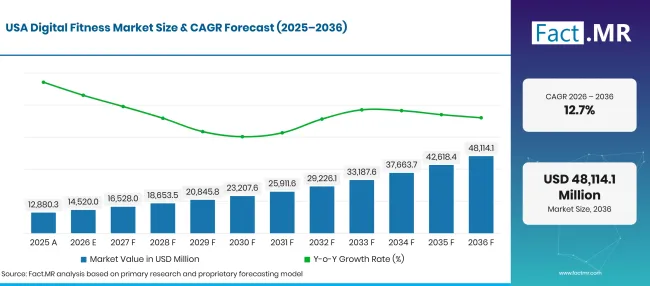
Digital Fitness Market Forecast Usa | Source: Fact.MR
The United States has an established market for connected fitness devices and applications. KPMG's 2026 Consumer Pulse Survey reported that 39% of qualified fitness-tracker and wearable-technology respondents used these products for exercise instruction and monitoring, compared with 26% for sleep tracking, 25% for dieting, weight loss and healthy eating, and 22% for mental health and well-being. These are multiple-response survey results, not market-share estimates [5].
What is driving the United Kingdom market?
11.4% CAGR, led by rising physical activity and the use of digital tools to monitor fitness progress.
The UK's active fitness environment creates opportunities for wearable devices that help consumers monitor exercise and track progress. Sport England's Active Lives Adult Survey for November 2024 to November 2025 found that 64.6% of adults in England met the recommended level of at least 150 minutes of moderate-intensity physical activity per week. This growing participation supports the relevance of smartwatches, fitness wristbands and companion applications for everyday activity and workout monitoring [6].
What supports Japan's market growth?
10.1% CAGR, backed by regular sports participation and demand for structured activity monitoring.
Japan's fitness market benefits from interest in regular exercise and personal fitness management. The Japan Sports Agency reported that 51.7% of adults aged 20 years and older participated in sports or exercise at least once a week in its FY2025 survey. Wearable devices can help users monitor activity duration, heart rate and workout progress, while sports-focused watches support more detailed performance tracking [7].
Who leads the Digital Fitness Market?
Fact.MR profiles Apple, Samsung Electronics, Garmin, Google Fitbit, Xiaomi, WHOOP, Oura, Polar Electro, Suunto and COROS across the connected fitness device and digital tracking ecosystem.
Competition spans general-purpose smartwatches, affordable fitness bands, premium sports watches and specialized recovery-focused wearables. Apple and Samsung combine wearable hardware with broader mobile ecosystems and fitness applications [8] [9]. Garmin, Polar, Suunto and COROS focus strongly on sports tracking, GPS functionality and training analysis.
The companies have distinct product positioning rather than directly interchangeable portfolios. Apple and Samsung offer broad smartwatch ecosystems, while Garmin, Polar, Suunto and COROS emphasize sports and endurance performance. WHOOP focuses on exertion and recovery metrics, and Oura offers a ring-based form factor with activity, sleep and readiness tracking. Xiaomi and Google Fitbit provide fitness bands and smartwatches with everyday activity-monitoring functions.
Which companies are the key providers?
Key companies include Apple Inc.; Samsung Electronics; Garmin Ltd.; Google LLC (Fitbit); Xiaomi Corporation; WHOOP Inc.; Oura Health; Polar Electro; Suunto; and COROS.
- Apple Inc.
- Samsung Electronics
- Garmin Ltd.
- Google LLC (Fitbit)
- Xiaomi Corporation
- WHOOP Inc.
- Oura Health
- Polar Electro
- Suunto
- COROS
Bibliography
- [1] Eurostat. (2025, August 28). Internet-connected devices are widely used in the EU.
- [2] Eurostat. (2025). Digitalisation in Europe – 2025 edition.
- [3] Statistisches Bundesamt (Destatis). (2025, November 18). Fernsehgeräte im Oktober 2025 um 10,6 % günstiger als ein Jahr zuvor. https://www.destatis.de/DE/Presse/Pressemitteilungen/Zahl-der-Woche/2025/PD25_47_p002.
- [4] Instituto Brasileiro de Geografia e Estatística. (2026, July 2). Proportion of Internet users in Brazil exceeded 90% of population aged 10 or over, in 2025.
- [5] KPMG. (2026). Consumer Pulse Survey: Summer 2026 report
- [6] Sport England. (2026). Active Lives Adult Survey: November 2024–25.
- [7] Japan Sports Agency. (2026, March 11). Results of the FY2025 public opinion survey on sports participation and activity.
- [8] Samsung Electronics. (n.d.). Samsung Health.
- [9] Garmin Ltd. (2026, February 24). Garmin announces feature updates for select smartwatches.
This Report Answers
- The report examines the development of connected wearable devices and digital platforms used for fitness and sports tracking.
- Product analysis compares smartwatches, fitness wristbands, smart shoes and smart fitness clothing.
- Product category analysis covers hand wear, head wear, leg wear and other wearable formats.
- Application analysis distinguishes everyday fitness monitoring from sports-performance tracking.
- Country analysis discusses Germany, Brazil, USA, UK and Japan alongside relevant fitness participation and digital connectivity indicators.
- The competitive overview profiles the ten named providers across consumer wearables, sports tracking and connected fitness applications.
What does the Digital Fitness Market cover?
The market covers connected wearable devices and their associated digital platforms used to monitor physical activity, exercise performance and fitness progress. It includes smartwatches, fitness wristbands, smart shoes and smart fitness clothing, along with companion applications that collect, organize and interpret device-generated fitness data. The analysis considers everyday activity monitoring and specialized sports tracking.
What is included in the scope?
Included products are wearable devices designed to collect and communicate fitness or sports-related data.
The scope covers devices worn on the wrist, head or legs, as well as other wearable formats identified in the segmentation. Associated software and application features are included where they directly support the covered devices and their fitness-monitoring functions.
What is excluded from the scope?
The analysis excludes conventional gym equipment without connected fitness-monitoring functionality, general-purpose consumer electronics without a defined fitness application, and standalone wellness or nutrition applications that are not linked to the covered wearable-device market.
General medical monitoring devices intended primarily for clinical diagnosis are also excluded unless they form part of a product specifically marketed for fitness or sports tracking.
How Was the Analysis Built?
The analysis draws on 120+ sources, 35+ company portfolios, 25+ countries, and more than 20 industry interviews.
- Primary Research: Primary research includes discussions with manufacturers, service providers, technology developers, distributors, end users, and subject-matter experts. These conversations examine purchasing priorities, product adoption, operational challenges, approval requirements, competitive positioning, and the factors that influence wider market acceptance.
- Desk Research: Desk research covers government statistics, regulatory publications, company filings, trade data, technical studies, industry associations, standards, public policy, and other authoritative sources. Every source used in the analysis is documented in the bibliography.
- Market Sizing and Forecasting: Market estimates combine historical performance, demand indicators, pricing and volume trends, segment shares, company participation, country-level growth, adoption patterns, investment activity, and barriers to market expansion.
- Data Validation and Update Cycle: Findings are validated by comparing primary interviews with public data, company activity, regulatory changes, trade patterns, and industry developments. Regular updates review new product launches, capacity changes, partnerships, approvals, and shifts in commercial adoption.
Segmentation
What is the report's scope and coverage?
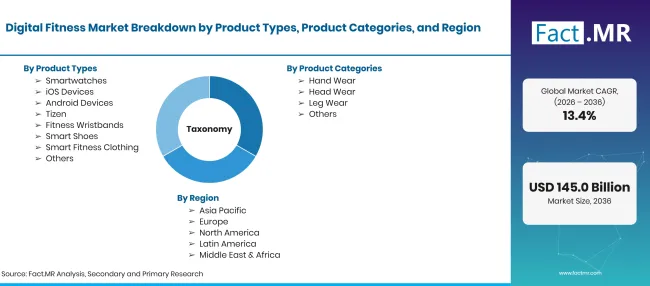
Digital Fitness Market Taxonomy | Source: Fact.MR
| Attribute | Details |
|---|---|
| Quantitative Units | USD billion in 2026 to USD billion by 2036, at CAGR |
| Market Definition | The digital fitness market comprises connected wearable devices and integrated digital platforms designed to monitor physical activity and exercise performance while helping users track fitness progress and recovery. It includes smartwatches and fitness wristbands as well as smart shoes and connected fitness apparel supported by companion applications that collect and analyse user activity data. |
| Product Type | Smartwatches; iOS Devices; Android Devices; Tizen; Fitness Wristbands; Smart Shoes; Smart Fitness Clothing; Others |
| Product Category | Hand Wear; Head Wear; Leg Wear; Others |
| Applications | Smart Wearable Fitness Devices; Smart Wearable Sports Devices |
| Regions Covered | North America; Latin America; Western Europe; Eastern Europe; East Asia; South Asia & Pacific; Middle East & Africa |
| Countries Covered | Germany; Brazil; USA; UK; Japan |
| Companies Profiled | Apple; Samsung Electronics; Garmin; Google Fitbit; Xiaomi; WHOOP; Oura; Polar Electro; Suunto; COROS |
| Forecast Period | 2026 to 2036 |
| Approach | Market segmentation and scenario-based analysis supported by company product portfolios, industry research and country-level digital fitness indicators |
Source: Fact.MR analysis. Updated Nov 5, 2026
How is the market segmented?
-
By Product Type
- Smartwatches
- iOS Devices
- Android Devices
- Tizen
- Fitness Wristbands
- Smart Shoes
- Smart Fitness Clothing
- Others
-
By Product Category
- Hand Wear
- Head Wear
- Leg Wear
- Others
-
By Applications
- Smart Wearable Fitness Devices
- Smart Wearable Sports Devices
-
By Region
- North America
- Latin America
- Western Europe
- Eastern Europe
- East Asia
- South Asia & Pacific
- Middle East & Africa
Frequently Asked Questions
How big is the Digital Fitness Market in 2026?
What is the CAGR from 2026 to 2036?
Which product type has the largest share?
Which product category leads?
Which application has the largest share?
Which companies are covered?
Who worked on this report


Preview the report firsthand - request a free sample
Free SampleGet the brochure for pricing and purchase details
Download PDF