Flame-Retardant Phosphate Esters Market (2026 - 2036)
Flame-Retardant Phosphate Esters Market Size and Share Forecast Outlook 2026 to 2036
Core Findings
Flame-Retardant Phosphate Esters Market Forecast and Outlook 2026 to 2036
The flame-retardant phosphate esters market is projected to reach USD 4.1 billion in 2026 and grow to USD 6.1 billion by 2036, advancing at a CAGR of 4.1%. According to Fact.MR, this growth is driven by a substantial shift toward halogen-free, phosphorus-based chemistries. This shift is being propelled by regulatory mandates in the EU and North America, which are targeting the phase-out of halogenated flame retardants, and the growing demand for high-performance materials for insulation in the rapidly expanding electric vehicle (EV) market.
Flame-Retardant Phosphate Esters Market Key Takeaways
- Market Value in 2026: USD 4.1 billion
- Market Forecast Value in 2036: USD 6.1 billion
- Market Forecast CAGR (2026-2036): 4.1%
- Dominant Product Type: Non-Halogenated Phosphate Esters with 46.0% share
- Leading Application: PU Foams (Flexible/Rigid) with 34.0% market share
- Key Market Players: ICL Group, LANXESS, BASF SE, Eastman Chemical Company, Clariant, Solvay, Dover Chemical, Adeka Corporation, KPX Green Chemical, Jiangsu Yoke Technology
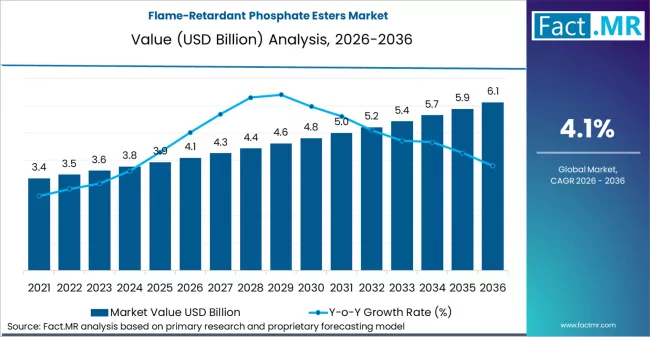
Leading the change is LANXESS with their introduction of Levagard® 2100, a next-generation reactive phosphonate flame retardant, which chemically bonds into the polymer matrix, preventing migration and reducing VOC emissions. As LANXESS unveiled this technology at K 2025, they highlighted its ability to significantly enhance the durability and fire resistance of rigid polyurethane and polyisocyanurate foams used in building insulation.
Clariant, another key player, has made significant strides in the high-voltage insulation market, especially with their Exolit® OP line. As EVs move toward 800V systems, Clariant’s phosphate ester solutions are providing electrical insulation stability under extreme high-voltage conditions, ensuring the longevity and safety of high-energy battery systems. Clariant’s CEO, Hariolf Kottmann, commented, “Our innovations in phosphorus-based flame retardants are key to shaping the future of safe, sustainable mobility. Our latest product offerings are designed to meet the growing demands of e-mobility with high-performance, halogen-free alternatives.”
Flame-Retardant Phosphate Esters Market
| Metric | Value |
|---|---|
| Estimated Value in (2026E) | USD 4.1 billion |
| Forecast Value in (2036F) | USD 6.1 billion |
| Forecast CAGR (2026 to 2036) | 4.1% |
Category
| Category | Segments |
|---|---|
| Product Type | Non-Halogenated Phosphate Esters; Halogenated Phosphate Esters; Reactive Phosphate Esters; Other Phosphate Esters |
| Application | PU Foams (Flexible/Rigid); Engineering Plastics & Compounds; Hydraulic Fluids & Lubricants; Other Uses |
| End-Use Sector | Construction & Buildings; Automotive & Transport; Electronics & Electrical; Industrial & Other Sectors |
| Regulatory Preference | Legacy/Established FRs; Low-Toxicity / Next-Gen FRs; Transition/Blended Portfolios |
| Region | North America; Europe; Asia Pacific; Latin America; Middle East & Africa |
Segmental Analysis
What Is the Impact of Product Type on the Flame-Retardant Phosphate Esters Market?
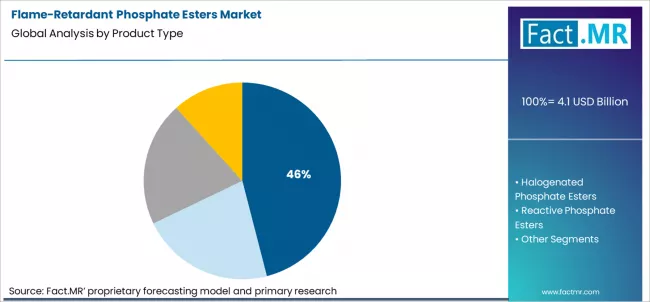
In the flame-retardant phosphate esters market, product type influences regulatory compliance, performance standards, and material compatibility across various industrial applications. Non-halogenated phosphate esters lead the market with a 46.0% share, driven by growing environmental regulations and a strong shift toward safer, more sustainable alternatives to halogenated compounds. Non-halogenated esters offer excellent flame retardancy and low toxicity, making them ideal for use in applications such as electronics, automotive parts, and building materials where safety, regulatory compliance, and environmental impact are key considerations. Their growing adoption in fire-resistant coatings, wiring, and automotive interiors reflects the demand for safer, non-toxic flame retardants in consumer and industrial products.
How Does Application Influence Demand in the Flame-Retardant Phosphate Esters Market?
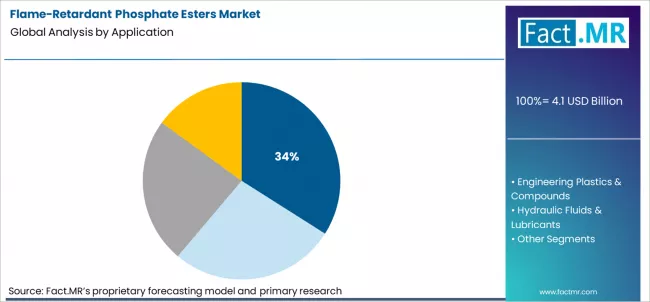
Application area plays a key role in determining the type of phosphate esters used, as different industries require specific formulations for effective flame retardancy and safety. PU foams (flexible/rigid) account for a 34.0% share due to their extensive use in furniture, automotive, and construction applications where flame resistance is a critical requirement. Flame-retardant phosphate esters are particularly effective in enhancing the fire safety of polyurethane foams, which are widely used in seating, insulation, and cushioning materials. The increased focus on fire safety standards and environmental regulations in both residential and commercial sectors continues to drive the demand for phosphate esters in foam applications.
What are the Drivers, Restraints, and Key Trends in the Flame-Retardant Phosphate Esters Market?
| Country | Driver | Restraint | Trend |
|---|---|---|---|
| USA | Strong demand from electronics, automotive and industrial sectors for fire safe materials. | Rising regulatory and compliance costs for chemical safety and emissions. | Shift toward low toxicity and environmentally preferable phosphate ester formulations. |
| UK | Emphasis on fire safety standards in construction and transport applications. | Budget constraints in adoption of high performance flame retardants. | Growing use of certified green flame retardant solutions. |
| Germany | Large automotive and engineering industries requiring advanced flame retardants. | Strict environmental and workplace safety regulations increasing compliance burden. | Integration of phosphate esters with performance polymers for lightweight applications. |
| China | Rapid industrial growth and electronics manufacturing driving flame retardant chemical use. | Price sensitivity and competition from lower cost alternatives. | Local capacity expansion and formulation innovation for high efficiency phosphate esters. |
| India | Expanding construction and infrastructure sectors increasing fire safety material demand. | Limited awareness and availability of advanced flame retardant chemistries. | Adoption of imported high performance products and gradual local formulation development. |
Analysis of the Flame-Retardant Phosphate Esters Market by Key Country
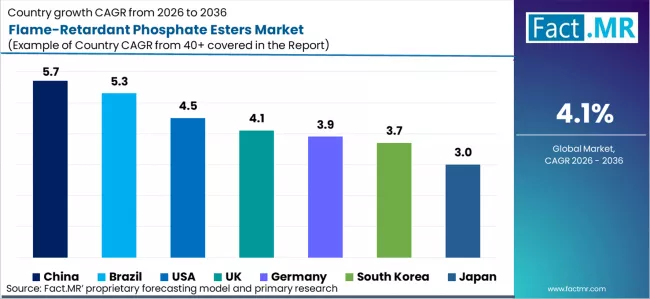
| Country | CAGR (%) |
|---|---|
| China | 5.7% |
| Brazil | 5.3% |
| USA | 4.5% |
| UK | 4.1% |
| Germany | 3.9% |
| South Korea | 3.7% |
| Japan | 3.0% |
The report covers an in-depth analysis of 40+ countries; top-performing countries are highlighted below.
What drives growth in China for flame retardant phosphate esters?
China is projected to grow at 5.7% CAGR, the highest among key markets, driven by rapid industrialization, extensive infrastructure development, and tightening fire safety and environmental regulations. Flame retardant phosphate esters are increasingly specified in electric power equipment, commercial construction, and manufacturing machinery where heat, flame, and electrical fault risks are mitigated through advanced chemistries. Chinese industrial standards emphasize fire performance and reduced smoke generation, boosting adoption of phosphate ester based solutions across sectors such as power generation, automation, and materials handling.
“In fast expanding industrial sectors, phosphate ester flame retardants provide reliable protection in applications where thermal and electrical safety are paramount,” explains Li Wei, Head of Materials Development at a Chinese specialty chemical supplier.
What fuels the rapid rise in Brazil?
Brazil’s flame retardant phosphate ester market is expected to grow at 5.3% CAGR, driven by expanding industrial and infrastructure sectors where flame and heat exposure risks are mitigated through advanced chemical solutions. Commercial construction, mass transit projects, and electrical grid expansions in major cities increase the need for certified flame retardant materials, particularly in power distribution and industrial process equipment. Brazilian safety standards, including NR 10 for electrical installations, encourage adoption of fluids and additives that provide fire resistance while minimizing environmental and health impacts.
“In Brazil’s growing industrial landscape, materials that enhance worker and asset safety while meeting regulatory requirements are increasingly specified,” explains Marcos Silva, Director of Materials at a Brazilian specialty chemicals producer.
How is the USA market evolving in the Flame Retardant Phosphate Esters sector?
The USA market is forecast to grow at 4.5%, reflecting sustained demand from industrial, electrical, and transportation applications where flame retardant performance and regulatory compliance are critical. Flame retardant phosphate esters are widely specified in hydraulic fluids, metalworking fluids, and electrical insulation systems that must meet stringent safety standards such as UL94 and NFPA fire protection codes. According to the National Fire Protection Association, materials processing and electrical equipment represent a large segment of flame retardant demand because phosphate ester chemistries offer high heat resistance and low smoke generation compared with halogenated alternatives.
“Phosphate esters deliver a balance of flame retardancy and thermal stability that is crucial in protecting industrial and electrical systems,” says Dr. Laura Campbell, Senior Materials Scientist at a U.S. specialty chemicals firm.
Why is the UK market important for flame retardant phosphate esters?
Demand in the UK market is expanding at 4.1%, supported by regulatory frameworks that emphasize fire safety in construction, transport, and industrial machinery. The Building Regulations Part B and industry standards require flame retardant materials in public buildings and facilities, encouraging use of phosphate ester based chemistries in panel systems, coatings, and electrical components. Facility managers and OEMs specify advanced flame retardants to meet both performance and compliance criteria, particularly in retrofit and modernization projects where aging infrastructure needs improved fire resistance.
“Fire protection codes in the UK promote materials that combine flame resistance with environmental acceptability, and phosphate esters fit that profile,” says Emma Clarke, Senior Fire Safety Consultant at a UK engineering firm.
What is driving expansion in Germany?
Germany is projected to grow at 3.9% CAGR, supported by its advanced engineering and industrial sectors that prioritize high performance and safety in materials. Flame retardant phosphate esters are specified in applications such as electrical transformers, industrial hydraulics, and transportation coatings where rigorous fire safety and material performance are required. Compliance with DIN and EN fire performance standards influences procurement of phosphate ester chemistry because it delivers reduced flammability without compromising mechanical properties.
“In precision manufacturing and heavy industry, flame retardant materials are essential to meeting both safety and performance expectations,” says Dr. Petra Müller, Principal Materials Engineer at a German industrial research institute.
How is South Korea shaping demand for flame retardant phosphate esters?
South Korea’s market is growing at 3.7% CAGR, underpinned by robust industrial production and advanced electronics manufacturing sectors where flame retardant chemistries are critical to reliability and safety. Korean OEMs and materials formulators increasingly adopt phosphate ester based solutions for hydraulic fluids, coatings, and electrical applications that require balanced fire performance and operational durability. Safety regulatory frameworks such as the Korean Fire Safety Standards encourage use of materials that demonstrate reduced flame propagation and smoke density in relevant tests.
“Demand for high performance flame retardants reflect South Korea’s focus on both safety and competitive materials performance in global markets,” notes Min Jae Kim, Senior Materials Scientist at a Korean specialty chemicals firm.
What fuels the gradual rise in Japan?
Japan’s flame retardant phosphate ester market is forecast to grow at 3.0% CAGR, reflecting measured but steady adoption in applications where fire safety, performance, and material stability are jointly prioritized. Japanese manufacturers emphasize chemistries that deliver low flammability and high thermal stability in electrical, automotive, and industrial sectors. Japan’s Building and Fire Service Law and rigorous product testing protocols encourage use of flame retardant materials that also meet environmental and exposure safety criteria.
“In Japan’s high precision manufacturing and infrastructure environments, flame retardant materials must balance performance, reliability, and compliance,” explains Hiroshi Tanaka, Senior Research Engineer at a Japanese materials institute.
Strategic Moves Are Defining Competitive Landscape?
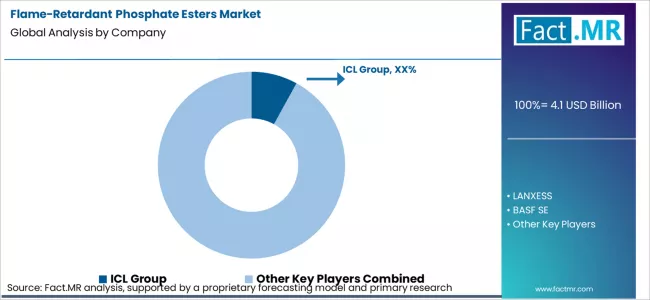
The flame-retardant phosphate esters market is currently shifting from a purely compliance-driven segment to a high-value arena of "material intelligence." Between 2020 and 2024 the industry focused on the rapid replacement of halogenated additives with phosphorus-based alternatives to meet tightening environmental mandates in electronics and construction. This phase established the baseline for non-toxic fire safety yet often created a performance gap where manufacturers struggled to maintain structural integrity at high loading levels.
As the industry advances into 2026 and beyond the focus is evolving toward molecular precision and "Zero-Halogen" orchestration. Strategic investment is now intensifying around bio-derived esters and AI-driven molecular simulation to optimize performance in electric vehicle battery enclosures and smart infrastructure. The strategic hypothesis is that competitive advantage no longer rests on volume but on the ability to integrate flame retardancy into the "Circular Asset" model. Success now depends on turning specialty chemistry into a measurable lever for ESG compliance and insurance risk reduction. Matthias Zachert the CEO of LANXESS highlights this move toward specialty focus as follows.
'Our focus is now firmly on specialty chemical products within attractive mid-sized niche markets globally where we can leverage our German quality expertise for higher returns and sustainable growth.' - Matthias Zachert, CEO of LANXESS
Companies like ICL Group and LANXESS are leveraging their early lead in polymeric flame retardants to set the standard for the next generation of safe automotive interiors. The competitors like Clariant and BASF are focusing on reactive phosphorus oligomers that prevent migration and enhance the recyclability of engineering plastics. This strategic evolution ensures they remain indispensable in a market that is rapidly moving away from commodity chemicals toward high-performance bio-assurance platforms.
Key Players in the Flame-Retardant Phosphate Esters Market
- ICL Group
- LANXESS
- BASF SE
- Eastman Chemical Company
- Clariant
- Solvay
- Dover Chemical
- Adeka Corporation
- KPX Green Chemical
- Jiangsu Yoke Technology
Scope of the Report
| Items | Values |
|---|---|
| Quantitative Units | USD billion |
| Product Type | Non-Halogenated Phosphate Esters; Halogenated Phosphate Esters; Reactive Phosphate Esters; Other Phosphate Esters |
| Application | PU Foams (Flexible/Rigid); Engineering Plastics & Compounds; Hydraulic Fluids & Lubricants; Other Uses |
| End-Use Sector | Construction & Buildings; Automotive & Transport; Electronics & Electrical; Industrial & Other Sectors |
| Regulatory Preference | Legacy/Established FRs; Low-Toxicity / Next-Gen FRs; Transition/Blended Portfolios |
| Regions Covered | Asia Pacific, Europe, North America, Latin America, Middle East & Africa |
| Countries Covered | China, Brazil, USA, UK, Germany, South Korea, Japan, and 40+ countries |
| Key Companies Profiled | ICL Group; LANXESS; BASF SE; Eastman Chemical Company; Clariant; Solvay; Dover Chemical; Adeka Corporation; KPX Green Chemical; Jiangsu Yoke Technology |
| Additional Attributes | Dollar sales by product type, application, and end-use sector; shift toward low-toxicity and next-generation flame retardants driven by regulatory changes and consumer demand for safer materials; adoption of reactive phosphate esters for high-performance applications in automotive and electronics sectors; focus on sustainable and efficient flame-retardant solutions with reduced environmental impact. |
Flame-Retardant Phosphate Esters Market Key Segment
-
Product Type :
- Non-Halogenated Phosphate Esters
- Halogenated Phosphate Esters
- Reactive Phosphate Esters
- Other Phosphate Esters
-
Application :
- PU Foams (Flexible/Rigid)
- Engineering Plastics & Compounds
- Hydraulic Fluids & Lubricants
- Other Uses
-
End-Use Sector :
- Construction & Buildings
- Automotive & Transport
- Electronics & Electrical
- Industrial & Other Sectors
-
Regulatory Preference :
- Legacy/Established FRs
- Low-Toxicity / Next-Gen FRs
- Transition/Blended Portfolios
-
Region :
- North America
- USA
- Canada
- Mexico
- Europe
- Germany
- UK
- France
- Italy
- Spain
- Nordic Countries
- BENELUX
- Rest of Europe
- Asia Pacific
- China
- Japan
- South Korea
- India
- Australia
- Rest of Asia Pacific
- Latin America
- Brazil
- Argentina
- Rest of Latin America
- Middle East and Africa
- Kingdom of Saudi Arabia
- United Arab Emirates
- South Africa
- Rest of Middle East and Africa
- Other Regions
- Oceania
- Central Asia
- Other Markets
- North America
Bibliographies
- International Organization for Standardization. (2023). Plastics-Determination of burning behaviour using oxygen index (ISO 4589-2:2023). ISO.
- European Commission. (2023). Commission Regulation (EU) 2023/2055 amending REACH as regards restriction of certain hazardous flame retardants. Official Journal of the European Union.
- United States Environmental Protection Agency. (2024). Phosphorus-based flame retardants: Risk evaluation and safer alternatives. U.S. EPA.
- LANXESS. (2024). Phosphorus-based flame retardants for engineering plastics and polyurethane applications. LANXESS Technical Documentation.
Table of Content
- Executive Summary
- Global Market Outlook
- Demand to side Trends
- Supply to side Trends
- Technology Roadmap Analysis
- Analysis and Recommendations
- Market Overview
- Market Coverage / Taxonomy
- Market Definition / Scope / Limitations
- Research Methodology
- Chapter Orientation
- Analytical Lens and Working Hypotheses
- Market Structure, Signals, and Trend Drivers
- Benchmarking and Cross-market Comparability
- Market Sizing, Forecasting, and Opportunity Mapping
- Research Design and Evidence Framework
- Desk Research Programme (Secondary Evidence)
- Company Annual and Sustainability Reports
- Peer-reviewed Journals and Academic Literature
- Corporate Websites, Product Literature, and Technical Notes
- Earnings Decks and Investor Briefings
- Statutory Filings and Regulatory Disclosures
- Technical White Papers and Standards Notes
- Trade Journals, Industry Magazines, and Analyst Briefs
- Conference Proceedings, Webinars, and Seminar Materials
- Government Statistics Portals and Public Data Releases
- Press Releases and Reputable Media Coverage
- Specialist Newsletters and Curated Briefings
- Sector Databases and Reference Repositories
- FMR Internal Proprietary Databases and Historical Market Datasets
- Subscription Datasets and Paid Sources
- Social Channels, Communities, and Digital Listening Inputs
- Additional Desk Sources
- Expert Input and Fieldwork (Primary Evidence)
- Primary Modes
- Qualitative Interviews and Expert Elicitation
- Quantitative Surveys and Structured Data Capture
- Blended Approach
- Why Primary Evidence is Used
- Field Techniques
- Interviews
- Surveys
- Focus Groups
- Observational and In-context Research
- Social and Community Interactions
- Stakeholder Universe Engaged
- C-suite Leaders
- Board Members
- Presidents and Vice Presidents
- R&D and Innovation Heads
- Technical Specialists
- Domain Subject-matter Experts
- Scientists
- Physicians and Other Healthcare Professionals
- Governance, Ethics, and Data Stewardship
- Research Ethics
- Data Integrity and Handling
- Primary Modes
- Tooling, Models, and Reference Databases
- Desk Research Programme (Secondary Evidence)
- Data Engineering and Model Build
- Data Acquisition and Ingestion
- Cleaning, Normalisation, and Verification
- Synthesis, Triangulation, and Analysis
- Quality Assurance and Audit Trail
- Market Background
- Market Dynamics
- Drivers
- Restraints
- Opportunity
- Trends
- Scenario Forecast
- Demand in Optimistic Scenario
- Demand in Likely Scenario
- Demand in Conservative Scenario
- Opportunity Map Analysis
- Product Life Cycle Analysis
- Supply Chain Analysis
- Investment Feasibility Matrix
- Value Chain Analysis
- PESTLE and Porter’s Analysis
- Regulatory Landscape
- Regional Parent Market Outlook
- Production and Consumption Statistics
- Import and Export Statistics
- Market Dynamics
- Global Market Analysis 2021 to 2025 and Forecast, 2026 to 2036
- Historical Market Size Value (USD Million) Analysis, 2021 to 2025
- Current and Future Market Size Value (USD Million) Projections, 2026 to 2036
- Y to o to Y Growth Trend Analysis
- Absolute $ Opportunity Analysis
- Global Market Pricing Analysis 2021 to 2025 and Forecast 2026 to 2036
- Global Market Analysis 2021 to 2025 and Forecast 2026 to 2036, By Product Type
- Introduction / Key Findings
- Historical Market Size Value (USD Million) Analysis By Product Type, 2021 to 2025
- Current and Future Market Size Value (USD Million) Analysis and Forecast By Product Type, 2026 to 2036
- Non-Halogenated Phosphate Esters
- Halogenated Phosphate Esters
- Reactive Phosphate Esters
- Other Phosphate Esters
- Non-Halogenated Phosphate Esters
- Y to o to Y Growth Trend Analysis By Product Type, 2021 to 2025
- Absolute $ Opportunity Analysis By Product Type, 2026 to 2036
- Global Market Analysis 2021 to 2025 and Forecast 2026 to 2036, By Application
- Introduction / Key Findings
- Historical Market Size Value (USD Million) Analysis By Application, 2021 to 2025
- Current and Future Market Size Value (USD Million) Analysis and Forecast By Application, 2026 to 2036
- PU Foams (Flexible/Rigid)
- Engineering Plastics & Compounds
- Hydraulic Fluids & Lubricants
- Other Uses
- PU Foams (Flexible/Rigid)
- Y to o to Y Growth Trend Analysis By Application, 2021 to 2025
- Absolute $ Opportunity Analysis By Application, 2026 to 2036
- Global Market Analysis 2021 to 2025 and Forecast 2026 to 2036, By End-Use Sector
- Introduction / Key Findings
- Historical Market Size Value (USD Million) Analysis By End-Use Sector, 2021 to 2025
- Current and Future Market Size Value (USD Million) Analysis and Forecast By End-Use Sector, 2026 to 2036
- Construction & Buildings
- Automotive & Transport
- Electronics & Electrical
- Industrial & Other Sectors
- Construction & Buildings
- Y to o to Y Growth Trend Analysis By End-Use Sector, 2021 to 2025
- Absolute $ Opportunity Analysis By End-Use Sector, 2026 to 2036
- Global Market Analysis 2021 to 2025 and Forecast 2026 to 2036, By Regulatory Preference
- Introduction / Key Findings
- Historical Market Size Value (USD Million) Analysis By Regulatory Preference, 2021 to 2025
- Current and Future Market Size Value (USD Million) Analysis and Forecast By Regulatory Preference, 2026 to 2036
- Legacy/Established FRs
- Low-Toxicity / Next-Gen FRs
- Transition/Blended Portfolios
- Legacy/Established FRs
- Y to o to Y Growth Trend Analysis By Regulatory Preference, 2021 to 2025
- Absolute $ Opportunity Analysis By Regulatory Preference, 2026 to 2036
- Global Market Analysis 2021 to 2025 and Forecast 2026 to 2036, By Region
- Introduction
- Historical Market Size Value (USD Million) Analysis By Region, 2021 to 2025
- Current Market Size Value (USD Million) Analysis and Forecast By Region, 2026 to 2036
- North America
- Latin America
- Western Europe
- Eastern Europe
- East Asia
- South Asia and Pacific
- Middle East & Africa
- Market Attractiveness Analysis By Region
- North America Market Analysis 2021 to 2025 and Forecast 2026 to 2036, By Country
- Historical Market Size Value (USD Million) Trend Analysis By Market Taxonomy, 2021 to 2025
- Market Size Value (USD Million) Forecast By Market Taxonomy, 2026 to 2036
- By Country
- USA
- Canada
- Mexico
- By Product Type
- By Application
- By End-Use Sector
- By Regulatory Preference
- By Country
- Market Attractiveness Analysis
- By Country
- By Product Type
- By Application
- By End-Use Sector
- By Regulatory Preference
- Key Takeaways
- Latin America Market Analysis 2021 to 2025 and Forecast 2026 to 2036, By Country
- Historical Market Size Value (USD Million) Trend Analysis By Market Taxonomy, 2021 to 2025
- Market Size Value (USD Million) Forecast By Market Taxonomy, 2026 to 2036
- By Country
- Brazil
- Chile
- Rest of Latin America
- By Product Type
- By Application
- By End-Use Sector
- By Regulatory Preference
- By Country
- Market Attractiveness Analysis
- By Country
- By Product Type
- By Application
- By End-Use Sector
- By Regulatory Preference
- Key Takeaways
- Western Europe Market Analysis 2021 to 2025 and Forecast 2026 to 2036, By Country
- Historical Market Size Value (USD Million) Trend Analysis By Market Taxonomy, 2021 to 2025
- Market Size Value (USD Million) Forecast By Market Taxonomy, 2026 to 2036
- By Country
- Germany
- UK
- Italy
- Spain
- France
- Nordic
- BENELUX
- Rest of Western Europe
- By Product Type
- By Application
- By End-Use Sector
- By Regulatory Preference
- By Country
- Market Attractiveness Analysis
- By Country
- By Product Type
- By Application
- By End-Use Sector
- By Regulatory Preference
- Key Takeaways
- Eastern Europe Market Analysis 2021 to 2025 and Forecast 2026 to 2036, By Country
- Historical Market Size Value (USD Million) Trend Analysis By Market Taxonomy, 2021 to 2025
- Market Size Value (USD Million) Forecast By Market Taxonomy, 2026 to 2036
- By Country
- Russia
- Poland
- Hungary
- Balkan & Baltic
- Rest of Eastern Europe
- By Product Type
- By Application
- By End-Use Sector
- By Regulatory Preference
- By Country
- Market Attractiveness Analysis
- By Country
- By Product Type
- By Application
- By End-Use Sector
- By Regulatory Preference
- Key Takeaways
- East Asia Market Analysis 2021 to 2025 and Forecast 2026 to 2036, By Country
- Historical Market Size Value (USD Million) Trend Analysis By Market Taxonomy, 2021 to 2025
- Market Size Value (USD Million) Forecast By Market Taxonomy, 2026 to 2036
- By Country
- China
- Japan
- South Korea
- By Product Type
- By Application
- By End-Use Sector
- By Regulatory Preference
- By Country
- Market Attractiveness Analysis
- By Country
- By Product Type
- By Application
- By End-Use Sector
- By Regulatory Preference
- Key Takeaways
- South Asia and Pacific Market Analysis 2021 to 2025 and Forecast 2026 to 2036, By Country
- Historical Market Size Value (USD Million) Trend Analysis By Market Taxonomy, 2021 to 2025
- Market Size Value (USD Million) Forecast By Market Taxonomy, 2026 to 2036
- By Country
- India
- ASEAN
- Australia & New Zealand
- Rest of South Asia and Pacific
- By Product Type
- By Application
- By End-Use Sector
- By Regulatory Preference
- By Country
- Market Attractiveness Analysis
- By Country
- By Product Type
- By Application
- By End-Use Sector
- By Regulatory Preference
- Key Takeaways
- Middle East & Africa Market Analysis 2021 to 2025 and Forecast 2026 to 2036, By Country
- Historical Market Size Value (USD Million) Trend Analysis By Market Taxonomy, 2021 to 2025
- Market Size Value (USD Million) Forecast By Market Taxonomy, 2026 to 2036
- By Country
- Kingdom of Saudi Arabia
- Other GCC Countries
- Turkiye
- South Africa
- Other African Union
- Rest of Middle East & Africa
- By Product Type
- By Application
- By End-Use Sector
- By Regulatory Preference
- By Country
- Market Attractiveness Analysis
- By Country
- By Product Type
- By Application
- By End-Use Sector
- By Regulatory Preference
- Key Takeaways
- Key Countries Market Analysis
- USA
- Pricing Analysis
- Market Share Analysis, 2025
- By Product Type
- By Application
- By End-Use Sector
- By Regulatory Preference
- Canada
- Pricing Analysis
- Market Share Analysis, 2025
- By Product Type
- By Application
- By End-Use Sector
- By Regulatory Preference
- Mexico
- Pricing Analysis
- Market Share Analysis, 2025
- By Product Type
- By Application
- By End-Use Sector
- By Regulatory Preference
- Brazil
- Pricing Analysis
- Market Share Analysis, 2025
- By Product Type
- By Application
- By End-Use Sector
- By Regulatory Preference
- Chile
- Pricing Analysis
- Market Share Analysis, 2025
- By Product Type
- By Application
- By End-Use Sector
- By Regulatory Preference
- Germany
- Pricing Analysis
- Market Share Analysis, 2025
- By Product Type
- By Application
- By End-Use Sector
- By Regulatory Preference
- UK
- Pricing Analysis
- Market Share Analysis, 2025
- By Product Type
- By Application
- By End-Use Sector
- By Regulatory Preference
- Italy
- Pricing Analysis
- Market Share Analysis, 2025
- By Product Type
- By Application
- By End-Use Sector
- By Regulatory Preference
- Spain
- Pricing Analysis
- Market Share Analysis, 2025
- By Product Type
- By Application
- By End-Use Sector
- By Regulatory Preference
- France
- Pricing Analysis
- Market Share Analysis, 2025
- By Product Type
- By Application
- By End-Use Sector
- By Regulatory Preference
- India
- Pricing Analysis
- Market Share Analysis, 2025
- By Product Type
- By Application
- By End-Use Sector
- By Regulatory Preference
- ASEAN
- Pricing Analysis
- Market Share Analysis, 2025
- By Product Type
- By Application
- By End-Use Sector
- By Regulatory Preference
- Australia & New Zealand
- Pricing Analysis
- Market Share Analysis, 2025
- By Product Type
- By Application
- By End-Use Sector
- By Regulatory Preference
- China
- Pricing Analysis
- Market Share Analysis, 2025
- By Product Type
- By Application
- By End-Use Sector
- By Regulatory Preference
- Japan
- Pricing Analysis
- Market Share Analysis, 2025
- By Product Type
- By Application
- By End-Use Sector
- By Regulatory Preference
- South Korea
- Pricing Analysis
- Market Share Analysis, 2025
- By Product Type
- By Application
- By End-Use Sector
- By Regulatory Preference
- Russia
- Pricing Analysis
- Market Share Analysis, 2025
- By Product Type
- By Application
- By End-Use Sector
- By Regulatory Preference
- Poland
- Pricing Analysis
- Market Share Analysis, 2025
- By Product Type
- By Application
- By End-Use Sector
- By Regulatory Preference
- Hungary
- Pricing Analysis
- Market Share Analysis, 2025
- By Product Type
- By Application
- By End-Use Sector
- By Regulatory Preference
- Kingdom of Saudi Arabia
- Pricing Analysis
- Market Share Analysis, 2025
- By Product Type
- By Application
- By End-Use Sector
- By Regulatory Preference
- Turkiye
- Pricing Analysis
- Market Share Analysis, 2025
- By Product Type
- By Application
- By End-Use Sector
- By Regulatory Preference
- South Africa
- Pricing Analysis
- Market Share Analysis, 2025
- By Product Type
- By Application
- By End-Use Sector
- By Regulatory Preference
- USA
- Market Structure Analysis
- Competition Dashboard
- Competition Benchmarking
- Market Share Analysis of Top Players
- By Regional
- By Product Type
- By Application
- By End-Use Sector
- By Regulatory Preference
- Competition Analysis
- Competition Deep Dive
- ICL Group
- Overview
- Product Portfolio
- Profitability by Market Segments (Product/Age /Sales Channel/Region)
- Sales Footprint
- Strategy Overview
- Marketing Strategy
- Product Strategy
- Channel Strategy
- LANXESS
- BASF SE
- Eastman Chemical Company
- Clariant
- Solvay
- Dover Chemical
- Adeka Corporation
- KPX Green Chemical
- Jiangsu Yoke Technology
- ICL Group
- Competition Deep Dive
- Assumptions & Acronyms Used
List Of Table
- Table 1: Global Market Value (USD Million) Forecast by Region, 2021 to 2036
- Table 2: Global Market Value (USD Million) Forecast by Product Type, 2021 to 2036
- Table 3: Global Market Value (USD Million) Forecast by Application, 2021 to 2036
- Table 4: Global Market Value (USD Million) Forecast by End-Use Sector, 2021 to 2036
- Table 5: Global Market Value (USD Million) Forecast by Regulatory Preference, 2021 to 2036
- Table 6: North America Market Value (USD Million) Forecast by Country, 2021 to 2036
- Table 7: North America Market Value (USD Million) Forecast by Product Type, 2021 to 2036
- Table 8: North America Market Value (USD Million) Forecast by Application, 2021 to 2036
- Table 9: North America Market Value (USD Million) Forecast by End-Use Sector, 2021 to 2036
- Table 10: North America Market Value (USD Million) Forecast by Regulatory Preference, 2021 to 2036
- Table 11: Latin America Market Value (USD Million) Forecast by Country, 2021 to 2036
- Table 12: Latin America Market Value (USD Million) Forecast by Product Type, 2021 to 2036
- Table 13: Latin America Market Value (USD Million) Forecast by Application, 2021 to 2036
- Table 14: Latin America Market Value (USD Million) Forecast by End-Use Sector, 2021 to 2036
- Table 15: Latin America Market Value (USD Million) Forecast by Regulatory Preference, 2021 to 2036
- Table 16: Western Europe Market Value (USD Million) Forecast by Country, 2021 to 2036
- Table 17: Western Europe Market Value (USD Million) Forecast by Product Type, 2021 to 2036
- Table 18: Western Europe Market Value (USD Million) Forecast by Application, 2021 to 2036
- Table 19: Western Europe Market Value (USD Million) Forecast by End-Use Sector, 2021 to 2036
- Table 20: Western Europe Market Value (USD Million) Forecast by Regulatory Preference, 2021 to 2036
- Table 21: Eastern Europe Market Value (USD Million) Forecast by Country, 2021 to 2036
- Table 22: Eastern Europe Market Value (USD Million) Forecast by Product Type, 2021 to 2036
- Table 23: Eastern Europe Market Value (USD Million) Forecast by Application, 2021 to 2036
- Table 24: Eastern Europe Market Value (USD Million) Forecast by End-Use Sector, 2021 to 2036
- Table 25: Eastern Europe Market Value (USD Million) Forecast by Regulatory Preference, 2021 to 2036
- Table 26: East Asia Market Value (USD Million) Forecast by Country, 2021 to 2036
- Table 27: East Asia Market Value (USD Million) Forecast by Product Type, 2021 to 2036
- Table 28: East Asia Market Value (USD Million) Forecast by Application, 2021 to 2036
- Table 29: East Asia Market Value (USD Million) Forecast by End-Use Sector, 2021 to 2036
- Table 30: East Asia Market Value (USD Million) Forecast by Regulatory Preference, 2021 to 2036
- Table 31: South Asia and Pacific Market Value (USD Million) Forecast by Country, 2021 to 2036
- Table 32: South Asia and Pacific Market Value (USD Million) Forecast by Product Type, 2021 to 2036
- Table 33: South Asia and Pacific Market Value (USD Million) Forecast by Application, 2021 to 2036
- Table 34: South Asia and Pacific Market Value (USD Million) Forecast by End-Use Sector, 2021 to 2036
- Table 35: South Asia and Pacific Market Value (USD Million) Forecast by Regulatory Preference, 2021 to 2036
- Table 36: Middle East & Africa Market Value (USD Million) Forecast by Country, 2021 to 2036
- Table 37: Middle East & Africa Market Value (USD Million) Forecast by Product Type, 2021 to 2036
- Table 38: Middle East & Africa Market Value (USD Million) Forecast by Application, 2021 to 2036
- Table 39: Middle East & Africa Market Value (USD Million) Forecast by End-Use Sector, 2021 to 2036
- Table 40: Middle East & Africa Market Value (USD Million) Forecast by Regulatory Preference, 2021 to 2036
List Of Figures
- Figure 1: Global Market Pricing Analysis
- Figure 2: Global Market Value (USD Million) Forecast 2021 to 2036
- Figure 3: Global Market Value Share and BPS Analysis by Product Type, 2026 and 2036
- Figure 4: Global Market Y to o to Y Growth Comparison by Product Type, 2026 to 2036
- Figure 5: Global Market Attractiveness Analysis by Product Type
- Figure 6: Global Market Value Share and BPS Analysis by Application, 2026 and 2036
- Figure 7: Global Market Y to o to Y Growth Comparison by Application, 2026 to 2036
- Figure 8: Global Market Attractiveness Analysis by Application
- Figure 9: Global Market Value Share and BPS Analysis by End-Use Sector, 2026 and 2036
- Figure 10: Global Market Y to o to Y Growth Comparison by End-Use Sector, 2026 to 2036
- Figure 11: Global Market Attractiveness Analysis by End-Use Sector
- Figure 12: Global Market Value Share and BPS Analysis by Regulatory Preference, 2026 and 2036
- Figure 13: Global Market Y to o to Y Growth Comparison by Regulatory Preference, 2026 to 2036
- Figure 14: Global Market Attractiveness Analysis by Regulatory Preference
- Figure 15: Global Market Value (USD Million) Share and BPS Analysis by Region, 2026 and 2036
- Figure 16: Global Market Y to o to Y Growth Comparison by Region, 2026 to 2036
- Figure 17: Global Market Attractiveness Analysis by Region
- Figure 18: North America Market Incremental Dollar Opportunity, 2026 to 2036
- Figure 19: Latin America Market Incremental Dollar Opportunity, 2026 to 2036
- Figure 20: Western Europe Market Incremental Dollar Opportunity, 2026 to 2036
- Figure 21: Eastern Europe Market Incremental Dollar Opportunity, 2026 to 2036
- Figure 22: East Asia Market Incremental Dollar Opportunity, 2026 to 2036
- Figure 23: South Asia and Pacific Market Incremental Dollar Opportunity, 2026 to 2036
- Figure 24: Middle East & Africa Market Incremental Dollar Opportunity, 2026 to 2036
- Figure 25: North America Market Value Share and BPS Analysis by Country, 2026 and 2036
- Figure 26: North America Market Value Share and BPS Analysis by Product Type, 2026 and 2036
- Figure 27: North America Market Y to o to Y Growth Comparison by Product Type, 2026 to 2036
- Figure 28: North America Market Attractiveness Analysis by Product Type
- Figure 29: North America Market Value Share and BPS Analysis by Application, 2026 and 2036
- Figure 30: North America Market Y to o to Y Growth Comparison by Application, 2026 to 2036
- Figure 31: North America Market Attractiveness Analysis by Application
- Figure 32: North America Market Value Share and BPS Analysis by End-Use Sector, 2026 and 2036
- Figure 33: North America Market Y to o to Y Growth Comparison by End-Use Sector, 2026 to 2036
- Figure 34: North America Market Attractiveness Analysis by End-Use Sector
- Figure 35: North America Market Value Share and BPS Analysis by Regulatory Preference, 2026 and 2036
- Figure 36: North America Market Y to o to Y Growth Comparison by Regulatory Preference, 2026 to 2036
- Figure 37: North America Market Attractiveness Analysis by Regulatory Preference
- Figure 38: Latin America Market Value Share and BPS Analysis by Country, 2026 and 2036
- Figure 39: Latin America Market Value Share and BPS Analysis by Product Type, 2026 and 2036
- Figure 40: Latin America Market Y to o to Y Growth Comparison by Product Type, 2026 to 2036
- Figure 41: Latin America Market Attractiveness Analysis by Product Type
- Figure 42: Latin America Market Value Share and BPS Analysis by Application, 2026 and 2036
- Figure 43: Latin America Market Y to o to Y Growth Comparison by Application, 2026 to 2036
- Figure 44: Latin America Market Attractiveness Analysis by Application
- Figure 45: Latin America Market Value Share and BPS Analysis by End-Use Sector, 2026 and 2036
- Figure 46: Latin America Market Y to o to Y Growth Comparison by End-Use Sector, 2026 to 2036
- Figure 47: Latin America Market Attractiveness Analysis by End-Use Sector
- Figure 48: Latin America Market Value Share and BPS Analysis by Regulatory Preference, 2026 and 2036
- Figure 49: Latin America Market Y to o to Y Growth Comparison by Regulatory Preference, 2026 to 2036
- Figure 50: Latin America Market Attractiveness Analysis by Regulatory Preference
- Figure 51: Western Europe Market Value Share and BPS Analysis by Country, 2026 and 2036
- Figure 52: Western Europe Market Value Share and BPS Analysis by Product Type, 2026 and 2036
- Figure 53: Western Europe Market Y to o to Y Growth Comparison by Product Type, 2026 to 2036
- Figure 54: Western Europe Market Attractiveness Analysis by Product Type
- Figure 55: Western Europe Market Value Share and BPS Analysis by Application, 2026 and 2036
- Figure 56: Western Europe Market Y to o to Y Growth Comparison by Application, 2026 to 2036
- Figure 57: Western Europe Market Attractiveness Analysis by Application
- Figure 58: Western Europe Market Value Share and BPS Analysis by End-Use Sector, 2026 and 2036
- Figure 59: Western Europe Market Y to o to Y Growth Comparison by End-Use Sector, 2026 to 2036
- Figure 60: Western Europe Market Attractiveness Analysis by End-Use Sector
- Figure 61: Western Europe Market Value Share and BPS Analysis by Regulatory Preference, 2026 and 2036
- Figure 62: Western Europe Market Y to o to Y Growth Comparison by Regulatory Preference, 2026 to 2036
- Figure 63: Western Europe Market Attractiveness Analysis by Regulatory Preference
- Figure 64: Eastern Europe Market Value Share and BPS Analysis by Country, 2026 and 2036
- Figure 65: Eastern Europe Market Value Share and BPS Analysis by Product Type, 2026 and 2036
- Figure 66: Eastern Europe Market Y to o to Y Growth Comparison by Product Type, 2026 to 2036
- Figure 67: Eastern Europe Market Attractiveness Analysis by Product Type
- Figure 68: Eastern Europe Market Value Share and BPS Analysis by Application, 2026 and 2036
- Figure 69: Eastern Europe Market Y to o to Y Growth Comparison by Application, 2026 to 2036
- Figure 70: Eastern Europe Market Attractiveness Analysis by Application
- Figure 71: Eastern Europe Market Value Share and BPS Analysis by End-Use Sector, 2026 and 2036
- Figure 72: Eastern Europe Market Y to o to Y Growth Comparison by End-Use Sector, 2026 to 2036
- Figure 73: Eastern Europe Market Attractiveness Analysis by End-Use Sector
- Figure 74: Eastern Europe Market Value Share and BPS Analysis by Regulatory Preference, 2026 and 2036
- Figure 75: Eastern Europe Market Y to o to Y Growth Comparison by Regulatory Preference, 2026 to 2036
- Figure 76: Eastern Europe Market Attractiveness Analysis by Regulatory Preference
- Figure 77: East Asia Market Value Share and BPS Analysis by Country, 2026 and 2036
- Figure 78: East Asia Market Value Share and BPS Analysis by Product Type, 2026 and 2036
- Figure 79: East Asia Market Y to o to Y Growth Comparison by Product Type, 2026 to 2036
- Figure 80: East Asia Market Attractiveness Analysis by Product Type
- Figure 81: East Asia Market Value Share and BPS Analysis by Application, 2026 and 2036
- Figure 82: East Asia Market Y to o to Y Growth Comparison by Application, 2026 to 2036
- Figure 83: East Asia Market Attractiveness Analysis by Application
- Figure 84: East Asia Market Value Share and BPS Analysis by End-Use Sector, 2026 and 2036
- Figure 85: East Asia Market Y to o to Y Growth Comparison by End-Use Sector, 2026 to 2036
- Figure 86: East Asia Market Attractiveness Analysis by End-Use Sector
- Figure 87: East Asia Market Value Share and BPS Analysis by Regulatory Preference, 2026 and 2036
- Figure 88: East Asia Market Y to o to Y Growth Comparison by Regulatory Preference, 2026 to 2036
- Figure 89: East Asia Market Attractiveness Analysis by Regulatory Preference
- Figure 90: South Asia and Pacific Market Value Share and BPS Analysis by Country, 2026 and 2036
- Figure 91: South Asia and Pacific Market Value Share and BPS Analysis by Product Type, 2026 and 2036
- Figure 92: South Asia and Pacific Market Y to o to Y Growth Comparison by Product Type, 2026 to 2036
- Figure 93: South Asia and Pacific Market Attractiveness Analysis by Product Type
- Figure 94: South Asia and Pacific Market Value Share and BPS Analysis by Application, 2026 and 2036
- Figure 95: South Asia and Pacific Market Y to o to Y Growth Comparison by Application, 2026 to 2036
- Figure 96: South Asia and Pacific Market Attractiveness Analysis by Application
- Figure 97: South Asia and Pacific Market Value Share and BPS Analysis by End-Use Sector, 2026 and 2036
- Figure 98: South Asia and Pacific Market Y to o to Y Growth Comparison by End-Use Sector, 2026 to 2036
- Figure 99: South Asia and Pacific Market Attractiveness Analysis by End-Use Sector
- Figure 100: South Asia and Pacific Market Value Share and BPS Analysis by Regulatory Preference, 2026 and 2036
- Figure 101: South Asia and Pacific Market Y to o to Y Growth Comparison by Regulatory Preference, 2026 to 2036
- Figure 102: South Asia and Pacific Market Attractiveness Analysis by Regulatory Preference
- Figure 103: Middle East & Africa Market Value Share and BPS Analysis by Country, 2026 and 2036
- Figure 104: Middle East & Africa Market Value Share and BPS Analysis by Product Type, 2026 and 2036
- Figure 105: Middle East & Africa Market Y to o to Y Growth Comparison by Product Type, 2026 to 2036
- Figure 106: Middle East & Africa Market Attractiveness Analysis by Product Type
- Figure 107: Middle East & Africa Market Value Share and BPS Analysis by Application, 2026 and 2036
- Figure 108: Middle East & Africa Market Y to o to Y Growth Comparison by Application, 2026 to 2036
- Figure 109: Middle East & Africa Market Attractiveness Analysis by Application
- Figure 110: Middle East & Africa Market Value Share and BPS Analysis by End-Use Sector, 2026 and 2036
- Figure 111: Middle East & Africa Market Y to o to Y Growth Comparison by End-Use Sector, 2026 to 2036
- Figure 112: Middle East & Africa Market Attractiveness Analysis by End-Use Sector
- Figure 113: Middle East & Africa Market Value Share and BPS Analysis by Regulatory Preference, 2026 and 2036
- Figure 114: Middle East & Africa Market Y to o to Y Growth Comparison by Regulatory Preference, 2026 to 2036
- Figure 115: Middle East & Africa Market Attractiveness Analysis by Regulatory Preference
- Figure 116: Global Market - Tier Structure Analysis
- Figure 117: Global Market - Company Share Analysis
- Frequently Asked Questions -
How big is the flame-retardant phosphate esters market in 2026?
The global flame-retardant phosphate esters market is estimated to be valued at USD 4.1 billion in 2026.
What will be the size of flame-retardant phosphate esters market in 2036?
The market size for the flame-retardant phosphate esters market is projected to reach USD 6.1 billion by 2036.
How much will be the flame-retardant phosphate esters market growth between 2026 and 2036?
The flame-retardant phosphate esters market is expected to grow at a 4.1?GR between 2026 and 2036.
What are the key product types in the flame-retardant phosphate esters market?
The key product types in flame-retardant phosphate esters market are non-halogenated phosphate esters, halogenated phosphate esters, reactive phosphate esters and other phosphate esters.
Which application segment to contribute significant share in the flame-retardant phosphate esters market in 2026?
In terms of application, pu foams (flexible/rigid) segment to command 34.0% share in the flame-retardant phosphate esters market in 2026.