- Base Value(2025): 239.1 Bn
- Forecast Value (2035): 1082 Bn
- CAGR (2035): 17.4%
Lithium Fluorophosphate Market Outlook 2025 to 2035
The global Lithium Fluorophosphate market is expected to reach USD 1,082 billion by 2035, up from USD 205.6 billion in 2024. During the forecast period (2025 to 2035), the industry is projected to expand at a CAGR of 16.3%.
The lithium fluorophosphate market is growing with the rising demand for high-performance lithium-ion batteries in electric vehicles and consumer electronics. Used as an electrolyte additive, it enhances thermal stability, cycling performance, and overall battery safety.
Its significance is also increased by the advancements and subsequent embracement of energy storage systems and solid-state battery innovations. Strict emission standards and a worldwide trend toward electrification are speeding up developments of high-performance electrolyte formulations that are paving their way to products based on lithium fluorophosphate.
Quick Stats for Lithium Fluorophosphate Market
- Industry Value (2025): USD 239.1 Million
- Projected Value (2035): USD 1,082.4 Million
- Forecast CAGR (2025 to 2035): 16.3%
- Leading Segment (2025): Lithium-ion Batteries (60% Market Share)
- Fastest Growing Country (2025-2035): China (11.2% CAGR)
- Top Key Players: Mitsubishi Chemical Group, Soulbrain Co., Ltd., and Shenzhen Capchem Technology Co., Ltd.
2025-to-2035.webp "Us Lithium Fluoro Phosphate Market Value(usd Billion)2025 To 2035")
Us Lithium Fluoro Phosphate Market Value(usd Billion)2025 To 2035 | Source: Fact.MR
What are the drivers of the Lithium Fluorophosphate market?
The lithium fluorophosphate market is growing well due to the rising demand of safer, high-performance lithium-ion batteries in the electric vehicles (EVs), energy, and storage systems along with other futuristic consumer electronics. Lithium fluorophosphate is also under a spotlight as a multifunctional electrolyte additive, particularly as energy density, thermal stability and cycle life become standard performance criteria.
It improves electrolyte conductivity, solid electrolyte interphase (SEI) layer stability and high-voltage gas formation suppression. The commercial viability of LiPO 2F 2 is being boosted by stringent regulatory requirements relating to EV safety and increasing usage of fast-charging specifications.
At the same time, work continues to invest in R&D in the development of the next generation of battery chemistries extending the use cases to solid-state and hybrid systems.
What are the regional trends of the Lithium Fluorophosphate market?
The regional market features of lithium fluorophosphate correspond to the changing priorities in the battery innovation, safety frameworks and electrification levels. Production and innovation is defined by East Asia, especially China, South Korea, and Japan, and China is benefiting by exploiting its cost benefits and supply chain management capabilities to take the lead in manufacturing the electrolyte additives.
In the meantime, Southeast Asia and India are joining the ranks of the major downstream markets in the face of increased national battery assembly and clean energy installations.
Europe is underlining high-purity LiPO 2F 2 in advanced EV and grid storage batteries as the directives of the green transition. EV mammoths and energy storage corporations are showing increased need in North America, which is enabled by federal electrification projects.
What are the challenges and restraining factors of the Lithium Fluorophosphate market?
The lithium fluorophosphate sector is under urgent pressure due to high production expenses, complicated exploitation methods, and rigorous quality necessities to support the application of the most up-to-date batteries. Different chemistries exhibit different thermal stability and performance, which limits their usability generally, and incorporation with lithium-ion batteries, commercially, is a technical challenge.
The limitation of the supply chain of precursor materials as well as the small-scale manufacturing facilities restricts the market growth. In addition, issues of safety regarding fluoride-based substances and changing regulations of the addition of electrolytes add substances make it challenging to certify and commercialize products across borders.
Adoption of next-generation energy storage systems is also stymied by market fragmentation in some countries, especially in developing markets, and to some extent limited additive benchmarking standardization.
Country-Wise Insights
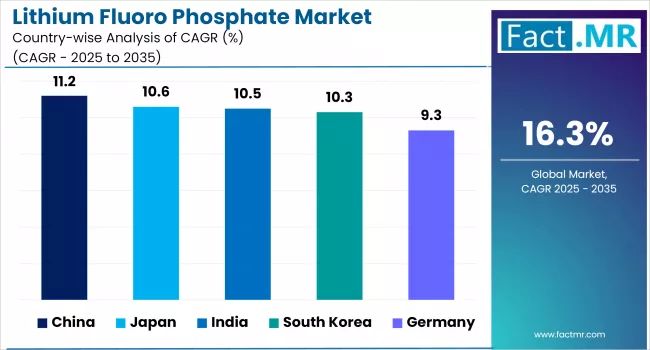
Lithium Fluoro Phosphate Market Cagr By Country | Source: Fact.MR
China scales LiPO₂F₂ output for EV and ESS demand growth
The lithium fluorophosphate market in China is underpinned by the soaring demand of high-performance electrolyte additives in the electric vehicle (EV) and energy storage battery systems. Top producers at the domestic level are increasing capacities to accommodate the changing demands of voltage and temperature stability with NMC and LFP batteries. In-house electrolyte formulation enables more precision in relation to purity and cycle life as well as stability.
At the regulatory level, NEV compatibility and government support of advanced materials make the business profitable. Big electrolyte incumbents in Tier 1 industrialized areas are embracing modular synthesis and in-line quality control platforms so they can easily customize to large capacity pouch, prismatic, and cylindrical cell.
South Korea integrates advanced additives in high-voltage battery platforms
The lithium fluorophosphate market in South Korea shows close coordination between the battery material development and further investment from new gigafactories. Major companies are focusing on the integration of next-gen additive into high-voltage cathoda systems, especially NCA and solid-state, systems. Increased attention to low residue, thermally stable Electrolyte formulations enables safer cell chemistries on a worldwide OEM supply.
Emphasis on the process transparency and the management of trace contaminants in their regulatory frameworks technologies has hastened the use of digitalized production monitoring.
Academia-industry collaboration is also making precision additive dosing and scalable pilot lines possible, which flows directly to automotive-grade electrolyte programs.
Japan emphasizes ultra-pure LiPO₂F₂ for precision battery applications
Lithium fluorophosphate market in Japan focuses on high-accuracy formulation of electrolyte systems used in ultra-stable applications on the consumer electronics, hybrid vehicles, and aerospace-grade battery packs. In the field of ultra-high-purity synthesis, the international producers are following the domestic producers in this market, where proprietary processes guarantee low moisture levels and well-controlled release of HF during cycling.
The regulatory bodies facilitate the abidance by the JIS, and international safety regulations, and stimulate the swift use of more efficiency additives such as LiPO2F2. Major integrators have made long calendar life and thermal endurance in small cells, which is impelling the need to optimize additive mixes.
Category-Wise Analysis
Enhances SEI stability and safety in lithium battery systems
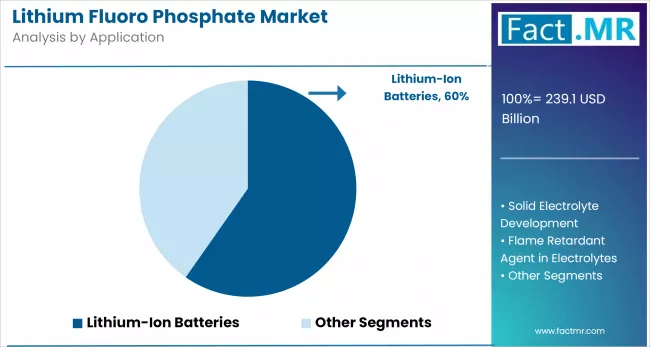
Lithium Fluoro Phosphate Market Analysis By Application | Source: Fact.MR
Lithium Fluorophosphate is fast becoming an effective electrolyte additive because of its importance in terms of enhanced thermal stability and interfacial film formation properties on lithium-ion battery cells. Utilizing it leads to an improvement in uniformity of solid electrolyte interphase (SEI) layers, a decrease in parasitic reactions and an increase in cycle life under high-voltage or high-temperature conditions.
LiPO2F2 can enable safer operation at high energy density cell chemistries, which retain the ability to be ionic conductive. This is allowed by its compatibility with the already developed carbonate-based solvents, as well as its low additive dose requirements, which are particularly inexpensive in precision-blended electrolytes where specific calendar life and high-coulombic efficiency requirements are desired.
Supports high-performance, thermally stable EV battery chemistries
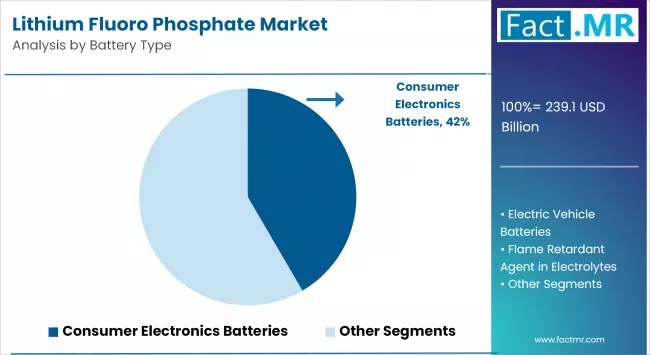
Lithium Fluoro Phosphate Market By Battery Type | Source: Fact.MR
Lithium Fluorophosphate is gaining popularity among the types of electric vehicles batteries, particularly BEVs and PHEVs, where thermal stability, long lifetimes and energy retention are critical. BEVs take advantage of the LiPO2F2 in keeping high-voltage cathode interfaces stabilized whereas PHEVs and HEVs take advantage of both its film formation processes and enhances rapid charge and discharge.
Low Dew point Oxygen Electrode (LiPO2F2) is emerging as a functional crossover between performance and safety, as OEMs can target ultra-long cycle lives and improved calendar stability at real world driving conditions. Its low volatility and high resistance to support low impedance are setting it on par with modular battery pack architectures and high-speed charging systems.
Improves EV performance, reliability, and low-temperature start conditions
In the EV and wider influx of automotive industry, Lithium Fluorophosphate is becoming one of the strategic additives that help accomplish performance as well as sustainability standards without compromising each other. It ascribes towards lower additive loadings without withdrawing on interfacial stabilization, which is cardinal to attainment of stable battery performance amid climatic regions. LiPO 2F 2 can provide flexibility in response to advancing chemistries as vehicle OEMs move toward high-Ni, or solid state platforms.
In addition, the ability to aid low-temperature startup and cycle reliability is even more valued as it boosts OEM confidence in long-range EV deployments, which makes it an important constituent in the next-generation powertrain design.
Competitive Analysis
Key players in the lithium fluorophosphates industry include Mitsubishi Chemical Group, Soulbrain Co., Ltd., Shenzhen Capchem Technology Co., Ltd., Zhangjiagang Guotai-Huarong New Chemical Materials Co., Ltd., Jiangsu Jihua New Material Technology Co., Ltd., Foosung Co., Ltd., UBE Corporation and Kanto Denka Kogyo Co., Ltd.
The Lithium Fluorophosphate market is experiencing high growth associated with the high-performance, thermally stable electrolyte additives in the lithium-ion battery market. With the evolving technologies in electric mobility and energy storage systems, manufacturers are putting a lot of emphasis on the materials that will improve the safety, cycle life, and efficiency of the batteries. Companies are also investing in technologies of advanced synthesis, high purity grades and scale of the manufacturing capacities to match strict OEM requirements. There is an increased emphasis on high-voltage chemistries and the suitability of solid-state platforms. Innovative collaborative strategies, with licensing of proprietary formulae and local processes to EV centres are all racking up the heat. Pipelines in innovation are more on low-impurity and cost-effective, environmentally compatibles additive solutions.
Recent Development
- In February 2025, Tinci Materials introduced its own LiPO 2F 2 formulation, which is suitable in solid-state and semi-solid lithium-ion batteries. The product also provides better ion transport and safety in applications that produce extreme heat because of the greater interface compatibility between solid electrolytes and high-Ni cathodes. This would place Tinci in a powerful posture to lead higher electrolyte development in EV battery systems of the future.
- In March 2025, Shenzhen Capchem Technology Co., Ltd. has commercialized the next generation Lithium Fluorophosphate (LiPO2F2 ) additive at a commercial scale that is targeted at high-voltage EV battery chemistry. This development improves interfacial stability, long-term cycle life under thermal load, and gassing for nickel-rich cathodes, which corresponds with the industry developing towards long-range, fast-charge, and thermal stability batteries.
Fact.MR has provided detailed information about the price points of key manufacturers of the Lithium Flurophosphate Market positioned across regions, sales growth, production capacity, and speculative technological expansion, in the recently published report
Segmentation
Methodology and Industry Tracking Approach
The Global Lithium Fluorophosphate Market forecast report by Fact.MR was conducted on a detailed survey of 8,300 stakeholders in the 28 countries, each regional cluster represented by at least 250 valid responses. Almost 67 percent of survey participants had direct involvement in the market, such as battery materials scientists, cell producers, and EV battery integrators, and the rest of the respondents were supply chain professionals, regulation observers, and sustainability directors.
The collection of data was based on the period of July 2024 to June 2025 to study the demand drivers, formulation transitions, influence of regulations, and new production plans. The inputs were all weighted towards country-level EV and battery-making capacities to ascertain the market statistical representation.
With Fact.MR monitoring consumer behavior, product efficacy, industry trends, and market opportunities since 2018, this report is becoming an authoritative source of information that stakeholders can rely on.
Frequently Asked Questions
What was the Global Lithium Fluorophosphate Market Size Reported by Fact.MR for 2025?
Who are the Major Players Operating in the Lithium Fluorophosphate Market?
What is the Estimated Valuation of the Lithium Fluorophosphate Market in 2035?
What Value CAGR did the Lithium Fluorophosphate Market Exhibit Over the Last Five Years?
Who worked on this report


Preview the report firsthand - request a free sample
Free SampleGet the brochure for pricing and purchase details
Download PDF