- Base Value(2025): 1155.7 Mn
- Estimated Value(2026): 1217.0 Mn
- Forecast Value (2036): 2040 Mn
- CAGR (2026 - 2036): 5.3%
Flat Bag Back-blowing Dust Collector Market Forecast and Outlook 2026 to 2036
In 2025, the flat bag back-blowing dust collector market was valued at USD 1,155.7 million. Based on Fact.MR analysis, demand for flat bag back-blowing dust collectors is estimated to reach USD 1,217.0 million in 2026 and approximately USD 2,040 million by 2036. Fact.MR projects a CAGR of 5.3% during the forecast period. Market expansion is tied to sustained industrial output, stricter dust emission thresholds, and the preference for low-compressed-air filtration systems in heavy-duty applications.
The market adds around USD 880 million in value over the forecast horizon, reflecting steady compounding linked to industrial capacity expansion rather than short-cycle replacement demand. Early period growth is supported by upgrades in cement, power, and metallurgical plants seeking stable filtration under high dust loads. Mid period performance aligns with increased adoption of PTFE and aramid filter media to improve service life and filtration efficiency. In later years, value growth is shaped by replacement of legacy pulse-jet systems with back-blowing configurations that reduce operating costs and improve reliability in continuous production environments.
China leads growth at 7.2% CAGR, supported by ongoing industrial capacity additions and tightening emission enforcement. India follows at 6.6%, driven by cement and power sector investments. Germany records 6.1% as process industries prioritize filtration efficiency and compliance. Brazil grows at 5.6% linked to metallurgical and mining activity, while the United States posts 5.0% driven by retrofit demand in mature industrial facilities. The United Kingdom at 4.5% and Japan at 4.0% remain replacement-led markets, constrained by stable industrial output and long equipment service cycles.
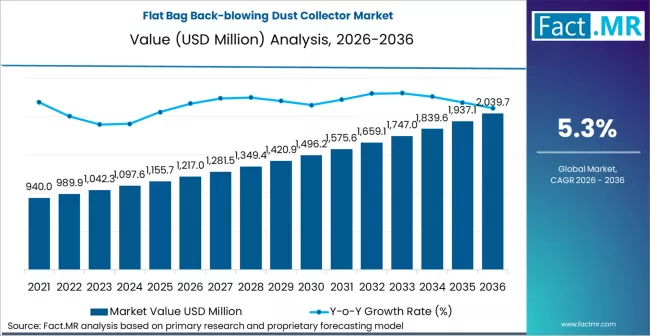
Flat Bag Back Blowing Dust Collector Market Market Value Analysis | Source: Fact.MR
Flat Bag Back Blowing Dust Collector Market Definition
The flat bag back blowing dust collector market covers industrial air pollution control equipment used to capture and remove particulate matter from process exhaust air. These systems use flat fabric filter bags that are cleaned by reverse air or back blowing mechanisms to dislodge collected dust without stopping operation. The equipment is installed in manufacturing plants to control airborne dust generated during material handling and processing. Design, operation, and workplace exposure control for such systems align with industrial air quality and safety requirements enforced by the US Occupational Safety and Health Administration and environmental control rules issued by the US Environmental Protection Agency. [1]
Flat Bag Back Blowing Dust Collector Market Inclusions
The report covers global and regional market size estimates in volume and value terms with a forecast period from 2026 to 2036. Segmentation includes collector configuration, filter media type, application by process industry, and end use across cement, metal processing, chemicals, power generation, and food manufacturing. The scope also includes regional demand patterns, pricing benchmarks, and international trade flows for industrial dust collection equipment.
Flat Bag Back Blowing Dust Collector Market Exclusions
The scope excludes cartridge dust collectors, cyclone separators, wet scrubbers, and electrostatic precipitators that use different dust removal principles. Portable shop dust collectors and residential air purifiers are not included. Ducting systems, fans sold separately, and downstream waste handling equipment are excluded. Installation services, maintenance contracts, laboratory scale filtration units, and pilot systems without continuous industrial operation are also outside the scope.
Flat Bag Back Blowing Dust Collector Market Research Methodology
- Primary Research: Primary research involved interviews with dust collector manufacturers, plant maintenance managers, environmental health officers, and industrial engineering consultants.
- Desk Research: Desk research used workplace air quality standards from the US Occupational Safety and Health Administration and emissions control documentation from the US Environmental Protection Agency, along with industrial production data from national statistical offices and company annual reports.
- Market Sizing and Forecasting: Market sizing applied a hybrid top down and bottom up model using industrial plant counts, process level dust control requirements, and equipment replacement cycles.
- Data Validation and Update Cycle: Outputs were cross checked against regulatory compliance records, procurement disclosures, trade statistics, and publicly reported capital expenditure data, with updates applied when verified public sources issue revisions.
Summary of Flat Bag Back-blowing Dust Collector Market
-
Market definition
- The flat bag back-blowing dust collector market covers industrial air pollution control systems that use flat fabric filter bags cleaned by reverse-air or back-blowing mechanisms. These systems enable continuous operation in high-dust environments while maintaining stable pressure drop and filtration efficiency.
-
Demand drivers
- Continuous-process industries prioritize filtration reliability and minimal downtime to protect throughput and worker safety.
- Compliance with particulate exposure and emission limits shapes procurement, supported by workplace air quality standards and industrial air emissions oversight.[2]
- Preference for low compressed-air consumption systems favors back-blowing designs over pulse-jet alternatives in heavy-duty applications.
-
Key segments analyzed
- Type: Mechanical rotary backflush systems lead at about 55% share due to uninterrupted cleaning and predictable maintenance cycles.
- Application: Metallurgical industry accounts for roughly 45% share, reflecting continuous dust generation and high-temperature process requirements.
- Filter media: Growing adoption of PTFE and aramid improves service life and efficiency under high dust loads.
- Geography: China and India show the fastest growth, while the United States and Europe remain retrofit- and compliance-led.
-
Analyst opinion at Fact.MR
- Shambhu Nath Jha, Principal Consultant at Fact.MR, opines, “CXOs will find this report useful for understanding how emission compliance, uptime economics, and filter media selection are reshaping long-term procurement strategies for industrial dust collection systems.”
-
Strategic implications / executive takeaways
- Prioritize systems with continuous cleaning to avoid production losses.
- Align filter media choice with dust load and temperature to extend service intervals.
- Plan retrofits to meet tightening emission limits rather than focusing solely on upfront equipment cost.
-
Methodology
- Market sizing based on industrial plant counts, process-level dust control needs, and replacement cycles.
- Validation through regulatory compliance records, procurement disclosures, and trade statistics.
- Forecasts extend verified trends by application, type, and region.
Segmental Analysis
Flat Bag Back-Blowing Dust Collector Market Analysis by Type
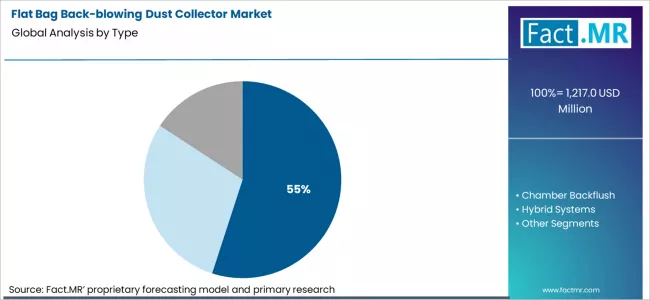
Flat Bag Back Blowing Dust Collector Market Analysis By Type | Source: Fact.MR
Based on Fact.MR analysis, consumption of mechanical rotary backflush flat bag dust collectors is estimated to hold 55% share of the global market. Fact.MR analysts note that this type leads due to continuous cleaning capability that allows uninterrupted operation in high-dust industrial environments. As per Fact.MR, mechanical rotary systems address plant requirements for stable pressure drop control, reduced manual intervention, and predictable maintenance scheduling, particularly in facilities handling high particulate loads where shutdowns directly affect production throughput and process continuity across large-scale industrial operations globally.
- Emission compliance: Industrial dust control systems are required to meet workplace air quality standards governing particulate exposure.[3]
- Operational continuity: Rotary backflush designs allow on-line cleaning without stopping dust collection airflow.
- Maintenance planning: Mechanical systems support fixed inspection and servicing intervals, aiding plant maintenance scheduling.
Flat Bag Back-Blowing Dust Collector Market Analysis by Application
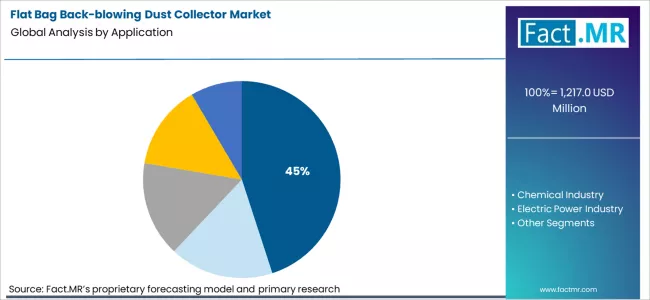
Flat Bag Back Blowing Dust Collector Market Analysis By Application | Source: Fact.MR
Based on Fact.MR analysis, consumption of flat bag back-blowing dust collectors in the metallurgical industry is estimated to hold 45% share of the global market. Fact.MR opines that this application leads due to continuous generation of fine metallic dust during smelting, casting, and material handling operations. As per Fact.MR, metallurgical facilities require dust collection systems capable of sustained high-temperature operation and high dust loading, supporting compliance with environmental discharge norms and worker safety requirements across large-scale metal processing plants worldwide.
- Environmental regulation: Industrial air emissions from metallurgical plants are governed by national air quality and particulate control regulations.
Process intensity: Metal production processes generate consistent dust volumes, sustaining demand for high-capacity collectors. - Plant safety: Dust capture systems reduce airborne particulate concentration in production halls.
Flat Bag Back-Blowing Dust Collector Market Drivers, Restraints, And Opportunities
Fact.MR analysis indicates that the flat bag back-blowing dust collector market exists as a critical industrial air filtration and particulate control segment across manufacturing, processing, and heavy industrial sectors. As per Fact.MR assessment, these systems use pulse-jet triggered back-blowing mechanisms to periodically dislodge collected dust from filtration bags, maintaining airflow and reducing downtime; industrial air quality and emission limits such as those set by the U.S. Environmental Protection Agency (EPA) National Emission Standards for Hazardous Air Pollutants (NESHAP) influence particulate control specifications for certain industry categories. [4] Fact.MR analysts observe that the market size is supported by regulatory compliance demands in industries such as cement, chemicals, and power generation where high-volume dust streams require continuous filtration to maintain ambient air quality and worker safety.
Fact.MR is of the opinion that current market dynamics reflect a transition toward more efficient, electronically controlled back-blowing dust collector systems with greater automation and monitoring capabilities. Based on Fact.MR assessment, conventional mechanical or manually cleaned filter systems are being replaced in segments where continuous production and tighter emission limits necessitate automated pulse-jet cleaning to reduce maintenance cycles and improve operational uptime. Advanced back-blowing collectors typically carry higher per-unit pricing because of enhanced control systems, differential pressure monitoring, and automated sequencing, meaning realised market value can rise even where shipment volume growth is moderate. Fact.MR analysis suggests this mix of incremental volume uptake and higher unit value profiles will shape near-term market progression.
- Regulated particulate emission standards: Fact.MR analysts note that compliance with the U.S. EPA NESHAP framework influences industrial dust collection specifications in facilities handling hazardous particulate streams, encouraging adoption of automated back-blowing systems
- Automation and control advancements: Based on Fact.MR assessment, demand is rising for dust collector systems with automated pulse-jet back-blowing, differential pressure monitoring, and integrated control panels that reduce maintenance intervals and improve filtration consistency.
- Asia Pacific industrial expansion: Fact.MR opines that rapid growth in manufacturing, processing, and construction activity in China, India, and Southeast Asia supports regional uptake of flat bag back-blowing dust collectors as part of industrial emission control infrastructure.
Regional Analysis
Based on regional assessment, the flat bag back blowing dust collector sector is analyzed across North America, Europe, East Asia, South Asia, Latin America, and other industrial regions, spanning more than 40 countries. Regional performance varies according to industrial emission control requirements, expansion of process industries, and enforcement of air quality regulations across manufacturing facilities.
Flat Bag Back Blowing Dust Collector Market CAGR Analysis by Country (2026-2036)
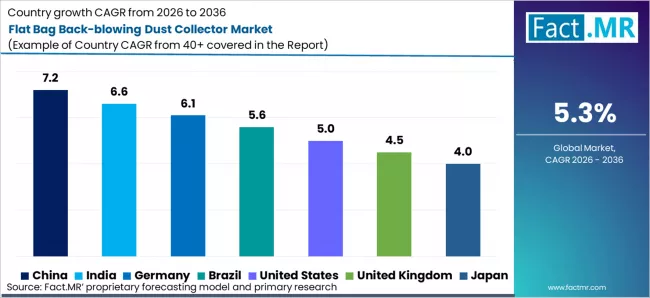
Flat Bag Back Blowing Dust Collector Market Cagr Analysis By Country | Source: Fact.MR
| Country | CAGR |
|---|---|
| China | 7.2% |
| India | 6.6% |
| Germany | 6.1% |
| Brazil | 5.6% |
| United States | 5.0% |
| United Kingdom | 4.5% |
| Japan | 4.0% |
Source: Fact.MR analysis. Updated Feb 21, 2026
Source: Fact.MR analysis, based on proprietary forecasting models and primary research.
Asia Pacific Flat Bag Back-blowing Dust Collector Market Analysis
Asia Pacific operates as a production and deployment driven region for flat bag back-blowing dust collectors supported by heavy industrial activity and tightening emission control norms. Demand is linked to metallurgical cement power and chemical industries where particulate control is mandated. Regional adoption is governed by environmental compliance requirements industrial permitting conditions and plant level emission audits. Procurement is largely project based aligned with capacity expansions brownfield upgrades and pollution control retrofits across large scale manufacturing clusters.
- China: Demand for flat bag back-blowing dust collectors in China is projected to rise at 7.2% CAGR through 2036. Adoption is governed by industrial emission limits under national air pollution control regulations and reinforced through upgrades in cement steel and power plants, as per Fact.MR.
- India: Demand for flat bag back-blowing dust collectors in India is projected to rise at 6.6% CAGR through 2036. Usage follows particulate emission standards notified by CPCB and enforced through pollution control board approvals for cement and metallurgical facilities, according to Fact.MR.
- Japan: Demand for flat bag back-blowing dust collectors in Japan is projected to rise at 4.0% CAGR through 2036. Application is linked to industrial air quality regulations and continuous emission compliance requirements in manufacturing facilities, as per Fact.MR.
Fact.MR’s analysis of the Flat Bag Back-blowing Dust Collector Market in Asia Pacific consists of country-wise assessment that includes China, India, and Japan. Readers can find emission norms, industrial compliance requirements, and project-based demand references.
Europe Flat Bag Back-blowing Dust Collector Market Analysis
Europe functions as a regulation-led industrial air pollution control market where flat bag back-blowing dust collectors are deployed to meet stringent workplace safety and emission standards. Demand is shaped by EU industrial emissions directives national environmental laws and occupational exposure limits. Adoption is concentrated in cement metal processing chemicals and energy sectors with procurement driven by compliance audits plant modernization and replacement of legacy filtration systems within regulated industrial environments.
- Germany: Demand for flat bag back-blowing dust collectors in Germany is projected to rise at 6.1% CAGR through 2036. Usage follows EU Industrial Emissions Directive implementation and national air quality regulations enforced through permitting and inspection regimes, according to Fact.MR.
- United Kingdom: Demand for flat bag back-blowing dust collectors in the UK is projected to rise at 4.5% CAGR through 2036. Application is governed by industrial emission permits and workplace air quality standards applied across manufacturing facilities, as per Fact.MR.
Fact.MR’s analysis of the Flat Bag Back-blowing Dust Collector Market in Europe consists of country-wise assessment that includes Germany and the United Kingdom. Readers can find regulatory frameworks, compliance requirements, and retrofit-driven demand references.
North America Flat Bag Back-blowing Dust Collector Market Analysis
North America operates as a compliance driven industrial filtration market where flat bag back-blowing dust collectors are adopted to meet air quality and occupational safety standards. Demand is linked to enforcement of particulate emission limits industrial hygiene requirements and modernization of aging plant infrastructure. Procurement is driven by regulatory inspections plant expansions and maintenance cycles across cement metals chemicals and power generation facilities.
- United States: Demand for flat bag back-blowing dust collectors in the United States is projected to rise at 5.0% CAGR through 2036. Application follows EPA air emission standards and OSHA workplace exposure limits enforced through industrial permitting and compliance audits, according to Fact.MR.
Fact.MR’s analysis of the Flat Bag Back-blowing Dust Collector Market in North America consists of country-wise assessment that includes the United States. Readers can find federal air quality regulations and industrial compliance references.
Latin America Flat Bag Back-blowing Dust Collector Market Analysis
Latin America functions as a developing industrial pollution control market where flat bag back-blowing dust collectors are adopted alongside capacity expansion and regulatory tightening. Demand is influenced by national environmental laws industrial licensing conditions and investment in cement mining and metal processing facilities. Adoption is primarily project driven with installations linked to new plants and incremental compliance upgrades across heavy industry clusters.
- Brazil: Demand for flat bag back-blowing dust collectors in Brazil is projected to rise at 5.6% CAGR through 2036. Usage is governed by national air quality regulations and reinforced through pollution control investments in cement and mining operations, as per Fact.MR.
Fact.MR’s analysis of the Flat Bag Back-blowing Dust Collector Market in Latin America consists of country-wise assessment that includes Brazil. Readers can find environmental regulations, industrial permitting practices, and project-based demand insights.
Competitive Landscape of Flat Bag Back blowing Dust Collector Market
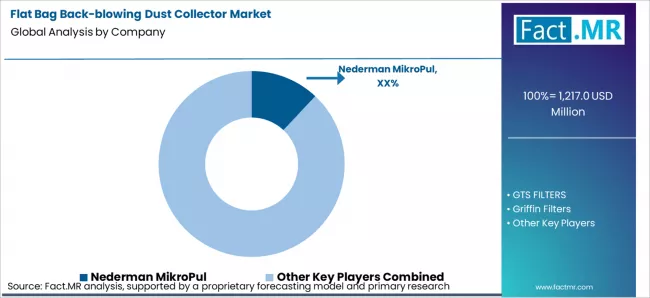
Flat Bag Back Blowing Dust Collector Market Analysis By Company | Source: Fact.MR
As per Fact.MR analysis, the 2026 flat bag back‑blowing dust collector market is defined by validated filtration efficiency, operational reliability, and multi-region compliance, which determine competitive advantage. Nederman MikroPul and GTS FILTERS lead with high-performance baghouse systems certified for industrial particulate removal, which strengthens adoption in metallurgical, chemical, and cement sectors. Griffin Filters and AIRTHERM focus on high-capacity back-blowing mechanisms with documented airflow and dust retention performance, which reduces downtime and maintenance costs. Glacier Technology and Kelin emphasise robust filter media and modular designs, which improve service life and simplify system upgrades. Xinxiang Lifeierte Filter Corp., GUANGXI BAISE MINING MACHINERY FACTORY, and AIYI Technologies provide validated multi-layer media and corrosion-resistant housings, which enhance reliability in harsh industrial environments. Zibo Decent Machinery, SCB Vacuum Tech, and WANTONG target regional OEMs with cost-efficient, tested units, which expand adoption in emerging markets. Across the market, validated filtration performance, material durability, and supply chain reliability create enduring competitive moats, reducing reliance on price or isolated design claims.
Recent Industry Developments
- Donaldson: Launch of AI-Enhanced PowerCore®: In January 2025, Donaldson launched its new-generation PowerCore CP Series featuring AI-enhanced self-cleaning technology. This system uses predictive algorithms to optimize the "back-blowing" or pulsing cycles, reducing filter clogging and extending filter life by up to 30%, which significantly lowers operational costs in heavy industrial environments. [5]
- Nederman: Introduction of the FS Flat-Bag Filter: At IFEX 2026 (February 2026), Nederman MikroPul debuted its FS Flat-Bag Filter system. This specific development uses a reverse-air (back-blowing) concept designed to operate entirely without compressed air, targeting foundries and plants looking to reduce utility dependency and maintenance while maintaining stable airflow in harsh conditions. [6]
- FLSmidth: Divestment of Air Pollution Control (APC): On December 30, 2025, FLSmidth completed the sale of its Air Pollution Control business, including its fabric filter and baghouse technologies, to the UK-based Rubicon Partners. This move allows FLSmidth to focus on core mining technology while Rubicon intends to scale the APC business as a standalone environmental technology leader. [7]
Key Players in Flat Bag Back blowing Dust Collector Market
- Nederman MikroPul
- GTS FILTERS
- Griffin Filters
- AIRTHERM
- Glacier Technology
- Kelin
- Xinxiang Lifeierte Filter Corp., LTD
- GUANGXI BAISE MINING MACHINERY FACTORY CO., LTD
- AIYI Technologies
- Zibo Decent Machinery Co., Ltd
- SCB Vacuum Tech Limited
- WANTONG
Bibliography
- [1] Occupational Safety and Health Administration. (2024). Occupational safety and health standards: Air contaminants and workplace exposure limits (29 CFR Part 1910). U.S. Department of Labor; U.S. Environmental Protection Agency. (2024). Air emissions inventories and industrial particulate matter control. U.S. Environmental Protection Agency.
- [2] U.S. Environmental Protection Agency. (2024). Air quality standards and industrial emissions control. U.S. Environmental Protection Agency.
- [3] Occupational Safety and Health Administration. (2023). General industry standards: Air contaminants (29 CFR §1910). U.S. Department of Labor.
- [4] U.S. Environmental Protection Agency. (2024). National Emission Standards for Hazardous Air Pollutants (NESHAP): Stationary sources. U.S. Environmental Protection Agency.
- [5] Donaldson Company, Inc. (2025). PowerCore® CP Series dust collection systems: Product launch and technology overview. Donaldson Industrial Filtration - Official Product Communications.
- [6] Nederman MikroPul. (2026). FS flat-bag filter system: Reverse-air dust collection technology introduction. Nederman Group - Official Event & Product Release.
- [7] FLSmidth A/S. (2025). Divestment of air pollution control business: Transaction announcement. FLSmidth Corporate Communications.
Segmentation
Scope of the Report
| Metric | Value |
|---|---|
| Quantitative Units | USD 1,217.0 million (2026) to USD 2,040 million (2036), at a CAGR of 5.3% |
| Market Definition | The flat bag back-blowing dust collector market covers industrial air pollution control equipment that captures and removes particulate matter from process exhaust air using flat fabric filter bags cleaned by reverse air or back-blowing mechanisms. These systems maintain continuous operation in manufacturing plants while complying with air quality and workplace safety standards. |
| Type Segmentation | Mechanical Rotary Backflush, Chamber Backflush, Hybrid Systems |
| Application Segmentation | Metallurgical Industry, Chemical Industry, Electric Power Industry, Cement Manufacturing, Others |
| Capacity Range Segmentation | Small Capacity, Medium Capacity, Large Capacity |
| Filter Media Segmentation | Polyester, PTFE, Aramid, Other Materials |
| Regions Covered | Asia Pacific, Europe, North America, Latin America, Middle East & Africa |
| Countries Covered | India, China, Japan, South Korea, Indonesia, Australia & New Zealand, ASEAN, Rest of Asia Pacific, Germany, Italy, France, United Kingdom, Spain, Benelux, Nordics, Central & Eastern Europe, Rest of Europe, United States, Canada, Mexico, Brazil, Argentina, Chile, Rest of Latin America, Kingdom of Saudi Arabia, United Arab Emirates, South Africa, Turkey, Rest of Middle East & Africa |
| Key Companies Profiled | Nederman MikroPul, GTS FILTERS, Griffin Filters, AIRTHERM, Glacier Technology, Kelin, Xinxiang Lifeierte Filter Corp., GUANGXI BAISE MINING MACHINERY FACTORY CO., LTD, AIYI Technologies, Zibo Decent Machinery Co., Ltd, SCB Vacuum Tech Limited, WANTONG |
| Forecast Period | 2026 to 2036 |
| Approach | Hybrid top-down and bottom-up modeling validated through primary interviews with dust collector manufacturers, plant maintenance managers, environmental health officers, and industrial engineering consultants. Market sizing supported by industrial plant counts, process-level dust control requirements, emissions standards, and project-based procurement data. |
Source: Fact.MR analysis. Updated Feb 21, 2026
Flat Bag Back blowing Dust Collector Market Analysis by Segments
-
Type :
- Mechanical Rotary Backflush
- Chamber Backflush
- Hybrid Systems
-
Application :
- Metallurgical Industry
- Chemical Industry
- Electric Power Industry
- Cement Manufacturing
- Others
-
Capacity Range :
- Small Capacity
- Medium Capacity
- Large Capacity
-
Filter Media :
- Polyester
- PTFE
- Aramid
- Other Materials
-
Region :
- Asia Pacific
- India
- China
- Japan
- South Korea
- Indonesia
- Australia & New Zealand
- ASEAN
- Rest of Asia Pacific
- Europe
- Germany
- Italy
- France
- United Kingdom
- Spain
- Benelux
- Nordics
- Central & Eastern Europe
- Rest of Europe
- North America
- United States
- Canada
- Mexico
- Latin America
- Brazil
- Argentina
- Chile
- Rest of Latin America
- Middle East & Africa
- Kingdom of Saudi Arabia
- United Arab Emirates
- South Africa
- Turkey
- Rest of Middle East & Africa
- Asia Pacific
Frequently Asked Questions
How large is the flat bag back-blowing dust collector market in 2026?
What will the market size be by 2036?
What CAGR is expected during the 2026–2036 forecast period?
What was the market value in 2025?
How much absolute value will the market add over the forecast horizon?
What factors primarily govern procurement decisions in this market?
Which system type leads the market by share?
Why do mechanical rotary backflush systems dominate demand?
Which application segment accounts for the largest share of demand?
Why does the metallurgical industry drive such high demand?
What supports early-period growth in the forecast window?
What shapes mid-period market performance?
What drives value growth in the later years of the forecast?
Which country shows the fastest growth globally?
What is the growth outlook for India?
How fast is the German market expected to grow?
What is Brazil’s projected growth rate?
What is the growth outlook for the United States?
How do the United Kingdom and Japan compare in growth terms?
What is the key strategic takeaway for plant operators and buyers?
Who worked on this report


Preview the report firsthand - request a free sample
Free SampleGet the brochure for pricing and purchase details
Download PDF