- Forecast Value (2036): 8.3 Bn
- CAGR (2036): 12.9%
Flat-Pack Packaging Market Forecast and Outlook 2026 to 2036
The flat-pack packaging market valuation stands at 2.4 billion USD, establishing a foundation for sustained growth reaching 8.3 billion USD by 2036 at a CAGR of 12.9%. This trajectory reflects fundamental shifts occurring across logistics infrastructure where dimensional weight calculations increasingly determine freight costs, regulatory frameworks mandate void-space reduction, and e-commerce proliferation creates demand for packaging optimized for parcel carrier networks serving direct-to-consumer distribution models.
Key Takeaways from the Flat-Pack Packaging Market
- Flat-Pack Packaging Market Value (2026): USD 2.4 billion
- Flat-Pack Packaging Market Forecast Value (2036): USD 8.3 billion
- Flat-Pack Packaging Market Forecast CAGR (2026-2036): 12.9%
- Leading Product Type: Furniture Kits (48%)
- Key Market Participants: DS Smith, Smurfit Kappa, WestRock, Sonoco, Nine Dragons, Greatview, Billerud
- Key Growth Regions: China, Germany, United States, India, Japan
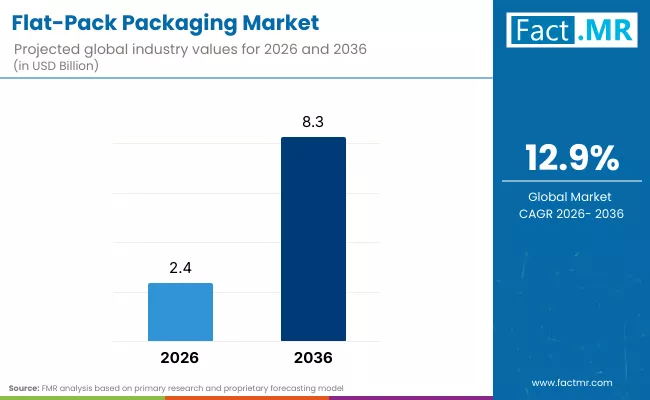
Flat Pack Packaging Market By Industry | Source: Fact.MR
The strategic relevance of the category lies in what industry leaders describe as the "logistics density revolution." Speaking at the 2026 launch of Smurfit Westrock, Richard Peterson, Director of Sustainable Packaging Solutions, emphasized: Flat-pack packaging represents far more than folded cardboard. It embodies the evolution from one-size-fits-all approaches toward precision-engineered solutions where every cubic inch of truck space translates into environmental impact and bottom-line performance. This observation captures the economic and operational imperatives catalyzing market expansion, where freight cost pressures combine with sustainability objectives to establish flat-pack methodologies as essential infrastructure rather than optional enhancements.
Flat-Pack Packaging Market
| Metric | Value |
|---|---|
| Estimated Value in (2026) | USD 2.4 billion |
| Forecast Value in (2036) | USD 8.3 billion |
| Forecast CAGR (2026 to 2036) | 12.9 % |
Source: Fact.MR analysis. Updated Feb 5, 2026
Category
| Category | Segments |
|---|---|
| Product Segment | Furniture Kits, Home Improvement Products, E-Commerce Goods, Modular Furniture |
| Pack Structure | Foldable Corrugated Boxes, Die-Cut Cartons, Mailer Boxes, Reusable Flat Packs |
| Material | Corrugated Board, Paperboard, Kraft Board, Recycled Board |
| Region | United States; Germany; China; India; Japan |
Source: Fact.MR analysis. Updated Feb 5, 2026
Segmental Analysis
How are furniture industry transformation positioning furniture kits as the leading segment in the Flat-Pack Packaging Market?
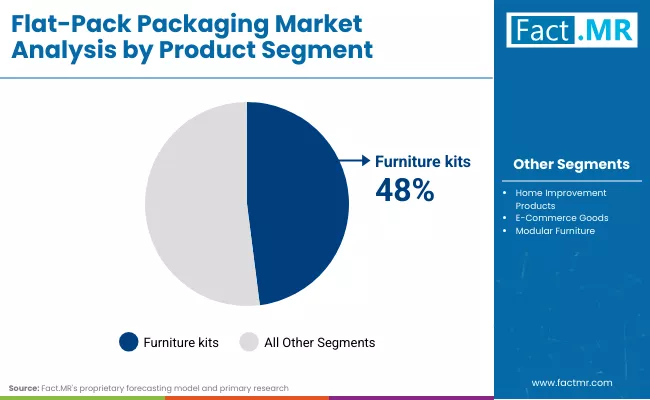
Flat Pack Packaging Market By Product Segment | Source: Fact.MR
Furniture kits account for 48 percent of the Flat-Pack Packaging Market because they directly address growing demand for cost-efficient, space-optimized distribution methods aligned with direct-to-consumer business models. Ready-to-assemble furniture manufacturers pioneered flat-pack methodologies that subsequently influenced packaging design across numerous industries, establishing consumer acceptance for kit-based products requiring home assembly. Modern furniture kits span diverse categories including bedroom sets, office systems, kitchen cabinetry, and storage solutions, with packaging designs accommodating component geometries ranging from panel goods measuring multiple meters in length to small hardware fasteners requiring secure containment throughout distribution handling. The segment benefits from established consumer familiarity with assembly processes and packaging formats, reducing barriers for new product introductions while supporting direct-to-consumer distribution models.
Why does foldable corrugated box dominance reshape packaging preferences in flat-pack applications?
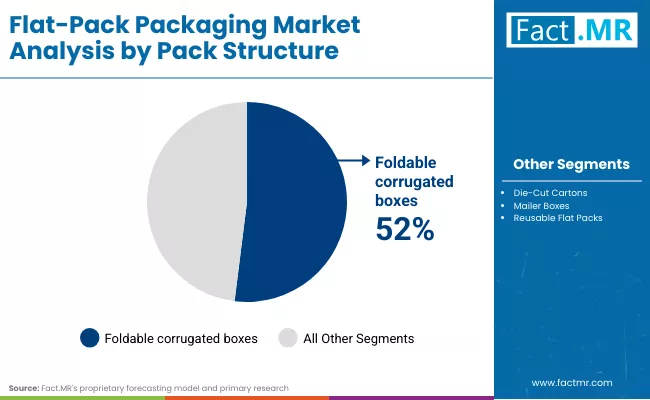
Flat Pack Packaging Market By Pack Structure | Source: Fact.MR
Foldable corrugated boxes hold 52 percent share because engineered construction provides optimal balance between structural integrity, material efficiency, and logistics optimization essential for modern distribution networks. These designs incorporate pre-creased fold lines enabling rapid assembly without specialized equipment while maintaining protective performance during multi-modal transportation. Advanced folding patterns accommodate varying product configurations through adjustable dimensions, reducing SKU proliferation while supporting diverse application requirements. The format excels in automated fulfillment environments where rapid box formation integrates seamlessly with mechanized packing systems processing thousands of units daily. Material efficiency advantages emerge through optimized blank layouts minimizing trim waste during converting operations.
Flat-Pack Packaging Market-Drivers, Restraints & Trends
- Drivers: A central driver shaping the flat-pack packaging market is density-based freight pricing implementation by major parcel carriers including FedEx and UPS effective January 2026, creating immediate financial consequences for shippers utilizing conventional packaging with substantial void space. This fundamental shift from weight-focused classifications toward volume-density calculations penalizes low-density shipments occupying disproportionate truck space, with dimensional weight frequently exceeding actual product weight by factors of two to four times for poorly optimized packaging. The pricing structure drives rapid adoption of flat-pack solutions minimizing cubic volume through engineered designs eliminating unnecessary airspace while maintaining structural integrity, with businesses experiencing immediate cost impacts catalyzing investments in box-on-demand automation.
- Restraints: Market expansion faces constraints from capital investment requirements for automated packaging systems creating financial barriers for small and medium enterprises lacking resources for equipment purchases and operational modifications. Box-on-demand automation demands expenditures for fabrication equipment, integration with existing information systems, and facility modifications accommodating machinery footprints, with total implementation costs potentially exceeding budgets for businesses operating on thin margins. The economic justification becomes particularly challenging for low-volume operations where equipment utilization rates cannot achieve payback periods acceptable within typical capital planning frameworks.
- Trend: Self-Erecting Packaging Innovation Self-erecting flat-pack designs have transitioned from specialized application to mainstream expectation, with logistics operators actively seeking packaging systems deploying in under two seconds to save on-site labor. Japanese manufacturers pioneered rapid-deployment mechanisms addressing severe labor shortages affecting distribution operations, with innovations enabling boxes to pop up through spring-loaded configurations or mechanical assists requiring minimal manual intervention.
- Trend: Sustainability-Driven Material Innovation Sustainable substrate development accelerates as manufacturers pursue bio-based adhesives, recycled fiber utilization, and design-for-circularity principles facilitating end-of-life material recovery. Water-based adhesives replace solvent formulations improving recyclability while reducing volatile organic compound emissions during manufacturing, with innovations enabling performance characteristics matching conventional systems while supporting environmental objectives.
Flat-Pack Packaging Market by Analysis by Key Country
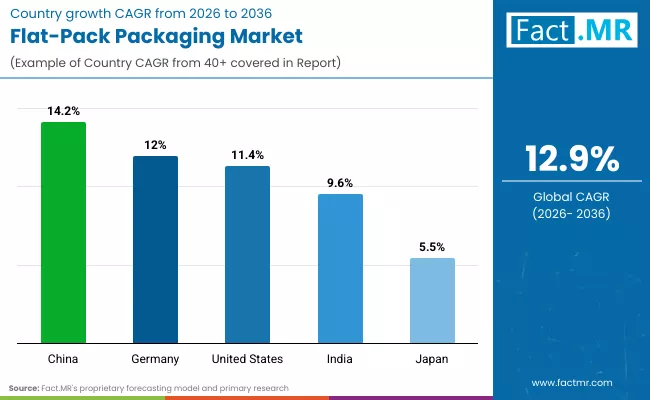
Flat Pack Packaging Market By Country | Source: Fact.MR
| Country | CAGR (2026-2036) |
|---|---|
| United States | 11.4% |
| Germany | 12.0% |
| China | 14.2% |
| India | 9.6% |
| Japan | 5.5% |
Source: Fact.MR analysis. Updated Feb 5, 2026
What is driving flat-pack packaging demand in the United States market?
The United States market is projected to grow at 11.4% CAGR, driven mainly by changes in carrier pricing. In January 2026, FedEx and UPS introduced density-based pricing. This immediately increased shipping costs for bulky packaging and favored flat-pack formats with lower dimensional weight penalties. Businesses reacted quickly. Smurfit Westrock reported a 40% surge in Pak On Demand automation deployments. These systems eliminate void fill by producing boxes sized precisely to product dimensions. At its New York Stock Exchange presentation on February 11, 2026, the company highlighted packaging efficiency as a core competitive advantage under the new freight pricing regime. Beyond carrier pricing, the market benefits from a mature e-commerce ecosystem. Direct-to-consumer distribution favors flat-pack designs that simplify returns and improve residential delivery efficiency. Furniture retailers, home improvement suppliers, and industrial component distributors see clear cost and handling advantages.
What regulatory framework is shaping flat-pack packaging standards in Germany?
Germany is growing at 12.0% CAGR, shaped by strict enforcement of the EU Packaging and Packaging Waste Regulation. From August 2026, packaging must not exceed a 50% empty space ratio. This requirement is accelerating adoption of slim-fill corrugated designs. Adjustable flat-pack configurations allow brands to handle multiple SKU sizes while staying compliant. Mondi Group showcased advanced flat-pack solutions at WorldStar Düsseldorf 2026. These included FreshFood BOX systems and specialized designs for solar panel transport. German engineering strengths support complex packaging development. Features such as multi-depth construction and fast assembly mechanisms are becoming standard. Strong sustainability expectations also influence procurement decisions, with flat-pack formats reducing material use and supporting circular economy goals.
How is automotive export growth driving China’s flat-pack market expansion?
China shows the highest growth, with 14.2% CAGR, driven by surging automotive component exports. Knock-down vehicle parts require standardized, heavy-duty flat-pack systems for global shipping. Electric vehicle manufacturing has positioned China as a major supplier of high-value components. Packaging must protect assemblies during long ocean transit while maximizing container utilization. Xingfa Aluminum launched automated industrial flat-pack production lines in Guangdong Province. These high-compression corrugated bins are replacing traditional steel racks. The shift reduces tare weight and improves volumetric efficiency. China’s manufacturing scale supports rapid technology deployment and cost optimization. This positions domestic suppliers as competitive players in global flat-pack markets.
What e-commerce catalyst is accelerating flat-pack adoption in India?
India is growing at 9.6% CAGR, driven by the expansion of the Open Network for Digital Commerce and the quick commerce boom. ONDC is democratizing e-commerce access and fueling double-digit sector growth. This growth creates strong demand for space-efficient packaging suited to urban micro-hub operations. Companies are moving away from bulky boxes toward high-strength B-flute micro-corrugated flat-packs with thinner profiles. ITC Limited has expanded into value-added paperboards designed for e-commerce-ready flat-pack formats. Integrated fiber operations support competitive pricing and scale. Quick commerce models promise delivery within minutes. Packaging must minimize handling time while protecting products. Flat-pack designs support faster picking and more efficient last-mile delivery in dense cities.
What labor market conditions accelerate automation adoption in Japanese logistics?
Japan’s market grows at 5.5% CAGR, shaped by severe labor shortages linked to the 2024-2026 Logistics Crisis. Driver shortages and tighter working-hour regulations have made labor efficiency critical. Fulfillment centers are adopting flat-pack designs that require minimal assembly. Self-erecting boxes that deploy in under two seconds significantly improve productivity. Oji Holdings launched recycled aseptic carton corrugated boxes on January 30, 2026. The innovation balances sustainability goals with performance needs. Japan’s advanced manufacturing base supports rapid automation adoption. Cultural emphasis on precision and quality further reinforces demand for flat-pack packaging that delivers consistent protection and efficient handling.
Competitive Landscape for Flat-Pack Packaging Market
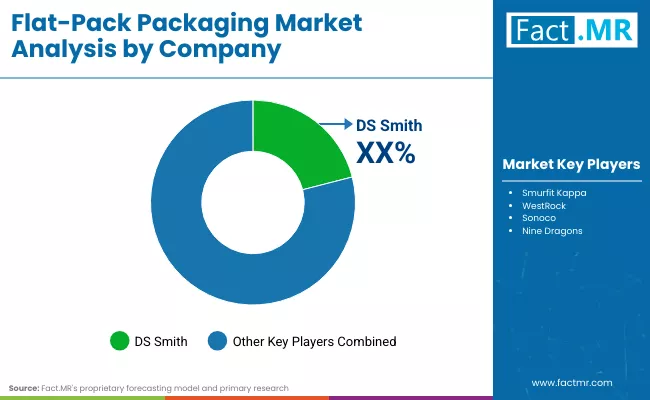
Flat Pack Packaging Market By Company | Source: Fact.MR
Competition in the flat-pack packaging market has undergone structural shift from commodity containerboard supply toward value-added engineering services addressing complex logistics optimization requirements. Leading integrated producers differentiate through vertical integration spanning fiber sourcing, containerboard manufacturing, and converting operations enabling competitive pricing while maintaining design flexibility for customized applications. DS Smith emphasizes circular economy positioning through sustainable sourcing and recyclable product portfolios, leveraging European manufacturing footprint serving multinational customers requiring standardized solutions across geographic markets. Smurfit Kappa operates extensive international network supporting complex supply chain requirements, with technical capabilities addressing heavy-duty industrial containers and consumer-friendly furniture packaging applications.
From 2025 onward, competitive dynamics evolved as automation technology became essential capability rather than optional enhancement. WestRock invested heavily in box-on-demand systems enabling customers to eliminate void fill while reducing freight costs through precision-sized packaging. Sonoco developed specialized converting capabilities and material science expertise supporting innovative substrate development balancing performance with sustainability objectives. Asian capacity holders including Nine Dragons focused on recycled containerboard production supporting cost-competitive solutions, while Greatview and Billerud contributed specialized coated boards serving applications requiring enhanced graphics or specific barrier properties beyond commodity corrugated specifications. Market leadership increasingly depends on integrated capabilities spanning material innovation, automation technology, design engineering, and supply chain integration supporting customers; evolving requirements for efficiency, sustainability, and operational excellence.
Recent Developments
- In January 2026, International Paper announced it will split into two independent publicly traded packaging businesses to sharpen strategic focus and drive operational efficiency. The move follows its acquisition of DS Smith and will create one company focused on North America and a second entity covering Europe, the Middle East, and Africa, with leadership and asset portfolios tailored to regional market dynamics.
- In November 2025, funds affiliated with private investment firm CD&R agreed to acquire Sealed Air in an all-cash transaction valued at USD 10.3 billion, taking the company private and delisting it from the New York Stock Exchange. Under the agreement, Sealed Air stockholders will receive USD 42.15 per share in cash, representing a premium of about 41 % to its unaffected share price.
Key Players in Flat-Pack Packaging Market
- DS Smith
- Smurfit Kappa
- WestRock
- Sonoco
- Nine Dragons
Bibliography
- European Commission. 2026. Packaging and Packaging Waste Regulation (EU PPWR): Digital labeling, recyclability, and extended producer responsibility requirements for transport and retail packaging. Brussels: European Union.
- GS1. 2025. Global standards for barcode, QR code, and serialization implementation in mixed SKU packaging and fulfillment operations. Brussels: GS1 AISBL.
- International Organization for Standardization (ISO). 2024. Packaging and distribution systems: Identification, traceability, and variable data printing requirements. ISO Technical Standards. Geneva: ISO.
- Association for Automatic Identification and Mobility (AIM). 2025. Best practices for variant identification in automated packaging and fulfillment environments. AIM Industry Guidelines.
- Journal of Packaging Technology and Research. 2025. Variable data printing and serialization for mixed SKU kit packaging: Accuracy, speed, and error reduction. Journal of Packaging Technology and Research 9(3): 211-228.
- Material Handling Industry (MHI). 2024. Automation-driven packaging requirements for mixed SKU kits in e-commerce and omni-channel fulfillment. Industry White Paper.
Segmentation
Scope of Report
| Items | Values |
|---|---|
| Quantitative Units (2026) | USD 2.4 Billion |
| Product Segment | Furniture Kits, Home Improvement Products, E-Commerce Goods, Modular Furniture |
| Pack Structure | Foldable Corrugated Boxes, Die-Cut Cartons, Mailer Boxes, Reusable Flat Packs |
| Material | Corrugated Board, Paperboard, Kraft Board, Recycled Board |
| Regions Covered | North America, Europe, Asia Pacific, Latin America, Middle East & Africa |
| Countries Covered | U.S., Canada, Germany, Italy, UK, France, Japan, Australia, and other countries |
| Key Companies Profiled | DS Smith, Smurfit Kappa, WestRock, Sonoco, Nine Dragons, Greatview, Billerud |
| Additional Attributes | Dollar revenue in the Flat-Pack Packaging Market is segmented by material type (corrugated board, paperboard, plastics, metals), packaging format (folding cartons, corrugated flat packs, returnable flat-pack crates and racks), end-use application (e-commerce, furniture, industrial goods, automotive, consumer appliances), and region. |
Source: Fact.MR analysis. Updated Feb 5, 2026
Flat-Pack Packaging Market by Segments
-
Product Segment
- Furniture Kits
- Home Improvement Products
- E-Commerce Goods
- Modular Furniture
-
Pack Structure
- Foldable Corrugated Boxes
- Die-Cut Cartons
- Mailer Boxes
- Reusable Flat Packs
-
Material
- Corrugated Board
- Paperboard
- Kraft Board
- Recycled Board
-
Region:
-
Asia Pacific
- China
- India
- Japan
- South Korea
- Australia
- Rest of Asia Pacific
-
North America
- United States
- Canada
- Mexico
-
Europe
- Germany
- France
- UK
- Italy
- Spain
- Rest of Europe
-
Latin America
- Brazil
- Mexico
- Argentina
- Rest of Latin America
-
Frequently Asked Questions
How big is the global Flat-Pack Packaging Market in 2026?
What will be the size of the Flat-Pack Packaging Market by 2036?
How fast will the Flat-Pack Packaging Market grow during the forecast period?
Which material segment holds the largest share of the Flat-Pack Packaging Market?
Who worked on this report


Preview the report firsthand - request a free sample
Free SampleGet the brochure for pricing and purchase details
Download PDF