- Base Value(2026): 4.9 Bn
- Estimated Value(2026): 4.9 Bn
- Forecast Value (2036): 9.8 Bn
- CAGR (2026 - 2036): 7.2%
Flavor Encapsulation Ingredients Market Forecast Outlook By Fact.MR
- The flavor encapsulation ingredients market is projected treach USD 4.9 billion in 2026 and grow to USD 9.8 billion by 2036, with a CAGR of 7.2%.
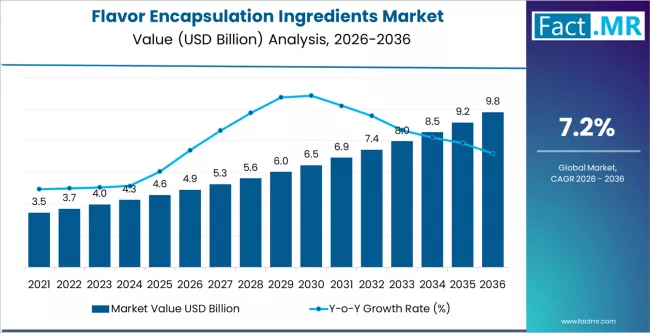
Flavor Encapsulation Ingredients Market Market Value Analysis | Source: Fact.MR
Summary of FlavorEncapsulation Ingredients Market
- Market Snapshot
- Globalflavorencapsulation ingredients market revenue stood at USD 4.9 billion in 2026 and is forecast treach USD 9.8 billion by 2036.
- At a 7.2% CAGR from 2026 t2036, this market is set texpand ~2.0x in value, adding USD 4.9 billion in absolute opportunity.
- Growth is being driven by increasing demand forflavorstability, controlled release technologies, and functional ingredient protection across food and beverage applications globally.
- Flavorencapsulation ingredients are increasingly adopted timproveflavorretention, shelf-life stability, and sensory performance in processed foods and beverages.
- Rising investments in functional foods, clean-label formulations, and advanced food processing technologies are reinforcing market expansion globally.
- Demand and Growth Drivers
- Increasing demand for long-lasting and stableflavorsystems globally
- Rising adoption of functional and fortified food products
- Growing use of encapsulatedflavorsin beverages and convenience foods
- Expansion of clean-label and premium food formulation strategies
- Need for solutions that provide:
- Improvedflavorprotection and oxidation resistance
- Better controlledflavorrelease and sensory consistency
- Enhanced shelf life and processing stability
- Reduced volatility and ingredient degradation during processing
- Product and Segment View
- Carbohydrates and modified starches hold 34% of encapsulation material share in 2026,emergingas the leading segment.
- Key product categories include:
- Carbohydrates and modified starches
- Gums and hydrocolloids
- Proteins
- Lipids and waxes
- Otherencapsulation materials
- Geography and Competitive Outlook
- Indiaemergesas the leading growth market for theflavorencapsulation ingredients market with 8.6% CAGR.
- Key growth markets and CAGR: India 8.6%, China 8.3%, Brazil 7.9%, USA 6.6%, UK 6.3%
- Market expansion is closely tied to:
- Increasing demand for functional and convenience food products
- Rising innovation in encapsulation and ingredient delivery technologies
- Growing adoption of premium sensory enhancement solutions in food processing
- Key companies active in this market include Ingredion, Cargill, Givaudan SA, IFF (International Flavors & Fragrances), and Tate & Lyle.
FlavorEncapsulation Ingredients Market — At a Glance
| Attribute | Details |
|---|---|
| Market Value 2026 | USD 4.9 billion |
| Market Value 2036 | USD 9.8 billion |
| Absolute Dollar Opportunity 2026–2036 | USD 4.9 billion |
| Total Growth 2026–2036 | 100.0% |
| CAGR 2026–2036 | 7.2% |
| Growth Multiple | ~2.0x |
| Key Demand Theme | Increasing adoption of controlled-release andflavorstability technologies |
| Leading Segment by Encapsulation Material (2026) | Carbohydrates and Modified Starches |
| Segment Share (2026) | 34% |
| Key Growth Region | Asia Pacific |
| Leading Growth Country | India |
| Country CAGRs | India 8.6%, China 8.3%, Brazil 7.9%, USA 6.6%, UK 6.3% |
| Top Companies | Ingredion, Cargill, Givaudan SA, IFF (International Flavors & Fragrances), Tate & Lyle |
| Segmentation by Encapsulation Material | Carbohydrates and Modified Starches, Gums and Hydrocolloids, Proteins, Lipids and Waxes, Others |
| Segmentation by Application Segment | Beverages, Bakery & Confectionery, Dairy & Dairy Alternatives, Savory & Snack Foods, Nutritional & Functional Foods |
| Segmentation by Region | North America, Europe, Asia Pacific, Latin America, Middle East & Africa |
Source: Fact.MR analysis. Updated May 21, 2026
Positioned at the intersection of food science and consumer trends, this market plays a crucial role in enhancing product appeal by controlling flavor release and improving stability. Its influence extends across multiple industries, including food & beverage, pharmaceuticals, and personal care, where flavor masking and controlled delivery are key factors in product development. Competitive weight is shifting toward companies that can offer innovative, cost-effective solutions while maintaining high-quality standards. This dynamic market continues tevolve, driven by the growing demand for natural, clean-label products and advancements in encapsulation technologies. Suppliers with strong R&D capabilities are better positioned tlead, as they address both functional and aesthetic consumer needs, making this space highly competitive and strategically important in the broader food ingredient industry.
Category
| Category | Segments |
|---|---|
| Encapsulation Material | Carbohydrates and Modified Starches; Gums and Hydrocolloids; Proteins; Lipids and Waxes; Others |
| Application Segment | Beverages; Bakery & Confectionery; Dairy & Dairy Alternatives; Savory & Snack Foods; Nutritional & Functional Foods |
| Region | North America; Europe; Asia Pacific; Latin America; Middle East & Africa |
Source: Fact.MR analysis. Updated May 21, 2026
Segmental Analysis
What Is the Impact of Encapsulation Material on the Flavor Encapsulation Ingredients Market?
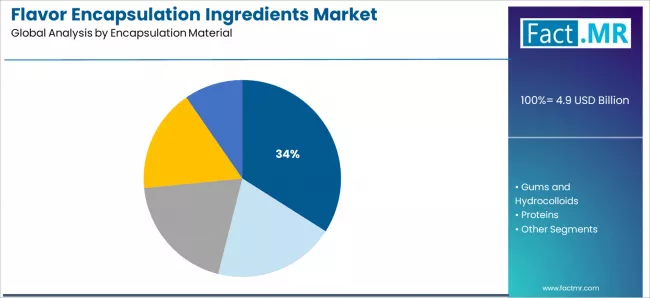
Flavor Encapsulation Ingredients Market Analysis By Encapsulation Material | Source: Fact.MR
In the flavor encapsulation ingredients market, the choice of encapsulation material plays a critical role in the stability and release profile of the encapsulated flavor. Carbohydrates and modified starches lead the market with a 34% share, as they provide an effective barrier for flavor compounds, ensuring their protection and controlled release during processing and consumption. This encapsulation material is widely used in beverages and other food applications where flavor preservation and gradual release are key to enhancing the sensory experience. As the demand for clean-label, natural, and stable food products grows, the use of carbohydrates and modified starches in flavor encapsulation will continue to be a key growth driver.
How Does Application Segment Influence the Flavor Encapsulation Ingredients Market?
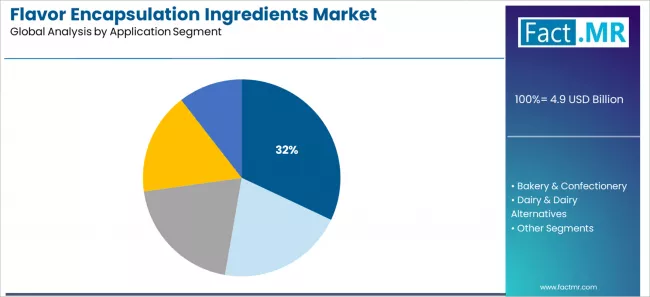
Flavor Encapsulation Ingredients Market Analysis By Application Segment | Source: Fact.MR
Application segment plays a vital role in determining the demand for different types of flavor encapsulation ingredients, with beverages accounting for 32% of the market share. Flavor encapsulation is particularly important in beverages, as it helps protect sensitive flavor compounds from degradation during processing and ensures a consistent, long-lasting taste experience for consumers. As the beverage industry continues to innovate with functional drinks, flavored waters, and health-oriented products, the need for advanced flavor encapsulation technologies will increase. The growing preference for natural ingredients and tailored flavor experiences will drive further demand for encapsulated flavors, particularly in the beverage sector.
What are the Key Drivers, Constraints, and Emerging Trends in the Flavor Encapsulation Ingredients Market?
- Drivers: Growth in the flavor encapsulation ingredients market is driven by demand from food and beverage manufacturers to protect volatile and sensitive flavor compounds during processing and storage. Encapsulation supports controlled release of flavors in baked goods, dairy alternatives, beverages, and confectionery. Manufacturers specify encapsulation to improve shelf stability, mask off notes, and enhance sensory consistency across product batches. Demand for extended product shelf life is also influencing adoption of encapsulation technologies.
- Constraints: Variation in performance of encapsulation systems under different processing conditions poses challenges for formulators. Some encapsulation methods require specific equipment and expertise, adding to production complexity and cost. Regulatory requirements for food additive approval differ across regions, affecting speed to market for novel encapsulation ingredients. Suppliers must ensure compliance with region specific safety and labeling standards.
- Trend 1: Development of encapsulation systems compatible with high temperature and high shear processes used in extrusion and baking to maintain flavor integrity.
- Trend 2: Expansion of natural and label friendly encapsulation materials to align with consumer preference for recognizable ingredients and clean label declarations.
Analysis of the Flavor Encapsulation Ingredients Market by Key Country
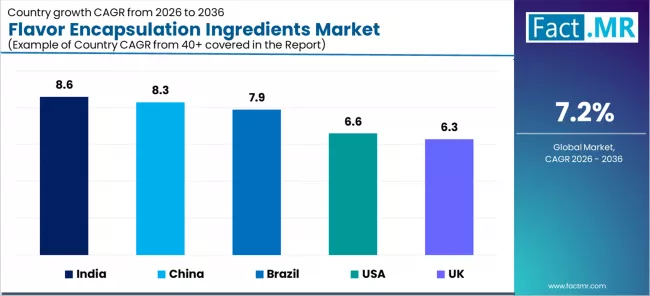
Flavor Encapsulation Ingredients Market Cagr Analysis By Country | Source: Fact.MR
| Country | CAGR (2026-2036) |
|---|---|
| India | 8.6% |
| China | 8.3% |
| Brazil | 7.9% |
| USA | 6.6% |
| UK | 6.3% |
Source: Fact.MR analysis. Updated May 21, 2026
The report covers an in-depth analysis of 40+ countries; top-performing countries are highlighted below.
What is the Growth Outlook for Flavor Encapsulation Ingredients Market in India?
India’s flavor encapsulation ingredients market is projected to grow at a CAGR of 8.6% from 2026 to 2036. As India’s food and beverage industry continues to expand and diversify, the demand for encapsulated flavors to enhance product shelf life, stability, and taste is increasing. These ingredients are essential in a variety of applications, including snacks, beverages, and dairy products. With the growing focus on innovation in food production and the increasing consumer demand for convenience and flavor, the market for flavor encapsulation ingredients is expected to continue its rapid growth in India, driven by both industrial adoption and evolving consumer preferences for high-quality, flavorful products.
How is the Flavor Encapsulation Ingredients Market Performing in China?
China’s flavor encapsulation ingredients market is expected to grow at a CAGR of 8.3% from 2026 to 2036. As one of the largest producers and consumers of food and beverages globally, China’s demand for flavor encapsulation ingredients remains strong. These ingredients are critical for maintaining the quality and taste of a wide range of products, from beverages to snacks and functional foods. With China’s ongoing industrial growth, increasing demand for functional and convenience foods, and evolving consumer preferences for high-quality, long-lasting flavors, the market for flavor encapsulation ingredients will continue to expand steadily over the forecast period.
What is the Market Outlook for Flavor Encapsulation Ingredients Market in Brazil?
Brazil’s flavor encapsulation ingredients market is projected to grow at a CAGR of 7.9% from 2026 to 2036. As Brazil’s food and beverage sector continues to develop, particularly in snacks, dairy products, and beverages, the demand for encapsulated flavors to preserve taste and improve product stability is on the rise. These ingredients are essential for creating long-lasting and stable flavors that meet consumer expectations. With the growing middle class, increasing focus on convenience foods, and the rise of health-conscious consumers, Brazil’s market for flavor encapsulation ingredients is expected to grow steadily, driven by both domestic and international demand for high-quality, flavorful food products.
What is the Growth Potential for Flavor Encapsulation Ingredients Market in the USA?
The USA’s flavor encapsulation ingredients market is forecast to grow at a CAGR of 6.6% from 2026 to 2036. As the demand for flavored and functional foods continues to rise, particularly in beverages, snacks, and dietary supplements, the need for flavor encapsulation ingredients remains strong. These ingredients are critical for providing long-lasting flavors and ensuring the stability of products throughout their shelf life. The USA’s market for flavor encapsulation ingredients is driven by consumer trends toward convenience, better taste experiences, and innovative food solutions. As the food industry continues to prioritize clean-label, sustainable, and high-quality products, the market for these ingredients will grow steadily.
What is the Demand for Flavor Encapsulation Ingredients Market in the UK?
The UK’s flavor encapsulation ingredients market is expected to grow at a CAGR of 6.3% from 2026 to 2036. As the UK’s food industry focuses on improving taste, texture, and product stability, the demand for flavor encapsulation ingredients is increasing. These ingredients are essential in various food and beverage products, including confectionery, beverages, and dairy alternatives, where flavor preservation and enhancement are key. With growing consumer demand for convenient, flavorful, and high-quality products, coupled with the UK’s focus on sustainability and clean-label foods, the market for flavor encapsulation ingredients is set to expand steadily.
How is Competition Structured in the Flavor Encapsulation Ingredients Market?
Competition in the flavor encapsulation ingredients market is defined by encapsulation efficiency, release control, and compatibility with diverse product matrices. Ingredion and Tate & Lyle are positioned with carbohydrate based encapsulants that are used in dry and wet food applications. Cargill is differentiated by starch and fiber systems that support controlled flavor release. Givaudan and IFF (International Flavors & Fragrances) compete with integrated flavor systems where encapsulation is paired with tailored flavor profiles.
Product differentiation is driven by particle size control, stability under thermal and storage conditions, and ability to mask off notes. Technical support for formulation and processing conditions influences supplier selection. Buyers evaluate offerings based on encapsulation performance data, regulatory compliance for target markets, and consistency of supply.
Key Players in the Flavor Encapsulation Ingredients Market?
- Ingredion
- Cargill
- Givaudan SA
- IFF (International Flavors & Fragrances)
- Tate & Lyle
Segmentation
Scope of the Report
| Items | Values |
|---|---|
| Quantitative Units (2026) | USD Billion |
| Encapsulation Material | Carbohydrates and Modified Starches, Gums and Hydrocolloids, Proteins, Lipids and Waxes, Others |
| Application Segment | Beverages, Bakery & Confectionery, Dairy & Dairy Alternatives, Savory & Snack Foods, Nutritional & Functional Foods |
| Regions Covered | North America, Europe, Asia Pacific, Latin America, Middle East & Africa |
| Countries Covered | United States, Canada, Mexico, Brazil, Germany, United Kingdom, France, Italy, Spain, China, Japan, South Korea, India, Australia & New Zealand |
| Key Companies Profiled | Ingredion, Cargill, Givaudan SA, IFF (International Flavors & Fragrances), Tate & Lyle |
| Additional Attributes | Dollar revenue by encapsulation material, application segment; regional demand trends, competitive landscape, technological advancements in flavor encapsulation, and innovations in food and beverage applications |
Source: Fact.MR analysis. Updated May 21, 2026
Flavor Encapsulation Ingredients Market Key Segments
-
Encapsulation Material :
- Carbohydrates and Modified Starches
- Gums and Hydrocolloids
- Proteins
- Lipids and Waxes
- Others
-
Application Segment :
- Beverages
- Bakery & Confectionery
- Dairy & Dairy Alternatives
- Savory & Snack Foods
- Nutritional & Functional Foods
-
Region :
- North America
- USA
- Canada
- Mexico
- Europe
- Germany
- UK
- France
- Italy
- Spain
- Nordic Countries
- BENELUX
- Rest of Europe
- Asia Pacific
- China
- Japan
- South Korea
- India
- Australia
- Rest of Asia Pacific
- Latin America
- Brazil
- Argentina
- Rest of Latin America
- Middle East and Africa
- Kingdom of Saudi Arabia
- United Arab Emirates
- South Africa
- Rest of Middle East and Africa
- Other Regions
- Oceania
- Central Asia
- Other Markets
- North America
Frequently Asked Questions
How big is the flavor encapsulation ingredients market in 2026?
What will be the size of flavor encapsulation ingredients market in 2036?
How much will be the flavor encapsulation ingredients market growth between 2026 and 2036?
What are the key product types in the flavor encapsulation ingredients market?
Which application segment segment to contribute significant share in the flavor encapsulation ingredients market in 2026?
Who worked on this report


Preview the report firsthand - request a free sample
Free SampleGet the brochure for pricing and purchase details
Download PDF