- Market Value (2025): USD 77.9 Mn
- Estimated Value (2026): USD 95 Mn
- Forecast Value (2036): USD 693.9 Mn
- CAGR (2026-2036): 22.0%
What is the floating dock chargers market forecast to be worth by 2036?
USD 95 million in 2026 to USD 693.9 million by 2036, at 22.0% CAGR.
- The floating dock chargers market reached USD 77.9 million in 2025.
- Market value is projected to increase to USD 95 million in 2026 before reaching USD 693.9 million by 2036.
- The market is forecast to expand at 22.0% CAGR during the assessment period as electric boating gains momentum across marinas, waterfront leisure facilities and public docking areas.
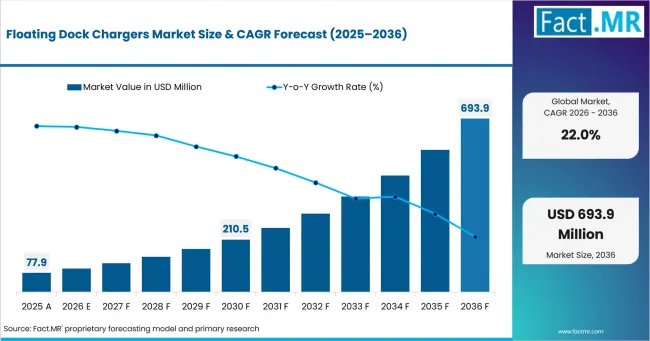
Floating Dock Chargers Market Market Value Analysis | Source: Fact.MR
What are the defining numbers behind floating dock chargers market growth?
USD 598 million absolute opportunity by 2036, led by expanding marina electrification across the United States and Norway.
- Demand Drivers in the Market
- Electric recreational boating continues increasing demand for floating charging systems.
- Marina operators are improving waterfront facilities through charging infrastructure upgrades.
- Public investment supports cleaner marine transport and waterfront electrification.
- Flexible floating installations simplify expansion across changing marina layouts.
- Key Segments Analyzed
- By Dock Type: Marina berths are expected to account for 35.0% share in 2026 as they remain the largest charging location for leisure boats.
- By Charger Type: DC fast chargers are projected to hold 37.0% share in 2026 because faster charging improves berth availability during busy periods.
- By Application: Marina charging is forecast to represent 33.0% share in 2026 as private boat owners continue adopting electric propulsion.
- By Buyer Type: Marinas are expected to capture 36.0% share in 2026 because they remain the leading investors in floating charging infrastructure.
- By Geography: The United States is projected to record 22.8% CAGR through 2036 as electric marina development continues expanding.
- Analyst Opinion at Fact.MR
- Shambhu Nath Jha, Senior Analyst at Fact.MR, states, "Floating charging systems provide marina operators with greater flexibility than conventional fixed infrastructure. Solutions that combine reliable charging with simple installation are expected to gain stronger market acceptance as electric boating continues expanding."
- Strategic Implications
- Charging equipment suppliers should develop modular systems that support future dock expansion.
- Marina operators should integrate charging infrastructure into long term waterfront planning.
- Dock builders should design floating platforms with dedicated charging capacity.
- Technology developers should improve energy management software for multi berth installations.
Floating dock chargers provide electrical charging directly from floating platforms installed on lakes, rivers and coastal marinas. They remove the need for long cable runs while improving charging access for boat owners. Their modular design also allows operators to expand charging capacity with changing berth demand.
Investment continues increasing as electric leisure boats become more common across developed boating markets. Marina owners are modernizing waterfront infrastructure to improve visitor services and attract new customers. Advances in waterproof charging equipment and intelligent energy control are further supporting market growth.
The United States is projected to record 22.8% CAGR through 2036 because marina electrification continues accelerating. Norway is expected to achieve 22.5% CAGR as electric boating adoption remains among the highest globally. Germany is likely to register 22.0% CAGR through marina modernization. Australia is forecast to grow at 21.6% CAGR as waterfront recreation expands. Japan is anticipated to record 21.2% CAGR through continued investment in coastal leisure infrastructure.
How does the floating dock chargers market break down by segment?
Marina berths lead at 35.0%. DC fast chargers lead at 37.0%.
Which dock type dominates?
Marina berths hold 35.0% share in 2026.
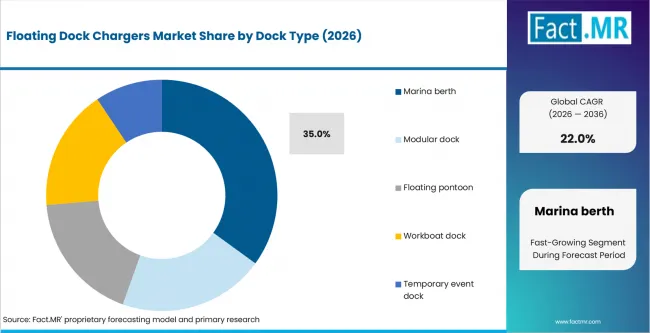
Floating Dock Chargers Market Analysis By Dock Type | Source: Fact.MR
Marina berths are expected to account for 35.0% share in 2026 because they serve the largest number of leisure boats requiring routine charging. Existing berth upgrades also reduce installation costs. Floating pontoons support flexible layouts. Modular docks simplify future expansion. Workboat docks serve commercial users. The dockside charging installation supports sustainable boating by enabling fast charging for electric vessels while strengthening the marina's commitment to zero-emission maritime transport and regional electrification.
Which charger type dominates?
DC fast chargers lead with 37.0% share in 2026.
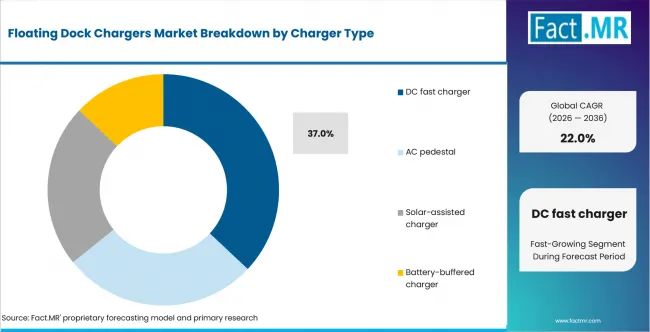
Floating Dock Chargers Market Analysis By Charger Type | Source: Fact.MR
DC fast chargers are projected to capture 37.0% share in 2026 because boat owners prefer shorter charging sessions before returning to the water. Faster charging also improves berth availability. AC pedestals remain suitable for overnight charging. Solar assisted chargers reduce electricity consumption. Battery buffered chargers improve charging stability during peak demand. Candela and Canopy Power signed a partnership to deploy floating solar-powered charging stations for electric vessels across the Asia-Pacific region, combining floating solar microgrids with fast-charging infrastructure for Candela's electric hydrofoil ferries.
Which application dominates?
Marina charging holds 33.0% share in 2026.
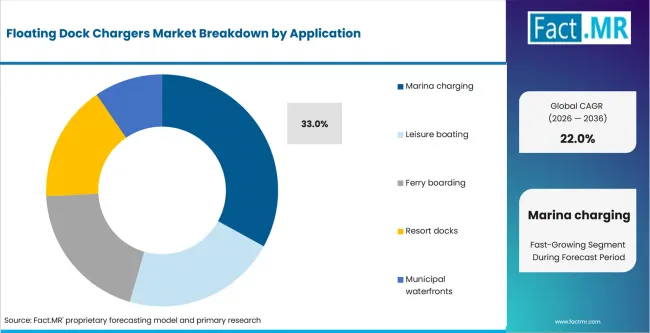
Floating Dock Chargers Market Analysis By Application | Source: Fact.MR
Marina charging remains the largest application because recreational boating represents the strongest source of charging demand. The segment is expected to account for 33.0% share in 2026. Leisure boating continues supporting new installations. Resort docks improve guest services. Ferry boarding areas require dependable charging. Municipal waterfronts expand public charging access. ACEL Power and Electrified Marina announced a strategic partnership to accelerate marine electrification across the U.S. East Coast through electric boating packages and marina charging support. The collaboration combines ACEL Power's electric propulsion systems with Electrified Marina's charging network to expand access to reliable dockside charging and support wider adoption of electric recreational and commercial vessels.
Which feature dominates?
Corrosion resistance leads market with 34.0%.
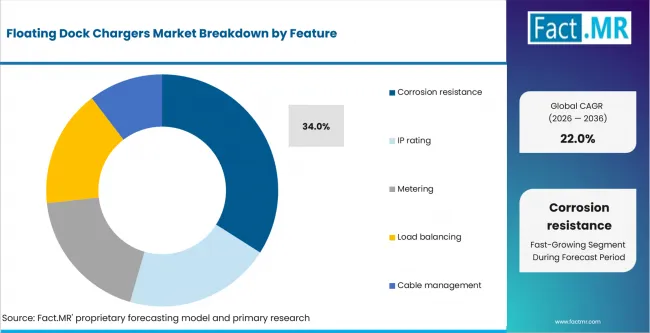
Floating Dock Chargers Market Analysis By Feature | Source: Fact.MR
Corrosion resistant designs are expected to account for 34.0% share in 2026 because charging equipment operates continuously in harsh waterfront conditions. Durable construction extends equipment life. IP rated enclosures improve electrical protection. Metering supports energy tracking. Load balancing improves power distribution. Cable management increases operational safety. Aqua superPower announced the successful completion of The Electric Seaway project, delivering eight new marine fast-charging sites along the UK's south coast to support electric leisure and commercial vessels under 24 metres.
Which buyer type dominates?
Marinas lead with 36.0% share in 2026.
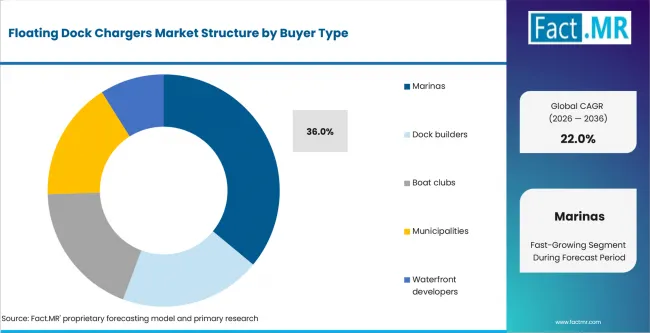
Floating Dock Chargers Market Analysis By Buyer Type | Source: Fact.MR
Marinas remain the largest customer group because they continue expanding charging facilities to attract electric boat owners. The segment is expected to account for 36.0% share in 2026. Dock builders integrate charging during new projects. Boat clubs improve member facilities. Municipalities support public waterfront charging. Waterfront developers include charging within mixed use projects.
What is accelerating Floating Dock Chargers Market and what is holding back?
Electric boating supports market expansion while high waterfront installation costs remain a challenge.
Drivers Impact Analysis
| DRIVER | (~) % IMPACT ON CAGR | GEOGRAPHIC RELEVANCE | IMPACT TIMELINE |
|---|---|---|---|
| Growth of electric recreational boating | +1.3% | Global | Medium term (2-4 years) |
| Marina modernization projects | +1.0% | Europe, North America | Medium term (2-4 years) |
| Public investment in waterfront electrification | +0.8% | Global | Long term (≥4 years) |
| Expansion of smart charging systems | +0.6% | Global | Medium term (2-4 years) |
| Rising demand for modular charging docks | +0.5% | Global | Short term (≤2 years) |
Source: Fact.MR analysis. Updated Jul 4, 2026
- Electric recreational boating
- Electric boats are becoming more common across lakes, rivers and coastal marinas. Charging demand continues increasing with fleet growth.
- Marina modernization
- Marina operators are upgrading docking facilities to improve customer experience. Charging infrastructure has become part of these projects.
- Waterfront electrification
- Governments continue supporting cleaner waterfront facilities through infrastructure funding. Floating chargers benefit from these programs.
- Smart charging systems
- Digital charging platforms improve electricity management across multiple docking locations. Operators also reduce energy waste.
- Modular charging docks
- Flexible dock systems simplify expansion without major shoreline construction. Marina operators gain better long term adaptability.
Opportunity Impact Analysis
| OPPORTUNITY | (~) % IMPACT ON CAGR | GEOGRAPHIC RELEVANCE | IMPACT TIMELINE |
|---|---|---|---|
| Expansion of floating marinas | +0.9% | Europe, North America | Medium term (2-4 years) |
| Solar assisted charging | +0.7% | Global | Long term (≥4 years) |
| Smart waterfront management | +0.5% | Global | Medium term (2-4 years) |
| Public recreational charging | +0.4% | Asia Pacific | Short term (≤2 years) |
Source: Fact.MR analysis. Updated Jul 4, 2026
- Floating marinas
- New marina developments increasingly include charging facilities from the planning stage. This creates consistent equipment demand.
- Solar assisted charging
- Solar supported charging reduces electricity costs while improving environmental performance. Hybrid systems continue gaining attention.
- Smart waterfront management
- Connected charging platforms improve equipment monitoring and maintenance planning. Operators benefit from better asset utilization.
- Public recreational charging
- Municipal waterfront projects create additional charging demand beyond private marinas. Public access supports wider electric boat adoption.
Restraints Impact Analysis
| RESTRAINT | (~) % IMPACT ON CAGR | GEOGRAPHIC RELEVANCE | IMPACT TIMELINE |
|---|---|---|---|
| High installation costs | -0.7% | Global | Medium term (2-4 years) |
| Electrical capacity constraints | -0.5% | Older marinas | Medium term (2-4 years) |
| Slow electric boat adoption | -0.4% | Emerging markets | Long term (≥4 years) |
| Maintenance in marine environments | -0.3% | Global | Short term (≤2 years) |
Source: Fact.MR analysis. Updated Jul 4, 2026
- High installation costs
- Floating charging projects require investment in electrical systems and dock upgrades. Initial project costs remain significant.
- Electrical capacity constraints
- Many existing marinas require power upgrades before installing multiple charging points. This extends project schedules.
- Slow electric boat adoption
- Conventional boats remain dominant across many regions. Slower fleet replacement delays charging demand.
- Marine environment maintenance
- Saltwater exposure and continuous weather conditions increase maintenance requirements. Durable equipment design remains essential.
Which countries are expanding floating dock charging infrastructure fastest?
United States 22.8%; Norway 22.5%; Germany 22.0%; Australia 21.6%; Japan 21.2%.
Based on regional analysis, the floating dock chargers market is segmented into North America, Europe, East Asia, Oceania, Latin America and Middle East and Africa.
| Country | CAGR |
|---|---|
| United States | 22.8% |
| Norway | 22.5% |
| Germany | 22.0% |
| Australia | 21.6% |
| Japan | 21.2% |
Source: Fact.MR analysis. Updated Jul 4, 2026
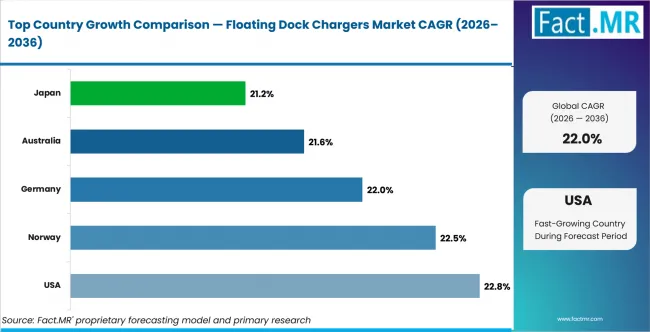
Floating Dock Chargers Market Cagr Analysis By Country | Source: Fact.MR
What is driving growth across the United States?
22.8% CAGR, supported by marina upgrades and electric boating.
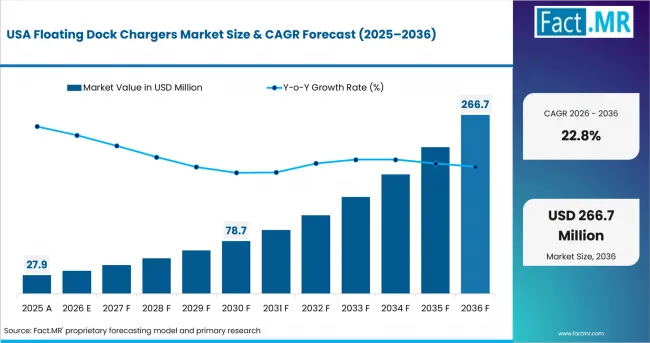
Floating Dock Chargers Market Country Value Analysis | Source: Fact.MR
The United States is projected to record 22.8% CAGR from 2026 to 2036 as marina operators continue installing charging infrastructure for electric boats. Coastal recreation and inland boating both support market demand. Private investment is also improving waterfront facilities. Companies offering flexible charging systems are expected to benefit from continued marina expansion.
Why is Norway maintaining strong demand?
22.5% CAGR, backed by electric marine transport leadership.
Norway is expected to achieve 22.5% CAGR through 2036 because electric boats and battery powered ferries continue gaining wider acceptance. Marina operators are expanding charging capacity to match vessel growth. Strong policy support also encourages long term infrastructure investment.
What supports Germany's market outlook?
22.0% CAGR, driven by waterfront modernization.
Germany is likely to register 22.0% CAGR by 2036 as marina operators continue upgrading docking facilities with electric charging systems. Recreational boating and inland waterways support consistent equipment demand. Smart energy management remains an important purchasing factor.
Why is Australia becoming a promising market?
21.6% CAGR, supported by coastal tourism and marina development.
Australia is forecast to expand at 21.6% CAGR as waterfront tourism projects increasingly include charging facilities for electric boats. New marina developments continue creating opportunities for floating charging systems. Leisure boating also supports equipment deployment.
How is Japan strengthening future demand?
21.2% CAGR, encouraged by efficient marina infrastructure.
Japan is expected to record 21.2% CAGR by 2036 as marina operators continue improving charging facilities for electric recreational vessels. Coastal infrastructure projects support wider charging availability. Compact floating systems remain attractive where installation space is limited.
Who leads the floating dock chargers market?
Aqua superPower, Rolec, Faroboats Powerdock shape market competition.
The market includes marine charging specialists and electrical equipment providers. Aqua superPower continues expanding dedicated charging networks for electric boats across recreational waterways. Rolec strengthens its position through marina charging equipment designed for demanding outdoor conditions.
Faroboats’ Powerdock supports the floating charging theme through a solar-powered floating dock designed to charge electric boats. Kempower contributes high power charging technology suited for commercial and recreational marine applications. Poralu Marine supports the landscape through floating dock engineering and marina accessory integration, but should not be positioned as a dedicated floating charger provider.
Competition increasingly depends on installation flexibility and long term equipment reliability. Customers compare charging speed and software capability before selecting suppliers. Companies that deliver scalable systems with dependable service support are expected to strengthen their market position.
Which companies are the key providers?
Aqua superPower, Rolec, Kempower, and Faroboats are relevant providers across marine charging, marina utility systems, high-power charging, and floating solar dock charging. Poralu Marine should be treated as a floating dock infrastructure participant rather than a dedicated charger supplier.
- Aqua superPower
- Rolec
- Faroboats Powerdock
- Kempower
- Poralu Marine
Bibliography
- Aqua superPower. (2025, April 15). Aqua superPower drives The Electric Seaway to success, powering sustainable marine travel on the UK’s South Coast.
- Candela. (2026, March 11). Candela and Canopy Power partner on floating solar charging for electric vessels in Asia-Pacific.
- Ocean Sun. (2026, March 11). Ocean Sun joins Canopy Power and Candela in launching floating solar-powered charging for electric vessels.
- ACEL Power Inc. (2025, May 2). ACEL Power and Electrified Marina announce strategic partnership to accelerate marine electrification on the U.S. East Coast. Business Wire.
- Rolec Services Ltd. (2025, November 18). Rolec launches new HEX & OCEAN marina pedestals at Metstrade 2025.
- Kempower. (2025, January 30). Kempower becomes the market-leading DC fast charging provider in Norway.
- Faroboats. (2026). Powerdock technology.
This Report Addresses
- Strategic assessment of floating dock chargers across marina electrification and waterfront charging infrastructure.
- Segment evaluation covering Marina Berths and DC Fast Chargers.
- Country outlook for the United States, Norway, Germany, Australia and Japan.
- Competitive review of Aqua superPower, Rolec, Faroboats Powerdock, Kempower and Poralu Marine.
- Technology review covering solar-assisted charging, battery-buffered charging, smart metering, load balancing and corrosion resistant construction.
- Operational assessment covering marinas, resort docks, ferry boarding locations, municipal waterfronts and leisure boating facilities.
- Market estimates supported by marina investment tracking, electric boat adoption analysis and industry interviews.
What does the floating dock chargers market cover?
Floating charging systems developed for electric marine vessels.
The market includes AC pedestal chargers, DC fast chargers, solar assisted chargers and battery buffered charging systems installed on floating dock infrastructure. These products provide safe charging while adapting to changing water levels.
The assessment is limited to floating charging installations. Conventional fixed shore charging stations, onboard chargers, propulsion systems, and batteries sold without floating charging infrastructure are outside the market scope.
What is included in the scope?
Charging systems integrated with floating marina infrastructure.
The study covers floating pontoons, modular docks, marina berths, workboat docks and temporary event docks. It also includes corrosion resistant designs, IP rated enclosures, metering, load balancing and cable management features.
Applications include leisure boating, marina charging, ferry boarding, resort docks and municipal waterfronts. The study evaluates products supplied to marinas, dock builders, boat clubs, municipalities and waterfront developers.
What is excluded from the scope?
Marine electrical equipment without floating charging capability is excluded.
The assessment excludes fixed quay charging systems, shore power connection equipment, propulsion systems and onboard batteries supplied without floating charging infrastructure. Standard marina utility pedestals are also outside the market definition.
How was the analysis built?
109+ sources, 41+ company portfolios, 29+ countries, 24+ interviews.
- Primary Research:
- Marina operators, dock manufacturers, charging technology suppliers and electric boat manufacturers provided commercial and technical insights. Waterfront developers also contributed practical project experience.
- Desk Research:
- The study reviewed company product portfolios, marina development projects, electric boating initiatives and waterfront infrastructure programs. Industry announcements supported market assessment.
- Market Sizing and Forecasting:
- Forecasts were prepared using marina expansion activity, electric boat adoption, charging equipment deployment and investment trends across major boating regions.
- Data Validation and Update Cycle:
- Forecasts were verified through supplier interviews, project tracking and expert review. Installation activity and procurement trends supported the final market estimates.
Segmentation
What is the report's scope and coverage?
| Attribute | Details |
|---|---|
| Quantitative Units | USD Million in 2026 to USD Million by 2036 at CAGR |
| Market Definition | Floating charging systems designed for electric boats and marine docking facilities |
| Dock Type | Floating pontoon; modular dock; marina berth; workboat dock; temporary event dock |
| Charger Type | AC pedestal; DC fast charger; solar-assisted charger; battery-buffered charger |
| Application | Leisure boating; marina charging; ferry boarding; resort docks; municipal waterfronts |
| Feature | Corrosion resistance; IP rating; metering; load balancing; cable management |
| Buyer Type | Marinas; dock builders; boat clubs; municipalities; waterfront developers |
| Regions Covered | North America; Europe; East Asia; Oceania; Latin America; Middle East and Africa |
| Countries Covered | United States; Norway; Germany; Australia; Japan |
| Key Companies Profiled | Aqua superPower; Rolec; Faroboats Powerdock; Kempower; Poralu Marine |
| Forecast Period | 2026 to 2036 |
| Approach | Hybrid top down and bottom up approach using marina investment, electric boat adoption, charging deployment and expert validation |
Source: Fact.MR analysis. Updated Jul 4, 2026
How is the market segmented?
-
By Dock Type:
- Floating pontoon
- Modular dock
- Marina berth
- Workboat dock
- Temporary event dock
-
By Charger Type:
- AC pedestal
- DC fast charger
- Solar-assisted charger
- Battery-buffered charger
-
By Application:
- Leisure boating
- Marina charging
- Ferry boarding
- Resort docks
- Municipal waterfronts
-
By Feature:
- Corrosion resistance
- IP rating
- Metering
- Load balancing
- Cable management
-
By Buyer Type:
- Marinas
- Dock builders
- Boat clubs
- Municipalities
- Waterfront developers
-
Region:
- North America
- United States
- Canada
- Mexico
- Europe
- Germany
- United Kingdom
- France
- Italy
- Spain
- Asia Pacific
- China
- Japan
- South Korea
- India
- Singapore
- Latin America
- Brazil
- Argentina
- Middle East & Africa
- GCC Countries
- South Africa
- Israel
- North America
Frequently Asked Questions
Which dock type leads the Floating Dock Chargers Market?
Which charger type leads the Floating Dock Chargers Market?
Which application leads the Floating Dock Chargers Market?
Which feature leads the Floating Dock Chargers Market?
Which buyer type leads the Floating Dock Chargers Market?
Which region leads the Floating Dock Chargers Market?
Which country expands fastest in the Floating Dock Chargers Market?
Who worked on this report


Preview the report firsthand - request a free sample
Free SampleGet the brochure for pricing and purchase details
Download PDF